

Africa’s ICC World Cup 2027 Hosts Collide in T20 Tri-Series
South Africa, Zimbabwe and Namibia meet in Windhoek for a seven-match T20 tri-series that doubles as an early test of depth, form and regional strength ahead of the 2027 Cricket World Cup. Here is our full preview of the squads, key players, tactical battles and likely finalists.

South Africa, Zimbabwe and Namibia will spend the next ten days playing T20 cricket in Windhoek, but the importance of this tournament stretches well beyond seven matches and one trophy.
These are the three countries that will host the 2027 ICC Men’s Cricket World Cup.
They are neighbors with very different cricketing resources, very different expectations and, heading into this tri-series, very different reasons for needing a strong tournament.
South Africa arrive without most of their established first-choice players and with left-arm spinner Bjorn Fortuin leading an experimental group filled with emerging talent.
Zimbabwe bring considerably more senior experience through captain Sikandar Raza, Blessing Muzarabani, Ryan Burl, Brian Bennett and the returning Graeme Cremer, but also carry the uncomfortable memory of six consecutive T20I defeats following their opening win against Bangladesh last month.
Namibia may have the most interesting combination of all.
Gerhard Erasmus leads a squad built around experienced internationals such as JJ Smit, Jan Frylinck, Ruben Trumpelmann, Bernard Scholtz and Jan-Nicol Loftie-Eaton, but the hosts have also introduced a new generation led by Junior Taanyanda, Alex Busing-Volschenk, Max Heingo, Waldo Smith and JC Balt.
The tournament begins on August 28 at the Namibia Cricket Ground in Windhoek and runs through September 6. Each team plays the other twice before the top two meet in the final.
That format matters.
This is not a three-game series where one bad night can effectively end a campaign. Every team gets four round-robin matches and enough time to adjust after seeing its opponents once.
By the final weekend, we should know considerably more about South Africa’s next wave, Zimbabwe’s T20 direction and whether Namibia are ready to become something more dangerous than an occasional upset threat.
South Africa-Zimbabwe-Namibia T20 Tri-Series 2026 at a Glance
| Detail | Information |
|---|---|
| Tournament | FNB T20 Tri-Series 2026 |
| Teams | Namibia, South Africa, Zimbabwe |
| Dates | August 28 to September 6, 2026 |
| Venue | Namibia Cricket Ground, Windhoek |
| Format | Double round-robin followed by final |
| Matches | 6 league matches plus final |
| South Africa captain | Bjorn Fortuin |
| Zimbabwe captain | Sikandar Raza |
| Namibia captain | Gerhard Erasmus |
Complete T20 Tri-Series Schedule
| Date | Fixture | Venue |
|---|---|---|
| August 28 | Namibia vs South Africa | Namibia Cricket Ground, Windhoek |
| August 29 | South Africa vs Zimbabwe | Namibia Cricket Ground, Windhoek |
| August 31 | Namibia vs Zimbabwe | Namibia Cricket Ground, Windhoek |
| September 1 | Zimbabwe vs South Africa | Namibia Cricket Ground, Windhoek |
| September 3 | Namibia vs Zimbabwe | Namibia Cricket Ground, Windhoek |
| September 4 | Namibia vs South Africa | Namibia Cricket Ground, Windhoek |
| September 6 | Final | Namibia Cricket Ground, Windhoek |
All matches are scheduled to begin at 2:00 PM local time.
This Tournament Is Also About African Cricket’s Next Phase
The most important context may actually sit outside the T20 format.
South Africa, Zimbabwe and Namibia will jointly host the 2027 ODI World Cup, returning the tournament to Africa for the first time since 2003.
Namibia will host matches at a senior men’s ODI World Cup for the first time.
The tri-series therefore serves as an early demonstration of what closer cricketing cooperation among the three countries could look like.
Officials have already spoken about using this tournament as part of a broader attempt to strengthen regular international competition within Africa, including plans to develop an Africa Cup from 2027.
That idea deserves attention.
African cricket has historically been too dependent on bilateral schedules determined by larger cricket boards elsewhere.
A meaningful regional competition would create recurring fixtures, commercial opportunities and a clearer pathway for countries below Full Member level.
This tournament cannot create that system on its own.
It can show whether the concept has competitive value.
South Africa Arrive With a Development Squad, Not a Weak Squad
That distinction matters.
Aiden Markram is not here.
David Miller is not here.
Tristan Stubbs is not here.
Ryan Rickelton, Kagiso Rabada, Marco Jansen, Lungi Ngidi, Corbin Bosch and Keshav Maharaj are among the other established names being rested.
South Africa have a demanding schedule ahead and have deliberately used this trip to widen their international player pool.
The ICC’s official South Africa squad announcement confirms Bjorn Fortuin as captain and a group featuring Dewald Brevis, Lhuan-dre Pretorius, Tony de Zorzi, Kwena Maphaka, Nqaba Peter and several players receiving another opportunity at international level.
Calling this a second-string squad is technically understandable.
Calling it an easy opponent would be a mistake.
South Africa Squad
- Bjorn Fortuin, captain
- Eathan Bosch
- Dewald Brevis
- Tony de Zorzi
- Connor Esterhuizen
- Jordan Hermann
- Rubin Hermann
- Duan Jansen
- Kwena Maphaka
- Nqobani Mokoena
- Nqaba Peter
- Lhuan-dre Pretorius
- Lutho Sipamla
- Prenelan Subrayen
Jason Smith was originally named in the touring squad but has subsequently been ruled out of the T20 tri-series with a right adductor strain.
Bjorn Fortuin Gets a Different Kind of Opportunity
Fortuin’s captaincy is one of the most interesting South African stories.
He is not being promoted as the next permanent national captain.
This is about putting an experienced domestic leader in charge of a squad containing several players who still need to understand international cricket.
Fortuin has captained the Lions successfully and already knows the demands of senior international competition.
His own role also creates a tactical wrinkle.
South Africa will be led by a left-arm spinner in a T20 tournament where the opposition contains several right-handed middle-order batters who prefer pace.
If the Windhoek surface slows during repeated use across seven matches, Fortuin could become important both as captain and strike option.
Dewald Brevis Is the Player Namibia and Zimbabwe Will Fear Most
South Africa’s squad may be experimental, but Brevis is no experiment anymore.
His ability to change a match within three overs makes him the most obvious destructive batting threat in the tournament.
That is particularly important in a South African batting group without Miller, Markram or Stubbs.
Brevis may have to become the player around whom the rest of the innings is built.
His challenge will be discipline.
Namibia know their own conditions and have experienced spinners capable of slowing the middle overs.
Zimbabwe have Raza, Cremer, Wellington Masakadza and Ryan Burl available as slow-bowling options.
Brevis will get chances to attack.
The better test is whether he can identify when not to.
Lhuan-dre Pretorius Has Another Chance to Accelerate His Rise
Pretorius is another South African player with genuine long-term importance.
His attacking ability at the top of the order gives South Africa the possibility of dominating powerplays even without their established stars.
Windhoek provides a useful test because this will not necessarily be about perfect batting surfaces and predictable pace.
Namibia’s attack can change angles.
Zimbabwe can attack with height through Muzarabani and use spin extensively through the middle.
Pretorius needs to show that his aggression survives when opponents refuse to feed him pace in comfortable areas.
Kwena Maphaka Is the Bowling Headliner
Maphaka represents something neither Namibia nor Zimbabwe possess in quite the same form.
Genuine left-arm pace.
He can attack the stumps, rush batters with the short ball and create wickets even when conventional swing disappears.
That makes him particularly important because South Africa’s senior pace attack is resting.
Lutho Sipamla offers greater experience.
Nqobani Mokoena provides another seam option.
Duan Jansen offers the left-arm angle and all-round balance.
But Maphaka is the bowler most capable of producing a spell that changes a match in eight deliveries.
Nqaba Peter Gives South Africa a Middle-Overs Wicket-Taker
Peter may become as important as Maphaka.
T20 teams increasingly need one bowler whose job is not simply keeping the run rate under control but actually removing set batters between overs seven and fifteen.
Leg-spin provides that possibility.
Against Namibia, Peter could be particularly useful against Erasmus, Smit and Frylinck.
Against Zimbabwe, his contest with Raza and Burl could determine entire innings.
Duan Jansen Is Playing for More Than This Tour
Duan Jansen earned his first senior call-up after an excellent domestic season.
He was named South Africa’s Division 1 One-Day Cup Player of the Year after helping the Titans win the competition, including an unbeaten 61 in the final.
His selection reflects exactly what tours like this should accomplish.
Domestic performance has created an international opportunity.
Now Jansen needs to show whether his combination of left-arm seam and lower-order batting can survive at international level.
A strong tournament could move him much closer to South Africa’s wider white-ball group.
Namibia Should Not Be Treated as the Third Team
This may be the biggest mistake neutral observers make when assessing the tournament.
Namibia are at home.
They have a far more experienced squad than South Africa.
They have won five of their seven T20Is since the 2026 Men’s T20 World Cup.
And they have already demonstrated that the Namibia Cricket Ground can become uncomfortable for visiting teams.
The hosts dominated a June tri-series against Hong Kong and Nigeria, winning all four of their matches.
They scored 194 for three against Nigeria.
They later made 230 for six against Hong Kong.
Then they finished the competition with 220 for five against Nigeria.
Those numbers tell us something useful.
Windhoek is not automatically a low-scoring venue.
Teams that establish a platform can score heavily.
Namibia Squad
The ICC’s official Namibia squad announcement confirms a 16-player group built around captain Gerhard Erasmus and several players with more than 100 international appearances across formats.
- Gerhard Erasmus, captain
- Michael van Lingen
- Zane Green
- Bernard Scholtz
- Ruben Trumpelmann
- JJ Smit
- Jan Frylinck
- Louren Steenkamp
- Malan Kruger
- Jack Brassell
- Max Heingo
- Alex Busing-Volschenk
- Junior Taanyanda
- Jan-Nicol Loftie-Eaton
- JC Balt
- Waldo Smith
Gerhard Erasmus Remains Namibia’s Reference Point
Erasmus has spent years giving Namibia something every developing international team needs: stability.
He bats in difficult situations.
He can bowl useful off-spin.
He understands opposition planning.
Most importantly, he knows how Namibia win matches.
The Sports Encounter’s review of a decade of ICC individual awards includes Erasmus’ recognition as ICC Men’s Associate Cricketer of the Year, a reminder of how long he has operated among the leading players outside the traditional Full Member structure.
Against a young South African side, experience may be Namibia’s biggest advantage.
Junior Taanyanda Could Be Namibia’s Breakout Player
If Erasmus represents continuity, Taanyanda represents the next phase.
The 21-year-old only made his T20I debut in June.
He then finished Namibia’s tri-series against Hong Kong and Nigeria as the leading run-scorer with 165 runs at an average of 82.50.
He also shared the tournament lead for sixes with Erasmus.
That is not enough evidence to declare him an international star.
It is more than enough to make South Africa and Zimbabwe pay attention.
This tournament is the ideal next test.
Scoring runs against Nigeria and Hong Kong established his potential.
Doing it against Maphaka, Fortuin, Muzarabani and Raza would significantly strengthen the case.
Alex Busing-Volschenk Gives Namibia Another Young Attacker
Busing-Volschenk also impressed during the June tournament.
He scored 73 from 32 balls as Namibia piled up 220 for five against Nigeria.
That innings showed the kind of power Namibia increasingly possess outside their veteran core.
For years, Namibia’s batting reputation was built heavily around Erasmus, Frylinck, Smit and experienced top-order players.
The emergence of Taanyanda and Busing-Volschenk makes the lineup less predictable.
JC Balt, Max Heingo and Waldo Smith Represent the Bowling Future
The age profile of Namibia’s attack is particularly encouraging.
Heingo and Waldo Smith are both only 18.
JC Balt is another younger option and was Namibia’s leading bowler in their most recent T20I series.
Balt also took four wickets, including a hat-trick, against Nigeria in June.
They do not have to lead the attack yet.
That is the advantage Namibia possess.
Trumpelmann, Smit, Frylinck and Scholtz can carry the experienced workload while the younger bowlers develop around them.
Ruben Trumpelmann Gives Namibia a Weapon South Africa Must Respect
Trumpelmann’s left-arm angle has troubled stronger international batting units before.
He is particularly dangerous when he gets early movement because the angle across right-handed batters creates uncertainty around the front pad and outside edge simultaneously.
South Africa’s young top order will know him.
Knowing what is coming does not make it easier to play.
Zimbabwe Bring the Most Experienced Core but the Worst Recent Form
This is what makes Zimbabwe so difficult to predict.
The squad looks capable.
The recent results do not.
Zimbabwe began their July T20I series against Bangladesh with a convincing 32-run victory.
Richard Ngarava and Blessing Muzarabani took four wickets each as Bangladesh were bowled out for 138.
The Sports Encounter covered that performance in Zimbabwe’s opening T20I victory over Bangladesh.
Then things changed quickly.
Bangladesh won the second match after Zimbabwe dropped four catches during the powerplay, a collapse in fielding standards examined in our analysis of Bangladesh’s series-leveling victory.
Bangladesh then won the decider by four wickets, completing a 2-1 comeback. TSE’s report on the final T20I highlighted Zimbabwe’s recurring problems with catches, concentration and finishing discipline.
India arrived next.
The decline became more severe.
Zimbabwe’s Recent T20I Sequence
| Opponent | Result |
|---|---|
| Bangladesh | Won by 32 runs |
| Bangladesh | Lost by 34 runs |
| Bangladesh | Lost by 4 wickets |
| India | Lost by 7 wickets |
| India | Lost by 90 runs |
| India | Lost by 35 runs |
The first India match was particularly revealing.
Zimbabwe were restricted to 125 for seven before India chased the target in only 13.2 overs. The Sports Encounter’s match analysis showed how quickly Zimbabwe’s top order lost control after Brian Bennett fell to the first ball.
The second T20I was worse.
India made 219 for five and bowled Zimbabwe out for 129.
By the end of the third match, Zimbabwe had been swept 3-0.
They arrive in Windhoek needing more than a few individual performances.
They need to rediscover a functioning T20 identity.
Zimbabwe Squad
The ICC’s official Zimbabwe squad announcement confirms Sikandar Raza as captain and the return of veteran spinner Graeme Cremer.
- Sikandar Raza, captain
- Brian Bennett
- Ryan Burl
- Graeme Cremer
- Ben Curran
- Brad Evans
- Innocent Kaia
- Wessly Madhevere
- Tadiwanashe Marumani
- Wellington Masakadza
- Kundai Matigimu
- Blessing Muzarabani
- Dion Myers
- Newman Nyamhuri
- Tafadzwa Tsiga
Richard Ngarava is unavailable because of a lower-back problem, while Tanaka Chivanga has undergone surgery after suffering an Achilles injury.
Those absences matter.
Zimbabwe lose one of their most productive new-ball bowlers in Ngarava and another pace option in Chivanga.
Sikandar Raza Still Carries an Enormous Share of Zimbabwe’s T20 Burden
Few international players are asked to solve as many different problems as Raza.
He may be required to rebuild after early wickets.
He may have to accelerate at the death.
He may bowl in the powerplay.
He may bowl through the middle.
He captains.
He fields in important positions.
That versatility is one of Zimbabwe’s greatest strengths.
It can also become a structural weakness when too many match-winning jobs fall onto one player.
The Windhoek tournament should tell us whether Bennett, Burl, Myers and Madhevere can reduce that dependence.
Brian Bennett Needs to Turn Starts Into Tournament-Shaping Innings
Bennett has already shown he can score quickly at international level.
He made 44 from 30 balls in Zimbabwe’s victory over Bangladesh.
But the India series showed how vulnerable Zimbabwe become when the top order disappears early.
Bennett’s challenge is no longer simply demonstrating talent.
He has to become a batter Zimbabwe can build powerplays around.
Ryan Burl Is More Important Than His Batting Position Suggests
Burl provides Zimbabwe with one of their best matchup players.
He can attack spin.
He can finish.
His leg-spin can become useful against left-handers.
He also brings considerable franchise experience.
A productive tournament from Burl would solve several balance problems simultaneously.
The Return of Graeme Cremer Is Fascinating
Cremer’s inclusion gives Zimbabwe another experienced wrist-spin option after recovering from the arm injury that kept him out against Bangladesh and India.
That creates an intriguing potential spin combination with Raza, Burl and Wellington Masakadza.
Windhoek has already demonstrated that large totals are possible.
But as the same surface is used repeatedly across the tournament, slow bowling could become more influential.
Zimbabwe may be the team best equipped to exploit that change.
Blessing Muzarabani Has to Lead the Pace Attack
Ngarava’s absence increases Muzarabani’s responsibility significantly.
His height and release point make him an awkward T20 bowler because he can produce bounce from lengths that ordinarily invite attacking shots.
He took 4 for 17 against Bangladesh in July.
That performance helped Zimbabwe defend 170 and reminded everyone what their attack looks like when Muzarabani controls both line and pace.
South Africa’s young batters will face a very different problem against him than anything Namibia can offer.
The same applies to Namibia’s emerging top order.
The Biggest Tactical Question: What Will 170 Mean in Windhoek?
This tournament may be decided by how quickly teams understand the ground.
Namibia’s June results demonstrate that totals above 190 are entirely possible.
The hosts scored 194 for three, 230 for six and 220 for five across three matches.
That does not mean 200 becomes par automatically against stronger bowling attacks.
It does tell us that teams cannot arrive expecting slow associate-cricket surfaces where 145 is always competitive.
Windhoek can reward batting intent.
The afternoon starts could also make surface pace and moisture different from evening T20 cricket.
Captains will have to learn quickly whether batting first or chasing offers the more reliable route.
Why Spin Could Become More Important as the Tournament Progresses
Seven matches are being played at the same ground.
That creates a natural question around wear.
Even if multiple strips are prepared, repeated cricket can change the overall character of the square.
That favors teams with variety.
South Africa have Fortuin, Peter and Prenelan Subrayen.
Zimbabwe can use Raza, Cremer, Burl and Masakadza.
Namibia have Erasmus, Bernard Scholtz and other slow-bowling options.
The first weekend may favor pace more than the final weekend.
Selection has to remain flexible.
Namibia vs South Africa Could Immediately Define the Tournament
The opening match may be more important than it looks.
If South Africa win comfortably, the narrative immediately returns to depth.
The Proteas can rest most established players and still dominate their neighbors.
If Namibia win, everything changes.
The hosts then have an immediate advantage in a tournament where only two teams qualify for the final.
South Africa would enter the Zimbabwe match less than 24 hours later under genuine pressure.
Namibia have beaten South Africa in Windhoek before.
That history means the Proteas should not need reminding that reputation offers no runs.
South Africa vs Zimbabwe Is the Tournament’s Best Talent Test
The next day’s match presents an entirely different contest.
South Africa bring youth and athleticism.
Zimbabwe bring experience and a more settled leadership structure.
Brevis against Muzarabani could be spectacular.
Maphaka against Bennett will be aggressive.
Peter against Raza could become a middle-overs chess match.
If Zimbabwe cannot compete against this South African squad, their recent T20 problems will become much harder to dismiss as a temporary dip.
Namibia vs Zimbabwe May Decide Who Reaches the Final
On paper, South Africa still have the deepest collection of high-end talent.
That makes Namibia-Zimbabwe especially important.
The teams meet twice.
A 2-0 head-to-head result for either side could become decisive.
Zimbabwe cannot assume Full Member status creates superiority.
Namibia cannot assume home advantage eliminates the difference in international experience.
This is exactly the kind of contest the proposed wider African cricket structure needs more often.
Five Players Who Could Define the Tri-Series
| Player | Team | Why He Matters |
|---|---|---|
| Dewald Brevis | South Africa | Most destructive batter in South Africa’s experimental lineup |
| Kwena Maphaka | South Africa | Left-arm pace and genuine wicket-taking threat |
| Gerhard Erasmus | Namibia | Captain, senior batter and tactical reference point |
| Junior Taanyanda | Namibia | Young opener coming off a breakthrough June tri-series |
| Sikandar Raza | Zimbabwe | Zimbabwe’s most adaptable match-winner |
Five More Players Worth Watching
- Lhuan-dre Pretorius: South Africa’s aggressive top-order prospect has another chance to force himself deeper into national plans.
- Nqaba Peter: Leg-spin could become increasingly important as the tournament progresses.
- Ruben Trumpelmann: Namibia’s left-arm new-ball threat could expose South Africa’s inexperienced top order.
- Blessing Muzarabani: Zimbabwe need him to compensate for Ngarava’s absence.
- Graeme Cremer: His return gives Zimbabwe a tactical option they lacked during the recent losing run.
Namibia’s Experience May Be Underestimated
There is another reason the hosts should be taken seriously.
Erasmus, Frylinck, Smit, Trumpelmann and Scholtz have spent years playing major ICC events together.
They understand their own limitations.
That sounds like a negative statement.
It is often one of associate cricket’s biggest strengths.
Namibia rarely need several matches to discover what kind of team they are.
They know which bowlers handle which phases.
They know which batters can take risks.
They understand what defending a total requires.
South Africa’s more talented squad will still be discovering some of those combinations.
Zimbabwe’s Fielding Cannot Collapse Again
This deserves emphasis because it helped destroy their Bangladesh T20I series.
Zimbabwe dropped four catches during the powerplay of the second match.
Bangladesh responded by building a 120-run opening partnership.
The hosts later lost the decider as further fielding problems prevented sustained pressure.
The issue was not confined to T20 cricket either.
Earlier in the same tour, Zimbabwe dropped six catches in the third ODI, allowing Bangladesh to avoid a clean sweep. TSE’s report from Harare showed how rapidly poor fielding can erase excellent work from the bowlers.
Against South Africa and Namibia, those mistakes will be punished again.
South Africa’s Players Are Competing Against More Than Namibia and Zimbabwe
Every fringe Proteas player arrives with another opponent.
The established national team.
Brevis is competing for future batting responsibility.
Pretorius is competing against a deep group of top-order players.
Maphaka wants more than occasional opportunities when senior quicks are rested.
Duan Jansen needs to prove his domestic performance translates internationally.
Jordan Hermann, Rubin Hermann and Connor Esterhuizen need innings substantial enough to survive beyond this tour in selectors’ minds.
The Sports Encounter recently watched another South African batter, Reeza Hendricks, turn franchise opportunity into a major innings when he struck an unbeaten 87 for Dambulla in the Lanka Premier League.
That is the challenge facing this touring squad.
International depth only matters when players use the opportunities created by rotation.
This Tournament Matters for Namibia’s 2027 and 2028 Plans
Namibia occupy an unusual position.
They are co-hosting the 2027 ODI World Cup but still need to qualify for the tournament through the ICC Cricket World Cup League 2 pathway.
They are simultaneously developing toward the 2028 Men’s T20 World Cup.
That makes every international fixture valuable.
Playing South Africa and Zimbabwe four times in a week provides a level of repeated pressure that bilateral games against lower-ranked opposition cannot reproduce.
The senior group can prepare for 2027.
The younger group can begin preparing for what comes after it.
The Series Also Revives the Value of Tri-Nation Cricket
Cricket has lost some of its traditional appetite for tri-series.
That is unfortunate.
Three-team tournaments create tactical variety that bilateral cricket cannot.
A team can move from facing Maphaka and Fortuin one day to Muzarabani and Cremer the next.
Preparation changes quickly.
Points matter.
Net run rate can matter.
The Sports Encounter’s ongoing Celebration of 5000 ODIs series repeatedly returns to historic tri-nation tournaments because the format produced matches with consequences beyond a simple bilateral series score.
T20 cricket could benefit from more of the same.
What South Africa Need From the Tournament
Winning would be useful.
Finding two or three additional senior-level players would be more valuable.
If Maphaka dominates, South Africa know their pace depth remains extraordinary.
If Pretorius scores heavily, another top-order option becomes harder to ignore.
If Jansen contributes with bat and ball, another all-round pathway opens.
If Fortuin leads well, South Africa strengthen their leadership depth too.
The trophy is therefore only one measurement.
What Zimbabwe Need
Zimbabwe need results.
The development argument matters less for them because this is largely an experienced squad.
Six straight T20I defeats have created pressure.
Raza’s team need to show that the Bangladesh and India series did not reveal a deeper short-format decline.
They need better fielding.
They need more stable powerplays.
They need someone other than Raza to decide important matches.
And they need Muzarabani to lead an attack missing Ngarava.
What Namibia Need
Validation.
The hosts have been competitive for years.
They have beaten established teams before.
What they need now is evidence that those performances can become repeatable.
Reaching the final ahead of either South Africa or Zimbabwe would be significant.
Winning the tournament would be one of the strongest home statements Namibia have produced.
TSE Predicted Team Strengths
| Team | Biggest Strength | Biggest Concern |
|---|---|---|
| South Africa | Raw talent, athleticism, pace and batting power | Inexperience and unfamiliar combinations |
| Namibia | Home conditions, experience and settled roles | Whether younger players can reproduce recent form against stronger opposition |
| Zimbabwe | Senior international experience and spin variety | Recent losing run, fielding and missing pace depth |
Who Should Start as Favorites?
South Africa.
Even without most first-choice players, their talent ceiling remains the highest.
Brevis, Pretorius, Maphaka, Fortuin, Peter, de Zorzi and Sipamla give them quality across every department.
But this should be a narrower gap than the countries’ overall cricketing resources suggest.
Namibia are playing at home with a settled core.
Zimbabwe have far more senior international experience than South Africa’s touring group.
If either African neighbor beats the Proteas, it should not be treated as an unbelievable upset.
TSE Tournament Prediction
South Africa to reach the final.
The second place is much harder to call.
Zimbabwe possess the greater individual pedigree.
Namibia arrive with better recent T20 form, home advantage and a more settled sense of how they want to play.
That makes Namibia a genuine candidate to reach the final.
If the hosts take one of their two games against South Africa and split the Zimbabwe matches, net run rate could decide everything.
Our slight pre-tournament lean is therefore:
- South Africa
- Namibia
- Zimbabwe
That prediction comes with very little confidence between second and third.
Zimbabwe have enough quality to win the tournament if their senior players rediscover form.
TSE Analysis: This Is Exactly the Kind of Series African Cricket Needs
The best thing about this tournament may be that nobody needs to pretend all three teams are equal.
They are not.
South Africa have a vastly larger player pool and cricket economy.
Zimbabwe have Full Member infrastructure and a long international history.
Namibia operate with fewer resources and a much smaller population.
That imbalance is precisely why regular competition matters.
Namibia improve by playing stronger neighbors.
Zimbabwe gain meaningful fixtures close to home.
South Africa can expose emerging players to international cricket without sending them halfway around the world.
Everyone benefits if the games remain competitive.
That is how a regional cricket structure becomes useful rather than ceremonial.
The Sports Encounter Verdict
South Africa begin as favorites, but this tournament should reveal far more than which team lifts a trophy on September 6.
The Proteas are testing the depth beneath their established white-ball stars.
Zimbabwe are trying to stop a worrying run of T20 defeats before it becomes an identity problem.
Namibia are attempting to turn home advantage, experienced leadership and a promising young generation into repeatable success against Full Member opposition.
There are individual stories everywhere.
Can Bjorn Fortuin lead?
Can Dewald Brevis become the dominant batter in a South African team without its senior stars?
Can Lhuan-dre Pretorius and Kwena Maphaka move closer to permanent national roles?
Is Junior Taanyanda ready for a major jump in opposition quality?
Can Erasmus and Namibia make Windhoek uncomfortable for everybody?
Will Sikandar Raza once again have to carry Zimbabwe, or can Bennett, Burl and Myers share the load?
Can Muzarabani lead the attack without Ngarava?
And can Zimbabwe finally hold their catches?
Those questions make this far more interesting than a late-August development tournament.
It is an early meeting of the three nations that will welcome world cricket to southern Africa next year.
For South Africa, the future is being tested.
For Zimbabwe, the present needs repairing.
For Namibia, this is an opportunity to prove that the gap is getting smaller.
Windhoek should tell us plenty.
Frequently Asked Questions
When does the South Africa-Zimbabwe-Namibia T20 tri-series begin?
The tournament begins on August 28, 2026, with Namibia facing South Africa in Windhoek.
Where will the T20 tri-series be played?
All seven matches will be played at the Namibia Cricket Ground in Windhoek.
What is the tournament format?
Each team plays the other two twice in a double round-robin format. The top two teams qualify for the final on September 6.
Who is captaining South Africa?
Left-arm spinner Bjorn Fortuin will captain South Africa’s youthful touring squad.
Why are South Africa missing several senior players?
Cricket South Africa is resting many established players ahead of a demanding international schedule and is using the Namibia tour to give younger and fringe players additional international experience.
Who are the key South Africa players?
Dewald Brevis, Lhuan-dre Pretorius, Kwena Maphaka, Nqaba Peter, Tony de Zorzi and captain Bjorn Fortuin are among the main players to watch.
Who is captaining Namibia?
Gerhard Erasmus will lead the hosts.
How are Namibia performing in T20 cricket?
Namibia have won five of their seven T20Is since the 2026 Men’s T20 World Cup and dominated a home tri-series against Hong Kong and Nigeria in June.
Who is Namibia’s young player to watch?
Junior Taanyanda is one of the most exciting prospects. He scored 165 runs at an average of 82.50 during Namibia’s June T20 tri-series.
Who is Zimbabwe’s captain?
Sikandar Raza will captain Zimbabwe.
Is Graeme Cremer back in the Zimbabwe squad?
Yes. Cremer has returned after recovering from the injury that kept him out of Zimbabwe’s recent series against Bangladesh and India.
Why is Richard Ngarava not playing?
Ngarava is continuing his recovery from a lower-back problem. Tanaka Chivanga is also unavailable after Achilles surgery.
What is Zimbabwe’s recent T20I form?
Zimbabwe have lost six consecutive T20Is after beating Bangladesh in the opening match of their July series. Bangladesh won the next two matches before India swept Zimbabwe 3-0.
Who are favorites to win the tri-series?
South Africa remain favorites because of their overall talent depth, although their inexperienced squad makes Namibia and Zimbabwe far more dangerous than they would be against a full-strength Proteas team.
Why is this tournament important for the 2027 Cricket World Cup?
South Africa, Zimbabwe and Namibia will jointly host the 2027 ODI World Cup. The tri-series strengthens cooperation among the three boards and gives Namibia valuable high-level international competition ahead of the tournament.





Breaking News
First Brydon Carse, Now Raheem Sterling: What’s Wrong with English Sportsmen?
Brydon Carse ended up in police handcuffs while Raheem Sterling now faces dangerous-driving and other charges. Their cases are legally different, but together they raise a wider question about whether professionalism among elite English sportsmen is carrying far enough beyond the playing arena.


LONDON: Brydon Carse should have been preparing for England’s second Test against Pakistan at Lord’s. Instead, images of the 31-year-old fast bowler in police handcuffs outside a Derby nightclub became one of the biggest stories surrounding the team.
Three days later, another 31-year-old English sports star appeared in a very different kind of headline.
Former England footballer Raheem Sterling was charged with dangerous driving, possession of nitrous oxide for wrongful inhalation and failing to provide a specimen following a single-vehicle collision involving a Lamborghini on the M3 in May.
No injuries were reported in Sterling’s crash. Carse was released without charge after the Derby incident. Their legal situations are therefore very different and must be treated that way.
The professional question connecting them is harder to avoid.
Two high-profile English sportsmen, both old enough and experienced enough to understand the consequences of their actions, have within days become the subject of serious off-field stories that raise legitimate questions about judgment, personal responsibility and what professionalism actually means once an athlete leaves the stadium.
Carse ended a celebration in handcuffs and lost his place in an England Test squad while the Cricket Regulator investigates. Sterling now faces three criminal charges and a court appearance on September 15.
These are not academy teenagers learning how fame works.
They are established international sportsmen who have spent years inside some of the most sophisticated professional environments in world sport.
That is precisely why the question deserves asking.
Brydon Carse and Raheem Sterling: Two Very Different Cases, One Professional Question
| Issue | Brydon Carse | Raheem Sterling |
|---|---|---|
| Age | 31 | 31 |
| Sport | Cricket | Football |
| Latest incident | Seen in police handcuffs outside a Derby nightclub | Charged following an M3 motorway collision |
| Legal status | Released without charge | Charged with three offences, not convicted |
| Professional consequence | Removed from England squad for second Pakistan Test | Faces court hearing while currently without a club |
| Next step | Cricket Regulator investigation | Basingstoke Magistrates’ Court on September 15 |
Carse Managed to Turn an England Victory Into Another Conversation About Behaviour
The timing of the Carse episode made it especially damaging.
England had just beaten Pakistan by an innings and 103 runs at Headingley, giving Joe Root a commanding victory at the beginning of his second spell as permanent Test captain.
The cricket should have dominated the build-up to Lord’s.
Instead, Root found himself answering questions about another late-night incident involving an England player.
Carse had been released from the England group to represent Durham against Derbyshire in the County Championship. Durham won comfortably, and the players went out afterward.
Footage then emerged showing Carse outside a Derby nightclub with his hands cuffed behind his back while police officers surrounded him.
Reports subsequently confirmed that he was released without charge.
The ECB responded by referring the matter to the Cricket Regulator and making Carse unavailable for the second Test against Pakistan while the facts are established. Sonny Baker replaced him in the squad.
That response matters.
Carse may ultimately face no criminal consequences from what happened in Derby. England still decided that the circumstances were serious enough to remove a centrally contracted international player from Test selection.
Professional sport has standards that extend beyond criminal law.
A player does not have to be convicted of an offence before an employer or governing body decides that his conduct has become damaging, distracting or inconsistent with the standards expected of an international representative.
Joe Root Said What Many Supporters Were Already Thinking
Root’s reaction stripped away any attempt to treat Carse’s situation as a harmless night out that simply attracted too much attention.
The England captain said he was “hacked off” and disappointed.
More importantly, he identified the wider problem.
“We continually keep making stupid mistakes away from the game and it’s detracting from what we’re doing on the field.”
That sentence should sit at the center of this discussion.
Root was not complaining about hostile journalists, social media or intrusive cameras.
He was talking about the decisions being made by his own players.
England had already spoken internally about standards. Root had publicly emphasized the importance of building a culture people could respect. The team had entered the Pakistan series attempting to reset after the turmoil that ended the previous leadership era.
The Sports Encounter’s England vs Pakistan series preview framed Root’s return around the need to restore judgment and stability after England’s cricket had become increasingly chaotic.
Our Headingley first-Test analysis made the same point more directly: England had enough talent, but could no longer afford to waste credibility.
They then won emphatically.
Within hours, Carse gave Root another off-field problem.
Being Off Duty Does Not Remove Professional Responsibility
One defense has appeared repeatedly around the Carse incident: he was not representing England when it happened.
That is factually true.
He had played for Durham and was celebrating a county victory.
It does not make the professional issue disappear.
Carse remains an England international and centrally contracted cricketer whose next scheduled assignment was an international Test match.
The standards attached to elite sport cannot realistically switch on at the dressing-room door and disappear when a player changes clothes.
A doctor remains responsible for serious professional misconduct outside a hospital. A senior executive can damage a company through behavior that happens away from the office. A politician does not become completely detached from public standards because Parliament has finished for the evening.
Elite athletes occupy a similar space.
They deserve private lives. They deserve holidays, dinners, celebrations and nights out.
Personal freedom still carries consequences when private choices develop into police involvement, disciplinary investigations or headlines that drag teammates and national organisations into the story.
Carse’s loss of selection demonstrates that reality more clearly than any lecture on professionalism could.
Carse Had Already Received One Serious Lesson About Responsibility
The Derby incident also carries extra weight because Carse has previously been through a formal disciplinary process.
In 2024, he received a 16-month suspension, with 13 months suspended, after admitting to placing 303 bets on cricket between 2017 and 2019.
The regulator found no evidence that he bet on matches in which he participated and found no wider integrity concerns. Carse cooperated with the investigation and served three months away from cricket.
The Cricket Regulator’s official ruling made clear that his cooperation and remorse were considered in determining the sanction.
The betting case has no factual connection to what happened in Derby and should not be presented as though it does.
It remains relevant to the question of professional judgment.
Carse already knows what it feels like for an off-field decision to remove cricket from his life.
He rebuilt his standing, returned to the England side and developed into an important bowler.
Only weeks ago, Carse was producing one of The Hundred’s strongest bowling performances for SunRisers Leeds.
Now another non-cricket episode has again removed him from an England squad.
At some point, experience has to become judgment.
Carse Is Hardly the First Warning England Cricket Has Received
This would be easier to dismiss if Carse’s case existed by itself.
England cricket has spent much of the past year discussing behaviour away from the field.
Harry Brook was fined around £30,000 and placed on a final warning after an incident involving a nightclub bouncer in Wellington during England’s tour of New Zealand.
Brook later acknowledged that he had stayed out too late and accepted responsibility for putting himself in the situation.
Ben Stokes and Gus Atkinson were subsequently suspended after breaking England’s midnight curfew following another nightclub episode during the New Zealand Test series.
The ECB later introduced additional player-behaviour guidelines covering curfews, public intoxication and the requirement to inform management when players remain away from the hotel late at night.
Stokes himself has acknowledged the wider cultural issue. Speaking after his retirement, he argued that cricket has retained a deeply embedded relationship with alcohol even as almost every other aspect of the game has become more professional.
That is a significant admission from someone who spent years leading England.
Our recent look at Stokes’ potential future as an England coach focused heavily on leadership and responsibility because those questions have become impossible to separate from England’s next era.
The end of his playing career had already arrived alongside wider questions over direction and discipline, as explored when New Zealand completed its series comeback at Trent Bridge.
Carse’s handcuffs therefore landed in a dressing room that had already been warned, disciplined, briefed and given new rules.
That makes the incident harder to excuse as simple naivety.
Then Raheem Sterling Put English Football Into the Same Conversation
Sterling’s situation is legally more serious.
Hampshire and Isle of Wight Constabulary said the former England forward has been charged following a single-vehicle collision involving a Lamborghini on the M3 southbound near the Minley Interchange on May 28.
The 31-year-old faces charges of dangerous driving, possession of nitrous oxide for wrongful inhalation and failing to provide a specimen.
No other vehicle was involved and no injuries were reported.
Sterling is due to appear at Basingstoke Magistrates’ Court on September 15.
Those remain allegations until the court process determines otherwise. Sterling has not been convicted of the offences.
The reported police charges against Sterling nevertheless create a legitimate professionalism issue before any verdict is reached.
Dangerous driving is not a football mistake.
Failing to provide a specimen is not a tactical decision.
Possession of nitrous oxide for wrongful inhalation has nothing to do with a poor first touch or a badly timed run.
These are allegations concerning an adult’s choices away from football.
That is exactly why the case belongs in a broader discussion about athletes and personal responsibility.
Sterling Has Spent Most of His Adult Life Inside Elite Football
Sterling has experienced professional sport at its highest level since he was a teenager.
He came through Queens Park Rangers, made his senior Liverpool debut at 17, moved to Manchester City and developed into one of the Premier League’s leading attackers under Pep Guardiola.
He won four Premier League titles with City and became one of Gareth Southgate’s most important England players.
Sterling earned 82 senior England caps and scored 20 international goals. He played a major role in England’s run to the 2018 World Cup semifinal and the Euro 2020 final.
His career later took him to Chelsea, Arsenal and Feyenoord.
He is now without a club.
Few footballers have spent more time surrounded by elite-level support systems.
Premier League players receive access to coaches, doctors, nutritionists, psychologists, analysts, security advisers, player-liaison staff and professional guidance that would have been unimaginable a generation ago.
The modern competition itself has become an enormous global operation. Our 2026-27 Premier League curtain-raiser reflects the scale, wealth and sophistication now surrounding England’s leading clubs.
Yet all of that professional structure eventually reaches a limit.
A club can provide advice.
It cannot make every adult decision for a player.
These Men Are 31, and That Matters
Age should be part of this discussion because the usual explanation of young athletes struggling with sudden fame does not comfortably fit either case.
Carse and Sterling are both 31.
They have each spent years inside professional sport.
They have travelled internationally, operated in dressing rooms full of senior players, worked with coaches and media teams, signed professional contracts and lived through the intense scrutiny attached to representing England.
They know cameras exist.
They know police involvement becomes news.
They know national-team selection and commercial reputations can be affected by what happens away from competition.
They also know that athletes are judged differently because their careers come with extraordinary visibility and privilege.
None of that means they should live like prisoners inside their homes.
It does mean that the excuse of youthful inexperience becomes increasingly difficult to sustain.
Elite Athletes Show Extraordinary Discipline When Sport Demands It
This is perhaps the strangest contradiction in professional sport.
An elite cricketer will spend months strengthening hamstrings, monitoring workload, analysing bowling footage, weighing meals and altering sleep patterns to gain a tiny competitive advantage.
A Premier League footballer will structure an entire week around recovery, hydration, tactical preparation and physical output.
These athletes understand discipline.
They understand delayed gratification.
They understand that small decisions can produce enormous consequences.
Then some step outside the sporting environment and appear capable of abandoning exactly those principles.
The issue is therefore deeper than education alone.
Professional athletes have already demonstrated that they can live disciplined lives when performance requires it.
The challenge is carrying the same judgment into ordinary adult situations where nobody is timing a sprint, checking a GPS vest or preparing a recovery plan.
Professionalism Cannot End at the Stadium Gate
Sport has traditionally separated the athlete from the person.
Supporters care about goals, wickets, records and trophies. What happens away from competition is often treated as irrelevant unless it affects performance.
That separation becomes impossible once off-field conduct begins affecting the sport itself.
Carse is missing a Test match because of an incident that happened outside cricket.
Root has had to spend preparation time discussing behaviour instead of Pakistan.
The ECB has had to open another disciplinary process.
Sterling’s legal proceedings will inevitably become part of the public conversation around a player whose career already sits at a crossroads.
These consequences have entered their professional lives because personal decisions created them.
That is why “what players do in their own time” cannot become an automatic shield against criticism.
Private life deserves privacy.
Conduct that ends with police handcuffs, criminal charges or disciplinary investigations has already crossed into a different category.
Fame and Money Can Create a Dangerous Buffer From Ordinary Consequences
Elite athletes live inside unusually protected environments.
Someone arranges travel.
Someone books accommodation.
Someone manages media.
Someone handles contracts.
Someone schedules medical treatment.
Someone can often solve logistical problems before the player even realizes they exist.
That support is necessary because professional sport demands enormous amounts of time and focus.
It can also create insulation.
The more successful an athlete becomes, the more people appear around him whose professional interest is keeping him available, comfortable and performing.
That creates a risk if sporting importance begins to feel like immunity from ordinary standards.
The overwhelming majority of athletes handle that environment responsibly.
The ones who do not can cause damage far beyond themselves because their visibility turns individual mistakes into institutional problems.
English Cricket’s Relationship With Alcohol Needs More Than Another Curfew
Carse’s case makes the cricket issue particularly difficult because the ECB has already tried rules.
England introduced a midnight curfew.
Players were told they should not appear publicly intoxicated.
Management expected to know when players stayed out late.
Disciplinary action followed previous breaches.
Carse still ended up in handcuffs outside a nightclub.
A curfew can establish a boundary.
It cannot provide judgment.
Stokes’ comments about cricket’s wider drinking culture deserve serious attention here. The sport has modernised almost everything around performance while retaining a social relationship with alcohol that belongs to another era.
That does not mean every post-match beer creates a problem.
It means cricket has to decide whether the old romantic image of players drinking hard after competing hard still belongs inside a game that otherwise treats professional preparation almost scientifically.
Root clearly wants his players to make adult decisions without being permanently controlled.
Carse has just shown why that approach requires the players to meet him halfway.
English Football Moved Away From the Old “Bad Boy” Culture for a Reason
Football has undergone its own cultural change.
Stories about drinking, nightclubs and reckless behaviour once formed a routine part of the mythology surrounding English footballers.
The modern Premier League largely demands something different.
Players compete more often, cover greater distances, follow detailed recovery schedules and operate inside a global commercial environment where clubs protect multimillion-pound assets.
Diet, sleep and conditioning are now career issues.
The old sporting idea that exceptional performance could excuse almost anything away from the pitch has gradually lost credibility.
Sterling belongs to the generation that benefited from that professional evolution.
That makes the allegations against him more striking.
A player who spent his career inside Liverpool, Manchester City, Chelsea and Arsenal cannot reasonably claim ignorance of the standards surrounding elite football.
The case will decide whether he committed the offences alleged against him.
The broader question of professional judgment already exists.
Personal Problems Can Explain Behaviour Without Excusing It
Elite athletes are human beings dealing with pressure, injuries, career uncertainty, family issues, mental-health challenges and the psychological difficulty of watching sporting status disappear.
Sterling’s career has changed dramatically since his Manchester City peak.
Carse has experienced injury setbacks and a previous suspension.
Those circumstances deserve empathy when they are relevant.
They cannot become automatic explanations for every poor decision.
Understanding why somebody makes a mistake and holding that person responsible for making it are compatible positions.
Professional sport sometimes becomes uncomfortable with that balance.
Criticism can become cruel and personal very quickly. The opposite extreme treats athletes as permanently vulnerable figures whose choices must always be explained through pressure or fame.
Neither approach helps.
Adult athletes deserve support.
Adult athletes also carry responsibility.
Teams Pay the Price for Individual Decisions
Carse’s case provides the clearest example.
England selected him because he could help win Test matches.
His pace and bounce gave Root another option against Pakistan. Our pre-series analysis identified England’s pace depth as one of its biggest advantages.
Carse is now unavailable for reasons unrelated to fitness, form or cricketing ability.
Sonny Baker receives the opportunity.
Root loses an option.
The coaching staff modifies plans.
The captain answers questions.
The governing body investigates.
Supporters debate culture instead of bowling.
One person’s night out becomes everybody else’s problem.
That is why professional teams care about off-field conduct.
It is not primarily about controlling private lives.
It is about preventing avoidable personal decisions from disrupting collective objectives.
England’s Young Players Are Watching How Senior Men Are Treated
There is another reason consistency matters.
Every dressing room teaches through example.
A young player watches what senior teammates do, what coaches tolerate and what consequences follow when standards are breached.
If established internationals receive endless exceptions because they are useful, the written code of conduct becomes meaningless.
If every mistake leads to public humiliation and career destruction, players learn to hide problems instead of seeking help.
The right standard sits between those extremes.
Clear expectations.
Real support.
Proportionate consequences.
No special immunity for star performers.
Root’s response to Carse suggests he understands that balance. England removed the bowler while the investigation proceeds, rather than pretending nothing happened or publicly deciding the outcome before the evidence is complete.
Role Model May Be an Uncomfortable Phrase, but Influence Is Real
Some athletes reject the idea that they should be role models.
They did not become professional sportsmen to raise strangers’ children.
That argument has some merit.
No footballer or cricketer should be expected to live a flawless life because a child owns his shirt.
Influence still exists whether the athlete asks for it or not.
Millions of young supporters watch how elite players train, celebrate, dress, speak and behave.
National teams actively use players to promote participation, community values and sporting ideals.
Clubs build marketing campaigns around personalities.
Sponsors pay for association with reputation as well as athletic skill.
Once sport commercialises a player’s public image, conduct naturally becomes part of that image.
English Sport Has Too Much Professional Infrastructure to Keep Calling These Things Naive Mistakes
This is the larger frustration.
English sport is among the best-resourced sporting systems on earth.
The Premier League generates extraordinary wealth.
The ECB runs professional pathways from academy cricket through domestic competitions and international teams.
Players receive media training.
They receive welfare support.
They receive security advice.
They receive education on gambling, drugs, anti-corruption rules and public conduct.
They work with experienced coaches and senior professionals who have already seen careers damaged by off-field choices.
The information is available.
The support is available.
What no system can manufacture is personal judgment.
That part eventually belongs to the athlete.
English Sportsmen Do Not Need More Parenting
The instinct after every controversy is to create another restriction.
Earlier curfews.
Alcohol bans.
More chaperones.
Additional conduct clauses.
Mandatory check-ins.
Some safeguards may be useful, particularly on international tours.
There is a limit to how far professional organisations should go in supervising grown adults.
Carse and Sterling are 31.
If elite sportsmen approaching the later stages of their careers require somebody to monitor every social decision, the system has already failed at a more basic level.
Professionalism should eventually become internal.
The athlete understands the standard and acts accordingly because he recognizes consequences, not because a team manager is checking his location.
The Standard Should Be Simple: Freedom, Responsibility and Consequences
English sport does not need puritanism.
Players should celebrate victories.
They should have social lives.
They should enjoy the money they have earned.
They should be free to spend time away from sport without every photograph becoming evidence of misconduct.
That freedom works only when responsibility travels with it.
When decisions bring police, courts or disciplinary bodies into the picture, sporting organisations have every right to respond.
When the same type of problem keeps returning, leaders have every right to question culture.
When senior athletes create avoidable distractions, supporters have every right to ask why professionalism appears to stop once competition ends.
What English Sport Should Learn From Carse and Sterling
The first lesson is that behavioural education has to begin early and continue after players become established.
The second is that consequences should remain consistent regardless of status.
The third is that player welfare must continue during injury, deselection, transfers and career decline, periods when athletes can lose much of the structure that once organized their lives.
The fourth is that sporting culture should stop romanticizing recklessness as personality.
The fifth is the most important.
Players themselves have to own the final decision.
No academy curriculum can stop every bad night.
No captain can control every teammate.
No club can occupy the passenger seat of every car.
The purpose of professional development should be to produce adults capable of making decisions after the institutional support disappears from view.
The Final Word: Professionalism Has to Follow the Athlete Home
First Brydon Carse.
Now Raheem Sterling.
Two sports.
Two very different legal situations.
Two experienced English internationals whose actions away from competition have become bigger stories than anything they were doing inside it.
Carse was shown in handcuffs after a late-night incident and has been removed from England’s Test squad while the Cricket Regulator investigates. He was released without charge, and the final facts still matter.
Sterling faces charges of dangerous driving, possession of nitrous oxide for wrongful inhalation and failing to provide a specimen. He has not been convicted, and the court will decide the case.
The professional lesson does not require us to prejudge either process.
English sport invests enormous sums teaching athletes how to make the right decision under pressure.
A bowler learns when to attack the stumps and when to pull his length back.
A footballer learns when to accelerate, when to release the ball and when to manage the game.
Those same men eventually step outside the arena, where the decisions become more important than a scoreboard.
That is where professionalism is being tested.
Joe Root has already identified the damage when players repeatedly make “stupid mistakes away from the game.” His frustration should resonate well beyond the England cricket dressing room.
Sporting talent creates opportunity, money and status.
It does not remove ordinary adult responsibility.
Carse and Sterling are the latest reminders that an athlete’s personal life remains his own until his choices begin affecting police, courts, teammates, employers and the reputation of the sport that made him famous.
At that point, the question becomes entirely legitimate.
What is the value of behaving like a consummate professional for 90 minutes or five days if the discipline disappears once the playing arena is left behind?
English sport has become extraordinarily good at producing elite performers.
It now needs more of them to carry elite judgment with them when they go home.
Follow The Sports Encounter’s football coverage and our wider reporting across cricket and global sport for the stories shaping competition both inside and outside the arena.
Frequently Asked Questions
What happened to Brydon Carse?
Brydon Carse was shown in police handcuffs outside a nightclub in Derby following Durham’s County Championship victory over Derbyshire. He was subsequently released without charge. The Cricket Regulator is investigating the incident.
Why was Brydon Carse dropped by England?
The ECB made Carse unavailable for England’s second Test against Pakistan while the Cricket Regulator investigates the Derby incident and establishes the full facts.
Has Brydon Carse been charged by police?
No charge was brought against Carse following the Derby incident.
What has Raheem Sterling been charged with?
Sterling has been charged with dangerous driving, possession of nitrous oxide for wrongful inhalation and failing to provide a specimen following a single-vehicle collision on the M3 on May 28, 2026.
Was anyone injured in Raheem Sterling’s motorway collision?
Police said no other vehicle was involved and no injuries were reported.
Has Raheem Sterling been convicted?
No. Sterling has been charged and is due to appear at Basingstoke Magistrates’ Court on September 15. The allegations remain to be determined by the court.
Why are the Carse and Sterling incidents being discussed together?
The legal circumstances are different, but both involve experienced England internationals becoming the subject of serious off-field incidents within days of each other. That creates a wider discussion around professionalism, judgment and personal responsibility among elite athletes.
A Celebration of 5000 ODIs
A Celebration of 5000 ODIs Match 12: Warne Turns 165 for 2 Into West Indies Heartbreak
West Indies were cruising toward the 1996 World Cup final at 165/2. Shane Warne then dragged Australia back from almost certain defeat in Mohali.

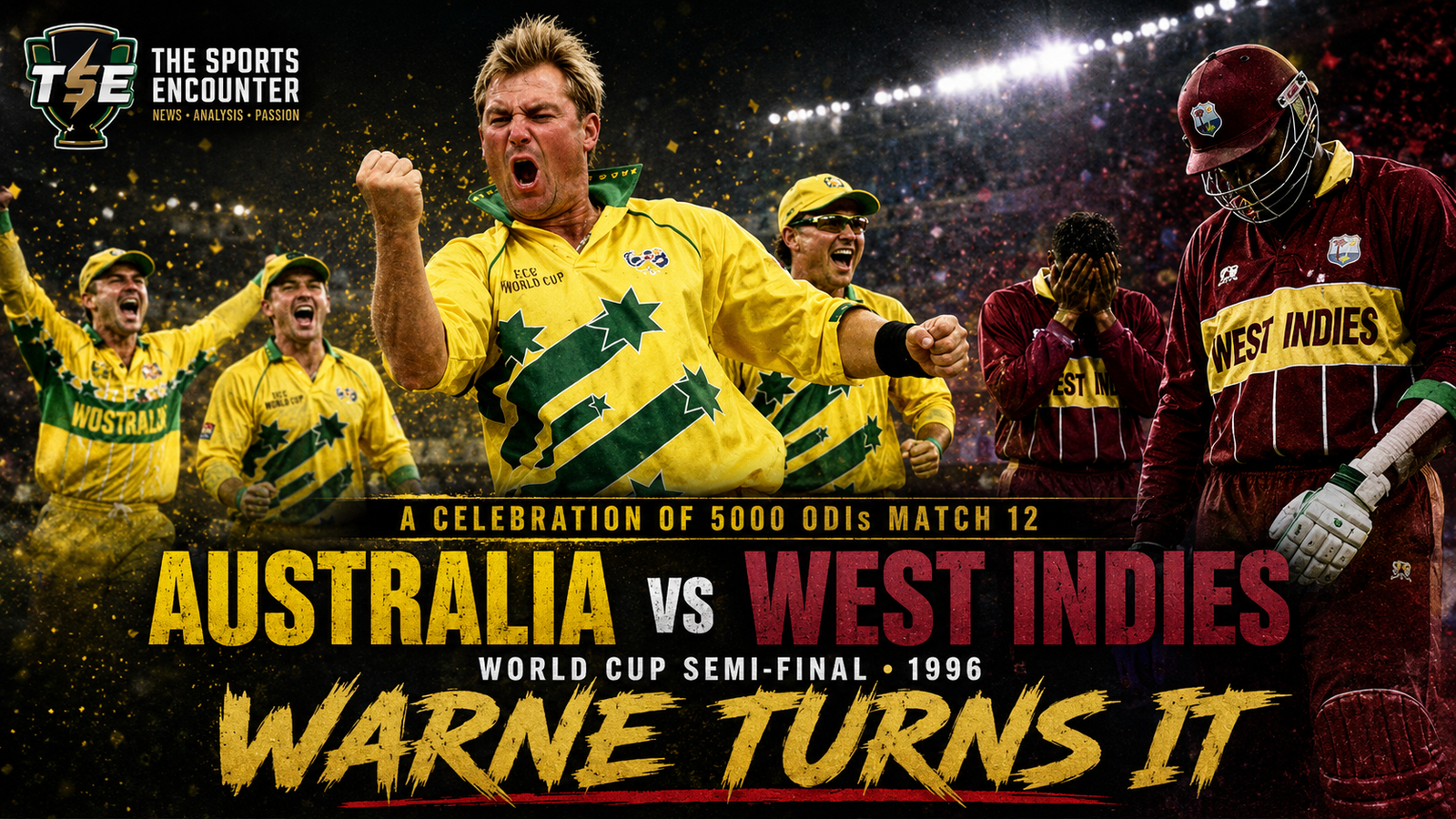
West Indies were 165 for two, chasing 208, with Richie Richardson and Shivnarine Chanderpaul at the crease and enough overs remaining to make the finish look almost routine.
Australia had already escaped 15 for four earlier in the day. Asking them to manufacture another recovery felt unreasonable.
Then Chanderpaul fell.
Within 49 balls, West Indies lost eight wickets for 37 runs. Shane Warne attacked the middle and lower order, Damien Fleming finished the job, and Richardson stood unbeaten at the other end as a World Cup semifinal that appeared safely under Caribbean control disappeared by five runs.
Australia’s victory at Mohali on March 14, 1996 belongs in A Celebration of 5000 ODIs because it produced two reversals inside the same knockout match. Australia first recovered from a position that should have ended its innings. West Indies then surrendered a chase that should have taken them into the final.
TL;DR
- Australia recovered from 15/4 to score 207/8 in 50 overs.
- Stuart Law made 72 and Michael Bevan 69 in a 138-run fifth-wicket partnership.
- West Indies reached 165/2 while chasing 208.
- Shivnarine Chanderpaul top-scored with 80, while Brian Lara made 45.
- Shane Warne took 4/36, including three wickets during the decisive late collapse.
- West Indies lost their final eight wickets for 37 runs and were dismissed for 202.
- Australia won by five runs and reached its third World Cup final.
Australia vs West Indies 1996: Match Information
| Detail | Information |
|---|---|
| Match | Australia vs West Indies, second semifinal |
| Tournament | 1996 Cricket World Cup |
| Date | March 14, 1996 |
| Venue | Punjab Cricket Association Stadium, Mohali |
| Toss | Australia won the toss and batted |
| Australia | 207/8 in 50 overs |
| West Indies | 202 all out in 49.3 overs |
| Result | Australia won by five runs |
| Player of the Match | Shane Warne, 4/36 |
| Australia’s top scorer | Stuart Law, 72 |
| West Indies’ top scorer | Shivnarine Chanderpaul, 80 |
| Key partnership | Law and Bevan, 138 for fifth wicket |
| Turning point | West Indies collapsed after reaching 165/2 |
| Tournament impact | Australia advanced to the World Cup final |
| Historical note | Richie Richardson played his final ODI |
The ICC’s official history of the 1996 Cricket World Cup also identifies the Mohali collapse as one of the defining moments of the tournament.
Why Match 12 Belongs in A Celebration of 5000 ODIs
The five-run margin alone makes this a thriller. The route toward that margin makes it unforgettable.
Australia were 15 for four after just 9.1 overs. Mark Waugh and Ricky Ponting had made ducks. Mark Taylor scored one. Steve Waugh managed three.
West Indies then reached 165 for two while chasing 208.
Either position could have decided an ordinary ODI.
This semifinal survived both.
That is exactly the type of match this series was designed to preserve: pressure, improbability, individual brilliance, World Cup consequence and a scorecard that still makes little sense until the entire story is reconstructed.
The same theme runs through earlier installments such as Gary Gilmour rescuing Australia after they collapsed to 39 for six in 1975 and India defending 183 against West Indies in the 1983 final.
Mohali produced both types of tension in one afternoon.
Stuart Law Rebuilds Australia From 15 for Four
Curtly Ambrose and Ian Bishop made Australia look finished during the opening ten overs.
Ambrose trapped Mark Waugh lbw with the second ball and later removed Ponting. Bishop bowled Taylor and Steve Waugh. Four of Australia’s first five batters had contributed just four runs between them.
Stuart Law walked into a semifinal already slipping away.
His response was patient rather than desperate.
Law made 72 from 105 balls, hitting five fours and giving Australia enough stability to move beyond survival. Against Ambrose, Bishop and Courtney Walsh, trying to manufacture quick runs would probably have accelerated the collapse.
Law instead stayed long enough for Michael Bevan to join him.
Michael Bevan Gives Australia a Total to Defend
Bevan’s 69 from 110 balls carried all the qualities that made him one of the defining ODI batters of his generation.
He understood the situation immediately.
Australia did not need spectacle at 15 for four. They needed time, wickets in hand and a total capable of giving Warne and the bowlers something to work with.
Law and Bevan added 138 for the fifth wicket, taking Australia from 15/4 to 153/5. It was the partnership that restored the semifinal.
Ian Healy then provided the late acceleration with 31 from 28 balls as Australia reached 207/8.
It looked competitive.
For much of the West Indian chase, it did not look enough.
Shivnarine Chanderpaul Takes West Indies to the Door
Shivnarine Chanderpaul was only 21 years old.
He batted like the calmest man at Mohali.
After Courtney Browne fell for ten, Chanderpaul rebuilt with Brian Lara and refused to allow Australia’s bowlers to create sustained pressure. Lara made 45 from 45 balls and helped take the score to 93 before Steve Waugh bowled him.
Richie Richardson then joined Chanderpaul.
The pair carried West Indies to 165 for two.
Chanderpaul’s 80 came from 126 deliveries, including seven boundaries. His innings lacked the violence usually associated with West Indies batting of the period, but the situation required control.
He had almost provided enough.
Glenn McGrath removed him at 165.
The match changed immediately.
Shane Warne Turns a Chase Into Panic
Warne had already dismissed Browne with his first delivery of the innings.
His most important work came much later.
Once Chanderpaul departed, West Indies still had Richardson established and required only 43 more runs. Roger Harper fell to McGrath for two before Warne entered the center of the collapse.
Ottis Gibson was caught behind.
Jimmy Adams was trapped lbw.
Ian Bishop followed lbw three deliveries into his stay.
Warne finished with 4/36 from nine overs.
Numbers describe the spell. Timing explains its greatness.
He took wickets precisely when West Indies needed composure and Australia needed something disruptive. The required rate remained manageable throughout. Warne made wickets, rather than runs, the problem.
That is why he received the Player of the Match award.
Richie Richardson Watches the Final Collapse
Richardson’s unbeaten 49 deserves attention because he remained at the crease while everything collapsed around him.
After Chanderpaul departed, West Indies lost Harper, Gibson, Adams, Keith Arthurton and Bishop.
Still, Richardson remained.
Even at 194 for eight, the contest had not completely disappeared. West Indies needed 14 with two wickets remaining.
Curtly Ambrose helped take the score to 202 before Ian Healy ran him out.
One wicket remained. Six runs were required.
Damien Fleming bowled Courtney Walsh with the next delivery.
Richardson stood unbeaten on 49 in his final ODI as Australia celebrated a five-run victory.
Curtly Ambrose and Ian Bishop Nearly Win It in the First Ten Overs
West Indies should also be remembered for how convincingly they began the semifinal.
Ambrose took 2/26 from ten overs.
Bishop returned 2/35.
Their opening spells reduced Australia’s highly rated batting order to 15 for four, a position from which very few teams should recover in a World Cup knockout match.
Ambrose was particularly economical, conceding only 2.60 runs per over. Walsh also gave away just 33 from his ten overs.
The bowling created the winning position.
West Indies simply failed to finish from it.
Complete Match Scorecard
Australia Innings: 207/8 in 50 Overs
| Batter | Dismissal | Runs | Balls | 4s | 6s |
| Mark Waugh | lbw b Ambrose | 0 | 2 | 0 | 0 |
| Mark Taylor | b Bishop | 1 | 11 | 0 | 0 |
| Ricky Ponting | lbw b Ambrose | 0 | 15 | 0 | 0 |
| Steve Waugh | b Bishop | 3 | 18 | 0 | 0 |
| Stuart Law | run out | 72 | 105 | 5 | 0 |
| Michael Bevan | c Richardson b Harper | 69 | 110 | 4 | 1 |
| Ian Healy | run out | 31 | 28 | 2 | 0 |
| Paul Reiffel | run out | 7 | 11 | 0 | 0 |
| Shane Warne | not out | 6 | 6 | 0 | 0 |
| Extras | 11 lb, 5 w, 2 nb | 18 | |||
| Total | 8 wickets, 50 overs | 207 |
Did not bat: Damien Fleming, Glenn McGrath.
Fall of wickets: 0/1, 7/2, 8/3, 15/4, 153/5, 171/6, 186/7, 207/8.
West Indies Bowling
| Bowler | Overs | Maidens | Runs | Wickets |
| Curtly Ambrose | 10 | 1 | 26 | 2 |
| Ian Bishop | 10 | 1 | 35 | 2 |
| Courtney Walsh | 10 | 1 | 33 | 0 |
| Ottis Gibson | 2 | 0 | 13 | 0 |
| Roger Harper | 9 | 0 | 47 | 1 |
| Jimmy Adams | 9 | 0 | 42 | 0 |
West Indies Innings: 202 All Out in 49.3 Overs
| Batter | Dismissal | Runs | Balls | 4s | 6s |
| Shivnarine Chanderpaul | c Fleming b McGrath | 80 | 126 | 7 | 0 |
| Courtney Browne | c & b Warne | 10 | 18 | 0 | 0 |
| Brian Lara | b Steve Waugh | 45 | 45 | 4 | 0 |
| Richie Richardson | not out | 49 | 83 | 4 | 0 |
| Roger Harper | lbw b McGrath | 2 | 5 | 0 | 0 |
| Ottis Gibson | c Healy b Warne | 1 | 2 | 0 | 0 |
| Jimmy Adams | lbw b Warne | 2 | 11 | 0 | 0 |
| Keith Arthurton | c Healy b Fleming | 0 | 4 | 0 | 0 |
| Ian Bishop | lbw b Warne | 3 | 3 | 0 | 0 |
| Curtly Ambrose | run out (Healy) | 2 | 2 | 0 | 0 |
| Courtney Walsh | b Fleming | 0 | 1 | 0 | 0 |
| Extras | 4 lb, 2 w, 2 nb | 8 | |||
| Total | All out, 49.3 overs | 202 |
Fall of wickets: 25/1, 93/2, 165/3, 173/4, 178/5, 183/6, 187/7, 194/8, 202/9, 202/10.
Australia Bowling
| Bowler | Overs | Maidens | Runs | Wickets |
| Glenn McGrath | 10 | 2 | 30 | 2 |
| Damien Fleming | 8.3 | 0 | 48 | 2 |
| Shane Warne | 9 | 0 | 36 | 4 |
| Mark Waugh | 4 | 0 | 16 | 0 |
| Steve Waugh | 7 | 0 | 30 | 1 |
| Paul Reiffel | 5 | 0 | 13 | 0 |
| Michael Bevan | 4 | 1 | 12 | 0 |
| Stuart Law | 2 | 0 | 13 | 0 |
The Match Changed Twice
The first turning point came before Australia had reached 20.
At 15 for four, West Indies had one foot in the final. Law and Bevan refused to allow that advantage to become decisive.
The second turning point arrived at 165 for two.
McGrath removed Chanderpaul and Australia suddenly found a route back into the contest. Warne then attacked that opening so effectively that West Indies lost their final eight wickets for just 37 runs.
It remains one of the sharpest late collapses in World Cup history.
The Sports Encounter has already revisited other Australian World Cup escapes, including the one-run victory over India in Chennai in 1987 and the seven-run 1987 final victory over England.
This one may have required even greater belief.
What the Result Meant
Australia reached its third men’s World Cup final after appearances in 1975 and 1987.
Sri Lanka ultimately defeated Mark Taylor’s team in Lahore, but Mohali helped confirm a trait that would define Australian World Cup cricket for the next two decades: they remained dangerous even when a match appeared lost.
West Indies faced the opposite emotion.
They had knocked South Africa out in the quarterfinal and were within 43 runs of returning to a World Cup final for the first time since 1983. Instead, the lower order disappeared around Richardson.
The result also ended Richardson’s international career.
Readers can continue the full historical journey through the A Celebration of 5000 ODIs main article or explore current and historical reporting through The Sports Encounter Cricket Hub.
For another example of a modest World Cup total becoming unexpectedly dangerous, revisit Eddo Brandes and Zimbabwe defending 134 against England in 1992.
Final Takeaway: 165 for Two Was Never the Finish
The score that explains this match is neither 207 nor 202.
It is 165 for two.
West Indies had eight wickets standing, an experienced captain at the crease, Chanderpaul set on 80 and fewer than 50 runs left to reach a World Cup final.
From there, Australia found ten minutes of belief and West Indies found panic.
Law and Bevan had already rescued Australia once. Warne made them do it again.
That double escape is why Mohali belongs among the 100 matches in A Celebration of 5000 ODIs, and why a five-run result from 1996 still feels impossible when you read the scorecard three decades later.
Cricket
Sri Lanka Avoid Innings Defeat as Sooriyabandara Leads Colombo Fightback
Sri Lanka avoided an innings defeat in Colombo after being forced to follow on by India, with Pasindu Sooriyabandara’s 92 and Kamindu Mendis’ 55 driving a spirited Day 4 recovery. The hosts closed on 229/6, leading by 16 runs before rain ended play.

COLOMBO: Sri Lanka began the fourth day of the second Test trying to delay an innings defeat. By the time rain covered the Sinhalese Sports Club Ground, they had removed that possibility completely and forced India to return on Thursday needing four more wickets before they can even think about completing a 2-0 series sweep.
Asked to follow on after being bowled out for 290 in reply to India’s imposing 503 for nine declared, Sri Lanka reached 229 for six in their second innings before rain ended play after 72.4 overs. They now lead by 16 runs.
The scoreboard still favors India. Sri Lanka have only four wickets remaining, their lead is small, and the visitors could yet finish the match quickly on the final morning.
But Day 4 changed the nature of the contest.
Pasindu Sooriyabandara produced a superb 92 from 173 balls, Kamindu Mendis made 55, and their 115-run third-wicket partnership transformed a follow-on innings that had begun under enormous pressure. Sri Lanka were 63 for two when the pair came together. By the time India finally separated them, the possibility of an innings victory had started slipping away.
India eventually fought back through Prasidh Krishna, Manav Suthar and Saransh Jain, reducing Sri Lanka from 178 for two to 218 for six. Rain then intervened at 229 for six, leaving Sonal Dinusha unbeaten on seven and Keshara Nuwantha on three.
The final day now begins with a simple equation carrying several possible endings: Sri Lanka lead by 16 with four wickets left. India still control the Test, but they must complete the job.
Sri Lanka vs India 2nd Test: Day 4 at a Glance
| Match Detail | Position |
|---|---|
| Match | Sri Lanka vs India, 2nd Test |
| Venue | Sinhalese Sports Club Ground, Colombo |
| India first innings | 503/9 declared |
| Sri Lanka first innings | 290 |
| First-innings deficit | 213 runs |
| Follow-on | Enforced by India |
| Sri Lanka second innings | 229/6 in 72.4 overs |
| Current lead | Sri Lanka lead by 16 runs |
| Top scorer | Pasindu Sooriyabandara 92 |
| Kamindu Mendis | 55 |
| India’s second-innings wickets | Suthar 2, Siraj 1, Prasidh 1, Jadeja 1, Jain 1 |
| Overnight batters | Sonal Dinusha 7*, Keshara Nuwantha 3* |
| Day 5 situation | India need four wickets before beginning any chase |
TL;DR
- India bowled Sri Lanka out for 290 after declaring their first innings on 503 for nine.
- Sri Lanka therefore trailed by 213 runs and were asked to follow on.
- Lahiru Udara fell for three and Kamil Mishara made 32 before Sri Lanka slipped to 63 for two.
- Pasindu Sooriyabandara and Kamindu Mendis added 115 for the third wicket.
- Sooriyabandara scored 92 from 173 balls after making 80 in the first innings.
- Kamindu contributed 55 from 92 balls.
- Prasidh Krishna broke the partnership by removing Kamindu.
- Manav Suthar then dismissed Dhananjaya de Silva and Sooriyabandara as India regained control.
- Sri Lanka closed on 229 for six, leading by 16 runs.
- Rain ended play early, leaving India four wickets away from setting up a final-innings chase.
Dinusha Completes His Century Before India Enforce the Follow-On
Day 4 began with Sri Lanka still completing the first innings that had occupied most of the previous day.
They resumed on 265 for eight, with Sonal Dinusha unbeaten on 85 and Lahiru Kumara on eight. India had already done enough to ensure the follow-on remained available unless Sri Lanka could extend their resistance considerably.
Dinusha nevertheless gave the home crowd another reason to appreciate what has been an outstanding series for him.
He reached his hundred from 147 deliveries, hitting eight fours and three sixes, and eventually finished with 103 from 162 balls. Kumara contributed 12 before Saransh Jain removed him, while Dinusha became the final wicket at 290.
India had a 213-run advantage.
Shubman Gill enforced the follow-on.
The decision followed logically from the position India had constructed across the opening three days. Their 503 for nine declared had been built around Devdutt Padikkal’s 117, Dhruv Jurel’s unbeaten 115, Rishabh Pant’s 63 and contributions throughout the batting order.
The Sports Encounter’s earlier report from Colombo detailed how Jurel and Pant turned India’s already strong first innings into a total that placed Sri Lanka under sustained scoreboard pressure.
By the start of the second innings, Sri Lanka were effectively being asked to bat again with one objective before anything else mattered: make India bat again.
Sri Lanka Lose Udara Again but Mishara Counterattacks
The follow-on started badly.
Mohammed Siraj removed Lahiru Udara for three from 15 balls, leaving Sri Lanka five for one.
India had taken three wickets for just 13 runs across the end of Sri Lanka’s first innings and the beginning of the second. Another collapse appeared possible.
Kamil Mishara refused to allow the innings to become completely defensive.
The Test debutant made 32 from 39 balls, hitting three fours and a six. His scoring rate mattered because it stopped India from immediately settling into a cycle of attacking fields and maiden overs.
Ravindra Jadeja eventually trapped Mishara lbw at 63 for two. Sri Lanka reviewed the decision, but umpire’s call preserved the wicket.
Lunch arrived with the hosts on 83 for two.
The deficit remained enormous, but Sri Lanka had survived the most dangerous phase after being sent straight back out to bat.
Sooriyabandara Takes the Fight to India
The defining innings of the day belonged to Pasindu Sooriyabandara.
He had already made 80 in Sri Lanka’s first innings, one of the few substantial scores around Dinusha’s century. Asked to begin again almost immediately, he produced an even better innings under much greater pressure.
Sooriyabandara did not simply occupy the crease.
He challenged India’s spinners.
Against Manav Suthar in particular, he repeatedly used the sweep and reverse sweep to disturb length and field placement. When the opportunity appeared, he also came down the pitch rather than allowing India’s slow bowlers to dictate where he could score.
It was intelligent counterattacking Test batting rather than uncontrolled aggression.
He reached fifty from 78 balls with seven fours.
By then, Sri Lanka had passed 100 and the innings had begun to look substantially different from the desperate follow-on survival exercise India had expected.
Kamindu Mendis Gives Sri Lanka the Partnership They Needed
Kamindu Mendis provided the ideal partner.
The left-hander took time to settle before gradually becoming more assertive. His fifty came from 87 balls and contained two fours and three sixes.
More importantly, he gave Sooriyabandara stability at the other end.
The partnership reached 50 from 102 deliveries and then crossed 100 from 156 balls.
At drinks in the afternoon session, Sri Lanka were 163 for two. Sooriyabandara had 69 and Kamindu was on 54.
India had entered the day expecting to use a 213-run first-innings lead to finish the Test without batting again. Instead, they were suddenly spending another long session in the field against two batters prepared to attack spin rather than merely survive it.
It was the strongest passage Sri Lanka produced during Day 4.
The resistance also followed a pattern already visible during this series. In the first Test at Galle, Sri Lanka recovered from 90 for five through a major middle-order stand, a fightback covered in our Day 3 report from Galle.
Colombo demanded another rescue.
This time, Sooriyabandara and Kamindu supplied it.
Prasidh Turns to the Short Ball and Finally Breaks Through
There was little conventional assistance available for India’s fast bowlers.
The surface offered neither significant movement nor the kind of consistent seam response that would allow Prasidh Krishna and Siraj to attack through traditional methods.
India therefore used the short ball repeatedly as a change of pace and method.
Prasidh eventually made it work.
Kamindu moved to 55 before a short delivery produced the breakthrough, with Shubman Gill completing the catch.
Sri Lanka were 178 for three.
The wicket ended a 115-run partnership and changed the final part of the day.
India had spent much of the second session being pushed backward. Now there was a new batter at the crease and Sooriyabandara was approaching a century.
The visitors had an opening again.
Sooriyabandara Reaches 90 but Misses a Deserved Century
By tea, Sooriyabandara had reached 90.
Sri Lanka were 199 for three.
An innings defeat was almost gone, and a maiden Test century appeared within touching distance.
Neither milestone arrived quite the way Sooriyabandara would have wanted.
Dhananjaya de Silva was dismissed for 23 when Suthar struck at 209 for four.
Three runs later came the day’s most painful moment for Sri Lanka.
Sooriyabandara advanced to Suthar, was beaten, and Rishabh Pant completed the stumping.
He was out for 92 from 173 balls.
His innings included 10 fours and a six.
The missing eight runs will hurt, particularly after he had reached 80 in the first innings without converting that start either.
But the significance of the innings was much larger than the century he missed.
When Sooriyabandara began his second innings, Sri Lanka were 213 runs behind and facing the prospect of losing without India batting again.
When he departed, they had reached 212 for five.
The innings defeat had effectively disappeared.
Manav Suthar Takes Two Quick Wickets as India Hit Back
Suthar had been put under more pressure than any Indian spinner during Sooriyabandara’s attack.
His final figures reflected that contest. He conceded 81 runs from 18 overs, comfortably more expensive than India’s other frontline bowlers.
But he also took two of the wickets that stopped Sri Lanka from turning resistance into genuine control.
Dhananjaya fell for 23.
Sooriyabandara followed three runs later.
Then Saransh Jain trapped Niroshan Dickwella lbw for six, reducing Sri Lanka to 218 for six.
India had suddenly taken four wickets for 40 runs after the hosts reached 178 for two.
That late spell shifted the balance back toward the visitors.
By this stage, Sri Lanka had achieved their first target. India would have to bat again.
The next question was how large a chase they could create.
Rain Protects Sri Lanka’s Last Four Wickets
Sonal Dinusha and Keshara Nuwantha slowed the game dramatically after Dickwella’s dismissal.
Dinusha, who had scored 103 earlier in the day, moved to seven from 37 balls.
Nuwantha reached three from 29.
The final 10 overs of the day produced only 11 runs for the loss of one wicket.
There was nothing mysterious about the approach.
Sri Lanka no longer needed to chase the deficit aggressively. Every delivery survived increased the possibility of extending the game and every additional run increased the target India may eventually have to chase.
Then the sky changed.
Conditions had been growing darker before rain arrived at 4:37 p.m. local time. Ground staff quickly covered the pitch and surrounding areas, and heavier rain followed.
With the ground almost entirely covered and light deteriorating further, play was eventually called off.
Sri Lanka finished on 229 for six.
India Have Bowled More Than 160 Overs in Two Sri Lankan Innings
There is another element India must manage on Day 5.
Workload.
The visitors bowled 89.4 overs during Sri Lanka’s first innings and another 72.4 in the second. That is more than 162 overs in the field across consecutive innings.
India are also without Jasprit Bumrah and Kuldeep Yadav in Colombo, while the squad entered the tour with several availability and injury issues. The wider personnel pressure around the series was one of the central themes of The Sports Encounter’s pre-series analysis.
Siraj has remained extremely economical in the second innings, taking one for 11 from nine overs. Prasidh has one for 31 from 10. Jadeja has one for 48 from 18, while Jain has one for 55 from 17.4 overs.
Those workloads are manageable individually, but the cumulative effect of bowling across almost two complete Sri Lankan innings matters.
India need four wickets quickly enough to leave themselves comfortable time for the chase.
Why the Final Morning Could Still Become Complicated
India remain overwhelming favorites from the current position.
Four wickets separate them from Sri Lanka’s final total.
The lead is only 16.
Three of the four remaining batters are Prabath Jayasuriya, Lahiru Kumara and Asitha Fernando.
But Test matches become awkward when the expected ending does not arrive on schedule.
If Dinusha and Nuwantha can survive the first hour and push the lead toward 50 or 60, India will have to spend more time bowling before beginning a chase.
If rain removes another portion of the final day, the clock becomes relevant again.
If Sri Lanka lose two wickets immediately, India could be chasing a very small target before lunch.
That range of possibilities is why the first hour matters so much.
Sri Lanka Have Repeatedly Made India Work for the Final Wickets
The resistance of the lower order has already been visible twice during this Test.
In the first innings, Sri Lanka were 230 for eight before Dinusha and Kumara added 58 runs for the ninth wicket. Dinusha reached his century during that stand and stretched the innings to 290.
Now Dinusha is there again.
He has already faced 199 deliveries across the two innings and scored 110 runs in the match.
India therefore know that dismissing the recognized top order has not automatically ended Sri Lanka’s resistance.
That theme also appeared during the final stages of the opening Test in Galle, where India entered Day 5 needing six wickets before eventually completing a 165-run victory.
Colombo now presents a different version of the same challenge.
Sooriyabandara Has Changed His Place in This Sri Lankan Team
Whatever happens on Day 5, Pasindu Sooriyabandara leaves this Test with a stronger claim to a permanent role in Sri Lanka’s batting order.
He made 80 from 133 balls in the first innings.
He followed it with 92 from 173 in the second.
That gives him 172 runs in the match.
More importantly, both innings came with Sri Lanka under substantial pressure.
The methods were different enough to matter.
The first innings required recovery after early wickets.
The second demanded immediate mental reset after the follow-on, followed by tactical aggression against spin.
His willingness to sweep, reverse sweep and use his feet prevented Suthar and Jadeja from settling into uninterrupted attacking rhythms during the middle session.
For a Sri Lankan batting group still searching for greater stability, that adaptability could matter long after this match is finished.
India Still Hold the Advantage, but the Innings Victory Is Gone
India should still expect to win this Test.
They have controlled most of the match since compiling 503 for nine declared. Padikkal, Jurel and Pant built the scoreboard advantage. Prasidh, Suthar and the rest of the attack then bowled Sri Lanka out for 290.
Enforcing the follow-on was therefore entirely justified.
Sri Lanka’s response simply made India work much harder than the first-innings deficit suggested they would have to.
The hosts now lead by 16.
That means one result has already disappeared.
India cannot win by an innings anymore.
They need four wickets and then a successful chase.
Sri Lanka need time, runs and preferably more help from the weather.
This series forms part of the ICC World Test Championship 2025-27, which makes the result more important than the series score alone. India entered the Colombo Test already 1-0 ahead after their victory in Galle and are pursuing valuable WTC points as they attempt to move back toward the championship’s top two.
The unusual scheduling context is also part of a larger month of red-ball cricket. Colombo is one component of 19 consecutive calendar days with Test cricket scheduled during August, alongside Australia against Bangladesh and England against Pakistan.
TSE Verdict: Sri Lanka Won the Middle of Day 4, India Still Own the Match
Sri Lanka did something important on Wednesday.
They changed the manner in which this Test can end.
An innings defeat appeared entirely realistic when India enforced the follow-on with a 213-run lead. Sooriyabandara and Kamindu then produced the partnership the hosts needed, scoring with enough freedom to prevent India from simply surrounding the bat and waiting for mistakes.
For one full session, India looked frustrated rather than dominant.
The response after Kamindu’s dismissal was equally important.
Suthar recovered from being attacked to remove Dhananjaya and Sooriyabandara. Jain dismissed Dickwella. Four wickets fell between 178 and 218, preventing Sri Lanka from turning a rescue into a serious attempt to build a match-winning lead.
Rain ultimately froze the contest at 229 for six.
India remain in front.
Sri Lanka have finally made them look toward the clock as well as the wickets.
That is enough to give the second Test one meaningful final day.
Follow The Sports Encounter’s cricket coverage for the Day 5 report, international Test cricket, tournament news, player performances and analysis from across the game.
Frequently Asked Questions
What is the score after Day 4 of the Sri Lanka vs India second Test?
Sri Lanka are 229 for six in their second innings after following on. They lead India by 16 runs with four wickets remaining.
Did Sri Lanka avoid an innings defeat?
Yes. Sri Lanka moved past India’s 213-run first-innings advantage during their second innings, which means India must bat again to win the Test.
Why did India enforce the follow-on?
India scored 503 for nine declared before bowling Sri Lanka out for 290. The 213-run deficit exceeded the 200-run requirement for enforcing the follow-on in a five-day Test.
How many runs did Pasindu Sooriyabandara score?
Sooriyabandara scored 92 from 173 balls in Sri Lanka’s second innings, with 10 fours and one six. He had already made 80 in the first innings.
How many runs did Kamindu Mendis score?
Kamindu made 55 from 92 deliveries, hitting two fours and three sixes.
How many runs did Sooriyabandara and Kamindu add?
They shared a 115-run partnership for the third wicket, taking Sri Lanka from 63 for two to 178 for three.
Who took the wickets for India in Sri Lanka’s second innings?
Manav Suthar has two wickets, while Mohammed Siraj, Prasidh Krishna, Ravindra Jadeja and Saransh Jain have taken one each.
Who is unbeaten for Sri Lanka?
Sonal Dinusha is unbeaten on seven and Keshara Nuwantha is three not out.
How many runs did Sonal Dinusha score in Sri Lanka’s first innings?
Dinusha scored 103 from 162 balls, including eight fours and three sixes.
Can Sri Lanka still win the second Test?
Yes, mathematically. Sri Lanka would need to build a substantially larger lead with their remaining four wickets and then dismiss India while defending that target. India remain in the much stronger position.
What does India need to win?
India must take Sri Lanka’s remaining four wickets and then successfully chase whatever target the hosts set.
Why did play end early on Day 4?
Rain arrived late in the afternoon with Sri Lanka on 229 for six. Conditions became increasingly dark, the ground was covered, and no further play was possible.
When is Day 5 of the Sri Lanka vs India second Test?
The fifth and final day is scheduled for Thursday, August 27, 2026, at the Sinhalese Sports Club Ground in Colombo.


FIFA Hits Argentina with Heavy World Cup Sanctions as Paredes Gets 10-Game Ban
FIFA has handed Argentina major disciplinary sanctions after the 2026 World Cup final brawl, including a 10-game suspension for Leandro...

Can FIFA Oust Gianni Infantino? Regional Powerhouses Now Weigh Historic No-Confidence Vote
Gianni Infantino is facing the most serious political challenge of his FIFA presidency as UEFA, the AFC and CONCACAF discuss...


AFC-Qatar Rift Deepens as Infantino Crisis Divides Asian Football
AFC President Sheikh Salman bin Ebrahim Al-Khalifa has hit back at Qatar after its football federation challenged the confederation’s stance...


Why FIFA COO Kevin Lamour Was Shown the Exit Way
FIFA COO Kevin Lamour has left the organization weeks after accusing staff of being deceived over the abandoned FIFA Forward...


Ireland Turns on Infantino as FIFA Election Revolt Spreads Beyond Europe’s Heavyweights
Ireland has withdrawn its support for Gianni Infantino’s re-election as FIFA president, adding another national association to a widening governance...


Donald Trump Comes to Gianni Infantino’s Rescue as FIFA Crisis Turns Political
Donald Trump has thrown his support behind Gianni Infantino as UEFA, AFC and CONCACAF deepen their challenge to the FIFA...


UEFA, AFC and CONCACAF Turn on Infantino as FIFA Crisis Becomes a Fight for His Presidency
UEFA, the AFC and CONCACAF have jointly accused FIFA President Gianni Infantino of breaking trust over the abandoned World Cup...


FIFA Says Infantino Is Being Undermined as Leadership Crisis Turns Into a Battle Over Legitimacy
FIFA has escalated its defense of Gianni Infantino, warning of a concerted effort to undermine its president as the fallout...


When Will Lionel Messi Retire? Argentina President Says Only Messi Has the Answer
Lionel Messi’s retirement remains an open question after his eight-goal 2026 World Cup. Argentina president Claudio Tapia says only Messi...


English FA Turns Its Back on Gianni Infantino, Withdraws Support for Re-Election
The English FA has formally withdrawn its support for Gianni Infantino’s bid for another term as FIFA president, adding major...


FIFA President Apologizes to Member Nations After FIFA World Cup Selloff Plan Fails to Inspire
FIFA has apologized to its member associations after abandoning a controversial plan to sell a 20% stake in a new...


Infantino in Survival Mode After World Cup Stake Sale Idea Results in Global Revolt
Gianni Infantino’s abandoned World Cup commercial rights proposal has triggered an internal FIFA revolt, lost European support, and drawn a...


Crisis Plagues FIFA as Wenger, Grafstrom and Federations Break Ranks
Gianni Infantino’s grip on FIFA is under growing pressure after senior officials, European federations and former allies distanced themselves from...


Infantino Looks to Smaller Nations After UEFA, CONCACAF Snub
Gianni Infantino’s FIFA future may depend on smaller and emerging nations after UEFA and CONCACAF lost confidence in his leadership....


FIFA’s World Cup Stake Plan Failed in Three Days. The Damage to Gianni Infantino May Last Much Longer
FIFA’s attempt to sell a 20% stake in a new World Cup commercial entity collapsed within days after a global...


Cristiano Ronaldo’s World Cup Career: Goals, Records and Final Farewell
Cristiano Ronaldo became the first man to score in six FIFA World Cups, but football’s greatest tournament never gave him...


The Golden Generation Saying Goodbye After the FIFA World Cup 2026
The 2026 World Cup did more than crown a champion. It marked the emotional farewell of a generation that shaped...


Neymar’s World Cup Career: Skill, Pain, and the Rainbow Flick Legacy
Neymar carried Brazil’s World Cup hopes across four tournaments, producing unforgettable goals while enduring injuries, criticism and elimination heartbreak. His...


Is the FIFA World Cup 2030 Not for Sale Anymore?
FIFA’s proposal to sell a minority stake in a $20 billion World Cup commercial company appears to have collapsed after...


FIFA Explores 64-Nation World Cup for 2030: Is Another Expansion Worth It?
FIFA is examining whether the 2030 World Cup should expand from 48 to 64 teams. The proposal could increase global...


Vietnam Survive Thailand’s Best Fightback to Retain ASEAN Championship 2026
Thailand pushed Vietnam into their most uncomfortable night of the tournament, but a missed penalty and two own goals helped...


Vietnam Hold the Lead, but Thailand Still Have 90 Minutes to Change the ASEAN Final
Vietnam carry a 2-0 lead into the ASEAN Championship final second leg, but Thailand still have attacking weapons capable of...


ASEAN Championship 2026 Top 10 Players: The Performers Who Shaped the Road to the Final
From Nguyễn Xuân Son’s semifinal goals to Ilhan Fandi’s decisive strikes and Ubaidullah Shamsul’s defensive work, these 10 players have...


Bruno Fernandes Wins PFA Player of the Year After Record-Breaking Manchester United Season
Bruno Fernandes has been named the 2026 PFA Men’s Players’ Player of the Year after producing a historic 21-assist Premier...


Bunny Shaw Wins PFA Players’ Player of the Year After Historic Manchester City Season
Khadija “Bunny” Shaw has been named the 2025/26 PFA Women’s Players’ Player of the Year after another dominant Manchester City...


Manchester United Sign Carlos Baleba From Brighton as Carrick’s Midfield Rebuild Accelerates
Manchester United have completed the signing of Carlos Baleba from Brighton, adding the 22-year-old Cameroon midfielder to Michael Carrick’s rebuilt...


Chelsea Beat Fulham 3-2 as Palmer, Rogers and João Pedro Launch Xabi Alonso Era
Chelsea opened the Xabi Alonso era with a dramatic 3-2 win at Fulham as João Pedro scored inside the first...


Premier League Opening Weekend: Arsenal Start Strong, United Stumble, and Brighton Set the Early Pace
The Premier League’s opening weekend delivered 25 goals across nine matches, with Arsenal starting strongly, Hull stunning Manchester United, Brighton...


Draisaitl and Peterka Are Going Home as NHL Expands Germany Push
The NHL is expanding its push into Germany with four regular-season games in 2027-28. The Edmonton Oilers will play in...


Ron Duguay Walks Without a Walker as Stage 4 Cancer Fight Enters a New Treatment Phase
Ron Duguay has reached an encouraging rehabilitation milestone after his recent hospitalization, walking without a walker as his Stage 4...


Anze Kopitar Becomes Immortal in Los Angeles as Kings Retire No. 11 and Build His Statue
The Los Angeles Kings will retire Anze Kopitar’s No. 11 and unveil a bronze statue outside Crypto.com Arena, cementing the...


Ville Koivunen’s Eight-Year, $32M Penguins Deal Is a Bet on Pittsburgh’s Next Era
The Pittsburgh Penguins have committed to their future by signing 23-year-old forward Ville Koivunen to an eight-year, $32 million contract...


Tommy Novak’s $13.95M Penguins Extension Reveals Pittsburgh’s Plan Beyond the Crosby Era
The Pittsburgh Penguins have secured versatile forward Tommy Novak on a three-year, $13.95 million extension. After recording 42 points in...


Tim Seifert Sets the Stage Before Liam Dawson Seals The Hundred 2026 Final
Tim Seifert powered Manchester Super Giants toward the title before Mohammad Amir’s late burst created panic and Liam Dawson settled...


Crawley’s Costly Blunder Helps Super Giants Reach The Hundred Final
Paul Walter and Heinrich Klaasen powered Manchester Super Giants to 186 before Josh Tongue’s four wickets and Zak Crawley’s costly...


MI London Beat Birmingham Phoenix by Two Runs but Miss Hundred Eliminator on Net Run Rate
MI London survived a remarkable Birmingham Phoenix comeback to win by two runs at Edgbaston, but the victory was nowhere...


Tim Seifert Blows Sunrisers Leeds Away as Manchester Super Giants Surge Toward Hundred Eliminator
Tim Seifert hammered an unbeaten 80 from 40 balls as Manchester Super Giants chased 128 in just 67 legal deliveries,...


Stubbs Spoils Trent Rockets’ Lord’s Party as Southern Brave Win by Six Wickets
Tristan Stubbs hit an unbeaten 52 from 28 balls as Southern Brave chased 159 in 97 balls to beat Trent...


Wimbledon 2026 Withstands FIFA World Cup Clash, Breaks Attendance Record
Wimbledon attracted a record 550,151 spectators and generated 4.8 billion social media impressions in 2026. Dry weather, Arthur Fery’s semifinal...


Wimbledon Men’s Singles Champions: How Triumph on Grass Changed Their Careers
From Spencer Gore and William Renshaw to Roger Federer, Novak Djokovic, Carlos Alcaraz, and Jannik Sinner, discover how every Wimbledon...


Guo Hanyu and Kristina Mladenovic Turn Trust Into Wimbledon 2026 Glory
Guo Hanyu and Kristina Mladenovic turned a new partnership into Wimbledon glory, defeating Gabriela Dabrowski and Luisa Stefani in a...


Jannik Sinner’s Wimbledon Defense Against Novak Djokovic and Alexander Zverev
Jannik Sinner’s Wimbledon 2026 defense began with a five-set escape and ended with victories over Novak Djokovic and Alexander Zverev....


Muchova, Noskova Turn Wimbledon Women’s Singles Final Into an All-Czech Affair
Karolina Muchova saved match point to beat Coco Gauff in a Centre Court thriller, while Linda Noskova handled Marta Kostyuk...


Swiatek Sweeps Aside Rybakina to Claim Toronto Crown Ahead of US Open
Iga Swiatek swept aside Elena Rybakina 6-2, 6-3 to claim the 2026 National Bank Open title in Toronto, securing her...


Brandon Nakashima Beats Jodar to Reach First Masters 1000 Final
Brandon Nakashima held off Rafael Jodar 7-6(3), 6-4 to reach the first Masters 1000 final of his career at the...


National Bank Open: Iga Swiatek, Elina Svitolina Reach Semifinals as Montreal Enters QF Stage
Iga Swiatek and Elina Svitolina became the first confirmed National Bank Open 2026 semifinalists in Toronto, while Montreal’s men’s draw...


When Paris Welcomed Two New French Open Champions
Paris, France – June 9, 2026: There are days at Roland Garros when tennis feels like a sport. Then there...


French Open 2026: Mirra Andreeva Becomes a Grand Slam Reality
Mirra Andreeva relived the memories of Monica Seles on Super Sunday at Roland Garros to lift her maiden French Open...


Galle Gallants Are LPL 2026 Champions After 5-Wicket Revenge Win Over Jaffna Kings
Galle Gallants are the 2026 Lanka Premier League champions after defeating Jaffna Kings by five wickets, chasing 124 in 15.5...


LPL 2026 Final Preview: Galle Seek Revenge as Jaffna Chase a Fifth Crown
Galle Gallants and Jaffna Kings meet in the Lanka Premier League 2026 final after three dramatic clashes this season, with...

Harper and Asalanka Punish Colombo’s Chaos as Galle Reach LPL Final
Sam Harper’s commanding 77 and Charith Asalanka’s composed 59 carried Galle Gallants past Colombo Kaps and into the LPL 2026...

McDermott and Neesham Set the Trap Before Sahan Ends Kandy’s LPL Run
Colombo Kaps eliminated Kandy Royals by 68 runs after McDermott and Neesham powered them past 200 before Sahan and Dahani...

Mishara’s Unbeaten 108 Sends Jaffna Kings Into LPL Final After 470-Run Assault
Kamil Mishara’s unbeaten century carried Jaffna Kings into the LPL 2026 final after Galle Gallants fell 14 runs short in...


Guyana Amazon Warriors Defend 85 to Break San Francisco Hearts and Retain Global Super League Title
Guyana Amazon Warriors recovered from 29 for eight, defended a total of 85, and defeated San Francisco Unicorns by six...


Tim Robinson Explodes as Unicorns Thump Vipers to Enter the Global Super League Final
Tim Robinson struck an unbeaten 68 as San Francisco Unicorns defeated Desert Vipers by eight wickets in the Global Super...


Perth Find Their Missing Finish as Spin Silences Guyana
Brody Couch rescued Perth Scorchers XI with 43 before five spin options dismantled Guyana Amazon Warriors for 121 in a...


Akeal Hosein Nearly Steals It, but Desert Vipers Escape in Final Over
Rilee Rossouw mastered a difficult Providence pitch before Desert Vipers survived Akeal Hosein’s four-wicket fightback to beat Perth Scorchers XI...


Shadab Khan and Zachary Carter Rescue Desert Vipers’ GSL Campaign
Shadab Khan dismantled San Francisco’s middle order before 19-year-old Zachary Carter launched a fearless chase, helping Desert Vipers secure their...


LeBron James Partners With PGA Tour for Akron Golf Event as Firestone Gets New Life
LeBron James is bringing professional golf back to Akron through a new PGA Tour-backed Invitational at Firestone Country Club, combining...


Lakers’ $12.5B Sale Confirms a New Reality: This Is Luka Dončić’s Team Now
The Lakers are entering another major transition, with a reported $12.5 billion ownership deal arriving as LeBron James departs and...


NBA 2026-27 Schedule Is Here: Opening Night, Christmas Games and Biggest Dates to Watch
The NBA has released its full 2026-27 schedule, with LeBron James opening his 76ers career against the defending champion Knicks,...


LeBron James to Challenge NBA Champions Knicks to Kick Off His 76ers Era
LeBron James will begin his Philadelphia 76ers era against the defending champion New York Knicks at Madison Square Garden before...


LeBron James Says No to LA 2028, but Team USA Is Reportedly Saving Him a Seat
LeBron James says he plans to watch the 2028 Los Angeles Olympics, but USA Basketball is reportedly prepared to give...

Calvin Austin Torn ACL: Giants Receiver Expected to Miss 2026 Season
New York Giants wide receiver Calvin Austin III is expected to miss the 2026 NFL season after reportedly tearing the...


NFL 2026: Trey Moore Set for Surgery, Brian Thomas Avoids Major Scare as Lions Meet Kareem Hunt
The NFL’s final preseason stretch brought injury concerns, roster moves and a major off-field honor, with Trey Moore set for...


NFL Injury Blow: Seahawks Lose Jake Bobo as Ravens Face Center Crisis After Danny Pinter Tear
The Seahawks may be without Jake Bobo for an extended period after a serious knee injury, while the Ravens face...



US Open 2026: Zverev’s Opening, Djokovic’s Record Chase and Shelton’s American Moment
The US Open 2026 men’s title race has opened up after Jannik Sinner’s withdrawal. Alexander Zverev brings Grand Slam confidence,...


Serena, Venus Get Another Run at US Open Women’s Doubles Event
Serena and Venus Williams are returning to the US Open women’s doubles draw after receiving a 2026 wildcard. The 14-time...

Fan Support Gives Stan Wawrinka His Last Shot at the US Open Title
Stan Wawrinka will return to the US Open one final time after receiving a late main-draw wildcard following Patrick Kypson’s...
-

 Cricket4 weeks ago
Is The Hundred Losing Its Oomph Among English Cricket Fans?
-

 Editor's Choice3 weeks ago
Premier League 2026–27 Curtain Raiser: Fixtures, Teams, Title Contenders, Transfers and Season Predictions
-

 Editor's Choice4 weeks ago
US Open 2026 Curtain-Raiser: Players, Schedule, Title Contenders, New York Storylines and Everything Fans Need to Know