A Celebration of 5000 ODIs Match 5: India Defend 183 and Break West Indies’ World Cup Reign
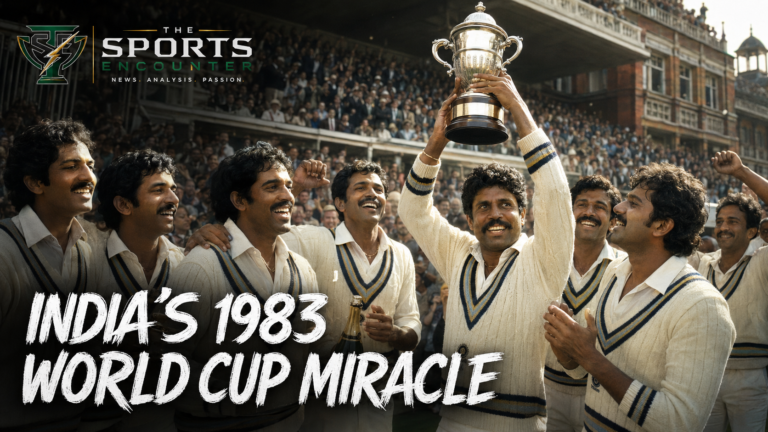
Kapil Dev’s unforgettable catch and Mohinder Amarnath’s all-round brilliance helped India defend 183, dethrone West Indies, and capture the 1983 World Cup at Lord’s.
Viv Richards was treating India’s 183 as a formality when the ball climbed over midwicket and Kapil Dev began running toward the Lord’s boundary. For several long seconds, an entire World Cup final appeared to hang above his shoulder.
Kapil completed the catch. Richards walked. West Indies lost their grip on the trophy, and Indian cricket began moving toward a future few could have imagined that morning.
India’s 43-run victory on June 25, 1983, belongs in A Celebration of 5000 ODIs because it changed the balance of one-day cricket. The two-time defending champions arrived at Lord’s expecting a third consecutive title. India arrived with 183 runs and the conviction that the game remained alive.
What followed became one of cricket’s defining acts of collective resistance.
TL;DR
- India scored 183 in 54.4 overs after West Indies chose to bowl.
- West Indies collapsed for 140, giving India a 43-run victory and its first World Cup.
- Kris Srikkanth top-scored with 38 against one of cricket’s greatest pace attacks.
- Kapil Dev’s running catch to dismiss Viv Richards changed the direction of the final.
- Mohinder Amarnath made 26 and took 3/12 to earn Man of the Match.
- The result ended West Indies’ bid for a third straight World Cup title.
India vs West Indies 1983 World Cup Final: Key Information
| Detail | Information |
|---|---|
| Match | India vs West Indies, 1983 World Cup final |
| Date | June 25, 1983 |
| Venue | Lord’s, London |
| Toss | West Indies won the toss and fielded |
| India | 183 all out in 54.4 overs |
| West Indies | 140 all out in 52 overs |
| Result | India won by 43 runs |
| Man of the Match | Mohinder Amarnath, 26 runs and 3/12 |
| Turning point | Kapil Dev’s running catch to dismiss Viv Richards |
| Tournament impact | India won its first World Cup and denied West Indies a third consecutive title |
Match information and figures are verified against the official ICC account and ESPNcricinfo scorecard.
Complete Match Scorecard
India Innings: 183 All Out in 54.4 Overs
| Batter | Dismissal | Runs | Balls | 4s | 6s |
|---|---|---|---|---|---|
| Sunil Gavaskar | c Dujon b Roberts | 2 | 12 | 0 | 0 |
| Kris Srikkanth | lbw b Marshall | 38 | 57 | 7 | 1 |
| Mohinder Amarnath | b Holding | 26 | 80 | 3 | 0 |
| Yashpal Sharma | c sub b Gomes | 11 | 32 | 1 | 0 |
| Sandeep Patil | c Gomes b Garner | 27 | 29 | 0 | 1 |
| Kapil Dev | c Holding b Gomes | 15 | 8 | 3 | 0 |
| Kirti Azad | c Garner b Roberts | 0 | 3 | 0 | 0 |
| Roger Binny | c Garner b Roberts | 2 | 8 | 0 | 0 |
| Madan Lal | b Marshall | 17 | 27 | 0 | 1 |
| Syed Kirmani | b Holding | 14 | 43 | 0 | 0 |
| Balwinder Sandhu | not out | 11 | 30 | 1 | 0 |
| Extras | 5 byes, 5 leg byes, 1 no-ball, 9 wides | 20 | |||
| Total | All out, 54.4 overs | 183 |
West Indies Bowling
| Bowler | Overs | Maidens | Runs | Wickets |
|---|---|---|---|---|
| Andy Roberts | 10 | 3 | 32 | 3 |
| Joel Garner | 12 | 4 | 24 | 1 |
| Malcolm Marshall | 11 | 1 | 24 | 2 |
| Michael Holding | 9.4 | 2 | 26 | 2 |
| Larry Gomes | 11 | 1 | 49 | 2 |
| Viv Richards | 1 | 0 | 8 | 0 |
West Indies Innings: 140 All Out in 52 Overs
| Batter | Dismissal | Runs | Balls | 4s | 6s |
|---|---|---|---|---|---|
| Gordon Greenidge | b Sandhu | 1 | 12 | 0 | 0 |
| Desmond Haynes | c Binny b Madan Lal | 13 | 33 | 2 | 0 |
| Viv Richards | c Kapil Dev b Madan Lal | 33 | 28 | 7 | 0 |
| Clive Lloyd | c Kapil Dev b Binny | 8 | 17 | 1 | 0 |
| Larry Gomes | c Gavaskar b Madan Lal | 5 | 16 | 0 | 0 |
| Faoud Bacchus | c Kirmani b Sandhu | 8 | 25 | 0 | 0 |
| Jeff Dujon | b Amarnath | 25 | 73 | 0 | 1 |
| Malcolm Marshall | c Gavaskar b Amarnath | 18 | 51 | 0 | 0 |
| Andy Roberts | lbw b Kapil Dev | 4 | 14 | 0 | 0 |
| Joel Garner | not out | 5 | 19 | 0 | 0 |
| Michael Holding | lbw b Amarnath | 6 | 24 | 0 | 0 |
| Extras | 4 leg byes, 10 wides | 14 | |||
| Total | All out, 52 overs | 140 |
India Bowling
| Bowler | Overs | Maidens | Runs | Wickets |
|---|---|---|---|---|
| Kapil Dev | 11 | 4 | 21 | 1 |
| Balwinder Sandhu | 9 | 1 | 32 | 2 |
| Madan Lal | 12 | 2 | 31 | 3 |
| Roger Binny | 10 | 1 | 23 | 1 |
| Mohinder Amarnath | 7 | 0 | 12 | 3 |
| Kirti Azad | 3 | 0 | 7 | 0 |
Kris Srikkanth Attacks When Survival Is Not Enough
India lost Gavaskar for two, bringing Srikkanth face to face with Roberts, Garner, Marshall and Holding. A passive approach could have allowed West Indies to control the innings completely.
Srikkanth chose aggression. His 38 from 57 balls included seven fours and a six, making him the final’s highest scorer. Amarnath supplied patience with 26 from 80, while Patil’s 27 and lower-order contributions carried India to 183.
The total looked inadequate, but every additional run mattered. It created enough distance for India’s bowlers to turn anxiety into pressure.
Kapil Dev’s Catch Changes the Final
Balwinder Sandhu gave India hope by bowling Gordon Greenidge for one, but Richards responded with seven boundaries in a 28-ball 33. He appeared ready to remove the target from the contest.
Madan Lal tempted Richards into another attacking stroke. The ball flew high toward deep midwicket, forcing Kapil to run backward while keeping his eyes fixed above him. His over-the-shoulder catch removed the batter most capable of making 184 look comfortable. The ICC identifies it as the final’s decisive turning point.
West Indies fell from 50/1 to 76/6. Madan also dismissed Haynes and Gomes, Roger Binny removed captain Clive Lloyd, and Sandhu accounted for Bacchus.
Mohinder Amarnath Delivers the Final Blow
Jeff Dujon and Malcolm Marshall added 43 for the seventh wicket, briefly restoring West Indian hope. Kapil needed someone to break the partnership before the required runs became manageable.
Amarnath answered. His controlled medium pace found enough movement from the Lord’s surface to bowl Dujon for 25. He then removed Marshall and trapped Michael Holding lbw to finish the final.
His figures of 3/12 complemented a determined 26 with the bat. That complete contribution earned him the Man of the Match award.
West Indies Lose Control of a Familiar Stage
West Indies bowled well enough to win. Roberts took three wickets, while Marshall, Holding and Gomes claimed two each. Their mistake came in treating a small chase as permission to keep attacking.
Once Richards fell, no specialist batter controlled the innings. Lloyd could not stabilize the middle order, while Dujon and Marshall were left with too much repair work.
The defeat ended an extraordinary World Cup reign that had begun in 1975. Readers can revisit that era through the chaotic 1975 final against Australia and Gary Gilmour’s remarkable semifinal performance.
Why This Match Belongs Among ODI Cricket’s Greatest
India’s victory showed how a one-day match could turn through fielding, patience and disciplined seam bowling even when the scoreboard appeared decisive.
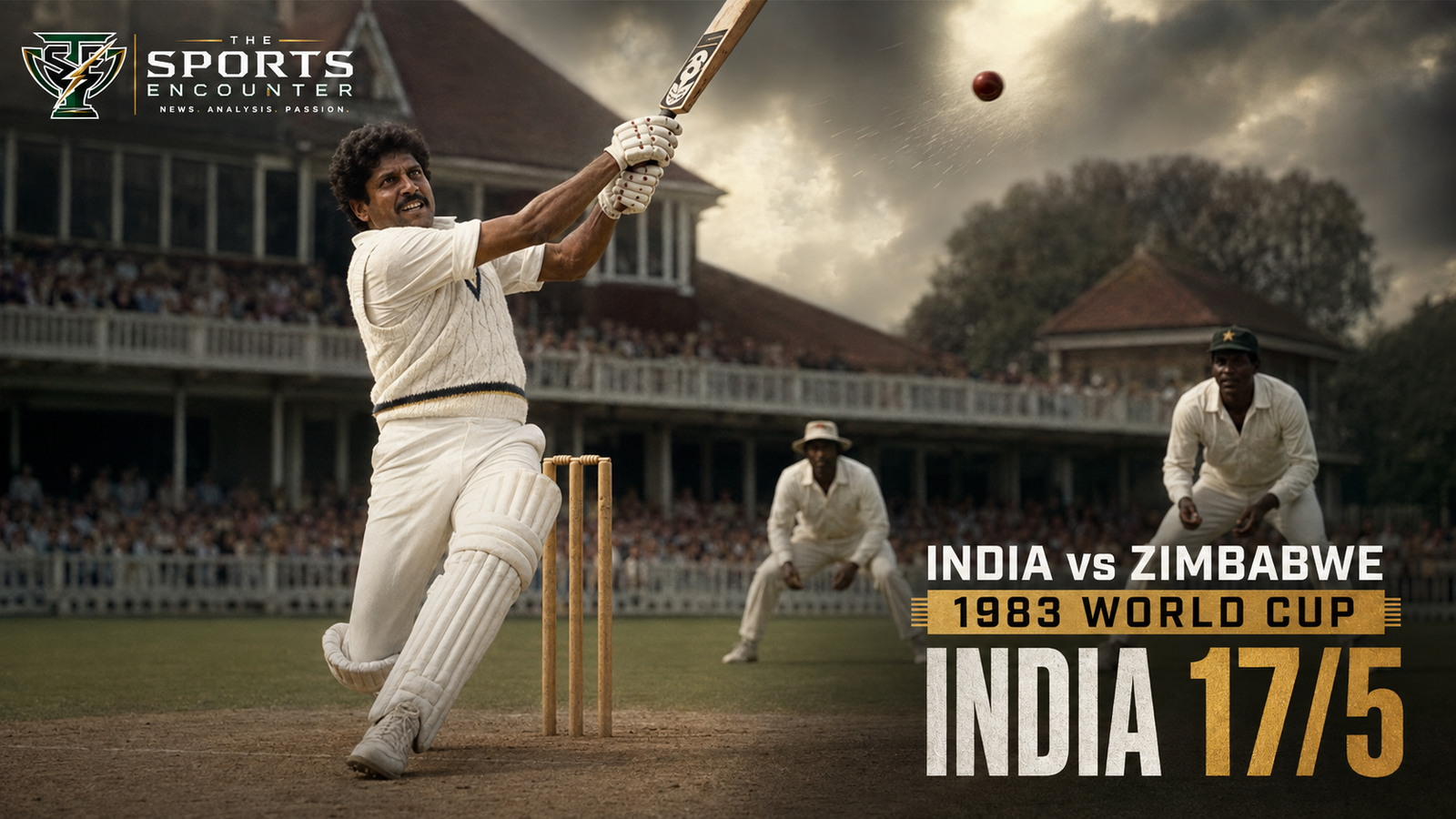
The triumph also completed an extraordinary Indian campaign shaped by Kapil’s earlier rescue against Zimbabwe. That innings is revisited in Match 4 of the series.
For more match reports and historical analysis, visit The Sports Encounter’s cricket coverage hub or explore the latest stories on The Sports Encounter homepage.
At Lord’s, India had only 183 to defend. By the time Amarnath trapped Holding in front, those 183 runs had become enough to end a dynasty, crown a new champion and reshape the history of ODI cricket.
A Celebration of 5000 ODIs
A Celebration of 5000 ODIs Match 8: Australia Break Pakistan’s World Cup Dream in Lahore
Steve Waugh transformed the final over before Craig McDermott dismantled Pakistan’s chase, sending Australia into the 1987 World Cup final by the narrowest of margins.
Eighteen runs separated Pakistan from a home World Cup final. Australia had collected exactly 18 from the last over of its innings.
That symmetry still defines the 1987 semifinal in Lahore. Pakistan recovered from 38 for three through Javed Miandad and Imran Khan, giving a packed Gaddafi Stadium reason to believe. Yet the runs Steve Waugh extracted at the end of Australia’s innings became a burden Pakistan could never shed.
Craig McDermott then took five wickets, including four during the closing stages, as Australia dismissed Pakistan for 249 to win by 18 runs.
That combination of late-innings calculation, a courageous recovery and ruthless fast bowling earns the semifinal its place as Match 8 in A Celebration of 5000 ODIs, The Sports Encounter’s journey through the matches that shaped one-day international cricket.
TL;DR
- Australia defeated Pakistan by 18 runs in the 1987 World Cup semifinal.
- Steve Waugh’s unbeaten 32 helped Australia score 18 from the final over and reach 267 for eight.
- Pakistan fell to 38 for three before Javed Miandad and Imran Khan added 112.
- Craig McDermott claimed five for 44 and won the Player of the Match award.
- Pakistan conceded 34 extras, a costly loss of control in a tight knockout match.
- Australia advanced to the final and secured its first World Cup title by beating England.
Match Information
| Detail | Information |
|---|---|
| Match | Australia vs Pakistan, 1987 World Cup semifinal |
| Date | November 4, 1987 |
| Venue | Gaddafi Stadium, Lahore |
| Toss | Australia won the toss and batted |
| Australia | 267/8 in 50 overs |
| Pakistan | 249 all out in 49 overs |
| Result | Australia won by 18 runs |
| Player of the Match | Craig McDermott, 5/44 |
| Turning Point | Australia scored 18 runs from the final over |
| Tournament Impact | Australia advanced to the World Cup final |
Complete Match Scorecard
Australia Batting
| Batter | Dismissal | Runs | Balls | 4s | 6s |
|---|---|---|---|---|---|
| Geoff Marsh | Run out | 31 | 57 | 2 | 0 |
| David Boon | St Javed Miandad b Saleem Malik | 65 | 91 | 4 | 0 |
| Dean Jones | b Tauseef Ahmed | 38 | 45 | 3 | 0 |
| Allan Border | Run out | 18 | 22 | 2 | 0 |
| Mike Veletta | b Imran Khan | 48 | 50 | 2 | 0 |
| Steve Waugh | Not out | 32 | 28 | 4 | 1 |
| Simon O’Donnell | Run out | 0 | 2 | 0 | 0 |
| Greg Dyer | b Imran Khan | 0 | 1 | 0 | 0 |
| Craig McDermott | b Imran Khan | 1 | 3 | 0 | 0 |
| Tim May | Not out | 0 | 2 | 0 | 0 |
| Bruce Reid | Did not bat | ||||
| Extras | 34 (b 1, lb 19, nb 1, w 13) | ||||
| Total | 267/8 in 50 overs |
Fall of wickets: 73, 155, 155, 215, 236, 236, 241, 249.
Pakistan Bowling
| Bowler | Overs | Maidens | Runs | Wickets |
|---|---|---|---|---|
| Imran Khan | 10 | 1 | 36 | 3 |
| Saleem Jaffar | 6 | 0 | 57 | 0 |
| Wasim Akram | 10 | 0 | 54 | 0 |
| Abdul Qadir | 10 | 0 | 39 | 0 |
| Tauseef Ahmed | 10 | 1 | 39 | 1 |
| Saleem Malik | 4 | 0 | 22 | 1 |
Pakistan Batting
| Batter | Dismissal | Runs | Balls | 4s | 6s |
|---|---|---|---|---|---|
| Ramiz Raja | Run out | 1 | 1 | 0 | 0 |
| Mansoor Akhtar | b McDermott | 9 | 19 | 0 | 0 |
| Saleem Malik | c McDermott b Waugh | 25 | 31 | 3 | 0 |
| Javed Miandad | b Reid | 70 | 103 | 4 | 0 |
| Imran Khan | c Dyer b Border | 58 | 84 | 4 | 0 |
| Wasim Akram | b McDermott | 20 | 13 | 0 | 2 |
| Ijaz Ahmed | c Jones b Reid | 8 | 7 | 1 | 0 |
| Saleem Yousuf | c Dyer b McDermott | 21 | 15 | 2 | 0 |
| Abdul Qadir | Not out | 20 | 16 | 2 | 0 |
| Saleem Jaffar | c Dyer b McDermott | 0 | 2 | 0 | 0 |
| Tauseef Ahmed | c Dyer b McDermott | 1 | 3 | 0 | 0 |
| Extras | 16 (lb 6, w 10) | ||||
| Total | 249 all out in 49 overs |
Fall of wickets: 2, 37, 38, 150, 177, 192, 212, 236, 247, 249.
Australia Bowling
| Bowler | Overs | Maidens | Runs | Wickets |
|---|---|---|---|---|
| Craig McDermott | 10 | 0 | 44 | 5 |
| Bruce Reid | 10 | 2 | 41 | 2 |
| Steve Waugh | 9 | 1 | 51 | 1 |
| Simon O’Donnell | 10 | 1 | 45 | 0 |
| Tim May | 6 | 0 | 36 | 0 |
| Allan Border | 4 | 0 | 26 | 1 |
David Boon Gives Australia Its Platform
David Boon’s 65 provided the control Australia needed after choosing to bat. His partnership with Geoff Marsh settled the innings, while Dean Jones maintained the tempo with 38.
Pakistan fought back when Jones and Boon departed at 155. Mike Veletta responded with 48 from 50 balls, keeping Australia above a run-a-ball trajectory without taking reckless risks.
Imran Khan led Pakistan’s attack superbly, conceding only 36 runs and taking three wickets. However, the support bowling lacked the same discipline. Pakistan conceded 34 extras, including 13 wides and 19 leg byes. In a match decided by 18 runs, those concessions were damaging.
Steve Waugh Turns One Over Into the Winning Margin
Australia slipped from 215 for three to 249 for eight as Imran attacked the lower order. Pakistan appeared to have limited the damage, but Waugh changed the shape of the contest in the final six deliveries.
His unbeaten 32 from 28 balls drove Australia to 267. The last over, delivered by Saleem Jaffar, cost 18 runs. Waugh’s calm, clean striking gave Australia a total that demanded an exceptional chase under semifinal pressure.
It echoed the composure Australia had shown in its one-run victory over India in Chennai. Once again, a handful of late runs proved decisive.
Javed Miandad and Imran Khan Rescue Pakistan
Pakistan’s chase began disastrously. Ramiz Raja was run out before McDermott removed Mansoor Akhtar. Waugh then dismissed Saleem Malik, leaving the hosts 38 for three.
Miandad and Imran refused to let the occasion collapse around them. Their 112-run partnership restored order through controlled rotation, selective aggression and a clear understanding of the required rate.
Imran made 58 before Allan Border dismissed him at 150. Miandad continued to 70, but Bruce Reid bowled him with Pakistan still needing 56 runs. Wasim Akram, Saleem Yousuf and Abdul Qadir attacked bravely, though Australia retained just enough control.
Craig McDermott Owns the Semifinal
McDermott delivered the performance that separated the teams. After removing Mansoor early, he returned to stop Pakistan’s lower-order charge.
Wasim Akram had struck two sixes in a rapid 20 when McDermott bowled him. Saleem Yousuf followed after making 21 from 15 balls. McDermott then dismissed Saleem Jaffar and Tauseef Ahmed to complete figures of five for 44.
The spell earned him the Player of the Match award and carried Australia into the final. Pace mattered, but so did his ability to attack the stumps when Pakistan’s batters had no time to settle.
Why This Semifinal Belongs in the 5,000 ODIs Collection
The match captured the unforgiving mathematics of knockout cricket. Australia’s final-over acceleration, Pakistan’s 34 extras and McDermott’s closing spell all contributed directly to an 18-run result.
Pakistan had enjoyed a powerful home campaign, winning five of its six group matches. The semifinal offered Imran’s team the chance to reach a World Cup final on home soil. Instead, Australia absorbed the atmosphere and survived Pakistan’s strongest partnership.
The victory also prepared the way for Australia’s seven-run win over England in the 1987 final, which secured the country’s first men’s World Cup title.
Readers can explore more landmark matches through The Sports Encounter’s Celebration of 5000 ODIs collection, including India’s 1983 final triumph and Kapil Dev’s rescue against Zimbabwe.
Pakistan found courage after losing three early wickets, but Australia owned the smaller moments. Waugh won the final over, McDermott won the closing passage, and those two interventions ended a nation’s dream within sight of the final.
A Celebration of 5000 ODIs
A Celebration of 5000 ODIs Match 7: Australia Punish Gatting’s Reverse Sweep to Win the 1987 World Cup Final
England appeared positioned to win its first World Cup until Mike Gatting’s reverse sweep opened the door for Allan Border and Australia at Eden Gardens.
England were 135/2 and moving steadily toward a first World Cup title when Mike Gatting attempted the shot that would follow him for the rest of his career.
Allan Border was bowling his occasional left-arm spin. Gatting moved across his crease and tried to reverse-sweep the Australian captain. The ball struck the top edge, looped behind the wicket and dropped into Greg Dyer’s gloves.
A partnership worth 69 runs had ended. Australia finally had an opening.
England remained in the chase until the last over, but the control established by Gatting and Bill Athey never fully returned. Australia defended 253/5, won by seven runs and lifted the World Cup for the first time at Eden Gardens on November 8, 1987.
The final earns its place as Match 7 in A Celebration of 5000 ODIs because one adventurous shot changed the emotional direction of a global final. David Boon supplied the innings, Mike Veletta transformed the total, and Border intervened precisely when England appeared ready to take command.
TL;DR
- Australia scored 253/5 after winning the toss at Eden Gardens.
- David Boon made 75 from 125 balls and received the Player of the Match award.
- Mike Veletta’s unbeaten 45 from 31 deliveries powered Australia’s late acceleration.
- Bill Athey scored 58, while Mike Gatting and Allan Lamb made 41 and 45.
- Gatting’s failed reverse sweep against Allan Border changed the direction of the chase.
- England finished on 246/8, leaving Australia with a seven-run victory and its first World Cup title.
Australia vs England 1987 World Cup Final: Key Information
| Detail | Information |
|---|---|
| Match | Australia vs England, 1987 World Cup final |
| Date | November 8, 1987 |
| Venue | Eden Gardens, Calcutta, now Kolkata |
| Toss | Australia won the toss and batted |
| Australia | 253/5 in 50 overs |
| England | 246/8 in 50 overs |
| Result | Australia won by seven runs |
| Player of the Match | David Boon, 75 from 125 balls |
| Leading England batter | Bill Athey, 58 from 103 balls |
| Leading bowlers | Eddie Hemmings 2/48; Steve Waugh 2/37; Allan Border 2/38 |
| Turning point | Mike Gatting’s reverse sweep against Border at 135/2 |
| Tournament impact | Australia won its first men’s Cricket World Cup |
The match and tournament history are documented by the International Cricket Council.
Complete Match Scorecard
Australia Innings: 253/5 in 50 Overs
| Batter | Dismissal | Runs | Balls | 4s | 6s |
|---|---|---|---|---|---|
| David Boon | c Downton b Hemmings | 75 | 125 | 7 | 0 |
| Geoff Marsh | b Foster | 24 | 49 | 3 | 0 |
| Dean Jones | c Athey b Hemmings | 33 | 57 | 1 | 1 |
| Craig McDermott | b Gooch | 14 | 8 | 2 | 0 |
| Allan Border | Run out | 31 | 31 | 3 | 0 |
| Mike Veletta | Not out | 45 | 31 | 6 | 0 |
| Steve Waugh | Not out | 5 | 4 | 0 | 0 |
| Simon O’Donnell | Did not bat | ||||
| Greg Dyer | Did not bat | ||||
| Tim May | Did not bat | ||||
| Bruce Reid | Did not bat | ||||
| Extras | 1 bye, 13 leg byes, 5 wides, 7 no-balls | 26 | |||
| Total | Five wickets, 50 overs | 253 |
England Bowling
| Bowler | Overs | Maidens | Runs | Wickets |
|---|---|---|---|---|
| Phil DeFreitas | 6 | 1 | 34 | 0 |
| Gladstone Small | 6 | 0 | 33 | 0 |
| Neil Foster | 10 | 0 | 38 | 1 |
| Eddie Hemmings | 10 | 1 | 48 | 2 |
| John Emburey | 10 | 0 | 44 | 0 |
| Graham Gooch | 8 | 1 | 42 | 1 |
England Innings: 246/8 in 50 Overs
| Batter | Dismissal | Runs | Balls | 4s | 6s |
|---|---|---|---|---|---|
| Graham Gooch | lbw b O’Donnell | 35 | 57 | 4 | 0 |
| Tim Robinson | lbw b McDermott | 0 | 1 | 0 | 0 |
| Bill Athey | Run out | 58 | 103 | 2 | 0 |
| Mike Gatting | c Dyer b Border | 41 | 45 | 3 | 1 |
| Allan Lamb | b Waugh | 45 | 55 | 4 | 0 |
| Paul Downton | c O’Donnell b Border | 9 | 8 | 1 | 0 |
| John Emburey | Run out | 10 | 16 | 0 | 0 |
| Phil DeFreitas | c Reid b Waugh | 17 | 10 | 2 | 1 |
| Neil Foster | Not out | 7 | 6 | 0 | 0 |
| Gladstone Small | Not out | 3 | 3 | 0 | 0 |
| Eddie Hemmings | Did not bat | ||||
| Extras | 1 bye, 14 leg byes, 2 wides, 4 no-balls | 21 | |||
| Total | Eight wickets, 50 overs | 246 |
Australia Bowling
| Bowler | Overs | Maidens | Runs | Wickets |
|---|---|---|---|---|
| Craig McDermott | 10 | 1 | 51 | 1 |
| Bruce Reid | 10 | 0 | 43 | 0 |
| Steve Waugh | 9 | 0 | 37 | 2 |
| Simon O’Donnell | 10 | 1 | 35 | 1 |
| Tim May | 4 | 0 | 27 | 0 |
| Allan Border | 7 | 0 | 38 | 2 |
David Boon Anchors Australia’s Innings
Boon’s 75 lacked the rapid scoring associated with modern finals, but the conditions demanded patience. He batted for 125 deliveries, absorbed England’s most disciplined periods and provided stability after Geoff Marsh departed with the score at 75.
Dean Jones added 33, while the unusual promotion of Craig McDermott produced 14 from eight balls. Australia then lost Jones, McDermott and Boon within 17 runs, slipping from 151/1 to 168/4.
Boon had given Australia a foundation. The innings still required someone to convert that foundation into a competitive final total.
His control and endurance earned him Player of the Match, completing a tournament in which he scored 447 runs.
Mike Veletta Changes the Value of Australia’s Total
Veletta arrived with Australia needing urgency and struck an unbeaten 45 from 31 balls. His six boundaries allowed Australia to collect 65 runs from the final six overs.
Border supported him with 31 from 31 deliveries before being run out at 241/5. Waugh added five from four balls, taking the total to 253.
Veletta’s innings became increasingly valuable as England’s pursuit tightened. Without his late acceleration, Gatting’s dismissal may have caused only a temporary interruption rather than a decisive shift.
Australia’s earlier ability to survive pressure had already appeared in the one-run group victory over India, which prepared Border’s side for another close finish.
Mike Gatting’s Reverse Sweep Opens the Final
Tim Robinson fell to McDermott from the first ball he faced, but England recovered through Gooch and Athey.
Gatting then changed the pace of the pursuit. His 41 came from 45 balls, and the partnership with Athey placed England at 135/2. The required rate remained manageable, both batters were settled, and Australia needed to create a mistake.
Border brought himself into the attack and Gatting supplied the opportunity.
The reverse sweep carried an obvious cost because of what followed. Athey was run out for 58 at 170/4, while Paul Downton managed nine. England had moved from a controlled chase into a sequence of new batters facing a rising required rate.
Allan Lamb Keeps England Alive
Lamb made 45 from 55 deliveries and carried England to 220/6. His innings prevented Australia from closing the final immediately after Athey’s departure.
Waugh then bowled Lamb, leaving England seven wickets down and still needing 34 runs. DeFreitas attacked with 17 from ten balls, including a six, but Waugh removed him at 235/8.
England required 17 from the final over and scored ten. Neil Foster and Gladstone Small remained unbeaten, yet the chase ended at 246/8.
Border finished with 2/38, while Waugh’s 2/37 gave Australia control during the closing overs.
Why Match 7 Belongs in A Celebration of 5000 ODIs
The seven-run margin tells only part of the story.
Australia entered the tournament as an unfancied side after a difficult period in its cricket history. Border’s team then survived the one-run match against India, defeated host Pakistan in the semifinal and held its nerve against England.
The final also marked a major change in World Cup geography and structure. India and Pakistan became the first countries outside England to host the tournament, while the competition adopted the 50-over innings that defines ODI cricket today.
This series previously revisited India’s 1983 final victory over West Indies, Kapil Dev’s rescue against Zimbabwe, the chaotic 1975 final and Gary Gilmour’s remarkable semifinal.
Readers can explore more historical match reports through The Sports Encounter Cricket Hub.
England had enough time, enough wickets and two established batters when Gatting shaped for the reverse sweep. Australia recognized the opening, controlled the next passage and completed the victory that began its rise as ODI cricket’s most successful World Cup nation.
A Celebration of 5000 ODIs
A Celebration of 5000 ODIs Match 6: Australia Beat India by One Run After Chennai Chase Turns Into Final-Over Agony
SEO Meta Title: India vs Australia 1987 World Cup Thriller
Meta Description: Australia edged India by one run in Chennai after Geoff Marsh’s century, Craig McDermott’s four wickets and a dramatic final-over collapse.
Suggested Slug: australia-india-1987-world-cup-one-run-thriller
Focus Keyphrase: Australia vs India 1987 World Cup
Excerpt: Geoff Marsh’s century gave Australia control, but India carried the chase to the final delivery before Steve Waugh secured a one-run World Cup escape in Chennai.
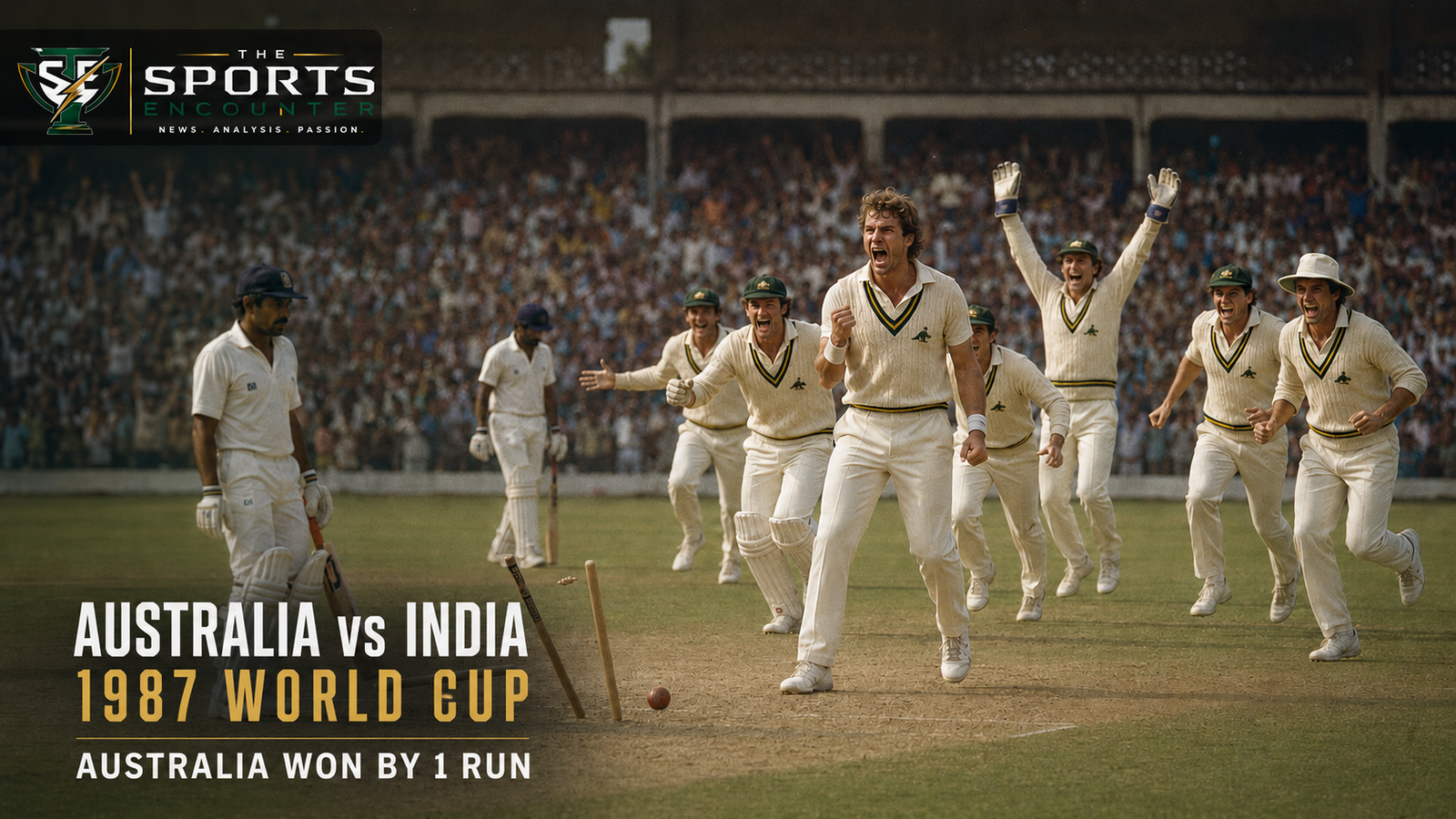
India needed two runs to tie when Maninder Singh faced Steve Waugh with one delivery left. Kiran More stood unbeaten at the other end, the Chennai crowd could barely process the tension, and a chase that had once appeared under control had reached its narrowest possible margin.
Waugh bowled straight. Maninder swung, missed and lost his stumps. Australia had won by one run.
The ending alone earns this match a place in A Celebration of 5000 ODIs, but the complete story carries even greater intrigue. Australia’s total had increased from 268 to 270 after a Dean Jones boundary was corrected from four to six during the innings break. India later finished on 269.
Geoff Marsh’s painstaking century, Navjot Sidhu’s five sixes, Craig McDermott’s middle-order intervention and Waugh’s final delivery produced a World Cup match in which every run acquired historical weight.
TL;DR
- Australia scored 270/6 after India chose to field in Chennai.
- Geoff Marsh made 110 from 141 balls and received the Player of the Match award.
- Kris Srikkanth scored 70 and Navjot Sidhu struck 73 during India’s chase.
- Craig McDermott took 4/56, including three wickets during a decisive middle-order spell.
- Steve Waugh bowled Maninder Singh from the penultimate delivery to complete a one-run victory.
- A Dean Jones boundary, initially recorded as four, was corrected to six during the innings break.
Australia vs India 1987 World Cup: Match Information
| Detail | Information |
|---|---|
| Match | India vs Australia, third match, 1987 World Cup |
| Date | October 9, 1987 |
| Venue | MA Chidambaram Stadium, Chennai |
| Toss | India won the toss and fielded |
| Australia | 270/6 in 50 overs |
| India | 269 all out in 49.5 overs |
| Result | Australia won by one run |
| Player of the Match | Geoff Marsh, 110 from 141 balls |
| Top Indian performers | Navjot Sidhu 73, Kris Srikkanth 70 |
| Leading bowler | Craig McDermott, 4/56 |
| Final turning point | Steve Waugh bowled Maninder Singh with one ball remaining |
| Tournament stage | Group A |
| ODI number | ODI No. 453 |
Match details can also be checked through the official ICC cricket platform.
Complete Match Scorecard
Australia Innings: 270/6 in 50 Overs
| Batter | Dismissal | Runs | Balls | 4s | 6s |
|---|---|---|---|---|---|
| David Boon | lbw b Shastri | 49 | 68 | 5 | 0 |
| Geoff Marsh | c Azharuddin b Prabhakar | 110 | 141 | 7 | 1 |
| Dean Jones | c Sidhu b Maninder Singh | 39 | 35 | 2 | 2 |
| Allan Border | b Binny | 16 | 22 | 0 | 0 |
| Tom Moody | c Kapil Dev b Prabhakar | 8 | 13 | 1 | 0 |
| Steve Waugh | Not out | 19 | 17 | 0 | 0 |
| Simon O’Donnell | Run out | 7 | 10 | 0 | 0 |
| Greg Dyer | Did not bat | ||||
| Peter Taylor | Did not bat | ||||
| Craig McDermott | Did not bat | ||||
| Bruce Reid | Did not bat | ||||
| Extras | 18 leg byes, 2 wides, 2 no-balls | 22 | |||
| Total | Six wickets, 50 overs | 270 |
India Bowling
| Bowler | Overs | Maidens | Runs | Wickets |
|---|---|---|---|---|
| Kapil Dev | 10 | 0 | 41 | 0 |
| Manoj Prabhakar | 10 | 0 | 47 | 2 |
| Roger Binny | 7 | 0 | 46 | 1 |
| Maninder Singh | 10 | 0 | 48 | 1 |
| Ravi Shastri | 10 | 0 | 50 | 1 |
| Mohammad Azharuddin | 3 | 0 | 20 | 0 |
India Innings: 269 All Out in 49.5 Overs
| Batter | Dismissal | Runs | Balls | 4s | 6s |
|---|---|---|---|---|---|
| Sunil Gavaskar | c Reid b Taylor | 37 | 32 | 6 | 1 |
| Kris Srikkanth | lbw b Waugh | 70 | 83 | 7 | 0 |
| Navjot Sidhu | b McDermott | 73 | 79 | 4 | 5 |
| Dilip Vengsarkar | c Jones b McDermott | 29 | 45 | 2 | 0 |
| Mohammad Azharuddin | b McDermott | 10 | 14 | 1 | 0 |
| Kapil Dev | c Boon b O’Donnell | 6 | 10 | 0 | 0 |
| Ravi Shastri | c and b McDermott | 12 | 11 | 1 | 0 |
| Kiran More | Not out | 12 | 14 | 2 | 0 |
| Roger Binny | Run out | 0 | 3 | 0 | 0 |
| Manoj Prabhakar | Run out | 5 | 7 | 0 | 0 |
| Maninder Singh | b Waugh | 4 | 5 | 0 | 0 |
| Extras | 2 byes, 7 leg byes, 2 wides | 11 | |||
| Total | All out, 49.5 overs | 269 |
Australia Bowling
| Bowler | Overs | Maidens | Runs | Wickets |
|---|---|---|---|---|
| Craig McDermott | 10 | 0 | 56 | 4 |
| Bruce Reid | 10 | 2 | 35 | 0 |
| Simon O’Donnell | 9 | 1 | 32 | 1 |
| Peter Taylor | 5 | 0 | 46 | 1 |
| Steve Waugh | 9.5 | 0 | 52 | 2 |
| Allan Border | 6 | 0 | 39 | 0 |
Geoff Marsh Gives Australia Its Foundation
Marsh batted through most of Australia’s innings and refused to let Chennai’s heat, spin or slow surface separate him from his method.
His 110 from 141 balls included seven fours and one six. The pace appears restrained beside modern ODI scoring, but Australia needed an anchor while adjusting to unfamiliar conditions. Marsh added 110 for the opening wicket with David Boon, who contributed 49.
Dean Jones then accelerated with 39 from 35 deliveries. Steve Waugh’s unbeaten 19 helped Australia reach 270, a strong total in the first World Cup played under the now-familiar 50-over format.
Marsh deserved the Player of the Match award because his innings gave every later Australian contribution its value.
The Boundary Correction That Became Part of the Result
Jones struck Maninder Singh toward the long boundary during his 39. The umpires initially awarded four, but Australia argued that the ball had cleared the rope.
During the innings break, the decision was corrected to six, with Indian captain Kapil Dev accepting the amendment. Australia’s score moved from 268 to 270.
The revision did not single-handedly defeat India. The chase still contained 299 legal deliveries, ten wickets and several moments India could have controlled. Yet the final margin ensured those two corrected runs would remain attached to the match forever.
Kapil’s career and sporting influence extend far beyond that painful incident, as explored in The Sports Encounter’s profile of the all-rounder who transformed Indian cricket.
Kris Srikkanth and Navjot Sidhu Put India Ahead
India began with aggression. Gavaskar made 37 from 32 balls before Srikkanth settled into a more substantial innings of 70.
Sidhu then attacked Australia’s spinners, hitting five sixes in his 73 from 79 balls. India reached 207/2 and appeared capable of controlling the remaining 64 runs.
That position made the collapse more damaging. India had wickets, established batters and a required rate within reach. Australia needed a bowler to disrupt the chase before India could coast through the final overs.
Craig McDermott Changes the Match
McDermott supplied Australia’s decisive spell.
He bowled Sidhu for 73, removed Azharuddin and then dismissed Vengsarkar, reducing India from 207/2 to 232/5. His fourth wicket came when he caught Shastri from his own bowling.
McDermott finished with 4/56. Bruce Reid went wicketless but conceded only 35 from ten overs, giving Australia the control required to survive Peter Taylor’s expensive spell.
Steve Waugh Owns the Final Delivery
India entered the final stages with More trying to guide the lower order home. Run-outs removed Binny and Prabhakar, but Maninder struck four and kept the chase alive.
Two runs were required from two balls. Waugh needed one wicket.
His straight delivery defeated Maninder and hit the stumps. Australia escaped with the smallest winning margin available in ODI cricket.
Waugh’s figures of 2/52 carried more importance than their economy rate suggests. He dismissed Srikkanth and then ended the match himself.
Why Match 6 Belongs in A Celebration of 5000 ODIs
The one-run margin supplies an obvious answer, but this match offers much more.
It featured a century, an aggressive Indian chase, a middle-order collapse, two late run-outs, a final-delivery wicket and a corrected boundary that exactly matched the eventual difference between the teams.
The result also introduced the resilience that would define Australia’s tournament. Allan Border’s side eventually lifted its first World Cup, beginning the country’s rise toward ODI dominance.
Readers can revisit India’s previous World Cup triumph through Match 5, the 1983 final against West Indies, Kapil Dev’s rescue against Zimbabwe and the chaotic 1975 World Cup final.
For more historical reports and current analysis, visit The Sports Encounter Cricket Hub.
India had controlled significant portions of the chase. Australia controlled its final delivery. In Chennai, that was enough to separate 270 from 269 and victory from one of India’s most painful World Cup defeats.
-
Cricket3 weeks agoIs The Hundred Losing Its Oomph Among English Cricket Fans?
-
Editor's Choice2 weeks agoPremier League 2026–27 Curtain Raiser: Fixtures, Teams, Title Contenders, Transfers and Season Predictions
-
Editor's Choice3 weeks agoUS Open 2026 Curtain-Raiser: Players, Schedule, Title Contenders, New York Storylines and Everything Fans Need to Know