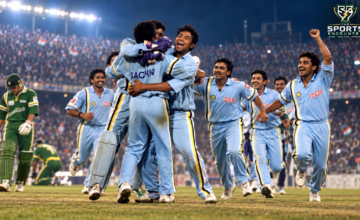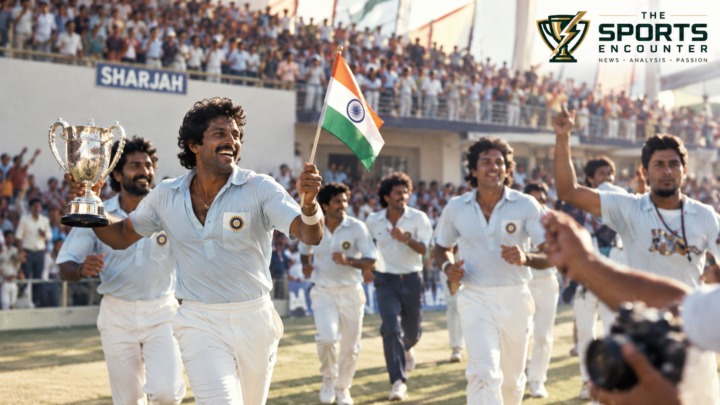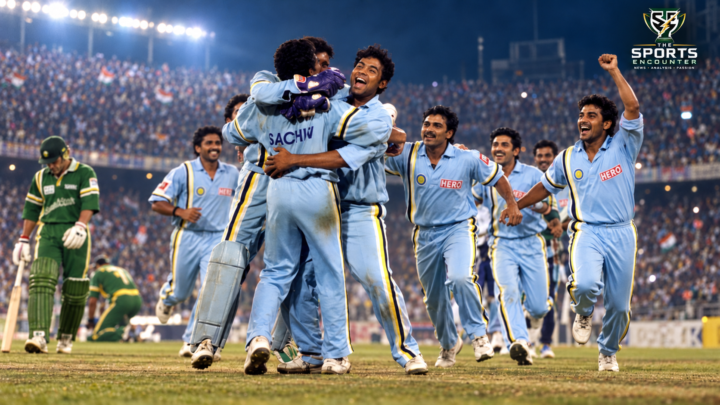
BRISBANE, Australia, March 4, 2008: Australia needed 14 runs from the final over to keep the Commonwealth Bank Series alive. James Hopes was batting on 63, India were defending 258, and a match that had seemed under control after Australia slumped to 32/3 was threatening one final reversal. Irfan Pathan then dismissed Nathan Bracken and Hopes in the space of four deliveries, bowling Australia out for 249 in 49.4 overs. India won by nine runs at the Gabba and completed a historic 2-0 victory in the best-of-three finals.
Sachin Tendulkar’s carefully constructed 91 from 121 balls had given India a competitive total, but Praveen Kumar’s 4/46 proved equally decisive. The young seamer dismissed Adam Gilchrist, Ricky Ponting and Michael Clarke before returning to remove Brett Lee. Australia recovered through Matthew Hayden’s 55, Michael Hussey’s 44 and Hopes’ defiant 63, repeatedly threatening to force a third final. Instead, India’s bowlers survived the pressure and delivered one of the most memorable ODI series victories of the MS Dhoni era.
Key Takeaways
- Australia needed 14 runs from the final over to keep the Commonwealth Bank Series alive.
- Sachin Tendulkar’s carefully constructed 91 from 121 balls had given India a competitive total, but Praveen Kumar’s 4/46 proved equally decisive.
- India had already defeated Australia by six wickets in the first final at Sydney on March 2.
- Sachin Tendulkar arrived in Brisbane having produced a magnificent unbeaten 117 in the first final at Sydney.
This encounter is Match 69 in The Sports Encounter’s A Celebration of 5000 ODIs, our historical series exploring 100 matches that defined the drama and evolution of One-Day International cricket.
Story at a glance

India vs Australia 2008: Commonwealth Bank Series Final Match Summary
India had already defeated Australia by six wickets in the first final at Sydney on March 2.
Sachin Tendulkar’s 91 Gives India a Defendable Total After His Sydney Century
Sachin Tendulkar arrived in Brisbane having produced a magnificent unbeaten 117 in the first final at Sydney.
Robin Uthappa’s 30 Gives India the Opening Partnership They Need
Robin Uthappa played an important supporting role.
Yuvraj Singh’s 38 and MS Dhoni’s 36 Keep India Moving
Yuvraj Singh contributed 38 from 38 deliveries, including two fours and two sixes.
Nathan Bracken’s 3/31 Keeps Australia Within Reach
Nathan Bracken was Australia’s outstanding bowler.
Its inclusion reflects the changing momentum throughout the chase, exceptional individual performances, Australia’s extraordinary lower-order resistance and the significance of India defeating the reigning world champions in their own conditions.
India vs Australia 2008: Commonwealth Bank Series Final Match Summary
| Match detail | Information |
|---|---|
| Tournament | Commonwealth Bank Series 2007-08 |
| Match | Second final |
| Date | March 4, 2008 |
| Venue | Brisbane Cricket Ground, the Gabba |
| Toss | India won and elected to bat |
| India | 258/9 in 50 overs |
| Australia | 249 all out in 49.4 overs |
| Result | India won by 9 runs |
| Finals series | India won 2-0 |
| Player of the Match | Praveen Kumar |
| Player of the Series | Nathan Bracken |
| India’s leading batter | Sachin Tendulkar, 91 |
| Australia’s leading batter | James Hopes, 63 |
| Best bowling, India | Praveen Kumar, 4/46 |
| Best bowling, Australia | Nathan Bracken, 3/31 |
| Decisive moment | Pathan’s two wickets in the final over |
India had already defeated Australia by six wickets in the first final at Sydney on March 2.
A victory in Brisbane would secure the trophy without requiring a third final in Adelaide.
Australia therefore entered the second final under pressure to protect their home tournament and prevent India’s young team from completing a series triumph.
That context made the nine-run margin particularly significant.
Sachin Tendulkar’s 91 Gives India a Defendable Total After His Sydney Century
Sachin Tendulkar arrived in Brisbane having produced a magnificent unbeaten 117 in the first final at Sydney.
India had successfully chased 240 in that encounter, and Tendulkar’s century had placed the visitors one victory away from the trophy.
In Brisbane, he delivered another innings of exceptional importance.
Tendulkar scored 91 from 121 deliveries, including seven fours.
His strike rate of 75.21 reflected the conditions and India’s approach rather than a lack of attacking intent.
Australia possessed an experienced bowling lineup featuring Brett Lee, Nathan Bracken, Stuart Clark and Mitchell Johnson.
India needed a reliable foundation.
Tendulkar provided it alongside Robin Uthappa.
The pair added 94 runs for the opening wicket, surviving the early pace attack and establishing a platform for the middle order.
Uthappa eventually fell for 30 in the 21st over.
Gautam Gambhir followed for 15, leaving India at 121/2.
Tendulkar continued batting through the middle overs, carefully controlling India’s scoring rate while other batters played more aggressively.
Yuvraj Singh contributed 38 from 38 balls, including two sixes.
Their third-wicket partnership added 54 runs, taking India to 175/3.
Tendulkar then combined with captain MS Dhoni.
India reached 205 before Michael Clarke dismissed Tendulkar for 91 in the 40th over.
The innings ended nine runs short of a century, but its value became clear when Australia fell nine runs short of India’s total.
Sachin Tendulkar’s Two Finals Against Australia
| Statistic | First Final, Sydney | Second Final, Brisbane |
|---|---|---|
| Date | March 2, 2008 | March 4, 2008 |
| Runs | 117* | 91 |
| Balls | 120 | 121 |
| Boundaries | 10 fours | 7 fours |
| India result | Won by 6 wickets | Won by 9 runs |
| Series position afterward | India led 1-0 | India won 2-0 |
Tendulkar scored 208 runs across the two finals and was dismissed only once.
That gave him an average of 208 across the championship matches.
The calculation illustrates how dominant he was when the series reached its decisive stage.
Although Praveen Kumar received the Player of the Match award in Brisbane, Tendulkar’s contributions across both finals were fundamental to India’s tournament victory.
Robin Uthappa’s 30 Gives India the Opening Partnership They Need
Robin Uthappa played an important supporting role.
He scored 30 from 49 deliveries while adding 94 for the first wicket with Tendulkar.
The partnership consumed 20.5 overs and prevented Australia from taking early control.
Uthappa was eventually dismissed by Stuart Clark, caught by James Hopes.
His innings was relatively cautious, with only one boundary, but India benefited from having two established batters survive the opening phase.
The partnership allowed Tendulkar to settle against Australia’s pace attack and build toward a substantial score.
India subsequently lost wickets at regular intervals, making that opening stand particularly valuable.
Yuvraj Singh’s 38 and MS Dhoni’s 36 Keep India Moving
Yuvraj Singh contributed 38 from 38 deliveries, including two fours and two sixes.
His innings arrived when India needed to accelerate after the relatively measured opening partnership.
Yuvraj attacked opportunities through the middle overs, helping Tendulkar increase the scoring rate.
Andrew Symonds eventually removed him, caught by Hayden.
MS Dhoni then scored 36 from 37 balls, including two fours and a six.
Dhoni’s innings was important because India’s batting began losing momentum after Tendulkar departed.
Rohit Sharma made only two.
Irfan Pathan contributed 12.
Harbhajan Singh scored three.
Praveen Kumar added seven before falling in the final over.
India finished on 258/9.
The total was competitive but not overwhelming.
Australia needed to score at 5.18 runs per over, a manageable rate for a side containing several established ODI batters.
Nathan Bracken’s 3/31 Keeps Australia Within Reach
Nathan Bracken was Australia’s outstanding bowler.
He claimed 3/31 from nine overs, including one maiden, finishing with an economy rate of 3.44.
Bracken removed Dhoni, Irfan Pathan and Praveen Kumar.
His late wickets prevented India from fully exploiting the foundation created by Tendulkar.
Michael Clarke also took three wickets, finishing with 3/52.
His victims included Tendulkar, Gambhir and Rohit Sharma.
Clarke’s dismissal of Tendulkar was particularly important because the Indian opener appeared capable of batting through the innings.
Brett Lee claimed one wicket, while Stuart Clark and Andrew Symonds also contributed.
Australia’s bowlers took nine wickets, but they conceded 258.
The total left the home side with a meaningful challenge rather than a straightforward chase.
Praveen Kumar’s 4/46 Destroys Australia’s Top Order
Praveen Kumar became the defining bowler of the final.
His figures of 4/46 from ten overs included two maidens.
Most importantly, his wickets came at stages when Australia desperately needed stability.
Adam Gilchrist fell for two in the opening over.
The wicket was particularly significant because it was Gilchrist’s final international appearance.
The Australian wicketkeeper-batter had enjoyed an extraordinary international career, but his farewell innings lasted only three deliveries.
Praveen then removed captain Ricky Ponting for one.
Australia were 8/2 in the third over.
Michael Clarke attempted to rebuild alongside Matthew Hayden, but Praveen bowled him for 17.
Australia slipped to 32/3 after nine overs.
The chase had become a serious challenge.
Australia still needed 227 runs, with seven wickets remaining.
Praveen’s early spell created the pressure that India’s other bowlers attempted to maintain throughout the innings.
He returned later to dismiss Brett Lee for seven, ending another potentially valuable lower-order contribution.
Praveen Kumar’s Four-Wicket Performance
| Statistic | Performance |
|---|---|
| Overs | 10 |
| Maidens | 2 |
| Runs conceded | 46 |
| Wickets | 4 |
| Economy rate | 4.60 |
| First wicket | Adam Gilchrist, 2 |
| Second wicket | Ricky Ponting, 1 |
| Third wicket | Michael Clarke, 17 |
| Fourth wicket | Brett Lee, 7 |
| Official award | Player of the Match |
Praveen accounted for four of Australia’s ten dismissals.
His first three wickets removed the top-order players most capable of controlling a demanding chase.
That combination of early breakthroughs and later intervention made his performance worthy of the official award.
Why Praveen Kumar’s Early Spell Was More Important Than the Final Margin
Australia lost three wickets for only 32 runs.
In numerical terms, 227 runs remained available to be scored.
However, the loss of Gilchrist, Ponting and Clarke forced Australia to rebuild before attempting to accelerate.
That changed the structure of the chase.
Hayden, Symonds and Hussey had to balance scoring with wicket preservation.
The innings therefore became increasingly dependent on partnerships rather than individual attacking performances.
Praveen had created the conditions that eventually allowed India to defend 258.
Matthew Hayden’s 55 and Andrew Symonds’ 42 Bring Australia Back
Matthew Hayden was Australia’s first major source of resistance.
He scored 55 from 68 deliveries, including seven fours.
His innings was particularly important because Australia had been reduced to 32/3.
Hayden established a fourth-wicket partnership with Andrew Symonds, who contributed 42 from 56 balls.
Together, they added 89 runs.
Australia advanced to 121/3.
The partnership brought the home side back into contention.
India needed a breakthrough before Hayden and Symonds could reduce the target further.
That opportunity arrived through sharp fielding.
Hayden was run out for 55 following work involving Yuvraj Singh and Harbhajan Singh.
Australia were 121/4.
Two runs later, Harbhajan trapped Symonds lbw for 42.
Australia slipped to 123/5.
The sudden loss of two established batters represented one of the most important shifts in the final.
The fourth-wicket partnership had restored Australia’s chances, but India removed both players before the chase entered its final phase.
Michael Hussey’s 44 Gives Australia Another Opportunity
Michael Hussey played an important rebuilding innings after Australia lost Hayden and Symonds.
He scored 44 from 42 deliveries, including three boundaries.
His partnership with James Hopes became Australia’s next significant recovery.
Together, they added 76 runs for the sixth wicket.
Australia advanced from 123/5 to 199/6.
Hussey’s controlled batting helped reduce the required scoring rate while Hopes became increasingly aggressive.
However, Sreesanth dismissed Hussey in the 42nd over.
He was caught behind by Dhoni.
Australia were 199/6.
The dismissal left Hopes responsible for completing the chase with the lower order.
India had removed another established batter, but Australia remained within reach.
James Hopes’ 63 Nearly Produces an Extraordinary Australian Escape
James Hopes delivered Australia’s most important innings.
He scored 63 from 80 deliveries, striking four fours and one six.
His contribution came after the top-order collapse and continued through several later dismissals.
At 199/6, Australia required another 60 runs.
Hopes retained the responsibility for scoring while the lower order attempted to survive.
Brett Lee contributed seven before Praveen dismissed him.
Mitchell Johnson made eight before Sreesanth removed him.
Australia were 238/8.
Hopes continued attacking.
His six in the penultimate over helped bring the required equation down to 14 runs from six deliveries.
India were suddenly under considerable pressure.
Australia needed one substantial over to force a deciding third final.
Hopes had already scored a half-century and remained capable of finding boundaries.
The match appeared headed toward a finish that could overturn India’s earlier advantage.
Irfan Pathan had other plans.
James Hopes’ Late Resistance
| Match situation | Australia |
|---|---|
| Australia after six wickets | 199/6 |
| Hopes’ individual score | 63 |
| Balls faced | 80 |
| Boundaries | 4 fours, 1 six |
| Score after eight wickets | 238/8 |
| Runs needed from final over | 14 |
| Final team score | 249 all out |
| Result | Lost by 9 runs |
Hopes’ innings was a reminder that a lower-order batter can keep a chase alive even after established international stars have failed.
His performance deserves recognition alongside Praveen’s bowling and Tendulkar’s innings.
Without Hopes, Australia would almost certainly have fallen considerably further short.
Irfan Pathan’s Final Over Secures India’s Series Victory
Australia needed 14 runs from the final six deliveries.
Irfan Pathan was entrusted with the responsibility of defending the target.
Hopes remained Australia’s greatest threat.
Nathan Bracken was also at the crease, with Stuart Clark the last batter available.
Pathan maintained his composure.
He dismissed Bracken, caught by Piyush Chawla, with Australia at 247/9.
Hopes remained, and the match was still alive.
However, Pathan removed him in the fourth delivery of the over.
Hopes attempted to find the runs Australia required but was caught by Chawla for 63.
Australia were all out for 249.
India had won by nine runs with two deliveries remaining.
Pathan completed the match with 2/54 from 8.4 overs.
Both wickets arrived in the last over.
His performance demonstrated the importance of maintaining control when a match appears almost won but the opposition retains one dangerous batter.
Five Turning Points That Defined the Brisbane Final
1. Tendulkar and Uthappa Add 94 for the First Wicket
India established a solid foundation against Australia’s pace attack.
The partnership allowed Tendulkar to build toward his match-defining 91.
2. Praveen Reduces Australia to 32/3
Gilchrist, Ponting and Clarke departed cheaply.
Australia were forced into a major rebuilding effort while chasing 259.
3. Hayden and Symonds Fall With Only Two Runs Added
Australia recovered to 121/3 through an 89-run partnership.
Hayden’s run-out and Symonds’ dismissal at 123/5 restored India’s advantage.
4. Hussey and Hopes Add 76 Runs
The sixth-wicket partnership returned Australia to contention.
Hussey’s dismissal at 199/6 exposed the lower order but left Hopes capable of completing the chase.
5. Pathan Dismisses Bracken and Hopes in the Final Over
Australia required 14 from six deliveries.
Pathan claimed the final two wickets, completing India’s nine-run victory.
The Numbers Behind India’s Nine-Run Victory
| Match Phase | Australia Score | Runs Required | Wickets Remaining |
|---|---|---|---|
| Gilchrist dismissed | 2/1 | 257 | 9 |
| Ponting dismissed | 8/2 | 251 | 8 |
| Clarke dismissed | 32/3 | 227 | 7 |
| Hayden dismissed | 121/4 | 138 | 6 |
| Symonds dismissed | 123/5 | 136 | 5 |
| Hussey dismissed | 199/6 | 60 | 4 |
| Lee dismissed | 228/7 | 31 | 3 |
| Johnson dismissed | 238/8 | 21 | 2 |
| Bracken dismissed | 247/9 | 12 | 1 |
| Hopes dismissed | 249 all out | India won by 9 | 0 |
Runs required are calculated against Australia’s winning target of 259.
The table reveals the match’s repeated changes in momentum.
Australia had three significant recovery phases.
Hayden and Symonds rescued the innings from 32/3.
Hussey and Hopes rebuilt after the collapse to 123/5.
Hopes then took the chase into the final over.
India’s defining achievement was repeatedly finding wickets before Australia’s partnerships could settle the result.
Why Praveen Kumar Was Player of the Match Instead of Tendulkar
Sachin Tendulkar’s 91 was the highest score of the final.
He had also scored an unbeaten 117 in the first final.
Across both matches, his contribution was exceptional.
However, Praveen Kumar received the Player of the Match award in Brisbane because his wickets decisively influenced Australia’s chase.
He removed Gilchrist and Ponting before the innings had developed.
He dismissed Clarke after Australia attempted to rebuild.
He later removed Lee, preventing another lower-order contribution.
His 4/46 was the strongest bowling performance of the match.
Tendulkar built the total.
Praveen established the bowling advantage.
Pathan completed the result.
Continue A Celebration of 5000 ODIs
 A Celebration of 5000 ODIsA Celebration of 5000 ODIs Match 65: South Africa Need Six, Tendulkar Concedes Three as India Steal the 1993 Hero Cup Semifinal
 A Celebration of 5000 ODIsA Celebration of 5000 ODIs Match 49: Tendulkar Turns the Desert Storm Into a Birthday Title Against Australia
 A Celebration of 5000 ODIsA Celebration of 5000 ODIs Match 48: Tendulkar Loses the Match but Wins India a Final in the Desert Storm
Those contributions illustrate how a major ODI victory often depends on several players influencing different stages of the match.
Why Match 69 Belongs in A Celebration of 5000 ODIs
India’s victory in the 2008 Commonwealth Bank Series final deserves its inclusion for several reasons.
The match featured a competitive 258/9 rather than an overwhelming total.
Australia possessed a lineup capable of chasing the target.
India nevertheless removed Gilchrist, Ponting and Clarke early.
Australia rebuilt through Hayden and Symonds, only to lose both established batters within two runs.
Hussey and Hopes then produced another significant recovery.
Finally, Hopes took the chase into the last over before Pathan delivered the decisive wickets.
The match therefore contained several distinct passages in which either team could reasonably believe victory remained possible.
Its tournament significance was equally substantial.
India had already won the first final.
A second consecutive victory secured the series against Australia in Australia.
The result also marked an important early achievement for MS Dhoni’s leadership in ODI cricket.
Dhoni had captained India to the inaugural ICC World Twenty20 title in 2007.
The Commonwealth Bank Series victory provided another major success for a team increasingly combining experienced players with emerging international talent.
It also represented a fitting farewell for Adam Gilchrist, although Australia were unable to deliver a victory in his final international appearance.
For the Indian side, the series demonstrated that its younger players could compete successfully against the world champions.
Praveen Kumar, Rohit Sharma, Robin Uthappa and Piyush Chawla were part of a squad developing the depth that would become increasingly important in subsequent years.
The match also connects naturally with other historic India-Australia encounters featured in A Celebration of 5000 ODIs, including Tendulkar’s famous 1998 Sharjah performances and his remarkable 175 against Australia in Hyderabad in 2009.
Those matches illustrate different aspects of his ODI greatness.
The Sharjah innings demonstrated his attacking brilliance.
The Brisbane innings emphasized patience, experience and the ability to establish a competitive total under pressure.
What Happened After India’s Commonwealth Bank Series Triumph?
India won the best-of-three finals 2-0.
The third final, which would have been played in Adelaide, was unnecessary.
The victory became one of India’s most memorable ODI achievements in Australia.
Tendulkar’s 208 runs across the finals supplied the batting foundation.
Praveen Kumar’s four wickets in Brisbane provided decisive early breakthroughs.
Pathan’s closing spell secured the trophy.
For Australia, the defeat ended a tournament in which they had reached the finals but failed to win either championship match.
Nathan Bracken received the Player of the Series award, recognition of his consistently strong bowling across the competition.
However, the home side’s established batting lineup could not produce the decisive partnership required to overturn India’s advantage.
India’s success demonstrated the value of a balanced ODI team, with experienced batting supported by emerging bowlers and increasingly confident leadership.
The series also showed that beating Australia in its own conditions required sustained execution rather than one spectacular performance.
India produced that execution twice.
India vs Australia 2008: Complete Match Scorecard
India Innings: 258/9 in 50 Overs
| Batter | Dismissal | Runs | Balls | 4s | 6s | SR |
|---|---|---|---|---|---|---|
| Robin Uthappa | c Hopes b Stuart Clark | 30 | 49 | 1 | 0 | 61.22 |
| Sachin Tendulkar | c Ponting b Michael Clarke | 91 | 121 | 7 | 0 | 75.21 |
| Gautam Gambhir | c Johnson b Michael Clarke | 15 | 16 | 1 | 0 | 93.75 |
| Yuvraj Singh | c Hayden b Symonds | 38 | 38 | 2 | 2 | 100.00 |
| MS Dhoni (c, wk) | c Michael Clarke b Bracken | 36 | 37 | 2 | 1 | 97.30 |
| Rohit Sharma | c Symonds b Michael Clarke | 2 | 5 | 0 | 0 | 40.00 |
| Irfan Pathan | b Bracken | 12 | 20 | 1 | 0 | 60.00 |
| Harbhajan Singh | lbw b Lee | 3 | 3 | 0 | 0 | 100.00 |
| Praveen Kumar | c Ponting b Bracken | 7 | 7 | 1 | 0 | 100.00 |
| Piyush Chawla | Not out | 6 | 2 | 1 | 0 | 300.00 |
| Sreesanth | Not out | 1 | 2 | 0 | 0 | 50.00 |
| Extras | 5 leg-byes, 12 wides | 17 | ||||
| Total | 9 wickets, 50 overs | 258 |
Fall of wickets: 1-94 (Uthappa, 20.5), 2-121 (Gambhir, 25.2), 3-175 (Yuvraj Singh, 34.6), 4-205 (Tendulkar, 39.2), 5-209 (Rohit Sharma, 41.1), 6-237 (Pathan, 47.2), 7-240 (Dhoni, 47.6), 8-249 (Harbhajan, 48.5), 9-255 (Praveen Kumar, 49.3).
Australia Bowling
| Bowler | Overs | Maidens | Runs | Wickets | Economy |
|---|---|---|---|---|---|
| Brett Lee | 10 | 0 | 58 | 1 | 5.80 |
| Nathan Bracken | 9 | 1 | 31 | 3 | 3.44 |
| Stuart Clark | 6 | 0 | 32 | 1 | 5.33 |
| Mitchell Johnson | 6 | 0 | 33 | 0 | 5.50 |
| James Hopes | 6 | 0 | 20 | 0 | 3.33 |
| Michael Clarke | 10 | 0 | 52 | 3 | 5.20 |
| Andrew Symonds | 3 | 0 | 27 | 1 | 9.00 |
Australia Innings: 249 All Out in 49.4 Overs
| Batter | Dismissal | Runs | Balls | 4s | 6s | SR |
|---|---|---|---|---|---|---|
| Adam Gilchrist (wk) | c Dhoni b Praveen Kumar | 2 | 3 | 0 | 0 | 66.67 |
| Matthew Hayden | run out (Yuvraj/Harbhajan) | 55 | 68 | 7 | 0 | 80.88 |
| Ricky Ponting (c) | c Yuvraj b Praveen Kumar | 1 | 7 | 0 | 0 | 14.29 |
| Michael Clarke | b Praveen Kumar | 17 | 22 | 1 | 0 | 77.27 |
| Andrew Symonds | lbw b Harbhajan | 42 | 56 | 2 | 1 | 75.00 |
| Michael Hussey | c Dhoni b Sreesanth | 44 | 42 | 3 | 0 | 104.76 |
| James Hopes | c Piyush Chawla b Pathan | 63 | 80 | 4 | 1 | 78.75 |
| Brett Lee | b Praveen Kumar | 7 | 12 | 0 | 0 | 58.33 |
| Mitchell Johnson | c Dhoni b Sreesanth | 8 | 6 | 1 | 0 | 133.33 |
| Nathan Bracken | c Piyush Chawla b Pathan | 1 | 2 | 0 | 0 | 50.00 |
| Stuart Clark | Not out | 0 | 0 | 0 | 0 | — |
| Extras | 2 leg-byes, 7 wides | 9 | ||||
| Total | All out, 49.4 overs | 249 |
Fall of wickets: 1-2 (Gilchrist, 0.3), 2-8 (Ponting, 2.3), 3-32 (Michael Clarke, 8.6), 4-121 (Hayden, 25.4), 5-123 (Symonds, 25.6), 6-199 (Hussey, 41.6), 7-228 (Lee, 46.4), 8-238 (Johnson, 48.2), 9-247 (Bracken, 49.2), 10-249 (Hopes, 49.4).
India Bowling
| Bowler | Overs | Maidens | Runs | Wickets | Economy |
|---|---|---|---|---|---|
| Praveen Kumar | 10 | 2 | 46 | 4 | 4.60 |
| Sreesanth | 9 | 0 | 43 | 2 | 4.78 |
| Irfan Pathan | 8.4 | 0 | 54 | 2 | 6.23 |
| Harbhajan Singh | 10 | 0 | 44 | 1 | 4.40 |
| Piyush Chawla | 9 | 0 | 45 | 0 | 5.00 |
| Yuvraj Singh | 3 | 0 | 15 | 0 | 5.00 |
Match result: India won by nine runs.
Series result: India won the best-of-three finals 2-0.
Player of the Match: Praveen Kumar, 4/46.
Player of the Series: Nathan Bracken.
Why This Brisbane Final Still Matters
The 2008 Commonwealth Bank Series final remains one of India’s most memorable overseas ODI victories because of how much resistance Australia produced despite losing three early wickets.
India were defending 258.
Praveen Kumar had reduced Australia to 32/3.
Hayden and Symonds rebuilt.
Hussey and Hopes then restored hope.
Finally, Hopes carried the chase into the last over before Pathan delivered the decisive wickets.
The match rewarded several different forms of skill.
Tendulkar provided the batting foundation.
Praveen supplied the early breakthroughs.
Harbhajan contributed an important middle-over wicket and participated in Hayden’s run-out.
Sreesanth dismissed Hussey and Johnson.
Pathan completed the victory.
Those contributions reflected a team capable of adapting to difficult match situations against elite opposition.
India’s nine-run victory also carried greater meaning because it secured a series trophy rather than simply settling an isolated ODI.
Australia’s reigning world champions had been beaten in consecutive finals on their home grounds.
For India, it represented growing confidence in a team combining legendary experience with emerging talent.
India vs Australia 2008 remains a defining example of how a competitive ODI final can change character repeatedly before being settled in the final over.
That combination of pressure, individual brilliance and championship consequence is why Match 69 deserves its place in The Sports Encounter’s A Celebration of 5000 ODIs.
A Celebration of 5000 ODIs
- A Celebration of 5000 ODIs Match 69: Praveen Kumar’s Four Wickets, Tendulkar’s 91 Break Australia in Brisbane Thriller
- A Celebration of 5000 ODIs Match 68: Aaqib Javed Takes 7/37, Three Indian Stars Fall in Three Balls as Pakistan Rule Sharjah
- A Celebration of 5000 ODIs Match 66: Imran Khan Takes 6/14, Pakistan Collapse for 87 as India Defend the Impossible
- A Celebration of 5000 ODIs Match 65: South Africa Need Six, Tendulkar Concedes Three as India Steal the 1993 Hero Cup Semifinal
- A Celebration of 5000 ODIs Match 64: Shaheen’s Double Strike Almost Saves Pakistan Before Asalanka Breaks Their Hearts