Connect with us
Hamad Hussain | The Sports Encounter

Published

on

Five thousand men’s One-Day Internationals have now been played across more than half a century, giving cricket one of those rare milestones that deserves more than a statistical graphic or nostalgic highlight reel.

The ODI No. 5000 has been marked by examining how the format has evolved across 55 years, including the rise of six-hitting, changing patterns in centuries and five-wicket hauls, and the venues that have hosted the most matches.

The numbers tell us how ODI cricket changed.

They cannot fully explain why certain matches still make fans stop what they are doing when somebody mentions them decades later.

That is where The Sports Encounter is going next.

We are launching a 100-episode editorial series titled A Celebration of 5000 ODIs. Each episode will revisit one of the most thrilling men’s ODIs ever played, reconstructing the pressure, turning points, individual brilliance and critical decisions that turned an ordinary scorecard into cricket history.

This opening article is the roadmap for that journey.

We have deliberately restricted the collection to matches involving ten nations that have played major roles in shaping ODI cricket:

Australia, England, South Africa, Pakistan, New Zealand, India, Sri Lanka, Zimbabwe, West Indies and Afghanistan.

Our selection follows a clear priority:

  1. World Cup matches
  2. Tri-nation and multi-nation tournaments
  3. Bilateral series

Close finishes naturally receive considerable weight, particularly last-over and last-ball games. Yet the final margin alone cannot define excitement.

Some of cricket’s greatest ODIs were transformed much earlier.

A team may have defended a total that appeared hopelessly inadequate. Another may have recovered from seven wickets down. One batter may have produced an innings that broke every reasonable expectation. A bowler may have turned a comfortable chase into panic within six deliveries.

Those are the games we want to revisit.

Readers can follow our wider coverage through The Sports Encounter Cricket Hub, including our deeper looks at Pakistan’s most lethal fast bowlers and why Asia still romanticizes Pakistan’s fast-bowling past.

What Makes an ODI Worthy of the Top 100?

Our selection is built around five broad tests.

Pressure

Was the match still genuinely alive deep into the closing overs?

Improbability

Did a team recover from a position where defeat seemed almost inevitable?

Individual brilliance

Did one player produce an innings, spell, partnership or moment that completely altered the contest?

Context

Was it a World Cup knockout, tournament final, qualification battle or emotionally significant rivalry?

Memory

Years later, does simply mentioning the match still trigger an immediate reaction from cricket supporters?

World Cups naturally dominate the list because the ICC Cricket World Cup repeatedly puts ODI cricket under its greatest pressure.

But some of the format’s finest drama has also unfolded at Sharjah, Sydney, Johannesburg, Adelaide, Kingston, Bulawayo, Port Elizabeth and countless other venues where a bilateral ODI suddenly felt as important as a tournament final.


World Cup Classics: Episodes 1–45

1. West Indies vs Pakistan, 1975 World Cup

Why we picked it: Pakistan appeared to have done enough after setting West Indies 267. The chase collapsed to 203 for 9 before wicketkeeper Deryck Murray and No. 11 Andy Roberts somehow completed a one-wicket escape.

It remains one of ODI cricket’s earliest examples of a match refusing to end when everybody believed it was finished.

2. England vs Australia, 1975 World Cup Semifinal

Why we picked it: Australia needed only 94 but crashed to 39 for 6. Gary Gilmour, who had already destroyed England with 6 for 14, then contributed with the bat as Australia survived.

A tiny target somehow became a semifinal thriller.

3. West Indies vs Australia, 1975 World Cup Final

Why we picked it: Clive Lloyd produced a magnificent century, Australia suffered five run-outs, and the inaugural World Cup final remained competitive deep enough to establish the new tournament’s dramatic potential.

4. India vs Zimbabwe, 1983 World Cup

Why we picked it: India were 17 for 5 when Kapil Dev walked into one of cricket’s most famous crises.

His unbeaten 175 transformed disaster into victory and became one of the foundational innings of India’s World Cup history.

5. India vs West Indies, 1983 World Cup Final

Why we picked it: India managed only 183 against a West Indies side chasing a third consecutive title.

Instead of surrendering, India’s bowlers turned an apparently inadequate score into one of sport’s great upsets.

6. Australia vs India, 1987 World Cup

Why we picked it: India needed 271 in Chennai and finished 269 all out.

Australia won by one run, producing a perfect early example of World Cup pressure reducing an entire match to the smallest possible margin.

7. Australia vs England, 1987 World Cup Final

Why we picked it: England still had a genuine chance late in the chase before Australia held their nerve to win by seven runs.

Mike Gatting’s reverse sweep became one of the enduring moments of World Cup debate.

8. Australia vs Pakistan, 1987 World Cup Semifinal

Why we picked it: Pakistan’s home World Cup dream faced Australia in Lahore.

The chase remained possible long enough to keep the stadium believing before Australia finally secured an 18-run victory.

9. Pakistan vs New Zealand, 1992 World Cup Semifinal

Why we picked it: New Zealand had been arguably the tournament’s most convincing team.

Then a young Inzamam-ul-Haq arrived.

His 60 from 37 balls altered the semifinal almost instantly and announced one of Pakistan cricket’s great batting talents.

10. Zimbabwe vs England, 1992 World Cup

Why we picked it: Zimbabwe scored only 134.

England should have won comfortably.

Instead, Eddo Brandes and Zimbabwe’s bowlers dismissed them for 125, producing one of the greatest low-total defenses in World Cup history.

11. South Africa vs England, 1992 World Cup Semifinal

Why we picked it: South Africa’s requirement went from 22 runs from 13 balls to 22 from one after rain and the tournament’s controversial calculation system intervened.

The finish became infamous and helped accelerate cricket’s search for a fairer rain rule.

12. Australia vs West Indies, 1996 World Cup Semifinal

Why we picked it: West Indies reached 165 for 2 chasing only 208.

The match looked over.

Australia, led by Shane Warne, somehow triggered a collapse and won by five runs.

13. West Indies vs South Africa, 1996 World Cup Quarterfinal

Why we picked it: South Africa entered as major contenders before Brian Lara produced a brilliant 111.

West Indies defended 264 and eliminated one of the tournament favorites.

14. Australia vs South Africa, 1999 World Cup Super Six

Why we picked it: Herschelle Gibbs appeared to catch Steve Waugh but failed to complete the dismissal.

Waugh survived and made an unbeaten 120 as Australia chased 272 and kept their World Cup alive.

What happened next made the moment even bigger.

15. Australia vs South Africa, 1999 World Cup Semifinal

Why we picked it: South Africa needed one run with four balls remaining.

Lance Klusener and Allan Donald then ended up stranded at the same end.

The match was tied. Australia advanced.

Few finishes in any sport have combined pressure, confusion and consequence so brutally.

16. Zimbabwe vs India, 1999 World Cup

Why we picked it: India appeared to have recovered during a difficult chase before Henry Olonga attacked the tail.

Zimbabwe won by three runs after India lost their final wickets in a devastating late collapse.

17. Pakistan vs Australia, 1999 World Cup

Why we picked it: Pakistan’s 275 gave Australia a substantial chase at Headingley.

Australia stayed close enough to create tension before Pakistan’s bowling attack closed out a ten-run win.

18. West Indies vs South Africa, 2003 World Cup

Why we picked it: Brian Lara’s 116 pushed West Indies to 278.

South Africa replied with 275 and fell three runs short in the tournament opener, immediately placing the hosts under enormous pressure.

19. England vs Australia, 2003 World Cup

Why we picked it: Australia were 135 for 8 chasing 205.

England appeared certain to win.

Michael Bevan and Andy Bichel then produced an extraordinary unbeaten partnership and stole victory by two wickets.

20. South Africa vs Sri Lanka, 2003 World Cup

Why we picked it: Rain returned to haunt South Africa.

A misunderstanding of the Duckworth-Lewis requirement left the scores tied and eliminated the hosts from their own World Cup.

21. South Africa vs Sri Lanka, 2007 World Cup

Why we picked it: South Africa were cruising toward a target of 210 before Lasith Malinga did something almost unimaginable.

Four wickets in four consecutive deliveries suddenly transformed the chase.

South Africa survived by one wicket.

22. Sri Lanka vs England, 2007 World Cup

Why we picked it: England needed three from the final ball.

Dilhara Fernando bowled Ravi Bopara.

Sri Lanka won by two runs.

23. West Indies vs England, 2007 World Cup

Why we picked it: Brian Lara’s final international appearance became a 300-run chase that reached the final ball.

England escaped with a one-wicket victory in a match full of emotional and competitive tension.

24. India vs England, 2011 World Cup

Why we picked it: India scored 338.

England, powered by Andrew Strauss’ 158, reached exactly 338.

Two heavyweight batting performances produced one of the World Cup’s great ties.

25. England vs South Africa, 2011 World Cup

Why we picked it: England made only 171.

South Africa reached 124 for 3 and seemed to have the match under control.

They were eventually dismissed for 165.

England won by six runs.

26. England vs West Indies, 2011 World Cup

Why we picked it: England’s survival in the tournament depended on defending 243.

West Indies repeatedly threatened to finish the chase before England dragged themselves back into the contest and eventually won by 18 runs.

27. New Zealand vs South Africa, 2011 World Cup Quarterfinal

Why we picked it: South Africa were 108 for 2 chasing only 222.

Then came another extraordinary knockout collapse.

New Zealand won by 49 runs and reached the semifinals.

28. New Zealand vs Australia, 2015 World Cup

Why we picked it: Australia were dismissed for 151.

New Zealand should have cruised home.

Mitchell Starc took six wickets and reduced them to 146 for 9 before Kane Williamson finally ended the madness with a six.

29. New Zealand vs South Africa, 2015 World Cup Semifinal

Why we picked it: New Zealand needed five from two balls.

Grant Elliott launched Dale Steyn for six.

The shot sent New Zealand into their first World Cup final and created one of the tournament’s defining images.

30. Pakistan vs South Africa, 2015 World Cup

Why we picked it: Pakistan’s total appeared vulnerable against South Africa’s powerful batting lineup.

Their fast bowlers responded with aggression and discipline, turning the defense into one of Pakistan’s most important performances of the tournament.

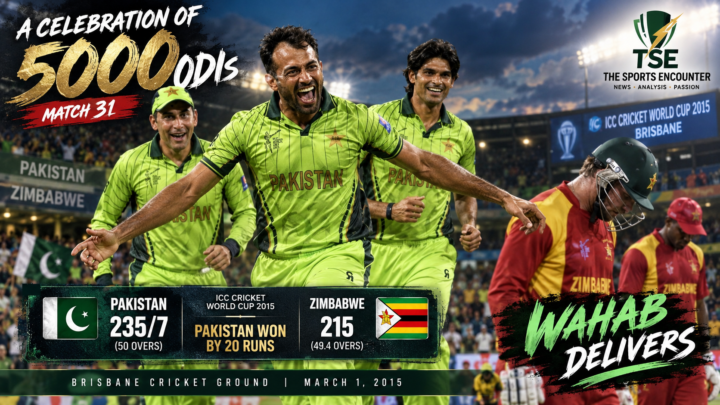
31. Pakistan vs Zimbabwe, 2015 World Cup

Why we picked it: Pakistan entered under severe pressure and managed only 235.

Zimbabwe remained in the chase long enough to make another Pakistan defeat feel dangerously possible before the bowlers secured a 20-run victory.

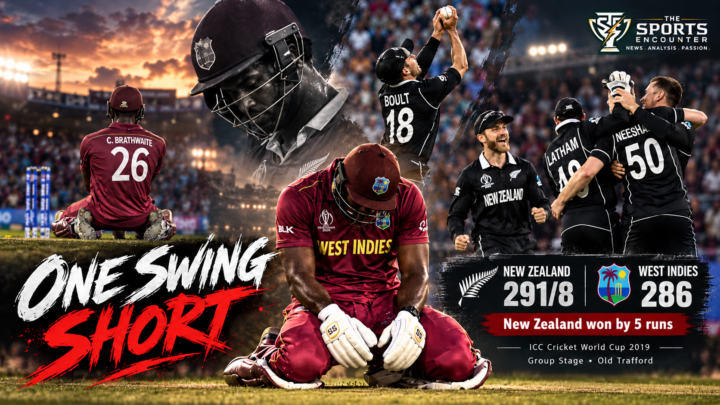
32. New Zealand vs West Indies, 2019 World Cup

Why we picked it: West Indies were 164 for 7 chasing 292.

Carlos Brathwaite then made 101 and brought his side within one boundary of an extraordinary victory.

Trent Boult caught him on the boundary.

New Zealand won by five runs.

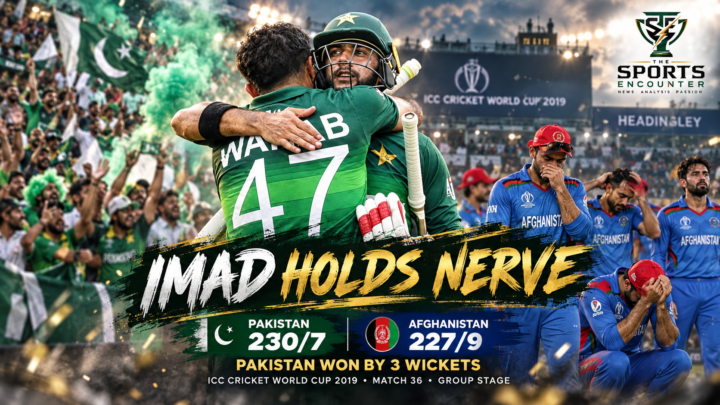
33. Pakistan vs Afghanistan, 2019 World Cup

Why we picked it: Pakistan’s World Cup hopes were hanging by a thread.

They needed 46 from the final five overs with four wickets remaining.

Imad Wasim held his nerve and Pakistan crossed the line with two balls to spare.

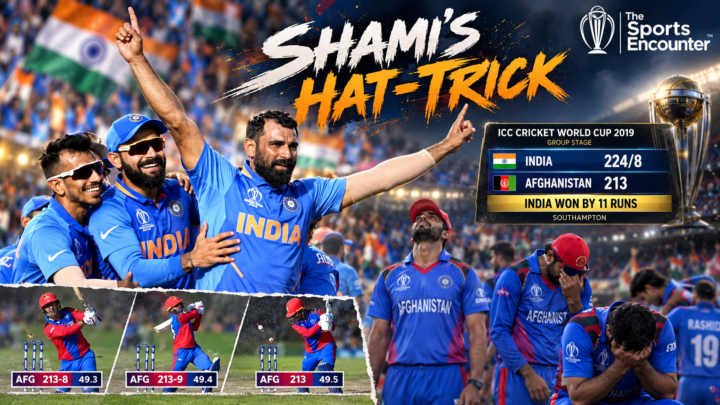
34. India vs Afghanistan, 2019 World Cup

Why we picked it: India managed only 224.

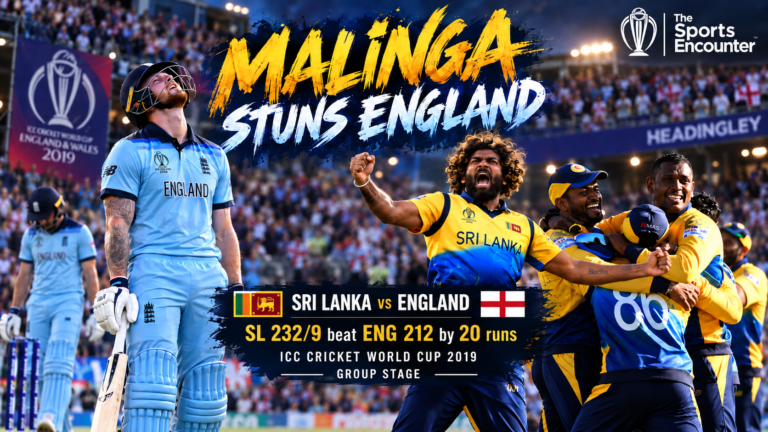
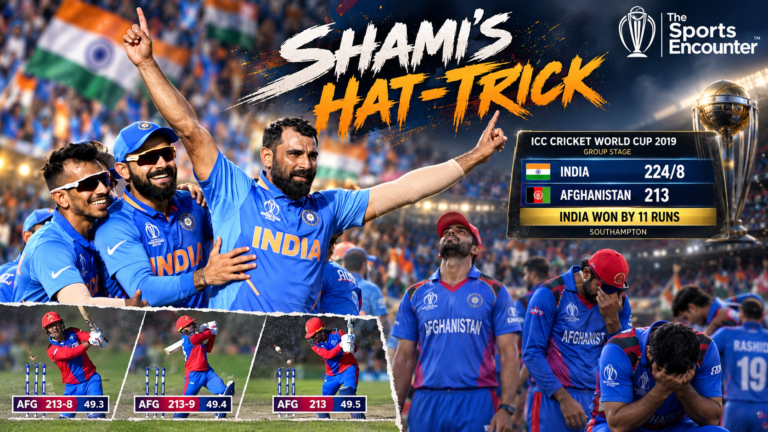
Afghanistan took the chase into the final over before Mohammed Shami completed a hat-trick and India escaped by 11 runs.

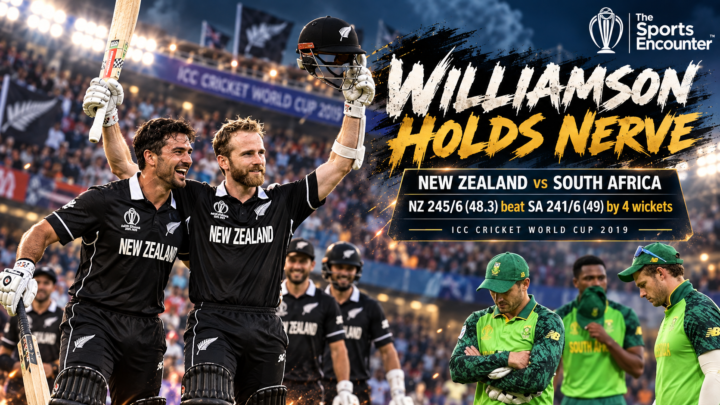
35. New Zealand vs South Africa, 2019 World Cup

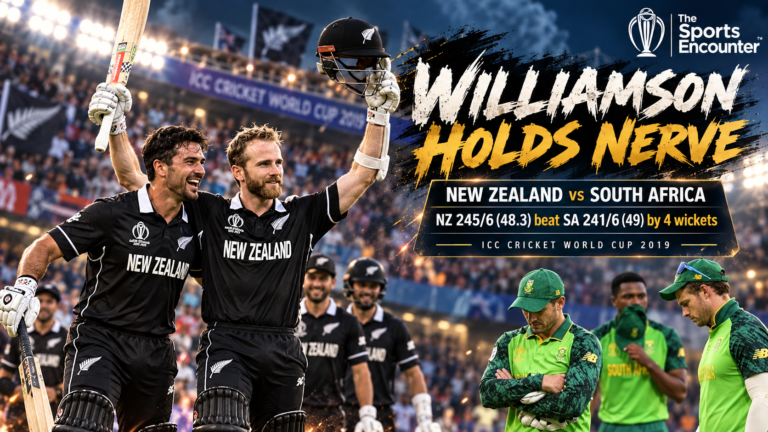
Why we picked it: Kane Williamson’s unbeaten century guided New Zealand through a chase that remained uncertain until the final over.

It was classic ODI pressure built slowly over several hours.

36. Sri Lanka vs England, 2019 World Cup

Why we picked it: Sri Lanka defended just 232 against the tournament favorites.

Lasith Malinga took four wickets and transformed the World Cup standings with one of the tournament’s biggest surprises.

37. Australia vs West Indies, 2019 World Cup

Why we picked it: Australia were 38 for 4.

Nathan Coulter-Nile, batting at No. 8, responded with 92 and helped lift Australia to 288.

West Indies remained dangerous before Australia completed a remarkable recovery win.

38. New Zealand vs India, 2019 World Cup Semifinal

Why we picked it: India collapsed to 5 for 3.

Later, Ravindra Jadeja and MS Dhoni revived a chase that had seemed completely dead.

New Zealand survived by 18 runs.

39. England vs New Zealand, 2019 World Cup Final

Why we picked it: Perhaps the strongest candidate for the most dramatic ODI ever played.

The match was tied.

The Super Over was tied.

England became world champions under the boundary-count rule.

ODI cricket has never produced another finish quite like it.

40. South Africa vs Pakistan, 2023 World Cup

Why we picked it: South Africa needed 21 runs with two wickets remaining and then lost another.

Keshav Maharaj and Tabraiz Shamsi survived Pakistan’s bowlers and completed a one-wicket escape.

41. Australia vs New Zealand, 2023 World Cup

Why we picked it: Australia scored 388.

New Zealand replied with 383.

After 771 runs, only five separated them.

42. Australia vs Afghanistan, 2023 World Cup

Why we picked it: Australia were 91 for 7 chasing 292.

Glenn Maxwell then produced an unbeaten 201 while struggling physically and barely able to run.

It stands among the most improbable ODI innings ever played.

43. Australia vs South Africa, 2023 World Cup Semifinal

Why we picked it: South Africa recovered from 24 for 4 to reach 212.

Australia then made a small chase look increasingly dangerous before Mitchell Starc and Pat Cummins finished a tense three-wicket victory.

44. Afghanistan vs England, 2023 World Cup

Why we picked it: The 69-run margin was not close, but the result was historically significant.

Afghanistan defeated the defending champions and announced themselves as a serious ODI force.

45. Pakistan vs New Zealand, 2023 World Cup

Why we picked it: New Zealand made 401.

Pakistan reached 200 for 1 after only 25.3 overs before rain ended the match.

Fakhar Zaman’s unbeaten 126 transformed an apparently impossible chase into a genuine possibility.

Multi-Nation Tournament Thrillers: Episodes 46–70

46. India vs Pakistan, 1986 Austral-Asia Cup Final

Why we picked it: Four needed from the final ball.

Javed Miandad facing Chetan Sharma.

Six over midwicket.

The finish became part of cricket folklore.

47. India vs Pakistan, 1998 Independence Cup Final

Why we picked it: India chased 315 in Dhaka, an enormous target for the era.

Hrishikesh Kanitkar struck the winning boundary with one ball remaining.

48. India vs Australia, 1998 Coca-Cola Cup, Sharjah

Why we picked it: India lost the match, yet Sachin Tendulkar’s 143 during the famous desert storm ensured qualification for the final.

It remains one of cricket’s strangest examples of a defeat feeling like victory.

49. India vs Australia, 1998 Coca-Cola Cup Final

Why we picked it: Tendulkar returned two days later and made 134 as India defeated Australia.

The final completed one of the greatest two-match batting sequences ODI cricket has seen.

50. India vs New Zealand, 2000 ICC KnockOut Final

Why we picked it: New Zealand were 132 for 5 chasing 265.

Chris Cairns produced an unbeaten century and delivered New Zealand its first major ICC title.

51. England vs India, 2002 NatWest Series Final

Why we picked it: India were 146 for 5 chasing 326.

Yuvraj Singh and Mohammad Kaif rebuilt the innings before Kaif carried India home with three balls remaining.

52. England vs West Indies, 2004 Champions Trophy Final

Why we picked it: West Indies were 147 for 8 chasing 218.

Courtney Browne and Ian Bradshaw then produced an unbeaten ninth-wicket partnership and somehow won the trophy.

53. India vs Pakistan, 2004 Champions Trophy

Why we picked it: Pakistan’s chase of 201 became increasingly tense as wickets fell.

Mohammad Yousuf helped guide them through a three-wicket victory.

54. England vs Australia, 2005 NatWest Series Final

Why we picked it: Australia scored 196.

England scored 196.

A tied final between the Ashes rivals provided an extraordinary prelude to one of cricket’s most memorable summers.

55. Pakistan vs India, 2010 Asia Cup

Why we picked it: India chased 268 in a match filled with confrontation and pressure.

Harbhajan Singh finished it with a six in the final over.

56. Pakistan vs India, 2012 Asia Cup

Why we picked it: Pakistan scored 329.

Virat Kohli responded with 183, one of the defining innings of his ODI career.

57. India vs Sri Lanka, 2012 Commonwealth Bank Series, Adelaide

Why we picked it: Sri Lanka made 236 for 9.

India finished 236 for 9.

Another ODI ended without either side able to create the final inch of separation.

58. India vs Sri Lanka, 2012 Commonwealth Bank Series, Hobart

Why we picked it: India effectively needed to chase 321 in around 40 overs to keep their finals hopes alive.

They completed it in 36.4 overs.

Virat Kohli finished unbeaten on 133.

59. England vs India, 2013 Champions Trophy Final

Why we picked it: Rain reduced the final to 20 overs per side.

England needed 20 from 16 balls with six wickets in hand.

India still won by five runs.

60. New Zealand vs Sri Lanka, 2013 Champions Trophy

Why we picked it: New Zealand needed only 139.

They staggered to 139 for 9.

What should have been routine became a one-wicket escape.

61. Pakistan vs India, 2014 Asia Cup

Why we picked it: Pakistan needed ten from four balls with one wicket left.

Shahid Afridi hit Ravichandran Ashwin for consecutive sixes.

Another India-Pakistan ODI entered folklore.

62. India vs Afghanistan, 2018 Asia Cup

Why we picked it: Afghanistan scored 252 for 8.

India were bowled out for exactly 252.

The tie became one of Afghanistan’s earliest signature performances against an elite ODI side.

63. Pakistan vs Afghanistan, 2018 Asia Cup

Why we picked it: Afghanistan pushed Pakistan deep into the final over before Shoaib Malik used all his experience to complete a three-wicket chase.

64. Sri Lanka vs Pakistan, 2023 Asia Cup

Why we picked it: A rain-reduced virtual semifinal came down to eight from the final over.

Sri Lanka needed two from the final ball.

Charith Asalanka got them.

65. India vs South Africa, 1993 Hero Cup Semifinal

Why we picked it: South Africa required six from the final over.

India unexpectedly handed the ball to Sachin Tendulkar.

He conceded only three.

India won by two runs.

66. India vs Pakistan, 1985 Rothmans Four-Nations Cup

Why we picked it: India were dismissed for only 125.

Pakistan still failed to chase it and were bowled out for 87.

Few games better demonstrate how pressure can make a tiny target feel enormous.

67. Pakistan vs Australia, 1990 Austral-Asia Cup Final

Why we picked it: Pakistan defended 266 as Wasim Akram completed a hat-trick and sealed another famous Sharjah triumph.

68. Pakistan vs India, 1991 Wills Trophy Final

Why we picked it: Aaqib Javed produced 7 for 37, including a hat-trick.

The margin was substantial, but one bowler overwhelming Pakistan’s greatest rival in a final made the match unforgettable.

69. Australia vs India, 2008 Commonwealth Bank Series Final, Brisbane

Why we picked it: India defended 258 and beat Australia by nine runs to secure the finals series.

Australia remained close enough throughout the chase for India to feel the pressure until the end.

70. Pakistan vs Sri Lanka, 2017 Champions Trophy

Why we picked it: Pakistan were 162 for 7 chasing 237 and appeared headed out of the tournament.

Sarfaraz Ahmed and Mohammad Amir then carried them home in an improbable three-wicket victory.

Bilateral Matches That Felt Bigger Than a Series: Episodes 71–100

71. South Africa vs Australia, Johannesburg, 2006

Why we picked it: Australia scored 434 for 4, then the highest ODI total ever.

South Africa chased 435 and won by one wicket with one ball remaining.

The match changed expectations about what was possible in ODI cricket.

72. New Zealand vs Australia, Christchurch, 2005

Why we picked it: Australia posted 331.

New Zealand survived a furious chase and won by two wickets, foreshadowing an era in which 300-plus targets would become increasingly vulnerable.

73. New Zealand vs Australia, Hamilton, 2007

Why we picked it: Australia made 346.

New Zealand reached 350 for 9 with three balls remaining.

Craig McMillan and Brendon McCullum helped produce another extraordinary one-wicket chase.

74. India vs Australia, Hyderabad, 2009

Why we picked it: Australia scored 350.

Sachin Tendulkar replied with 175.

India reached 347 before falling three runs short.

75. Australia vs Sri Lanka, Melbourne, 2010

Why we picked it: Sri Lanka were 107 for 8 chasing 240.

Angelo Mathews and Lasith Malinga added 132 for the ninth wicket.

Sri Lanka eventually won by one wicket.

76. Pakistan vs South Africa, Abu Dhabi, 2010

Why we picked it: Pakistan appeared beaten while chasing 287.

Abdul Razzaq then produced an extraordinary unbeaten 109 from 72 balls and finished a one-wicket victory.

77. Zimbabwe vs New Zealand, Bulawayo, 2011

Why we picked it: New Zealand scored 328 for 5.

Zimbabwe reached 329 for 9 with one ball remaining.

Malcolm Waller finished unbeaten on 99 in one of Zimbabwe’s greatest ODI chases.

78. West Indies vs India, Kingston, 2006

Why we picked it: India needed two from the final ball.

Dwayne Bravo produced a slower delivery that bowled Yuvraj Singh.

West Indies won by one run.

79. India vs West Indies, Visakhapatnam, 2018

Why we picked it: India made 321 for 6.

West Indies finished 321 for 7.

Shai Hope’s boundary from the final delivery created a tie.

80. England vs South Africa, Southampton, 2017

Why we picked it: South Africa needed seven from the final over chasing 331.

Mark Wood defended the target.

England won by two runs.

81. England vs Australia, Manchester, 2020, Third ODI

Why we picked it: Australia were 73 for 5 chasing 303.

Glenn Maxwell and Alex Carey both made centuries and completed the chase with two balls remaining.

82. England vs Australia, Manchester, 2020, Second ODI

Why we picked it: Australia were 144 for 2 chasing 232.

England appeared finished.

A spectacular collapse followed, and England won by 24 runs.

83. South Africa vs Pakistan, Port Elizabeth, 2013

Why we picked it: Pakistan defended 262 and won by one run, completing a historic bilateral series victory in South Africa.

84. Pakistan vs Zimbabwe, Rawalpindi, 2020

Why we picked it: Zimbabwe made 278 for 6.

Pakistan matched 278.

Zimbabwe then won the Super Over, extending an already dramatic ODI into another contest entirely.

85. Zimbabwe vs Pakistan, Harare, 2015

Why we picked it: Zimbabwe kept a rain-affected chase alive long enough to secure a narrow DLS victory at home against Pakistan.

86. Australia vs Pakistan, Melbourne, 2024

Why we picked it: Pakistan were bowled out for 203 and then reduced Australia to 155 for 7.

Pat Cummins eventually guided the hosts to a nervous two-wicket victory.

87. Afghanistan vs Pakistan, Hambantota, 2023

Why we picked it: Afghanistan scored 300 for 5.

Pakistan needed 11 from the final over with only two wickets remaining.

They won by one wicket with one ball left.

88. England vs Pakistan, Southampton, 2019

Why we picked it: England scored 373.

Pakistan replied with 361.

After 734 runs, just 12 separated the teams.

89. England vs Pakistan, Nottingham, 2019

Why we picked it: Pakistan made 340.

England stumbled during the chase before Ben Stokes and the lower order completed a three-wicket win with three balls remaining.

90. England vs India, The Oval, 2007

Why we picked it: India chased 317 in a match that swung repeatedly.

Robin Uthappa’s late improvisation completed a two-wicket victory and kept the series alive.

91. India vs Australia, Mohali, 2019

Why we picked it: India scored 358.

Australia responded with what was then their highest successful ODI chase, powered by Peter Handscomb and Ashton Turner.

92. South Africa vs Australia, Durban, 2016

Why we picked it: Australia made 371.

South Africa were 265 for 6.

David Miller’s unbeaten 118 then drove them to victory with four balls remaining.

93. India vs Sri Lanka, Rajkot, 2009

Why we picked it: India scored 414 for 7.

Sri Lanka replied with 411 for 8.

After 825 runs, India won by three.

94. Sri Lanka vs West Indies, Pallekele, 2020

Why we picked it: Sri Lanka made 307.

West Indies reached 301 for 9.

Six runs separated the teams after another final-over contest.

95. West Indies vs Zimbabwe, Providence, 2010

Why we picked it: Zimbabwe defended 254 and won by two runs, producing one of their finest ODI victories in the Caribbean.

96. Sri Lanka vs Zimbabwe, Hambantota, 2017

Why we picked it: Zimbabwe chased 204 in the deciding ODI and won by three wickets to secure a historic 3-2 series victory in Sri Lanka.

97. India vs Pakistan, Ahmedabad, 2005

Why we picked it: Pakistan needed three from the final ball.

Inzamam-ul-Haq found the boundary and completed a three-wicket victory.

98. India vs Pakistan, Karachi, 2004

Why we picked it: India posted 349 for 7.

Pakistan replied with 344 for 8.

The opening match of one of the most anticipated tours in cricket history was decided by five runs.

99. Australia vs Pakistan, Perth, 2010

Why we picked it: Pakistan pushed Australia deep into the final over before the hosts completed a two-wicket victory with four deliveries remaining.

100. India vs England, Pune, 2017

Why we picked it: England scored 350.

India collapsed to 63 for 4.

Virat Kohli and Kedar Jadhav then added 200 and turned a seemingly doomed chase into a three-wicket victory.

This Series Is About More Than Close Scores

Looking across these 100 matches reveals something important about ODI cricket.

The format has never relied on one type of drama.

Sometimes excitement comes from abundance.

Australia make 434, and South Africa chase 435.

India score 414 and almost watch Sri Lanka chase it.

New Zealand concede 388 at a World Cup and answer with 383.

Other times, scarcity creates the pressure.

India defend 183 in a World Cup final.

Zimbabwe score 134 against England and still win.

Australia set New Zealand a target that should be straightforward, only for Mitchell Starc to turn 152 into something resembling a mountain.

That range helps explain why ODI cricket has survived repeated predictions of decline.

The format gives a match enough time to change character.

A batter can begin cautiously, absorb pressure and accelerate later. A team can be seven wickets down and still construct a match-winning partnership. A bowler can disappear during the opening spell and return at the death to decide everything.

Twenty20 cricket compresses pressure.

Test cricket stretches it across days.

ODI cricket occupies the fascinating territory between them.

How ODI Cricket Changed on the Road to 5000

These articles will highlight how the format evolved statistically across 55 years, particularly through six-hitting, centuries, five-wicket hauls and the changing geography of the game.

Our list reveals that evolution in another way.

Many older classics revolved around totals below 250.

Modern thrillers increasingly involve 300, 350 and occasionally 400.

Batting expectations have expanded dramatically. Our recent look at six consecutive sixes and cricket’s rarest power-hitting feats shows how dramatically the boundaries of attacking cricket have shifted.

Bowling has changed with it.

Modern ODI bowlers operate in a world where 300 can sometimes feel ordinary. Fielding restrictions, equipment, surfaces, boundary dimensions and tactical thinking have all evolved.

That also changes how careers should be evaluated.

A batter’s strike rate from 1985 cannot simply be placed beside a modern figure without context. Economy rates require the same care.

Each episode of A Celebration of 5000 ODIs will therefore reconstruct its match within the conditions and expectations of its own era.

Why These Ten Teams?

This collection is curated rather than encyclopedic.

Australia, India, Pakistan, West Indies, England, South Africa, Sri Lanka and New Zealand account for an enormous share of ODI cricket’s major tournament history.

Zimbabwe bring one of the format’s great underdog traditions.

Afghanistan represent its newest compelling chapter.

Pakistan inevitably feature heavily because volatility has long been part of their ODI identity. Few sides have produced so many matches where victory and collapse seemed equally plausible within the same ten overs.

Australia bring tournament authority.

India bring enormous cultural weight.

West Indies connect the project directly to ODI cricket’s early history.

Sri Lanka repeatedly challenged tactical convention.

South Africa supplied extraordinary brilliance alongside some of the game’s most painful finishes.

New Zealand turned resourcefulness into an art.

England eventually reinvented their entire white-ball philosophy.

Zimbabwe repeatedly reminded stronger teams that reputation guarantees nothing.

Afghanistan are still writing their history, and their recent World Cup performances suggest several future episodes may eventually join this collection.

What Every Episode Will Explore

We have no interest in publishing 100 recycled scorecard summaries.

Every installment will ask a more important question:

Why does this match still matter?

Each episode will reconstruct the match situation, identify the moment where probability shifted, examine the central individual performances and analyze the decisions that shaped the result.

Where appropriate, episodes will include:

  • Full match and tournament context
  • Score progression
  • Major turning points
  • The decisive innings or bowling spell
  • Captaincy and tactical decisions
  • Final-over or final-wicket reconstruction
  • Historical statistical context
  • Where the major players were in their careers
  • What the result changed for both teams
  • Contemporary reaction
  • How the match’s reputation has evolved with time

Some episodes will celebrate genius.

Others will examine panic, missed chances, tactical errors and collapses.

That variety is part of ODI cricket’s appeal.

Which Match Should Open the Series?

There are several compelling candidates.

The 2019 World Cup final between England and New Zealand may be impossible to beat for competitive absurdity.

The 1999 Australia-South Africa semifinal remains the definitive World Cup collapse under knockout pressure.

South Africa’s 435 chase against Australia in Johannesburg changed expectations about what could be achieved in 50 overs.

Javed Miandad’s last-ball six against India in Sharjah needs only one delivery to explain why generations still remember it.

Glenn Maxwell’s unbeaten 201 against Afghanistan represents a completely different form of drama, where physical survival and mathematical improbability collided.

Then there are matches whose scorecards become far more extraordinary once viewed through their era.

India defending 183 in 1983.

Zimbabwe defending 134 against England in 1992.

West Indies surviving from 203 for 9 against Pakistan in 1975.

That is why this project is called A Celebration of 5000 ODIs rather than simply a ranking of the 100 greatest matches.

Greatness can be argued forever.

Thrill is more personal.

Every match in this collection shares one quality: at some point, it gave spectators a reason to believe the result could still change after logic suggested otherwise.

The Next 100 Episodes Begin Here

Five thousand men’s ODIs represent more than five decades of experimentation, reinvention, power hitting, reverse swing, middle-overs chess, collapses, impossible chases and final-over panic.

The statistics explain how the format evolved.

Our series will concentrate on something statistics struggle to preserve:

what it felt like when the match turned.

Over the next 100 episodes, The Sports Encounter will return to these games one at a time.

Some will be instantly familiar.

Others deserve to be rediscovered.

Together, they will tell the story of why, after 5000 men’s One-Day Internationals, ODI cricket still owns a type of sporting drama entirely its own.

Welcome to A Celebration of 5000 ODIs.

Hamad Hussain is the Dubai-based Founder and Senior Editor of The Sports Encounter, where he leads editorial direction, coverage standards, and the publication’s reader-first approach to sports journalism. His primary focus is cricket, with additional work across sports opinion, athlete performance, team selection, match analysis, tournament developments, and major international sporting stories. Hamad brings more than 22 years of leadership experience across corporate governance, operations, finance, HR, administration, and business development. That background shapes a structured, decision-focused approach to sports analysis, particularly when examining team strategy, selection calls, leadership, performance trends, and the wider consequences of results. Before taking on his current editorial leadership role, Hamad worked with The Sports Encounter as a Sports Analyst from 2010 to 2015. Today, his writing combines fan perspective with statistical context, historical comparison, and practical analysis of the decisions that shape teams, players, and competitions.

A Celebration of 5000 ODIs

A Celebration of 5000 ODIs Match 17: Inzamam and Wasim Deny Australia in a Headingley Thriller

Inzamam-ul-Haq rebuilt Pakistan’s innings before Wasim Akram and Saqlain Mushtaq stopped Michael Bevan’s pursuit, sealing a tense 10-run World Cup victory at Headingley.

Hamad Hussain | The Sports Encounter

Published

on

A Celebration of 5000 ODIs Match 17: Inzamam and Wasim Deny Australia in a Headingley Thriller

Australia still needed 62 runs when Michael Bevan watched Steve Waugh’s off stump fly out of the ground. The target remained possible, but Pakistan had released Shoaib Akhtar at precisely the moment when the chase appeared ready to turn.

Bevan carried on. Australia reached 265 with seven deliveries available, leaving 11 runs between Pakistan and a victory that had repeatedly threatened to escape.

Wasim Akram settled the argument himself. Damien Martyn fell to the fourth ball of the final over, and Glenn McGrath lost his stumps two deliveries later. Pakistan had defended 275 by 10 runs after a contest shaped by recoveries, counterattacks and a constant sense that either team could seize control.

The tension and quality on both sides explain why Pakistan versus Australia at Headingley is Match 17 in A Celebration of 5000 ODIs.

TL;DR

  • Pakistan beat Australia by 10 runs in their 1999 World Cup group match at Headingley.
  • Inzamam-ul-Haq scored 81 after Pakistan slipped to 46/3 and earned Player of the Match.
  • Abdul Razzaq supported Inzamam with 60 in a match-defining 118-run partnership.
  • Moin Khan’s 31 from 12 balls lifted Pakistan to 275/8.
  • Michael Bevan made 61 and kept Australia alive deep into the final over.
  • Wasim Akram finished with 4/40, including the final two wickets.

Pakistan vs Australia 1999 World Cup Match Information

DetailInformation
MatchPakistan vs Australia, 16th match, Group B
Tournament1999 ICC Cricket World Cup
DateMay 23, 1999
VenueHeadingley, Leeds
TossAustralia won the toss and fielded
Pakistan275/8 in 50 overs
Australia265 all out in 49.5 overs
ResultPakistan won by 10 runs
Player of the MatchInzamam-ul-Haq, 81 from 104 balls
Best bowlingWasim Akram, 4/40
Turning pointAustralia fell from 214/4 to 251/8
Tournament impactPakistan strengthened its Group B position; Australia slipped to a second defeat

The ICC’s World Cup history of Headingley also identifies Inzamam and Razzaq’s recovery as the foundation of Pakistan’s victory.

Complete Match Scorecard

Pakistan Batting

BatterDismissalRunsBalls4s6s
Wajahatullah Wastic Steve Waugh b McGrath93110
Saeed Anwarc Gilchrist b Reiffel252350
Abdul Razzaqc Fleming b Warne609931
Ijaz Ahmedlbw b Fleming0600
Inzamam-ul-Haqrun out (Fleming)8110461
Yousuf Youhanarun out (Warne/Lehmann)291641
Wasim Akramc Gilchrist b Fleming131210
Moin Khannot out311223
Azhar Mahmoodrun out (Martyn/McGrath)1100
Saqlain Mushtaqnot out0000
Shoaib Akhtardid not bat
Extras1 bye, 5 leg byes, 15 wides, 5 no-balls26
Total8 wickets, 50 overs275

Fall of wickets: 32/1, 44/2, 46/3, 164/4, 216/5, 230/6, 262/7, 265/8.

Australia Bowling

BowlerOversMaidensRunsWickets
Damien Fleming103372
Paul Reiffel101491
Glenn McGrath101541
Shane Warne100501
Steve Waugh60370
Damien Martyn20250
Darren Lehmann20170

Australia Batting

BatterDismissalRunsBalls4s6s
Adam Gilchristb Wasim Akram0300
Mark Waughc Moin Khan b Razzaq414960
Ricky Pontingc Saeed Anwar b Saqlain476070
Darren Lehmannc Moin Khan b Saqlain5910
Steve Waughb Shoaib Akhtar496521
Michael Bevanc Ijaz Ahmed b Wasim Akram618031
Damien Martynb Wasim Akram182500
Shane Warnerun out (Ijaz Ahmed)1600
Paul Reiffelc Wasim Akram b Saqlain1400
Damien Flemingnot out4300
Glenn McGrathb Wasim Akram0200
Extras7 byes, 10 leg byes, 14 wides, 7 no-balls38
TotalAll out, 49.5 overs265

Fall of wickets: 0/1, 91/2, 100/3, 101/4, 214/5, 238/6, 248/7, 251/8, 265/9, 265/10.

Pakistan Bowling

BowlerOversMaidensRunsWickets
Wasim Akram9.51404
Shoaib Akhtar100461
Azhar Mahmood100610
Saqlain Mushtaq101513
Abdul Razzaq100501

Inzamam-ul-Haq Rebuilds Pakistan From 46/3

Pakistan’s innings threatened to unravel when Ijaz Ahmed’s dismissal left the score at 46/3. Australia had removed both openers and found enough movement to challenge every new batter.

Inzamam responded with patience rather than panic. He absorbed pressure, picked off loose deliveries and allowed Pakistan to rebuild without letting the required acceleration disappear from view.

His partnership with Razzaq added 118 for the fourth wicket. Inzamam eventually scored 81 from 104 balls, with six fours and a six. It was the highest score of the match and earned him the Player of the Match award.

He later described the 81 as his best World Cup score while reflecting on Pakistan’s 1999 campaign for the ICC.

Abdul Razzaq Gives Pakistan the Stability It Needed

Razzaq was only 19, yet he handled Australia’s experienced attack with striking maturity.

His 60 from 99 deliveries gave Inzamam a reliable partner during the innings’ most vulnerable phase. The scoring rate remained measured, but Pakistan could afford that restraint because both batters preserved wickets for the final assault.

Razzaq also removed Mark Waugh after Australia had recovered from Gilchrist’s first-over duck. That all-around contribution made him one of the match’s most valuable performers.

Moin Khan Changes the Value of Pakistan’s Total

Pakistan reached 230/6 with 22 deliveries remaining. A finish around 255 would have given Australia a far less demanding chase.

Moin Khan transformed the equation.

The wicketkeeper struck three sixes and two fours in an unbeaten 31 from 12 balls. Pakistan collected 45 from the final 22 deliveries, turning a respectable innings into a total capable of surviving Bevan’s expertise.

His late acceleration was the difference between making Australia uncomfortable and forcing them to chase aggressively until the final over.

Michael Bevan Brings Australia Back From 101/4

Australia’s reply began with Wasim bowling Gilchrist for a duck. Mark Waugh and Ponting repaired the damage, but Saqlain removed Ponting and Lehmann in the space of three deliveries.

At 101/4, Australia needed another recovery.

Steve Waugh and Bevan provided it through a 113-run fifth-wicket stand. Bevan controlled the required rate while Waugh worked through a demanding spell from Pakistan’s fast bowlers.

The partnership carried Australia to 214/4. With 62 required from 51 balls and six wickets available, the chase had tilted toward the batting side.

Wasim Akram and Saqlain Mushtaq Close the Door

Shoaib’s dismissal of Steve Waugh for 49 reopened the contest. Wasim then removed Bevan for 61, denying Australia the specialist finisher they wanted at the crease for the final overs.

Saqlain’s contribution was equally important. His 3/51 included Ponting, Lehmann and Reiffel, while Warne’s run-out intensified Australia’s late collapse.

Martyn took the chase to the final over, but Wasim retained control. Two wickets in three balls gave the Pakistan captain figures of 4/40 and completed the 10-run victory.

Pakistan and Australia Performance Analysis

Pakistan won because its players answered each setback with the right type of response. Inzamam and Razzaq repaired the top-order damage. Moin supplied the acceleration. Wasim and Saqlain then attacked when Australia’s chase entered its decisive phase.

Australia’s bowlers performed well early and Fleming conceded only 37 from his 10 overs. However, the fifth and sixth options proved expensive, while Moin’s closing assault added runs that became increasingly significant.

The batting effort contained three substantial partnerships, but Australia repeatedly lost wickets in clusters. The collapse from 214/4 to 251/8 left Martyn with too much responsibility and too little support.

Why Match 17 Belongs in the Celebration

A 10-run finish would already merit attention. The deeper value lies in how many times control changed hands.

Pakistan recovered from 46/3. Australia rebuilt from 101/4. Bevan and Waugh appeared to have positioned the chase for a composed finish before Pakistan’s attack struck again.

The result also created an intriguing contrast with the teams’ next meeting. Pakistan reached the Lord’s final, where Australia reversed the outcome emphatically to become world champion.

That wider journey connects Match 17 with Pakistan’s 1987 semifinal defeat to Australia, Inzamam’s breakthrough in the 1992 semifinal and Australia’s extraordinary 1999 semifinal escape.

Readers can also revisit Steve Waugh’s Headingley rescue against South Africa and Henry Olonga’s late intervention against India.

Every installment is available through the A Celebration of 5000 ODIs collection, alongside wider reporting and analysis in The Sports Encounter’s cricket coverage hub.

Final Takeaway

Headingley offered an early look at two teams whose paths would converge again at Lord’s. On this afternoon, Pakistan possessed the stronger middle-order recovery, the more destructive late surge and the bowlers capable of surviving Bevan’s challenge.

Inzamam built the victory. Moin enlarged it. Wasim finished it.

Continue Reading

A Celebration of 5000 ODIs

A Celebration of 5000 ODIs Match 16: Olonga Takes Three Wickets as India Fall Three Runs Short

India needed nine runs from two overs with three wickets remaining. Henry Olonga then delivered six balls that transformed Zimbabwe’s World Cup campaign.

Hamad Hussain | The Sports Encounter

Published

on

A Celebration of 5000 ODIs Match 16: Olonga Takes Three Wickets as India Fall Three Runs Short

India needed nine runs from 12 balls. Robin Singh had survived the repair work, Javagal Srinath had already struck two sixes, and Zimbabwe were turning to a bowler who had struggled to control the ball earlier in the chase.

Henry Olonga had conceded six wides across three overs. His return for the 45th carried obvious risk. India held three wickets and still had another over available.

Six deliveries later, the match was over.

Olonga removed Robin, bowled Srinath and trapped Venkatesh Prasad lbw. India were dismissed for 249, three runs short of Zimbabwe’s 252/9, with six balls of their reduced allocation unused.

The ending alone earns this contest a place in A Celebration of 5000 ODIs. The path toward it adds several more reasons: 90 overs of fluctuating control, 90 extras, India’s costly slow-over-rate penalty, the absence of Sachin Tendulkar, and a match-winning performance from Grant Flower that extended far beyond the final score.

TL;DR

  • Zimbabwe beat India by three runs at Grace Road during the 1999 World Cup.
  • Andy Flower anchored Zimbabwe’s innings with 68 not out from 85 balls.
  • Grant Flower made 45 and conceded only 33 runs from 10 overs to earn Player of the Match.
  • India’s slow over rate reduced its chase from 50 overs to 46.
  • Sadagoppan Ramesh top-scored for India with 55, while Ajay Jadeja made 43.
  • Henry Olonga took three wickets in the 45th over to end India’s chase at 249.

Zimbabwe vs India 1999 World Cup: Match Information

DetailInformation
MatchIndia vs Zimbabwe, Group A
Tournament1999 Cricket World Cup
DateMay 19, 1999
VenueGrace Road, Leicester
TossIndia won the toss and fielded
Zimbabwe252/9 in 50 overs
India249 all out in 45 overs
ResultZimbabwe won by three runs
Player of the MatchGrant Flower, 45 and 1/33
Zimbabwe’s top scorerAndy Flower, 68 not out
India’s top scorerSadagoppan Ramesh, 55
Best bowling figuresHeath Streak, 3/36; Henry Olonga, 3/22
Turning pointOlonga took three wickets in the 45th over
Tournament impactZimbabwe earned its second win; India suffered a second consecutive defeat

Complete Match Scorecard

Zimbabwe Innings: 252/9 in 50 Overs

BatterDismissalRunsBalls4s6s
Neil Johnsonc Mongia b Srinath71010
Grant Flowerc Mongia b Jadeja458940
Paul Strangb Agarkar182610
Murray Goodwinc Robin Singh b Ganguly174030
Andy FlowerNot out688520
Alistair Campbellst Mongia b Kumble242930
Guy Whittallb Kumble4800
Stuart Carlisleb Srinath1200
Heath Streakc Mongia b Prasad141820
Eddo Brandesc Mongia b Prasad2500
Henry OlongaNot out1400
Extras14 leg byes, 21 wides, 16 no-balls51
TotalNine wickets in 50 overs252

Fall of wickets: 12/1, 45/2, 87/3, 144/4, 204/5, 211/6, 214/7, 244/8, 250/9.

India Bowling

BowlerOversMaidensRunsWickets
Javagal Srinath101352
Venkatesh Prasad101372
Ajit Agarkar90701
Sourav Ganguly50221
Robin Singh20110
Anil Kumble100412
Ajay Jadeja40221

India Innings: 249 All Out in 45 Overs

BatterDismissalRunsBalls4s6s
Sourav Gangulyc Brandes b Johnson9820
Sadagoppan Rameshc Goodwin b Grant Flower557731
Rahul Dravidc Grant Flower b Streak131420
Mohammad Azharuddinc Campbell b Streak71110
Ajay Jadejalbw b Streak437630
Robin Singhc Campbell b Olonga354710
Ajit AgarkarRun out (Goodwin)1500
Nayan Mongiab Whittall282421
Javagal Srinathb Olonga181202
Anil KumbleNot out1100
Venkatesh Prasadlbw b Olonga0100
Extras1 bye, 4 leg byes, 24 wides, 10 no-balls39
TotalAll out in 45 overs249

Fall of wickets: 13/1, 44/2, 56/3, 155/4, 174/5, 175/6, 219/7, 246/8, 249/9, 249/10.

Zimbabwe Bowling

BowlerOversMaidensRunsWickets
Eddo Brandes30270
Neil Johnson70511
Heath Streak90363
Henry Olonga40223
Guy Whittall40261
Paul Strang80490
Grant Flower100331

India’s 51 Extras Change the Shape of the Match

Zimbabwe’s recognized batters scored only 200 runs between them. India supplied the remaining 51 through 21 wides, 16 no-balls and 14 leg byes.

Ajit Agarkar conceded 70 from nine overs, including five no-balls and four wides. Srinath bowled five no-balls, while almost every frontline option contributed to the extras column.

Those mistakes also slowed the innings. Match officials penalized India four overs for its slow over rate, leaving the team 46 overs to chase 253. In a match decided by three runs, the missing 24 deliveries became impossible to ignore.

Andy Flower Holds Zimbabwe Together

Zimbabwe reached 87/3 before Andy Flower began building the innings around control and placement.

Grant Flower’s 45 had occupied India’s bowlers for 89 deliveries, but his dismissal left Zimbabwe 144/4. Andy then added 60 with captain Alistair Campbell, who contributed 24 from 29 balls.

Three wickets fell for 10 runs after Campbell departed. Andy stayed unbeaten, pushed the total beyond 250 and finished with 68 from 85 balls.

His innings continued a remarkable family contribution to Zimbabwe cricket. The ICC’s history of Zimbabwe’s cricketing brothers identifies the Flower siblings as central figures in the country’s strongest World Cup campaign.

Grant Flower Delivers the Complete Match

Grant’s 45 was slower than Andy’s unbeaten innings, but it gave Zimbabwe stability after Neil Johnson and Paul Strang fell inside the first 10 overs.

His greater influence emerged during India’s chase.

Ramesh and Jadeja had rebuilt from 56/3 with a 99-run fourth-wicket partnership. Grant ended it by dismissing Ramesh for 55, then completed his 10 overs for only 33 runs.

That economy mattered in a chase requiring more than five runs per over. His combined batting and bowling contribution earned him Player of the Match, even though Olonga produced the unforgettable finish.

Heath Streak Breaks India’s Top Order

India played without Sachin Tendulkar, who had returned home following his father’s death. His absence placed greater pressure on Ganguly, Dravid and captain Azharuddin.

All three were gone by the ninth over.

Neil Johnson dismissed Ganguly before Heath Streak removed Dravid and Azharuddin. Streak later trapped Jadeja lbw for 43, finishing with 3/36 from nine overs.

India had recovered from 56/3 to 155/3, but Streak’s third wicket prevented Jadeja from carrying the chase into its closing phase.

Tendulkar returned in India’s next game and scored an emotional unbeaten 140 against Kenya, an innings documented in the ICC’s account of his finest World Cup performances.

Ramesh, Robin and Srinath Take India Within Reach

Ramesh’s 55 gave India its first substantial innings. Jadeja supported him with 43, but their dismissals and Agarkar’s run-out left India 175/6.

Robin Singh then rebuilt with Mongia. After Mongia fell for 28, Srinath attacked, striking two sixes in his 12-ball 18.

India moved to 246/7 and needed seven runs from 10 deliveries. Zimbabwe appeared to have lost control despite repeatedly creating winning positions.

Campbell brought Olonga back.

Henry Olonga Wins the Match in Five Balls

Olonga’s second delivery removed Robin for 35, with Campbell completing the catch.

Srinath survived two more balls before Olonga bowled him with the fifth delivery. Prasad faced the last ball and was trapped lbw for a duck.

Olonga had taken three wickets in five balls. His final figures read 3/22 from four overs, an extraordinary return considering the six wides he had delivered earlier.

The ICC ranks Zimbabwe’s victory among the greatest World Cup upsets, while its review of Zimbabwe’s classic World Cup matches highlights Olonga’s ability to recover from his earlier problems and attack India’s final three wickets.

Why Match 16 Belongs in A Celebration of 5000 ODIs

This match asked both teams to recover repeatedly.

Zimbabwe survived early wickets, India’s middle order rebuilt from 56/3, and Robin and Srinath brought the chase back after it slipped to 175/6. Olonga then turned a likely defeat into victory within one over.

The three-run margin connects the game with Zimbabwe’s earlier World Cup surprises, including Eddo Brandes defending 134 against England in Match 10. It also provides a very different counterpoint to Kapil Dev’s rescue against Zimbabwe in 1983.

The contest followed the two Australia-South Africa classics from the same tournament: Steve Waugh’s survival at Headingley and the tied semifinal at Edgbaston.

Readers can explore every published installment through the A Celebration of 5000 ODIs collection and follow wider historical and current reporting through The Sports Encounter’s cricket coverage hub.

What Happened Next

Zimbabwe later defeated South Africa and reached the Super Six stage for the first time. India recovered to win its next three group matches, but the points carried forward from this defeat damaged its position in the following round.

Grace Road produced the result through accumulated mistakes and small interventions rather than a dominant century or five-wicket haul. India conceded 51 extras, lost four overs and still reached the final nine runs with three wickets available.

Olonga needed one over to make every earlier detail decisive.

Continue Reading

A Celebration of 5000 ODIs

A Celebration of 5000 ODIs Match 15: One Run, Two Stranded Batters and South Africa’s World Cup Collapse

Lance Klusener carried South Africa within one run of the 1999 World Cup final before confusion with Allan Donald completed cricket’s most painful tie.

Hamad Hussain | The Sports Encounter

Published

on

A Celebration of 5000 ODIs Match 15: One Run, Two Stranded Batters and South Africa’s World Cup Collapse

Lance Klusener had already struck the first two balls of the final over for four. The scores were level, South Africa had four deliveries left, and Australia appeared to have exhausted every escape route.

Then time seemed to slow down at Edgbaston.

Klusener drove Damien Fleming’s fourth delivery toward mid-off and ran. Allan Donald remained at the non-striker’s end, watching the ball instead of his partner. By the time Donald reacted, Klusener had reached the same end and Australia had transferred the ball to Adam Gilchrist.

The wicketkeeper broke the stumps. Donald dropped his bat. South Africa’s World Cup ended with both batters stranded at the wrong end and one winning run still unclaimed.

Australia and South Africa had scored 213 each, but the tie sent Australia into the final because they had finished higher in the Super Six standings. That combination of pressure, confusion and irreversible consequence makes the 1999 semifinal an essential part of A Celebration of 5000 ODIs.

TL;DR

  • Australia and South Africa tied after both teams were dismissed for 213.
  • Australia advanced to the World Cup final because they finished higher in the Super Six table.
  • Michael Bevan scored 65 and Steve Waugh made 56 after Australia slipped to 68/4.
  • Shaun Pollock took 5/36, while Allan Donald claimed 4/32.
  • Shane Warne earned Player of the Match honors after taking 4/29.
  • Lance Klusener struck 31 not out from 16 balls before Allan Donald was run out with the scores level.

Australia vs South Africa 1999 Semifinal: Match Information

DetailInformation
MatchAustralia vs South Africa, second semifinal
Tournament1999 Cricket World Cup
DateJune 17, 1999
VenueEdgbaston, Birmingham
TossSouth Africa won the toss and fielded
Australia213 all out in 49.2 overs
South Africa213 all out in 49.4 overs
ResultMatch tied; Australia advanced
Player of the MatchShane Warne, 4/29
Top Australia batterMichael Bevan, 65
Top South Africa batterJacques Kallis, 53
Best bowling figuresShaun Pollock, 5/36
Turning pointKlusener and Donald’s run-out with the scores level
Tournament impactAustralia advanced to face Pakistan in the final

The official ICC review of the 1999 World Cup confirms that Australia progressed because of its higher Super Six position.

Complete Match Scorecard

Australia Innings: 213 All Out in 49.2 Overs

BatterDismissalRunsBalls4s6s
Adam Gilchristc Donald b Kallis203911
Mark Waughc Boucher b Pollock0400
Ricky Pontingc Kirsten b Donald374831
Darren Lehmannc Boucher b Donald1400
Steve Waughc Boucher b Pollock567661
Michael Bevanc Boucher b Pollock6510160
Tom Moodylbw b Pollock0300
Shane Warnec Cronje b Pollock182410
Paul Reiffelb Donald0100
Damien Flemingb Donald0200
Glenn McGrathNot out0100
Extras1 bye, 6 leg byes, 3 wides, 6 no-balls16
TotalAll out in 49.2 overs213

Fall of wickets: 3/1, 54/2, 58/3, 68/4, 158/5, 158/6, 207/7, 207/8, 207/9, 213/10.

South Africa Bowling

BowlerOversMaidensRunsWickets
Shaun Pollock9.21365
Steve Elworthy100590
Jacques Kallis102271
Allan Donald101324
Lance Klusener91500
Hansie Cronje1020

South Africa Innings: 213 All Out in 49.4 Overs

BatterDismissalRunsBalls4s6s
Gary Kirstenb Warne184210
Herschelle Gibbsb Warne303660
Daryll CullinanRun out (Bevan)63000
Hansie Cronjec Mark Waugh b Warne0200
Jacques Kallisc Steve Waugh b Warne539230
Jonty Rhodesc Bevan b Reiffel435521
Shaun Pollockb Fleming201411
Lance KlusenerNot out311641
Mark Boucherb McGrath51000
Steve ElworthyRun out (Reiffel/McGrath)1100
Allan DonaldRun out (Mark Waugh/Fleming/Gilchrist)0000
Extras1 leg bye, 5 wides6
TotalAll out in 49.4 overs213

Fall of wickets: 48/1, 53/2, 53/3, 61/4, 145/5, 175/6, 183/7, 196/8, 198/9, 213/10.

Australia Bowling

BowlerOversMaidensRunsWickets
Glenn McGrath100511
Damien Fleming8.41401
Paul Reiffel80281
Shane Warne104294
Mark Waugh80370
Tom Moody50270

The figures and dismissals have been checked against the archived ESPNcricinfo scorecard.

Michael Bevan and Steve Waugh Rescue Australia

South Africa’s attack created the first crisis of the semifinal.

Mark Waugh fell for a duck, while Donald removed Ricky Ponting and Darren Lehmann. Kallis dismissed Gilchrist to leave Australia 68/4.

Steve Waugh and Michael Bevan responded with a 90-run partnership. Their approach suited the conditions: cautious against Donald and Pollock, selective against the supporting bowlers, and willing to preserve wickets while rebuilding the innings.

Waugh made 56 from 76 balls before Pollock removed him. Bevan remained until the final delivery of the innings, scoring 65 from 101 balls. Those runs gave Warne and Australia’s seamers a total they could defend.

The innings continued Australia’s survival story from Match 14, when Waugh’s unbeaten 120 kept their World Cup alive against South Africa.

Shaun Pollock and Allan Donald Take Nine Wickets

Pollock and Donald gave South Africa almost complete control of Australia’s innings.

Pollock claimed 5/36, dismissing both Waugh and Bevan while also removing Mark Waugh, Moody and Warne. Donald’s pace brought him 4/32, including three wickets during Australia’s two major collapses.

Australia fell from 158/4 to 158/6 and later from 207/6 to 207/9. South Africa’s bowlers had done enough to make 214 appear manageable, but their batters would face an equally influential spell.

Shane Warne Changes the Semifinal in Eight Deliveries

South Africa reached 48 without loss. Gibbs had struck six boundaries and appeared ready to continue the form that brought him a century against Australia four days earlier.

Warne bowled him for 30.

Eight deliveries later, South Africa were 53/3. Warne had also bowled Kirsten and removed Cronje for a duck. The chase that had begun with confidence suddenly required reconstruction.

Warne later dismissed Kallis for 53, completing figures of 4/29 with four maidens. His ability to attack while suppressing runs earned him Player of the Match and recalled his earlier knockout intervention in Australia’s 1996 semifinal escape against West Indies.

Jacques Kallis and Jonty Rhodes Rebuild the Chase

Kallis absorbed the pressure created by Warne and gradually repaired South Africa’s innings. Jonty Rhodes then brought urgency, making 43 from 55 balls during an 84-run fifth-wicket partnership.

Their stand lifted South Africa from 61/4 to 145/4.

Reiffel removed Rhodes before Warne claimed Kallis. Pollock’s 20 from 14 balls kept the chase moving, but another series of wickets left South Africa at 198/9.

Only Klusener and Donald remained.

Lance Klusener Brings South Africa to the Brink

Klusener had dominated the tournament’s closing overs and approached the semifinal with the same aggression.

He struck 31 from 16 balls, including four fours and a six. South Africa needed nine from Fleming’s final over. Klusener hammered the first two deliveries through the field, leveling the scores immediately.

The third ball produced no run and nearly caused a run-out when Donald wandered from his crease. Australia missed that chance.

On the fourth, Klusener drove toward mid-off and committed to the single. Donald did not respond until it was too late. The ICC’s reconstruction of the final over preserves the chaos that followed.

Why Match 15 Belongs in A Celebration of 5000 ODIs

The final run-out remains unforgettable, but the match deserves inclusion for much more than its last four deliveries.

Both teams recovered from four-wicket collapses. South Africa’s two leading fast bowlers shared nine wickets. Bevan and Waugh constructed a partnership under elimination pressure. Warne overturned a stable chase, Kallis repaired it, and Klusener nearly finished it.

The semifinal also deepened South Africa’s painful World Cup history. Rain had destroyed their opportunity in the 1992 semifinal against England, while Brian Lara ended their unbeaten 1996 campaign.

Readers can follow the complete sequence through the dedicated A Celebration of 5000 ODIs collection or explore current matches and historical analysis through The Sports Encounter’s cricket coverage hub.

What Happened Next

Australia faced Pakistan at Lord’s three days later. Warne took another four wickets as Pakistan were dismissed for 132, and Australia won by eight wickets to claim its second men’s World Cup title.

South Africa left Edgbaston without technically losing the semifinal. Ninety-nine overs had failed to separate the teams, yet a previous defeat to Australia determined who advanced.

That is the cruelty at the center of Match 15. South Africa reached the same score, stood one run from the final and still went home.

Continue Reading

FIFA World Cup 2026 Hub

Gianni Infantino and UEFA officials featured in a cinematic FIFA governance graphic highlighting the escalating legal and political fight over the abandoned FIFA Forward Enterprise plan. Gianni Infantino and UEFA officials featured in a cinematic FIFA governance graphic highlighting the escalating legal and political fight over the abandoned FIFA Forward Enterprise plan.
Breaking News4 days ago

FIFA Accuses UEFA of “Smear Campaign” as Infantino Fight Enters US Courts

FIFA has accused UEFA of using U.S. court proceedings as part of a smear campaign against Gianni Infantino as the...

Leandro Paredes and Argentina players during the fallout from the 2026 FIFA World Cup final as FIFA announces suspensions and disciplinary sanctions. Leandro Paredes and Argentina players during the fallout from the 2026 FIFA World Cup final as FIFA announces suspensions and disciplinary sanctions.
Breaking News2 weeks ago

FIFA Hits Argentina with Heavy World Cup Sanctions as Paredes Gets 10-Game Ban

FIFA has handed Argentina major disciplinary sanctions after the 2026 World Cup final brawl, including a 10-game suspension for Leandro...

Gianni Infantino at the center of a cinematic FIFA power struggle as UEFA, AFC and CONCACAF weigh a possible no-confidence move against the FIFA president. Gianni Infantino at the center of a cinematic FIFA power struggle as UEFA, AFC and CONCACAF weigh a possible no-confidence move against the FIFA president.
Breaking News3 weeks ago

Can FIFA Oust Gianni Infantino? Regional Powerhouses Now Weigh Historic No-Confidence Vote

Gianni Infantino is facing the most serious political challenge of his FIFA presidency as UEFA, the AFC and CONCACAF discuss...

AFC President Sheikh Salman and Qatar football officials depicted in a dramatic split-screen graphic as the Gianni Infantino crisis deepens divisions inside Asian football. AFC President Sheikh Salman and Qatar football officials depicted in a dramatic split-screen graphic as the Gianni Infantino crisis deepens divisions inside Asian football.
Editor's Choice3 weeks ago

AFC-Qatar Rift Deepens as Infantino Crisis Divides Asian Football

AFC President Sheikh Salman bin Ebrahim Al-Khalifa has hit back at Qatar after its football federation challenged the confederation’s stance...

Kevin Lamour and Gianni Infantino feature in a FIFA governance graphic highlighting Lamour’s departure after criticism of the abandoned World Cup investment plan. Kevin Lamour and Gianni Infantino feature in a FIFA governance graphic highlighting Lamour’s departure after criticism of the abandoned World Cup investment plan.
Breaking News3 weeks ago

Why FIFA COO Kevin Lamour Was Shown the Exit Way

FIFA COO Kevin Lamour has left the organization weeks after accusing staff of being deceived over the abandoned FIFA Forward...

Gianni Infantino pictured against an Ireland football backdrop as the FAI withdraws support for his FIFA re-election campaign. Gianni Infantino pictured against an Ireland football backdrop as the FAI withdraws support for his FIFA re-election campaign.
Breaking News4 weeks ago

Ireland Turns on Infantino as FIFA Election Revolt Spreads Beyond Europe’s Heavyweights

Ireland has withdrawn its support for Gianni Infantino’s re-election as FIFA president, adding another national association to a widening governance...

Donald Trump backs Gianni Infantino as UEFA, AFC and CONCACAF intensify pressure on the FIFA president ahead of the 2027 election. Donald Trump backs Gianni Infantino as UEFA, AFC and CONCACAF intensify pressure on the FIFA president ahead of the 2027 election.
Breaking News4 weeks ago

Donald Trump Comes to Gianni Infantino’s Rescue as FIFA Crisis Turns Political

Donald Trump has thrown his support behind Gianni Infantino as UEFA, AFC and CONCACAF deepen their challenge to the FIFA...

Gianni Infantino appears under intense scrutiny as UEFA, AFC and CONCACAF challenge his FIFA leadership over the abandoned World Cup commercial rights stake-sale plan. Gianni Infantino appears under intense scrutiny as UEFA, AFC and CONCACAF challenge his FIFA leadership over the abandoned World Cup commercial rights stake-sale plan.
Editor's Choice4 weeks ago

UEFA, AFC and CONCACAF Turn on Infantino as FIFA Crisis Becomes a Fight for His Presidency

UEFA, the AFC and CONCACAF have jointly accused FIFA President Gianni Infantino of breaking trust over the abandoned World Cup...

Gianni Infantino stands under intense scrutiny in a cinematic FIFA leadership crisis scene, surrounded by press cameras, officials, global football imagery, and the headline “Infantino Under Pressure.” Gianni Infantino stands under intense scrutiny in a cinematic FIFA leadership crisis scene, surrounded by press cameras, officials, global football imagery, and the headline “Infantino Under Pressure.”
Editor's Choice4 weeks ago

FIFA Says Infantino Is Being Undermined as Leadership Crisis Turns Into a Battle Over Legitimacy

FIFA has escalated its defense of Gianni Infantino, warning of a concerted effort to undermine its president as the fallout...

Lionel Messi raises both index fingers toward the sky in Argentina’s No. 10 jersey during a match, illustrating the uncertainty around when the 39-year-old legend will retire from international football. Lionel Messi raises both index fingers toward the sky in Argentina’s No. 10 jersey during a match, illustrating the uncertainty around when the 39-year-old legend will retire from international football.
Editor's Choice1 month ago

When Will Lionel Messi Retire? Argentina President Says Only Messi Has the Answer

Lionel Messi’s retirement remains an open question after his eight-goal 2026 World Cup. Argentina president Claudio Tapia says only Messi...

Cinematic FIFA governance graphic showing a somber football executive at a FIFA Congress podium, a glowing FA letter stamped “Support Withdrawn,” the headline “FA Turns Against Infantino,” international flags, a connected globe, and The Sports Encounter logo. Cinematic FIFA governance graphic showing a somber football executive at a FIFA Congress podium, a glowing FA letter stamped “Support Withdrawn,” the headline “FA Turns Against Infantino,” international flags, a connected globe, and The Sports Encounter logo.
Breaking News1 month ago

English FA Turns Its Back on Gianni Infantino, Withdraws Support for Re-Election

The English FA has formally withdrawn its support for Gianni Infantino’s bid for another term as FIFA president, adding major...

A suited FIFA official bows at a crisis meeting beneath a fractured world football graphic, surrounded by delegates, torn $4.2 billion deal papers and the headline “World Cup Not for Sale.” A suited FIFA official bows at a crisis meeting beneath a fractured world football graphic, surrounded by delegates, torn $4.2 billion deal papers and the headline “World Cup Not for Sale.”
Editor's Choice1 month ago

FIFA President Apologizes to Member Nations After FIFA World Cup Selloff Plan Fails to Inspire

FIFA has apologized to its member associations after abandoning a controversial plan to sell a 20% stake in a new...

Gianni Infantino stands under pressure as FIFA officials hold crisis talks in Morocco following the rejected World Cup commercial stake sale proposal. Gianni Infantino stands under pressure as FIFA officials hold crisis talks in Morocco following the rejected World Cup commercial stake sale proposal.
Breaking News1 month ago

Infantino in Survival Mode After World Cup Stake Sale Idea Results in Global Revolt

Gianni Infantino’s abandoned World Cup commercial rights proposal has triggered an internal FIFA revolt, lost European support, and drawn a...

Gianni Infantino stands isolated at a FIFA podium as Arsène Wenger, Mattias Grafstrom, Prince Ali and divided football officials surround him, with fractured blue-and-red VFX imagery, The Sports Encounter logo, and the headline “Allies Break Ranks.” Gianni Infantino stands isolated at a FIFA podium as Arsène Wenger, Mattias Grafstrom, Prince Ali and divided football officials surround him, with fractured blue-and-red VFX imagery, The Sports Encounter logo, and the headline “Allies Break Ranks.”
Editor's Choice1 month ago

Crisis Plagues FIFA as Wenger, Grafstrom and Federations Break Ranks

Gianni Infantino’s grip on FIFA is under growing pressure after senior officials, European federations and former allies distanced themselves from...

Gianni Infantino stands between representatives of smaller football nations and the rejected UEFA and CONCACAF blocs, with a glowing world map, voting imagery, and the headline “Small Nations, Big Power” beneath The Sports Encounter logo. Gianni Infantino stands between representatives of smaller football nations and the rejected UEFA and CONCACAF blocs, with a glowing world map, voting imagery, and the headline “Small Nations, Big Power” beneath The Sports Encounter logo.
Editor's Choice1 month ago

Infantino Looks to Smaller Nations After UEFA, CONCACAF Snub

Gianni Infantino’s FIFA future may depend on smaller and emerging nations after UEFA and CONCACAF lost confidence in his leadership....

Gianni Infantino appears under a fractured World Cup trophy as UEFA, AFC, and other football stakeholders reject FIFA’s failed private investment stake plan. Gianni Infantino appears under a fractured World Cup trophy as UEFA, AFC, and other football stakeholders reject FIFA’s failed private investment stake plan.
Editor's Choice1 month ago

FIFA’s World Cup Stake Plan Failed in Three Days. The Damage to Gianni Infantino May Last Much Longer

FIFA’s attempt to sell a 20% stake in a new World Cup commercial entity collapsed within days after a global...

Cinematic tribute to Cristiano Ronaldo’s World Cup career, showing his rise, record-breaking goals and six-tournament journey on one side, and his emotional final farewell with Portugal on the other, under the headline “Goals. Records. Farewell.” with The Sports Encounter logo. Cinematic tribute to Cristiano Ronaldo’s World Cup career, showing his rise, record-breaking goals and six-tournament journey on one side, and his emotional final farewell with Portugal on the other, under the headline “Goals. Records. Farewell.” with The Sports Encounter logo.
Editor's Choice1 month ago

Cristiano Ronaldo’s World Cup Career: Goals, Records and Final Farewell

Cristiano Ronaldo became the first man to score in six FIFA World Cups, but football’s greatest tournament never gave him...

Cinematic VFX featured image showing fictionalized World Cup legend silhouettes walking toward a glowing stadium tunnel, with farewell confetti, The Sports Encounter logo, and the headline “The Last Dance: World Cup Legends Say Goodbye.” Cinematic VFX featured image showing fictionalized World Cup legend silhouettes walking toward a glowing stadium tunnel, with farewell confetti, The Sports Encounter logo, and the headline “The Last Dance: World Cup Legends Say Goodbye.”
Editor's Choice1 month ago

The Golden Generation Saying Goodbye After the FIFA World Cup 2026

The 2026 World Cup did more than crown a champion. It marked the emotional farewell of a generation that shaped...

Cinematic tribute to Neymar Jr.’s World Cup journey, showing his Brazilian flair and rainbow-flick skill on one side and his pain, injuries and emotional heartbreak on the other, with the headline “Skill. Pain. Legacy.” and The Sports Encounter logo. Cinematic tribute to Neymar Jr.’s World Cup journey, showing his Brazilian flair and rainbow-flick skill on one side and his pain, injuries and emotional heartbreak on the other, with the headline “Skill. Pain. Legacy.” and The Sports Encounter logo.
Editor's Choice1 month ago

Neymar’s World Cup Career: Skill, Pain, and the Rainbow Flick Legacy

Neymar carried Brazil’s World Cup hopes across four tournaments, producing unforgettable goals while enduring injuries, criticism and elimination heartbreak. His...

Cinematic FIFA World Cup 2030 graphic showing the golden trophy at the center of a global football revolt, with protesting delegates, distressed executives, collapsing financial charts, torn investment documents, and the headline “World Cup 2030: Not for Sale?” alongside The Sports Encounter logo. Cinematic FIFA World Cup 2030 graphic showing the golden trophy at the center of a global football revolt, with protesting delegates, distressed executives, collapsing financial charts, torn investment documents, and the headline “World Cup 2030: Not for Sale?” alongside The Sports Encounter logo.
Editor's Choice1 month ago

Is the FIFA World Cup 2030 Not for Sale Anymore?

FIFA’s proposal to sell a minority stake in a $20 billion World Cup commercial company appears to have collapsed after...

ASEAN Championship 2026

English Premier League 2026

NHL 2026

The Hundred 2026

Wimbledon 2026

French Open 2026

Lanka Premier League 2026

Global Super League 2026

The World of LeBron James

NFL 2026-27

Boxing Gloves On

US Open 2026

Breaking News