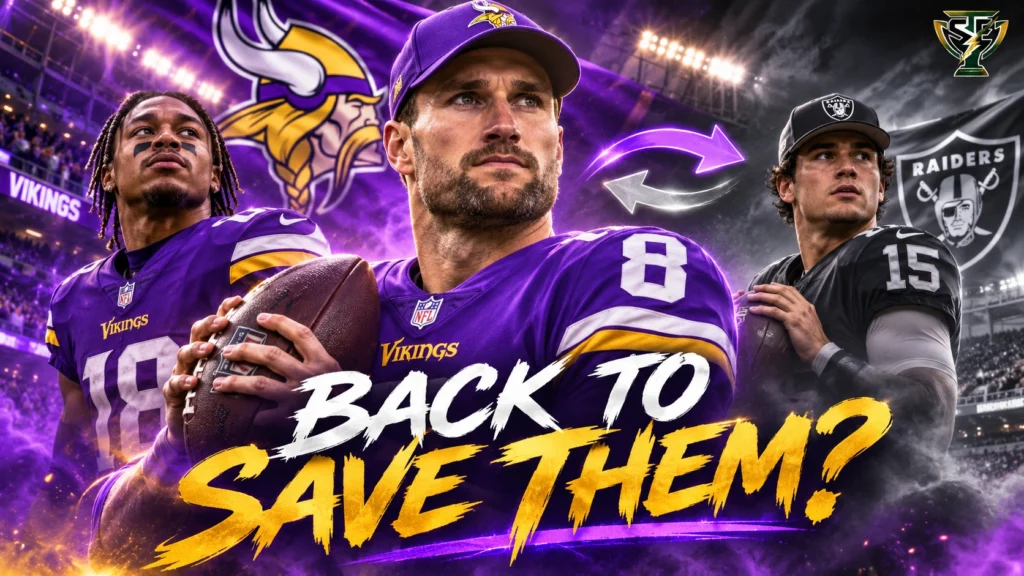
EAGAN, Minnesota, November 10, 2026: The Minnesota Vikings have turned back to Kirk Cousins to rescue an offense that has threatened to undermine one of the NFL’s strongest defenses, acquiring their former quarterback from the Las Vegas Raiders in exchange for a 2027 third-round draft pick. The Vikings announced the reunion ahead of Tuesday’s trade deadline, bringing back the 38-year-old four-time Pro Bowler less than three years after the Achilles injury that ended his final season in Minnesota. Cousins returns with 2,340 passing yards and 20 touchdowns from nine games in Las Vegas, while his former team has fallen to 31st in passing and total offense despite carrying a 6-2 record into a crucial NFC North confrontation with the Green Bay Packers.
The agreement, which remains subject to Cousins passing a physical, also marks a turning point for the Raiders. Las Vegas is preparing to hand its offense to Fernando Mendoza, the No. 1 overall pick in the 2026 NFL Draft, after beginning the season with Cousins as an experienced starter. For Minnesota, the transaction reverses a succession plan that has included J.J. McCarthy, Sam Darnold, Kyler Murray and Carson Wentz. The decision follows Wentz’s three-turnover performance in Monday’s 23-6 defeat against Buffalo and reunites Cousins with head coach Kevin O’Connell, receiver Justin Jefferson and several familiar offensive players. Whether the move can revive Minnesota’s playoff ambitions will depend on more than nostalgia: Cousins must improve a struggling attack, regain his old rhythm and deliver results almost immediately.
Kirk Cousins Returns to Minnesota: Key Trade Details
The Vikings have confirmed the acquisition on their official website, although the transaction must still satisfy the required physical examination.
Minnesota is sending a third-round selection in the 2027 NFL Draft to Las Vegas.
Story at a glance
Kirk Cousins Returns to Minnesota: Key Trade Details
The Vikings have confirmed the acquisition on their official website, although the transaction must still satisfy the required physical examination.
Why the Vikings Are Bringing Back the Quarterback They Let Go
The decision represents a major reversal in Minnesota’s quarterback strategy.
The Numbers Behind Minnesota’s Quarterback Crisis
Minnesota’s defense has performed at a level capable of supporting a serious postseason challenge.
Carson Wentz’s Collapse Against Buffalo Forces Minnesota’s Hand
The immediate catalyst was Monday’s 23-6 defeat against the Buffalo Bills.
Can Cousins Rebuild His Chemistry With Justin Jefferson?
One of the strongest arguments for the reunion is that Cousins already knows several of Minnesota’s principal offensive players.
The trade comes at a particularly important moment because both franchises are attempting to solve different quarterback problems.
Minnesota needs immediate production from an experienced starter. Las Vegas has decided that its rookie quarterback should receive the opportunity to play.
| Trade Detail | Confirmed or Reported Position | Competitive Significance |
|---|---|---|
| Player | Kirk Cousins, quarterback, age 38 | Experienced starter returns to his former team |
| Acquiring team | Minnesota Vikings | Attempt to improve one of the NFL’s weakest offenses |
| Departing team | Las Vegas Raiders | Opportunity to transition to Fernando Mendoza |
| Compensation | 2027 third-round draft pick | Minnesota sacrifices future draft capital |
| Trade status | Announced, pending physical | Medical clearance remains required |
| Minnesota record | 6-2 | Competing for NFC North position |
| Las Vegas record | 4-5 | Evaluating future quarterback direction |
| Next Minnesota opponent | Green Bay Packers | Immediate divisional consequences |
The Vikings’ official trade announcement confirms the reunion, the reported draft compensation and the physical requirement.
It is important to distinguish the agreement from Cousins’ first appearance. Minnesota has not established through the announcement alone that he will definitely start against Green Bay.
Why the Vikings Are Bringing Back the Quarterback They Let Go
The decision represents a major reversal in Minnesota’s quarterback strategy.
Cousins played six seasons for the Vikings between 2018 and 2023, establishing himself as one of the franchise’s most productive passers.
He left for Atlanta as a free agent in 2024, while Minnesota began planning for a future centered on younger quarterbacks.
The Vikings drafted J.J. McCarthy with the tenth overall pick that year.
However, injuries and uneven development complicated the transition.
Sam Darnold became Minnesota’s starter in 2024, helping the team finish 14-3 before leaving after the season.
McCarthy subsequently received opportunities but did not establish himself as the long-term answer.
The Vikings traded him to the New York Giants on September 28, receiving a fifth-round draft selection.
Minnesota had also signed Kyler Murray during the offseason, hoping his mobility and passing ability could create a more productive offense.
That plan has not delivered the consistency the team expected.
Minnesota’s Quarterback Experiment Has Become Increasingly Expensive
The Vikings are not simply returning to a familiar player because he was popular with supporters.
They are paying a draft-pick price to restore a quarterback whose departure was part of their attempt to build a different future.
The cost must therefore be evaluated against the failure of the intervening quarterback strategy.
The decision also shows that Minnesota’s current coaching staff believes the roster can still compete during the present season.
At 6-2, the Vikings are not rebuilding from a losing position.
They have already established themselves as a difficult opponent because of their defense.
But the offense has repeatedly failed to turn that defensive advantage into convincing results.
The Sports Encounter’s Week 5 NFL power rankings identified Minnesota’s unusual imbalance when the Vikings were 4-0.
At that stage, Minnesota had become the first NFL team since the 1923 Chicago Cardinals to begin 4-0 without scoring an offensive touchdown in two of its victories.
The undefeated record was impressive, but the warning was already visible.
Winning without dependable offensive production is difficult to sustain against stronger opponents.
The Numbers Behind Minnesota’s Quarterback Crisis
Minnesota’s defense has performed at a level capable of supporting a serious postseason challenge.
Its offense has not.
Through eight games, the Vikings rank 31st in total offense and passing yards, and 27th in scoring.
The team averages approximately 266.8 total yards and 160.8 passing yards per game.
Meanwhile, its defense has allowed approximately 14.5 points per game, the lowest figure in the league at the reported statistical snapshot.
The contrast explains why Minnesota has reached the trade deadline with a winning record but little confidence in its quarterback situation.
Vikings Offense vs Cousins’ Raiders Production
| Measure | Minnesota Vikings | Kirk Cousins With Raiders |
|---|---|---|
| Games in sample | 8 team games | 9 starts |
| Passing yards | 160.8 per game | 2,340 total |
| Passing yards per game | 160.8 | 260.0 |
| Passing touchdowns | Inconsistent production across quarterbacks | 20 |
| Interceptions | Multiple quarterbacks involved | 8 |
| Completion percentage | Not used for comparison | 64.1% |
| Passer rating | Not used for comparison | 97.1 |
| League context | 31st in passing yards | Established veteran production |
TSE original statistical calculation: Cousins’ 260.0 passing yards per game with Las Vegas are 99.2 yards higher than Minnesota’s team average of 160.8. That represents approximately 61.7% more passing production per game.
This is not a prediction that Minnesota will immediately gain another 99 yards every week.
Cousins played in a different offense, with different receivers, protection assignments, opponents and game situations.
However, the gap helps explain why the Vikings were willing to surrender a third-round pick.
They are not attempting a marginal upgrade. They are trying to repair an offense that has been performing near the bottom of the league.
Carson Wentz’s Collapse Against Buffalo Forces Minnesota’s Hand
The immediate catalyst was Monday’s 23-6 defeat against the Buffalo Bills.
With Murray unavailable because of a hamstring problem, Wentz started at quarterback.
He completed only eight of 25 passes for 81 yards.
He did not throw a touchdown and was intercepted twice.
His performance also included another turnover, leaving him responsible for three giveaways.
The Vikings scored only six points.
That was especially damaging for a team whose defensive performances have repeatedly created opportunities to win.
Why the Buffalo Game Changed the Quarterback Conversation
The problem was not simply losing one football game.
Minnesota had already endured several weeks of limited offensive production.
Before the Buffalo defeat, the Vikings had lost their unbeaten record against Detroit.
The Lions won 19-15 in Week 8, with Jahmyr Gibbs rushing for 153 yards and a touchdown.
TSE’s full Week 8 report examined how Detroit ended Minnesota’s perfect start and made the NFC North race more competitive.
The defeats against Detroit and Buffalo highlighted different aspects of the same weakness.
Against Detroit, the Vikings struggled to generate enough points to overcome a competitive opponent.
Against Buffalo, the passing game collapsed so severely that Minnesota never established a credible offensive challenge.
The response was a trade designed to address the position with the greatest immediate influence over the offense.
Can Cousins Rebuild His Chemistry With Justin Jefferson?
One of the strongest arguments for the reunion is that Cousins already knows several of Minnesota’s principal offensive players.
That includes Justin Jefferson, Jordan Addison and T.J. Hockenson.
He also understands Kevin O’Connell’s offensive system from their previous two seasons together.
In 2022 and 2023, Cousins played 25 regular-season games under O’Connell, throwing for 6,878 yards and 47 touchdowns with 19 interceptions.
That experience should reduce the adjustment required compared with signing a quarterback who has never played in the system.
However, familiarity is not the same as being fully prepared for the next game.
Playbooks evolve. Personnel responsibilities change. Protection assignments and route concepts may have been modified since Cousins left Minnesota.
Why the Cousins-Jefferson Connection Matters
Jefferson became one of the NFL’s leading receivers while Cousins was Minnesota’s starting quarterback.
The partnership was particularly productive in 2022, when Jefferson led the league with 128 receptions and 1,809 receiving yards.
Cousins’ willingness to target Jefferson in demanding situations helped establish the receiver as a central part of the offense.
Their previous connection provides a useful foundation for rebuilding the passing game.
It could also influence defensive coverage.
Opponents must respect Jefferson’s ability to win against individual coverage, but Minnesota’s offense needs other receivers and tight ends to exploit the space created when defenses concentrate on him.
Cousins’ experience with Addison and Hockenson could make those secondary options more important.
That is particularly relevant because Minnesota has already attempted to improve its receiving production through roster changes.
TSE’s analysis of the collapsed Jauan Jennings trade examined the Vikings’ receiving concerns and the consequences of their defeat against Detroit.
Adding Cousins changes the quarterback responsible for distributing the ball, but the receivers must still create separation and convert opportunities.
How Cousins’ Previous Minnesota Record Compares With His Current Form
Cousins’ return is not based solely on his earlier achievements with Minnesota.
He has played effectively for Las Vegas this season, making the move more defensible than a reunion with a veteran whose production had substantially declined.
Through nine games, he completed 202 of 315 passes for 2,340 yards, 20 touchdowns and eight interceptions.
That amounts to a completion percentage of 64.1 and a passer rating of 97.1.
The figures also demonstrate why Las Vegas originally selected him as its starter ahead of Mendoza.
Cousins’ Recent Quarterback Production
| Period | Games | Passing Yards | TD | INT | Yards per Game |
|---|---|---|---|---|---|
| Minnesota under O’Connell, 2022-23 | 25 | 6,878 | 47 | 19 | 275.1 |
| Las Vegas, current season | 9 | 2,340 | 20 | 8 | 260.0 |
The Minnesota figures cover Cousins’ 25 appearances under O’Connell, not every game from his six-year Vikings career. Yards-per-game figures are calculated from the recorded totals.
Cousins’ current passing average is approximately 15 yards per game below the figure from his first period under O’Connell.
That does not indicate a dramatic decline by itself.
The two samples involve different teams and circumstances, while the current nine-game sample is comparatively small.
What matters is that Cousins has demonstrated an ability to produce at a level Minnesota’s quarterbacks have not approached consistently this season.
What Does the Trade Mean for Kyler Murray and Carson Wentz?
Cousins’ arrival immediately complicates the Vikings’ quarterback hierarchy.
Murray was signed during the offseason to become the team’s starter.
He has appeared in six games, throwing five touchdowns and three interceptions.
Injuries have disrupted his availability, including a concussion early in the season and the hamstring problem that kept him out against Buffalo.
Wentz has also received opportunities but failed to provide the necessary stability.
The Vikings have not established in their trade announcement exactly how the depth chart will be organized once Cousins passes his physical.
Minnesota’s Quarterback Options After the Trade
| Quarterback | Situation | Potential Role | Outstanding Question |
|---|---|---|---|
| Kirk Cousins | Acquired from Raiders, pending physical | Potential immediate starter | How quickly can he prepare for Green Bay? |
| Kyler Murray | Previously signed as starter; hamstring issue | Available competition or backup when healthy | How will his role change? |
| Carson Wentz | Started against Buffalo; struggled severely | Uncertain | Will Minnesota retain him on the roster? |
| Max Brosmer | Young quarterback with previous Vikings experience | Developmental depth | How many quarterbacks will the Vikings retain? |
| J.J. McCarthy | Traded to Giants in September | No longer on Minnesota’s roster | Illustrates the abandoned succession plan |
The table identifies plausible roles rather than confirmed coaching decisions.
Wentz’s future may be affected by the acquisition, but a release should not be reported as completed until the team announces it.
Murray’s future also depends on his health, contract circumstances and the coaching staff’s evaluation.
Why the Vikings’ Defense Makes This Reunion Worth the Gamble
Minnesota’s offense is struggling, but the defense has given the team a strong competitive platform.
The Vikings have allowed only 14.5 points per game at the reported statistical snapshot.
They have also generated 29 sacks through eight games, demonstrating the effectiveness of their pressure packages.
That performance makes the quarterback position particularly important.
A team conceding relatively few points does not necessarily need its offense to produce 35 points every week.
It does need sustained drives, controlled turnovers and the ability to capitalize when the defense creates favorable field position.
The Quarterback Does Not Need to Solve Every Problem
Cousins’ most valuable contribution may be more consistent decision-making rather than spectacular individual plays.
Completing manageable passes, recognizing defensive pressure and avoiding unnecessary turnovers could reduce the burden on the defense.
Minnesota demonstrated early in the season that it could win games through defensive execution.
In Week 7, the Vikings defeated Indianapolis 16-10 to remain the NFL’s final unbeaten team.
TSE’s Week 7 report examined how Minnesota survived another close contest and why its unbeaten record depended heavily on defense.
That victory was encouraging, but it also illustrated the limits of relying on low-scoring games.
Cousins is being acquired to improve the balance between offense and defense.
If he can create longer drives and more consistent scoring opportunities, Minnesota’s defense may no longer need to deliver an exceptional performance every week.
Why Minnesota Must Beat Green Bay
The timing of the trade makes the next fixture particularly significant.
Minnesota travels to Green Bay on Sunday, November 15, for an NFC North contest at Lambeau Field.
The Vikings enter at 6-2, while the Packers are 6-3.
The game matters because the teams are competing in a division that also includes Detroit, whose victory over Minnesota made the race more competitive.
Cousins’ previous Minnesota tenure ended with an Achilles injury suffered at Lambeau Field in October 2023.
His potential return at the same stadium creates a compelling personal storyline.
But the football consequences are more important.
A victory would allow Minnesota to improve its record to 7-2 while handing Green Bay another defeat.
A loss would leave both teams with three defeats and increase the pressure on the Vikings’ remaining divisional schedule.
Vikings-Packers Scenarios
| Outcome | Minnesota Record | Green Bay Record | Immediate Implication |
|---|---|---|---|
| Minnesota wins | 7-2 | 6-4 | Vikings gain ground against a direct division rival |
| Green Bay wins | 6-3 | 7-3 | Packers improve their competitive position and Vikings lose another division game |
| Tie | 6-2-1 | 6-3-1 | Both teams receive half a win for standings-percentage purposes |
These are direct calculations from the teams’ reported entering records. They do not establish final division positions because Detroit’s results and the applicable NFL tiebreakers also matter.
Green Bay’s Defense Is a Serious Test for Cousins
The Packers have built their recent success around a strong defense.
They allowed only 73 points over a five-game stretch entering November, with an improved ability to generate takeaways.
However, Green Bay’s offense has struggled to run the ball consistently.
TSE’s detailed analysis of Green Bay’s defensive resurgence and rushing problems explains why the Packers have remained competitive despite their offensive imbalance.
That creates an intriguing matchup.
Minnesota is trying to improve its passing game against an effective defense, while Green Bay must prevent the Vikings from using Cousins’ experience to exploit weaknesses in coverage.
The Packers’ defensive pressure could also test how quickly Cousins has reacclimated to Minnesota’s protection assignments.
Nothing about the reunion guarantees immediate success.
What the Trade Means for Fernando Mendoza and the Raiders
The other half of the story is taking place in Las Vegas.
The Raiders selected Fernando Mendoza with the first overall pick in the 2026 NFL Draft.
They subsequently signed Cousins to provide veteran experience while Mendoza adjusted to professional football.
That plan originally involved allowing the rookie time to develop.
Head coach Klint Kubiak ultimately named Cousins the starter after training camp.
His reasoning was based on the veteran’s experience and performance, not a rejection of Mendoza’s long-term potential.
The Raiders’ original announcement naming Cousins the starter confirms that the team held a competition before choosing the veteran.
The decision had been understandable.
Mendoza was entering his first NFL season after winning the Heisman Trophy and leading Indiana to a national championship.
But the Raiders viewed immediate playing time and long-term development as separate considerations.
TSE’s report on the Raiders’ opening quarterback decision explained why Mendoza was initially asked to learn behind Cousins.
Why the Raiders Are Changing Plans Now
Las Vegas stands at 4-5 after nine games.
Cousins has played well enough to keep the team competitive, but the Raiders have decided to exchange his immediate production for draft compensation and an opportunity to evaluate Mendoza.
The third-round pick gives Las Vegas another asset for future roster development.
Mendoza now has an opportunity to gain meaningful NFL experience rather than continue working primarily through practice.
That decision involves risk.
The rookie may struggle against defenses capable of disguising coverage, generating pressure and forcing quarterbacks to make rapid decisions.
He has only limited regular-season experience.
However, giving him meaningful opportunities could provide valuable information about his readiness before the following offseason.
How Cousins’ Raiders Performances Changed the Decision
The trade is particularly interesting because Cousins was not performing poorly enough to justify a straightforward benching.
Las Vegas began the season with victories in its first two games.
Against Miami in Week 1, Cousins threw three touchdowns while Ashton Jeanty contributed 102 rushing yards and two receiving touchdowns.
TSE’s opening-week analysis explained how the Raiders built that victory around their running game and controlled possession.
Cousins followed with another three-touchdown performance against the Los Angeles Chargers.
Las Vegas won 26-14, extending its unbeaten start.
TSE’s Week 2 report examined why Cousins’ strong performances made it easier for the Raiders to delay Mendoza’s introduction.
The situation changed when the team’s overall results became less consistent.
Las Vegas eventually lost four consecutive games before defeating the New York Jets 38-33 in Week 8.
Cousins threw for 247 yards and three touchdowns during that victory.
The performance featured in TSE’s wider Week 8 coverage and preparations, which examined the pressure facing several teams entering that stage of the season.
The Raiders now face a different question.
Instead of evaluating whether Cousins deserves to keep starting, they must assess how quickly Mendoza can turn college success into reliable NFL production.
Can Fernando Mendoza Succeed Immediately?
Mendoza’s college achievements establish an impressive foundation, but professional football presents different demands.
He must read more complex defensive structures, adjust protections and make decisions against faster defenders.
He also needs to develop relationships with the Raiders’ offensive line and receiving group.
That includes tight end Brock Bowers and running back Ashton Jeanty, both of whom can help a young quarterback through reliable receiving options.
The Raiders’ earlier game against Buffalo illustrated why Jeanty’s versatility is valuable.
TSE’s preview of the Bills-Raiders matchup examined how Las Vegas could combine its passing game with Jeanty’s rushing and receiving abilities.
That balance could become especially important for Mendoza.
The Raiders should avoid forcing him to reproduce Cousins’ passing volume immediately if doing so would expose weaknesses in protection or decision-making.
His development should be evaluated through more than touchdowns and interceptions.
Passing accuracy under pressure, third-down decisions, protection adjustments and the ability to sustain drives will provide a more complete assessment.
Why a Third-Round Pick Is an Important Investment for Minnesota
The Vikings are surrendering a meaningful draft asset for an experienced quarterback approaching the later stages of his career.
A third-round selection does not guarantee a future starter, but it provides an opportunity to acquire a player on a comparatively affordable rookie contract.
That matters in a league where salary-cap management affects roster flexibility.
From Minnesota’s perspective, the trade must be justified by the immediate competitive benefit.
Cousins is not being acquired as a long-term developmental project.
He is being brought back to improve an offense that is limiting a strong team.
The Contract Adds Another Financial Consideration
Reports indicate that Cousins’ existing agreement includes a $10 million roster bonus scheduled for 2027.
The Vikings are expected to assume the relevant obligations under the contract, although the teams have not fully detailed every salary-cap consequence in their public announcements.
The distinction between salary, guaranteed compensation, roster bonuses and salary-cap accounting is important.
Those figures should not be treated as interchangeable.
It would also be premature to claim that the Vikings have committed to keeping Cousins beyond this season without confirming the final contract structure and any subsequent changes.
How Minnesota and Las Vegas Should Judge the Trade
| Team | Immediate Objective | Potential Benefit | Main Risk | Measure of Success |
|---|---|---|---|---|
| Minnesota | Improve quarterback production | More efficient passing and stronger drives | Adjustment time and age-related risk | Better offensive performance and competitive results |
| Minnesota | Protect playoff position | More support for its leading defense | Third-round draft pick surrendered | Results against Green Bay and remaining contenders |
| Las Vegas | Evaluate Fernando Mendoza | Meaningful experience for the No. 1 pick | Rookie inconsistency | Improvement in decisions, accuracy and command |
| Las Vegas | Recover future draft capital | Additional 2027 third-round selection | Loss of proven passing production | Successful roster development and quarterback progression |
The teams are making different decisions about time.
Minnesota is prioritizing the present because it believes its current roster is competitive.
Las Vegas is accepting greater short-term uncertainty to evaluate the quarterback it selected first overall.
Neither strategy can be judged solely from the trade announcement.
Could Cousins Turn Minnesota Into a Super Bowl Contender?
It is possible, but the evidence does not justify declaring the Vikings championship favorites.
Minnesota’s defense has been outstanding, while its offense has been among the league’s least productive.
Cousins provides experience, familiarity with the head coach and a demonstrated ability to generate passing yards and touchdowns.
Those qualities make him a credible solution.
However, he must establish rhythm with the current offense, avoid turnovers and perform against teams that can pressure the quarterback without sacrificing coverage.
The Packers game will provide an early indication of whether the reunion can deliver immediate results.
Minnesota’s recent defeat against Detroit also showed that a strong defense cannot always compensate for limited offensive production.
Even if Cousins improves the passing game, the Vikings must continue controlling the line of scrimmage, protecting the football and converting red-zone opportunities.
A quarterback change alone cannot guarantee those outcomes.
Continue the NFL Story
 NFLJauan Jennings Rejects 49ers Reunion as Vikings’ Trade Deal Collapses Ahead of NFL Deadline
 NFLNFL Trade Deadline: 49ers Land Keenan Allen, Bengals’ Ebiketie Deal Collapses as Dolphins Lose Sieler
 NFLNFL Week 8 Preview: Lamar Jackson Returns, Vikings Face Lions as Injuries Threaten Playoff Contenders
Frequently Asked Questions
Did the Minnesota Vikings trade for Kirk Cousins?
Yes. Minnesota announced an agreement to acquire Kirk Cousins from the Las Vegas Raiders in exchange for a 2027 third-round draft pick. The transaction remains subject to a physical.
What did Minnesota give up for Cousins?
The Vikings agreed to send their 2027 third-round draft selection to Las Vegas.
How old is Kirk Cousins?
Cousins is 38 years old. He originally entered the NFL as a fourth-round draft pick in 2012.
Why did the Vikings want Cousins back?
Minnesota has struggled with quarterback production and ranks near the bottom of the league in passing and total offense despite a strong defense and a 6-2 record.
How many passing touchdowns has Cousins thrown this season?
He threw 20 touchdowns in nine games for the Raiders, alongside 2,340 yards and eight interceptions.
Will Cousins start against Green Bay?
He could start against the Packers, but the final decision depends on his physical, preparation and Minnesota’s official quarterback plans.
What happens to Kyler Murray?
Murray remains part of Minnesota’s quarterback situation. His role following the acquisition has not been definitively established in the trade announcement.
Who will replace Cousins for the Raiders?
Fernando Mendoza, the first overall pick in the 2026 NFL Draft, is expected to take over as Las Vegas moves toward its long-term quarterback plan.
How many years did Cousins play for Minnesota?
Cousins played six seasons with the Vikings from 2018 through 2023 before joining Atlanta.
When do the Vikings play the Packers?
Minnesota visits Green Bay on Sunday, November 15, in an important NFC North matchup at Lambeau Field.
Cousins Is Back, but Minnesota’s Real Test Starts Against Green Bay
The Vikings have spent more than two years attempting to move beyond Kirk Cousins.
Their succession plan has involved injuries, changing starters, a highly drafted quarterback and multiple attempts to establish a dependable offense.
Now, with a winning record and a defense capable of competing against strong opponents, they have returned to the player they originally allowed to leave.
That makes the reunion unusual, but not necessarily misguided.
Cousins has demonstrated that he can still produce at a high level. His 20 touchdown passes in nine Raiders games provide stronger evidence of his current ability than memories of his previous Minnesota tenure.
He also knows O’Connell’s offensive system and has an established relationship with Jefferson and several other important players.
But the trade carries a cost.
Minnesota has surrendered a third-round pick and assumed contractual responsibilities to solve an immediate problem.
Las Vegas has taken the opposite approach, collecting future draft capital and preparing to evaluate Mendoza.
The Raiders are prioritizing development. The Vikings are prioritizing a season they believe is still worth saving.
Sunday’s game at Lambeau Field will not determine the entire outcome of the trade, but it will provide the first major test of Minnesota’s decision.
Cousins’ previous Vikings chapter ended with an Achilles injury in Green Bay. His new chapter could begin at the same stadium.
Whether it becomes a successful reunion will depend on something far more important than the symbolism: can the quarterback Minnesota once let go finally make its offense worthy of its defense?