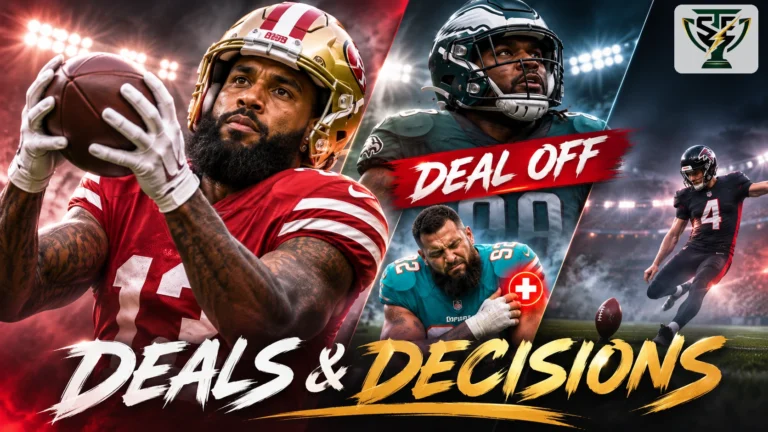
NEW YORK, United States, November 10, 2026: San Francisco moved to strengthen its passing attack by agreeing to acquire veteran wide receiver Keenan Allen from Indianapolis, while Cincinnati abandoned a proposed trade for Philadelphia pass rusher Arnold Ebiketie after discovering the potential cost to its compensatory draft-pick position. The contrasting decisions highlighted a busy NFL trade deadline in which Miami also suffered a major setback, with defensive tackle Zach Sieler reportedly requiring season-ending surgery for a ruptured biceps. Atlanta, meanwhile, moved to sign kicker Jake Moody from Baltimore’s practice squad after losing confidence in veteran Nick Folk.
The personnel decisions expose different priorities across the league. San Francisco, entering the deadline at 7-1, is adding an experienced receiving option for an offense already positioned among the NFC contenders. Cincinnati, at 6-2, decided that acquiring defensive depth was not worth jeopardizing a potentially valuable third-round compensatory selection. Miami must reorganize its defensive front without one of its most productive veterans, while Atlanta’s search for reliable kicking creates an immediate problem for Baltimore. Beyond the NFL, Oregon State reportedly secured quarterback Braden Atkinson for another season, and Rutgers confirmed Greg Schiano would remain head coach despite a disappointing 2-7 campaign.
NFL Trade Deadline: Six Major Football Developments
The most important distinction across the announcements is whether a transaction has been completed, agreed, canceled or merely reported.
The Ebiketie situation shows why that distinction matters. Early reports described him as a Cincinnati acquisition, but subsequent reporting confirmed that the Bengals called off the arrangement.
Story at a glance
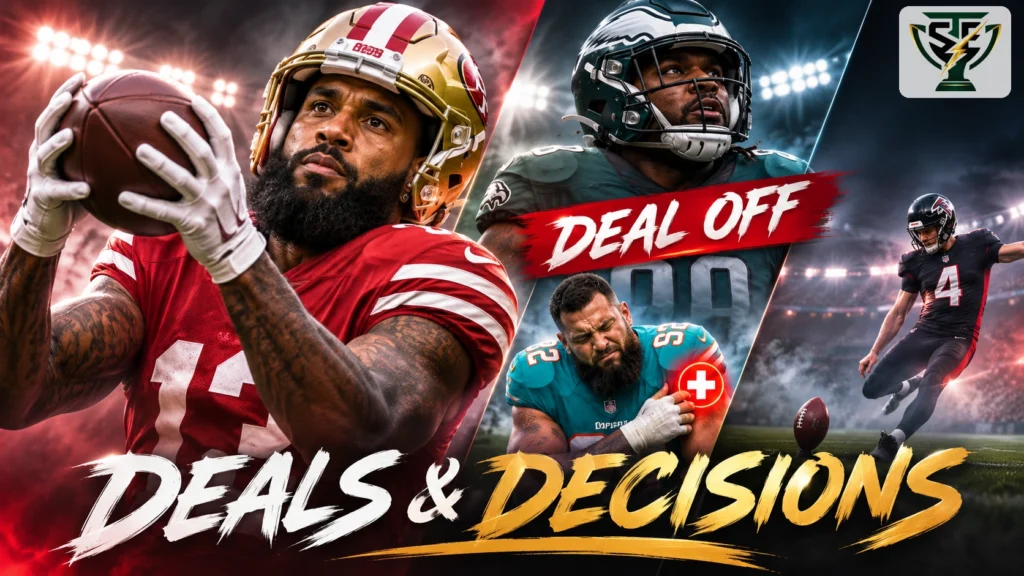
NFL Trade Deadline: Six Major Football Developments
The most important distinction across the announcements is whether a transaction has been completed, agreed, canceled or merely reported.
49ers Acquire Keenan Allen as Indianapolis Continues Reshaping Its Roster
San Francisco’s agreement to acquire Keenan Allen from the Indianapolis Colts represents a calculated addition rather than an expensive rebuilding project.
Bengals Cancel Arnold Ebiketie Trade After Compensatory-Pick Warning
Cincinnati’s decision involving Arnold Ebiketie may be the most instructive transaction story of the deadline.
Miami Dolphins Lose Zach Sieler to Season-Ending Biceps Injury
Miami’s most serious development concerns a player who will not be available for the rest of the campaign.
Falcons Move for Jake Moody After Nick Folk’s Kicking Struggles
Atlanta’s reported signing of Jake Moody from Baltimore’s practice squad addresses a different kind of roster weakness.
| Team or Program | Development | Verified Status | Immediate Consequence |
|---|---|---|---|
| San Francisco 49ers | Acquire Keenan Allen from Indianapolis for a reported 2027 sixth-round pick | Trade agreement reported by NFL Network | Additional receiving depth for a contender |
| Cincinnati Bengals | Cancel proposed Arnold Ebiketie trade with Philadelphia | Deal called off | Protects potential 2027 compensatory draft capital |
| Miami Dolphins | Zach Sieler suffers ruptured biceps | Season-ending surgery reported | Starting defensive-line responsibilities must be redistributed |
| Atlanta Falcons | Move to sign Jake Moody from Baltimore | Practice-squad signing reported | Kicking change following Nick Folk’s struggles |
| Oregon State | Braden Atkinson agrees to return | Return agreement reported | Retains the nation’s leading passer for another season |
| Rutgers | Greg Schiano retained | Official university announcement | Head coach returns despite a 2-7 campaign |
The first four developments concern NFL roster decisions. The final two involve college football, where player retention and coaching continuity operate under different competitive and contractual arrangements.
49ers Acquire Keenan Allen as Indianapolis Continues Reshaping Its Roster
San Francisco’s agreement to acquire Keenan Allen from the Indianapolis Colts represents a calculated addition rather than an expensive rebuilding project.
The reported compensation is a sixth-round selection in the 2027 NFL Draft.
Allen is one of the NFL’s most accomplished active receivers, known particularly for his route-running precision, ability to recognize coverage and effectiveness on intermediate passing plays.
For the 49ers, the immediate attraction is experience.
Brock Purdy has already helped San Francisco establish one of the NFC’s strongest records. Adding a receiver capable of finding open space against zone coverage gives the quarterback another potential option when opponents restrict the team’s primary attacking weapons.
The NFL’s report on the Allen agreement identifies the 2027 sixth-round pick as the expected compensation.
Why San Francisco’s Acquisition Is More Than a Depth Signing
The 49ers began the season with a historic 27-7 victory over the Los Angeles Rams in Melbourne.
Purdy threw three touchdowns in that contest, while San Francisco’s defense produced a crucial goal-line stop before the offense launched a 99-yard touchdown drive.
TSE’s report on San Francisco’s victory in Australia explained how Purdy’s decision-making and the team’s balanced execution established a promising foundation.
The following victory against Miami reinforced that impression.
San Francisco won 35-13, scoring touchdowns on its first five possessions, while Purdy completed 20 of 22 passes for 287 yards and two touchdowns.
That performance was examined in TSE’s Week 2 analysis of the 49ers’ offensive efficiency.
The team’s unbeaten beginning continued until Atlanta inflicted a 29-20 defeat in Week 7.
San Francisco accumulated approximately 400 yards in that game but committed four turnovers.
That distinction is important when evaluating Allen’s arrival.
The problem in Atlanta was not simply the inability to move the football. It was the failure to preserve possessions and convert offensive production into a winning result.
Allen’s experience could help improve receiving reliability on important downs, although no individual receiver can eliminate turnovers arising elsewhere in the offense.
TSE’s detailed Week 7 report reconstructed the Falcons’ victory and identified the four turnovers that ended San Francisco’s perfect start.
What Does Keenan Allen Offer Brock Purdy?
Allen’s value is more closely associated with receiving technique and decision-making than raw straight-line speed.
He can operate from inside alignments, adjust routes against coverage and provide a quarterback with a dependable target when a passing play requires accurate timing.
That could be useful alongside Christian McCaffrey, George Kittle and San Francisco’s other available receiving options.
However, his exact role will depend on the coaching staff’s personnel decisions, his physical condition and the amount of the playbook he can absorb.
His arrival should not automatically be interpreted as confirmation that another receiver will be released or that Allen will immediately become a starter.
For Indianapolis, the trade continues a broader reshaping of the roster.
The Colts have already moved established players, including Quenton Nelson and DeForest Buckner, while attempting to recover draft capital and adjust their financial commitments.
The earlier movement was analyzed in TSE’s examination of Baltimore’s Jacoby Brissett acquisition and the wider NFL trading market.
Allen’s departure fits that pattern, although Indianapolis has not publicly established every long-term decision behind its personnel changes.
Bengals Cancel Arnold Ebiketie Trade After Compensatory-Pick Warning
Cincinnati’s decision involving Arnold Ebiketie may be the most instructive transaction story of the deadline.
Early reports indicated that the Bengals had agreed to acquire the Philadelphia defensive end in exchange for a 2027 sixth-round pick.
That agreement was subsequently abandoned.
The reason was not a failed physical or concern about Ebiketie’s playing ability.
Instead, Cincinnati reportedly discovered that acquiring him could cost the team a more valuable compensatory draft selection.
The NFL’s account of the canceled agreement explains that the proposed move could have affected Cincinnati’s compensatory-pick calculation following Trey Hendrickson’s departure to Baltimore.
Why Would a Sixth-Round Trade Threaten a Third-Round Pick?
The NFL awards certain compensatory draft selections according to a formula involving qualifying free-agent departures and signings.
The precise calculation considers factors established under the league’s rules, including the number and value of qualifying free agents lost and acquired.
Ebiketie had joined Philadelphia as a qualifying compensatory free agent.
According to the reported calculation, Cincinnati had lost three qualifying free agents and signed two.
Acquiring Ebiketie could have changed that balance and removed the Bengals’ projected third-round compensatory selection associated with Hendrickson’s departure.
The decision illustrates why an apparently inexpensive trade can have a much greater opportunity cost than the pick directly exchanged.
| Draft Consideration | Proposed Transaction | Reported Additional Effect |
|---|---|---|
| Player acquired | Arnold Ebiketie | Additional defensive-end depth |
| Direct trade compensation | 2027 sixth-round pick | Late-round selection surrendered |
| Potential compensatory consequence | Projected 2027 third-round compensatory pick | Selection reportedly placed at risk |
| Reason for concern | Compensatory free-agent formula | Acquiring Ebiketie could alter Cincinnati’s qualifying balance |
| Final decision | Trade canceled | Ebiketie remains with Philadelphia under the abandoned arrangement |
TSE information-gain assessment: The publicly reported direct price was a sixth-round pick, but the potential additional cost was a third-round compensatory selection. Those picks do not have equivalent value, and the difference makes the canceled agreement more consequential than the original trade terms suggested.
This does not establish a cash value for the projected selection or guarantee that Cincinnati will ultimately receive it. The final compensatory allocation remains subject to the applicable NFL formula.
Why Cincinnati Wanted Ebiketie
Ebiketie, 27, offers NFL experience as an edge defender.
He had appeared in nine games for Philadelphia this season, with 25 tackles.
Across his career with Atlanta and Philadelphia, he has recorded 16.5 sacks, 43 quarterback hits, 154 tackles and four forced fumbles in 76 games.
Cincinnati entered the deadline at 6-2, level with Pittsburgh near the top of the AFC North.
The Bengals had already invested substantially in their defense, but injuries continued affecting their edge-rushing depth.
Rookie Cashius Howell required wrist surgery earlier in November, creating another personnel concern.
That development was included in TSE’s report on the latest NFL roster changes and Cincinnati’s defensive injury problem.
Ebiketie would have provided another experienced option, but the Bengals ultimately decided that the expected draft consequences outweighed the immediate benefit.
What the Canceled Deal Means for Philadelphia
Philadelphia entered the deadline at 2-7, having lost seven consecutive games.
The Eagles had already agreed to move defensive tackle Jordan Davis to Jacksonville as they accumulated future draft assets.
Ebiketie’s proposed departure would have continued that process.
Instead, the canceled deal leaves him with Philadelphia unless another transaction is completed.
The Eagles’ decline has been visible for several weeks.
In Week 8, they lost 27-10 to Washington after leading 10-0 in the first quarter, conceding 27 unanswered points.
TSE’s Week 8 report examined the collapse and the growing pressure surrounding Philadelphia’s roster.
The canceled Ebiketie trade does not reverse that wider situation, but it demonstrates that not every reported deal survives the final evaluation of financial and draft implications.
Miami Dolphins Lose Zach Sieler to Season-Ending Biceps Injury
Miami’s most serious development concerns a player who will not be available for the rest of the campaign.
Defensive tackle Zach Sieler reportedly ruptured his biceps on the opening defensive play of Sunday’s 19-9 defeat against Detroit.
Remarkably, the 31-year-old continued playing despite the injury.
Subsequent reports indicated that he would require surgery, with an expected recovery period of five to six months.
The projected absence removes one of Miami’s most experienced defensive contributors.
Sieler had started all eight of the Dolphins’ games, recording 24 tackles, seven tackles for loss and two sacks.
He had also recorded 10 sacks in each of the 2023 and 2024 seasons, demonstrating his ability to generate pressure from an interior defensive position.
Why Sieler’s Absence Changes Miami’s Defensive Structure
Sieler’s value cannot be measured solely through sacks.
An interior defensive lineman must help control rushing lanes, occupy blockers, maintain gap responsibilities and generate pressure when opponents attempt to protect the quarterback through the middle.
Removing a regular starter from that rotation forces the coaching staff to redistribute those responsibilities.
Jordan Phillips, Zeek Biggers and Kenneth Grant are among Miami’s available interior options.
Phillips and Biggers already received substantial playing time against Detroit, making them logical candidates for increased workloads.
However, additional snaps will also test their ability to maintain effectiveness over longer periods.
Miami cannot assume that replacing Sieler’s playing time will automatically reproduce his experience, production or leadership.
Miami’s Defensive-Line Replacement Options
| Player | Relevant Situation | Potential Responsibility | Remaining Question |
|---|---|---|---|
| Jordan Phillips | Played 38 defensive snaps against Detroit | Additional interior rotation and run defense | Can he sustain an expanded workload? |
| Zeek Biggers | Played 39 defensive snaps against Detroit | More interior snaps and pass-rushing opportunities | How will greater usage affect efficiency? |
| Kenneth Grant | Part of Miami’s defensive tackle rotation | Additional interior responsibilities | Can his role expand without weakening depth? |
| Zach Sieler | Ruptured biceps; season-ending surgery reported | Unavailable for the remainder of the season | Recovery and future participation depend on medical clearance |
The five-to-six-month recovery estimate should not be interpreted as a confirmed date for Sieler’s return to football activities.
The injury’s precise management, rehabilitation progress and eventual clearance remain medical matters.
Miami’s broader problems were evident before the Detroit defeat.
The Dolphins lost 24-19 to New England in Week 8 after struggling to sustain enough offensive production to complete a comeback.
That game featured in TSE’s comprehensive Week 8 results analysis.
Miami had also suffered a 15-10 defeat against Minnesota earlier in the season, when the Vikings won without scoring an offensive touchdown.
TSE’s Week 4 report explained how Minnesota’s special teams and defensive performance frustrated Miami.
Sieler’s absence introduces another problem for a team already searching for consistency on both sides of the ball.
Falcons Move for Jake Moody After Nick Folk’s Kicking Struggles
Atlanta’s reported signing of Jake Moody from Baltimore’s practice squad addresses a different kind of roster weakness.
The Falcons were seeking improved reliability at kicker after Nick Folk missed another field goal during their defeat against Cincinnati.
Folk had converted 13 of 18 field-goal attempts during the season, a rate of approximately 72.2%.
He had also made only one of four attempts from 50 yards or farther.
Those struggles prompted Atlanta to move for Moody, who had recently been handling kicking duties for Baltimore.
The Ravens’ official report on the proposed signing confirms the reported move and explains why Atlanta’s offer was attractive.
Why Moody Was Available on Baltimore’s Practice Squad
Baltimore had already experienced problems at kicker.
Tyler Loop was placed on injured reserve with a right groin injury, creating an opportunity for Moody.
Moody was elevated from the practice squad for the Ravens’ game against Jacksonville.
He converted a 53-yard field goal, demonstrating his ability to deliver from long distance.
However, Baltimore did not immediately secure him on its active roster.
That allowed Atlanta to move for the veteran.
The Falcons reportedly offered a place on their 53-man roster, creating an opportunity for Moody to become the team’s regular kicker.
Atlanta also plays its home games inside Mercedes-Benz Stadium, where controlled indoor conditions can reduce some of the weather-related uncertainty associated with outdoor kicking.
Those conditions do not guarantee accuracy, but they may make the role attractive to a specialist seeking stability.
How the Move Affects Both Teams
Atlanta is trying to reduce the likelihood that missed kicks influence future close games.
Baltimore, meanwhile, must find another option while Loop remains unavailable.
That creates another personnel problem for a Ravens team already dealing with injuries at quarterback.
Baltimore recently traded for Jacoby Brissett after Lamar Jackson required thumb surgery and Tyler Huntley suffered a season-ending toe injury.
The quarterback emergency was examined in TSE’s earlier analysis of Baltimore’s injury and roster decisions, with subsequent developments covered in the Brissett trade report.
Atlanta’s move therefore has two immediate consequences: it creates competition and potential stability at one team’s kicking position while removing a short-term replacement from another.
How the NFL Decisions Affect Different Competitive Objectives
The four NFL developments should not be evaluated as though every team is pursuing the same outcome.
San Francisco is strengthening an established contender.
Cincinnati is weighing immediate defensive reinforcement against future draft capital.
Miami is responding to a medical absence rather than choosing to move a player.
Atlanta is attempting to improve a specialist position after disappointing conversion rates.
| Team | Current Priority | Potential Benefit | Principal Risk |
|---|---|---|---|
| San Francisco | Additional receiving experience | More reliable passing options on important downs | Integration time, role allocation and health |
| Cincinnati | Preserve draft capital while pursuing the playoffs | Avoid jeopardizing projected third-round compensation | Pass-rush depth remains limited |
| Miami | Replace Sieler’s defensive contribution | Development opportunity for younger linemen | Reduced interior experience and consistency |
| Atlanta | Improve field-goal reliability | Potentially stronger finishing in close games | Moody’s future accuracy remains unproven in Atlanta |
| Baltimore | Find another available kicker | Opportunity to reassess short-term specialist options | Loop remains unavailable and Moody is departing |
| Philadelphia | Manage a struggling roster and future assets | Retains Ebiketie after the canceled agreement | Uncertainty remains over longer-term defensive plans |
The central lesson is that the same deadline produces different calculations depending on a franchise’s record, available players and future resources.
The distinction was also visible in TSE’s earlier report on NFL injuries and personnel decisions, which examined how losing important starters can create different tactical problems across the league.
College Football: Oregon State Keeps Braden Atkinson for Another Season
Outside the NFL, Oregon State reportedly secured the return of quarterback Braden Atkinson for the 2027 college football season.
The sophomore has been one of the most productive passers in the country.
Through the reported statistical snapshot, Atkinson has completed 65.8% of his passes for 3,169 yards, 25 touchdowns and three interceptions.
He has also added two rushing touchdowns and a receiving touchdown.
Those figures explain why retaining him is important for Oregon State’s offensive continuity.
Atkinson’s Passing Numbers Explain His Value
| Statistic | Recorded Total | Competitive Significance |
|---|---|---|
| Passing yards | 3,169 | Nation-leading production at the reported snapshot |
| Passing touchdowns | 25 | Major contribution to scoring offense |
| Interceptions | 3 | Relatively limited turnover total |
| Completion percentage | 65.8% | Consistent passing accuracy |
| Rushing touchdowns | 2 | Additional short-yardage scoring threat |
| Receiving touchdowns | 1 | Evidence of involvement beyond conventional passing |
| Passing TD-to-interception ratio | 25:3 | Calculated ratio of approximately 8.33 to 1 |
The passing touchdown-to-interception ratio is particularly encouraging, although it should not be treated as a complete measure of quarterback performance without assessing opponent strength, offensive structure and individual play context.
Atkinson’s reported return gives Oregon State coach JaMarcus Shephard another experienced offensive leader for his second season.
Receiver Jesse Legree has also reportedly committed to returning.
Retaining the quarterback-receiver combination could help preserve the relationships, timing and system familiarity developed during the current campaign.
Atkinson and Legree were also reported to have joined Nike’s Blue Ribbon Elite name, image and likeness program.
Those arrangements concern college athlete compensation and should not be confused with a professional NFL contract.
The financial details of Atkinson’s agreement have not been publicly established in the available reporting.
Rutgers Retains Greg Schiano Despite a 2-7 Season
Rutgers has taken a different approach to continuity by keeping head coach Greg Schiano for another season.
The university’s decision follows a difficult campaign in which the Scarlet Knights have won only two of their first nine games.
The team is also 1-5 in Big Ten competition.
The results guarantee another losing season and have intensified criticism of the program’s competitive direction.
However, Rutgers athletic director Keli Zinn announced that Schiano would return in 2027.
In the university’s official statement on its football program, Zinn acknowledged that the results had fallen below expectations while arguing that retaining Schiano served Rutgers’ longer-term interests.
Why Rutgers Chose Continuity Instead of Another Coaching Search
Schiano is the winningest head coach in Rutgers football history.
His experience and previous achievements provide the background to the university’s decision, but they do not erase the present results.
Rutgers has lost 12 of its last 15 Big Ten games, a record that illustrates the scale of the challenge.
The university believes changes to the roster and football program can improve future performance without replacing the head coach.
That approach carries risk.
Continuity allows the existing coaching staff to continue recruiting, developing players and implementing its plans.
However, retaining the same leadership also raises the expectation that the proposed changes must produce measurable results.
What Rutgers Must Improve
| Measure | Current Position | Required Response |
|---|---|---|
| Overall record | 2-7 | Significantly improve win production |
| Big Ten record | 1-5 | Become more competitive inside the conference |
| Recent conference trend | 12 defeats in 15 Big Ten games | Reverse sustained conference underperformance |
| Coaching status | Schiano retained | Translate continuity into improved results |
| Program strategy | Roster changes planned | Demonstrate stronger recruiting, development and execution |
The retention decision is therefore not an endorsement of the current results.
It represents a judgment that the university can improve more effectively by changing elements of the program while maintaining its head coach.
Whether that judgment is successful will depend on the performance of Rutgers’ future teams, not the announcement itself.
Which Decisions Could Have the Greatest Immediate Impact?
Among the NFL developments, the most immediate competitive consequences involve San Francisco’s receiving rotation, Miami’s defensive front and Atlanta’s kicking position.
Cincinnati’s canceled deal has a different significance because its primary benefit is preserving a potential future asset rather than changing the current roster.
For the 49ers, Allen could contribute during the remaining regular season and a potential postseason campaign.
For Miami, replacing Sieler will become an immediate requirement.
Atlanta must determine whether Moody can improve on Folk’s recent results, while Baltimore needs another available kicker.
These changes should be judged by subsequent performances rather than assumptions made on the transaction date.
Continue the NFL Story

Frequently Asked Questions
Did the 49ers acquire Keenan Allen?
San Francisco reportedly agreed to acquire Keenan Allen from Indianapolis in exchange for a sixth-round selection in the 2027 NFL Draft.
Why did the Bengals cancel the Arnold Ebiketie trade?
Cincinnati reportedly called off the agreement because acquiring Ebiketie could have cost the team a projected third-round compensatory draft pick.
Is Arnold Ebiketie joining Cincinnati?
No completed trade has been established. The previously reported Bengals-Eagles agreement was canceled.
Is Zach Sieler out for the season?
Yes. Reporting indicates that Sieler ruptured his biceps and will require season-ending surgery, with an estimated recovery period of five to six months.
Who could replace Sieler in Miami?
Jordan Phillips, Zeek Biggers and Kenneth Grant are among the available defensive linemen who could receive additional responsibilities.
Why are the Falcons signing Jake Moody?
Atlanta is seeking improved kicking reliability after Nick Folk converted 13 of 18 field-goal attempts during the season.
What happens to the Ravens after Moody’s departure?
Baltimore must identify another kicking option while Tyler Loop remains on injured reserve.
Is Braden Atkinson returning to Oregon State?
Multiple reports indicate that the quarterback has agreed to return for the 2027 college football season.
Is Greg Schiano staying at Rutgers?
Yes. Rutgers has officially confirmed that Schiano will remain head coach for the 2027 season despite the team’s 2-7 record.
What the Deadline Reveals About NFL Team-Building
The most important NFL decisions are not always the largest trades.
San Francisco has chosen to spend a late-round pick on an experienced receiver who could help a contender improve its offensive flexibility.
Cincinnati has taken the opposite approach, abandoning a defensive acquisition to avoid jeopardizing a projected third-round compensatory selection.
Miami faces a problem it did not choose, with Sieler’s injury removing a reliable veteran from its defensive line.
Atlanta is attempting to improve a specialist position, but the move creates another concern for Baltimore.
Meanwhile, Oregon State and Rutgers have opted for continuity in college football, although the reasons differ considerably.
Atkinson’s reported return protects an exceptionally productive passing offense. Schiano’s retention gives Rutgers another opportunity to improve under an experienced coach despite disappointing results.
Each decision carries a different measure of success.
For San Francisco and Atlanta, the next games will provide the earliest evidence.
For Cincinnati, the eventual compensatory draft allocation will matter. For Miami, the performance of Sieler’s replacements will be closely watched.
Oregon State and Rutgers will need to demonstrate their progress over a longer period.
The deadline has changed several rosters, but it has also shown why the smartest decision is not necessarily the transaction that attracts the biggest headline.