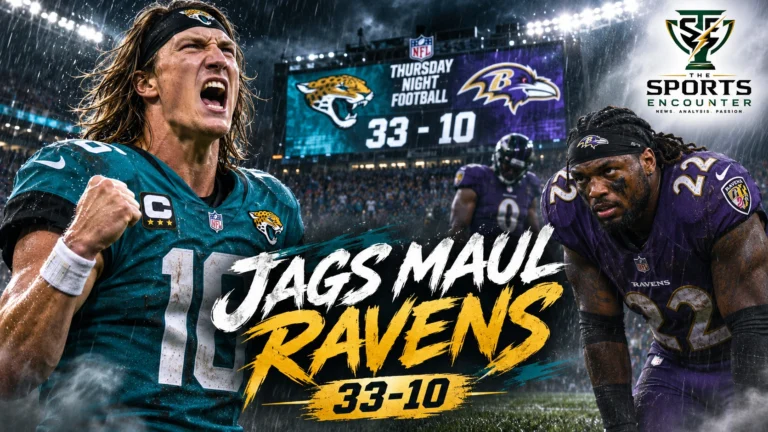
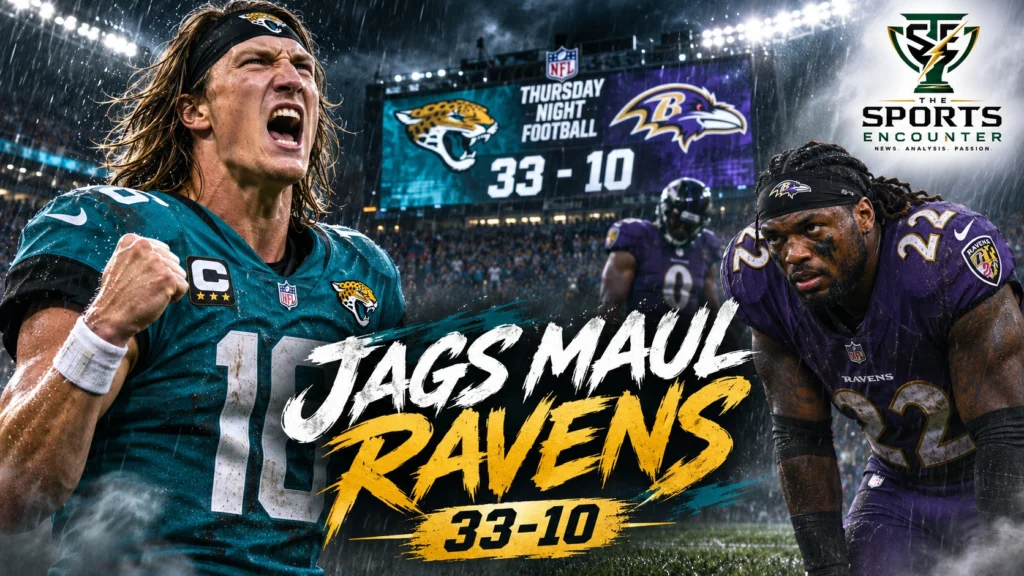
BALTIMORE, Maryland, November 5, 2026: Trevor Lawrence punished Baltimore’s injury-hit defense with 242 passing yards and a touchdown as the Jacksonville Jaguars crushed the Ravens 33-10 in Thursday Night Football at a rain-soaked M&T Bank Stadium. Parker Washington’s 50-yard touchdown reception just before halftime broke open a game that had remained competitive through most of the second quarter, while Jacksonville’s defense forced three turnovers against undrafted rookie quarterback Joe Fagnano and Baltimore’s struggling special teams. The Jaguars improved to 6-2, strengthened their grip on the AFC South and secured their second consecutive victory without trailing at any stage.
The defeat exposed a much deeper problem for Baltimore, which has now lost four consecutive games after beginning the season 4-1. With Lamar Jackson recovering from thumb surgery and backup Tyler Huntley unavailable through injury, the Ravens handed Fagnano his first NFL start. He completed only 10 of 18 passes for 60 yards and threw two interceptions as Baltimore produced just 227 yards of offense. Derrick Henry moved into seventh place on the NFL’s all-time rushing list, but even that historical achievement could not disguise the collapse. The Ravens fell to 4-5, lost All-Pro safety Kyle Hamilton to a hip injury and now face another difficult stretch in their attempt to rescue a season that has deteriorated dramatically.
Jacksonville Jaguars vs Baltimore Ravens: Final Score and Thursday Night Football Result
Jacksonville arrived in Baltimore having won four of its previous five games and immediately demonstrated the efficiency that has helped establish the Jaguars as AFC South leaders.
The visitors scored on their opening possession and never surrendered the lead.
Story at a glance
Jacksonville Jaguars vs Baltimore Ravens: Final Score and Thursday Night Football Result
Jacksonville arrived in Baltimore having won four of its previous five games and immediately demonstrated the efficiency that has helped establish the Jaguars as AFC South leaders.
Trevor Lawrence Turns Jacksonville’s Opening Possession Into an Immediate Warning
The Jaguars took control before Baltimore had an opportunity to settle.
Parker Washington’s 50-Yard Touchdown Changes the Game Before Halftime
For much of the second quarter, Baltimore remained within touching distance.
Trevor Lawrence’s 242 Yards Show How Efficient Quarterback Play Can Dominate a Game
Lawrence completed 16 of 26 passes for 242 yards, one touchdown and no interceptions.
Joe Fagnano’s First NFL Start Exposes Baltimore’s Quarterback Emergency
Baltimore’s offensive problems cannot be understood without examining the circumstances surrounding Fagnano’s first start.
Although Baltimore briefly remained within one score, the Jaguars took control through a combination of explosive passing plays, disciplined defensive execution and turnovers that repeatedly gave their offense favorable field position.
| Team | Q1 | Q2 | Q3 | Q4 | Total |
|---|---|---|---|---|---|
| Jacksonville Jaguars | 10 | 7 | 3 | 13 | 33 |
| Baltimore Ravens | 3 | 0 | 0 | 7 | 10 |
| Jacksonville margin | +7 | +7 | +3 | +6 | +23 |
Final result: Jacksonville Jaguars defeated Baltimore Ravens 33-10.
Venue: M&T Bank Stadium, Baltimore.
Attendance: 70,007.
Records: Jacksonville 6-2; Baltimore 4-5.
The result also continued Jacksonville’s impressive response to its Week 7 bye.
The Jaguars had defeated Indianapolis 42-7 in their previous game, and Thursday’s victory means they have outscored their last two opponents by a combined 75-17.
That 58-point aggregate differential demonstrates the scale of their recent improvement, although the Colts and Ravens presented different challenges.
The contrast with Baltimore’s deteriorating form is striking. The Sports Encounter’s Week 8 NFL results analysis examined the developments preceding Thursday’s matchup, including the Ravens’ defeat to Buffalo.
Trevor Lawrence Turns Jacksonville’s Opening Possession Into an Immediate Warning
The Jaguars took control before Baltimore had an opportunity to settle.
On the second play from scrimmage, Lawrence connected with rookie tight end Nate Boerkircher for a 52-yard gain, moving Jacksonville deep into Ravens territory.
The completion demonstrated how effectively the Jaguars could attack Baltimore’s secondary even in difficult weather conditions.
Bhayshul Tuten finished the seven-play, 77-yard drive with a one-yard touchdown run, giving Jacksonville a 7-0 advantage with 11:24 remaining in the opening quarter.
The drive also established an important tactical pattern.
Jacksonville did not need to rely on a sustained rushing attack to advance downfield. Lawrence could exploit coverage mistakes with accurate intermediate and deep throws, while the running game provided an effective option in short-yardage situations.
Baltimore responded with a 53-yard field goal from Jake Moody to reduce the deficit to 7-3.
It was an encouraging response from a team forced to operate without its two leading quarterbacks, but the Ravens could not turn that moment into sustained offensive pressure.
Jacksonville answered with a ten-play, 47-yard possession that ended in Cam Little’s 36-yard field goal.
The Jaguars led 10-3 after the first quarter.
It was still a manageable deficit for Baltimore. The difficulty was that the Ravens’ offense lacked the ability to consistently generate meaningful gains when Jacksonville’s defense began to control the line of scrimmage.
Parker Washington’s 50-Yard Touchdown Changes the Game Before Halftime
For much of the second quarter, Baltimore remained within touching distance.
The score was still 10-3 late in the half, and the Ravens had opportunities to keep the contest competitive through halftime.
Then Jacksonville produced the game’s decisive offensive play.
With less than a minute remaining before the break, Lawrence found Parker Washington downfield for a 50-yard touchdown.
Washington beat Ravens safety Malaki Starks in coverage, gathered the pass and finished the play in the end zone.
The touchdown extended Jacksonville’s lead to 17-3 with 58 seconds remaining.
That score was particularly damaging because it transformed a one-possession contest into a 14-point deficit just before Baltimore returned to the locker room.
Jacksonville had already exposed Baltimore’s pass defense through Boerkircher’s 52-yard reception. Washington’s touchdown provided another example of how one breakdown could erase several minutes of otherwise competitive defensive play.
Lawrence entered halftime with 197 passing yards from nine completions.
Six of those completions gained at least 15 yards, emphasizing how much damage Jacksonville had caused through explosive plays rather than sheer passing volume.
The Jaguars had outgained Baltimore 224-101 in the opening half, even though the Ravens had run more offensive plays.
That difference reveals why the halftime score was not simply the result of one spectacular touchdown.
Jacksonville was generating considerably more yardage from its opportunities, while Baltimore struggled to threaten the defense beyond the shorter areas of the field.
Trevor Lawrence’s 242 Yards Show How Efficient Quarterback Play Can Dominate a Game
Lawrence completed 16 of 26 passes for 242 yards, one touchdown and no interceptions.
His completion percentage was approximately 61.5%, but that figure does not fully capture the effectiveness of his performance.
He averaged 9.3 yards per pass attempt, an impressive return in persistent rain against a defense that knew Jacksonville could attempt deep throws.
He was not sacked, allowing the Jaguars to maintain offensive rhythm and avoid the damaging negative plays that repeatedly undermined Baltimore.
The performance also reflected an important aspect of Jacksonville coach Liam Coen’s offensive approach.
The Jaguars did not need Lawrence to throw 40 or 50 passes. They needed him to recognize favorable matchups, protect possession and deliver explosive plays when Baltimore’s coverage presented opportunities.
He did all three.
Jakobi Meyers led Jacksonville’s receivers with four catches for 65 yards, while Washington supplied the most decisive touchdown reception.
Boerkircher’s early 52-yard gain helped establish the first touchdown drive.
The distribution of responsibility made Jacksonville’s offense difficult to contain despite the relatively modest number of completed passes.
Lawrence also benefited from the work of a defense that repeatedly denied Baltimore an opportunity to build momentum.
That combination of reliable quarterback play and complementary football is one of the strongest reasons Jacksonville now leads the AFC South.
Joe Fagnano’s First NFL Start Exposes Baltimore’s Quarterback Emergency
Baltimore’s offensive problems cannot be understood without examining the circumstances surrounding Fagnano’s first start.
The undrafted rookie entered Thursday’s game because both Lamar Jackson and Tyler Huntley were unavailable.
Jackson had suffered a thumb injury against Buffalo and required surgery. Huntley was also injured, leaving Baltimore without its established quarterback options.
Fagnano therefore faced a difficult assignment: leading a struggling offense against one of the AFC’s strongest early-season teams, in poor weather, with limited experience operating the first-team system.
TSE’s detailed report on Lamar Jackson’s thumb surgery and Baltimore’s quarterback injuries explained how the crisis developed.
Further changes followed, with our November 3 NFL roster update documenting the Ravens’ decision to prepare Fagnano for Thursday’s game.
Fagnano finished with 60 passing yards, completing ten of 18 attempts and throwing two interceptions.
His longest completion gained only 14 yards.
That limited passing threat allowed Jacksonville to concentrate on preventing manageable gains and forcing Baltimore into difficult situations.
Fagnano also played with a heavily wrapped ankle, adding another complication to an already demanding debut.
It would be unfair to attribute the entire defeat to an inexperienced quarterback operating under those circumstances.
But the statistical comparison with Lawrence illustrates the enormous difference in offensive effectiveness.
Trevor Lawrence vs Joe Fagnano: Quarterback Comparison
| Statistic | Trevor Lawrence | Joe Fagnano |
|---|---|---|
| Team | Jacksonville Jaguars | Baltimore Ravens |
| Completions/Attempts | 16/26 | 10/18 |
| Completion percentage | 61.5% | 55.6% |
| Passing yards | 242 | 60 |
| Passing touchdowns | 1 | 0 |
| Interceptions | 0 | 2 |
| Yards per attempt | 9.3 | 3.3 |
| Sacks taken | 0 | 1 |
| Passer rating | 105.0 | 22.7 |
Source: Official NFL game statistics, November 5, 2026.
Lawrence generated more than four times Fagnano’s passing yardage.
That is not simply a criticism of the rookie. It reflects Jacksonville’s better protection, more effective passing concepts and ability to produce explosive completions.
For Baltimore, replacing an elite quarterback such as Jackson with an inexperienced starter was always going to reduce the offense’s options.
The more serious concern is that the team’s supporting structure did not compensate for that disadvantage.
Why Derrick Henry Took Direct Snaps and Baltimore Still Could Not Move the Ball
Offensive coordinator Declan Doyle attempted to protect Fagnano by using unconventional formations.
One of the most notable adjustments involved Derrick Henry taking direct snaps from the Wildcat formation.
Henry lined up as the quarterback for ten direct snaps, twice his previous career high for that type of involvement.
The idea was understandable.
Henry is one of the most productive running backs in NFL history, and giving him direct possession offered a way to reduce the passing responsibilities placed on Fagnano.
It also allowed Baltimore to present Jacksonville with different rushing formations and create uncertainty about how the ball would be distributed.
But the Jaguars were prepared for the approach.
Jacksonville coach Liam Coen said his team had practiced extensively against the Wildcat formations, and the defensive performance showed that Baltimore’s attempts to alter the offensive structure were insufficient.
Henry finished with 57 rushing yards on 17 carries.
His average of approximately 3.4 yards per carry was not enough to sustain the kind of rushing dominance Baltimore required.
There was, nevertheless, a significant historical achievement.
Derrick Henry Moves Into Seventh Place on NFL’s All-Time Rushing List
Henry’s 57 yards took him to 13,707 career rushing yards, moving him ahead of LaDainian Tomlinson into seventh place in NFL history.
The milestone adds another achievement to a career defined by extraordinary rushing production and physical durability.
Yet it came during a game in which the Ravens’ offense was otherwise overwhelmed.
Henry’s place in history is secure. Baltimore’s immediate challenge is finding ways to make his contributions more effective while the quarterback position remains unsettled.
The Ravens have faced repeated injuries and roster disruptions this season. TSE’s earlier analysis of the Cam Jurgens trade and Baltimore’s quarterback concerns provides useful continuity for understanding how the problems developed.
Jacksonville’s Defense Forces Three Turnovers and Gives Baltimore No Way Back
The Jaguars’ defense produced another commanding performance, allowing only 227 total yards and forcing three turnovers.
Two interceptions came against Fagnano, while a fumbled kickoff return provided another opportunity for Jacksonville’s offense.
The first major second-half turnover occurred immediately after halftime.
Cornerback Montaric Brown intercepted Fagnano on Baltimore’s opening possession of the third quarter.
Jacksonville converted the opportunity into a 45-yard field goal from Little, extending the advantage to 20-3.
The interception was particularly damaging because Baltimore had needed a positive start to the second half to reduce the deficit.
Instead, the Ravens surrendered possession almost immediately.
The next decisive sequence arrived in the fourth quarter.
Cornerback Jourdan Lewis intercepted another Fagnano pass, setting up Little’s 33-yard field goal.
That increased Jacksonville’s lead to 26-3.
On the following kickoff, Baltimore returner LaJohntay Wester lost the ball, and Jaguars linebacker Jalen McCleod recovered it.
Jacksonville capitalized again when Chris Rodriguez Jr. scored on a two-yard touchdown run.
The Jaguars led 33-3 with 7:26 remaining.
In a matter of minutes, Baltimore’s turnovers had removed any realistic possibility of a comeback.
| Baltimore Mistake | Jacksonville Response | Score Afterward |
|---|---|---|
| Fagnano intercepted by Montaric Brown | Cam Little makes 45-yard field goal | 20-3 |
| Fagnano intercepted by Jourdan Lewis | Cam Little makes 33-yard field goal | 26-3 |
| Wester fumbles the ensuing kickoff | Chris Rodriguez Jr. scores two-yard touchdown | 33-3 |
Those three takeaways directly preceded 13 Jacksonville points.
The sequence reveals an important distinction between the offenses.
Jacksonville was capable of punishing mistakes through efficient possession management. Baltimore repeatedly made those mistakes while struggling to establish sustained drives of its own.
The Jaguars also allowed ten points or fewer for the second consecutive game, conceding just 17 points across their two games since the bye.
That defensive consistency has become an increasingly important element of their early-season success.
Cam Little Scores Four Field Goals as Jaguars Find Multiple Ways to Win
Not every Jacksonville drive ended with a touchdown, but the Jaguars consistently collected points when opportunities appeared.
Little converted four field goals, from 36, 45, 47 and 33 yards.
His 12 points ensured that stalled drives still contributed to Jacksonville’s growing advantage.
The kicker’s consistency was especially valuable in difficult weather conditions, where possession control and field position often become more important than elaborate offensive plays.
Jacksonville’s scoring distribution also deserves attention.
Tuten supplied the opening rushing touchdown, Washington provided the explosive passing score, Rodriguez Jr. scored late, and Little added four field goals.
That variety meant the Jaguars were not dependent on one player or one offensive method.
Complete Jacksonville vs Baltimore Scoring Summary
| Quarter | Scoring Play | Score |
|---|---|---|
| Q1 | Bhayshul Tuten, 1-yard rushing TD; extra point good | Jaguars 7-0 |
| Q1 | Jake Moody, 53-yard field goal | Jaguars 7-3 |
| Q1 | Cam Little, 36-yard field goal | Jaguars 10-3 |
| Q2 | Parker Washington, 50-yard TD reception from Trevor Lawrence; extra point good | Jaguars 17-3 |
| Q3 | Cam Little, 45-yard field goal | Jaguars 20-3 |
| Q4 | Cam Little, 47-yard field goal | Jaguars 23-3 |
| Q4 | Cam Little, 33-yard field goal | Jaguars 26-3 |
| Q4 | Chris Rodriguez Jr., 2-yard rushing TD; extra point good | Jaguars 33-3 |
| Q4 | Justice Hill, 65-yard rushing TD; extra point good | Jaguars 33-10 |
Jacksonville scored through seven separate possessions that produced points, and the team maintained control despite allowing Baltimore one late touchdown.
The scoring sequence also shows why Washington’s touchdown was the game’s defining offensive moment. It created the first double-digit advantage, forcing Baltimore to chase a game it was poorly equipped to recover.
Justice Hill’s 65-Yard Touchdown Gives Baltimore One Late Highlight
Justice Hill produced Baltimore’s only touchdown with a spectacular 65-yard run in the fourth quarter.
The score came shortly after Jacksonville had extended its lead to 33-3.
Hill finished with 85 rushing yards from nine carries.
His touchdown also ended Baltimore’s prolonged inability to score in the second half, producing the team’s first post-halftime touchdown since Week 5.
The run was the second-longest of Hill’s NFL career.
It also snapped Jacksonville’s 24-game streak of not allowing an individual opponent to reach 75 rushing yards.
That makes Hill’s contribution significant beyond the circumstances of a one-sided defeat.
Nevertheless, the timing limits its impact on the match result.
Baltimore were already trailing by 30 points, and Jacksonville remained comfortably ahead.
The touchdown illustrated that individual explosive plays were still possible, but it did not solve the structural problems that had left the Ravens with almost no passing threat.
Jacksonville vs Baltimore: Full Team Statistics
The statistical comparison shows how Jacksonville controlled the contest despite Baltimore generating more rushing yards.
| Statistic | Jacksonville | Baltimore |
|---|---|---|
| Final score | 33 | 10 |
| Total net yards | 319 | 227 |
| Net passing yards | 242 | 55 |
| Rushing yards | 77 | 172 |
| Turnovers committed | 1 | 3 |
| Turnover differential | +2 | -2 |
| Quarterback passing yards | Lawrence: 242 | Fagnano: 60 |
| Passing touchdowns | 1 | 0 |
| Interceptions thrown | 0 | 2 |
| Quarterback sacks allowed | 0 | 1 |
Source: NFL game statistics. Net team passing yards account for yardage lost on sacks and therefore differ from individual quarterback passing totals.
Baltimore’s 172 rushing yards were more than double Jacksonville’s 77, but that advantage did not translate into an effective offense.
Hill’s late 65-yard touchdown accounted for a substantial portion of the Ravens’ ground production.
Jacksonville, meanwhile, generated 242 net passing yards and avoided the interceptions that repeatedly undermined Fagnano.
The 92-yard difference in total offense was important. So was the quality of the yards gained.
Jacksonville produced gains that changed field position and created scoring chances. Baltimore accumulated much of its most notable rushing yardage after the contest was effectively decided.
Ravens’ Seven Penalties and Another Kyle Hamilton Injury Compound the Defeat
The quarterback crisis was only one part of Baltimore’s problems.
The Ravens were penalized seven times, with six false starts creating avoidable difficulties for an offense already struggling to move the ball.
Repeated pre-snap mistakes are particularly costly when a team lacks confidence in its passing game.
A manageable second-and-short situation can quickly become a more difficult assignment when an offense moves backward before the play begins.
Baltimore’s inability to control those details helped Jacksonville dictate the contest.
The situation was made worse when Kyle Hamilton left with a hip injury in the third quarter and did not return.
Hamilton is one of Baltimore’s most important defenders, and his absence removed another established contributor from an already weakened lineup.
The Ravens had also entered the game without cornerback Nate Wiggins.
After the game, Baltimore had not confirmed a recovery timeline for Hamilton.
His status should therefore be monitored rather than treated as a confirmed long-term absence.
The accumulation of injuries has been a recurring concern. TSE’s November 2 injury analysis examined Hamilton, Calais Campbell and other significant injury developments.
Earlier reports also tracked Jackson’s health, including his injury concerns entering Week 7.
Injuries can explain why a team struggles, but they do not eliminate the need to protect possession, avoid penalties and execute fundamental defensive assignments.
Those are precisely the areas where Baltimore fell short on Thursday.
Jaguars Move to 6-2 and Take Command of the AFC South
Jacksonville’s victory strengthened its position as the AFC South leader.
The Jaguars now hold a 6-2 record, while Houston, their nearest divisional challenger at the start of the weekend, stand at 2-5.
Because the teams have played different numbers of games, the Jaguars’ advantage is expressed as 3½ games.
| Team | W | L | Winning Percentage | Position |
|---|---|---|---|---|
| Jacksonville Jaguars | 6 | 2 | .750 | 1st, AFC South |
| Houston Texans | 2 | 5 | .286 | 2nd |
| Indianapolis Colts | 2 | 6 | .250 | 3rd |
| Tennessee Titans | 1 | 7 | .125 | 4th |
AFC South standings immediately following Thursday Night Football on November 5. Other Week 9 games have not yet been played.
The division lead is substantial, but Jacksonville have not clinched the title.
The Jaguars still have important games remaining, including upcoming contests against division opponents.
Their recent form nevertheless provides genuine encouragement.
They have won five of their last six games and outscored their two post-bye opponents by 58 points.
The importance of those trends becomes clearer when compared with the early-season playoff picture. TSE’s Week 5 playoff analysis examined how divisional standings were developing before Jacksonville established its present advantage.
Our earlier NFL power rankings also provide context for the changes in team form during October and November.
Jacksonville’s next task is to maintain its consistency rather than simply rely on the size of its current lead.
Ravens Drop to 4-5: Can Baltimore Still Rescue Its Season?
Baltimore’s position is considerably less comfortable.
The Ravens opened the season 4-1 but have since suffered four consecutive defeats.
That leaves them at 4-5 and outside the AFC North’s leading positions entering the rest of Week 9.
The immediate standings picture illustrates the difficulty of their situation.
| AFC North Team | W | L | Winning Percentage |
|---|---|---|---|
| Pittsburgh Steelers | 6 | 2 | .750 |
| Cincinnati Bengals | 5 | 2 | .714 |
| Cleveland Browns | 5 | 3 | .625 |
| Baltimore Ravens | 4 | 5 | .444 |
Standings as of November 6, before the remaining Week 9 games.
The Ravens remain mathematically alive in the divisional and wild-card races, but their prospects depend on stabilizing the offense and ending their losing streak.
The injuries to Jackson and Huntley have already forced significant changes.
Baltimore have also been linked with a move for veteran quarterback Jacoby Brissett, who could provide experience while the established quarterbacks recover.
However, the reported move should not be treated as a completed transaction until officially confirmed.
Even if Brissett arrives, the Ravens’ problems extend beyond the quarterback position.
The defense has allowed too many explosive plays, penalties have repeatedly disrupted possessions and the offense has failed to produce sufficient second-half scoring.
Across the four-game losing streak, Baltimore have been outscored 84-10 after halftime.
That figure is more damaging than any single loss because it suggests the Ravens have repeatedly struggled to respond when opponents adjust or establish leads.
The team also faces uncertainty over Hamilton’s condition.
A quarterback change could improve offensive execution, but it will not automatically resolve the defensive and disciplinary problems exposed by Jacksonville.
Five Turning Points That Decided Jaguars vs Ravens
The game was decided through a series of developments rather than one isolated mistake.
| Turning Point | Game Situation | Consequence |
|---|---|---|
| Boerkircher’s 52-yard reception | Jacksonville’s opening drive | Set up Tuten’s opening touchdown |
| Washington’s 50-yard touchdown | 58 seconds before halftime | Extended Jacksonville’s lead from 10-3 to 17-3 |
| Brown’s interception | Baltimore’s first second-half possession | Produced a Jacksonville field goal and a 20-3 lead |
| Lewis’ interception | Fourth quarter | Led to another field goal and a 26-3 advantage |
| Wester’s kickoff fumble | Immediately after Jacksonville’s fourth field goal | Set up Rodriguez’s touchdown, making it 33-3 |
These moments demonstrate why Jacksonville won by such a substantial margin.
Lawrence created explosive plays when Baltimore was still competitive. The defense then forced mistakes that prevented any serious recovery.
Jacksonville’s combination of offensive efficiency and defensive pressure allowed the visitors to control the game without needing extraordinary production from every player.
What Happens Next for the Jaguars and Ravens?
Both teams have additional time to prepare for their next assignments following Thursday’s game.
Jacksonville are scheduled to visit Tennessee on November 15.
Baltimore will host the Los Angeles Chargers on Monday, November 16.
| Team | Next Opponent | Date | Main Priority |
|---|---|---|---|
| Jacksonville Jaguars | At Tennessee Titans | November 15, 2026 | Maintain AFC South control and extend the winning streak |
| Baltimore Ravens | Vs Los Angeles Chargers | November 16, 2026 | End four-game losing streak and stabilize quarterback play |
Jacksonville’s next divisional contest provides another opportunity to strengthen its position.
The Jaguars enter that matchup with significant momentum and a defense that has allowed only 17 points across its last two games.
Baltimore’s challenge is more urgent.
The Ravens need to establish a functional offense, reduce penalties and determine which players will be available following the additional injuries suffered against Jacksonville.
The longer gap before their next game may help with preparation, but the team cannot assume that additional rest alone will correct the problems.
Continue the NFL Story
 NFLNFL Updates: Ravens Turn to Rookie QB, Cardinals Lose Love, and Colts Bet $35 Million on Adebawore
 NFLLamar Jackson’s Return Lasts One Play as Ravens Lose Three Quarterbacks to Injury and Face a Thursday Night Crisis
 NFLPatriots’ Offensive Line Crisis Puts Drake Maye’s Revival at Risk Against Chicago Bears
Frequently Asked Questions About Jaguars vs Ravens
Who won Thursday Night Football on November 5, 2026?
The Jacksonville Jaguars defeated the Baltimore Ravens 33-10 at M&T Bank Stadium.
What was Trevor Lawrence’s passing record?
Lawrence completed 16 of 26 passes for 242 yards and one touchdown, with no interceptions.
Who scored Jacksonville’s touchdowns?
Bhayshul Tuten scored on a one-yard run, Parker Washington caught a 50-yard touchdown pass from Trevor Lawrence, and Chris Rodriguez Jr. scored on a two-yard run.
Who started at quarterback for Baltimore?
Undrafted rookie Joe Fagnano made his first NFL start because Lamar Jackson and Tyler Huntley were injured.
How did Joe Fagnano perform?
Fagnano completed ten of 18 passes for 60 yards, with no touchdowns and two interceptions.
Why was Lamar Jackson unavailable?
Jackson was recovering from thumb surgery following an injury suffered against Buffalo.
How many turnovers did Baltimore commit?
The Ravens committed three turnovers, including two Fagnano interceptions and a fumbled kickoff return.
Did Derrick Henry break an NFL record?
Henry moved past LaDainian Tomlinson into seventh place on the NFL’s all-time rushing yards list, reaching 13,707 career yards.
What happened to Kyle Hamilton?
Hamilton left the game with a hip injury and did not return. His recovery timeline had not been confirmed immediately after the contest.
What are the Jaguars’ and Ravens’ records?
Jacksonville improved to 6-2, while Baltimore fell to 4-5.
When do the Jaguars play next?
Jacksonville are scheduled to visit Tennessee on Sunday, November 15, 2026.
When do the Ravens play next?
Baltimore are scheduled to host the Los Angeles Chargers on Monday, November 16, 2026.
Final Verdict: Jaguars Look Like Contenders While Baltimore’s Problems Run Deeper Than Lamar Jackson’s Injury
The Jacksonville Jaguars did not need a flawless performance to defeat the Baltimore Ravens.
They needed Trevor Lawrence to make good decisions, their defense to take advantage of an inexperienced quarterback and their offense to convert favorable field position into points.
They accomplished all three.
Lawrence delivered the explosive passing plays that changed the game. Washington supplied the decisive touchdown before halftime, while Little ensured additional drives contributed to the scoreboard.
Jacksonville’s defense then took control, forcing turnovers that helped turn a competitive opening half into a comfortable victory.
The result strengthened the Jaguars’ position at the top of the AFC South and extended an increasingly convincing run of performances.
For Baltimore, the defeat was another warning about the scale of the rebuilding work required during the season.
Fagnano faced a difficult assignment without the experience and supporting circumstances normally expected of an NFL starter.
But the Ravens’ problems were not confined to his performance. The defense surrendered explosive plays, the offense committed too many penalties and special teams added another costly turnover.
Henry’s historical milestone and Hill’s late touchdown provided moments of individual significance, but neither could alter the result.
The Ravens have now lost four straight games and dropped below .500. A potential quarterback reinforcement may improve their options, but the team must also repair the weaknesses surrounding that position.
Jacksonville leave Baltimore looking increasingly capable of controlling their division.
The Ravens leave with a more uncomfortable question: can they fix enough of their problems before the season slips beyond recovery?