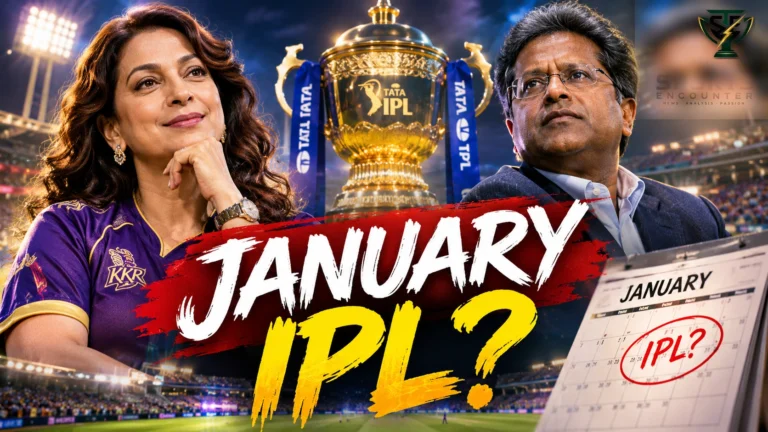
LONDON, England, November 10, 2026: Kolkata Knight Riders co-owner Juhi Chawla has backed a proposal to move the Indian Premier League from the scorching March-to-May period to January, arguing that cricket’s most commercially powerful franchise competition should no longer accept some of India’s harshest playing conditions. Her intervention follows former IPL chairman Lalit Modi’s call for the Board of Control for Cricket in India (BCCI) to consider either a January start or an extended October-to-April season. Both believe the tournament has become influential enough to reshape the international cricket calendar rather than continue accommodating it. However, the BCCI has not announced a January switch, and the proposal faces significant scheduling, climatic and commercial obstacles.
The debate extends well beyond player comfort. January already overlaps with Australia’s Big Bash League, South Africa’s SA20 and international cricket, while a six-month IPL season could interfere with national-team commitments and established domestic competitions. Moving the tournament would also force franchises, broadcasters and cricket boards to reconsider player releases, television agreements, stadium availability and the distribution of cricket’s growing franchise revenues. The IPL has substantial commercial influence, but the strongest argument for changing its calendar must demonstrate that better weather and greater earning potential would outweigh the disruption elsewhere.
Why Juhi Chawla Wants the IPL Moved to January
Chawla’s central argument is straightforward: the IPL has become one of cricket’s biggest commercial properties, yet much of its season is played when Indian temperatures can make outdoor sport uncomfortable for players and spectators.
The KKR co-owner believes January could provide a more enjoyable environment, particularly compared with April and May, when temperatures in several IPL cities can exceed 40 degrees Celsius.
Story at a glance

Why Juhi Chawla Wants the IPL Moved to January
Chawla’s central argument is straightforward: the IPL has become one of cricket’s biggest commercial properties, yet much of its season is played when Indian temperatures can make outdoor sport uncomfortable for players and spectators.
What Exactly Has Lalit Modi Proposed?
Lalit Modi, the IPL’s founding chairman, has advanced a broader argument than Chawla.
Has the BCCI Actually Agreed to Move the IPL?
No official decision to move the IPL to January has been established.
Would January Actually Offer Better Cricket Weather?
The proposal’s strongest immediate argument concerns reducing exposure to extreme heat.
The Biggest Scheduling Obstacle: Big Bash and SA20 Already Occupy January
The main international obstacle is not whether the BCCI possesses the authority to organize its domestic league.
Her public intervention also suggests that the league should exercise greater influence over its scheduling rather than treat the international calendar as an immovable constraint.
Chawla is not proposing a change to the IPL’s playing format, teams or competition rules. Her immediate argument concerns timing.
That distinction matters because the benefits she identifies are not guaranteed across every Indian venue.
January offers generally cooler conditions in much of the country, but winter can also bring cold evenings, fog and substantial dew, particularly across northern India.
Nevertheless, her suggestion raises a legitimate question: if a league has the financial resources to consider alternative scheduling, should it continue playing during periods of severe heat without examining the available options?
What Exactly Has Lalit Modi Proposed?
Lalit Modi, the IPL’s founding chairman, has advanced a broader argument than Chawla.
He believes the IPL has become commercially significant enough to establish a preferred calendar and negotiate international cricket around it.
Modi has suggested two alternatives.
The first is a January start, moving the competition into the Indian winter.
The second is a structured October-to-April season, potentially spreading matches across several months instead of concentrating them into approximately nine weeks.
His case is based on player welfare, commercial development, broadcasting opportunities and the value the league generates for international cricketers.
He has compared the IPL’s influence with the English Premier League, arguing that successful domestic competitions should have a meaningful role in shaping the wider sporting calendar.
However, Modi is a former IPL administrator, not the current decision-maker.
His proposal does not constitute a formal BCCI scheduling announcement.
Current IPL Window vs Proposed Alternatives
| Calendar Option | Potential Advantage | Principal Obstacle | Decision Status |
|---|---|---|---|
| Traditional late March-May | Established broadcasting and player-availability arrangements | Severe heat and possible late-season weather disruption | Established model |
| Earlier March-May | May reduce exposure to the hottest part of the season | Would still require coordination with international fixtures | Discussed by BCCI officials |
| January-February | Generally cooler conditions in many Indian cities | Big Bash, SA20, winter fog, dew and international commitments | Public proposal, not approved |
| October-April | Longer commercial season and more separated matchdays | Major restructuring of international and domestic cricket | Proposal from Lalit Modi |
The most realistic solution may not be the most radical one.
A modestly earlier start could reduce some heat exposure without demanding the extensive structural changes necessary for a January or six-month competition.
Has the BCCI Actually Agreed to Move the IPL?
No official decision to move the IPL to January has been established.
BCCI secretary Devajit Saikia has previously discussed the possibility of beginning the competition earlier than late March.
The concern involves both heat during the tournament and the possibility of pre-monsoon rain affecting matches toward the end of May.
That is materially different from approving a January calendar.
The BCCI’s publicly discussed option involves adjusting the existing window rather than relocating the entire season to winter.
Official scheduling history provides an important reference.
IPL 2026 comprised 70 league-stage matches and four playoff fixtures. The playoffs began on May 26 and concluded with the final on May 31.
The IPL’s official 2026 playoff announcement confirms those dates and the structure of the closing stage.
Any substantial relocation of a competition this size would involve more than selecting a different opening date.
Franchises would need confirmed schedules, venues, player agreements, travel arrangements and commercial commitments sufficiently far in advance.
Would January Actually Offer Better Cricket Weather?
The proposal’s strongest immediate argument concerns reducing exposure to extreme heat.
High temperatures can increase physical strain during outdoor competition, particularly when combined with humidity, travel and insufficient recovery time.
Daytime IPL fixtures are especially exposed, although evening matches can also take place in uncomfortable conditions.
Players can receive hydration, cooling facilities and medical support, but those protections do not remove every risk associated with severe heat.
A cooler window could potentially improve comfort for fielders, bowlers, umpires, support staff and spectators.
However, January is not uniformly ideal throughout India.
How Winter Conditions Differ Across IPL Cities
| City or Region | Potential January Advantage | Possible Winter Problem |
|---|---|---|
| Delhi and northern India | Reduced exposure to extreme summer heat | Cold evenings, fog, reduced visibility and dew |
| Lucknow and nearby northern venues | More comfortable daytime temperatures in many conditions | Fog and substantial nighttime dew |
| Mohali/New Chandigarh region | Much cooler than peak summer | Cold conditions and possible visibility disruption |
| Mumbai and western coastal venues | Potentially more comfortable evenings | Humidity and dew may still affect play |
| Chennai and southern coastal venues | Generally less intense heat than peak summer | Humidity, dew and local seasonal weather variations |
| Bengaluru and Hyderabad | Potentially favorable temperatures for many fixtures | Conditions still require venue-specific evaluation |
This table describes qualitative seasonal risks, not verified forecasts for specific matchdays. Actual suitability requires venue-level historical weather analysis.
The major cricketing issue is dew.
Moisture on the outfield and ball can make gripping and controlling deliveries more difficult, particularly for spin bowlers.
Heavy dew can also change conditions between innings, potentially giving the team batting second an advantage.
That does not mean every winter match would be decided by the toss, but it would be a significant factor for administrators to examine.
A January IPL could reduce one environmental problem while creating another.
The Biggest Scheduling Obstacle: Big Bash and SA20 Already Occupy January
The main international obstacle is not whether the BCCI possesses the authority to organize its domestic league.
It is whether overseas players could participate without conflicting contractual and national-team responsibilities.
Australia’s Big Bash League traditionally occupies part of December and January.
South Africa’s SA20 has also established itself in the January period.
Both competitions recruit international players and depend on predictable availability.
Moving the IPL into the same period would create direct competition for certain overseas cricketers.
It could also force IPL-associated ownership groups to reconsider how they manage investments across different leagues.
Why SA20 Makes the Proposal Especially Complicated
South Africa’s SA20 is not entirely separate from the IPL’s commercial ecosystem.
The six original SA20 franchises were acquired by groups associated with IPL teams.
Those connections include Mumbai Indians and MI Cape Town, Chennai Super Kings and Joburg Super Kings, and Sunrisers Hyderabad and Sunrisers Eastern Cape.
The ownership relationships are explored in TSE’s investigation into international franchise ownership and increasingly similar cricket identities.
For those investors, a January IPL would not simply challenge an unrelated competitor.
It could create scheduling conflicts between businesses in which IPL-connected ownership groups already have substantial interests.
If leading overseas players were required in India and South Africa simultaneously, franchises would need to determine which competition received priority.
The same issue would arise for broadcasters attempting to distribute overlapping cricket properties.
Which International Competitions Could Be Affected?
January and February already contain important cricket commitments.
Besides the Big Bash and SA20, national teams schedule bilateral tours and other international matches during this period.
Those commitments are not necessarily identical from year to year, making a permanent January IPL window more complicated than examining a single season.
| Competition or Commitment | Existing Calendar Relationship | Potential Impact of January IPL |
|---|---|---|
| Australia’s Big Bash League | Regularly includes January fixtures | Competing player and broadcasting commitments |
| South Africa’s SA20 | Established January competition window | Direct conflict involving overseas players and IPL-connected investors |
| International bilateral cricket | Varies by country and season | Possible interruptions to tours and national-team selection |
| Other franchise competitions | Some operate close to the proposed winter period | Recruitment, travel and player-release complications |
| ICC tournaments | Dates vary across tournament cycles | Multi-year planning would need to protect confirmed global events |
There is also a distinction between controlling the IPL’s domestic schedule and controlling the calendars of other cricket boards.
The BCCI can determine when its league operates, subject to its governing arrangements.
It cannot independently guarantee that other boards will release every contracted international player for the entire tournament.
That requires coordination and, in some cases, the renegotiation of obligations.
The difficulties surrounding national-board permissions have already appeared elsewhere.
TSE’s investigation into the PCB’s Abu Dhabi T10 participation dispute examined how delays and uncertainty over no-objection certificates can affect overseas franchise recruitment.
A January IPL would make the reliability of those processes even more important.
Would a January IPL Help or Hurt the Pakistan Super League?
This is one of the most important consequences for South Asian franchise cricket.
Pakistan’s HBL PSL 12 is scheduled from March 18 to May 2, 2027.
The Pakistan Cricket Board has confirmed an eight-team competition with 44 matches across a 46-day window.
The PCB’s official PSL roadmap also confirms a player auction on January 23 and plans to stage matches at five or six venues.
Under the IPL’s traditional calendar, the PSL faces competition for overseas players during March, April and May.
TSE’s analysis of the confirmed PSL calendar and expected IPL overlap examined the practical consequences for player recruitment and franchise planning.
A permanent January IPL could potentially reduce the direct matchday overlap with the PSL.
That would be an important benefit for the Pakistani competition.
However, the outcome would depend on when the January IPL ended, whether the season expanded, and how national-team commitments were rescheduled.
A January opening does not necessarily mean a tournament finishes before March.
How Different IPL Calendars Could Affect PSL 2027
| IPL Scenario | Potential Relationship With PSL | Key Uncertainty |
|---|---|---|
| Traditional late March-May | Substantial direct overlap likely | Exact IPL fixtures remain to be finalized |
| Earlier March-May | Overlap likely, depending on closing date | Whether moving earlier shortens the conflict |
| January start with completion before March 18 | No direct date overlap with the announced PSL window | Whether a full IPL season could fit before the PSL begins |
| January start extending into March or April | Some direct overlap remains possible | Actual tournament duration |
| October-April IPL season | Would overlap with part of the PSL season | Player releases, international breaks and scheduling structure |
TSE original calendar calculation: The PCB’s confirmed March 18-May 2 window covers 46 calendar days, inclusive. If a hypothetical IPL finished on March 17, it would have no direct date overlap with that window. If it continued through April, a significant collision would remain.
The calculation illustrates possible consequences. It is not evidence that the BCCI has selected either ending date.
Could the IPL Follow the English Premier League’s October-April Model?
Lalit Modi’s longer proposal is arguably more ambitious than moving the tournament to January.
A season extending from October to April would change the rhythm of franchise cricket.
Instead of staging fixtures almost daily across a concentrated period, administrators could spread matches across months, potentially concentrating more attention on selected matchdays.
That might provide greater opportunities for broadcasting packages, club promotion and sustained supporter engagement.
It would also change players’ relationships with franchises.
Overseas cricketers might need repeated periods of availability across several months rather than one clearly defined tournament commitment.
National boards would have to coordinate international tours around those obligations.
The comparison with football is attractive commercially but incomplete operationally.
International cricketers commonly represent national teams across Test, ODI and T20 formats. Their calendars differ significantly from those of footballers participating in an established system of domestic leagues and international breaks.
The World Cup Creates an Immediate Example of the Problem
The ICC Men’s Cricket World Cup is scheduled from October 2 to November 21, 2027, in South Africa, Zimbabwe and Namibia.
The ICC’s official tournament schedule confirms those dates.
An IPL season beginning in October 2027 would therefore overlap with the World Cup unless it incorporated an extended international break or adopted another arrangement.
This does not make an October-to-April competition impossible.
It demonstrates why applying a football-style calendar to cricket requires more detailed planning than simply extending the current league.
Players would need a workable schedule covering national-team responsibilities, franchise contracts, rest periods and travel.
Without that structure, a longer IPL could increase rather than reduce workload pressure.
Would Broadcasters Earn More From a Longer IPL?
Commercial expansion is one of the strongest arguments advanced by Modi.
A longer season could create more opportunities for sponsored programming, recurring match coverage and league-related content.
However, a longer period does not automatically produce higher broadcasting revenue.
The important variables would include total matches, average audience, advertising demand, distribution agreements and production costs.
Spreading a fixed number of matches across six months would create a different product from adding extra fixtures.
Similarly, adding matches could increase available advertising inventory while also increasing operating expenses and potentially reducing average audience attention.
The Hundred provides a useful comparison.
England’s franchise competition has experienced significant commercial and branding changes, but greater investment has not removed questions about stadium attendance and supporter loyalty.
TSE’s investigation into The Hundred’s attendance and commercial challenges examined the difference between increasing franchise investment and securing dependable matchday demand.
The lesson is relevant to the IPL.
Financial strength provides options, but a new calendar would still require evidence that supporters and broadcasters want the proposed product.
Could Other Franchise Leagues Lose Their Best Players?
The IPL’s financial strength already influences overseas-player recruitment.
Some cricketers face difficult decisions when tournament schedules overlap or when national boards impose participation conditions.
The IPL’s global reach allows its franchises to compete effectively for leading talent, but that does not eliminate existing contracts elsewhere.
A January relocation could force players to choose between IPL opportunities and established winter competitions.
That would be especially relevant for Australian and South African players already committed to domestic franchise cricket.
The problem extends beyond January.
England’s Hundred has also been examining changes to overseas-player recruitment, reflecting greater competition among T20 leagues.
Meanwhile, the UAE’s International League T20 has expanded its commercial profile through international recruitment and a player auction.
TSE’s analysis of the ILT20’s latest season and recruitment strategy examines how another established franchise competition is building its identity and attracting overseas players.
For franchise owners, availability can be as important as batting averages, strike rates or bowling figures.
A player who misses an important part of the tournament because of another contractual commitment can leave a squad with problems that were foreseeable months earlier.
The expanding global franchise market makes these calculations increasingly important.
What About the IPL’s Existing Player Contracts and Auctions?
The current IPL recruitment process is moving ahead under the existing framework.
Franchises are preparing their retention decisions and the December player auction.
Chennai Super Kings and Sunrisers Hyderabad have already completed a significant four-player trade.
Liam Livingstone and Jack Edwards have joined Chennai, while Khaleel Ahmed and Nathan Ellis have moved to Hyderabad.
TSE’s detailed breakdown of the four-player trade examines the confirmed player fees, squad changes and strategic risks.
Those decisions are being made before any January calendar has been approved.
That is an important limitation on speculation.
Franchises cannot reasonably be expected to finalize travel schedules, overseas-player availability and contractual commitments on the assumption that a social-media proposal will become official policy.
Any change affecting an already scheduled competition would require adequate notice and an orderly transition.
What Could a January IPL Mean for Cricket’s Commercial Power Balance?
Moving the IPL would do more than change playing conditions.
It could influence how other leagues select tournament dates, negotiate player availability and evaluate their financial prospects.
Some competitions might benefit if the IPL moved away from their existing windows.
Others could face direct competition.
For example, a completed January-February IPL could potentially reduce the scheduling pressure on the PSL while intensifying it for the Big Bash and SA20.
That redistribution of commercial pressure is central to the debate.
It is also why decisions cannot be evaluated solely from the perspective of IPL franchises.
National boards have responsibilities involving domestic cricket, player development and international commitments.
New Zealand Cricket recently demonstrated that such priorities can influence decisions about overseas franchise investments.
TSE’s report on New Zealand Cricket withdrawing from a proposed Major League Cricket franchise arrangement examined why the board chose to prioritize its domestic and high-performance systems.
That example is not directly equivalent to the IPL’s calendar debate, but it illustrates the competing responsibilities faced by national cricket administrators.
What Must the BCCI Investigate Before Making a Decision?
A scheduling change should be assessed through measurable outcomes rather than commercial confidence alone.
Three questions deserve priority.
First, how much would the change improve player and spectator safety?
Second, could leading overseas players remain available without damaging existing international commitments?
Third, would broadcasters, sponsors and supporters value the resulting competition enough to justify its additional costs?
Evidence Needed Before Approving a New IPL Window
| Area | Required Evidence | Decision Criterion |
|---|---|---|
| Player welfare | Historical heat, humidity, dew, recovery and injury data | Measurable improvement in playing conditions |
| Venue suitability | City-specific winter conditions, fog and visibility records | Reliable competition scheduling |
| International calendar | Confirmed bilateral and ICC commitments | Workable national-team release arrangements |
| Franchise availability | Overseas contracts and competing league schedules | Players available for the tournament’s decisive stages |
| Broadcast economics | Projected audiences, rights terms and production costs | Financial benefit supported by evidence |
| Supporter experience | Ticket demand, travel patterns and match-time preferences | Improved accessibility and attendance |
| Domestic cricket | State-association and development competition schedules | Minimal avoidable disruption to cricket pathways |
There are broader welfare concerns as well.
Modern franchise cricketers frequently move between countries and competitions with limited recovery periods.
Contractual obligations, injury provisions and national-board clearances can add uncertainty to already demanding schedules.
TSE’s investigation into Mitchell Santner’s reported IPL payment dispute examined why injury-related contract terms require transparency, while clearly distinguishing allegations from established contractual breaches.
A longer or rescheduled IPL should provide greater clarity on such protections, not introduce additional uncertainty.
Could a Bigger IPL Calendar Damage Smaller Franchise Competitions?
The concern is not limited to established international leagues.
Smaller competitions also depend on recognizable scheduling windows and the ability to recruit players.
Pakistan has already considered creating an additional PSL-branded six-a-side event to reach smaller cities and develop another commercial product.
TSE’s examination of the proposed PSL Sixes competition identified player availability and broadcasting economics among the principal unanswered questions.
A longer IPL could complicate scheduling for such emerging events if their preferred dates overlap.
On the other hand, a carefully selected January IPL finishing before other competitions begin might create new opportunities elsewhere in the year.
The result depends on the actual schedule, not simply the reputation or commercial power of the league proposing the change.
This is why coordinated planning could produce better outcomes than competing administrators independently announcing increasingly long tournaments.
Continue the Cricket Story
 Indian Premier LeagueCSK-SRH Four-Player IPL 2027 Trade: Livingstone Joins Chennai as Khaleel and Ellis Head to Hyderabad
 CricketU19 Asia Cup Semifinals: Pakistan’s Perfect Run Meets Bangladesh Bowlers as India Face Unbeaten Afghanistan
 Abu Dhabi T10Abu Dhabi T10: Yas Lions End United Tigers’ Perfect Run as Hetmyer and Haider Punish UAE Bulls
Frequently Asked Questions About Moving the IPL to January
Why does Juhi Chawla want the IPL in January?
The Kolkata Knight Riders co-owner believes January could offer better playing and spectator conditions than the extreme heat frequently experienced during April and May.
Has the BCCI officially moved IPL 2027 to January?
No. The BCCI has not announced a January switch. Its officials have publicly discussed the possibility of starting the tournament earlier than late March.
What is Lalit Modi’s IPL calendar proposal?
The former IPL chairman has suggested examining either a January start or a structured October-to-April season, emphasizing better conditions and greater commercial opportunities.
Would January weather be better for IPL players?
January is generally cooler across much of India, but conditions differ by venue. Cold evenings, winter fog and dew could create problems at some grounds.
Which leagues could clash with a January IPL?
Australia’s Big Bash League and South Africa’s SA20 are the two most obvious established franchise competitions with January scheduling exposure.
Would moving the IPL help the Pakistan Super League?
It could reduce direct scheduling overlap if the IPL finished before the PSL’s March 18 start. However, a January IPL extending into March or April could still conflict with the Pakistani tournament.
Can the IPL change its dates without ICC permission?
The BCCI controls the organization of its domestic competition, but a new window would still require coordination over player releases, national-team commitments and existing commercial agreements.
Could the IPL run from October to April?
It is technically a possible competition model, but the calendar would need restructuring. The 2027 Cricket World Cup already occupies October and November, illustrating the need for international breaks.
When is the IPL 2027 auction?
The mini-auction is scheduled for December 16, 2026, in Goa, with teams preparing their retention and squad decisions beforehand.
What is the most realistic alternative to the current IPL calendar?
Moving the start earlier in March appears less disruptive than January or October-to-April, but its suitability would still require confirmation from the BCCI and supporting operational analysis.
Will the IPL Move to January?
The argument for reconsidering the IPL calendar is legitimate.
Extreme summer heat affects players, officials and spectators, and a competition with substantial commercial resources has reasons to investigate safer and more comfortable playing conditions.
Juhi Chawla has brought that concern into a wider debate about the IPL’s responsibilities and influence.
Lalit Modi has taken the argument further, proposing that cricket’s most powerful franchise competition should reshape the international calendar around its commercial strength.
But the alternatives are not free from consequences.
A January start could reduce heat exposure while creating conflicts with the Big Bash, SA20 and international cricket.
An October-to-April season could provide greater broadcasting opportunities but would require major changes to international scheduling, including accommodation of global events such as the 2027 World Cup.
A modestly earlier March start would be less revolutionary, although it would not eliminate every weather concern.
The BCCI’s decision should therefore depend on verified benefits, realistic player availability, venue suitability and financial evidence.
The IPL has earned substantial influence through its players, franchises, supporters and commercial success.
Whether it has earned the ability to reshape world cricket’s calendar is a more complicated question.
The answer will depend not on who makes the strongest public argument, but on whether a better schedule can be created without making the rest of cricket pay an unreasonable price.