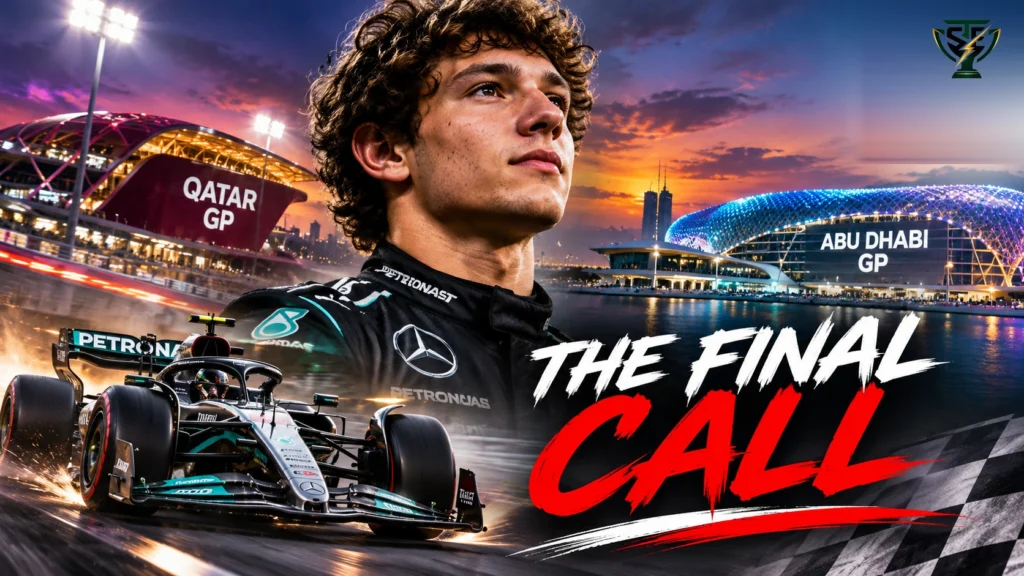
LONDON, England, November 10, 2026: Formula 1 will proceed with its scheduled season-ending races in Qatar and Abu Dhabi after telling Italy’s Imola circuit that its services as an emergency replacement are no longer required. The decision, communicated to the championship’s 11 teams and local organizers on Tuesday, preserves the Qatar Grand Prix on November 29 and the Abu Dhabi Grand Prix on December 6. It ends months of uncertainty over a possible Italian finale, although Formula 1 has made clear that worsening security conditions in the Middle East could still force either race to be canceled.
The announcement comes after a season repeatedly disrupted by regional conflict, including the cancellation of Saudi Arabia’s Grand Prix and the relocation of Bahrain’s race to Malaysia. Yet the implications now extend beyond the Formula 1 championship itself. Kimi Antonelli has already secured the drivers’ title and Mercedes have clinched the constructors’ championship, leaving the closely contested Formula 2 championship as one of the most important sporting reasons to preserve the final two race weekends. Rafael Câmara leads Nikola Tsolov by seven points and Alexander Dunne by 18, meaning the events at Lusail and Yas Marina could still settle a championship on the track.
What Has Formula 1 Decided About Qatar, Abu Dhabi and Imola?
The immediate decision is straightforward. Formula 1 intends to complete its remaining calendar at the venues already scheduled, starting with Las Vegas before heading to Qatar and Abu Dhabi.
Imola, officially the Autodromo Enzo e Dino Ferrari, had been preparing to host a replacement race on the Abu Dhabi weekend if Formula 1 concluded that racing in the Middle East was unsafe.
Story at a glance
What Has Formula 1 Decided About Qatar, Abu Dhabi and Imola?
The immediate decision is straightforward. Formula 1 intends to complete its remaining calendar at the venues already scheduled, starting with Las Vegas before heading to Qatar and Abu Dhabi.
Why Was Imola Preparing to Replace Abu Dhabi?
Imola became Formula 1’s contingency option after the conflict involving Iran, Israel and the United States disrupted the championship’s Middle East schedule.
Does the Decision Guarantee Both Middle East Races Will Happen?
No. Formula 1’s decision confirms its operational intention, not an unconditional commitment to race regardless of circumstances.
Why the Qatar MotoGP Weekend Matters to Formula 1’s Decision
One recent development provided additional evidence that major motorsport activity remains possible in Qatar.
Why the Decision Still Matters After Antonelli and Mercedes Won Both Titles
The unusual feature of this season-ending decision is that neither Formula 1 world championship remains undecided.
That contingency required an operational deadline. Organizers could not continue preparing a major international sporting event indefinitely without knowing whether it would take place.
Formula 1 has now informed the Italian venue that those arrangements are unnecessary.
All 11 championship teams have been informed of the decision and, according to Formula 1’s account, support proceeding with the scheduled races.
However, the announcement does not mean the championship has removed security considerations from its planning.
Formula 1 and the FIA retain responsibility for assessing conditions as the race weekends approach. Further deterioration could still lead to cancellations.
The Three Remaining Formula 1 Races
| Round | Grand Prix | Race Date | Circuit | Current Status |
|---|---|---|---|---|
| 21 | Las Vegas | November 21 | Las Vegas Strip Circuit, United States | Scheduled |
| 22 | Qatar | November 29 | Lusail International Circuit, Qatar | Scheduled, subject to ongoing safety assessments |
| 23 | Abu Dhabi | December 6 | Yas Marina Circuit, United Arab Emirates | Scheduled, subject to ongoing safety assessments |
The dates correspond to the official Formula 1 race calendar, which currently lists 23 rounds.
The important change is that the possibility of substituting Imola has been removed from the active planning arrangements.
For teams, promoters and spectators, the next task is preparing for the original venues while remaining alert to further official announcements.
Why Was Imola Preparing to Replace Abu Dhabi?
Imola became Formula 1’s contingency option after the conflict involving Iran, Israel and the United States disrupted the championship’s Middle East schedule.
The initial calendar contained races in Bahrain and Saudi Arabia during April.
Those events could not take place at their originally planned venues and dates.
Saudi Arabia’s round was canceled, while Bahrain’s Grand Prix was subsequently held at Malaysia’s Sepang International Circuit in October.
The later races in Qatar and Abu Dhabi remained on the calendar, but uncertainty over regional security prompted Formula 1 to examine alternatives.
Imola was an attractive option because it had previously staged Formula 1 races, possessed established infrastructure and could theoretically accommodate a replacement event in the final available calendar window.
However, staging a Grand Prix requires considerable advance preparation.
Grandstands, security services, staffing, broadcasting facilities, local transport arrangements and commercial operations cannot be assembled at a moment’s notice.
That practical reality explains why Formula 1 needed to decide whether Imola should continue preparing, even though the Middle East races were still several weeks away.
How Regional Conflict Changed the Championship Calendar
| Event | Original Plan | What Changed | Current Consequence |
|---|---|---|---|
| Bahrain Grand Prix | Race at Sakhir in April | Original event disrupted; replacement held at Sepang in October | Championship round retained at a different venue |
| Saudi Arabian Grand Prix | Race at Jeddah in April | Event canceled | Calendar reduced by one round |
| Qatar Grand Prix | November race at Lusail | Security concerns prompted contingency planning | Original event remains scheduled |
| Abu Dhabi Grand Prix | Season finale at Yas Marina | Imola considered as potential replacement | Original event remains scheduled |
| Potential Imola replacement | Not part of the original championship calendar | Prepared as a contingency for the final weekend | Organizers informed that the venue is no longer required |
The calendar was originally announced with 24 rounds. It now contains 23.
That reduction is directly attributable to the loss of the Saudi Arabian race, while the Bahrain round survived through relocation.
The Qatar and Abu Dhabi decision therefore prevents another immediate revision, rather than reversing the disruptions that have already occurred.
Does the Decision Guarantee Both Middle East Races Will Happen?
No. Formula 1’s decision confirms its operational intention, not an unconditional commitment to race regardless of circumstances.
FIA president Mohammed Ben Sulayem has publicly expressed confidence in the championship’s preparations for Qatar and Abu Dhabi.
His position reflects a determination to complete the season at the scheduled venues, while the sport continues monitoring the regional situation.
Formula 1 officials have also emphasized that the safety of drivers, team personnel, officials and spectators remains the deciding consideration.
This is particularly important because Formula 1 races involve thousands of people traveling between countries, transporting equipment and working at circuits for several days.
A venue’s ability to operate normally today does not establish what security conditions will be several weeks later.
The governing and commercial authorities must therefore assess the situation continuously, rather than treating the announcement as a permanent security guarantee.
What Happens Under Different Safety Scenarios?
| Scenario | Current Evidence | Possible Consequence |
|---|---|---|
| Conditions remain acceptable | Formula 1 plans to race at Lusail and Yas Marina | Both scheduled Grands Prix proceed |
| Security conditions deteriorate before Qatar | Formula 1 retains the option to cancel events | Qatar may be canceled; subsequent arrangements require a new decision |
| Qatar proceeds, but conditions deteriorate before Abu Dhabi | Safety decisions remain subject to ongoing assessment | Abu Dhabi could be canceled |
| Imola is reconsidered | Organizers have been stood down from the current replacement plan | No replacement race is currently confirmed or being prepared under that plan |
| Both Middle East races are canceled | Possible only if further decisions are taken | Las Vegas could become the final completed Formula 1 round |
These are conditional possibilities, not predictions.
There is no official announcement that Qatar or Abu Dhabi will be canceled, and no replacement race has been confirmed.
The distinction matters because interpreting the withdrawal of Imola as proof that every risk has disappeared would misrepresent the decision.
Why the Qatar MotoGP Weekend Matters to Formula 1’s Decision
One recent development provided additional evidence that major motorsport activity remains possible in Qatar.
MotoGP completed its race weekend at Lusail in early November.
The event took place despite security concerns, demonstrating that the venue could conduct a major international motorsport meeting under the conditions prevailing at that time.
That experience is relevant to Formula 1 because both championships operate large international events requiring extensive logistics and coordination.
However, the successful staging of one event cannot guarantee the safety of another several weeks later.
Formula 1 has different logistical requirements, a different race schedule and its own responsibility for assessing conditions.
The MotoGP weekend is therefore evidence that Lusail can operate under current circumstances, rather than proof that future disruption is impossible.
Why the Decision Still Matters After Antonelli and Mercedes Won Both Titles
The unusual feature of this season-ending decision is that neither Formula 1 world championship remains undecided.
Italian driver Kimi Antonelli secured the drivers’ championship at the Mexico City Grand Prix, becoming the youngest world champion in Formula 1 history.
Mercedes completed the double at São Paulo, clinching the constructors’ championship following the results of George Russell and Antonelli.
Russell finished fourth in Brazil, with Antonelli fifth. Those positions were sufficient to secure Mercedes’ ninth constructors’ title.
The championship also marked Mercedes’ first constructors’ success since 2021.
According to Formula 1’s official account of Mercedes’ championship achievement, the result brought the team level with Williams on nine constructors’ titles.
The final three Grands Prix will therefore take place without a fight for either Formula 1 world championship.
Individual race victories, remaining championship positions, team performance and preparation for the following season still matter.
For the drivers, the opportunity to compete at established circuits also carries value beyond the final championship standings.
Antonelli can continue his first title-winning season, while rivals such as Max Verstappen, Lando Norris, Charles Leclerc and George Russell seek strong finishes.
The calendar decision also preserves the commercial and operational commitments associated with the races, although no verified financial estimate has been established for the consequences of cancellation.
What Is Already Decided and What Remains Open?
| Competition or Issue | Position Before Las Vegas | What Remains at Stake? |
|---|---|---|
| Formula 1 Drivers’ Championship | Kimi Antonelli is champion | Remaining finishing positions and race results |
| Formula 1 Constructors’ Championship | Mercedes are champions | Remaining team positions and individual race performances |
| Formula 2 Drivers’ Championship | Rafael Câmara leads by seven points | Championship title remains undecided |
| Qatar Grand Prix | Scheduled for November 29 | Successful delivery depends on continuing acceptable safety conditions |
| Abu Dhabi Grand Prix | Scheduled for December 6 | Season finale remains subject to safety assessments |
| Imola contingency | Venue stood down | No active replacement race confirmed |
The table highlights why the decision cannot be assessed solely through Formula 1’s two championship trophies.
The Formula 2 title race remains close enough that removing its final events would materially change how the championship concludes.
Formula 2 Has the Most Immediate Championship Stake
Unlike Formula 1, the Formula 2 drivers’ championship remains unresolved.
Brazilian Rafael Câmara leads with 207 points for Invicta Racing.
Nikola Tsolov of Campos Racing follows on 200, while Rodin Motorsport’s Alexander Dunne is third with 189.
Those figures come from the official FIA Formula 2 championship standings.
Formula 2 Drivers’ Championship Before the Final Two Rounds
| Position | Driver | Team | Points | Gap to Leader |
|---|---|---|---|---|
| 1 | Rafael Câmara | Invicta Racing | 207 | Leader |
| 2 | Nikola Tsolov | Campos Racing | 200 | 7 |
| 3 | Alexander Dunne | Rodin Motorsport | 189 | 18 |
| 4 | Gabriele Minì | MP Motorsport | 163 | 44 |
| 5 | Dino Beganovic | DAMS Lucas Oil | 137 | 70 |
TSE statistical analysis: Tsolov is only seven points behind Câmara, while Dunne trails by 18. The difference between the top three is small enough to make the remaining championship rounds important to the eventual outcome.
Any exact mathematical title permutations would need to incorporate the applicable sprint-race, feature-race and bonus-point rules, as well as the remaining race program.
Those calculations should not be replaced by assumptions about who needs to win a particular race.
The most significant immediate consequence of retaining Qatar and Abu Dhabi is that Formula 2 is expected to have the opportunity to settle its championship through the scheduled sporting competition.
For young drivers building careers toward Formula 1, those results also provide important evidence of performance under pressure.
Câmara has already attracted Formula 1 attention, including an appearance with Haas during the Brazilian Grand Prix weekend.
His title fight with Tsolov and Dunne therefore carries interest beyond the Formula 2 championship standings.
Why Dropping Imola Changes the Emergency Options
Imola was never part of the original Formula 1 race calendar for this season.
Its potential return was a contingency designed to preserve a season-ending event if conditions prevented racing in the Middle East.
By releasing the circuit from those preparations, Formula 1 has removed an immediately available alternative from its current planning.
That does not prevent the sport from making new decisions if circumstances change.
It does mean there is no longer a confirmed, prepared Italian replacement waiting to be activated under the previously established arrangement.
The sporting implications of any later cancellation are now clearer because the championship has already lost one originally scheduled round.
If Qatar alone were canceled, the season would finish with 22 races unless another event was added.
If Abu Dhabi alone were canceled, the same total would apply.
If both were canceled, the season would finish with 21 completed rounds, assuming Las Vegas proceeds.
These calculations describe the effect on the Formula 1 calendar only. They do not establish that either cancellation is likely.
What the Decision Means for Drivers, Teams and Fans
For Formula 1 teams, Tuesday’s announcement provides a clearer basis for travel, freight and staffing arrangements.
Preparing for consecutive races in different countries requires considerable logistical coordination.
The decision also provides additional certainty to the organizers of the Qatar and Abu Dhabi Grands Prix, who can continue preparing for their scheduled events.
For fans holding tickets or planning to travel, the announcement confirms Formula 1’s current intention to race at both venues.
However, people making travel decisions should continue checking official event and government information, including applicable travel and insurance conditions.
Neither Formula 1’s sporting confirmation nor the successful recent MotoGP event should be interpreted as a personal safety guarantee.
The eventual decision to proceed remains dependent on developments that could change before either Grand Prix.
Continue the Motorsport Story

Frequently Asked Questions
Will Formula 1 race in Qatar and Abu Dhabi?
Formula 1 intends to hold both Grands Prix as scheduled. Qatar is set for November 29 and Abu Dhabi for December 6, subject to ongoing security assessments.
Why was Imola considered as a replacement?
Imola was preparing as a contingency because regional conflict created uncertainty around the season-ending races in the Middle East.
Is Imola hosting a Formula 1 race this season?
No. Formula 1 has informed the circuit that it is no longer required for the previously planned replacement event.
Could the Qatar and Abu Dhabi Grands Prix still be canceled?
Yes. Formula 1 retains the ability to cancel either race if worsening security conditions make proceeding inappropriate.
Who won the Formula 1 Drivers’ Championship?
Kimi Antonelli secured the championship in Mexico City, becoming the youngest drivers’ world champion in Formula 1 history.
Who won the Constructors’ Championship?
Mercedes clinched the title at the São Paulo Grand Prix, securing their ninth constructors’ championship.
Which championship remains undecided?
The Formula 2 Drivers’ Championship remains open, with Rafael Câmara leading Nikola Tsolov by seven points before the remaining rounds.
When is the next Formula 1 race?
The next Grand Prix is scheduled for November 21 in Las Vegas, followed by Qatar on November 29 and Abu Dhabi on December 6.
What Happens Next?
Formula 1 now moves toward Las Vegas with its two world champions already crowned and its final travel plans largely established.
The Qatar and Abu Dhabi rounds remain scheduled, giving the championship the opportunity to complete 23 races despite an unusually disrupted season.
The decision has also kept Formula 2’s championship fight on course for a competitive conclusion, with Câmara, Tsolov and Dunne still pursuing the title.
However, the remaining uncertainty cannot be resolved through a calendar announcement alone.
Formula 1 has chosen to proceed with its original Middle East finale and released Imola from contingency preparations. What happens next will depend on whether security conditions continue to support that decision.
For the teams and fans preparing for Lusail and Yas Marina, the schedule is clearer. The final confirmation will come when the races actually take place.
Readers interested in the championship’s wider history can also explore TSE’s feature on Alan Jones, the champion who delivered Williams its first Formula 1 drivers’ title.