Key Takeaways
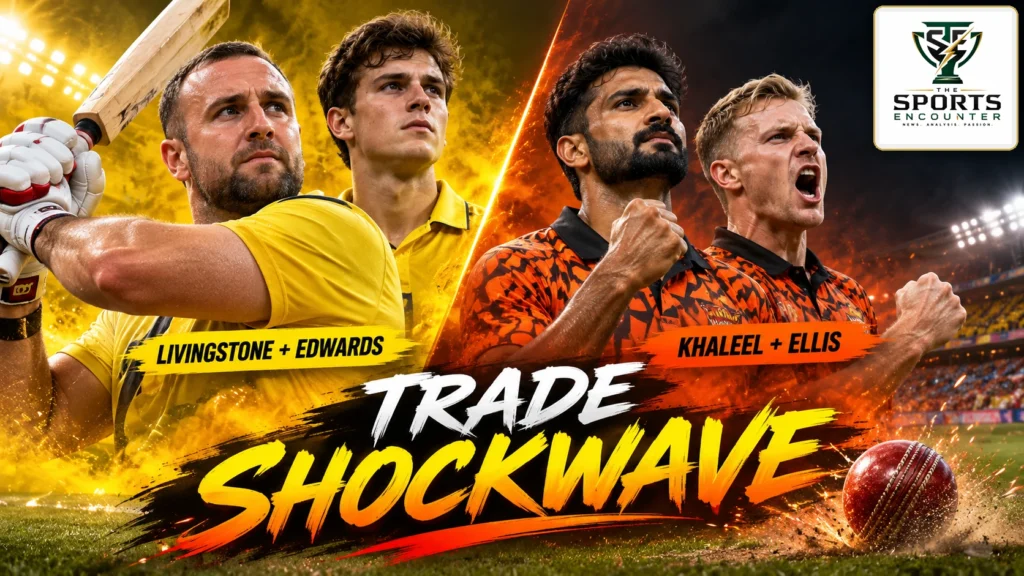
- Livingstone and Edwards move from Hyderabad to Chennai.
- The transfer figures were confirmed by the IPL’s official November 5 trade announcement.
- Nathan Ellis could prove equally important to Hyderabad’s plans.
- Chennai Super Kings and Sunrisers Hyderabad have confirmed a transaction that changes four important squad positions.
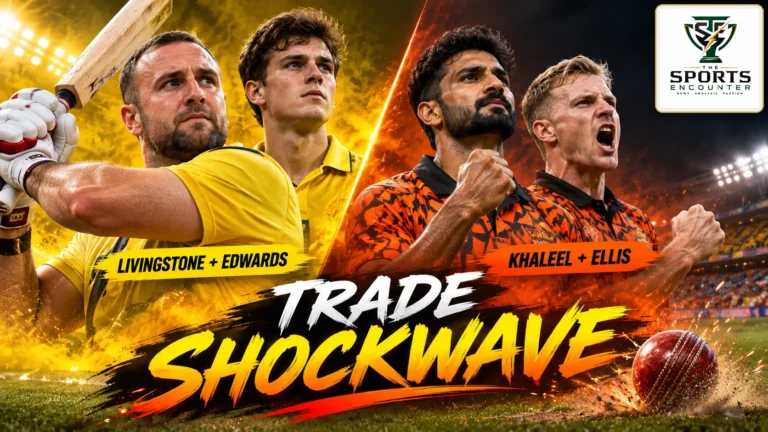
NEW DELHI, India, November 5, 2026: Chennai Super Kings and Sunrisers Hyderabad have completed a four-player trade ahead of IPL 2027, exchanging two specialist fast bowlers for two all-rounders in one of the biggest confirmed squad changes before the December mini-auction. England’s Liam Livingstone and Australia’s Jack Edwards will join five-time champions CSK, while India’s Khaleel Ahmed and Australian pacer Nathan Ellis will move to SRH. The Indian Premier League confirmed the agreement on Thursday, with Livingstone joining Chennai at a revised fee of ₹6 crore, down from the ₹13 crore Hyderabad previously paid for him. Edwards moves for ₹3 crore, Khaleel for ₹4.8 crore and Ellis for ₹2 crore.
The agreement reflects the contrasting requirements of two franchises emerging from very different IPL 2026 campaigns. Chennai finished eighth with six victories from 14 league matches, while Hyderabad placed third with nine wins before losing the Eliminator to Rajasthan Royals. CSK are adding batting power and all-round flexibility, but surrendering two established pace options. SRH are strengthening their fast-bowling resources, particularly the powerplay and death overs, while giving up Livingstone’s explosive batting and Edwards’ developing all-round potential. With the November 17 retention deadline and December 16 auction approaching, both teams have made significant decisions before their final 2027 squads are assembled.
CSK-SRH IPL 2027 Trade: Which Four Players Have Changed Teams?
The IPL’s official announcement establishes the destination and fee of every player involved.
Story at a glance
CSK-SRH IPL 2027 Trade: Which Four Players Have Changed Teams?
The IPL’s official announcement establishes the destination and fee of every player involved.
Why Chennai Super Kings Have Signed Liam Livingstone for ₹6 Crore
Livingstone is the biggest established batting name involved in the trade.
Who Is Jack Edwards, Chennai’s New Australian All-Rounder?
Jack Edwards is the less established IPL player in the exchange, but potentially an important long-term addition.
Khaleel Ahmed Returns to Sunrisers Hyderabad After Two Seasons With CSK
Khaleel’s move has an additional element of familiarity.
Nathan Ellis to SRH: Why His Death-Overs Skills Matter
Nathan Ellis could prove equally important to Hyderabad’s plans.
Livingstone and Edwards move from Hyderabad to Chennai. Khaleel and Ellis travel in the opposite direction.
The transaction changes the balance of both squads without waiting for the player auction.
IPL 2027 Four-Player Trade: Complete List and Confirmed Fees
| Player | Previous Team | New Team | Confirmed Fee | Primary Role |
|---|---|---|---|---|
| Liam Livingstone | Sunrisers Hyderabad | Chennai Super Kings | ₹6 crore | Power-hitting batting all-rounder, part-time spin |
| Jack Edwards | Sunrisers Hyderabad | Chennai Super Kings | ₹3 crore | Seam-bowling all-rounder |
| Khaleel Ahmed | Chennai Super Kings | Sunrisers Hyderabad | ₹4.8 crore | Left-arm fast bowler |
| Nathan Ellis | Chennai Super Kings | Sunrisers Hyderabad | ₹2 crore | Right-arm fast bowler, death-overs specialist |
The transfer figures were confirmed by the IPL’s official November 5 trade announcement.
Livingstone is the only player whose confirmed fee was revised in the deal. Edwards, Khaleel and Ellis retain their existing fees.
The trade is not a simple exchange of identical playing roles. Chennai have transferred two specialist pacers and acquired two players capable of contributing with both bat and ball.
Hyderabad have moved in the opposite direction, choosing more specialized pace-bowling options.
Why Chennai Super Kings Have Signed Liam Livingstone for ₹6 Crore
Livingstone is the biggest established batting name involved in the trade.
The England international is known for his powerful hitting against spin and pace, his ability to clear long boundaries and his usefulness as a part-time bowler.
He can bowl both off-spin and leg-spin, giving captains an additional tactical option depending on the opposition’s batting lineup.
For Chennai, his main attraction is the ability to change a T20 innings quickly.
He is capable of attacking during the middle overs, when many teams try to control the scoring rate through spin.
That could be particularly valuable at Chennai’s MA Chidambaram Stadium, where variations in pace and spin often influence tactical decisions.
However, Livingstone’s effectiveness will depend on his batting position, form and the conditions he encounters. His reputation alone cannot guarantee improvement.
Livingstone’s Price Falls From ₹13 Crore to ₹6 Crore
The most striking financial detail is Livingstone’s revised fee.
Hyderabad had acquired him for ₹13 crore before IPL 2026.
Chennai will now receive him at a confirmed fee of ₹6 crore.
The reduction amounts to ₹7 crore, or approximately 53.85% of the original figure.
| Livingstone Contract Detail | Amount |
|---|---|
| Previous SRH fee | ₹13 crore |
| Revised CSK fee | ₹6 crore |
| Reduction | ₹7 crore |
| Percentage reduction | 53.85% |
| Revised fee as share of old fee | 46.15% |
The reduction is confirmed by the league, but it should not automatically be described as ₹7 crore in cash saved by Chennai.
The original ₹13 crore was Hyderabad’s acquisition price, not an amount Chennai had previously committed to paying.
Furthermore, franchise salary-cap treatment and the overall financial consequences of trades depend on applicable IPL rules and each team’s wider squad commitments.
What can be established is that Livingstone joins CSK at less than half his previous listed fee.
Can Livingstone Solve Chennai’s Middle-Order Problems?
CSK’s 2026 league campaign produced only six victories in 14 games.
The team finished eighth with 12 points and a negative net run rate.
That outcome makes the addition of an attacking middle-order batter understandable.
Livingstone can provide an option to accelerate between overs seven and 15, particularly against opponents using spin to restrict boundaries.
But Chennai must decide whether he should operate as a specialist middle-order aggressor, a floating batter or a more regular all-round option.
Those are different responsibilities, and his effectiveness will depend partly on how clearly his role is defined.
The Sports Encounter covered Livingstone’s explosive limited-overs batting in its report on Livingstone and Dewald Brevis attacking Birmingham Phoenix.
His ability to contribute in difficult circumstances was also evident in his 69 against Manchester Super Giants in The Hundred.
Those performances demonstrate his attacking potential in short-form cricket, although The Hundred and the IPL are different competitions and their performances cannot be treated as directly interchangeable.
Who Is Jack Edwards, Chennai’s New Australian All-Rounder?
Jack Edwards is the less established IPL player in the exchange, but potentially an important long-term addition.
The Australian is a seam-bowling all-rounder who offers another combination of batting and pace bowling.
Hyderabad signed him for ₹3 crore before he made his senior international debut for Australia.
However, a foot injury prevented him from appearing in IPL 2026.
Consequently, Edwards moves to Chennai without having made his IPL debut.
That distinction matters when evaluating his value.
He has demonstrated the ability to contribute in Australian domestic cricket, but there is no IPL performance sample from which to predict his immediate results.
Why Edwards Could Be More Than a Backup Player
An all-rounder who can contribute useful overs of seam bowling and score quickly lower in the order provides selection flexibility.
Chennai could use Edwards to strengthen batting depth without entirely sacrificing a bowling option.
But whether he plays regularly will depend on squad balance, overseas-player availability and the final composition of CSK’s pace attack.
His position also raises a practical question: can a developing all-rounder compensate for the specialist bowling resources Chennai have surrendered?
The answer cannot be established before seeing him perform in IPL conditions.
His injury history also requires careful consideration. The foot problem that ruled him out of IPL 2026 is documented, but his precise fitness and availability for the 2027 season will require updated confirmation closer to the tournament.
For context on the wider pipeline of Australian T20 talent, The Sports Encounter’s 2026-27 Big Bash League preview examines the competition’s squad development and recruitment environment.
Khaleel Ahmed Returns to Sunrisers Hyderabad After Two Seasons With CSK
Khaleel’s move has an additional element of familiarity.
The Indian left-arm fast bowler previously represented Sunrisers Hyderabad from 2018 through 2021.
He will now return to the franchise after two seasons associated with Chennai.
His transfer fee remains ₹4.8 crore.
Unlike Livingstone, Khaleel is not joining at a revised amount.
Khaleel’s 2025 Form and 2026 Injury Explain the Trade’s Risk
Khaleel was an important part of Chennai’s pace attack during IPL 2025.
He took 15 wickets in 14 matches, establishing himself as a useful wicket-taking option.
However, his following season was interrupted.
He appeared in only five IPL 2026 matches before a right quadriceps injury ruled him out.
| Season | Team | Matches | Verified Outcome |
|---|---|---|---|
| 2018-2021 | Sunrisers Hyderabad | Previous SRH tenure | Established his association with the franchise |
| 2025 | Chennai Super Kings | 14 | 15 wickets |
| 2026 | Chennai Super Kings | 5 | Season ended by right quadriceps injury |
| 2027 | Sunrisers Hyderabad | Not yet played | Returns at ₹4.8 crore |
For Hyderabad, Khaleel offers something different from a right-arm pace bowler.
His left-arm angle can alter the lines batters must defend and create opportunities during the powerplay.
He can also provide a different match-up against right-handed top-order players.
But SRH must evaluate how effectively he has recovered from the quadriceps injury.
A confirmed transfer should not be confused with a verified return to full match fitness.
Nathan Ellis to SRH: Why His Death-Overs Skills Matter
Nathan Ellis could prove equally important to Hyderabad’s plans.
The Australian fast bowler is known for changes of pace, slower deliveries and the ability to operate during the final overs of T20 innings.
Those skills are valuable because the closing stages often involve established batters attempting to maximize boundary scoring.
Ellis gives SRH a specialist option for that phase of an innings.
He joins for ₹2 crore, the same amount as his existing Chennai contract.
Ellis’ Value Goes Beyond Conventional Pace
Ellis does not depend exclusively on raw speed.
His effectiveness is associated with disguising variations, changing his lengths and forcing batters to adjust after committing to a stroke.
That can be particularly useful against teams that maintain strong hitting depth until the final over.
However, death bowling is inherently high risk. Even skilled bowlers can concede heavily against well-set batters on favorable pitches.
For Hyderabad, the benefit is having another recognized specialist rather than relying on one fixed closing-overs combination.
The Sports Encounter documented Ellis’ wicket-taking ability in his five-wicket performance against Zimbabwe.
His composure in close matches also featured in Australia’s narrow ODI victory over Zimbabwe.
These matches support an assessment of his wider bowling qualities, although one-day international performances cannot establish how many wickets or runs he will produce in IPL 2027.
Ellis Also Enters the Trade After an Injury-Disrupted Season
Ellis was expected to contribute to Chennai’s pace attack in IPL 2026.
However, a hamstring injury sustained during Australia’s domestic One-Day Cup prevented him from participating in the tournament.
Chennai subsequently recruited Spencer Johnson as a replacement.
Ellis therefore moves to Hyderabad having missed the previous IPL season.
As with Edwards and Khaleel, his current injury recovery and fitness should be assessed separately from the announcement of his transfer.
The trade confirms his contractual destination, not the number of matches he will play next year.
Did Chennai or Hyderabad Get the Better Financial Deal?
The four confirmed fees provide an interesting numerical comparison.
CSK’s two incoming players carry combined listed fees of ₹9 crore.
SRH’s incoming players carry combined listed fees of ₹6.8 crore.
That creates a ₹2.2 crore difference between the two incoming groups.
CSK vs SRH: Financial Comparison of the Four-Player Trade
| Measure | Chennai Super Kings | Sunrisers Hyderabad |
|---|---|---|
| Players acquired | Livingstone, Edwards | Khaleel, Ellis |
| Combined incoming fees | ₹9 crore | ₹6.8 crore |
| Combined outgoing fees at trade values | ₹6.8 crore | ₹9 crore |
| Difference: incoming minus outgoing | +₹2.2 crore | -₹2.2 crore |
| Principal resources gained | Batting power, all-round depth | Specialist pace, bowling variation |
| Principal resources surrendered | Two specialist pacers | Two all-round options |
The difference is an arithmetic comparison of the listed player fees. It is not proof that Chennai have transferred ₹2.2 crore in cash to Hyderabad, nor is it a confirmed calculation of either franchise’s remaining auction purse.
Final salary-cap implications depend on the league’s trade accounting, retained players, releases and subsequent transactions.
Those details have not all been established by this announcement.
The immediate conclusion is that Chennai have acquired a more expensive incoming pair in exchange for a cheaper pair of specialized bowlers.
Hyderabad have done the reverse.
What Did CSK and SRH Need After Their IPL 2026 Campaigns?
The trade becomes easier to understand when viewed alongside the two teams’ final league-stage records.
Hyderabad finished third, winning nine of their 14 games and qualifying for the playoffs.
Chennai finished eighth, winning six and losing eight.
The difference was six league points.
CSK vs SRH: IPL 2026 League-Stage Performance
| Indicator | CSK | SRH |
|---|---|---|
| Final league position | 8th | 3rd |
| Matches played | 14 | 14 |
| Victories | 6 | 9 |
| Defeats | 8 | 5 |
| Points | 12 | 18 |
| Net run rate | -0.345 | +0.524 |
| Playoff qualification | No | Yes |
| Final outcome | Eliminated after league stage | Eliminated by Rajasthan Royals |
Chennai require improvements in several areas after finishing outside the playoff positions.
Adding Livingstone could make their middle order more aggressive, while Edwards offers an additional all-round option.
However, the departures of Khaleel and Ellis may leave Chennai needing further pace-bowling reinforcements.
Hyderabad have a different challenge.
They were already competitive enough to reach the playoffs, so their changes appear more targeted toward strengthening bowling resources.
Even a strong batting lineup can struggle in knockout games when its bowlers cannot restrict opponents during high-pressure overs.
That makes Khaleel’s early-overs capabilities and Ellis’ closing-overs variations potentially complementary.
How Could Chennai Super Kings’ IPL 2027 Playing XI Change?
Livingstone’s arrival offers Chennai several tactical possibilities.
He can strengthen the middle order, operate as a designated attacking batter or provide occasional spin overs.
Edwards adds another potential seam-bowling option while contributing batting depth.
But selecting both regularly would depend on their form, fitness, the other overseas players available and the final squad assembled before IPL 2027.
CSK’s Possible Tactical Changes After the Trade
| Area | Before the Trade | Possible 2027 Adjustment |
|---|---|---|
| Middle-order power | Required greater consistency | Livingstone provides an additional attacking option |
| Spin flexibility | Dependent on selected bowling combination | Livingstone can contribute either off-spin or leg-spin |
| All-round depth | Need to balance batting and bowling slots | Edwards offers seam-bowling all-round potential |
| New-ball pace | Khaleel previously provided left-arm variation | Replacement options must be assessed |
| Death bowling | Ellis offered a specialist profile | Another closing-overs option may be required |
The biggest challenge is balance.
Chennai cannot assume that two all-rounders will automatically replace every role fulfilled by two specialist bowlers.
Equally, greater batting depth might allow the team to attack more confidently rather than saving resources for the final overs.
Those trade-offs are part of what makes the decision interesting.
The Sports Encounter examined the wider tension between batting depth and specialist all-round roles in its analysis of the IPL Impact Player rule and India’s all-rounder development.
What Could Khaleel and Ellis Change in Sunrisers Hyderabad’s Attack?
SRH’s two acquisitions have more clearly defined bowling specializations.
Khaleel can operate with the new ball, particularly when the fielding restrictions create opportunities for attacking fields.
Ellis offers a different skill set for the final overs.
He can use slower deliveries and changes of length to make boundary hitting more difficult.
Together, they provide Hyderabad with different pace-bowling options for different stages of a match.
How SRH Could Divide Their Bowling Responsibilities
| Match Phase | Potential Use | Main Objective |
|---|---|---|
| Powerplay, overs 1-6 | Khaleel’s left-arm pace | Take early wickets and challenge top-order batters |
| Middle overs, 7-15 | Selected seam and spin combination | Control scoring and maintain wicket pressure |
| Death overs, 16-20 | Ellis’ pace variations | Limit boundaries and force mistimed strokes |
| Match-up adjustments | Either bowler depending on conditions | Respond to opposition strengths |
This is a tactical projection, not an officially announced bowling plan.
Hyderabad’s final deployment will depend on its complete squad, team combinations and match conditions.
The benefit of acquiring both players is the ability to choose between different styles rather than relying on identical fast-bowling profiles.
Why the IPL Impact Player Rule Makes This Trade More Interesting
Modern IPL squad construction is influenced by the availability of specialist replacements and tactical substitutions.
The Impact Player rule has changed how teams approach batting depth and bowling specialization.
It allows franchises to consider different combinations of specialist players and all-rounders.
Chennai’s decision to obtain Livingstone and Edwards could reflect a desire for greater flexibility, but the club has not officially explained the transaction in those exact terms.
Hyderabad’s decision to acquire specialist bowlers could support a more defined division of responsibilities.
Neither approach guarantees superior results.
The value depends on whether the chosen players fit the team’s plans and execute their roles effectively.
Roster composition also has commercial and identity considerations. The Sports Encounter examined the growing similarities between T20 franchise brands and team presentations in its report on cricket franchise kits and brand identity.
But on-field suitability should remain the primary measure of this trade’s success.
What Happens Before the IPL 2027 Mini-Auction?
The trade was completed before franchises submit their retention and release lists.
The deadline for those lists is November 17, 2026, with the IPL 2027 mini-auction scheduled for December 16 in Goa.
Those dates create an important distinction between a confirmed transaction and a finalized squad.
The four players have changed franchises, but both organizations can still make further recruitment decisions before the season begins.
Continue the Indian Premier League Story
 CricketPSL and IPL on Another Collision Course in 2027: Why PSL Franchises Chose a Crowded Cricket Calendar
 The HundredLiam Livingstone Fights Hard, But Manchester Super Giants Beat London Spirit by 7 Runs
 The HundredLivingstone and Brevis Tear Through Phoenix as London Spirit Finally Find Their Night at Lord’s
IPL 2027 Recruitment Timeline
| Date | Event | Why It Matters |
|---|---|---|
| November 5, 2026 | CSK-SRH four-player trade announced | Four contractual moves confirmed |
| November 17, 2026 | Retention and release deadline | Clubs finalize key decisions before auction |
| December 16, 2026 | IPL mini-auction in Goa | Teams can pursue remaining squad requirements |
| IPL 2027 season | Player availability and performances | On-field value of the trade can be assessed |
Reuters’ November 5 report on the completed trade provides the original news account, while the additional Cricbuzz analysis of the four-player agreement explains the injury-disrupted 2026 campaigns and the reasons both teams needed adjustments.
Player recruitment will also take place in a crowded international T20 environment.
Pakistan’s franchise competition is expected to overlap with the IPL calendar again in 2027, an issue explored in The Sports Encounter’s analysis of the IPL-PSL scheduling collision.
Overseas-player availability has also become an increasingly important planning concern in other competitions. Our report on The Hundred’s proposed fifth overseas-player rule examines the changing recruitment landscape.
Which Team Has Taken the Bigger Risk in the CSK-SRH Trade?
Chennai’s decision carries the more visible positional trade-off.
CSK have acquired greater batting and all-round flexibility but surrendered two specialist fast bowlers.
That could leave the franchise dependent on further auction recruitment to restore its pace-bowling depth.
Hyderabad have made the reverse decision.
SRH have acquired more specialized bowling resources but lost two all-round options.
There are also fitness uncertainties on both sides.
Khaleel’s 2026 season ended through injury, Ellis missed the tournament, and Edwards was unavailable because of his foot problem.
The confirmed transfer itself does not resolve those fitness questions.
Livingstone’s lower fee makes his acquisition particularly interesting for Chennai, but his recent IPL form must still justify a meaningful role.
Meanwhile, Hyderabad’s improved pace options could become valuable in close matches, especially during the final five overs.
It is too early to establish a winner based solely on player names or prices.
How Should the Success of This Trade Be Measured in IPL 2027?
The fairest evaluation will consider each player’s actual contribution to the specific problems their new team hoped to address.
Livingstone’s value should be measured through batting impact, scoring rate, consistency and any useful bowling overs.
Edwards should be assessed on his ability to contribute in both disciplines and earn a regular place.
Khaleel’s performance should be evaluated through new-ball effectiveness, wickets and fitness.
Ellis’ contribution should be assessed through death-overs execution, bowling economy in difficult situations and availability.
IPL 2027 Trade Evaluation: Five Measurable Questions
| Player or Team | Performance Indicator | What It Would Show |
|---|---|---|
| Livingstone | Middle-over strike rate and useful bowling contribution | Whether he improves CSK’s attacking flexibility |
| Edwards | Matches played, batting output and bowling overs | Whether his all-round potential converts into IPL value |
| Khaleel | Powerplay wickets and match availability | Whether SRH gain consistent early breakthroughs |
| Ellis | Death-overs economy, wickets and availability | Whether SRH improve their closing-overs bowling |
| CSK and SRH | Final league position and playoff performance | Whether wider squad changes produce better team results |
Even these indicators should not be treated as proof that a single trade caused a team’s final league position.
Coaching, other signings, injuries, fixtures and individual form will influence the 2027 season.
The trade should be judged as one part of each franchise’s wider recruitment strategy.
CSK-SRH IPL 2027 Trade Verdict: Two Different Plans, One Major Gamble
Chennai Super Kings and Sunrisers Hyderabad have confirmed a transaction that changes four important squad positions.
For CSK, the most recognizable gain is Livingstone’s batting power at a revised fee of ₹6 crore.
Edwards adds another option for developing a flexible batting and seam-bowling combination.
For SRH, Khaleel offers a familiar left-arm pace option, while Ellis brings specialized bowling skills for the closing overs.
The deal is therefore less about one team surrendering a star to another and more about two franchises redefining what they need.
Chennai must decide how to replace the pace resources they have transferred.
Hyderabad must determine whether greater specialist bowling depth compensates for the all-round talent leaving its squad.
The November 17 retention deadline and December 16 mini-auction will provide the next important clues.
For now, the confirmed facts are clear. Four players have changed teams, Livingstone’s listed fee has fallen significantly, and both franchises have chosen different approaches to strengthening their IPL 2027 prospects.
Which team made the better decision will depend on what happens on the field.
CSK-SRH Four-Player IPL 2027 Trade: Frequently Asked Questions
Which players have joined Chennai Super Kings from Sunrisers Hyderabad?
Liam Livingstone and Jack Edwards have joined Chennai Super Kings in the four-player trade confirmed on November 5, 2026.
Which players have joined Sunrisers Hyderabad from CSK?
Khaleel Ahmed and Nathan Ellis have moved to Sunrisers Hyderabad.
How much will Chennai pay Liam Livingstone?
Livingstone’s revised listed fee is ₹6 crore, compared with the ₹13 crore paid by Hyderabad when he was originally acquired.
What is Jack Edwards’ IPL 2027 fee?
Edwards joins Chennai at his existing fee of ₹3 crore.
How much is Khaleel Ahmed’s SRH contract worth?
Khaleel moves at his existing listed fee of ₹4.8 crore.
What is Nathan Ellis’ fee at Hyderabad?
Ellis joins Sunrisers Hyderabad at ₹2 crore.
Did Khaleel Ahmed previously play for Sunrisers Hyderabad?
Yes. He represented the franchise between 2018 and 2021 before returning ahead of IPL 2027.
Why did Jack Edwards miss IPL 2026?
Edwards was ruled out by a foot injury before he could make his IPL debut.
Why did Nathan Ellis miss IPL 2026?
Ellis missed the tournament after suffering a hamstring injury.
How many wickets did Khaleel take for CSK in IPL 2025?
He took 15 wickets in 14 matches.
When is the IPL 2027 retention deadline?
Franchises must submit their retention and release decisions by November 17, 2026.
When and where is the IPL 2027 mini-auction?
The mini-auction is scheduled for December 16, 2026, in Goa.
Who benefited more from the CSK-SRH trade?
The outcome cannot yet be determined. Chennai have gained batting and all-round flexibility, while Hyderabad have strengthened their specialist pace-bowling options. The players’ performances and availability during IPL 2027 will provide a stronger basis for comparison.