

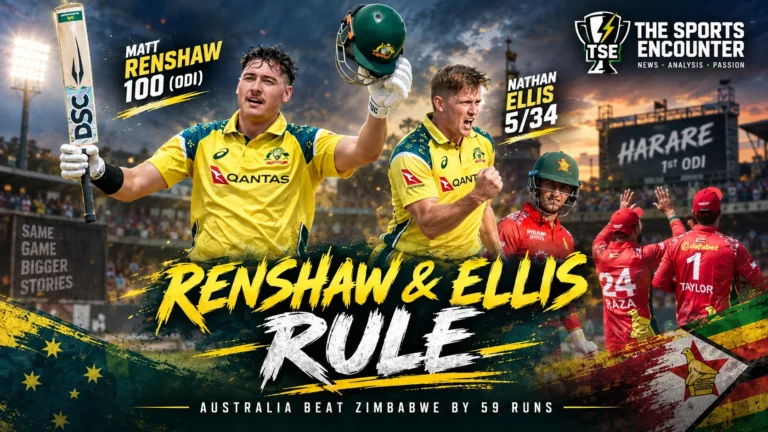
HARARE, Zimbabwe, September 15, 2026: Australia came to Zimbabwe looking for answers before next year’s World Cup.
Matt Renshaw and Nathan Ellis supplied two of the most convincing ones available.
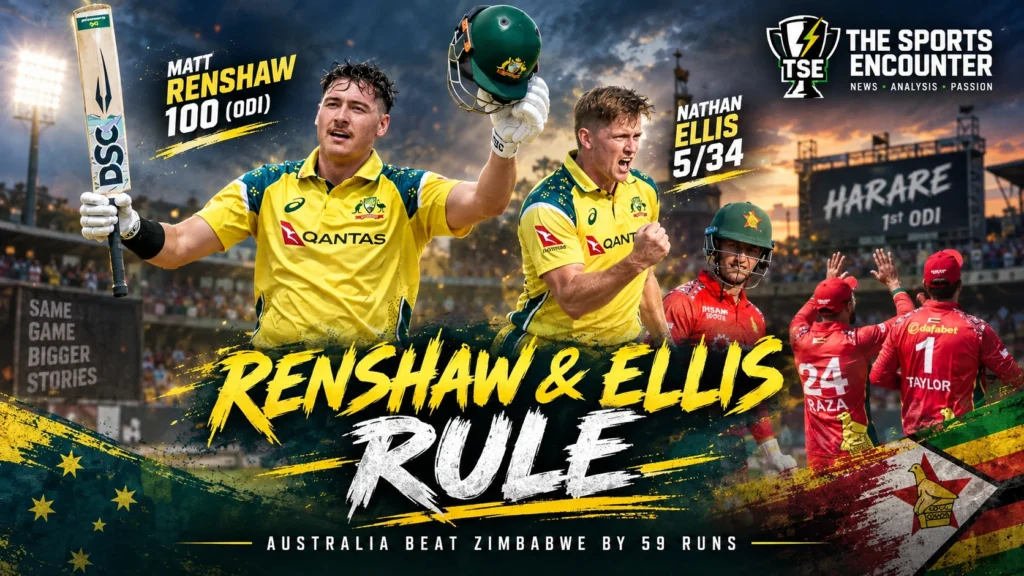
Renshaw rescued Australia from 107 for four with a superb 109 from 94 balls, his maiden ODI century, before Ellis claimed the first five-wicket haul of his ODI career as the visitors beat Zimbabwe by 59 runs at Harare Sports Club on Tuesday.
Australia made 294 for eight after choosing to bat. Zimbabwe reached 235 in 45.1 overs despite half-centuries from Craig Ervine and captain Sikandar Raza.
Story at a glance
Zimbabwe vs Australia 1st ODI Score: What Was the Final Result?
Australia beat Zimbabwe by 59 runs in the opening ODI of the three-match series.
How Did Matt Renshaw Score 109 Against Zimbabwe?
Renshaw’s century was built around circumstance rather than immediate aggression.
Nathan Ellis Five Wickets: Why Was His 5/31 So Important?
Ellis’ figures were the statistical finish to Australia’s victory, but their significance reaches further than one afternoon in Harare.
Should Nathan Ellis Be in Australia’s 2027 World Cup XI?
One five-wicket haul cannot settle a World Cup selection debate.
Who Is Newman Nyamhuri and How Did He Take 5/62 Against Australia?
Zimbabwe lost the match, but Nyamhuri produced one of its most important individual performances.
The final margin makes the contest look more comfortable than it felt for significant periods.
Newman Nyamhuri took five for 62 and repeatedly dragged Zimbabwe back into Australia’s innings. The hosts then recovered from 62 for four through a 98-run partnership between Ervine and Raza, reaching 160 for four with enough batting still available to make Australia work.
Ellis broke that resistance and eventually finished with five for 31 from 9.1 overs.
For Australia, that combination mattered beyond the series opener.
Renshaw, Ellis, Cooper Connolly, Oliver Peake and several others are trying to establish exactly where they belong in Australia’s plans for the 2027 ICC Men’s Cricket World Cup, which will be played in South Africa, Zimbabwe and Namibia. The ICC’s Australia squad announcement made clear that these six September ODIs in Zimbabwe and South Africa form an important part of that preparation.
Renshaw did more than strengthen his case.
He produced the innings Australia needed when the match could easily have moved in Zimbabwe’s direction.
Zimbabwe vs Australia 1st ODI: Key Facts
- Australia: 294/8 in 50 overs
- Zimbabwe: 235 all out in 45.1 overs
- Result: Australia won by 59 runs
- Series: Australia lead 1-0
- Player of the Match: Matt Renshaw
- Matt Renshaw: 109 from 94 balls and 1/32
- Nathan Ellis: 5/31 from 9.1 overs
- Newman Nyamhuri: 5/62 from nine overs
- Craig Ervine: 59 from 60 balls
- Sikandar Raza: 57 from 76 balls
- Cooper Connolly: 51 from 46 balls and 1/23
- Venue: Harare Sports Club
- Next match: September 18 at Harare Sports Club
Zimbabwe vs Australia 1st ODI Score: What Was the Final Result?
Australia beat Zimbabwe by 59 runs in the opening ODI of the three-match series.
| Match Detail | Information |
|---|---|
| Match | Zimbabwe vs Australia, 1st ODI |
| Date | September 15, 2026 |
| Venue | Harare Sports Club |
| Toss | Australia won and batted |
| Australia | 294/8 in 50 overs |
| Zimbabwe | 235 in 45.1 overs |
| Result | Australia won by 59 runs |
| Player of the Match | Matt Renshaw |
| Series position | Australia lead 1-0 |
This was Australia’s first ODI in Zimbabwe since 2014 and came with some uncomfortable recent history attached. Zimbabwe had won the teams’ previous ODI meeting in Townsville in 2022 and also defeated Australia during the 2026 T20 World Cup.
Cricket Australia’s official series guide had therefore framed the tour as both World Cup preparation and an opportunity for Australia to answer recent defeats against Zimbabwe.
The first response was emphatic enough, although Zimbabwe created more problems than the scoreline suggests.
How Did Matt Renshaw Score 109 Against Zimbabwe?
Renshaw’s century was built around circumstance rather than immediate aggression.
Australia had started quickly through Mitchell Marsh, who made 36 from 28 balls in his 100th ODI, but the innings became unstable once Zimbabwe began taking wickets regularly.
Travis Head fell for four.
Marsh was removed at 60.
Josh Inglis made four.
Connolly produced an impressive 51 from 46 balls but was bowled by Raza at 107 for four in the 18th over.
Renshaw walked into an innings that needed repair rather than another burst of hitting.
He initially allowed Alex Carey to share the workload as the pair added 72 for the fifth wicket.
Carey’s 27 from 53 deliveries will not dominate the scorecard, but his presence mattered because Australia had lost four wickets before reaching halfway.
When Carey fell at 179, Renshaw was on 45.
That was when his innings changed.
Matt Renshaw’s Century Came After Australia Lost Four Early Wickets
Renshaw reached fifty from 55 balls.
His next fifty required only 31.
The acceleration was controlled rather than frantic. He moved from rebuilding the innings to driving it forward once the risk of an Australian collapse had diminished.
Oliver Peake contributed 30 from 40 deliveries in a 75-run sixth-wicket partnership that took Australia from 179 for five to 254.
Renshaw reached his hundred from 86 balls before eventually falling for 109 from 94, having struck seven fours and three sixes.
| Matt Renshaw | Figure |
|---|---|
| Runs | 109 |
| Balls | 94 |
| Fours | 7 |
| Sixes | 3 |
| Strike rate | 115.95 |
| Bowling | 1/32 |
After receiving the Player of the Match award, Renshaw summed up the personal significance neatly: “Ten years between international hundreds was not something I was expecting.”
His latest hundred continues an excellent white-ball year. Renshaw was also named Player of the Series when Australia completed a 3-0 T20I whitewash in Bangladesh, having repeatedly shown an ability to perform different roles rather than demanding one fixed position.
Nathan Ellis Five Wickets: Why Was His 5/31 So Important?
Ellis’ figures were the statistical finish to Australia’s victory, but their significance reaches further than one afternoon in Harare.
He took five for 31 from 9.1 overs, delivered 39 dot balls and removed batters at several different stages of Zimbabwe’s innings.
Brian Bennett fell to him for 25.
Innocent Kaia was another early victim.
Most importantly, Ellis removed Ervine for 59 when Zimbabwe’s fifth-wicket recovery had taken the chase to 160.
He then returned to dismiss Wellington Masakadza and Nyamhuri as the innings ended.
Australia captain Mitch Marsh was unequivocal afterward.
“Nathan Ellis is a gem. I believe he’s one of the best white-ball bowlers in the world.”
That assessment carries weight because Australia’s World Cup pace equation is unusually crowded.
Pat Cummins and Mitchell Starc will join the squad for the South Africa ODIs. Josh Hazlewood remains part of the broader plans. Xavier Bartlett and Spencer Johnson are pushing for places.
Ellis is making omission increasingly difficult.
He had already demonstrated that value earlier this year when Australia stopped Bangladesh’s white-ball momentum in Chattogram.
Harare was a stronger statement because it came in the format Australia will defend a world title in next year.
Should Nathan Ellis Be in Australia’s 2027 World Cup XI?
One five-wicket haul cannot settle a World Cup selection debate.
Ellis’ case is nevertheless becoming difficult to reduce to backup status.
His greatest advantage is phase versatility.
He can operate with a relatively new ball, change pace through the middle overs and use cutters, slower balls and yorkers near the death.
That gives Marsh options rather than requiring one specialist role.
Australia’s pace hierarchy has traditionally begun with Cummins, Starc and Hazlewood.
Those names remain formidable.
The question for 2027 is whether Australia’s best XI must automatically contain all three every time conditions permit.
Ellis is forcing selectors to consider performance rather than reputation alone.
The Sports Encounter has already examined Australia’s changing personnel as the next major cycle approaches, including the questions around its senior and emerging players in our analysis of the squads selected for South Africa.
Ellis’ Harare spell adds another decision to that conversation.
Who Is Newman Nyamhuri and How Did He Take 5/62 Against Australia?
Zimbabwe lost the match, but Nyamhuri produced one of its most important individual performances.
The young fast bowler finished with five for 62 from nine overs.
His wickets included Marsh, Inglis, Peake, Xavier Bartlett and finally Renshaw.
He became only the second Zimbabwean bowler to claim an ODI five-wicket haul against Australia.
There was some expense around the wickets, including seven wides, but that should not obscure what he achieved.
Zimbabwe needed a bowler capable of interrupting Australia’s innings repeatedly.
Nyamhuri did exactly that.
He first removed Marsh after the Australian captain had threatened to turn a brisk start into something much larger.
He then dismissed Inglis to leave Australia at 83 for three.
Later, he returned to break the Peake partnership and deny Renshaw the chance to bat through the innings.
| Zimbabwe Bowler | Figures |
|---|---|
| Newman Nyamhuri | 5/62 |
| Brad Evans | 2/51 |
| Sikandar Raza | 1/62 |
| Blessing Muzarabani | 0/46 |
Nyamhuri’s emergence should not be viewed in isolation. Zimbabwe’s home season has repeatedly shown signs of improved fast-bowling depth. During their July ODI series, they defeated Bangladesh 2-1 before a weakened attack was punished in the final match, a result covered in TSE’s report on Bangladesh avoiding a Zimbabwe series whitewash.
The ICC’s official Zimbabwe squad announcement also identified Nyamhuri among the pace options selected around Muzarabani and Brad Evans while Richard Ngarava recovers from injury.
How Did Cooper Connolly Perform in the First ODI Against Zimbabwe?
Connolly quietly produced one of Australia’s most useful all-round performances.
He made 51 from 46 balls, striking four fours and three sixes, before Raza bowled him.
Later, his left-arm spin returned one for 23 from four overs.
His wicket of Wessly Madhevere arrived just as Zimbabwe were trying to rebuild for a second time.
Connolly’s role matters because Australia are still working out the shape of their middle order after losing significant experience from the previous World Cup cycle.
He has already shown that he can change games with the bat, including during the Bangladesh tour that helped reshape Australia’s white-ball plans.
In the first T20I of that tour, Connolly’s aggressive 47 turned a fragile chase back toward Australia.
Harare offered something different.
He was asked to bat at No. 3, score quickly without reckless risk, and then provide overs because Australia’s bowling balance required them.
That flexibility may ultimately be as valuable as the fifty itself.
What Happened to Zimbabwe’s Chase of 295?
Zimbabwe’s chase was badly damaged in the opening 14 overs.
Ben Curran was dismissed for a duck at one for one.
Kaia made 18.
Bennett reached 25 before Ellis removed him.
Brendan Taylor managed four.
At 62 for four, Zimbabwe needed both a partnership and a significant change in tempo.
Ervine and Raza supplied the partnership.
| Zimbabwe Batter | Runs | Balls |
|---|---|---|
| Craig Ervine | 59 | 60 |
| Sikandar Raza | 57 | 76 |
| Brian Bennett | 25 | 32 |
| Wessly Madhevere | 22 | 30 |
| Brad Evans | 18 | 20 |
The senior pair added 98 for the fifth wicket.
Ervine played the more fluent innings, reaching fifty from 51 balls. Raza provided the control, reaching his half-century from 61.
For a period, Zimbabwe had rebuilt enough to keep Australia interested.
The required rate, however, kept rising because so much damage had been done early.
Zimbabwe’s recent home cricket has shown this same contradiction. The side can compete with strong opponents and has enough bowling to create winning situations, but batting collapses still leave too much repair work. That pattern featured heavily in our assessment of Zimbabwe’s form before the southern African tri-series.
Craig Ervine and Sikandar Raza Partnership: Could Zimbabwe Have Won?
At 160 for four after Ervine and Raza had rebuilt the innings, Zimbabwe were still mathematically alive.
The difficulty was the required tempo.
Australia’s 294 had forced Zimbabwe to score close to six runs per over from the beginning.
The early wickets meant Ervine and Raza first had to repair the innings before attacking the target.
That created a squeeze.
By the time Ellis bowled Ervine at 160, Zimbabwe had lost the batter most capable of combining stability with acceleration.
Raza fell to Spencer Johnson for 57 at 181.
From there, the chase became increasingly unlikely.
Madhevere, Evans and Masakadza kept scoring, but nobody produced the 60-ball hundred or late 40-run burst required to reopen the contest.
Raza’s post-match assessment was therefore accurate without being overly generous.
“We felt we were in the game.”
Zimbabwe were.
They simply spent too much of the game recovering.
What ODI Record Did Brendan Taylor Break Against Australia?
Taylor’s contribution with the bat was only four runs, but his appearance carried major historical significance.
The veteran wicketkeeper-batter became the longest-serving ODI player by career span, overtaking Sachin Tendulkar.
Taylor made his ODI debut for Zimbabwe in 2004 and returned to international cricket in 2025 after several years away from the national side.
His presence alongside Ervine and Raza illustrates the unusual experience inside Zimbabwe’s current group.
That veteran core is being combined with players such as Bennett and Nyamhuri as Zimbabwe builds toward a World Cup it will co-host.
That transition was visible earlier in the year when Zimbabwe dominated significant portions of their home series against Bangladesh. They carried that confidence into the T20 leg with a 32-run victory built around another strong bowling performance.
Why Matt Renshaw and Nathan Ellis Matter to Australia’s 2027 World Cup Plans
This is where the first ODI becomes larger than a 1-0 series lead.
Australia are defending ODI world champions.
The team attempting to retain that title in 2027 will not simply be the 2023 side four years older.
Steve Smith has retired from ODIs. Other senior names have moved on. Cummins and Starc remain important, but Australia are deliberately using the current run of matches to identify the next layer.
Renshaw’s hundred strengthens one part of the argument.
Ellis strengthens another.
Connolly’s fifty and wicket add further evidence.
Peake gained another 40 balls of international experience.
Bartlett and Johnson both took wickets.
This is how successful succession usually happens.
Not through one mass handover, but by allowing emerging and fringe players to become match-winners while established internationals are still available around them.
The Sports Encounter recently examined the same tension from a red-ball perspective when Bangladesh exposed Australia’s ageing core and batting vulnerability in Darwin.
Australia then responded brutally in Mackay, where Mitchell Starc’s ten wickets showed how much power still remains in the senior generation.
The ODI challenge is balancing those two realities.
Australia want the old champions available.
They also need enough new match-winners that selection does not depend on reputation.
Harare gave them several.
Why the Zimbabwe Series Matters Before the 2027 Cricket World Cup
Harare Sports Club is not merely hosting a bilateral series.
It will also be part of the cricket landscape when Zimbabwe co-hosts the 2027 World Cup with South Africa and Namibia.
Australia will travel from Zimbabwe directly into three ODIs in South Africa.
That gives the defending champions six matches in the region roughly a year before the tournament.
The conditions matter.
The early starts matter.
The surfaces matter.
So does learning which combinations function when Cummins, Starc and other senior players are rotated or unavailable.
Australia had already received a warning about assuming its white-ball superiority earlier this year when Bangladesh won their ODI series. TSE examined the significance of that breakthrough in our feature on Bangladesh’s changing relationship with major cricket nations.
The current tour is another step in Australia’s response.
What Did Mitchell Marsh Say After Australia Beat Zimbabwe?
Marsh was pleased with the result but focused particularly on the contributions that rescued and finished the match.
He praised the way Carey and Renshaw rebuilt Australia’s innings and described Renshaw’s hundred as brilliant.
His strongest endorsement, however, went to Ellis.
Calling him one of the world’s best white-ball bowlers creates an obvious selection question once Australia’s leading quicks return.
That conversation will follow Australia throughout the remaining five ODIs of this southern African block.
Marsh himself also reached an important milestone in Harare, playing his 100th ODI and contributing 36 from 28 deliveries.
His captaincy has become increasingly important as Australia moves between generations. Earlier this year, he also played the decisive innings when Australia completed its Bangladesh T20I whitewash.
When Is Zimbabwe vs Australia 2nd ODI?
The second ODI will be played at Harare Sports Club on Friday, September 18, 2026.
The third and final match follows at the same venue on Sunday, September 20.
| Match | Date | Venue |
|---|---|---|
| 1st ODI | September 15 | Harare Sports Club |
| 2nd ODI | September 18 | Harare Sports Club |
| 3rd ODI | September 20 | Harare Sports Club |
Zimbabwe enter Friday needing to address two obvious problems.
The first is bowling discipline. Raza acknowledged that his attack offered Australia too many hittable deliveries despite Nyamhuri’s wickets.
The second is the top order. Another 62-for-four start will leave Ervine and Raza doing emergency repair work rather than controlling a chase.
Australia have a different problem.
The selectors now have more evidence than they had on Tuesday morning.
Renshaw has a hundred.
Connolly has another fifty.
Ellis has five wickets.
That is exactly what a World Cup audition is supposed to produce.
Why Australia’s 59-Run Win Was More Important Than the Margin
ODI No. 5013 will eventually disappear into a long list of bilateral results.
The Sports Encounter’s A Celebration of 5000 ODIs project exists partly because scorecards rarely explain by themselves why particular one-day matches mattered.
This one may matter because of timing.
Renshaw had spent years moving between formats, positions and selection conversations. He now has an ODI hundred.
Ellis has spent much of his international career operating around Australia’s established fast-bowling trio. He now has an ODI five-for and a captain publicly calling him one of the best white-ball bowlers in the game.
Connolly continues accumulating reasons to be selected.
Nyamhuri showed Zimbabwe possess another young fast bowler capable of hurting elite opposition.
Ervine and Raza showed the hosts can recover against Australia’s attack, even if they could not finish the job.
The score says Australia won by 59 runs.
The more useful story is that both teams left Harare with evidence about what their 2027 World Cup sides could become.
Australia simply collected the points as well.
For continuing ODI reports, international cricket analysis and World Cup coverage, visit The Sports Encounter Cricket hub.
Continue the Cricket Story



Frequently Asked Questions About Zimbabwe vs Australia 1st ODI
Who won Zimbabwe vs Australia 1st ODI?
Australia beat Zimbabwe by 59 runs at Harare Sports Club to take a 1-0 lead in the three-match ODI series.
What was the Zimbabwe vs Australia 1st ODI score?
Australia scored 294 for eight from 50 overs. Zimbabwe were bowled out for 235 in 45.1 overs.
Who was Player of the Match in Zimbabwe vs Australia?
Matt Renshaw was named Player of the Match after scoring 109 from 94 balls and taking one wicket.
How many runs did Matt Renshaw score?
Renshaw scored 109 from 94 balls, including seven fours and three sixes. It was his maiden ODI century.
How many wickets did Nathan Ellis take?
Ellis took five for 31 from 9.1 overs, his first five-wicket haul in ODI cricket.
What were Newman Nyamhuri’s bowling figures?
Nyamhuri took five for 62 from nine overs for Zimbabwe.
Who scored fifties for Zimbabwe?
Craig Ervine scored 59 from 60 balls and Sikandar Raza made 57 from 76.
How many runs did Cooper Connolly score?
Connolly scored 51 from 46 deliveries and later took one for 23 with his left-arm spin.
What record did Brendan Taylor break?
Taylor became the longest-serving ODI player by career span, moving past Sachin Tendulkar after first representing Zimbabwe in the format in 2004.
What is the Zimbabwe vs Australia ODI series score?
Australia lead the three-match series 1-0.
When is Zimbabwe vs Australia 2nd ODI?
The second ODI will be played on Friday, September 18, 2026, at Harare Sports Club.
When is Zimbabwe vs Australia 3rd ODI?
The third ODI is scheduled for Sunday, September 20, 2026, at Harare Sports Club.
Why is the Zimbabwe ODI series important for Australia?
Australia are using the series as preparation for the 2027 ICC Men’s Cricket World Cup, which will be hosted by South Africa, Zimbabwe and Namibia.
Will Pat Cummins and Mitchell Starc play in Zimbabwe?
No. Cummins and Starc are not part of the Zimbabwe leg but are scheduled to join Australia’s ODI squad for the subsequent series in South Africa.
Australia
- Renshaw and Ellis Show: Australia Draw First Blood in Zimbabwe ODI Series with 59-Run Victory
- Bul Juach Comes Off the Bench to Fire South Melbourne Into Australia Cup Final
- How Australia’s Ageing Problem Puts the Next Generation in the Spotlight
- Australia Bring Their World Cup Questions to a Zimbabwe Side That No Longer Fears Them
- Spain Crush Australia 89-66 to Join the Best Four in the FIBA World Cup 2026