Starc Destroys Bangladesh in Two Days, but Historic 1-1 Draw Changes Their Story in Australia
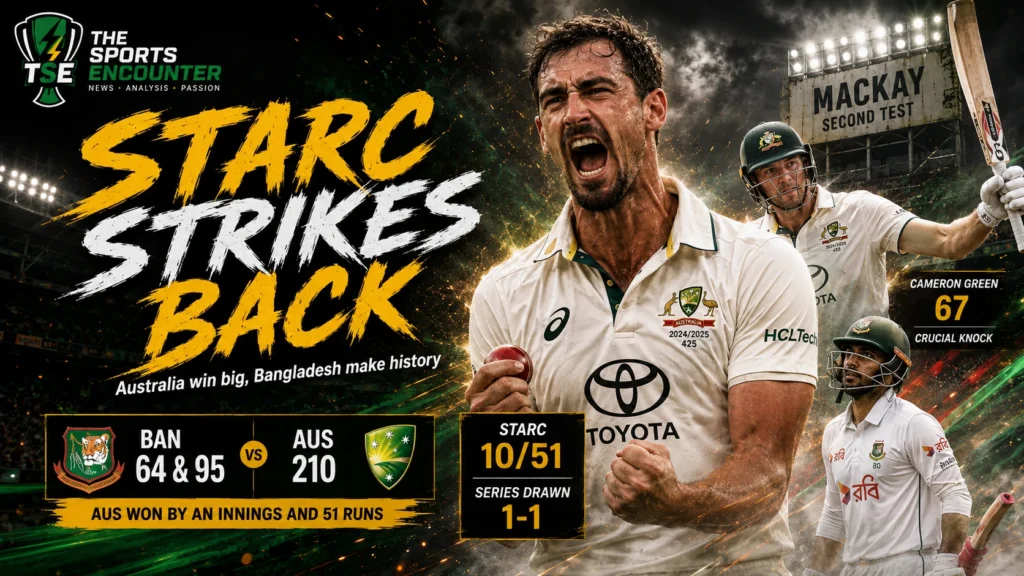
Mitchell Starc took 10 wickets as Australia overwhelmed Bangladesh inside two days in Mackay, but the visitors still made history by drawing a Test series on Australian soil for the first time.
Mitchell Starc produced a devastating 10-wicket match haul as Australia demolished Bangladesh by an innings and 51 runs inside two days in Mackay, but the brutality of the series finale could not erase the history Bangladesh had already made.
Australia bowled the visitors out for 64 and 95 at the Great Barrier Reef Arena, with Starc taking 6 for 12 in the first innings and 4 for 39 in the second. Cameron Green’s 67 helped Australia reach 210 despite a magnificent seven-wicket haul from Shoriful Islam, leaving Bangladesh with a 146-run first-innings deficit they never came close to overturning.
Nathan Lyon eventually ended the match when Shoriful charged down the pitch and sliced a catch to backward point, where Starc completed the final act of a Test he had controlled from its opening delivery.
Australia won by an innings and 51 runs after only 125 overs of cricket, making the Mackay Test the second-shortest Test completed in Australia and the fourth-shortest completed Test in history by balls bowled.
The scoreline was merciless.
The series result was far more complicated.
Bangladesh’s historic victory in Darwin meant Australia’s response could only level the two-match contest. The trophy was therefore shared at 1-1, giving Bangladesh their first Test series draw on Australian soil, 23 years after their previous visit ended in two innings defeats.
That makes the final verdict on this series impossible to reduce to Mackay alone.
Australia rediscovered the ruthless bowling identity that deserted them in Darwin.
Bangladesh discovered that they could beat Australia in Australia.
Both truths will survive long after the extraordinary two-day finale.
Australia vs Bangladesh 2nd Test: Match Summary
| Series | Bangladesh tour of Australia 2026 |
| Match | Australia vs Bangladesh, 2nd Test |
| Venue | Great Barrier Reef Arena, Mackay |
| Dates | August 22-23, 2026 |
| Toss | Australia elected to field |
| Bangladesh 1st innings | 64 all out in 34 overs |
| Australia 1st innings | 210 all out in 52.3 overs |
| Bangladesh 2nd innings | 95 all out in 38.3 overs |
| Result | Australia won by an innings and 51 runs |
| Series result | Drawn 1-1 |
| Player of the Match | Mitchell Starc, 10/51 |
| Player of the Series | Mitchell Starc, 12 wickets and 20 runs |
| WTC points | Australia 12, Bangladesh 0 |
TL;DR
- Australia crushed Bangladesh by an innings and 51 runs in the second Test at Mackay.
- Bangladesh were dismissed for 64 and 95, the first time they had been bowled out below 100 in both innings of a Test.
- Mitchell Starc took 6/12 and 4/39 to finish with 10 wickets in the match.
- Starc was named both Player of the Match and Player of the Series.
- Shoriful Islam produced a career-best 7/48 as Bangladesh bowled Australia out for 210.
- Cameron Green’s 67 was the highest score of a Test dominated by bowlers.
- Pat Cummins took six wickets in the match, while Nathan Lyon claimed three in Bangladesh’s second innings.
- The Test finished during the second afternoon after only 125 overs.
- It became the second-shortest Test completed in Australia and fourth-shortest completed Test overall by balls bowled.
- The series finished 1-1 after Bangladesh’s historic first-Test victory in Darwin.
- It is Bangladesh’s first-ever drawn Test series on Australian soil.
Mackay Was Australia’s Answer to Darwin
Australia entered the second Test carrying something unusual at home: embarrassment.
Bangladesh had not merely competed in Darwin.
They had beaten Australia and entered Mackay with a 1-0 lead.
That possibility had looked remote when the teams arrived in Australia after a 23-year gap between Bangladesh’s Test tours, a challenge examined in The Sports Encounter’s Australia-Bangladesh series preview.
The preview asked whether Bangladesh’s recent progress could travel.
Darwin answered yes.
Mackay asked a different question.
How would Australia respond?
Pat Cummins’ side provided the answer from the first ball.
Starc Strikes With the First Ball and Bangladesh Never Recover
Shadman Islam faced the opening delivery.
He did not survive it.
Starc found the edge, Cameron Green completed the catch, and Bangladesh were 0 for one before the match had properly begun.
It established the tone for what followed.
Tanzid Hasan made zero.
Najmul Hossain Shanto made zero.
Litton Das made zero.
Bangladesh were 12 for five after 6.4 overs.
Starc had taken all five.
The left-armer’s opening spell was not simply fast.
It was relentlessly full enough to threaten the stumps and outside edge, while the angle created by his left arm forced Bangladesh’s right-handers to make decisions almost immediately after release.
They kept losing those decisions.
Five Wickets in 22 Balls
Starc completed his five-wicket haul in only 22 deliveries.
That alone placed the spell among the fastest five-fors in Test history.
For Bangladesh, the statistical significance hardly mattered in the moment.
They were trying to survive an attack that suddenly looked exactly as intimidating as the one expected before the series.
The contrast with Darwin was enormous.
There, Bangladesh had shown composure against Australia’s celebrated attack and created enough pressure to expose the hosts’ own batting problems.
In Mackay, Australia’s fast bowlers never allowed that confidence to become established.
The wider build-up to this series had focused heavily on the return of Starc, Cummins, Josh Hazlewood and Nathan Lyon together, one of the central themes in TSE’s pre-series analysis.
Match two finally produced the version of that attack Australia expected.
Bangladesh’s Top Order Disappears
The collapse was severe enough to make individual scores look almost incidental.
Mominul Haque reached nine.
Mushfiqur Rahim occupied 42 deliveries but made only five.
Mehidy Hasan Miraz scored 11 from 51 balls.
Hasan Mahmud made 10.
Taijul Islam finished unbeaten on 11.
Shoriful’s 14 from 19 balls was the highest score of the innings.
Bangladesh’s resistance came almost entirely from consuming deliveries rather than scoring runs.
Mushfiqur and Mehidy faced 93 balls between them.
They added 16 runs.
That tells the story of Australia’s control.
There were few release deliveries and almost no sustained period when Bangladesh could dictate the field.
Cummins Joins the Destruction
Starc did not have to take all 10 wickets.
Cummins removed Mushfiqur, Mehidy and Taskin Ahmed to finish with 3 for 25 from 10 overs.
Hazlewood took one wicket while conceding only 18 from 11.
The visitors were dismissed for 64 from 34 overs.
Australia had conceded 1-0 in the series.
Less than a session into the second Test, they had already built the platform for a response.
Then Shoriful Made Australia Look Vulnerable Again
For all the dominance of Australia’s bowling, the hosts’ batting still refused to offer complete reassurance.
Shoriful Islam returned to the side and produced one of the finest fast-bowling performances by a Bangladeshi in Australia.
Matt Renshaw made eight.
Travis Head reached 22 before Shoriful bowled him.
Marnus Labuschagne made four and also lost his stumps to the left-armer.
Australia were 41 for three.
The visitors had scored only 64, yet the game was not completely dead.
That was important because Bangladesh’s progress as an international side has increasingly been linked to a pace attack capable of causing damage outside traditional Asian conditions.
The Sports Encounter examined that broader development in Bangladesh cricket’s recent rise.
Shoriful’s spell in Mackay gave another example.
Green and Smith Prevent Another Australian Collapse
Steve Smith and Cameron Green added 77 for the fourth wicket.
It became the most important batting partnership of the match.
Smith made 42 from 74 balls.
Green produced 67 from 105.
Neither innings was extravagant.
Both were valuable because Australia were batting on a surface that required discipline while Shoriful continued asking serious questions.
Green looked particularly assured.
His 10 boundaries came without the kind of reckless strokeplay that had contributed to Australia’s problems in Darwin.
Cummins later described Green as looking in total command and said he hoped the innings would give him confidence.
That assessment matters because Green has spent much of his Test career carrying expectations that sometimes feel larger than his numbers.
Mackay offered evidence of the batter Australia continue to believe he can become.
Shoriful Takes Seven and Still Cannot Save Bangladesh
Shoriful kept coming.
He removed Smith.
Then Beau Webster.
Then Cummins.
Then Starc.
Later he returned to dismiss Green.
His final figures were 7 for 48 from 15 overs.
Seven Australian wickets for fewer than 50 runs should normally transform a Test.
It could not erase Bangladesh’s 64.
That is the brutal arithmetic of first-innings collapses.
Even after losing wickets regularly, Australia reached 210.
Nathan Lyon’s 32 from 62 balls also mattered enormously.
His late runs stretched the lead to 146.
What had looked like a damaged Australian innings became an almost impossible deficit for Bangladesh.
Australia’s Batting Still Leaves Questions
The scoreboard says 210.
The bowling dominance makes the total look much larger than it really was.
Australia’s top order remains unsettled.
Renshaw made eight.
Head made 22.
Labuschagne made four.
Carey scored five.
Webster, Cummins and Starc contributed one run between them.
Only Green, Smith and Lyon crossed 30.
This was part of the contradiction Cummins’ team will take from the series.
The attack can still destroy opposition batting lineups.
The batting order does not currently offer the same certainty.
That concern had already surfaced in Darwin, including during the Steve Smith DRS controversy on the opening day, when Smith’s 71 carried an otherwise fragile Australian innings.
Mackay improved the result.
It did not eliminate the underlying issue.
Bangladesh’s Second Innings Begins With the Same Nightmare
Any realistic route back into the match required Bangladesh to bat for a long time.
Their second innings lasted 38.3 overs.
Shadman made one.
Mominul was bowled for a first-ball duck.
Bangladesh were five for two.
Starc had both.
Tanzid tried to settle before Cummins removed him for nine.
At 24 for three, the possibility of making Australia bat again was already slipping away.
Shanto and Mushfiqur Try to Resist
Najmul Hossain Shanto responded with Bangladesh’s most positive batting of the innings.
The captain scored 31 from 46 balls, hitting six fours.
Mushfiqur played the opposite role.
He occupied the crease.
His unbeaten 29 came from 80 balls and lasted 146 minutes.
The pair gave Bangladesh their only meaningful period of control during the second innings.
They took the score to 51.
Then Lyon removed Shanto.
The innings folded again.
Lyon Enters After the Fast Bowlers Do the Damage
Nathan Lyon did not bowl in Bangladesh’s first innings.
There had been no need.
In the second, he became the finishing weapon.
Shanto was his first wicket.
Taskin Ahmed became his second after striking a six.
Shoriful was the last.
Lyon finished with 3 for 25 from 11.3 overs.
Cummins also collected three wickets for only 10 runs.
Starc added four more.
Hazlewood somehow finished wicketless despite conceding just 16 from seven overs.
Bangladesh were surrounded by pressure from every direction.
Starc Finishes With 10 Wickets
Starc’s match figures were 10 for 51.
He had taken 6 for 12 in the first innings.
He added 4 for 39 in the second.
Bangladesh’s top order had no answer to the combination of pace, swing, angle and full length.
Starc also completed two catches in the second innings, including the final one.
His influence therefore stretched beyond the bowling figures.
He was named Player of the Match.
Then Player of the Series.
Across the two Tests, he finished with 12 wickets.
His comments afterward were revealing because he did not pretend the second Test erased Darwin.
“A much better week. We knew we were not at our best in Darwin.”
That was exactly the series.
One terrible week.
One devastating response.
Bangladesh Become First Team in 21 Years Bowled Out Under 100 Twice in a Test
The Mackay collapse entered Test history for uncomfortable reasons.
Bangladesh were dismissed for 64 and 95.
It was the first time they had been bowled out for fewer than 100 in both innings of a Test.
It was also the first time any team had suffered that fate in 21 years.
Those numbers explain why the match disappeared so quickly.
Bangladesh scored 159 runs across two completed innings.
Australia scored 210 once.
Green alone scored more than 42 percent of Bangladesh’s first-innings total.
The Second-Shortest Test Ever Completed in Australia
The Test required only two days.
More precisely, the entire match lasted 125 overs, or 750 legal deliveries.
That made it the second-shortest completed Test ever played in Australia by balls bowled and the fourth-shortest completed Test in the history of the format.
The statistic inevitably raised questions about the Great Barrier Reef Arena pitch.
Australia’s players resisted blaming the surface.
Josh Hazlewood said it was not a wicket that should naturally have produced a two-day Test and noted that conditions became easier once the shine disappeared from the ball.
Nathan Lyon went further, describing the surface positively and arguing that 18 wickets on day one reflected the quality of the bowlers rather than a fundamentally flawed pitch.
Shanto also avoided making conditions an excuse.
He acknowledged extra bounce and swing but said Bangladesh had to become better at handling precisely these kinds of environments.
Shanto Wants Bangladesh Back Before Another 23 Years Pass
That may have been the most important comment of the presentation.
Bangladesh waited 23 years between Test tours of Australia.
Shanto does not want another generation to wait the same amount of time.
“Not 23 years to wait to come here.”
His argument goes beyond scheduling politics.
Teams learn overseas conditions by playing in them.
A batter cannot master Australian bounce through theory.
A seamer cannot learn the ideal length on Australian surfaces without overs in Australian conditions.
Bangladesh’s Mackay collapse was evidence of the gap that still exists.
Darwin was evidence of what becomes possible when preparation, confidence and execution align.
The two Tests together make a stronger argument for more regular competition than either result would make alone.
Australia’s 2003 Dominance Makes the 2026 Draw More Significant
Bangladesh’s previous Test tour of Australia came in 2003.
It was painful.
Australia won in Darwin by an innings and 132 runs.
They followed it with an innings-and-98-run victory in Cairns.
Bangladesh were still a young Test nation.
The competitive gap was enormous.
The Sports Encounter revisited that history before this series in our full Australia vs Bangladesh 2026 curtain raiser.
Twenty-three years later, the visitors leave with a trophy shared 1-1.
That does not mean Bangladesh are suddenly Australia’s equal in Australian conditions.
Mackay proved otherwise.
It does mean the gap is no longer large enough to make an upset unimaginable.
Bangladesh proved that in Darwin.
The Darwin Victory Changes How Mackay Should Be Read
If Mackay had been the first Test, the narrative around Bangladesh would have been brutal.
Another Asian side overwhelmed by pace.
Another two-day Test.
Another innings defeat.
Darwin prevents that interpretation from becoming the whole story.
Bangladesh had already beaten Australia.
They had already shown their bowlers could expose the hosts’ batting.
They had already survived the celebrated Australian attack long enough to create and then finish a historic victory.
The same tour therefore produced Bangladesh’s greatest Test result in Australia and one of their heaviest batting failures.
That contradiction makes the series more useful than a comfortable 2-0 result would have been.
Bangladesh’s Broader 2026 Rise Gains Another Historic Marker
The drawn Test series also fits into a larger year for Bangladesh cricket.
Earlier in 2026, they beat Australia in a bilateral ODI series, another breakthrough analyzed in TSE’s assessment of Bangladesh’s changing international profile.
Australia responded by taking control of the T20I leg, beginning with a four-wicket victory in the opening T20I before eventually completing a 3-0 whitewash.
Bangladesh’s year has contained plenty of uneven cricket.
That is why the bigger trend matters more than pretending every result represents uninterrupted progress.
They are collecting experiences and victories that previous generations rarely had.
A drawn Test series in Australia now belongs on that list.
Cummins Gets the Response He Wanted
Pat Cummins described the second Test as the opposite of Darwin.
The comparison was accurate.
Australia were sharper in the field.
The bowlers hit their lengths immediately.
The opening hours controlled the direction of the entire match.
Cummins highlighted that point specifically after the victory.
“If you get a really good first hour or two it can set up the rest of the match.”
Australia won those opening hours so comprehensively that Bangladesh spent the remainder of the Test trying to recover from them.
Cummins himself contributed six wickets across the match.
His second-innings figures of 3 for 10 were especially economical.
The captain also praised Green, whose 67 provided the batting stability Australia lacked elsewhere.
Australia’s Bowlers Look Ready for What Comes Next
One of the major questions before this tour involved the age and workload of Australia’s attack.
Starc is 36.
Hazlewood is 35.
Cummins is 33.
Lyon is 38.
The Sports Encounter highlighted the issue in its August Test-cricket schedule analysis, which placed this series at the beginning of an unusually demanding red-ball period.
Mackay provided a reassuring answer about current performance.
Starc took 10.
Cummins took six.
Lyon completed the second innings.
Hazlewood remained difficult to score against even when wickets went elsewhere.
The attack still works.
The longer-term question is how often Australia can ask the same group to work together across an increasingly crowded calendar.
Australia’s Batting Is the Bigger Concern
The bowlers answered their critics.
The batters did not completely do the same.
Green’s 67 was excellent.
Smith’s 42 was valuable.
Lyon’s 32 became unusually important.
Beyond them, the returns were thin.
| Australia batter | Runs |
|---|---|
| Cameron Green | 67 |
| Steven Smith | 42 |
| Nathan Lyon | 32* |
| Travis Head | 22 |
| Matt Renshaw | 8 |
| Alex Carey | 5 |
| Marnus Labuschagne | 4 |
| Mitchell Starc | 1 |
| Beau Webster | 0 |
| Pat Cummins | 0 |
An innings victory can hide batting problems because the bowling attack creates such a large margin.
Australia should resist that comfort.
Shoriful’s 7 for 48 exposed vulnerabilities that stronger teams will study carefully.
Shoriful Leaves Mackay With Something Valuable
Bangladesh had few individual positives from the match.
Shoriful was the obvious exception.
His seven-wicket haul demonstrated exactly why his return for the second Test mattered.
He missed Darwin through injury.
In Mackay, he gave Australia serious problems through angle, movement and discipline.
The challenge for Bangladesh is building enough batting stability around performances like his.
A bowler taking seven wickets in Australia should create a chance to win.
A first innings of 64 removed that chance before Shoriful could exploit it.
Mitchell Starc’s Match Figures
| Innings | Overs | Runs | Wickets |
|---|---|---|---|
| Bangladesh first innings | 10 | 12 | 6 |
| Bangladesh second innings | 10 | 39 | 4 |
| Match total | 20 | 51 | 10 |
Bangladesh Batting: A Test to Forget
| Innings | Total | Highest scorer | Overs |
|---|---|---|---|
| First innings | 64 | Shoriful Islam 14 | 34 |
| Second innings | 95 | Najmul Hossain Shanto 31 | 38.3 |
| Combined | 159 | – | 72.3 |
Key Turning Points
- Starc strikes first ball: Shadman Islam is dismissed immediately and Australia establish the tone.
- Bangladesh fall to 12/5: Starc completes a five-wicket burst in 22 balls.
- Bangladesh dismissed for 64: Australia gain a huge advantage before batting.
- Australia slip to 41/3: Shoriful briefly gives Bangladesh a route back.
- Smith and Green add 77: Australia’s most important partnership establishes control.
- Shoriful takes 7/48: Bangladesh’s left-armer produces a career-best performance despite the match position.
- Lyon scores 32: Australia’s lower order extends the lead to 146.
- Bangladesh fall to 5/2 second time around: Starc removes Shadman and Mominul.
- Shanto falls for 31: Lyon ends Bangladesh’s main resistance.
- Shoriful holes out: Lyon takes the final wicket as Australia win by an innings and 51 runs.
Series Result: Australia 1-1 Bangladesh
| Test | Venue | Result |
|---|---|---|
| 1st Test | Darwin | Bangladesh won |
| 2nd Test | Mackay | Australia won by an innings and 51 runs |
| Series | Australia | Drawn 1-1 |
Why the 1-1 Draw Matters for Bangladesh
Bangladesh do not need to pretend Mackay did not happen.
The defeat should hurt.
Being bowled out below 100 twice exposes exactly how much work remains before they can become consistently competitive in Australia.
History can still coexist with failure.
Before this tour, Bangladesh had never avoided defeat in a Test series played in Australia.
Their previous visit ended 2-0.
They waited 23 years for another opportunity.
They leave this one at 1-1.
No innings defeat can take that away.
Why Australia Will Leave Frustrated Too
Australia won the final Test about as emphatically as Test cricket allows.
They will still look back at Darwin.
The second Test demonstrated the level available to them.
That only makes the first-Test defeat more irritating.
Starc acknowledged Australia were below their standards in Darwin.
Cummins said essentially the same thing.
A side with Australia’s experience does not often require a defeat to become sharp.
This time it did.
That is why the trophy picture at the end tells a stranger story than the Mackay scorecard.
Australia destroyed Bangladesh.
Australia did not win the series.
The Series Bangladesh Wanted, Even If Mackay Was Not the Ending They Wanted
When Bangladesh arrived, a 1-1 draw would have represented an extraordinary result.
That remains true.
The emotional sequence complicates how it feels.
Winning the opening Test created the possibility of something even larger.
Mackay then ended that dream brutally.
Bangladesh therefore leave simultaneously disappointed and historic.
That is not a contradiction.
It is what happens when an underdog changes expectations halfway through a series.
What This Series Says About Test Cricket
The broader schedule placed Australia-Bangladesh inside a remarkable stretch of red-ball cricket covered in TSE’s 19-days-of-Test-cricket feature.
This series justified its place in that run.
One Test produced a historic upset.
The next produced one of the shortest completed Tests ever played.
A series many could have dismissed as predictable before the first ball delivered two completely different contests and a result few would have confidently predicted.
That is part of the value of giving nations such as Bangladesh more frequent opportunities in Australia.
The official Cricket Australia schedule provides Australia’s wider international program, while the ICC World Test Championship gives the series additional context through championship points. Bangladesh’s official international cricket information is available through the Bangladesh Cricket Board.
The Sports Encounter Verdict
Mackay belonged to Mitchell Starc.
The series belongs to a more complicated story.
Starc produced the kind of Test a fast bowler dreams about. Six wickets in the first innings. Four in the second. Ten for 51 across the match. Player of the Match. Player of the Series.
Australia’s attack responded to Darwin with fury and precision.
Green gave the batting innings the control it needed.
Cummins and Lyon ensured there was no second escape for Bangladesh.
Yet the trophy was shared.
That is the line Bangladesh will remember.
Twenty-three years after returning home from Australia with two innings defeats, they leave in 2026 having won a Test and drawn the series.
Mackay exposed how far they still have to go.
Darwin proved how far they have already come.
Australia remain the stronger Test side. Nothing in the two weeks seriously challenges that assessment.
Bangladesh achieved something more important for their own trajectory.
They turned an Australian Test tour from an exercise in survival into a contest whose trophy had to be shared.
Shanto’s request after the series should therefore carry weight.
Do not make them wait another 23 years.
Frequently Asked Questions
Who won the second Test between Australia and Bangladesh?
Australia won by an innings and 51 runs at the Great Barrier Reef Arena in Mackay.
What was the Australia vs Bangladesh 2026 Test series result?
The two-match Test series finished level at 1-1.
Is this Bangladesh’s first drawn Test series in Australia?
Yes. The 1-1 result is Bangladesh’s first-ever drawn Test series on Australian soil.
How did Bangladesh perform in the second Test?
Bangladesh were bowled out for 64 in their first innings and 95 in their second.
How many wickets did Mitchell Starc take?
Starc took 10 wickets in the match, including 6 for 12 in the first innings and 4 for 39 in the second.
Who was Player of the Match?
Mitchell Starc was named Player of the Match.
Who was Player of the Series?
Starc was also named Player of the Series after taking 12 wickets across the two Tests.
Who took seven wickets for Bangladesh?
Shoriful Islam took a career-best 7 for 48 in Australia’s first innings.
Who top-scored for Australia?
Cameron Green scored 67 from 105 balls.
How quickly did the second Test finish?
The match ended on the second afternoon after only 125 overs of cricket.
Was the Mackay Test one of the shortest Tests ever?
Yes. It was the second-shortest completed Test played in Australia and the fourth-shortest completed Test overall by balls bowled.
Has Bangladesh ever beaten Australia in Australia before 2026?
No. Bangladesh’s victory in the first Test at Darwin was their first Test win on Australian soil.
When had Bangladesh previously toured Australia for Tests?
Bangladesh’s previous Test tour of Australia was in 2003, meaning they waited 23 years to return for another Test series.
What did Najmul Hossain Shanto say about future tours?
Shanto said Bangladesh need more opportunities to play in conditions such as Australia and expressed hope that his team would not have to wait another 23 years for its next Test tour.

A Celebration of 5000 ODIs
A Celebration of 5000 ODIs Match 12: Warne Turns 165 for 2 Into West Indies Heartbreak
West Indies were cruising toward the 1996 World Cup final at 165/2. Shane Warne then dragged Australia back from almost certain defeat in Mohali.
West Indies were 165 for two, chasing 208, with Richie Richardson and Shivnarine Chanderpaul at the crease and enough overs remaining to make the finish look almost routine.
Australia had already escaped 15 for four earlier in the day. Asking them to manufacture another recovery felt unreasonable.
Then Chanderpaul fell.
Within 49 balls, West Indies lost eight wickets for 37 runs. Shane Warne attacked the middle and lower order, Damien Fleming finished the job, and Richardson stood unbeaten at the other end as a World Cup semifinal that appeared safely under Caribbean control disappeared by five runs.
Australia’s victory at Mohali on March 14, 1996 belongs in A Celebration of 5000 ODIs because it produced two reversals inside the same knockout match. Australia first recovered from a position that should have ended its innings. West Indies then surrendered a chase that should have taken them into the final.
TL;DR
- Australia recovered from 15/4 to score 207/8 in 50 overs.
- Stuart Law made 72 and Michael Bevan 69 in a 138-run fifth-wicket partnership.
- West Indies reached 165/2 while chasing 208.
- Shivnarine Chanderpaul top-scored with 80, while Brian Lara made 45.
- Shane Warne took 4/36, including three wickets during the decisive late collapse.
- West Indies lost their final eight wickets for 37 runs and were dismissed for 202.
- Australia won by five runs and reached its third World Cup final.
Australia vs West Indies 1996: Match Information
| Detail | Information |
|---|---|
| Match | Australia vs West Indies, second semifinal |
| Tournament | 1996 Cricket World Cup |
| Date | March 14, 1996 |
| Venue | Punjab Cricket Association Stadium, Mohali |
| Toss | Australia won the toss and batted |
| Australia | 207/8 in 50 overs |
| West Indies | 202 all out in 49.3 overs |
| Result | Australia won by five runs |
| Player of the Match | Shane Warne, 4/36 |
| Australia’s top scorer | Stuart Law, 72 |
| West Indies’ top scorer | Shivnarine Chanderpaul, 80 |
| Key partnership | Law and Bevan, 138 for fifth wicket |
| Turning point | West Indies collapsed after reaching 165/2 |
| Tournament impact | Australia advanced to the World Cup final |
| Historical note | Richie Richardson played his final ODI |
The ICC’s official history of the 1996 Cricket World Cup also identifies the Mohali collapse as one of the defining moments of the tournament.
Why Match 12 Belongs in A Celebration of 5000 ODIs
The five-run margin alone makes this a thriller. The route toward that margin makes it unforgettable.
Australia were 15 for four after just 9.1 overs. Mark Waugh and Ricky Ponting had made ducks. Mark Taylor scored one. Steve Waugh managed three.
West Indies then reached 165 for two while chasing 208.
Either position could have decided an ordinary ODI.
This semifinal survived both.
That is exactly the type of match this series was designed to preserve: pressure, improbability, individual brilliance, World Cup consequence and a scorecard that still makes little sense until the entire story is reconstructed.
The same theme runs through earlier installments such as Gary Gilmour rescuing Australia after they collapsed to 39 for six in 1975 and India defending 183 against West Indies in the 1983 final.
Mohali produced both types of tension in one afternoon.
Stuart Law Rebuilds Australia From 15 for Four
Curtly Ambrose and Ian Bishop made Australia look finished during the opening ten overs.
Ambrose trapped Mark Waugh lbw with the second ball and later removed Ponting. Bishop bowled Taylor and Steve Waugh. Four of Australia’s first five batters had contributed just four runs between them.
Stuart Law walked into a semifinal already slipping away.
His response was patient rather than desperate.
Law made 72 from 105 balls, hitting five fours and giving Australia enough stability to move beyond survival. Against Ambrose, Bishop and Courtney Walsh, trying to manufacture quick runs would probably have accelerated the collapse.
Law instead stayed long enough for Michael Bevan to join him.
Michael Bevan Gives Australia a Total to Defend
Bevan’s 69 from 110 balls carried all the qualities that made him one of the defining ODI batters of his generation.
He understood the situation immediately.
Australia did not need spectacle at 15 for four. They needed time, wickets in hand and a total capable of giving Warne and the bowlers something to work with.
Law and Bevan added 138 for the fifth wicket, taking Australia from 15/4 to 153/5. It was the partnership that restored the semifinal.
Ian Healy then provided the late acceleration with 31 from 28 balls as Australia reached 207/8.
It looked competitive.
For much of the West Indian chase, it did not look enough.
Shivnarine Chanderpaul Takes West Indies to the Door
Shivnarine Chanderpaul was only 21 years old.
He batted like the calmest man at Mohali.
After Courtney Browne fell for ten, Chanderpaul rebuilt with Brian Lara and refused to allow Australia’s bowlers to create sustained pressure. Lara made 45 from 45 balls and helped take the score to 93 before Steve Waugh bowled him.
Richie Richardson then joined Chanderpaul.
The pair carried West Indies to 165 for two.
Chanderpaul’s 80 came from 126 deliveries, including seven boundaries. His innings lacked the violence usually associated with West Indies batting of the period, but the situation required control.
He had almost provided enough.
Glenn McGrath removed him at 165.
The match changed immediately.
Shane Warne Turns a Chase Into Panic
Warne had already dismissed Browne with his first delivery of the innings.
His most important work came much later.
Once Chanderpaul departed, West Indies still had Richardson established and required only 43 more runs. Roger Harper fell to McGrath for two before Warne entered the center of the collapse.
Ottis Gibson was caught behind.
Jimmy Adams was trapped lbw.
Ian Bishop followed lbw three deliveries into his stay.
Warne finished with 4/36 from nine overs.
Numbers describe the spell. Timing explains its greatness.
He took wickets precisely when West Indies needed composure and Australia needed something disruptive. The required rate remained manageable throughout. Warne made wickets, rather than runs, the problem.
That is why he received the Player of the Match award.
Richie Richardson Watches the Final Collapse
Richardson’s unbeaten 49 deserves attention because he remained at the crease while everything collapsed around him.
After Chanderpaul departed, West Indies lost Harper, Gibson, Adams, Keith Arthurton and Bishop.
Still, Richardson remained.
Even at 194 for eight, the contest had not completely disappeared. West Indies needed 14 with two wickets remaining.
Curtly Ambrose helped take the score to 202 before Ian Healy ran him out.
One wicket remained. Six runs were required.
Damien Fleming bowled Courtney Walsh with the next delivery.
Richardson stood unbeaten on 49 in his final ODI as Australia celebrated a five-run victory.
Curtly Ambrose and Ian Bishop Nearly Win It in the First Ten Overs
West Indies should also be remembered for how convincingly they began the semifinal.
Ambrose took 2/26 from ten overs.
Bishop returned 2/35.
Their opening spells reduced Australia’s highly rated batting order to 15 for four, a position from which very few teams should recover in a World Cup knockout match.
Ambrose was particularly economical, conceding only 2.60 runs per over. Walsh also gave away just 33 from his ten overs.
The bowling created the winning position.
West Indies simply failed to finish from it.
Complete Match Scorecard
Australia Innings: 207/8 in 50 Overs
| Batter | Dismissal | Runs | Balls | 4s | 6s |
| Mark Waugh | lbw b Ambrose | 0 | 2 | 0 | 0 |
| Mark Taylor | b Bishop | 1 | 11 | 0 | 0 |
| Ricky Ponting | lbw b Ambrose | 0 | 15 | 0 | 0 |
| Steve Waugh | b Bishop | 3 | 18 | 0 | 0 |
| Stuart Law | run out | 72 | 105 | 5 | 0 |
| Michael Bevan | c Richardson b Harper | 69 | 110 | 4 | 1 |
| Ian Healy | run out | 31 | 28 | 2 | 0 |
| Paul Reiffel | run out | 7 | 11 | 0 | 0 |
| Shane Warne | not out | 6 | 6 | 0 | 0 |
| Extras | 11 lb, 5 w, 2 nb | 18 | |||
| Total | 8 wickets, 50 overs | 207 |
Did not bat: Damien Fleming, Glenn McGrath.
Fall of wickets: 0/1, 7/2, 8/3, 15/4, 153/5, 171/6, 186/7, 207/8.
West Indies Bowling
| Bowler | Overs | Maidens | Runs | Wickets |
| Curtly Ambrose | 10 | 1 | 26 | 2 |
| Ian Bishop | 10 | 1 | 35 | 2 |
| Courtney Walsh | 10 | 1 | 33 | 0 |
| Ottis Gibson | 2 | 0 | 13 | 0 |
| Roger Harper | 9 | 0 | 47 | 1 |
| Jimmy Adams | 9 | 0 | 42 | 0 |
West Indies Innings: 202 All Out in 49.3 Overs
| Batter | Dismissal | Runs | Balls | 4s | 6s |
| Shivnarine Chanderpaul | c Fleming b McGrath | 80 | 126 | 7 | 0 |
| Courtney Browne | c & b Warne | 10 | 18 | 0 | 0 |
| Brian Lara | b Steve Waugh | 45 | 45 | 4 | 0 |
| Richie Richardson | not out | 49 | 83 | 4 | 0 |
| Roger Harper | lbw b McGrath | 2 | 5 | 0 | 0 |
| Ottis Gibson | c Healy b Warne | 1 | 2 | 0 | 0 |
| Jimmy Adams | lbw b Warne | 2 | 11 | 0 | 0 |
| Keith Arthurton | c Healy b Fleming | 0 | 4 | 0 | 0 |
| Ian Bishop | lbw b Warne | 3 | 3 | 0 | 0 |
| Curtly Ambrose | run out (Healy) | 2 | 2 | 0 | 0 |
| Courtney Walsh | b Fleming | 0 | 1 | 0 | 0 |
| Extras | 4 lb, 2 w, 2 nb | 8 | |||
| Total | All out, 49.3 overs | 202 |
Fall of wickets: 25/1, 93/2, 165/3, 173/4, 178/5, 183/6, 187/7, 194/8, 202/9, 202/10.
Australia Bowling
| Bowler | Overs | Maidens | Runs | Wickets |
| Glenn McGrath | 10 | 2 | 30 | 2 |
| Damien Fleming | 8.3 | 0 | 48 | 2 |
| Shane Warne | 9 | 0 | 36 | 4 |
| Mark Waugh | 4 | 0 | 16 | 0 |
| Steve Waugh | 7 | 0 | 30 | 1 |
| Paul Reiffel | 5 | 0 | 13 | 0 |
| Michael Bevan | 4 | 1 | 12 | 0 |
| Stuart Law | 2 | 0 | 13 | 0 |
The Match Changed Twice
The first turning point came before Australia had reached 20.
At 15 for four, West Indies had one foot in the final. Law and Bevan refused to allow that advantage to become decisive.
The second turning point arrived at 165 for two.
McGrath removed Chanderpaul and Australia suddenly found a route back into the contest. Warne then attacked that opening so effectively that West Indies lost their final eight wickets for just 37 runs.
It remains one of the sharpest late collapses in World Cup history.
The Sports Encounter has already revisited other Australian World Cup escapes, including the one-run victory over India in Chennai in 1987 and the seven-run 1987 final victory over England.
This one may have required even greater belief.
What the Result Meant
Australia reached its third men’s World Cup final after appearances in 1975 and 1987.
Sri Lanka ultimately defeated Mark Taylor’s team in Lahore, but Mohali helped confirm a trait that would define Australian World Cup cricket for the next two decades: they remained dangerous even when a match appeared lost.
West Indies faced the opposite emotion.
They had knocked South Africa out in the quarterfinal and were within 43 runs of returning to a World Cup final for the first time since 1983. Instead, the lower order disappeared around Richardson.
The result also ended Richardson’s international career.
Readers can continue the full historical journey through the A Celebration of 5000 ODIs main article or explore current and historical reporting through The Sports Encounter Cricket Hub.
For another example of a modest World Cup total becoming unexpectedly dangerous, revisit Eddo Brandes and Zimbabwe defending 134 against England in 1992.
Final Takeaway: 165 for Two Was Never the Finish
The score that explains this match is neither 207 nor 202.
It is 165 for two.
West Indies had eight wickets standing, an experienced captain at the crease, Chanderpaul set on 80 and fewer than 50 runs left to reach a World Cup final.
From there, Australia found ten minutes of belief and West Indies found panic.
Law and Bevan had already rescued Australia once. Warne made them do it again.
That double escape is why Mohali belongs among the 100 matches in A Celebration of 5000 ODIs, and why a five-run result from 1996 still feels impossible when you read the scorecard three decades later.
Cricket
Sri Lanka Avoid Innings Defeat as Sooriyabandara Leads Colombo Fightback
Sri Lanka avoided an innings defeat in Colombo after being forced to follow on by India, with Pasindu Sooriyabandara’s 92 and Kamindu Mendis’ 55 driving a spirited Day 4 recovery. The hosts closed on 229/6, leading by 16 runs before rain ended play.
COLOMBO: Sri Lanka began the fourth day of the second Test trying to delay an innings defeat. By the time rain covered the Sinhalese Sports Club Ground, they had removed that possibility completely and forced India to return on Thursday needing four more wickets before they can even think about completing a 2-0 series sweep.
Asked to follow on after being bowled out for 290 in reply to India’s imposing 503 for nine declared, Sri Lanka reached 229 for six in their second innings before rain ended play after 72.4 overs. They now lead by 16 runs.
The scoreboard still favors India. Sri Lanka have only four wickets remaining, their lead is small, and the visitors could yet finish the match quickly on the final morning.
But Day 4 changed the nature of the contest.
Pasindu Sooriyabandara produced a superb 92 from 173 balls, Kamindu Mendis made 55, and their 115-run third-wicket partnership transformed a follow-on innings that had begun under enormous pressure. Sri Lanka were 63 for two when the pair came together. By the time India finally separated them, the possibility of an innings victory had started slipping away.
India eventually fought back through Prasidh Krishna, Manav Suthar and Saransh Jain, reducing Sri Lanka from 178 for two to 218 for six. Rain then intervened at 229 for six, leaving Sonal Dinusha unbeaten on seven and Keshara Nuwantha on three.
The final day now begins with a simple equation carrying several possible endings: Sri Lanka lead by 16 with four wickets left. India still control the Test, but they must complete the job.
Sri Lanka vs India 2nd Test: Day 4 at a Glance
| Match Detail | Position |
|---|---|
| Match | Sri Lanka vs India, 2nd Test |
| Venue | Sinhalese Sports Club Ground, Colombo |
| India first innings | 503/9 declared |
| Sri Lanka first innings | 290 |
| First-innings deficit | 213 runs |
| Follow-on | Enforced by India |
| Sri Lanka second innings | 229/6 in 72.4 overs |
| Current lead | Sri Lanka lead by 16 runs |
| Top scorer | Pasindu Sooriyabandara 92 |
| Kamindu Mendis | 55 |
| India’s second-innings wickets | Suthar 2, Siraj 1, Prasidh 1, Jadeja 1, Jain 1 |
| Overnight batters | Sonal Dinusha 7*, Keshara Nuwantha 3* |
| Day 5 situation | India need four wickets before beginning any chase |
TL;DR
- India bowled Sri Lanka out for 290 after declaring their first innings on 503 for nine.
- Sri Lanka therefore trailed by 213 runs and were asked to follow on.
- Lahiru Udara fell for three and Kamil Mishara made 32 before Sri Lanka slipped to 63 for two.
- Pasindu Sooriyabandara and Kamindu Mendis added 115 for the third wicket.
- Sooriyabandara scored 92 from 173 balls after making 80 in the first innings.
- Kamindu contributed 55 from 92 balls.
- Prasidh Krishna broke the partnership by removing Kamindu.
- Manav Suthar then dismissed Dhananjaya de Silva and Sooriyabandara as India regained control.
- Sri Lanka closed on 229 for six, leading by 16 runs.
- Rain ended play early, leaving India four wickets away from setting up a final-innings chase.
Dinusha Completes His Century Before India Enforce the Follow-On
Day 4 began with Sri Lanka still completing the first innings that had occupied most of the previous day.
They resumed on 265 for eight, with Sonal Dinusha unbeaten on 85 and Lahiru Kumara on eight. India had already done enough to ensure the follow-on remained available unless Sri Lanka could extend their resistance considerably.
Dinusha nevertheless gave the home crowd another reason to appreciate what has been an outstanding series for him.
He reached his hundred from 147 deliveries, hitting eight fours and three sixes, and eventually finished with 103 from 162 balls. Kumara contributed 12 before Saransh Jain removed him, while Dinusha became the final wicket at 290.
India had a 213-run advantage.
Shubman Gill enforced the follow-on.
The decision followed logically from the position India had constructed across the opening three days. Their 503 for nine declared had been built around Devdutt Padikkal’s 117, Dhruv Jurel’s unbeaten 115, Rishabh Pant’s 63 and contributions throughout the batting order.
The Sports Encounter’s earlier report from Colombo detailed how Jurel and Pant turned India’s already strong first innings into a total that placed Sri Lanka under sustained scoreboard pressure.
By the start of the second innings, Sri Lanka were effectively being asked to bat again with one objective before anything else mattered: make India bat again.
Sri Lanka Lose Udara Again but Mishara Counterattacks
The follow-on started badly.
Mohammed Siraj removed Lahiru Udara for three from 15 balls, leaving Sri Lanka five for one.
India had taken three wickets for just 13 runs across the end of Sri Lanka’s first innings and the beginning of the second. Another collapse appeared possible.
Kamil Mishara refused to allow the innings to become completely defensive.
The Test debutant made 32 from 39 balls, hitting three fours and a six. His scoring rate mattered because it stopped India from immediately settling into a cycle of attacking fields and maiden overs.
Ravindra Jadeja eventually trapped Mishara lbw at 63 for two. Sri Lanka reviewed the decision, but umpire’s call preserved the wicket.
Lunch arrived with the hosts on 83 for two.
The deficit remained enormous, but Sri Lanka had survived the most dangerous phase after being sent straight back out to bat.
Sooriyabandara Takes the Fight to India
The defining innings of the day belonged to Pasindu Sooriyabandara.
He had already made 80 in Sri Lanka’s first innings, one of the few substantial scores around Dinusha’s century. Asked to begin again almost immediately, he produced an even better innings under much greater pressure.
Sooriyabandara did not simply occupy the crease.
He challenged India’s spinners.
Against Manav Suthar in particular, he repeatedly used the sweep and reverse sweep to disturb length and field placement. When the opportunity appeared, he also came down the pitch rather than allowing India’s slow bowlers to dictate where he could score.
It was intelligent counterattacking Test batting rather than uncontrolled aggression.
He reached fifty from 78 balls with seven fours.
By then, Sri Lanka had passed 100 and the innings had begun to look substantially different from the desperate follow-on survival exercise India had expected.
Kamindu Mendis Gives Sri Lanka the Partnership They Needed
Kamindu Mendis provided the ideal partner.
The left-hander took time to settle before gradually becoming more assertive. His fifty came from 87 balls and contained two fours and three sixes.
More importantly, he gave Sooriyabandara stability at the other end.
The partnership reached 50 from 102 deliveries and then crossed 100 from 156 balls.
At drinks in the afternoon session, Sri Lanka were 163 for two. Sooriyabandara had 69 and Kamindu was on 54.
India had entered the day expecting to use a 213-run first-innings lead to finish the Test without batting again. Instead, they were suddenly spending another long session in the field against two batters prepared to attack spin rather than merely survive it.
It was the strongest passage Sri Lanka produced during Day 4.
The resistance also followed a pattern already visible during this series. In the first Test at Galle, Sri Lanka recovered from 90 for five through a major middle-order stand, a fightback covered in our Day 3 report from Galle.
Colombo demanded another rescue.
This time, Sooriyabandara and Kamindu supplied it.
Prasidh Turns to the Short Ball and Finally Breaks Through
There was little conventional assistance available for India’s fast bowlers.
The surface offered neither significant movement nor the kind of consistent seam response that would allow Prasidh Krishna and Siraj to attack through traditional methods.
India therefore used the short ball repeatedly as a change of pace and method.
Prasidh eventually made it work.
Kamindu moved to 55 before a short delivery produced the breakthrough, with Shubman Gill completing the catch.
Sri Lanka were 178 for three.
The wicket ended a 115-run partnership and changed the final part of the day.
India had spent much of the second session being pushed backward. Now there was a new batter at the crease and Sooriyabandara was approaching a century.
The visitors had an opening again.
Sooriyabandara Reaches 90 but Misses a Deserved Century
By tea, Sooriyabandara had reached 90.
Sri Lanka were 199 for three.
An innings defeat was almost gone, and a maiden Test century appeared within touching distance.
Neither milestone arrived quite the way Sooriyabandara would have wanted.
Dhananjaya de Silva was dismissed for 23 when Suthar struck at 209 for four.
Three runs later came the day’s most painful moment for Sri Lanka.
Sooriyabandara advanced to Suthar, was beaten, and Rishabh Pant completed the stumping.
He was out for 92 from 173 balls.
His innings included 10 fours and a six.
The missing eight runs will hurt, particularly after he had reached 80 in the first innings without converting that start either.
But the significance of the innings was much larger than the century he missed.
When Sooriyabandara began his second innings, Sri Lanka were 213 runs behind and facing the prospect of losing without India batting again.
When he departed, they had reached 212 for five.
The innings defeat had effectively disappeared.
Manav Suthar Takes Two Quick Wickets as India Hit Back
Suthar had been put under more pressure than any Indian spinner during Sooriyabandara’s attack.
His final figures reflected that contest. He conceded 81 runs from 18 overs, comfortably more expensive than India’s other frontline bowlers.
But he also took two of the wickets that stopped Sri Lanka from turning resistance into genuine control.
Dhananjaya fell for 23.
Sooriyabandara followed three runs later.
Then Saransh Jain trapped Niroshan Dickwella lbw for six, reducing Sri Lanka to 218 for six.
India had suddenly taken four wickets for 40 runs after the hosts reached 178 for two.
That late spell shifted the balance back toward the visitors.
By this stage, Sri Lanka had achieved their first target. India would have to bat again.
The next question was how large a chase they could create.
Rain Protects Sri Lanka’s Last Four Wickets
Sonal Dinusha and Keshara Nuwantha slowed the game dramatically after Dickwella’s dismissal.
Dinusha, who had scored 103 earlier in the day, moved to seven from 37 balls.
Nuwantha reached three from 29.
The final 10 overs of the day produced only 11 runs for the loss of one wicket.
There was nothing mysterious about the approach.
Sri Lanka no longer needed to chase the deficit aggressively. Every delivery survived increased the possibility of extending the game and every additional run increased the target India may eventually have to chase.
Then the sky changed.
Conditions had been growing darker before rain arrived at 4:37 p.m. local time. Ground staff quickly covered the pitch and surrounding areas, and heavier rain followed.
With the ground almost entirely covered and light deteriorating further, play was eventually called off.
Sri Lanka finished on 229 for six.
India Have Bowled More Than 160 Overs in Two Sri Lankan Innings
There is another element India must manage on Day 5.
Workload.
The visitors bowled 89.4 overs during Sri Lanka’s first innings and another 72.4 in the second. That is more than 162 overs in the field across consecutive innings.
India are also without Jasprit Bumrah and Kuldeep Yadav in Colombo, while the squad entered the tour with several availability and injury issues. The wider personnel pressure around the series was one of the central themes of The Sports Encounter’s pre-series analysis.
Siraj has remained extremely economical in the second innings, taking one for 11 from nine overs. Prasidh has one for 31 from 10. Jadeja has one for 48 from 18, while Jain has one for 55 from 17.4 overs.
Those workloads are manageable individually, but the cumulative effect of bowling across almost two complete Sri Lankan innings matters.
India need four wickets quickly enough to leave themselves comfortable time for the chase.
Why the Final Morning Could Still Become Complicated
India remain overwhelming favorites from the current position.
Four wickets separate them from Sri Lanka’s final total.
The lead is only 16.
Three of the four remaining batters are Prabath Jayasuriya, Lahiru Kumara and Asitha Fernando.
But Test matches become awkward when the expected ending does not arrive on schedule.
If Dinusha and Nuwantha can survive the first hour and push the lead toward 50 or 60, India will have to spend more time bowling before beginning a chase.
If rain removes another portion of the final day, the clock becomes relevant again.
If Sri Lanka lose two wickets immediately, India could be chasing a very small target before lunch.
That range of possibilities is why the first hour matters so much.
Sri Lanka Have Repeatedly Made India Work for the Final Wickets
The resistance of the lower order has already been visible twice during this Test.
In the first innings, Sri Lanka were 230 for eight before Dinusha and Kumara added 58 runs for the ninth wicket. Dinusha reached his century during that stand and stretched the innings to 290.
Now Dinusha is there again.
He has already faced 199 deliveries across the two innings and scored 110 runs in the match.
India therefore know that dismissing the recognized top order has not automatically ended Sri Lanka’s resistance.
That theme also appeared during the final stages of the opening Test in Galle, where India entered Day 5 needing six wickets before eventually completing a 165-run victory.
Colombo now presents a different version of the same challenge.
Sooriyabandara Has Changed His Place in This Sri Lankan Team
Whatever happens on Day 5, Pasindu Sooriyabandara leaves this Test with a stronger claim to a permanent role in Sri Lanka’s batting order.
He made 80 from 133 balls in the first innings.
He followed it with 92 from 173 in the second.
That gives him 172 runs in the match.
More importantly, both innings came with Sri Lanka under substantial pressure.
The methods were different enough to matter.
The first innings required recovery after early wickets.
The second demanded immediate mental reset after the follow-on, followed by tactical aggression against spin.
His willingness to sweep, reverse sweep and use his feet prevented Suthar and Jadeja from settling into uninterrupted attacking rhythms during the middle session.
For a Sri Lankan batting group still searching for greater stability, that adaptability could matter long after this match is finished.
India Still Hold the Advantage, but the Innings Victory Is Gone
India should still expect to win this Test.
They have controlled most of the match since compiling 503 for nine declared. Padikkal, Jurel and Pant built the scoreboard advantage. Prasidh, Suthar and the rest of the attack then bowled Sri Lanka out for 290.
Enforcing the follow-on was therefore entirely justified.
Sri Lanka’s response simply made India work much harder than the first-innings deficit suggested they would have to.
The hosts now lead by 16.
That means one result has already disappeared.
India cannot win by an innings anymore.
They need four wickets and then a successful chase.
Sri Lanka need time, runs and preferably more help from the weather.
This series forms part of the ICC World Test Championship 2025-27, which makes the result more important than the series score alone. India entered the Colombo Test already 1-0 ahead after their victory in Galle and are pursuing valuable WTC points as they attempt to move back toward the championship’s top two.
The unusual scheduling context is also part of a larger month of red-ball cricket. Colombo is one component of 19 consecutive calendar days with Test cricket scheduled during August, alongside Australia against Bangladesh and England against Pakistan.
TSE Verdict: Sri Lanka Won the Middle of Day 4, India Still Own the Match
Sri Lanka did something important on Wednesday.
They changed the manner in which this Test can end.
An innings defeat appeared entirely realistic when India enforced the follow-on with a 213-run lead. Sooriyabandara and Kamindu then produced the partnership the hosts needed, scoring with enough freedom to prevent India from simply surrounding the bat and waiting for mistakes.
For one full session, India looked frustrated rather than dominant.
The response after Kamindu’s dismissal was equally important.
Suthar recovered from being attacked to remove Dhananjaya and Sooriyabandara. Jain dismissed Dickwella. Four wickets fell between 178 and 218, preventing Sri Lanka from turning a rescue into a serious attempt to build a match-winning lead.
Rain ultimately froze the contest at 229 for six.
India remain in front.
Sri Lanka have finally made them look toward the clock as well as the wickets.
That is enough to give the second Test one meaningful final day.
Follow The Sports Encounter’s cricket coverage for the Day 5 report, international Test cricket, tournament news, player performances and analysis from across the game.
Frequently Asked Questions
What is the score after Day 4 of the Sri Lanka vs India second Test?
Sri Lanka are 229 for six in their second innings after following on. They lead India by 16 runs with four wickets remaining.
Did Sri Lanka avoid an innings defeat?
Yes. Sri Lanka moved past India’s 213-run first-innings advantage during their second innings, which means India must bat again to win the Test.
Why did India enforce the follow-on?
India scored 503 for nine declared before bowling Sri Lanka out for 290. The 213-run deficit exceeded the 200-run requirement for enforcing the follow-on in a five-day Test.
How many runs did Pasindu Sooriyabandara score?
Sooriyabandara scored 92 from 173 balls in Sri Lanka’s second innings, with 10 fours and one six. He had already made 80 in the first innings.
How many runs did Kamindu Mendis score?
Kamindu made 55 from 92 deliveries, hitting two fours and three sixes.
How many runs did Sooriyabandara and Kamindu add?
They shared a 115-run partnership for the third wicket, taking Sri Lanka from 63 for two to 178 for three.
Who took the wickets for India in Sri Lanka’s second innings?
Manav Suthar has two wickets, while Mohammed Siraj, Prasidh Krishna, Ravindra Jadeja and Saransh Jain have taken one each.
Who is unbeaten for Sri Lanka?
Sonal Dinusha is unbeaten on seven and Keshara Nuwantha is three not out.
How many runs did Sonal Dinusha score in Sri Lanka’s first innings?
Dinusha scored 103 from 162 balls, including eight fours and three sixes.
Can Sri Lanka still win the second Test?
Yes, mathematically. Sri Lanka would need to build a substantially larger lead with their remaining four wickets and then dismiss India while defending that target. India remain in the much stronger position.
What does India need to win?
India must take Sri Lanka’s remaining four wickets and then successfully chase whatever target the hosts set.
Why did play end early on Day 4?
Rain arrived late in the afternoon with Sri Lanka on 229 for six. Conditions became increasingly dark, the ground was covered, and no further play was possible.
When is Day 5 of the Sri Lanka vs India second Test?
The fifth and final day is scheduled for Thursday, August 27, 2026, at the Sinhalese Sports Club Ground in Colombo.
A Celebration of 5000 ODIs
A Celebration of 5000 ODIs Match 11: 22 From One Ball Ends South Africa’s World Cup Dream
South Africa were closing on their first World Cup final when 12 minutes of Sydney rain turned a demanding chase into cricket’s most infamous impossible equation.
South Africa needed 22 runs from 13 balls. Brian McMillan and Dave Richardson were still there. A place in the World Cup final remained difficult, but entirely possible.
Then Sydney’s rain arrived.
Twelve minutes later, the equation that had taken almost seven hours of cricket to create had become impossible. The giant SCG scoreboard flashed the numbers that would follow South African cricket for decades: 22 runs required from one ball.
There is an important detail behind that famous image. Archived match records show the scoreboard was actually wrong. Under the calculation eventually applied, South Africa’s true requirement was 21 from the final delivery. It hardly mattered. No legal delivery could produce either number. The semifinal had effectively ended in a calculation rather than a cricketing contest.
That extraordinary finish is why England’s 19-run victory on March 22, 1992, is Match 11 in The Sports Encounter’s A Celebration of 5000 ODIs series. The match gave us Graeme Hick’s finest World Cup innings, Jonty Rhodes attacking under knockout pressure, a genuinely competitive chase and, finally, a rain rule so inadequate that cricket was forced to rethink how interrupted matches should be decided.
TL;DR
- England scored 252/6 from 45 overs, led by Graeme Hick’s 83 from 90 balls.
- South Africa reached 231/6 after 42.5 overs and required 22 from the final 13 balls when rain interrupted play.
- The Most Productive Overs method reduced the chase to an impossible final-ball equation.
- Jonty Rhodes made an attacking 43 from 38 balls, while Andrew Hudson top-scored with 46.
- Richard Illingworth and Gladstone Small took two wickets each for England.
- Graeme Hick was Player of the Match as England advanced to the final against Pakistan.
England vs South Africa 1992 World Cup Semifinal: Match Information
| Detail | Information |
|---|---|
| Match | England vs South Africa, 2nd Semifinal |
| Tournament | 1992 Cricket World Cup |
| Date | March 22, 1992 |
| Venue | Sydney Cricket Ground, Sydney |
| Toss | South Africa won the toss and fielded |
| England | 252/6 in 45 overs |
| South Africa | 232/6 in 43 overs |
| Result | England won by 19 runs under the revised target |
| Player of the Match | Graeme Hick, 83 from 90 balls |
| Top South Africa Batter | Andrew Hudson, 46 from 52 balls |
| Turning Point | Rain with South Africa needing 22 from 13 balls |
| Tournament Impact | England reached the World Cup final |
| Historical Impact | The finish exposed serious flaws in cricket’s rain-adjustment system |
Why Match 11 Belongs in A Celebration of 5000 ODIs
A famous controversy alone would not be enough.
This semifinal deserves its place because a very good cricket match was unfolding before the mathematics swallowed it.
South Africa were playing their first World Cup after returning to international cricket following more than two decades of isolation. They had already reached the semifinals at their first attempt. England, meanwhile, were trying to reach their third World Cup final.
The chase remained alive almost to its natural conclusion.
That combination of historical context, individual performance, knockout pressure and an unprecedented finish satisfies exactly what our 100-match ODI collection was built to preserve. The series has already revisited extraordinary World Cup moments such as Kapil Dev rescuing India from 17 for five against Zimbabwe and India defending 183 against West Indies in the 1983 final.
This one belongs for another reason: cricket eventually learned from it.
Graeme Hick Builds England’s Innings Under Pressure
England lost Graham Gooch for two and Ian Botham for 21, leaving the innings at 39 for two.
Graeme Hick supplied the stability they needed.
His 83 from 90 balls contained nine fours and came at a strike rate above 92, excellent tempo for an ODI semifinal in 1992. He added 71 with Alec Stewart, then helped push England toward a total capable of surviving South Africa’s deep batting order.
Hick’s dismissal at 187 for five could have stalled the innings.
Instead, England found another gear.
Dermot Reeve Turns 220 Into 252
Dermot Reeve’s contribution lasted only 14 balls.
It changed the value of England’s total.
Reeve struck an unbeaten 25 with four boundaries, while Chris Lewis added 18 not out from 16 deliveries. Their late acceleration carried England to 252 for six after the innings had been restricted to 45 overs because South Africa failed to complete their scheduled overs within the allotted time.
Those final runs became even more significant once the chase tightened.
Andrew Hudson Keeps South Africa Moving
South Africa lost captain Kepler Wessels for 17, but Andrew Hudson refused to allow England complete control.
Hudson made 46 from 52 deliveries with six fours and kept the required rate manageable despite regular wickets around him. Peter Kirsten fell for 11 before Hudson departed at 90 for three.
Adrian Kuiper then made 36, but England kept removing batters before partnerships could become decisive.
Richard Illingworth was particularly important, dismissing Hudson and Kuiper while conceding 46 from his 10 overs.
Jonty Rhodes Attacks the Semifinal
Jonty Rhodes produced South Africa’s most aggressive innings.
His 43 from 38 balls pushed the chase forward when the required rate was becoming uncomfortable. England knew one substantial partnership could take the match away from them, and Rhodes was beginning to build exactly that threat.
Gladstone Small eventually removed him with the score on 206.
Yet South Africa were not finished.
McMillan and Richardson took the total to 231 for six. Thirteen legitimate deliveries remained.
They needed 22.
Then the weather intervened.
The 12 Minutes That Changed Cricket’s Rain Rules
The 1992 World Cup used the Most Productive Overs method for rain-affected matches. When overs disappeared from the chasing team’s innings, the target was adjusted by removing the least productive overs from the first innings.
That logic became absurd when rain arrived near the end of this chase.
South Africa had only 13 balls left. Losing two overs therefore removed almost all their remaining opportunities, while England’s target reduction amounted to only one run.
The television and SCG scoreboard famously changed from 22 required from 13 balls, to 22 from seven, and finally 22 from one. Archived ESPN records note that the mathematically correct requirement was actually 21 from one.
McMillan pushed Chris Lewis’ final delivery for a single.
Nobody celebrated the cricket.
England had earned their position and had arguably been the better side over the match, but even they had reached the final through an ending nobody could reasonably defend as a competitive solution. The incident became one of the strongest arguments for developing a more sophisticated method for rain-adjusted targets, eventually leading ODI cricket toward the Duckworth-Lewis system.
Man of the Match: Graeme Hick
Hick’s 83 remains the central performance of the semifinal.
England’s innings repeatedly threatened to lose momentum, and none of their other top-six batters reached 35. Without Hick, there would probably have been no 252 to defend and perhaps no controversy for history to remember.
He therefore deserved the Player of the Match award.
His innings tends to disappear behind the famous scoreboard image, which is unfortunate. The rain rule explains why the match became infamous. Hick explains why England had something worth defending in the first place.
Complete Match Scorecard
England Innings: 252/6 in 45 Overs
| Batter | Dismissal | Runs | Balls | 4s | 6s |
|---|---|---|---|---|---|
| Graham Gooch | c Richardson b Donald | 2 | 8 | 0 | 0 |
| Ian Botham | b Pringle | 21 | 23 | 3 | 0 |
| Alec Stewart | c Richardson b McMillan | 33 | 54 | 4 | 0 |
| Graeme Hick | c Rhodes b Snell | 83 | 90 | 9 | 0 |
| Neil Fairbrother | b Pringle | 28 | 50 | 1 | 0 |
| Allan Lamb | c Richardson b Donald | 19 | 22 | 1 | 0 |
| Chris Lewis | not out | 18 | 16 | 2 | 0 |
| Dermot Reeve | not out | 25 | 14 | 4 | 0 |
| Extras | b 1, lb 7, w 9, nb 6 | 23 | |||
| Total | 6 wickets, 45 overs | 252 |
Did not bat: Phil DeFreitas, Gladstone Small, Richard Illingworth.
Fall of wickets: 20-1, 39-2, 110-3, 183-4, 187-5, 221-6.
South Africa Bowling
| Bowler | Overs | Maidens | Runs | Wickets |
|---|---|---|---|---|
| Allan Donald | 10 | 0 | 69 | 2 |
| Meyrick Pringle | 9 | 2 | 36 | 2 |
| Richard Snell | 8 | 0 | 52 | 1 |
| Brian McMillan | 9 | 0 | 47 | 1 |
| Adrian Kuiper | 5 | 0 | 26 | 0 |
| Hansie Cronje | 4 | 0 | 14 | 0 |
South Africa Innings: 232/6 in 43 Overs
| Batter | Dismissal | Runs | Balls | 4s | 6s |
|---|---|---|---|---|---|
| Kepler Wessels | c Lewis b Botham | 17 | 21 | 1 | 0 |
| Andrew Hudson | lbw b Illingworth | 46 | 52 | 6 | 0 |
| Peter Kirsten | b DeFreitas | 11 | 26 | 0 | 0 |
| Adrian Kuiper | b Illingworth | 36 | 44 | 5 | 0 |
| Hansie Cronje | c Hick b Small | 24 | 46 | 1 | 0 |
| Jonty Rhodes | c Lewis b Small | 43 | 38 | 3 | 0 |
| Brian McMillan | not out | 21 | 21 | 0 | 0 |
| Dave Richardson | not out | 13 | 10 | 1 | 0 |
| Extras | lb 17, w 4 | 21 | |||
| Total | 6 wickets, 43 overs | 232 |
Did not bat: Richard Snell, Meyrick Pringle, Allan Donald.
Fall of wickets: 26-1, 61-2, 90-3, 131-4, 176-5, 206-6.
England Bowling
| Bowler | Overs | Maidens | Runs | Wickets |
|---|---|---|---|---|
| Ian Botham | 10 | 0 | 52 | 1 |
| Chris Lewis | 5 | 0 | 38 | 0 |
| Phil DeFreitas | 8 | 1 | 28 | 1 |
| Richard Illingworth | 10 | 1 | 46 | 2 |
| Gladstone Small | 10 | 1 | 51 | 2 |
England Were Better, but South Africa Deserved a Cricketing Finish
It is tempting to retell this semifinal entirely as an injustice.
That loses some of its complexity.
England had made 252 despite being limited to 45 overs. Hick had played the game’s strongest innings. Their bowlers had taken six wickets and repeatedly prevented South Africa from putting together the partnership that could have settled the chase earlier.
South Africa also contributed to their own difficulty by taking too long to bowl England’s innings, which led to the reduction from 50 overs to 45.
Yet none of that makes the final equation sensible.
A World Cup semifinal with 22 required from 13 balls deserved to be decided by players attempting those 13 balls.
That is ultimately why Match 11 survives.
Readers can revisit other matches where a single moment changed a World Cup through our reports on Australia’s seven-run 1987 final victory over England and Gary Gilmour’s extraordinary 1975 semifinal against England, while ongoing match reports and analysis are available through The Sports Encounter Cricket Hub.
Final Takeaway: The Match Cricket Had to Learn From
England advanced to face Pakistan and South Africa went home from their first World Cup carrying an image that would become part of cricket folklore.
The semifinal’s real legacy, however, reaches further than heartbreak.
Hick played a superb innings. Rhodes attacked the chase. England’s bowlers kept the game under pressure. South Africa remained alive with 13 balls remaining.
Then the rules failed the match.
Thirty-four years later, people still remember 22 from one without needing the teams, venue or date explained to them. Few scoreboards in ODI history have said so little while revealing so much about why cricket sometimes has to change.https://chatgpt.com/backend-api/sentinel/frame.html?sv=20260810913b
-
Cricket4 weeks agoIs The Hundred Losing Its Oomph Among English Cricket Fans?
-
Editor's Choice3 weeks agoPremier League 2026–27 Curtain Raiser: Fixtures, Teams, Title Contenders, Transfers and Season Predictions
-
Editor's Choice4 weeks agoUS Open 2026 Curtain-Raiser: Players, Schedule, Title Contenders, New York Storylines and Everything Fans Need to Know