
POTCHEFSTROOM, South Africa, September 30, 2026: Australia arrived in Potchefstroom trying to avoid a whitewash. By the time the rain finally ended the third ODI, Alex Carey and Mitchell Marsh had already done enough to make sure South Africa would not get one.
Carey anchored Australia’s middle overs with 74 from 88 balls after Marsh had attacked the new ball for 56 from 42, helping the visitors reach 322/9 from their 50 overs after being sent in under overcast skies.
South Africa’s chase never completely disappeared, largely because Ryan Rickelton remained unbeaten on 71, but the hosts lost Quinton de Kock and Aiden Markram early and were still only 145/4 after 28 overs when rain made further play impossible.
At that point, the DLS par score was 190.
Story at a glance

Why Did Mitchell Marsh’s 56 Matter More Than the Score Suggests?
Australia had spent too much of this series allowing promising positions to collapse.
How Did Alex Carey Hold Australia’s Innings Together?
Marsh supplied acceleration.
Did Australia’s Middle Order Finally Give Marsh Enough Support?
Not perfectly.
How Did Corbin Bosch Stop Australia From Reaching 350?
South Africa rotated heavily after securing the series.
Why Was South Africa’s Chase in Trouble Almost Immediately?
The chase began with exactly the kind of damage Australia had failed to create often enough earlier in the series.
Australia were therefore awarded a 45-run victory under the DLS method, ending South Africa’s hopes of completing a 3-0 sweep.
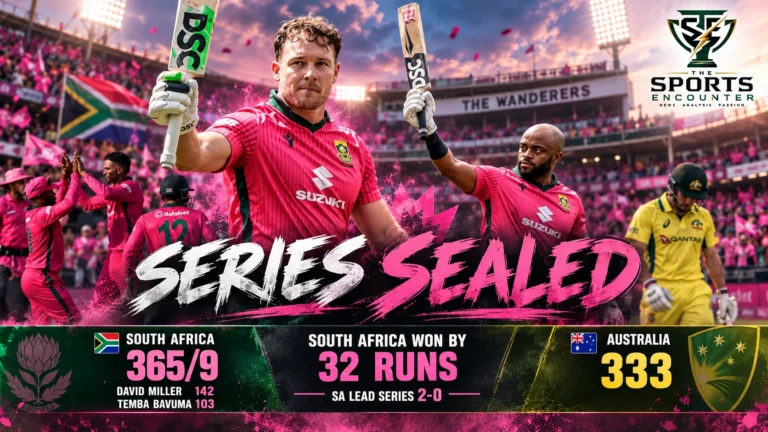
The larger series still belonged emphatically to the Proteas. Their 67-run win in Durban and 32-run victory in Johannesburg had already secured a sixth consecutive bilateral ODI series triumph over Australia.
Potchefstroom changed the scoreline from a potential whitewash to 2-1. It did not change who had been the better side across the series.
TL;DR: South Africa vs Australia Third ODI
- Australia scored 322/9 after South Africa elected to field.
- Alex Carey top-scored with 74 from 88 balls.
- Mitchell Marsh made 56 from 42 and gave Australia an aggressive start.
- Oliver Peake contributed 48 and Matt Renshaw made 30.
- Corbin Bosch led South Africa’s bowling with 4/60.
- South Africa lost Quinton de Kock for a duck and Aiden Markram for 15.
- Ryan Rickelton remained unbeaten on 71 from 81 balls.
- Xavier Bartlett and Adam Zampa took two wickets each.
- Rain ended the chase at 145/4 after 28 overs.
- Australia won by 45 runs under DLS.
- South Africa won the three-match ODI series 2-1.
- Alex Carey was Player of the Match.
- Keshav Maharaj was named Player of the Series.
- Cameron Green did not bowl after taking a blow while batting, creating another fitness concern for Australia.
South Africa vs Australia Third ODI at a Glance
| Match Detail | Information |
|---|---|
| Match | South Africa vs Australia, 3rd ODI |
| Date | September 30, 2026 |
| Venue | Senwes Park, Potchefstroom |
| Toss | South Africa elected to field |
| Australia | 322/9 in 50 overs |
| South Africa | 145/4 in 28 overs |
| DLS target at 28 overs | 191 to win, par score 190 |
| Result | Australia won by 45 runs, DLS method |
| Player of the Match | Alex Carey |
| Player of the Series | Keshav Maharaj |
| Series Result | South Africa won 2-1 |
Why Did Mitchell Marsh’s 56 Matter More Than the Score Suggests?
Australia had spent too much of this series allowing promising positions to collapse.
The first ODI offered the clearest example. Marsh smashed 60 from 36 balls and drove Australia to 90 without loss, only for South Africa’s spinners to change the contest completely.
Australia were eventually dismissed for 230.
In Johannesburg, Marsh attacked again, making 84 while Australia chased 366, but the innings eventually broke apart under another combination of South African spin and scoreboard pressure.
Potchefstroom finally produced a better response around him.
Marsh did not abandon his attacking approach. He struck eight fours and two sixes, reaching 50 from only 33 balls.
With Travis Head contributing 24 from 20, Australia’s opening partnership reached 78 in fewer than nine overs.
The difference came after Marsh departed.
Australia did not implode.
That may be the most important batting lesson they take from the entire ODI series.
The visitors entered this tour after completing a 3-0 ODI sweep of Zimbabwe, but South Africa repeatedly exposed the difference between scoring aggressively and controlling an innings against stronger opposition.
On Wednesday, Australia finally managed both phases in the same game.
How Did Alex Carey Hold Australia’s Innings Together?
Marsh supplied acceleration.
Carey supplied architecture.
Australia had slipped from 78 without loss to 118/3 when Cooper Connolly became Gerald Coetzee’s first wicket.
That was the moment at which another collapse could have developed.
Instead, Carey accepted a different tempo.
Oliver Peake made 48 from 53 balls alongside him, and the pair added 73 for the fourth wicket. Peake fell two short of a half-century with Australia on 191, but the innings was no longer drifting.
Carey then worked with Matt Renshaw, who made 30 from 29 balls, to push Australia beyond 250.
His own half-century required 68 deliveries.
There was nothing spectacular about that pace.
That was exactly why it mattered.
Australia already possessed enough aggressive players. What they had repeatedly lacked against South Africa was somebody willing to stay at the crease after the match changed shape.
Carey finished with 74 from 88 balls, including four fours and two sixes.
“I know my role in the team, catching balls and sometimes playing as a batter.”
Carey’s post-match understatement disguised the value of the innings.
Josh Inglis had already been ruled out of the remaining ODIs with a fractured right index finger, forcing Carey into the wicketkeeping role. The ICC confirmed Inglis suffered the fracture during the first ODI in Durban.
Carey’s response was to finish the series by becoming Player of the Match.
Did Australia’s Middle Order Finally Give Marsh Enough Support?
Not perfectly.
But sufficiently.
Peake’s 48 was particularly useful because it came after Australia lost Marsh and Connolly in relatively quick succession.
Renshaw added another 30.
Cameron Green made 23 from 18 balls.
Australia then lost wickets regularly during the closing overs, but Mitchell Starc’s unbeaten 11 from seven deliveries helped push the final total beyond 320.
Australia scored 73 runs in the final ten overs while losing five wickets.
It was untidy.
It was also enough.
This remains a team trying to determine which younger players belong around its established World Cup core. TSE’s analysis of Australia’s generational transition identified Connolly, Peake and several others as players whose opportunities will become increasingly important as the older core approaches the end of the cycle.
The South African tour has not solved those selection questions.
Peake’s innings at least added another useful piece of evidence.
How Did Corbin Bosch Stop Australia From Reaching 350?
South Africa rotated heavily after securing the series.
Temba Bavuma, David Miller, Marco Jansen and Keshav Maharaj were among the senior players not in the XI, while Aiden Markram led the side.
The changes created opportunities for players who had spent much of the series outside the central narrative.
Bosch took his.
His 4/60 from nine overs included the wickets of Travis Head, Oliver Peake, Alex Carey and Cameron Green.
Those were not tail-end wickets collected after the innings had already been decided.
They repeatedly prevented Australia from turning good partnerships into a total closer to 350.
| South Africa Bowler | Overs | Runs | Wickets | Economy |
|---|---|---|---|---|
| Corbin Bosch | 9 | 60 | 4 | 6.66 |
| Gerald Coetzee | 9 | 61 | 2 | 6.77 |
| Lizaad Williams | 6 | 48 | 2 | 8.00 |
| Bjorn Fortuin | 9 | 50 | 1 | 5.55 |
Coetzee’s two wickets were also significant after his return to South Africa’s ODI setup. TSE had examined his recall when South Africa restored several senior players for the Australia series.
The larger value of Wednesday for South Africa was exactly what Bavuma later emphasized: opportunity.
“We managed to go 2-0 up and we had the luxury of resting guys and giving others opportunities.”
Bosch and Coetzee were among the players who made those opportunities meaningful.
Why Was South Africa’s Chase in Trouble Almost Immediately?
The chase began with exactly the kind of damage Australia had failed to create often enough earlier in the series.
Xavier Bartlett removed Quinton de Kock for a five-ball duck.
South Africa were 4/1.
Aiden Markram attempted to rebuild, but Bartlett trapped him lbw for 15.
At 30/2 after 5.5 overs, South Africa had lost both of the batters most capable of turning the chase into an immediate powerplay assault.
That changed Rickelton’s job completely.
Instead of chasing 323 through sustained aggression, he first had to prevent two early wickets from becoming four.
How Close Did Ryan Rickelton Bring South Africa?
Rickelton played the best South African innings of the chase.
He reached 50 from 48 balls with five fours and two sixes and shared a 72-run third-wicket partnership with Matthew Breetzke.
The stand took South Africa from 30/2 to 102/3.
Breetzke made 25 from 29 balls before Adam Zampa stumped him.
Tristan Stubbs followed for 14, also falling to Zampa.
Rickelton remained.
He finished unbeaten on 71 from 81 balls, with five fours and two sixes.
The innings gave him exactly the kind of substantial time in the middle Bavuma wanted from South Africa’s rotated side.
It did not place South Africa close enough to the DLS par score when the rain arrived.
At 145/4 after 28 overs, South Africa were 45 runs behind the par score of 190.
Once the rain refused to clear, that gap became the final margin.
Why Did Adam Zampa and Xavier Bartlett Decide the Chase?
Neither bowler produced a four or five-wicket haul.
Their wickets mattered because of who they removed.
Bartlett took the new ball and dismissed both de Kock and Markram.
His figures were 2/25 from five overs.
Zampa then broke the partnership that had repaired the early damage.
He removed Breetzke and Stubbs to finish with 2/34 from six overs.
Pat Cummins went wicketless but conceded only 17 from his five overs.
That economy became more valuable when Australia’s bowling resources were unexpectedly reduced.
What Happened to Cameron Green?
The biggest concern for Australia may have arrived during their own innings rather than South Africa’s chase.
Green made 23 from 18 balls but took a blow to his body while batting.
He did not bowl during South Africa’s innings.
No firm diagnosis was provided in the immediate post-match update, so any assessment beyond that would be premature.
His absence nevertheless forced Australia to manufacture eight overs from Cooper Connolly, Matt Renshaw and Oliver Peake.
Connolly bowled three overs for 13.
Renshaw conceded eight from one.
Peake delivered two overs for 11.
Australia escaped without Green because Bartlett, Cummins, Starc and Zampa controlled enough of the chase before the rain arrived.
Whether Green’s problem affects the Test series is a much bigger question.
It also comes after an increasingly difficult sequence of injuries for Australia’s touring group. Nathan Ellis and Joel Davies had already been ruled out of the third ODI, while Inglis and Billy Stanlake had previously left the tour because of injuries.
Why Is Keshav Maharaj the Player of the Series?
Maharaj did not need to play the third ODI to remain the defining bowler of the series.
His influence had already been established.
In Durban, Australia were 90 without loss and threatening to turn 298 into a straightforward chase when Maharaj removed Marsh.
He finished that match with 4/20.
In Johannesburg, he again played an important role in slowing Australia’s middle order as South Africa defended 365.
Across the first two ODIs, Maharaj repeatedly did more than take wickets.
He altered Australia’s scoring options.
“As a spinner, the lengths is important in South Africa, with bounce or stop or turn. Understanding the batters and figuring out game-plans against batters.”
His Player of the Series award also reinforces a larger South African selection question before the 2027 World Cup.
The tournament will be staged in South Africa, Zimbabwe and Namibia, and South Africa have increasingly shown that home ODI success does not need to be constructed around fast bowling alone.
Bjorn Fortuin reinforced the same point throughout the series.
That spin depth had already emerged during South Africa’s earlier 3-0 sweep of Namibia.
What Does Australia’s Win Actually Change?
It changes the mood.
It does not change the series winner.
Australia had arrived from Zimbabwe with three consecutive victories and several encouraging individual performances. Travis Head scored a century in the second match, Adam Zampa reached 200 ODI wickets, and Australia eventually completed the sweep.
TSE’s report on Head’s century and Zampa’s milestone highlighted how useful those matches were for Australia’s World Cup preparation.
South Africa provided a tougher examination.
The hosts won the first two matches through very different routes.
Matthew Breetzke’s century, Marco Jansen’s all-round influence and Maharaj’s spin turned Durban.
Bavuma and David Miller then made centuries at the Wanderers, with Miller’s 142 driving South Africa to 365/9.
Australia were competitive for long passages in both defeats.
They still lost both.
That is why Potchefstroom matters.
For the first time in the series, Australia produced enough stability around their aggressive batting to prevent South Africa from reversing the game completely.
“I thought the way we batted showed improvement. Disappointing series… Looking forward to the World Cup in 12 months’ time.”
Marsh’s assessment was accurate.
Australia improved.
South Africa won the series.
Both facts can be true.
What Did South Africa Learn From Losing the Dead Rubber?
Calling the third ODI a dead rubber undersells its value to South Africa.
The series was won, but several regulars were rested and several fringe or returning players were asked to perform against the reigning ODI world champions.
Bosch took four wickets.
Coetzee took two.
Rickelton batted through the chase.
Breetzke added another useful contribution after already making 112 in the series opener.
Those are exactly the kinds of outcomes a team wants from a match in which the trophy has already been secured.
South Africa’s player-pool development has been visible throughout September. Jordan Hermann’s record-equalling 150 on ODI debut against Namibia was one example of how quickly competition for places is developing underneath the established lineup.
Bavuma’s series-closing message therefore focused more on progress than disappointment.
“The result didn’t go our way, but we wanted to give guys opportunities… from that point of view, it was good.”
What Does the 2-1 Series Result Mean Before the 2027 World Cup?
South Africa will co-host the 2027 Men’s Cricket World Cup with Zimbabwe and Namibia.
That makes every ODI played in these conditions useful evidence.
For South Africa, the evidence is encouraging.
They won while missing players.
They won through batting depth.
They won through spin.
They won after Australia dominated phases of matches.
And they secured another bilateral series against an opponent they have repeatedly troubled in ODI cricket.
Australia’s questions are different.
The ICC described Australia’s six ODIs in Zimbabwe and South Africa as an important lead-in to the 2027 World Cup, with selectors deliberately mixing established players with younger options.
Zimbabwe produced answers.
South Africa exposed new questions.
Potchefstroom at least gave Australia one answer they badly needed: they can still build a 300-plus innings after losing momentum, rather than allowing one setback to become an innings-wide collapse.
What Comes Next for South Africa and Australia?
The white-ball series is finished.
The rivalry now changes format.
The teams begin a three-match Test series at Kingsmead in Durban on October 9.
Cricket South Africa’s official home schedule confirms Durban will stage the first Test.
That transition creates immediate selection and fitness questions.
Australia will want clarity on Green.
Inglis’s availability remains uncertain after his fractured finger.
South Africa will reassess the fitness of several frontline bowlers while restoring senior players rested in Potchefstroom.
The ODI series belonged to South Africa.
Australia got the final word.
From October 9, neither result will matter nearly as much as what happens with the red ball.
Key Individual Performances
| Player | Team | Performance |
|---|---|---|
| Alex Carey | Australia | 74 from 88 balls; Player of the Match |
| Mitchell Marsh | Australia | 56 from 42 balls, 8 fours, 2 sixes |
| Oliver Peake | Australia | 48 from 53 balls |
| Corbin Bosch | South Africa | 4/60 from 9 overs |
| Gerald Coetzee | South Africa | 2/61 from 9 overs |
| Ryan Rickelton | South Africa | 71 not out from 81 balls |
| Xavier Bartlett | Australia | 2/25 from 5 overs |
| Adam Zampa | Australia | 2/34 from 6 overs |
Five Turning Points That Decided the Third ODI
1. Marsh and Head Put on 78 in 8.4 Overs
South Africa chose to bowl under overcast conditions. Australia’s openers removed much of the advantage from that decision almost immediately.
2. Carey and Peake Stop 118/3 Becoming a Collapse
Their 73-run partnership turned the middle overs from survival into reconstruction and gave Australia’s lower middle order a platform.
3. Bosch Removes Carey Before the Final Assault
Carey fell for 74 at 285/6. Bosch’s fourth wicket prevented Australia from carrying a set batter into the final four overs.
4. Bartlett Removes de Kock and Markram
South Africa lost two top-order wickets before reaching 31, forcing Rickelton to rebuild instead of attacking the target.
5. Zampa Breaks South Africa’s Recovery
Rickelton and Breetzke had repaired the innings to 102/2. Zampa removed Breetzke and Stubbs, leaving South Africa too far behind the DLS curve when the rain arrived.
Continue the Cricket Story
 CricketMarsh Blasts Australia to 90/0, Then South Africa Turn a Runaway Chase Into a 67-Run Statement
 CricketMiller’s 142 Drives South Africa to Sixth Straight ODI Series Win over Australia
 A Celebration of 5000 ODIsA Celebration of 5000 ODIs Match 40: Maharaj Saves South Africa After Pakistan Turn 271 Into a One-Wicket World Cup Trap
Frequently Asked Questions
Who Won the Third ODI Between South Africa and Australia?
Australia won by 45 runs under the DLS method after South Africa finished on 145/4 from 28 overs when rain ended the match.
What Did Australia Score?
Australia made 322/9 from 50 overs.
Who Was Player of the Match?
Alex Carey was named Player of the Match after scoring 74 from 88 balls.
Who Was Player of the Series?
Keshav Maharaj was named Player of the Series after playing a decisive role with spin during South Africa’s victories in the first two ODIs.
Who Won the ODI Series?
South Africa won the three-match series 2-1.
How Many Runs Did Ryan Rickelton Score?
Rickelton remained unbeaten on 71 from 81 balls.
What Happened to Cameron Green?
Green took a blow while batting and did not bowl during South Africa’s chase. No confirmed diagnosis was available in the immediate post-match update.
When Is the First South Africa vs Australia Test?
The first Test begins in Durban on October 9, 2026.
Australia
- Australia Cup Final: South Melbourne’s Historic Run Meets Melbourne Victory’s Cup Pedigree at AAMI Park
- Carey and Marsh Put Australia Ahead of the Rain as South Africa’s Sweep Bid Ends on a Soggy Night
- Endrick Changes the Game as Brazil Recover From 2-1 Down to Beat Australia 4-2
- A Celebration of 5000 ODIs Match 37: Coulter-Nile Rises From No. 8 as Australia Escape 38/4 and Starc Breaks West Indies Late
- Miller’s 142 Drives South Africa to Sixth Straight ODI Series Win over Australia