
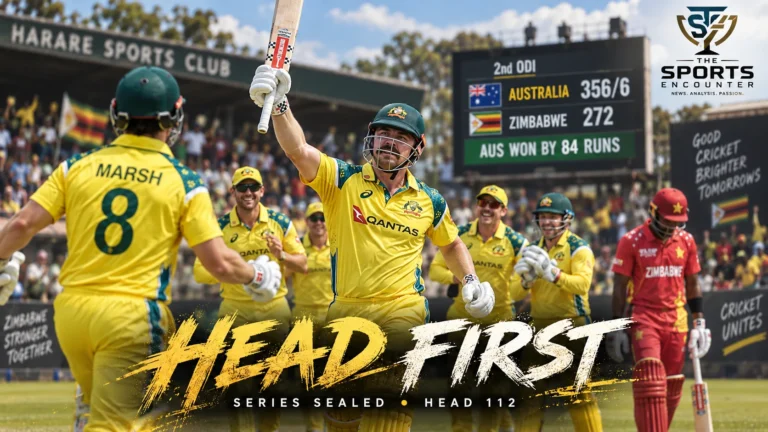
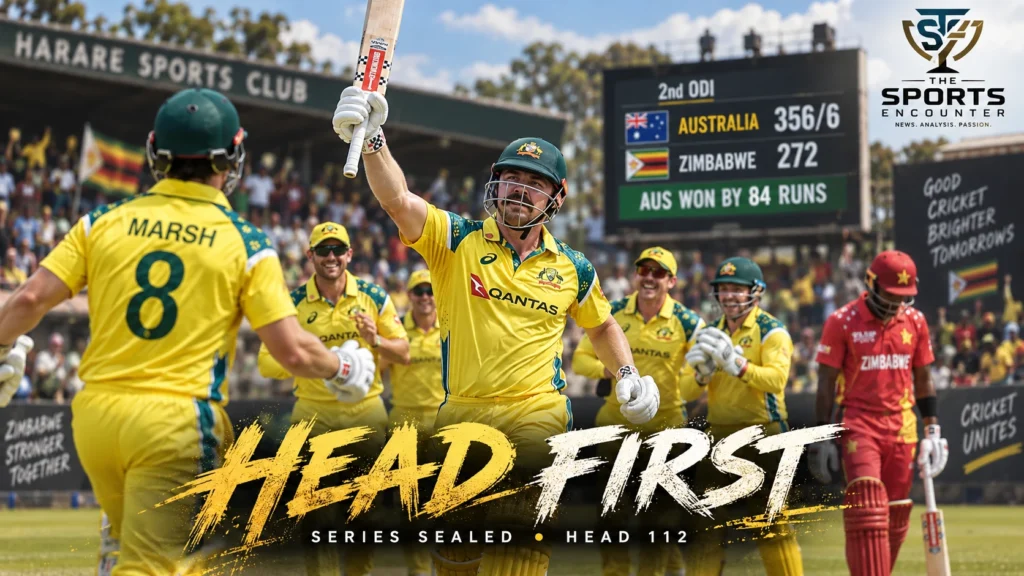
HARARE, Zimbabwe, September 19, 2026: Travis Head returned to his destructive best with 112 from 84 balls, Adam Zampa reached 200 ODI wickets and Australia’s younger all-rounders filled an unexpected bowling gap as the world champions beat Zimbabwe by 84 runs at Harare Sports Club to secure an unassailable 2-0 series lead.
Australia piled up 356 for six, their highest ODI total against Zimbabwe, after being sent in to bat. Head reached his eighth ODI century from only 75 deliveries, Mitchell Marsh made 53, Cooper Connolly continued his strong run with 78, and Oliver Peake hammered an unbeaten 41 from 18 balls to provide the late acceleration.
Zimbabwe replied with 272 in 48.3 overs. Six of their top seven reached double figures and five passed 30, but nobody reached 50 and the required rate steadily moved beyond reach. Sikandar Raza top-scored with 45 before Connolly took the final two wickets from consecutive deliveries.
The result followed Australia’s 59-run victory in the first ODI, where Matt Renshaw’s maiden ODI hundred and Nathan Ellis’ five-wicket haul had put the visitors ahead. Australia have now turned the three-match contest into a series win with Sunday’s final ODI still to play.
Story at a glance
Travis Head Turns a Difficult Run Into a 75-Ball Century
Head entered the second ODI needing an innings of substance.
Mitchell Marsh and Head Make Zimbabwe Pay for the Early Miss
Zimbabwe’s decision to bowl first was understandable.
Cooper Connolly Strengthens His 2027 World Cup Case
Head’s dismissal did not end Australia’s scoring momentum because Connolly again supplied a substantial innings.
Oliver Peake Changes the Final Five Overs
Australia were 297 for five after 45.1 overs when Connolly departed.
Zimbabwe’s Chase Fell Behind Before the Middle Order Could Attack
Zimbabwe did not suffer the kind of early collapse that usually ends a chase of 357 immediately.
Cricket Australia’s official second ODI match report confirmed Head’s century, Australia’s record total against Zimbabwe, Zampa’s milestone and Billy Stanlake’s side injury.
Zimbabwe vs Australia 2nd ODI: Key Facts
| Match Detail | Information |
|---|---|
| Match | Zimbabwe vs Australia, 2nd ODI |
| Series | Australia tour of Zimbabwe 2026 |
| Date | September 18, 2026 |
| Venue | Harare Sports Club, Harare |
| Toss | Zimbabwe won the toss and elected to field |
| Australia | 356/6 in 50 overs |
| Zimbabwe | 272 all out in 48.3 overs |
| Result | Australia won by 84 runs |
| Series Position | Australia lead 2-0 with one match remaining |
| Player of the Match | Travis Head, 112 from 84 balls |
| Major Milestone | Adam Zampa reached 200 ODI wickets |
| Match Number | ODI No. 5014 |
Travis Head Turns a Difficult Run Into a 75-Ball Century
Head entered the second ODI needing an innings of substance.
He had made only four in the series opener and had not passed 26 in his previous eight innings across formats. Zimbabwe then gave Australia a small opening almost immediately when Wessly Madhevere put Marsh down from the first ball of the match.
Head made sure the reprieve became expensive.
The left-hander attacked from the beginning rather than waiting for the surface to settle. He reached 50 from 32 deliveries with eight fours and two sixes, while Australia raced to 78 without loss from the opening 10 overs.
Marsh played the steadier role. Their opening partnership reached 100 from 76 balls and eventually finished at 130 when Wellington Masakadza bowled the Australian captain for 53.
Head kept attacking.
His hundred arrived from 75 balls, with 13 fours and three sixes already behind him. By the time Madhevere finally removed him for 112 in the 28th over, Australia were 190 for two and had a platform capable of producing a score well above 300.
Head later explained that freshness had helped after Australia reduced its training load between matches.
Travis Head said: “It was nice to spend some time in the middle and spend some time out there with Mitch. We didn’t train for a couple of days which was good actually. We’d done a fair bit of training going into the series. It was nice to be fresh. We just tried to be aggressive and impact the game.”
That approach matched the role Australia have built around Head in ODI cricket. He is most dangerous when the opening overs become an opportunity rather than an examination.
Mitchell Marsh and Head Make Zimbabwe Pay for the Early Miss
Zimbabwe’s decision to bowl first was understandable.
Raza later pointed to early seam and carry at Harare Sports Club, conditions that had also influenced Australia’s thinking throughout a series The Sports Encounter framed beforehand as a 2027 World Cup dress rehearsal.
The problem was execution after winning the toss.
Marsh’s first-ball escape removed the possibility of an immediate breakthrough, and Head punished Zimbabwe whenever their bowlers missed either length or width.
The pair added 130 in 19 overs. Marsh reached his half-century from 52 balls, hitting three fours and three sixes, while Head supplied most of the tempo.
Zimbabwe captain Raza did not criticize the decision to field.
Sikandar Raza said: “I think bowling first was the right decision. There was seam and carry in the wicket. Credit to Travis and Mitch Marsh. They put us under pressure. The boys tried but their skills, even some of our good balls went for boundaries. Sometimes when two of the world’s best get going it’s hard to control at times. I thought 350 was too much. 300-310 was chasable.”
His final point explains the scale of Australia’s batting success. Zimbabwe did not necessarily need to dismiss Australia cheaply. They needed to prevent a 300-run contest from becoming a 350-plus chase.
Cooper Connolly Strengthens His 2027 World Cup Case
Head’s dismissal did not end Australia’s scoring momentum because Connolly again supplied a substantial innings.
The 22-year-old made 78 from 69 balls, including three fours and three sixes. He reached 50 from 51 deliveries and shared another useful partnership with Head before carrying the innings through the middle overs.
It was Connolly’s third consecutive ODI score above 50, following 149 in Australia’s previous ODI before this series and 51 in the opening match in Harare.
That consistency matters because Australia’s middle order remains one of the central selection questions before the 2027 World Cup. The Sports Encounter’s analysis of Australia’s ageing squad and emerging generation identified Connolly, Peake and other younger players as part of a transition that selectors cannot postpone indefinitely.
The issue has become even more visible with Marnus Labuschagne currently outside Australia’s ODI plans.
The ICC described the Zimbabwe and South Africa matches as an important part of Australia’s preparation when announcing the touring squad. Its official squad announcement specifically highlighted the value of these six ODIs in the region that will host the 2027 World Cup.
Connolly is using that opportunity well.
Oliver Peake Changes the Final Five Overs
Australia were 297 for five after 45.1 overs when Connolly departed.
A total around 330 still looked realistic. Peake pushed it much further.
The 20-year-old finished unbeaten on 41 from 18 balls at a strike rate of 227.77, hitting two fours and three sixes.
His most damaging burst came at the end. Australia entered the final over on 332 for six. Peake attacked Brad Evans and helped extract 24 runs from the over, taking the innings to 356 for six.
Those late runs mattered because Zimbabwe had already shown in the first ODI that their experienced middle order could build partnerships in Harare. Australia effectively moved the required rate beyond seven runs per over before the chase had begun.
Peake later contributed with the ball as well, removing Brendan Taylor for 39 to claim his first ODI wicket.
For an Australian side actively testing its next generation, a player contributing in both halves of a match carries more value than an isolated cameo.
Zimbabwe’s Chase Fell Behind Before the Middle Order Could Attack
Zimbabwe did not suffer the kind of early collapse that usually ends a chase of 357 immediately.
That was part of the problem.
Brian Bennett and Ben Curran reached 41 without loss after 10 overs. The wickets were intact, but Australia had already been 78 without loss at the same stage.
The required rate continued climbing.
Bennett made 23 from 34 balls and Curran 30 from 46. Both were bowled by part-time spinner Matt Renshaw, leaving Zimbabwe 60 for two after 15.2 overs.
Innocent Kaia made 34 from 47. Brendan Taylor scored 39 from 40. Craig Ervine added 38 from 39 and Raza 45 from 49.
Those were useful starts in isolation. In a chase of 357, Zimbabwe needed at least one of them to turn a start into a century-level innings or for several batters to score at substantially higher rates.
None did.
Raza’s assessment that 300 to 310 would have been chaseable fits what unfolded. Zimbabwe reached competitive positions without ever reaching the pace required to threaten 356.
Billy Stanlake Injury Forces Australia to Improvise
The one significant concern for Australia came when Billy Stanlake left the field with a side strain.
The fast bowler had delivered only 4.2 overs for 19 runs when he grabbed his left side during his fifth over and could not continue. Marsh said after the match that Australia did not yet have an injury update.
Mitchell Marsh said: “We thought it was a complete performance from the boys. The way Travis batted gave us a platform for the middle order. It was great to see Cooper Connolly and Peakey play roles like that and then obviously we had Billy Stanlake go down and our part timers and allrounders really stepped up in those conditions. No update yet on Billy but hopefully he’s OK.”
Stanlake’s absence left Australia short of a frontline bowler for most of Zimbabwe’s innings.
What followed may have been almost as useful to Australia’s selectors as the result itself.
Renshaw bowled seven overs and took two wickets. Connolly returned 2/25. Peake claimed his first ODI wicket. Head supplied two overs. Marsh was able to move between Josh Hazlewood, Nathan Ellis, Zampa and four secondary options without losing control of the chase.
That flexibility matters in tournament cricket, where injury, conditions and workload can force captains away from their preferred bowling plans.
Adam Zampa Reaches 200 ODI Wickets
Australia also had a major individual milestone to celebrate.
Zampa bowled Innocent Kaia with a googly in the 25th over to claim his 200th ODI wicket. He became only the second Australian spinner after Shane Warne to reach the mark.
The leg-spinner later dismissed Craig Ervine and finished with 2/62 from nine overs.
Zampa had entered the series on 198 ODI wickets and moved to 199 during the first match. Kaia therefore became the batter attached to one of the most significant milestones of Zampa’s international career.
Australia’s modern ODI identity has changed around him. Several senior players have retired or moved out of the format, yet Zampa remains the specialist spinner around whom the middle overs can be organized.
His milestone also arrives as ODI cricket moves through another generational cycle, a theme The Sports Encounter has been documenting in the A Celebration of 5000 ODIs series.
Josh Hazlewood Returns With Two Wickets
Josh Hazlewood’s return gave Australia another positive development ahead of the South Africa leg of the tour.
He finished with 2/48 from nine overs, including two maidens.
His wickets came late, removing Wessly Madhevere for a rapid 26 from 13 balls and bowling Newman Nyamhuri two deliveries later.
Madhevere’s counterattack briefly gave Zimbabwe their fastest scoring passage of the innings, but by that stage the required rate had become unrealistic.
Australia therefore received almost everything they wanted from the afternoon: runs for Head, another substantial Connolly innings, useful experience for Peake, a landmark for Zampa, overs for Hazlewood and evidence that the bowling attack could adapt after losing Stanlake.
Continue the Cricket Story


Complete Zimbabwe vs Australia 2nd ODI Scorecard
Australia Batting
| Batter | Dismissal | R | B | 4s | 6s | SR |
|---|---|---|---|---|---|---|
| Mitchell Marsh (c) | b Wellington Masakadza | 53 | 63 | 3 | 3 | 84.12 |
| Travis Head | c sub (Ryan Burl) b Wessly Madhevere | 112 | 84 | 15 | 3 | 133.33 |
| Cooper Connolly | c Brendan Taylor b Brad Evans | 78 | 69 | 3 | 3 | 113.04 |
| Josh Inglis (wk) | c & b Wellington Masakadza | 21 | 20 | 2 | 0 | 105.00 |
| Alex Carey | c Ben Curran b Brad Evans | 20 | 30 | 1 | 0 | 66.66 |
| Matt Renshaw | c Innocent Kaia b Brad Evans | 15 | 11 | 1 | 0 | 136.36 |
| Oliver Peake | not out | 41 | 18 | 2 | 3 | 227.77 |
| Nathan Ellis | not out | 6 | 5 | 0 | 0 | 120.00 |
| Extras | 10 (lb 2, w 8) | |||||
| Total | 356/6 in 50 overs | |||||
Did not bat: Adam Zampa, Josh Hazlewood, Billy Stanlake.
Fall of wickets: 130/1 (Mitchell Marsh, 18.6), 190/2 (Travis Head, 27.5), 229/3 (Josh Inglis, 34.1), 286/4 (Alex Carey, 43.2), 297/5 (Cooper Connolly, 45.1), 321/6 (Matt Renshaw, 47.3).
Zimbabwe Bowling
| Bowler | O | M | R | W | Econ |
|---|---|---|---|---|---|
| Blessing Muzarabani | 9 | 0 | 68 | 0 | 7.55 |
| Brad Evans | 9 | 0 | 86 | 3 | 9.55 |
| Newman Nyamhuri | 5 | 0 | 37 | 0 | 7.40 |
| Sikandar Raza | 10 | 0 | 60 | 0 | 6.00 |
| Wellington Masakadza | 9 | 0 | 51 | 2 | 5.66 |
| Wessly Madhevere | 8 | 0 | 52 | 1 | 6.50 |
Zimbabwe Batting
| Batter | Dismissal | R | B | 4s | 6s | SR |
|---|---|---|---|---|---|---|
| Brian Bennett | b Matt Renshaw | 23 | 34 | 3 | 0 | 67.64 |
| Ben Curran | b Matt Renshaw | 30 | 46 | 4 | 0 | 65.21 |
| Innocent Kaia | b Adam Zampa | 34 | 47 | 3 | 0 | 72.34 |
| Brendan Taylor (wk) | c Josh Hazlewood b Oliver Peake | 39 | 40 | 3 | 0 | 97.50 |
| Craig Ervine | c Mitchell Marsh b Adam Zampa | 38 | 39 | 3 | 0 | 97.43 |
| Sikandar Raza (c) | c Matt Renshaw b Cooper Connolly | 45 | 49 | 5 | 0 | 91.83 |
| Brad Evans | c Cooper Connolly b Nathan Ellis | 12 | 12 | 0 | 1 | 100.00 |
| Wessly Madhevere | lbw b Josh Hazlewood | 26 | 13 | 4 | 0 | 200.00 |
| Newman Nyamhuri | b Josh Hazlewood | 2 | 2 | 0 | 0 | 100.00 |
| Wellington Masakadza | not out | 10 | 8 | 1 | 0 | 125.00 |
| Blessing Muzarabani | b Cooper Connolly | 0 | 1 | 0 | 0 | 0.00 |
| Extras | 13 (b 4, w 9) | |||||
| Total | 272 all out in 48.3 overs | |||||
Fall of wickets: 46/1 (Brian Bennett, 11.5), 60/2 (Ben Curran, 15.2), 115/3 (Innocent Kaia, 24.4), 159/4 (Brendan Taylor, 31.5), 187/5 (Craig Ervine, 36.1), 218/6 (Brad Evans, 41.2), 253/7 (Wessly Madhevere, 44.4), 255/8 (Newman Nyamhuri, 44.6), 272/9 (Sikandar Raza, 48.2), 272/10 (Blessing Muzarabani, 48.3).
Australia Bowling
| Bowler | O | M | R | W | Econ |
|---|---|---|---|---|---|
| Josh Hazlewood | 9 | 2 | 48 | 2 | 5.33 |
| Billy Stanlake | 4.2 | 0 | 19 | 0 | 4.38 |
| Nathan Ellis | 6 | 0 | 31 | 1 | 5.16 |
| Cooper Connolly | 6.1 | 0 | 25 | 2 | 4.05 |
| Matt Renshaw | 7 | 0 | 44 | 2 | 6.28 |
| Oliver Peake | 5 | 0 | 29 | 1 | 5.80 |
| Travis Head | 2 | 0 | 10 | 0 | 5.00 |
| Adam Zampa | 9 | 0 | 62 | 2 | 6.88 |
What Australia’s Series Win Means Before the 2027 World Cup
The series result matters because of where these matches are being played.
Zimbabwe will co-host the 2027 ICC Men’s Cricket World Cup with South Africa and Namibia. The ICC’s official announcement of Australia’s Zimbabwe tour described the series as important preparation for the tournament.
Australia’s selectors are therefore gathering more than results.
Head and Marsh have reaffirmed the opening combination. Connolly has produced three consecutive ODI half-centuries. Peake has added a 41-ball-impact cameo and his first wicket. Renshaw followed his first-ODI century with two wickets here. Ellis took five in the opener. Zampa remains the experienced spin reference point.
This is exactly why Australia’s generational transition deserves attention. The established champions still provide the framework, while younger players are being asked to demonstrate that the team can eventually evolve around them.
That broader 2027 landscape is already developing elsewhere. The Sports Encounter recently covered Afghanistan securing its place at the 2027 ODI World Cup, another reminder that teams are already building toward the tournament rather than waiting until next year.
When Is the Zimbabwe vs Australia 3rd ODI?
The third and final ODI will be played at Harare Sports Club on Sunday, September 20, with the match scheduled to begin at 9:30 a.m. local time.
Australia cannot lose the series, but the final match still carries selection value before the squad travels to South Africa for three more ODIs.
Zimbabwe have something different to pursue. They need a batting performance that converts several starts into one decisive innings and a bowling display capable of controlling Australia’s power without relying on missed chances.
For further match reports, records, ODI analysis and international cricket coverage, follow The Sports Encounter’s Cricket Hub.
Zimbabwe vs Australia 2nd ODI FAQs
Who won the Zimbabwe vs Australia 2nd ODI?
Australia beat Zimbabwe by 84 runs at Harare Sports Club on September 18, 2026.
What was the score in the second Zimbabwe vs Australia ODI?
Australia scored 356 for six from 50 overs. Zimbabwe were dismissed for 272 in 48.3 overs while chasing 357.
Who was Player of the Match?
Travis Head was named Player of the Match after scoring 112 from 84 balls, including 15 fours and three sixes.
How quickly did Travis Head reach his century?
Head reached his eighth ODI century from 75 balls.
How many ODI wickets does Adam Zampa have?
Zampa reached 200 ODI wickets when he bowled Innocent Kaia. He later dismissed Craig Ervine to finish the match on 201 career ODI wickets.
Who became Adam Zampa’s 200th ODI wicket?
Zimbabwe batter Innocent Kaia became Zampa’s 200th ODI wicket when the Australian leg-spinner bowled him for 34.
What happened to Billy Stanlake?
Stanlake left the field with a side strain after bowling 4.2 overs. Mitchell Marsh said immediately after the match that Australia did not yet have a further medical update.
How many runs did Cooper Connolly score?
Connolly made 78 from 69 balls and later took two wickets for 25 runs with his left-arm spin.
What did Oliver Peake score?
Peake finished unbeaten on 41 from only 18 balls and later claimed his maiden ODI wicket by dismissing Brendan Taylor.
Has Australia won the ODI series?
Yes. Australia lead the three-match series 2-0 and have secured the series before the third ODI on September 20.
Australia
- Ashes 2005: How England Broke Australia’s 16-Year Hold And Why England’s Two-Run Escape Still Matters
- Australia Seal Zimbabwe ODI Series as Travis Head Smashes 112 and Adam Zampa Reaches 200 Wickets
- India U19 Hold Their Nerve as Australia U19 Fall Seven Runs Short in Rajkot Thriller
- Renshaw and Ellis Show: Australia Draw First Blood in Zimbabwe ODI Series with 59-Run Victory
- Bul Juach Comes Off the Bench to Fire South Melbourne Into Australia Cup Final