Key Takeaways
- Rohit Sharma’s dismissal for a six-ball duck could have given New Zealand the opening they needed.
- If Kamboj suffocated the scoring, Arshdeep Singh supplied the cutting edge.
- India’s opening victory offers several encouraging signs ahead of the 2027 ICC Men’s Cricket World Cup.
- The second ODI is scheduled for Saturday, November 7, 2026, in Wellington.
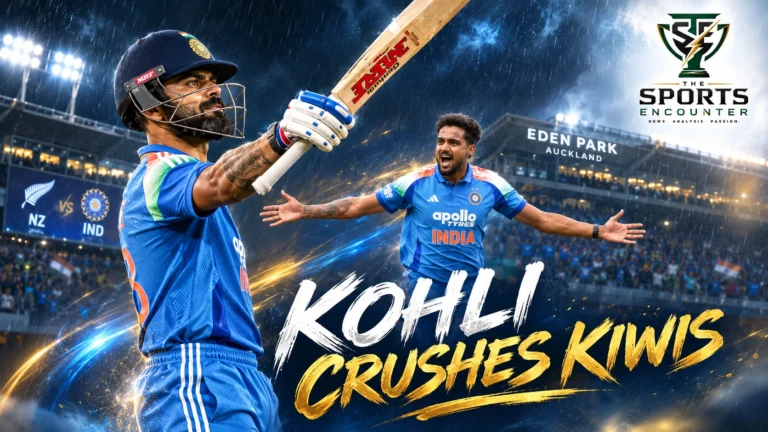
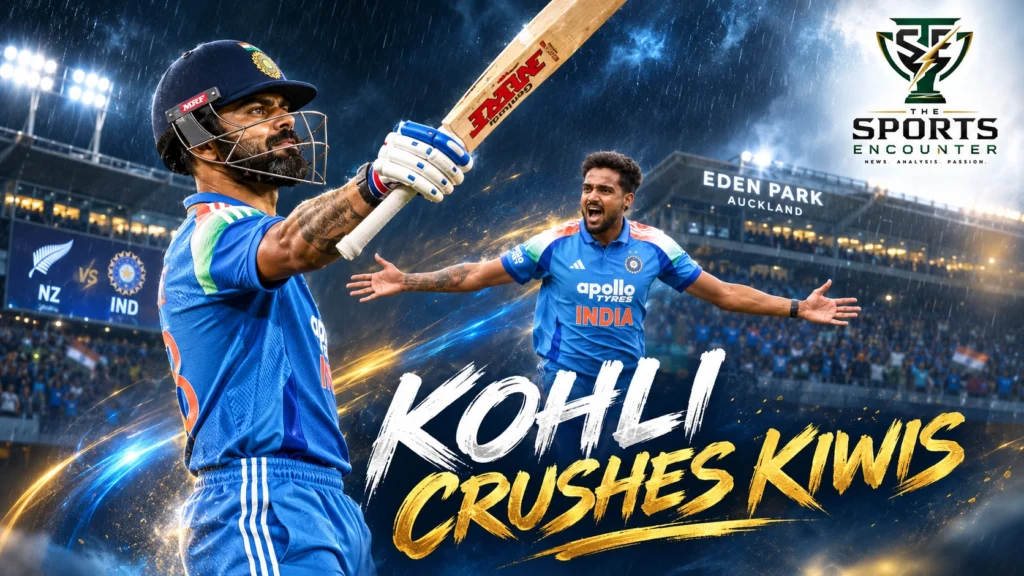
AUCKLAND, New Zealand, November 4, 2026: Virat Kohli turned a potentially awkward run chase into an exhibition of stroke play at Eden Park on Wednesday, smashing 74 from just 51 deliveries as India defeated New Zealand by five wickets under the Duckworth-Lewis-Stern (DLS) method in the opening One-Day International. Kohli struck 13 fours and one six, punished anything short or overpitched, and helped India reach their revised target of 143 with 56 deliveries remaining.
India’s victory was built on an outstanding bowling performance that dismissed New Zealand for 185 in 40.2 overs. Arshdeep Singh took four wickets, Gurnoor Brar claimed three, and Anshul Kamboj delivered a remarkable 10-over spell of 2/22 to earn Player of the Match. Captain Shubman Gill contributed 37 in a 113-run partnership with Kohli, although Jacob Duffy’s three wickets sparked a late collapse before KL Rahul and Naman Dhir completed the chase. India now lead the five-match ODI series 1-0.
India vs New Zealand 1st ODI 2026: Match Result at a Glance
| Match Detail | Result |
|---|---|
| Match | New Zealand vs India, 1st ODI |
| Date | November 4, 2026 |
| Venue | Eden Park, Auckland |
| Toss | India elected to field |
| New Zealand | 185 all out, 40.2 overs |
| India | 143/5, 22.4 overs |
| Revised DLS target | 143 runs from 32 overs |
| Result | India won by five wickets, with 56 balls remaining, DLS method |
| Player of the Match | Anshul Kamboj, 2/22 |
| Best batter | Virat Kohli, 74 off 51 balls |
| Best wicket-taker | Arshdeep Singh, 4/70 |
| Series standing | India lead 1-0 |
| ODI number | 5058 |
The result is corroborated by the BCCI’s official match center.
Story at a glance
India vs New Zealand 1st ODI 2026: Match Result at a Glance
The result is corroborated by the BCCI’s official match center.
Virat Kohli’s 74: How India Turned a Difficult Chase Into a Batting Exhibition
Rohit Sharma’s dismissal for a six-ball duck could have given New Zealand the opening they needed. Kyle Jamieson removed him in the first over, leaving India at 1/1.
Anshul Kamboj’s 2/22: The Spell That Really Won the Match
Kohli provided the spectacle, but Anshul Kamboj supplied the foundation.
Arshdeep Singh’s Four Wickets Leave New Zealand Reeling
If Kamboj suffocated the scoring, Arshdeep Singh supplied the cutting edge.
New Zealand’s Batting Collapse: Why 185 Was Never Enough
New Zealand had opportunities to build a competitive total.
Virat Kohli’s 74: How India Turned a Difficult Chase Into a Batting Exhibition
Rohit Sharma’s dismissal for a six-ball duck could have given New Zealand the opening they needed. Kyle Jamieson removed him in the first over, leaving India at 1/1.
With a lively pitch offering pace and bounce, the opening setback demanded judgment as well as attacking intent.
Kohli provided both.
Rather than allow New Zealand’s fast bowlers to dictate the length, he attacked deliveries that offered width and punished the short ball with authoritative pulls. His driving was equally effective, allowing him to score freely without becoming dependent on one area of the field.
The contrast with New Zealand’s earlier batting was striking. Where several home batters had struggled against the bounce and lost their rhythm, Kohli used the speed of the surface to generate boundaries.
He reached his half-century in just 35 balls, with eight fours and a six, and eventually finished with 74 from 51 deliveries at a strike rate of 145.09.
That was his 80th ODI half-century, another reminder of his extraordinary longevity on the eve of his 38th birthday.
It also continued an impressive period of ODI batting. In September, Kohli had produced an unbeaten 139 against West Indies while crossing the 15,000-run landmark, a performance covered in The Sports Encounter’s analysis of Kohli’s historic ODI innings.
The Numbers Behind Kohli’s Destruction
| Batting Metric | Virat Kohli |
|---|---|
| Runs | 74 |
| Balls faced | 51 |
| Fours | 13 |
| Sixes | 1 |
| Runs from boundaries | 58 |
| Boundary share of total runs | 78.38% |
| Strike rate | 145.09 |
| Half-century reached | 35 balls |
| Dismissal | c Seifert b Duffy |
The Sports Encounter statistical insight: Kohli scored 58 of his 74 runs in boundaries, meaning 78.38% of his individual runs came from fours and sixes. His 14 boundary shots accounted for 27.45% of the 51 deliveries he faced. That combination of frequent boundaries and a high scoring rate prevented New Zealand from maintaining pressure between rain interruptions.
There is also a historical connection to his approach. In the 2012 Asia Cup, Kohli’s 183 against Pakistan transformed a chase of 330 into one of India’s most memorable ODI victories. Our A Celebration of 5000 ODIs retrospective on Kohli’s 183 examines an earlier demonstration of his ability to take control of a demanding chase.
Auckland was a much smaller target and a different challenge. The common feature was Kohli’s ability to seize control after an early Indian wicket.
Anshul Kamboj’s 2/22: The Spell That Really Won the Match
Kohli provided the spectacle, but Anshul Kamboj supplied the foundation.
New Zealand’s batting lineup never settled against the right-arm seamer, who maintained a demanding length and exploited the movement and bounce available at Eden Park.
Kamboj conceded only 22 runs from his full allocation of 10 overs, including two maidens. He dismissed captain Mitchell Santner for four and Nathan Smith for one, both at a stage when New Zealand desperately needed partnerships.
His most revealing statistic was not the number of wickets.
It was the number of deliveries New Zealand failed to score from.
Kamboj bowled 46 dot balls, equivalent to 76.67% of his 60 legal deliveries.
That meant New Zealand scored from fewer than one in every four legal deliveries he sent down.
His economy rate of 2.20 was the lowest among India’s five bowlers, just ahead of Axar Patel’s equally disciplined 2.40.
Why Kamboj Deserved Player of the Match
Arshdeep’s four wickets made him the leading wicket-taker, but Kamboj’s control created a different form of pressure.
He denied New Zealand the opportunity to rebuild after successive dismissals. Batters who survived one spell still had to find a way to score against him.
That pressure mattered because the home side’s middle order was already struggling to manage the bounce.
Kamboj explained after the match that his plan was built around consistent lines and lengths. The wobble seam was effective, and he used the natural bounce he generates to keep the batters uncomfortable.
His performance also strengthens India’s emerging pace-bowling options. A reliable seamer capable of controlling the middle overs outside the subcontinent offers considerable value as India prepare for the 2027 ODI World Cup.
Arshdeep Singh’s Four Wickets Leave New Zealand Reeling
If Kamboj suffocated the scoring, Arshdeep Singh supplied the cutting edge.
The left-arm fast bowler dismissed Will Young for nine and Henry Nicholls for nine, denying New Zealand an established opening partnership.
He later removed Glenn Phillips for 30 and Kyle Jamieson for one, finishing with 4/70 from 10 overs.
His figures were relatively expensive, but the four wickets repeatedly interrupted New Zealand’s attempts to regain control.
Young fell at 22/1, Nicholls at 40/2 and Phillips at 146/9. Each dismissal reduced the hosts’ ability to construct a substantial innings.
Arshdeep’s contribution was particularly important with several Indian bowling combinations being tested during this tour.
Gurnoor Brar Makes the Bounce Count
Gurnoor Brar finished with 3/44 in 9.2 overs and delivered another significant performance for India’s pace attack.
He removed Tim Seifert for 38, took a return catch to dismiss Tom Latham for three, and ended the innings by having Blair Tickner caught behind.
Seifert’s dismissal was particularly valuable.
The opener had reached 38 from 43 balls and was the only New Zealand top-order batter to pass 30. Removing him at 73/3 prevented the hosts from building around their most productive early batter.
Seifert had entered the ODI series in strong form after his 93 in the fifth T20I at Hamilton. That innings helped New Zealand win the final match of the shorter-format series, as detailed in our fifth T20I match report.
In Auckland, however, his dismissal exposed a middle order that could not withstand sustained pace pressure.
New Zealand’s Batting Collapse: Why 185 Was Never Enough
New Zealand had opportunities to build a competitive total.
Seifert made 38, Daryl Mitchell contributed 28 and Glenn Phillips scored 30. But none managed to convert a start into the innings New Zealand required.
The hosts were 73/3 when Seifert departed in the 15th over. Tom Latham then fell for three, Mitchell was run out for 28 following a fielding effort involving Rohit Sharma and Rahul, and Santner departed for four.
By the time Nathan Smith fell at 115/7, New Zealand had lost four wickets for 42 runs since Seifert’s dismissal.
The middle-order collapse left Phillips with too much responsibility and too little support.
India also benefited from sharp fielding. Rohit Sharma’s involvement in Mitchell’s run-out was a particularly important intervention, with Gill later identifying the dismissal as a turning point.
Blair Tickner’s Four Sixes Provide Late Resistance
New Zealand’s last pair produced an unexpected burst of resistance.
Blair Tickner struck 34 from 23 balls, including four sixes, while Jacob Duffy remained unbeaten on 15.
Their 39-run final-wicket partnership lifted New Zealand from 146/9 to 185 all out.
Tickner’s aggressive contribution prevented an even more embarrassing total, but it could not disguise the damage caused by the earlier collapse.
For Santner, the failure to adapt to Eden Park’s faster surface became the defining batting problem.
New Zealand had already entered the match with selection difficulties. Devon Conway missed the opener following a training-ground concussion, adding to an injury list examined in our report on Conway’s injury and its impact on New Zealand.
The absences of Rachin Ravindra and Mark Chapman had also restricted the hosts’ batting options. Our analysis of New Zealand’s revised ODI squads explained the selection problems facing Santner before the series began.
New Zealand vs India 1st ODI: Complete New Zealand Batting Scorecard
| Batter | Dismissal | R | B | 4s | 6s | SR |
|---|---|---|---|---|---|---|
| Will Young | c Iyer b Arshdeep | 9 | 11 | 2 | 0 | 81.81 |
| Tim Seifert | c sub (Gaikwad) b Brar | 38 | 43 | 3 | 2 | 88.37 |
| Henry Nicholls | c Naman Dhir b Arshdeep | 9 | 11 | 2 | 0 | 81.81 |
| Daryl Mitchell | run out (Sharma/Rahul) | 28 | 41 | 3 | 1 | 68.29 |
| Tom Latham (wk) | c & b Brar | 3 | 11 | 0 | 0 | 27.27 |
| Glenn Phillips | c Iyer b Arshdeep | 30 | 51 | 2 | 1 | 58.82 |
| Mitchell Santner (c) | b Kamboj | 4 | 16 | 0 | 0 | 25.00 |
| Nathan Smith | c Kohli b Kamboj | 1 | 9 | 0 | 0 | 11.11 |
| Kyle Jamieson | c Kohli b Arshdeep | 1 | 6 | 0 | 0 | 16.66 |
| Jacob Duffy | not out | 15 | 21 | 3 | 0 | 71.42 |
| Blair Tickner | c Rahul b Brar | 34 | 23 | 1 | 4 | 147.82 |
| Extras | 4 lb, 1 nb, 8 w | 13 | ||||
| Total | All out, 40.2 overs | 185 | 4.58 RR |
Fall of wickets: 22/1 (Young, 4.3), 40/2 (Nicholls, 8.3), 73/3 (Seifert, 14.2), 84/4 (Latham, 16.6), 97/5 (Mitchell, 21.1), 113/6 (Santner, 26.1), 115/7 (Smith, 28.3), 131/8 (Jamieson, 31.1), 146/9 (Phillips, 35.1), 185/10 (Tickner, 40.2).
India Bowling Scorecard
| Bowler | O | M | R | W | Economy |
|---|---|---|---|---|---|
| Arshdeep Singh | 10 | 0 | 70 | 4 | 7.00 |
| Auqib Nabi | 6 | 0 | 33 | 0 | 5.50 |
| Anshul Kamboj | 10 | 2 | 22 | 2 | 2.20 |
| Gurnoor Brar | 9.2 | 0 | 44 | 3 | 4.71 |
| Axar Patel | 5 | 0 | 12 | 0 | 2.40 |
Rain Changes India’s Target Twice, But Kohli Refuses to Slow Down
India initially began their chase requiring 186 runs.
Rain then interrupted proceedings with the visitors at 54/1 after 10.5 overs, forcing a recalculation of the target.
The revised requirement became 167 runs from 40 overs.
A further interruption, with India at 64/1 after 12 overs, resulted in another DLS adjustment. The final target was reduced to 143 from 32 overs.
Those revisions changed the arithmetic of the match, but they did not change Kohli’s approach.
He continued scoring at a rate well above the requirement, turning the chase into a race between New Zealand’s bowlers and India’s most experienced batter.
Gill played the supporting role, reaching 37 from 56 deliveries and helping Kohli add 113 for the second wicket.
The partnership took India from 1/1 to 114/2, effectively determining the direction of the match.
Jacob Duffy’s Three Wickets Expose an Unexpected Indian Weakness
New Zealand were comprehensively outplayed for much of the contest, but Jacob Duffy ensured the match did not end without resistance.
Gill fell at 114/2, caught behind off Nathan Smith. Ten runs later, Duffy dismissed Kohli for 74.
Axar Patel then departed for a duck two deliveries later, leaving India at 124/4.
Shreyas Iyer briefly maintained the scoring momentum with 15 from 13 balls before Duffy removed him as well.
India had slipped from 114/1 to 136/5, losing four wickets for just 22 runs.
Rahul and Dhir then completed the job, finishing unbeaten on three and five respectively.
Duffy’s figures of 3/49 showed that New Zealand still possessed the bowling resources to trouble India’s middle order.
Only days earlier, Duffy had delivered a match-winning performance in New Zealand’s fourth T20I victory over India at the same venue. Our analysis of Phillips and Duffy’s Auckland T20I performances explains how New Zealand had previously dominated the visitors.
The ODI result reversed that outcome, but Duffy’s late wickets offered Santner something positive to take into the second match.
India’s Complete Batting Scorecard
| Batter | Dismissal | R | B | 4s | 6s | SR |
|---|---|---|---|---|---|---|
| Rohit Sharma | c Santner b Jamieson | 0 | 6 | 0 | 0 | 0.00 |
| Shubman Gill (c) | c Latham b Smith | 37 | 56 | 5 | 0 | 66.07 |
| Virat Kohli | c Seifert b Duffy | 74 | 51 | 13 | 1 | 145.09 |
| Shreyas Iyer | c Nicholls b Duffy | 15 | 13 | 1 | 1 | 115.38 |
| Axar Patel | c Phillips b Duffy | 0 | 2 | 0 | 0 | 0.00 |
| KL Rahul (wk) | not out | 3 | 5 | 0 | 0 | 60.00 |
| Naman Dhir | not out | 5 | 3 | 1 | 0 | 166.66 |
| Extras | 1 lb, 8 w | 9 | ||||
| Total | 5 wickets, 22.4 overs | 143 | 6.30 RR |
Did not bat: Anshul Kamboj, Arshdeep Singh, Auqib Nabi and Gurnoor Brar.
Fall of wickets: 1/1 (Rohit, 0.6), 114/2 (Gill, 18.2), 124/3 (Kohli, 19.4), 124/4 (Axar, 19.6), 136/5 (Iyer, 21.4).
New Zealand Bowling Scorecard
| Bowler | O | M | R | W | Economy |
|---|---|---|---|---|---|
| Kyle Jamieson | 7 | 0 | 34 | 1 | 4.85 |
| Jacob Duffy | 7 | 0 | 49 | 3 | 7.00 |
| Blair Tickner | 4 | 0 | 38 | 0 | 9.50 |
| Nathan Smith | 4.4 | 0 | 21 | 1 | 4.50 |
Five Turning Points That Decided the First ODI
| Moment | Match Situation | Impact |
|---|---|---|
| Arshdeep’s opening strikes | New Zealand 40/2 | Both Young and Nicholls dismissed cheaply |
| Seifert removed | New Zealand 73/3 | Brar ended the best early batting contribution |
| Middle-order collapse | New Zealand 115/7 | India prevented a substantial recovery |
| Gill-Kohli partnership | India 114/2 | 113-run second-wicket stand put India in control |
| Duffy’s late strikes | India 136/5 | New Zealand briefly threatened an unlikely comeback |
The Sports Encounter’s assessment: The match was decided by the combination of India’s middle-over bowling control and Kohli’s immediate attacking response to Rohit’s dismissal. Duffy’s late wickets mattered, but New Zealand had too few runs to defend once Kohli and Gill established their partnership.
What the Captains Said After India’s Victory
Shubman Gill Praises Bowling, Fielding and Kohli
India captain Shubman Gill identified the team’s bowling and fielding as the central reasons for the victory.
He singled out Rohit Sharma’s run-out involvement as a moment that changed the momentum and praised Kamboj and Brar for using the conditions effectively.
Gill also acknowledged that the surface became quicker after rain and said Kohli’s batting made the chase much easier for India.
His emphasis on consistency was significant. India had won convincingly, but the captain was looking beyond a single match toward the standards required throughout the series.
Mitchell Santner Admits New Zealand Failed to Adapt
New Zealand captain Mitchell Santner accepted that his batters had struggled to adjust to the faster Eden Park surface.
He acknowledged the difficulties created by bounce and credited India’s fast bowlers for exploiting those conditions.
Santner also noted that the ball skidded on more effectively after rain, helping India’s batting during the chase.
His side will take encouragement from the late bowling response, but the bigger problem remains New Zealand’s inability to establish partnerships against sustained seam pressure.
What Does India’s Victory Mean for the 2027 Cricket World Cup?
India’s opening victory offers several encouraging signs ahead of the 2027 ICC Men’s Cricket World Cup.
First, Kohli remains capable of controlling a chase while scoring at a rate that can overwhelm an opposition attack.
Second, Kamboj and Brar have demonstrated that India’s emerging fast bowlers can deliver significant performances in unfamiliar overseas conditions.
Third, the team’s fielding contributed directly to restricting New Zealand.
But India should not ignore the batting collapse that followed Kohli’s dismissal.
Rohit’s early duck and the subsequent loss of four wickets for 22 runs exposed a weakness that could prove considerably more costly when chasing a larger target against stronger bowling attacks.
The selection questions are equally interesting.
Continue the Cricket Story
 CricketConway’s Concussion Leaves New Zealand Short of Batters as Seifert Faces India Test at Eden Park
 CricketIndia vs Pakistan World Cup Clash Draws 8.4M Ticket Requests as ICC World Cup Demand Crosses 120M
 CricketJJ Smit’s Three Wickets in Four Balls Break Ireland as Namibia Claim Historic First ODI Series Victory
Auqib Nabi conceded 33 runs without a wicket in six overs. Axar Patel bowled economically but contributed little with the bat. Naman Dhir, meanwhile, completed the chase and continues to offer flexibility within the batting order.
Those individual contributions provide an early basis for evaluating the team’s balance, although one ODI is not enough to settle the selection debate.
India’s position at the top of the ODI rankings adds another dimension to the result. The race for supremacy before the World Cup has been examined in our November 2026 ODI rankings analysis.
The growing interest in the next World Cup also provides context for this bilateral series. Our report on demand for India-Pakistan World Cup tickets examines the scale of attention already surrounding the 2027 tournament.
What Must New Zealand Fix Before the Second ODI?
New Zealand have four immediate challenges.
Top-order stability: Seifert provided a useful start, but the repeated loss of wickets prevented the hosts from building a substantial total.
Handling bounce: Several batters struggled against the pace and length of India’s seamers. Better judgment and more disciplined shot selection will be necessary.
Middle-order partnerships: Mitchell, Phillips and Santner must find ways to bat together for longer periods rather than leaving the lower order responsible for recovery.
Bowling consistency: Duffy’s three wickets demonstrated New Zealand’s ability to respond, but the attack needs to create more sustained pressure before a chase reaches its closing stages.
New Zealand’s available personnel will also influence their decisions. Any further changes must account for injuries, squad rotation and preparations for the Test series later in November.
Santner has reason to believe his team can respond. New Zealand won the final two matches of the preceding T20I series after losing the first three, demonstrating an ability to recover from setbacks.
For further coverage of the bilateral contest and international cricket, visit The Sports Encounter’s cricket desk.
When Is the Second ODI Between New Zealand and India?
The second ODI is scheduled for Saturday, November 7, 2026, in Wellington.
India enter that contest with a 1-0 lead in the five-match series. New Zealand must win to restore parity before the teams move to Hamilton for the third match.
| ODI | Date | Venue |
|---|---|---|
| 1st ODI | November 4 | Eden Park, Auckland |
| 2nd ODI | November 7 | Wellington |
| 3rd ODI | November 10 | Seddon Park, Hamilton |
| 4th ODI | November 13 | Bay Oval, Mount Maunganui |
| 5th ODI | November 15 | Bay Oval, Mount Maunganui |
The remaining fixtures are listed in the ICC’s official New Zealand home-season announcement.
The Sports Encounter Verdict: Kohli Dominates, But India’s Seamers Make the Difference
The most memorable image from Auckland will be Kohli pulling and driving New Zealand’s fast bowlers around Eden Park.
He was aggressive, confident and rarely allowed the attack to control the tempo while he occupied the crease.
Yet the match belonged just as much to the bowlers who made his task manageable.
Arshdeep’s four wickets dismantled important partnerships. Brar used the bounce intelligently. Kamboj delivered a masterclass in consistency and control.
Their performances reduced New Zealand to a total that was always vulnerable, even allowing for rain and the revised target.
For India, the result was a satisfying beginning to the ODI series and another demonstration of Kohli’s enduring importance.
For New Zealand, it was a reminder that late resistance cannot compensate for a batting innings that loses direction during the middle overs.
And for the neutrals, Auckland provided two contrasting examinations of white-ball cricket: a bowling attack that refused to release pressure, and a great batter who refused to let the opposition regain it.
New Zealand vs India 1st ODI: Frequently Asked Questions
Who Won the First ODI Between India and New Zealand on November 4, 2026?
India won by five wickets under the DLS method at Eden Park in Auckland, reaching 143/5 in 22.4 overs.
How Many Runs Did Virat Kohli Score?
Virat Kohli scored 74 from 51 balls, including 13 fours and one six, at a strike rate of 145.09.
Who Was Player of the Match?
Anshul Kamboj won Player of the Match for taking 2/22 from 10 overs, including two maidens.
How Many Wickets Did Arshdeep Singh Take?
Arshdeep Singh claimed four wickets for 70 runs from 10 overs.
Why Was India’s Target Reduced to 143?
Rain interrupted India’s chase twice. The DLS method ultimately revised the target to 143 from 32 overs.
Who Took the Most Wickets for New Zealand?
Jacob Duffy took three wickets for 49 runs from seven overs.
Who Top-Scored for New Zealand?
Tim Seifert top-scored with 38 runs from 43 balls.
When Is the Next ODI?
The second ODI is scheduled for November 7, 2026, in Wellington.
Editorial source note: Match details, batting figures, bowling figures and the DLS result were checked against the supplied full scorecard and contemporary match reporting. The official ICC match center provides the governing body’s match reference. All original statistical percentages in this article are calculated from the scorecard figures.
Virat Kohli
- Virat Kohli, Bowlers Dominate New Zealand as India Draw First Blood in ODI Series
- This Too Shall Pass: When Babar Azam’s Words for Virat Kohli Came Back to Save Him
- A Celebration of 5000 ODIs Match 58: Sri Lanka Post 320, but Kohli’s Furious 133 Makes India’s Impossible Chase Look Easy
- A Celebration of 5000 ODIs Match 56: Pakistan Post 329, Kohli Unleashes 183, but India’s Greatest Chase Cannot Save Their Asia Cup
- Virat Kohli Becomes Fastest to 15,000 Runs as Kuldeep Yadav Pegs Back West Indies in the First ODI