Key Takeaways
- The official ATP Paris Masters tournament page confirms the event’s status as the final Masters 1000 tournament of the season.
- A missed forehand volley contributed to the reversal, and Vacherot claimed the final four points of the tiebreak to take the set 7-6(5).
- The two players had previously met in the semifinals of the 2025 Shanghai Masters, where Vacherot defeated Djokovic 6-3, 6-4 before winning the tournament.
- Djokovic entered the tournament outside the automatic qualification positions for the ATP Finals, the season-ending championship scheduled for November 15-22 in Turin.
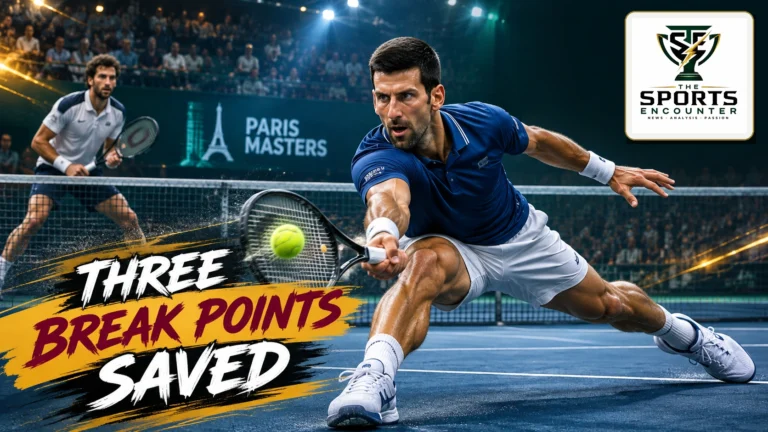
NANTERRE, France, November 3, 2026: Novak Djokovic was three break points away from a possible early exit at the Paris Masters. Instead, the 39-year-old Serbian survived the danger, defeated Monaco’s Valentin Vacherot 6-7(5), 7-5, 6-1 on Tuesday, and became the oldest match winner in tournament history. The record seven-time Paris champion needed two hours and 35 minutes to overcome an opponent who had beaten him in Shanghai last year. More importantly, Djokovic kept alive his increasingly difficult pursuit of a place at the ATP Finals in Turin.
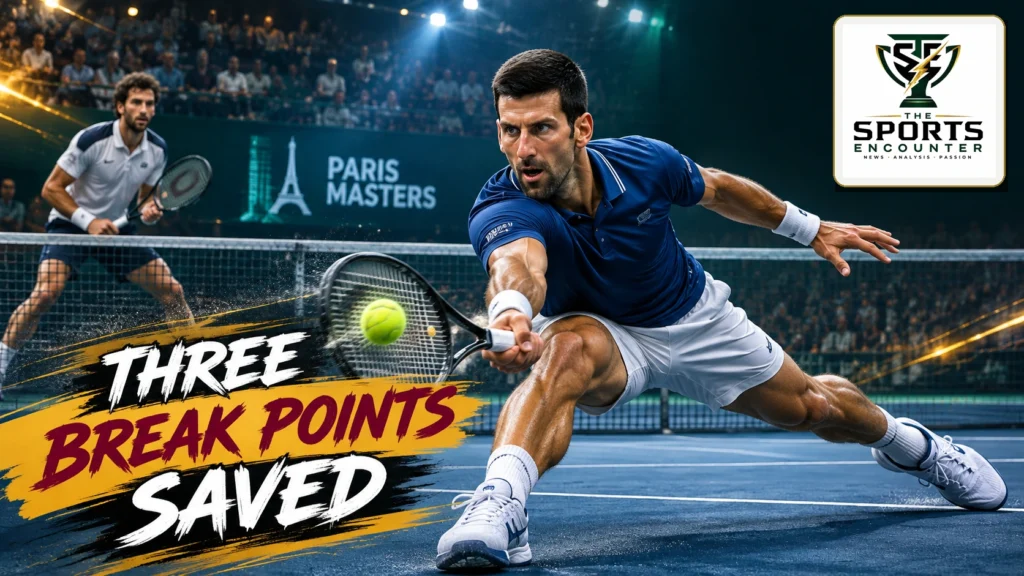
The turning point came with Djokovic serving at 4-4 in the second set, already trailing by a set. Vacherot earned three break points that could have left him serving for the match. Djokovic saved all three, broke his opponent at 6-5 and dominated the deciding set. Both players required medical attention during the contest, adding another physical test to a season in which Djokovic has struggled for consistency. His reward is a second-round meeting with Australia’s Rinky Hijikata, although reaching Turin will require considerably more than surviving one difficult afternoon.
Djokovic vs. Vacherot: Paris Masters 2026 Result at a Glance
The victory adds another historical achievement to Djokovic’s record, but the circumstances make it especially revealing. He arrived in Paris under pressure after early departures from Shanghai and Basel, without the benefit of a first-round bye and facing an opponent who had recently won another indoor title.
Story at a glance
Djokovic vs. Vacherot: Paris Masters 2026 Result at a Glance
The victory adds another historical achievement to Djokovic’s record, but the circumstances make it especially revealing. He arrived in Paris under pressure after early departures from Shanghai and Basel, without the benefit of a first-round bye and facing an opponent who had recently won another indoor title.
Three Break Points That Could Have Ended Djokovic’s Turin Bid
Djokovic’s recovery was far from straightforward. Vacherot was the more dangerous player for long periods of the opening two sets, repeatedly using his serve to limit Djokovic’s opportunities to attack.
How the Match Turned: The Decisive Sequence
The most important statistical discovery from the sequence is straightforward. Vacherot created six particularly significant set-or-match-position opportunities across two phases of the contest: three set points in the first set and three break points at 4-4 in the second.
Why Vacherot Was Such a Dangerous First-Round Opponent
For a player with Djokovic’s history in Paris, an opening match against Vacherot was unusually demanding.
What Changed Since Vacherot Beat Djokovic in Shanghai?
The two players had previously met in the semifinals of the 2025 Shanghai Masters, where Vacherot defeated Djokovic 6-3, 6-4 before winning the tournament.
Read next Alcaraz Makes Vienna His Own: De Minaur Overpowered as Perfect ATP 500 Season Reaches 16-0
| Match Detail | Verified Information |
|---|---|
| Tournament | 2026 Rolex Paris Masters |
| Round | First round |
| Match date | November 3, 2026 |
| Venue | Paris La Défense Arena, Nanterre, France |
| Winner | Novak Djokovic, Serbia |
| Opponent | Valentin Vacherot, Monaco |
| Final score | 6-7(5), 7-5, 6-1 |
| Match duration | 2 hours, 35 minutes |
| Djokovic’s age | 39 |
| Djokovic’s seed | 10th |
| Next opponent | Rinky Hijikata, Australia |
| Historical achievement | Oldest match winner in Paris Masters history |
The official ATP Paris Masters tournament page confirms the event’s status as the final Masters 1000 tournament of the season. That positioning is important because players outside the ATP Finals qualification places have increasingly limited opportunities to earn the points they need.
Three Break Points That Could Have Ended Djokovic’s Turin Bid
Djokovic’s recovery was far from straightforward. Vacherot was the more dangerous player for long periods of the opening two sets, repeatedly using his serve to limit Djokovic’s opportunities to attack.
Vacherot Takes the Opening Set After Djokovic’s Tiebreak Mistake
The opening set passed without a service break. Djokovic saved three set points while serving at 5-6 and eventually moved ahead 5-3 in the tiebreak.
That advantage disappeared rapidly.
A missed forehand volley contributed to the reversal, and Vacherot claimed the final four points of the tiebreak to take the set 7-6(5).
The outcome was particularly frustrating for Djokovic because he had worked through a demanding opening set and established a favorable position in the tiebreak. He then found himself behind despite having been only two points from winning the set.
Vacherot Breaks First, but Djokovic Escapes at 4-4
Vacherot immediately strengthened his position by breaking early in the second set and moving ahead 2-0.
Djokovic received medical attention for a shoulder issue while trailing 2-1. He subsequently recovered the break, although Vacherot continued to challenge his service games.
The defining moment arrived at 4-4.
With Djokovic serving, Vacherot created three break-point opportunities. Converting any one of them would have allowed the Monegasque to serve for the biggest victory of his week.
Djokovic defended all three.
That escape changed the immediate scoreboard pressure. Vacherot no longer had the chance to serve out the match, and Djokovic broke at 6-5 to take the second set 7-5.
Djokovic Takes Control as Vacherot’s Movement Becomes a Concern
Vacherot also required treatment for an ankle problem during the second set. Reports from the match indicated that his movement became more restricted afterward.
Djokovic exploited the opportunities available, increasing the pressure through longer baseline exchanges and moving Vacherot across the court.
The deciding set finished 6-1. Djokovic had completed the comeback, but the contrast between the first two sets and the third underlined how dramatically the contest had changed.
How the Match Turned: The Decisive Sequence
| Stage | What Happened | Why It Mattered |
|---|---|---|
| First set, 5-6 | Djokovic saves three set points | Forces the opening set into a tiebreak |
| First-set tiebreak | Vacherot wins the final four points | Djokovic loses the opener 7-6(5) |
| Second set, early games | Vacherot breaks for 2-0 | Djokovic faces a set-and-break deficit |
| Second set, 2-1 | Djokovic receives shoulder treatment | Raises questions about his physical condition |
| Second set, 4-4 | Djokovic saves three break points | Prevents Vacherot from serving for the match |
| Second set, 6-5 | Djokovic breaks Vacherot | Levels the contest at one set each |
| Deciding set | Djokovic wins 6-1 | Completes his comeback and advances |
The most important statistical discovery from the sequence is straightforward. Vacherot created six particularly significant set-or-match-position opportunities across two phases of the contest: three set points in the first set and three break points at 4-4 in the second.
Djokovic survived all three first-set set points but ultimately lost the tiebreak. In the second set, however, saving three break points allowed him to turn defensive survival into an immediate attacking opportunity.
The distinction illustrates how pressure points influence the direction of a match even when they do not immediately change the set score.
Why Vacherot Was Such a Dangerous First-Round Opponent
For a player with Djokovic’s history in Paris, an opening match against Vacherot was unusually demanding.
The 27-year-old Monegasque arrived with five consecutive tour-level victories after winning the Swiss Indoors Basel title. His powerful first and second serves repeatedly prevented Djokovic from establishing the kind of return-game pressure that has defined much of his career.
Djokovic’s difficulties were also familiar from previous indoor matches. Strong servers can reduce the number of extended rallies and force even exceptional returners to make decisions with very little preparation time.
The Sports Encounter examined a similar challenge when Jan-Lennard Struff struck 27 aces to eliminate Djokovic in Basel.
Vacherot offered a different combination of heavy serving and aggressive court positioning, but the underlying problem remained: Djokovic needed to protect his own service games while waiting for limited return opportunities.
Vacherot’s form should also be evaluated independently of his defeat. The Monegasque had earned his place among dangerous indoor opponents through his results, and his performance over the opening two sets demonstrated why.
His development has been followed in TSE’s broader coverage, including Vacherot’s Japan Open semifinal against Jiri Lehecka.
What Changed Since Vacherot Beat Djokovic in Shanghai?
The two players had previously met in the semifinals of the 2025 Shanghai Masters, where Vacherot defeated Djokovic 6-3, 6-4 before winning the tournament.
That result was one of the defining breakthroughs of Vacherot’s career. It also gave Djokovic a clear understanding of the difficulties his opponent could create.
| Comparison | Shanghai 2025 | Paris 2026 |
|---|---|---|
| Competition | Shanghai Masters | Paris Masters |
| Round | Semifinal | First round |
| Winner | Valentin Vacherot | Novak Djokovic |
| Score | 6-3, 6-4 | 6-7(5), 7-5, 6-1 to Djokovic |
| Sets played | 2 | 3 |
| Major consequence | Vacherot advanced toward his breakthrough Masters title | Djokovic advanced and preserved his ATP Finals chances |
| Head-to-head after match | Vacherot led 1-0 | Level at 1-1 |
The comparison reveals an important reversal. Vacherot won their first meeting in straight sets, but Djokovic recovered from a set down in the rematch.
There are limits to what that reversal proves.
The Paris result does not establish that Djokovic has permanently solved Vacherot’s serving patterns. The Monegasque was competitive for much of the match and required treatment before the contest turned decisively.
Nevertheless, Djokovic’s willingness to remain patient and extend rallies ultimately gave him a route back into the match.
Their head-to-head now stands level at one victory apiece.
Two Medical Interruptions Raise Different Questions
Both players required treatment, but their situations should not be presented as identical or as confirmed diagnoses.
Djokovic received attention for his shoulder after falling behind in the second set. He subsequently recovered, completed the match and won the deciding set convincingly.
Vacherot later required treatment for an ankle problem, and his movement appeared less effective as the contest progressed.
The available match reporting supports describing these incidents and their observable effects. It does not establish the full medical severity of either problem or a definitive recovery timetable.
For Djokovic, physical uncertainty has been one of the recurring themes of 2026.
His Grand Slam campaign included an Australian Open final and Wimbledon semifinal, but also earlier-than-expected defeats at Roland Garros and the US Open.
TSE’s earlier investigation into Djokovic’s difficult US Open campaign and physical endurance explored why isolated victories cannot fully settle questions about sustained tournament performance.
That issue remains relevant in Paris. A 155-minute comeback shows Djokovic can still recover under pressure, but subsequent rounds will test how effectively he can maintain his level while managing the demands of consecutive matches.
Why This Paris Masters Victory Matters for Djokovic’s ATP Finals Qualification
Djokovic entered the tournament outside the automatic qualification positions for the ATP Finals, the season-ending championship scheduled for November 15-22 in Turin.
He was placed 11th in the ATP Live Race before the Paris event and remained outside the principal qualifying places after his opening victory.
Reports following the match put his live race total at 2,940 points. He therefore needed a deep run in Paris rather than simply an opening-round victory.
His qualification hopes have also been influenced by the absence of Jannik Sinner, who is sidelined through injury. However, that development does not provide Djokovic with an automatic invitation.
Alexander Zverev, Carlos Alcaraz, Ben Shelton and Daniil Medvedev had already secured their places, while Rafael Jodar was among the players competing for a remaining qualifying position.
The larger contest involves several players with different points totals and opportunities to improve their positions.
The Sports Encounter previously examined Djokovic’s Basel return and the tightening race for Turin. His defeat to Struff subsequently increased the pressure on his Paris campaign.
What Does Djokovic Need to Do to Reach Turin?
Based on the qualification picture reported immediately after his November 3 victory, Djokovic needed at least a semifinal appearance in Paris to remain in realistic contention. Winning the tournament would provide the strongest route to qualification.
These are time-sensitive scenarios. The exact position can change with other players’ results, withdrawals and remaining ranking-point opportunities.
| Paris Outcome | Qualification Significance | Status |
|---|---|---|
| First-round victory | Preserves Djokovic’s opportunity to earn more points | Confirmed |
| Second-round victory | Advances him further, but does not itself secure Turin qualification | Conditional |
| Quarterfinal appearance | Adds points but falls short of the reported minimum semifinal target | Conditional |
| Semifinal appearance | Reaches the reported minimum threshold to remain in contention | Conditional |
| Paris Masters title | Provides the reported qualification-guaranteeing outcome | Conditional |
| Results of direct rivals | Can alter the effective qualification threshold and available places | Not yet decided |
This scenario table reflects the reported qualification position on November 3, 2026. It is not a substitute for the ATP’s live calculations, which must be reassessed as the tournament progresses.
Djokovic’s path is particularly challenging because he must combine his own results with the shifting positions of other contenders.
For broader context, TSE’s report on Daniil Medvedev securing his ATP Finals place in Vienna explains how another experienced contender converted late-season results into qualification.
Rinky Hijikata Is Next: What Changes for Djokovic?
Djokovic will face Australian qualifier Rinky Hijikata in the second round.
Hijikata defeated Luciano Darderi 6-2, 6-2 in his opening match, advancing without losing a set.
The Australian represents another challenge for Djokovic, particularly after the Serbian’s demanding three-set encounter with Vacherot.
The important tactical question is whether Djokovic can establish control earlier.
Against Vacherot, he spent much of the first two sets responding to his opponent’s serving and attacking pressure. A similar slow start against Hijikata would create additional risk.
Djokovic will benefit from protecting his service games more comfortably and avoiding another extended physical recovery.
His capacity to respond under pressure has never been seriously in doubt. The larger question is how frequently he can afford to need those recoveries.
TSE’s Paris Masters tournament coverage and early-round analysis places Djokovic’s campaign alongside the other major contenders and developments in the draw.
Djokovic’s 2026 Season Explains Why Paris Carries So Much Weight
The Paris comeback becomes more meaningful when viewed alongside Djokovic’s uneven season.
He reached the Australian Open final and Wimbledon semifinals, demonstrating that his competitive ceiling remains unusually high for a 39-year-old.
He also experienced significant setbacks, including early Grand Slam exits and disappointing results at two major indoor events.
The most convincing positive result came in Beijing, where Djokovic won his 102nd career ATP singles title.
TSE’s analysis of Djokovic’s seventh China Open championship and 102nd career title showed that he could still defeat high-quality opponents and win tournaments.
Another revealing performance came during that event when he recovered from a set down against Alexander Zverev. The Beijing quarterfinal report examined how Djokovic adjusted to Zverev’s serving and fought back to reach the semifinals.
Yet the momentum did not continue uninterrupted.
His losses in Shanghai and Basel exposed the difficulty of sustaining a strong run late in a demanding season.
Paris therefore represents an opportunity to demonstrate that Beijing was part of a sustainable improvement rather than an isolated success.
The Oldest Paris Masters Winner Still Has Something to Prove
Djokovic’s place in tennis history is already secure.
He owns 24 Grand Slam singles titles, seven Paris Masters championships and seven ATP Finals titles.
Tuesday’s victory added an age record to that collection, moving him beyond previous veteran winners in the event’s history.
Yet the achievement carries a different meaning from the records he set during his prime.
At 39, Djokovic is competing against younger opponents while managing the physical demands of a season that has repeatedly interrupted his momentum.
He remains capable of producing exceptional tennis. The difficulty lies in making those performances frequent enough to support another deep tournament run.
That is the central question explored in TSE’s recent feature on Djokovic’s pursuit of a 25th Grand Slam title and his future against tennis’s younger generation.
The Paris Masters adds a more immediate test.
Djokovic needs victories now, with ranking points and qualification opportunities disappearing as the season approaches its conclusion.
What Happens Next for Djokovic and the ATP Finals Race?
Djokovic’s immediate assignment is to defeat Hijikata and continue advancing through the Paris draw.
Reaching the semifinals would strengthen his qualification prospects, while a championship would deliver the outcome reported as sufficient to guarantee his place in Turin.
He must also monitor the results of direct rivals, with the remaining qualification positions dependent on the evolving race.
The official 2026 ATP Tour calendar lists the Paris Masters for November 2-8, the Stockholm event for November 8-14 and the ATP Finals for November 15-22.
The ATP’s report on Djokovic’s 2025 Paris withdrawal provides another relevant historical connection. Djokovic missed last year’s Paris event after his Shanghai semifinal defeat to Vacherot, making this year’s return particularly significant.
The comeback against Vacherot offers encouragement, but Djokovic has not completed his work.
He has shown that he can still win a demanding match when the scoreboard turns against him. His next challenge is to do it repeatedly, preferably without requiring another escape from the brink.
For a player whose career has been built around winning the points that matter most, the three break points saved at 4-4 may prove to be among the most consequential of his season.
Continue the Tennis Story
 TennisCarlos Alcaraz Returns to Paris as Musetti Survives Tiebreak Thriller to Challenge World No. 1 Zverev
 TennisHas Novak Djokovic Still Got It? The Battle for Grand Slam No. 25 Against Tennis’s New Generation
 TennisAlcaraz Makes Vienna His Own: De Minaur Overpowered as Perfect ATP 500 Season Reaches 16-0
Frequently Asked Questions
Who won the Djokovic vs. Vacherot match at the 2026 Paris Masters?
Novak Djokovic defeated Valentin Vacherot 6-7(5), 7-5, 6-1 in the first round on November 3, 2026.
How old was Djokovic when he set the Paris Masters record?
Djokovic was 39, becoming the oldest player to win a match in Paris Masters history.
What was the turning point against Vacherot?
Djokovic saved three break points at 4-4 in the second set. Had Vacherot converted one, he would have served for the match.
Did Djokovic suffer an injury against Vacherot?
Djokovic received treatment for a shoulder issue during the second set. He completed the match, but the available reporting did not establish a definitive diagnosis or recovery timetable.
Who does Djokovic play next at the Paris Masters?
His confirmed second-round opponent is Australian qualifier Rinky Hijikata, who defeated Luciano Darderi 6-2, 6-2.
Can Djokovic still qualify for the 2026 ATP Finals?
Yes. His opening victory preserved his chances, although he needs a much deeper Paris run and must account for other players’ results. The qualification calculations remain subject to change.
When are the 2026 ATP Finals?
The ATP Finals are scheduled for November 15-22, 2026, in Turin, Italy.
How many Paris Masters titles has Djokovic won?
Djokovic has won the tournament seven times, the competition record.
What is Djokovic’s head-to-head record against Valentin Vacherot?
Their head-to-head stands at 1-1 after Djokovic’s Paris victory. Vacherot won their previous meeting in the 2025 Shanghai Masters semifinals.
Why is the Paris Masters important in the ATP Finals race?
It is the final ATP Masters 1000 tournament of the season, offering substantial ranking-point opportunities immediately before the season-ending championship.