BEIJING, China, October 4, 2026: Alexander Zverev put Novak Djokovic a set behind. Andrey Rublev overwhelmed Alex de Minaur for half an hour. Francisco Cerundolo recovered the break that appeared to have cost him the first set. Karen Khachanov stayed level with Hubert Hurkacz until a tiebreak finally separated them.
None of them reached the China Open semifinals.
Djokovic recovered to beat top seed Zverev 4-6, 6-4, 6-4 and extend his perfect career record in Beijing to 32-0. De Minaur responded to a brutal opening set by defeating Rublev 1-6, 6-2, 6-3. Daniil Medvedev handled Cerundolo 7-6(4), 6-3, while Hurkacz defeated Khachanov 7-6(2), 6-2.
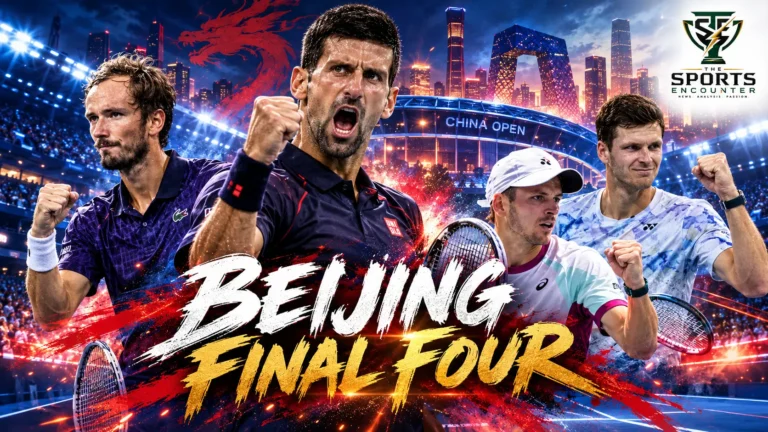
The four victories completed a semifinal field with two very different matchups: Djokovic against Medvedev and De Minaur against Hurkacz.
Story at a glance
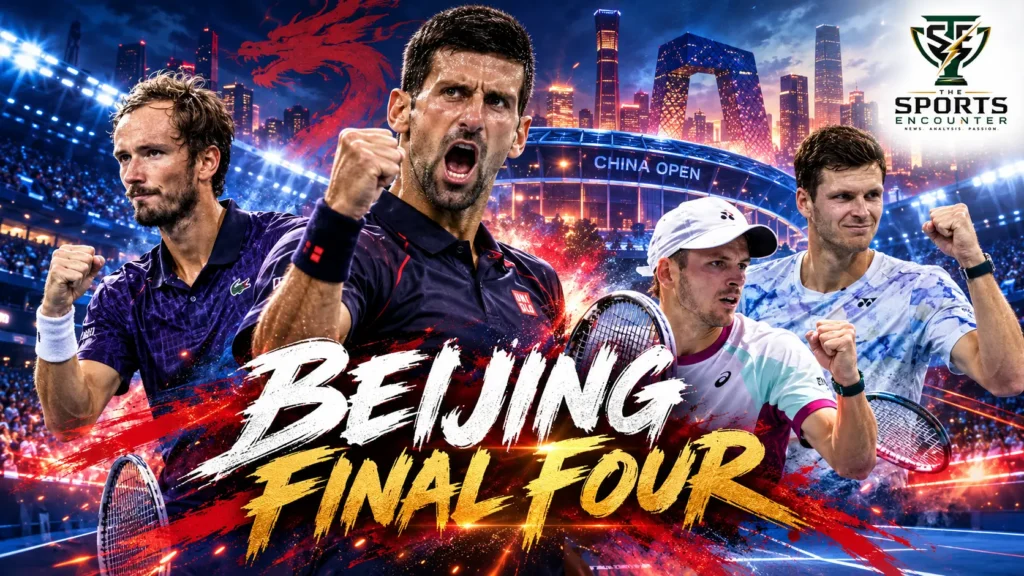
China Open 2026 Men’s Quarterfinal Results
The complete tournament results can also be followed through the ATP Tour’s official China Open results coverage.
Djokovic Turns Zverev’s Best Serving Stretch Into Another Beijing Victory
Zverev began the biggest match of the day exactly as the top seed would have wanted.
Daniil Medvedev Wins the Match Cerundolo Nearly Reopened
Medvedev’s 7-6(4), 6-3 victory looked relatively controlled by the finish.
De Minaur Goes From 1-6 Down to Controlling Rublev
If Djokovic produced the day’s most historically significant victory, De Minaur completed its sharpest transformation.
Hurkacz Turns One Tiebreak Into a Straight-Sets Quarterfinal
Hurkacz and Khachanov gave each other almost nothing in the opening set.
The Sports Encounter will examine those two matches separately in our semifinal preview. Sunday belongs to the four quarterfinals and the very different reasons each winner survived them.
For readers following the tournament from the beginning, TSE’s China Open Round of 32 report tracked Zverev, Rublev, De Minaur and Hurkacz through the opening stage before the men’s draw narrowed to eight.
China Open 2026 Men’s Quarterfinal Results
| Quarterfinal | Winner | Score | Semifinal Opponent |
|---|---|---|---|
| Alexander Zverev vs Novak Djokovic | Novak Djokovic | 4-6, 6-4, 6-4 | Daniil Medvedev |
| Daniil Medvedev vs Francisco Cerundolo | Daniil Medvedev | 7-6(4), 6-3 | Novak Djokovic |
| Alex de Minaur vs Andrey Rublev | Alex de Minaur | 1-6, 6-2, 6-3 | Hubert Hurkacz |
| Hubert Hurkacz vs Karen Khachanov | Hubert Hurkacz | 7-6(2), 6-2 | Alex de Minaur |
The complete tournament results can also be followed through the ATP Tour’s official China Open results coverage.
Djokovic Turns Zverev’s Best Serving Stretch Into Another Beijing Victory
Zverev began the biggest match of the day exactly as the top seed would have wanted.
He broke Djokovic immediately, protected the advantage and eventually closed the opening set 6-4 after an hour of pressure-heavy tennis.
The Serbian had opportunities to recover the break. He could not take them.
That mattered because Djokovic had arrived at the quarterfinal already carrying physical questions. He needed nearly three hours to defeat Yunchaokete Bu in the previous round, a match that took his China Open record to 31-0 and required another medical timeout.
The ATP documented Djokovic’s physical concerns after the Bu victory, making Sunday’s recovery against Zverev even more significant.
TSE had been tracking the same issue for months. His Cincinnati defeat raised serious questions about how much physical stress Djokovic could absorb late in the 2026 season, while our later analysis asked whether his struggles represented decline or a temporary loss of rhythm.
The Second Set Produced the Match’s Most Revealing Statistic
Zverev landed 23 consecutive first serves during the second set.
At one stage his first-serve percentage for the set stood at an extraordinary 96 percent.
Djokovic still won it.
With Zverev serving at 4-5, Djokovic found enough depth on return to start rallies rather than merely react to the German’s serve. The pressure finally produced the break, and Djokovic took the set 6-4.
That single game changed the match.
Zverev had served at a level that normally removes an opponent’s access to return games. Djokovic waited until the only game that mattered and broke anyway.
The deciding set again finished 6-4 to Djokovic, completing his second consecutive comeback from a set down in Beijing.
Djokovic Is Now 32-0 at the China Open
Djokovic returned to Beijing this year for the first time since winning his sixth China Open title in 2015.
He began the tournament 29-0.
Wins over Nuno Borges, Bu and now Zverev have extended that record to 32 victories without a defeat.
Before the Zverev match, his 31-0 start at the event had already matched Rafael Nadal’s record for the best undefeated start at a tournament in the Open Era.
Sunday moved Djokovic beyond it.
That achievement carries added weight because this has not been an uncomplicated season. TSE’s US Open title-race analysis framed Djokovic as a contender whose largest question was increasingly physical rather than technical.
Beijing has not removed that concern.
It has shown that the competitive instinct behind six China Open titles remains intact.
Daniil Medvedev Wins the Match Cerundolo Nearly Reopened
Medvedev’s 7-6(4), 6-3 victory looked relatively controlled by the finish.
The opening set was anything but routine.
Medvedev broke Cerundolo immediately, but the Argentine stayed close enough to recover the break when Medvedev served for the set. At 5-5, the contest had effectively restarted.
The tiebreak decided who benefited from that reset.
Medvedev took it 7-4 and then produced a cleaner second set, breaking late before closing 6-3.
Medvedev’s Serve Keeps Carrying His Asian Swing
The Russian hit 10 aces against Cerundolo and committed only one double fault. He landed 74 percent of his first serves and won 78 percent of the points behind them.
Those numbers follow directly from what happened in Hangzhou.
Only five days earlier, Medvedev fired 23 aces against Rublev to win the Hangzhou Open and claim his 24th ATP Tour title.
He has now carried that form directly into Beijing.
The broader significance is consistency.
Medvedev’s difficult stretches in 2026 often involved unstable service games and opponents gaining too much access to neutral rallies. Over the past two tournaments, his serve has increasingly allowed him to dictate where those rallies begin.
His reward is the most historically significant semifinal available in this draw: Djokovic, still unbeaten in Beijing, against one of the finest hard-court players of his generation.
That matchup deserves its own analysis rather than being reduced to a few paragraphs here.
De Minaur Goes From 1-6 Down to Controlling Rublev
If Djokovic produced the day’s most historically significant victory, De Minaur completed its sharpest transformation.
Rublev won the opening set 6-1 in only 36 minutes.
He controlled the baseline with his forehand, pushed De Minaur behind the court and repeatedly shortened points before the Australian could turn defense into pressure.
The match looked close to getting away from De Minaur.
Instead, he changed it completely.
De Minaur broke for a 3-1 lead in the second set, survived Rublev’s attempts to recover the deficit and took the set 6-2. The deciding set stayed tighter until 3-3.
De Minaur then won the final three games.
The 1-6, 6-2, 6-3 comeback took two hours and one minute and sent him into the Beijing semifinals for the second consecutive year.
Tennis Australia reported that De Minaur finished with 29 winners against 17 unforced errors, while Rublev produced 26 winners and 30 errors.
The Error Gap Explains the Comeback Better Than the Score Alone
De Minaur did not suddenly begin hitting Rublev off the court.
He made the Russian keep producing offense.
That difference grew as the match went on.
Rublev’s 30 unforced errors eventually became too expensive, while De Minaur kept his own total to 17 and saved nine of the 12 break points he faced.
The Australian had already shown this season that his game becomes more dangerous when matches turn uncomfortable. TSE highlighted that quality before the 2026 Laver Cup, where De Minaur entered as one of Team World’s most dependable singles players.
He then beat Zverev from a set down in London, even though Team Europe ultimately recovered to win the competition 13-5.
Beijing has extended the same pattern.
De Minaur can lose control of a match without losing his willingness to solve it.
Hurkacz Turns One Tiebreak Into a Straight-Sets Quarterfinal
Hurkacz and Khachanov gave each other almost nothing in the opening set.
Neither player broke serve.
Continue the China Open Story
 China OpenZverev Holds Firm, Shang Delivers at Home, While Safiullin Shocks Cobolli in China Open
 China OpenBartunkova Stuns Sabalenka, Osaka Survives, and Andreeva Takes Control as sBeijing Draw Opens Up
 China OpenZheng Survives, Badosa Escapes, While Beijing’s Young Chinese Players Light Up China Open Round of 128
Both relied heavily on first-strike tennis.
The difference appeared in the tiebreak, where Hurkacz accelerated to a 7-2 win.
The second set looked completely different.
Hurkacz broke twice and closed the match 7-6(2), 6-2 in 91 minutes.
Hurkacz Lost Only Six Points Behind His First Serve
The most important number was not his eight aces.
It was his first-serve efficiency.
Hurkacz landed 71 percent of his first serves and won 40 of 46 points behind them, an 87 percent success rate. He did not commit a double fault and saved the only break point Khachanov created.
Once Hurkacz won the first-set tiebreak, that serving level made the second set increasingly difficult for Khachanov to reopen.
The victory also gave Hurkacz his 250th tour-level win and continued an Asian stretch in which his results have steadily improved.
His presence in the semifinal is particularly notable given how uneven the North American hard-court season had been for many of Beijing’s contenders. TSE’s National Bank Open analysis documented how quickly the hierarchy collapsed in Montreal, with several established men’s contenders disappearing early.
Hurkacz has arrived in Beijing with a different trajectory.
He is now one win from the final.
China Open 2026 Men’s Semifinal Lineup
| Semifinal | Player 1 | Player 2 | Quarterfinal Route |
|---|---|---|---|
| Semifinal 1 | Novak Djokovic | Daniil Medvedev | Djokovic beat Zverev; Medvedev beat Cerundolo |
| Semifinal 2 | Alex de Minaur | Hubert Hurkacz | De Minaur beat Rublev; Hurkacz beat Khachanov |
The semifinal field contains a six-time Beijing champion who has never lost here, a former world No. 1 carrying a seven-match winning streak through China, an Australian who has just completed another comeback, and a Pole whose serve has become increasingly difficult to touch.
That is where this quarterfinal story ends.
The tactical questions begin with Djokovic against Medvedev and De Minaur against Hurkacz, and those deserve a separate examination before the first semifinal ball is struck.
China Open 2026 Quarterfinal FAQs
Did Novak Djokovic beat Alexander Zverev at the China Open?
Yes. Djokovic recovered from losing the opening set to defeat top seed Alexander Zverev 4-6, 6-4, 6-4.
What is Djokovic’s China Open record after beating Zverev?
Djokovic is now 32-0 in career matches at the China Open. He has won the tournament six times and has never lost a completed singles match in Beijing.
Who will Djokovic play in the China Open semifinal?
Djokovic will face Daniil Medvedev, who defeated Francisco Cerundolo 7-6(4), 6-3.
What was the De Minaur vs Rublev score?
Alex de Minaur recovered from a one-sided opening set to defeat Andrey Rublev 1-6, 6-2, 6-3.
Who will De Minaur play in the semifinal?
De Minaur will face Hubert Hurkacz.
What was the Hurkacz vs Khachanov score?
Hubert Hurkacz defeated Karen Khachanov 7-6(2), 6-2.
Who are the four China Open 2026 men’s semifinalists?
Novak Djokovic, Daniil Medvedev, Alex de Minaur and Hubert Hurkacz comprise the men’s singles semifinal field.
China
- Djokovic Refuses to Lose as De Minaur, Medvedev, and Hurkacz Complete China Open Final Four
- Bartunkova Stuns Sabalenka, Osaka Survives, and Andreeva Takes Control as sBeijing Draw Opens Up
- Asian Games 2026 End With China on Top, India’s Late Gold Rush and a New Generation of Asian Stars
- Matt Orr and Everton Camargo Crown Unbeaten Hong Kong as First FIFA ASEAN Challenge Cup Champions
- WTA Closes the WTA 1000 Pay Gap in 2027, but Tennis’ Equality Project Is Not Finished