National Bank Open 2026 Turns Wild: Eala, Fernandez and Fonseca Rise as Favorites Keep Falling
The National Bank Open 2026 has turned unpredictable after a first week packed with major upsets, breakout performances and rising U.S. Open storylines in Montreal and Toronto.
The National Bank Open 2026 has reached its second week with two tournaments moving in very different directions. Montreal has lost many of its biggest men’s contenders, while Toronto has produced a fascinating mix of established champions, home-crowd emotion and rising players who refuse to disappear.
Seven days into Canada’s biggest tennis event, certainty has become increasingly difficult to find.
Alexander Zverev arrived in Montreal as the top seed, French Open champion and obvious favorite. Daniil Medvedev brought a long record of success on North American hard courts. Taylor Fritz entered Canada carrying a Washington title. Alex de Minaur survived the initial wave of upsets and briefly became the highest-ranked man left in the draw.
All four are now gone.
Ben Shelton remains alive to defend his National Bank Open title. Joao Fonseca has knocked out two Grand Slam finalists in his first two matches. Learner Tien is quietly building another significant Masters 1000 run. Tallon Griekspoor and Botic van de Zandschulp have turned Montreal into an unlikely Dutch stronghold.
Toronto has developed differently.
Elena Rybakina and Coco Gauff are still advancing. Naomi Osaka suddenly looks dangerous again on hard courts. Leylah Fernandez produced the biggest Canadian moment of the tournament by overwhelming Mirra Andreeva. Alexandra Eala has extended the momentum created by her historic Washington title despite entering Toronto with almost no recovery time.
The result is a National Bank Open that feels less predictable with every session.
For complete tournament previews, results and continuing coverage, readers can follow The Sports Encounter’s Tennis section and revisit our National Bank Open 2026 tournament preview.
Official schedules, draws and tournament information are available through the National Bank Open presented by Rogers.
National Bank Open 2026 First-Week Snapshot
| Storyline | What Has Happened |
|---|---|
| Top men’s seed | Alexander Zverev eliminated by Tallon Griekspoor |
| Other major ATP exits | Daniil Medvedev, Taylor Fritz, Alex de Minaur, Lorenzo Musetti, Andrey Rublev |
| Defending men’s champion | Ben Shelton remains alive |
| ATP breakout story | Joao Fonseca has beaten Stefanos Tsitsipas and Casper Ruud |
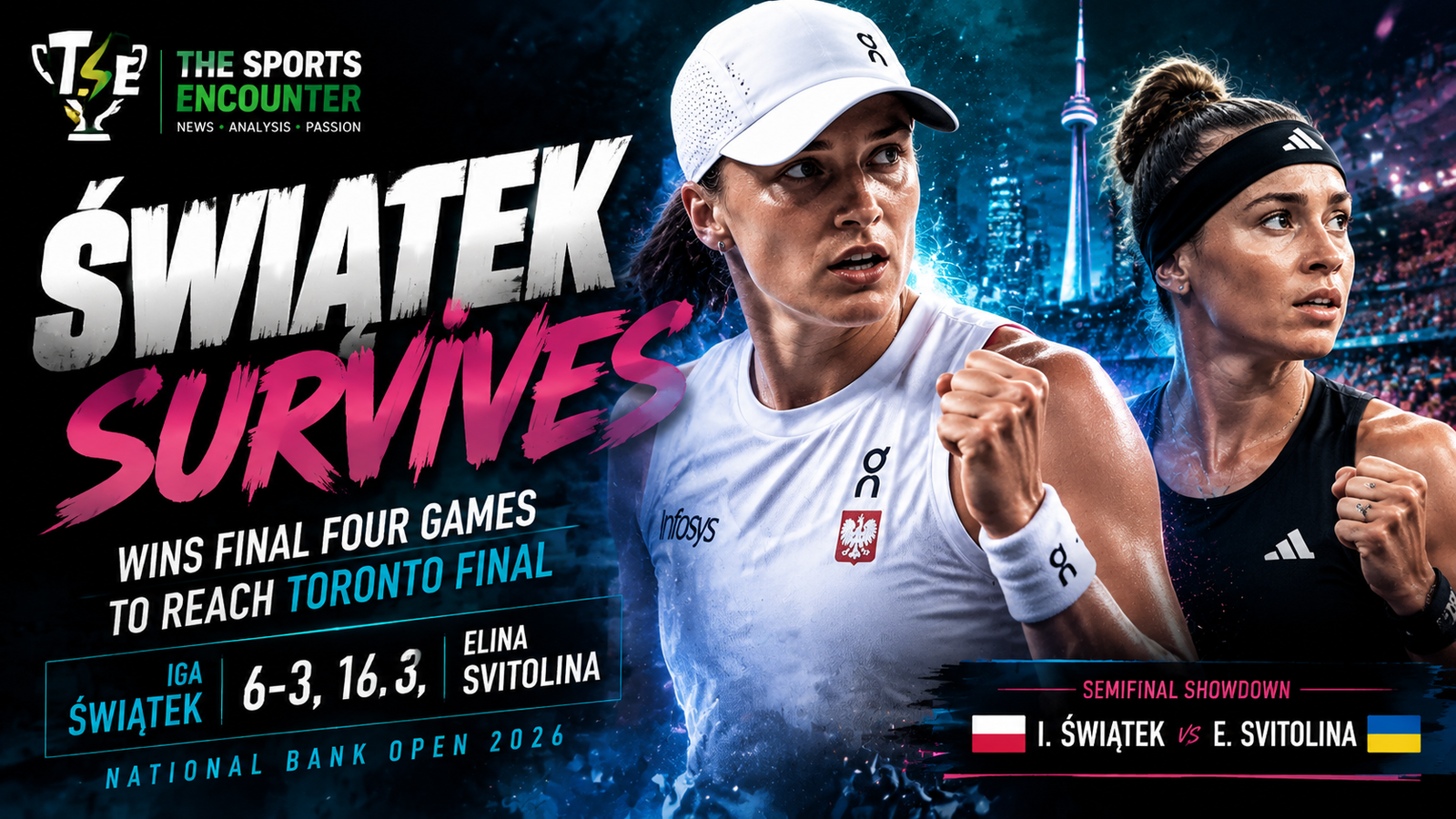
| Biggest Toronto upset Friday | Leylah Fernandez beat Mirra Andreeva 6-1, 6-4 |
| Eala’s latest result | Beat Caty McNally 6-3, 5-7, 6-4 |
| Osaka’s latest result | Beat Elise Mertens 6-1, 6-2 |
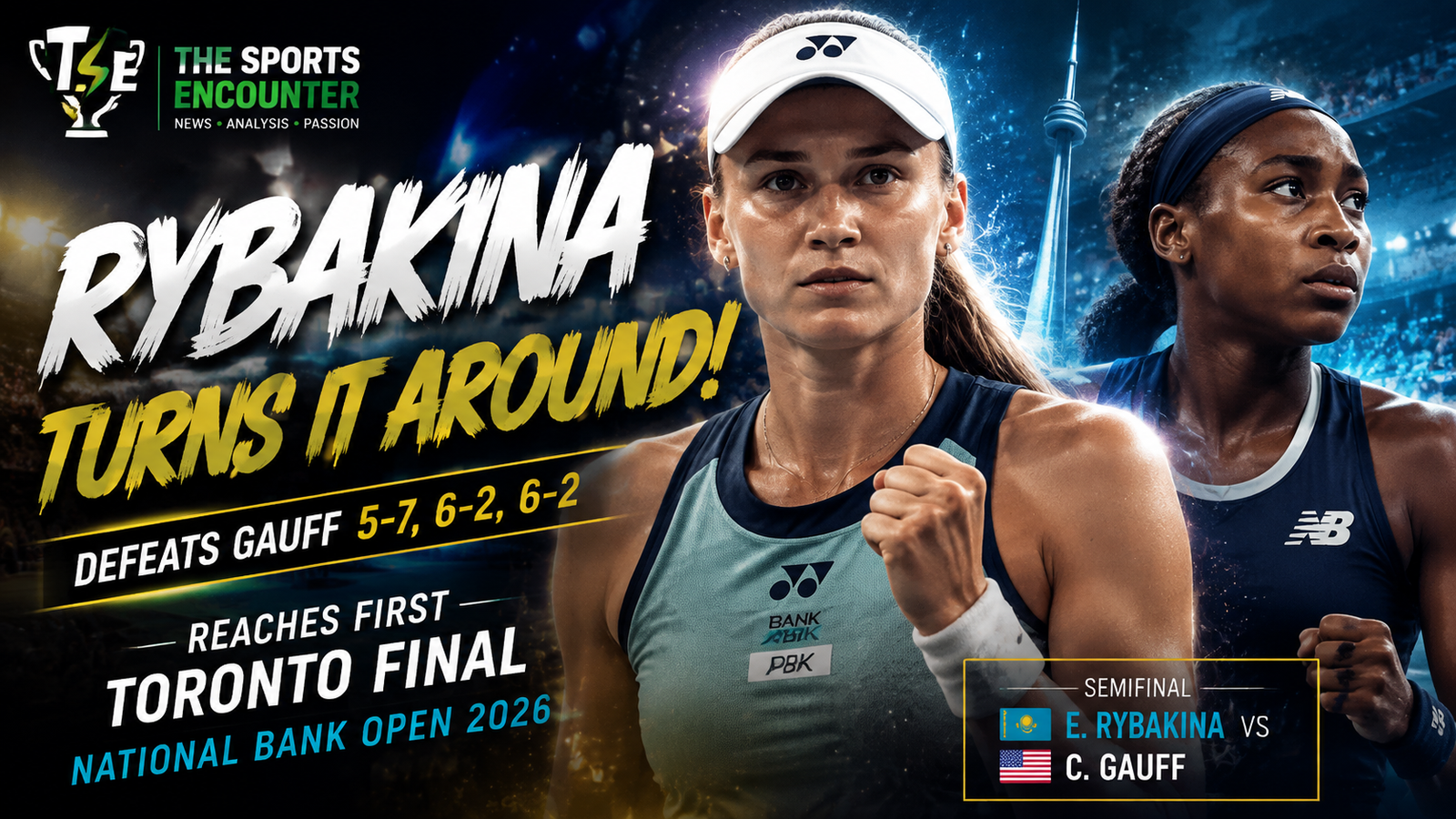
| Rybakina’s latest result | Beat Ann Li 6-2, 7-5 |
| Gauff’s latest result | Beat Maria Sakkari 6-1, 6-4 |
| Tournament dates | August 2-13, 2026 main-draw period |
| Men’s venue | IGA Stadium, Montreal |
| Women’s venue | Sobeys Stadium, Toronto |
TL;DR
- Alexander Zverev, Daniil Medvedev, Taylor Fritz and Alex de Minaur are already out of the men’s tournament.
- Defending champion Ben Shelton reached the round of 16 with a 6-3, 6-2 win over Zizou Bergs.
- Joao Fonseca defeated Casper Ruud 7-6(6), 6-3 after previously beating Stefanos Tsitsipas.
- Learner Tien eliminated Tommy Paul 6-3, 6-2.
- Tallon Griekspoor followed his upset of Zverev by beating Matteo Arnaldi.
- Leylah Fernandez stunned world No. 5 Mirra Andreeva 6-1, 6-4.
- Alexandra Eala survived Caty McNally in three sets despite receiving treatment for foot discomfort.
- Naomi Osaka dominated Elise Mertens 6-1, 6-2.
- Elena Rybakina recovered from a second-set deficit to beat Ann Li 6-2, 7-5.
- Coco Gauff reached the round of 16 with a straight-sets victory over Maria Sakkari.
Montreal Has Lost the Hierarchy It Started With
The men’s National Bank Open began with an unusual opportunity already built into the draw.
Jannik Sinner and Novak Djokovic withdrew before the tournament, while Carlos Alcaraz was unavailable because of his wrist problem. The Sports Encounter examined those absences before play began in our analysis of why Sinner and Djokovic skipped Montreal.
That left Zverev with the clearest route to becoming the central figure of the event.
It lasted one match.
Griekspoor recovered from losing the opening set to defeat Zverev 6-7(3), 6-2, 6-4. Later that same day, Van de Zandschulp removed Medvedev 6-3, 7-6(5), while Thiago Agustin Tirante defeated Fritz 7-5, 6-3.
The Sports Encounter documented that extraordinary session in our National Bank Open Day 5 report.
At that point, Alex de Minaur became one of the highest-ranked surviving players.
Then Cameron Norrie beat him 5-7, 7-6(5), 6-1.
Montreal had lost another possible anchor.
Ben Shelton Suddenly Looks Like the Established Man in the Room
Defending champion Ben Shelton now occupies an intriguing position.
Twelve months ago, he won his first Masters 1000 title in Canada. This year he entered the tournament surrounded by higher-ranked players and several more experienced Masters champions.
Many of them have disappeared.
Shelton has not.
After defeating Jenson Brooksby 6-3, 7-5 in his opening match, the American produced a more comfortable performance against Zizou Bergs on Friday.
He won 6-3, 6-2 in only 64 minutes.
That efficiency matters.
The expanded 12-day Masters format creates recovery time, but it also rewards players who can avoid unnecessary physical work before the closing rounds. Shelton has so far achieved that better than several players who arrived with stronger recent résumés.
His next opponent introduces an entirely different problem.
Joao Fonseca Has Become Montreal’s Most Dangerous Young Player
Fonseca’s first trip to Montreal has already produced two victories that would normally define an entire tournament run.
He first defeated Stefanos Tsitsipas 7-6(3), 7-5.
Then came Casper Ruud.
Ruud had opportunities to control Friday’s third-round match. He created five break points across Fonseca’s first two service games and eventually broke for a 4-2 advantage.
The Brazilian survived the difficult opening period, recovered the break and forced a tiebreak.
Ruud led that tiebreak 5-3.
Fonseca still took the set.
The second became far more decisive. Fonseca attacked the backhand side effectively, accumulated 16 winners against only seven unforced errors during the set and completed a 7-6(6), 6-3 victory.
For the second consecutive match in Montreal, he had eliminated a Grand Slam finalist.
The consequence is one of the most appealing round-of-16 matches of the tournament:
Ben Shelton vs Joao Fonseca.
Shelton brings the defending champion’s serve, athleticism and experience of winning this event. Fonseca brings fearless ball-striking and the confidence that comes from solving two difficult opponents in succession.
They have already met once this year, with Shelton winning on clay in Munich.
Montreal should present a very different match.
Learner Tien Is Building a Run Without Much Noise
Fonseca is attracting the louder attention, but Learner Tien has been equally convincing.
The American defeated Gael Monfils 6-3, 0-6, 6-3 in an emotionally charged match that marked the Frenchman’s final National Bank Open appearance.
Tien then faced compatriot Tommy Paul on Friday.
The result was considerably more straightforward.
Tien won 6-3, 6-2 and booked a fourth-round meeting with Tirante.
That matchup gives him a realistic route toward the quarterfinals, although Tirante has already demonstrated why ranking expectations have meant little in Montreal.
The Argentine eliminated Fritz and then defeated former champion Alexei Popyrin 6-3, 6-4.
Every remaining opponent in this draw now carries evidence that he belongs.
The Dutch Run Has Become More Than One Night of Upsets
Griekspoor and Van de Zandschulp could easily have followed their headline victories with emotional letdowns.
Neither did.
Griekspoor dropped the first set against Matteo Arnaldi before winning 3-6, 6-4, 6-3.
Van de Zandschulp faced a more difficult escape against Hubert Hurkacz.
He lost the first set 6-3, edged the second-set tiebreak 7-4 and then won the deciding set 7-5.
The significance is important.
Defeating Zverev or Medvedev creates a headline. Winning again determines whether the upset actually changes the tournament.
Both Dutch players have now done that.
Rafael Jodar Keeps Adding Substance to His Breakthrough Season
Rafael Jodar’s rise has also continued in Montreal.
The 19-year-old defeated Lorenzo Musetti 6-4, 6-3 after coming through a three-set match against Corentin Moutet.
Jodar entered Canada shortly after losing the Mubadala DC Open final to Taylor Fritz, a match The Sports Encounter covered in our report on Fritz’s Washington title.
His ability to immediately reproduce that level at a Masters 1000 event strengthens the argument that Washington was part of a genuine development curve.
The physical challenge becomes greater now.
A long North American hard-court stretch can expose younger players who are still adapting to the travel, heat, recovery and repeated high-level matches required on tour.
So far, Jodar continues to answer those questions positively.
Toronto’s Story Is Becoming About Momentum
While Montreal has been defined by elimination, Toronto has been shaped by players carrying momentum from very different places.
Rybakina is trying to establish herself near the top of the women’s hierarchy.
Gauff is building another North American hard-court campaign.
Osaka has brought the confidence generated by a strong Wimbledon.
Fernandez has found emotional energy from the Canadian crowd.
Eala arrived with almost no time to process the biggest title of her career.
The common thread is that several of the most compelling players in the draw look increasingly comfortable rather than increasingly tired.
Leylah Fernandez Gives Canada Its Moment
Fernandez entered Friday as the last Canadian remaining in either National Bank Open singles draw.
Her opponent was Mirra Andreeva, the reigning Roland Garros champion and world No. 5.
The pressure could easily have become restrictive.
Instead, Fernandez produced one of her cleanest performances of the season.
She committed only four unforced errors in the opening set and won it 6-1 in approximately half an hour.
The second set began with another surge. Fernandez broke twice and moved ahead 3-0 before Andreeva attempted to fight back.
There was a brief wobble when Fernandez failed to serve out the match at her first opportunity.
She recovered immediately.
The Canadian closed a 6-1, 6-4 victory while winning 89 percent of her first-serve points.
It was her first Top 5 victory since her Washington title run in 2025 and her biggest win of the current season.
The reaction inside Sobeys Stadium reflected the stakes.
Canada’s singles hopes now rest with her.
Fernandez vs Osaka Is More Than a Crowd Match
Fernandez’s reward is a fourth-round meeting with Naomi Osaka.
That matchup deserves attention beyond the Canadian storyline.
Osaka destroyed Elise Mertens 6-1, 6-2 on Friday. She was never broken, saved all three break points she faced and broke Mertens twice in each set.
Her ball-striking looked clean, her court position remained assertive and the match never developed into the kind of extended physical contest that might have drained her before the second week.
Osaka’s recent form has been building for some time.
At Wimbledon she defeated world No. 1 Aryna Sabalenka and reached the quarterfinals before losing to Karolina Muchova. The Sports Encounter covered that breakthrough in our Wimbledon report on Osaka’s victory over Sabalenka.
Fernandez will now test whether Osaka can maintain that aggression against a left-handed counterpuncher backed by a partisan crowd.
Alexandra Eala Refuses to Come Down From Washington
Eala’s presence in the Toronto round of 16 may be the most impressive physical story of the tournament.
Only days before the National Bank Open began, she completed a rain-delayed Washington final against Jessica Pegula.
Eala recovered from a set down to win 4-6, 6-4, 6-0 and become the first Filipino player to win a WTA Tour singles title.
The complete breakthrough is covered in The Sports Encounter’s report on Eala’s historic Washington championship.
Toronto offered almost no recovery window.
She still defeated Alycia Parks in three sets.
Then she faced Caty McNally on Friday night.
Eala recovered from a 1-3 deficit in the opening set by winning five consecutive games. She then moved ahead early in the second.
The match became considerably harder when she began receiving treatment on her foot and showed visible discomfort while moving.
McNally forced a deciding set.
Eala responded by breaking immediately in the third and protecting that advantage all the way to the finish.
The final score was 6-3, 5-7, 6-4.
That victory revealed something different from her Washington title.
Washington showed how high Eala’s level can rise.
Toronto is showing what she can do when the body is tired, momentum shifts and the match becomes uncomfortable.
Rybakina Keeps Winning Even When Her Serve Wobbles
Elena Rybakina has not played flawless tennis in Toronto.
That may actually make her progress more interesting.
Her opening victory against Daria Kasatkina required three sets and contained an extraordinary combination of 58 winners and 58 unforced errors.
Against Ann Li, Rybakina looked much cleaner early.
She broke immediately and won the opening set 6-2.
The second became complicated.
Li moved ahead 5-3 and created an opportunity to force a decider.
Rybakina responded by winning four consecutive games.
She broke when Li served for the set, survived pressure on her own serve, broke again and closed the match 6-2, 7-5.
She also struck her 306th ace of the season, the highest total on the WTA Tour at this stage.
Rybakina has therefore reached the round of 16 without finding her absolute best level for an entire match.
For a title contender, that can be encouraging.
Coco Gauff’s Return Game Does the Heavy Lifting
Gauff’s 6-1, 6-4 victory over Maria Sakkari was built around pressure on return.
The American broke Sakkari five times.
She nearly complicated the finish after leading 5-1 in the second set, allowing Sakkari to recover one break and move to 5-4.
Gauff closed the match on her second opportunity.
There was little spectacular about the result, which may be exactly why it was useful.
Early rounds at major preparation tournaments are often more valuable when a contender can advance without creating unnecessary drama.
Gauff has already played enough high-pressure tennis this season. Toronto is about building rhythm toward New York.
Belinda Bencic Survives the Match of the Day
Not every important Friday match was quick.
Belinda Bencic and Taylor Townsend spent three hours and 26 minutes separating themselves.
Townsend won the opening set 7-6(5).
The second also reached a tiebreak, with Bencic taking it 7-6(4).
Bencic then broke early in the third before Townsend fought back to 4-4.
The Swiss immediately regained the break and served out a 6-4 deciding set.
The final score, 6-7(5), 7-6(4), 6-4, captures how small the margins were.
Matches like this often matter beyond one round because recovery becomes part of the next opponent’s strategy.
Alina Korneeva Adds Another Young Name to the Conversation
Qualifier Alina Korneeva has quietly constructed one of Toronto’s surprise runs.
She defeated Iva Jovic 6-3, 6-4 on Friday to reach the fourth round of a WTA 1000 event for the first time.
Korneeva came through qualifying after previously trailing by a set and a break, and she has now eliminated consecutive seeded opponents in straight sets.
Her presence adds another layer to a women’s tournament already filled with young players challenging established expectations.
Eala, Andreeva and Jovic entered Toronto carrying considerable attention.
Korneeva may end up being the less familiar teenager who stays longest.
What Happened to the Original Favorites?
The National Bank Open began with a very different hierarchy.
Alexander Zverev
The French Open champion was eliminated in his opening match by Griekspoor.
Daniil Medvedev
His reputation as one of the strongest North American hard-court players of his generation could not prevent a straight-sets loss to Van de Zandschulp.
Taylor Fritz
The Washington champion fell immediately to Tirante and could not convert his recent title into another deep run.
Alex de Minaur
After surviving the first upset wave, the Australian lost in three sets to Norrie.
Mirra Andreeva
The Roland Garros champion was comprehensively outplayed by Fernandez in Toronto.
Linda Noskova
The Wimbledon champion had already exited against McNally after surrendering a 5-1 first-set lead.
The Sports Encounter’s previous National Bank Open Day 4 report tracked several of the earlier shifts that began destabilizing both draws.
The U.S. Open Context Is Becoming Impossible to Ignore
Canada is important on its own.
It is also one of the clearest laboratories for what may happen in New York.
The U.S. Open singles main draw begins later this month, giving players only a limited period to sharpen hard-court patterns and manage physical load.
Several questions are already emerging.
Can Shelton become a genuine U.S. Open title threat?
Repeating a deep Canadian run would strengthen his case considerably.
How quickly is Fonseca moving toward the sport’s top tier?
Beating Tsitsipas and Ruud in succession at a Masters 1000 event suggests his ceiling is moving closer to his week-to-week level.
Can Osaka return to Grand Slam-winning hard-court form?
Her Wimbledon run showed progress. Toronto could provide stronger evidence because hard courts remain the surface most naturally suited to her first-strike game.
How dangerous is Eala now?
She has gone from Wimbledon breakthrough to Washington champion to Toronto round-of-16 player in a matter of weeks.
Can Rybakina convert survival into dominance?
She is winning despite uneven stretches. The next rounds should show whether the serve and baseline timing can stabilize.
Those broader questions are explored in The Sports Encounter’s complete US Open 2026 preview.
National Bank Open 2026 Round-of-16 Storylines to Watch
| Storyline | Why It Matters |
|---|---|
| Ben Shelton vs Joao Fonseca | Defending champion meets the young player who has already beaten Tsitsipas and Ruud |
| Leylah Fernandez vs Naomi Osaka | Canada’s final singles hope faces one of the most dangerous hard-court attackers in the draw |
| Alexandra Eala’s physical condition | She required treatment against McNally after an exhausting run from Washington |
| Rybakina’s serve | Her ceiling remains enormous if she reduces the mid-match dips seen in her first two matches |
| Learner Tien’s opportunity | His draw has opened and a Masters 1000 quarterfinal is within reach |
| Dutch momentum | Griekspoor and Van de Zandschulp have shown their upsets were not isolated results |
| Gauff’s return form | Her pressure on second serves can become increasingly decisive against stronger opponents |
What the First Week Has Really Told Us
The most revealing feature of National Bank Open 2026 has been how quickly reputation has lost value.
Zverev’s Grand Slam breakthrough did not protect him.
Medvedev’s hard-court history did not protect him.
Fritz’s Washington momentum did not protect him.
Andreeva’s Roland Garros title did not protect her.
Noskova’s Wimbledon championship did not protect her.
The players still standing have generally solved the match in front of them rather than relying on the status created by the previous tournament.
That sounds obvious, but the North American summer exposes the difference brutally.
The surfaces change. Temperatures rise. Travel accumulates. Recovery windows shrink. Players arrive carrying trophies, injuries, disappointment and expectations from completely different parts of the season.
The player who looked unbeatable three weeks earlier can suddenly appear ordinary.
The player ranked outside the major favorites can find one clean week and transform an entire draw.
Final Verdict
The National Bank Open began as an important preparation tournament before the U.S. Open.
It has already become something more interesting.
Montreal has lost enough favorites that the championship no longer belongs to a clearly defined hierarchy. Shelton is the defending champion, but Fonseca, Tien, Griekspoor, Van de Zandschulp, Jodar and several others now have genuine reasons to believe the trophy is available.
Toronto retains more of its established power structure, yet the emotional center of the event has shifted.
Fernandez gave Canada its defining victory by beating Andreeva. Eala continues producing results that would have seemed extraordinary only a few months ago. Osaka is playing with increasing authority. Rybakina and Gauff continue advancing without needing their absolute best tennis.
The tournament still has nearly a week remaining.
That may be the most exciting part.
The first seven days have already removed champions, exposed vulnerabilities and created matchups nobody would have confidently predicted when the draws were released.
Now the question changes.
Who can turn opportunity into a championship?
Frequently Asked Questions
Who is still playing at the National Bank Open 2026?
Leading players still in contention after the completed August 7 action include Ben Shelton, Joao Fonseca, Learner Tien, Tallon Griekspoor, Botic van de Zandschulp, Elena Rybakina, Coco Gauff, Naomi Osaka, Leylah Fernandez and Alexandra Eala.
Is Alexander Zverev still in the National Bank Open?
No. Top seed Alexander Zverev lost 6-7(3), 6-2, 6-4 to Tallon Griekspoor in Montreal.
Who beat Daniil Medvedev?
Botic van de Zandschulp defeated Medvedev 6-3, 7-6(5).
Who did Joao Fonseca beat in Montreal?
Fonseca defeated Stefanos Tsitsipas 7-6(3), 7-5 and then beat Casper Ruud 7-6(6), 6-3.
Who will Ben Shelton play next?
Shelton is scheduled to face Joao Fonseca in the round of 16.
Did Leylah Fernandez beat Mirra Andreeva?
Yes. Fernandez defeated the reigning Roland Garros champion 6-1, 6-4.
Who will Leylah Fernandez play next?
Fernandez will face Naomi Osaka in the round of 16.
Did Alexandra Eala win her latest National Bank Open match?
Yes. Eala defeated Caty McNally 6-3, 5-7, 6-4 to reach the round of 16.
How did Naomi Osaka perform against Elise Mertens?
Osaka won 6-1, 6-2 without dropping serve.
Did Coco Gauff advance?
Yes. Gauff defeated Maria Sakkari 6-1, 6-4.
Where is the National Bank Open 2026 being played?
The men’s ATP Masters 1000 event is being played at IGA Stadium in Montreal, while the women’s WTA 1000 event is being held at Sobeys Stadium in Toronto.
When does the National Bank Open 2026 end?
The tournament concludes on August 13, with both competitions moving through the round of 16, quarterfinals and semifinals before the championship matches.
Breaking News
Emma Navarro Finally Solves Kalinskaya, but Jessica Pegula Awaits in All-American US Open Quarterfinal
Emma Navarro finally defeated Anna Kalinskaya after losing their first two meetings, winning 6-4, 6-2 to reach the US Open quarterfinals. Now she faces Jessica Pegula, who leads their rivalry 4-0, in an all-American clash that guarantees a home semifinalist.
NEW YORK: Emma Navarro entered Sunday night carrying a small piece of unfinished business against Anna Kalinskaya.
She left Arthur Ashe Stadium with it settled.
The No. 26 seed defeated Kalinskaya 6-4, 6-2 to reach the 2026 US Open quarterfinals, overturning an 0-2 career record against the Russian and extending a New York run that has become cleaner and more convincing with every round.
Her reward is another familiar opponent.
This one presents a considerably larger problem.
Jessica Pegula awaits in an all-American quarterfinal after defeating Sorana Cirstea 6-3, 6-4 earlier Sunday. Pegula leads Navarro 4-0 in their career head-to-head and beat her as recently as Cincinnati three weeks ago.
That creates the real story behind Navarro’s progress.
She has just removed one opponent she had never beaten.
To reach her second US Open semifinal in three years, she must immediately do it again.
The matchup also guarantees an American woman in the semifinals and sends two players with very different current trajectories into a quarterfinal carrying much more history than their rankings suggest.
Pegula is World No. 3, a former US Open finalist and still mathematically alive in the race for the WTA World No. 1 ranking.
Navarro entered New York ranked No. 27 after a season that included illness, a ranking slide and a gradual rebuild. Four victories later, she is back where her international breakthrough accelerated two years ago.
For continuing tournament coverage, analysis and results, visit The Sports Encounter Tennis Hub.
Emma Navarro vs Anna Kalinskaya: US Open 2026 Result
| Player | Seed | Set 1 | Set 2 | Result |
|---|---|---|---|---|
| Emma Navarro | 26 | 6 | 6 | Winner |
| Anna Kalinskaya | 21 | 4 | 2 | Eliminated |
The result is confirmed by the official US Open women’s singles draw, which now places Navarro opposite Pegula in the quarterfinals.
Navarro Did More Than Reverse a 0-2 Head-to-Head
Kalinskaya had beaten Navarro twice before Sunday.
Their most recent meeting came earlier this season in Doha, where Kalinskaya won 7-5, 2-6, 6-2.
That history mattered because both players arrived in the fourth round with evidence that New York suited them.
Kalinskaya had finally broken through the US Open third-round barrier by defeating No. 9 seed Elina Svitolina 6-3, 2-6, 6-3. She had previously reached the third round in each of the previous two years without advancing farther.
Navarro had already produced one of the women’s draw’s most significant upsets by defeating No. 7 seed Karolina Muchova 6-3, 7-5.
The pre-match expectation was therefore a close contest between a clean ball-striker and an American player whose movement, patience and willingness to make opponents hit another ball have historically worked well in New York.
The match never became as complicated as that forecast suggested.
Navarro took the first set 6-4.
She then expanded the advantage rather than allowing Kalinskaya to reset.
The second set finished 6-2.
That difference is important because Navarro’s first two matches of this US Open had required three sets.
Navarro’s Tournament Is Becoming More Efficient as the Opposition Gets Better
| Round | Opponent | Score | Match Pattern |
|---|---|---|---|
| Round 1 | Lois Boisson | 7-6(8), 6-7(1), 6-3 | Three-set battle disrupted by rain |
| Round 2 | Caty McNally | 3-6, 6-2, 6-3 | Recovered after losing first set |
| Round 3 | Karolina Muchova | 6-3, 7-5 | Straight-sets upset of No. 7 seed |
| Round of 16 | Anna Kalinskaya | 6-4, 6-2 | First career win over Kalinskaya |
The progression is one of the most interesting parts of Navarro’s tournament.
Her supposedly easier matches were the ones that required recovery work.
Rain interrupted her opening match against Boisson overnight, and Navarro eventually needed a third set after originally being close to a straight-sets victory. Our analysis of the US Open’s rain-disrupted opening week identified Navarro as perhaps the clearest example of how uneven scheduling conditions were affecting players.
Round 2 presented another problem.
McNally won the opening set 6-3 before Navarro stabilized the match and took the next two 6-2, 6-3.
Since then, she has not dropped a set.
Muchova had reached the Wimbledon final and entered New York as the No. 7 seed.
Kalinskaya had just eliminated Svitolina.
Navarro handled both in two sets.
That is a healthier tournament trajectory than simply counting four victories.
Her tennis is becoming less expensive as the draw becomes more difficult.
The Muchova Victory Changed How Navarro’s US Open Should Be Viewed
The third round was the moment Navarro’s run stopped looking like another respectable appearance and began resembling something more serious.
Muchova entered that match carrying the kind of résumé that normally creates hesitation in an opponent.
She had reached back-to-back US Open semifinals in 2024 and 2025, made the Wimbledon final earlier this summer and climbed into the elite end of the WTA rankings.
Navarro beat her 6-3, 7-5.
The result came through movement and discomfort rather than overwhelming power.
Muchova later acknowledged that Navarro repeatedly made the exchanges difficult and prevented her from finding the clean rhythm she wanted.
That matters before Pegula because Navarro’s quarterfinal opponent is one of the best players in women’s tennis at denying opponents time.
Pegula takes the ball early, redirects pace efficiently and rarely requires elaborate preparation to change direction.
Navarro’s job will be to prevent those exchanges from settling into Pegula’s preferred tempo.
Jessica Pegula Is the Wall Navarro Has Never Broken
If Kalinskaya represented unfinished business, Pegula represents a recurring problem.
They have played four times.
Pegula has won four times.
| Year | Tournament | Surface | Winner | Score |
|---|---|---|---|---|
| 2024 | Miami | Hard | Jessica Pegula | 7-6(1), 6-3 |
| 2025 | Bad Homburg | Grass | Jessica Pegula | 6-4, 1-6, 6-3 |
| 2025 | Beijing | Hard | Jessica Pegula | 6-7(2), 6-2, 6-1 |
| 2026 | Cincinnati | Hard | Jessica Pegula | 7-5, 6-2 |
The most recent result is the most useful.
Pegula defeated Navarro 7-5, 6-2 in Cincinnati on August 17.
The Sports Encounter’s Cincinnati analysis noted at the time that Pegula had improved to 4-0 against Navarro and had gradually removed the American’s ability to disturb her rhythm after a competitive opening set.
The official WTA match record from Cincinnati confirms the 7-5, 6-2 result.
That match took place only three weeks before this quarterfinal.
Neither player therefore needs much video work to understand what the other wants to do.
Why Pegula Has Controlled This Matchup
Navarro’s greatest strengths usually become more valuable as rallies lengthen.
She moves efficiently, changes defensive positions quickly and rarely appears uncomfortable being asked to hit several additional balls before an opportunity develops.
Pegula’s game attacks that comfort zone.
Her compact preparation allows her to redirect pace early, particularly from the backhand side, and she often takes time away without needing the kind of visibly explosive swing associated with bigger hitters.
That can force Navarro into defending before she has established the neutral rally she prefers.
Navarro needs to change where the rally begins
The solution is unlikely to be simply playing more aggressively.
Trying to outhit Pegula from ordinary baseline positions risks giving the World No. 3 exactly the pace she likes to redirect.
Navarro instead needs to vary the height, depth and direction of the opening exchanges enough to prevent Pegula from stepping immediately into predictable patterns.
That means returning with depth, changing direction earlier when the opportunity is genuine and being willing to bring Pegula forward rather than playing every important point through the same baseline geometry.
Pegula will want to shorten Navarro’s decision time
Pegula’s best periods against Navarro have come when she controls the first two meaningful shots of the rally.
If the serve creates a neutral return and the next groundstroke lands deep, Navarro can spend the remainder of the point reacting.
New York’s quicker hard courts make that pattern particularly dangerous.
Navarro’s 2026 Season Makes This Quarterfinal More Significant Than Her Ranking Suggests
Navarro entered the tournament ranked No. 27.
That number does not fully describe the season she has had.
She finished 2025 at No. 15 but slid to No. 39 during a difficult first half of 2026.
Illness forced her to miss both the Miami Open and the Charleston tournament in her hometown.
She eventually rebuilt momentum by winning Strasbourg in May, her first title in 15 months, before reaching the Nottingham final during the grass season.
The US Open has now provided the clearest evidence that the recovery is no longer simply about ranking repair.
She is beating players who entered the tournament with stronger recent Grand Slam résumés.
Muchova was one.
Kalinskaya was another opponent Navarro had never previously solved.
Pegula represents the next level.
New York Has Always Meant More to Navarro Than an Ordinary Major
Navarro’s best Grand Slam result came here in 2024.
She reached the semifinals after defeating fellow American Coco Gauff during the run, establishing herself as one of the country’s leading young players.
The semifinal became a reference point for what her game could look like when confidence, movement and hard-court timing aligned.
The two seasons since have not followed a straight upward line.
That is precisely why another US Open quarterfinal carries weight.
This is not simply a return to a familiar round.
It is evidence that the 2024 run was not a one-time accident created by a favorable fortnight.
Our broader US Open 2026 preview identified Navarro as part of a deep American group underneath the headline contenders. She has now moved beyond that supporting role.
Pegula Arrives With Different Pressure
Pegula’s quarterfinal contains stakes Navarro does not carry.
The 32-year-old is still chasing her first Grand Slam singles title.
She reached the 2024 US Open final before losing to Aryna Sabalenka and returned to the semifinals in 2025.
Earlier this year she also reached the Australian Open semifinals.
The pattern is no longer about proving she can survive the second week of a major.
The question is whether she can finish one.
Her summer provided plenty of high-level preparation.
Pegula reached the Washington final, where Alexandra Eala completed a dramatic comeback to beat her. The Sports Encounter covered that result in our analysis of Eala’s breakthrough title.
Toronto produced disappointment when Pegula exited earlier than expected, part of the changing WTA landscape examined in our National Bank Open Round-of-16 report.
Cincinnati then provided the strongest response.
Pegula beat Navarro, survived Sorana Cirstea in three sets, defeated Amanda Anisimova despite a physical concern and then beat Iga Swiatek before losing to Coco Gauff in the final.
Our Cincinnati quarterfinal analysis showed how Pegula survived an injury scare and a deciding-set tiebreak against Anisimova.
The complete closing-week picture was covered in our Cincinnati women’s final analysis, where Pegula’s run was more significant than the championship loss alone suggested.
Pegula’s World No. 1 Dream Now Runs Through Navarro
The quarterfinal also intersects with the WTA ranking race.
Pegula remains mathematically capable of becoming World No. 1 after the US Open.
Her route requires two things.
She must win the title.
Elena Rybakina must lose before reaching the semifinals.
Pegula cannot control the Rybakina part.
Navarro can control whether the rest of the equation survives.
If Navarro wins their quarterfinal, Pegula’s first opportunity to reach World No. 1 disappears immediately.
That gives the matchup another layer.
Navarro is playing for a semifinal.
Pegula is playing for the semifinal, the Grand Slam title and potentially the top ranking in women’s tennis.
The All-American Label Does Not Mean the Matchup Is Comfortable
American tennis has had an unusually strong presence in the second week.
Ten Americans reached the fourth round across the men’s and women’s draws.
Navarro beating Kalinskaya and Pegula beating Cirstea now guarantee at least one American woman in the semifinals.
That is good news for the home audience.
It does not make the quarterfinal emotionally easy.
These players know one another well.
They share the same tour, the same national-team environment and many of the same North American tournaments.
The Cincinnati meeting happened less than a month ago.
The familiarity removes mystery.
It also removes excuses.
Navarro Has Already Changed One Matchup in New York
This may be the most useful psychological point she carries into the quarterfinal.
Before Sunday, Kalinskaya had beaten Navarro every time they played.
Navarro did not need five sets of tennis, luck or physical collapse from the opponent to change that history.
She won 6-4, 6-2.
Pegula’s 4-0 record is stronger evidence than Kalinskaya’s previous 2-0 advantage.
It remains history rather than destiny.
Navarro has just reminded herself of the difference.
How Navarro Reached the Quarterfinal After a Difficult Opening Week
The context of the first four rounds also explains why this run feels different from a simple upset sequence.
Navarro’s tournament began in chaos.
Rain forced her opening match against Boisson across two days.
McNally then took the first set in Round 2 before another weather delay interrupted the contest.
By the time Navarro reached Muchova, she had already dealt with schedule disruption, a three-set escape and two different recovery windows.
The early conditions were detailed in our US Open qualifying and draw report and later in our broader analysis of how rain changed the tournament’s opening week.
What followed was the opposite.
She beat Muchova in two.
She beat Kalinskaya in two.
That is exactly the trajectory a player wants before entering a major quarterfinal.
Navarro vs Pegula: What the Numbers Say Before the Quarterfinal
| Category | Emma Navarro | Jessica Pegula |
|---|---|---|
| US Open seed | No. 26 | No. 3 |
| Current ranking entering tournament | No. 27 | No. 3 |
| Best US Open result | Semifinal, 2024 | Final, 2024 |
| 2026 US Open sets lost | 2 | 1 |
| Career H2H | 0 wins | 4 wins |
| Most recent meeting | Pegula won 7-5, 6-2 in Cincinnati, August 2026 | |
| Quarterfinal stakes | Second US Open semifinal | Third straight deep New York run, first major title and No. 1 bid |
The Winner Will Enter a Very Different Kind of Semifinal
A place in the semifinal also places either Navarro or Pegula within one match of the championship.
The other quarterfinal in their section features World No. 1 Aryna Sabalenka against Wimbledon champion Linda Noskova.
That means the American survivor will not simply be rewarded with a deeper run.
Another major champion-level test is likely waiting immediately afterward.
The women’s draw therefore leaves little room for a player to build slowly from this point.
Navarro has already shown she can remove a higher seed.
Pegula has shown throughout the summer that she can beat elite opponents in consecutive rounds.
Tuesday will determine which profile survives.
The Sports Encounter Verdict
Emma Navarro’s victory over Anna Kalinskaya should not be reduced to the fact that she reached another US Open quarterfinal.
The more useful detail is how her tournament has changed.
She needed three sets to survive each of the first two rounds.
Then the opposition became stronger and Navarro became cleaner.
Karolina Muchova went out in straight sets.
Anna Kalinskaya followed in straight sets.
The second victory also ended a personal matchup she had never previously solved.
That makes Jessica Pegula an almost perfectly timed examination.
Pegula has beaten Navarro four times.
She beat her three weeks ago.
She knows how to take time away from Navarro’s defensive strengths and has more experience in the final stages of New York than almost anyone left in the draw.
Navarro does not need to pretend those facts do not exist.
She needs to use Sunday night’s result correctly.
An 0-2 head-to-head against Kalinskaya existed when the players walked onto Arthur Ashe Stadium.
It did not win Kalinskaya a single set.
Now another unfavorable history sits in front of Navarro.
This one is 0-4.
If she changes it too, the 2026 US Open stops being another comeback story.
It becomes a genuine championship run.
Frequently Asked Questions
Did Emma Navarro beat Anna Kalinskaya at the 2026 US Open?
Yes. Emma Navarro defeated Anna Kalinskaya 6-4, 6-2 in the fourth round to reach the women’s singles quarterfinals.
Who will Emma Navarro play next at the US Open?
Navarro will face fellow American Jessica Pegula in the quarterfinals.
What was the Emma Navarro vs Anna Kalinskaya score?
Navarro won in straight sets, 6-4, 6-2.
Had Emma Navarro beaten Anna Kalinskaya before?
No. Kalinskaya led their head-to-head 2-0 before the US Open match. Navarro’s victory was her first against Kalinskaya.
What is Jessica Pegula’s record against Emma Navarro?
Pegula leads their career head-to-head 4-0.
When did Pegula and Navarro last play?
They last met at the 2026 Cincinnati Open, where Pegula won 7-5, 6-2.
Has Emma Navarro reached a US Open semifinal before?
Yes. Navarro reached the semifinals at the 2024 US Open, which remains her best Grand Slam singles result.
What is Jessica Pegula’s best US Open result?
Pegula reached the women’s singles final in 2024 and returned to the semifinals in 2025.
Can Jessica Pegula still become World No. 1?
Yes. Pegula must win the US Open title and Elena Rybakina must lose before reaching the semifinals.
Is an American woman guaranteed to reach the US Open semifinals?
Yes. Because Navarro and Pegula meet in the quarterfinals, one American woman is guaranteed a semifinal place.
Breaking News
Barbados Tridents Beat St Lucia Kings by 8 Wickets as CPL 2026 Playoff Race Becomes Five-Team Fight
Barbados Tridents chased 139 in 17.5 overs to defeat St Lucia Kings by eight wickets in CPL 2026 Match 29. With Guyana and Antigua already through, Barbados, Jamaica, St Lucia, St Kitts and TKR are now fighting for the final two playoff places.
BRIDGETOWN, Barbados: Barbados Tridents are still sitting seventh in the Caribbean Premier League table.
That position has rarely looked more misleading.
A controlled eight-wicket victory over St Lucia Kings at Kensington Oval on Sunday moved the Tridents to six points, improved their net run rate and, more importantly, gave them three remaining matches in which they can still reach 12 points.
St Lucia posted 138 for six after being sent in, with Kamil Pooran making 37 from 24 balls and captain Roston Chase contributing 34 from 28. Mujeeb Ur Rahman took 3 for 22 and Daniel Sams added 2 for 20 as Barbados prevented a workable middle-overs position from becoming a competitive finish.
The chase never developed into the pressure game St Lucia needed.
Brandon King and Zachary Carter put Barbados on course before Quinton de Kock and Rivaldo Clarke closed the match without another wicket falling. De Kock finished unbeaten on 47 from 31 balls, Clarke made 36 not out from 34, and the Tridents reached 139 for two in 17.5 overs.
They won with 13 balls remaining.
For an ordinary league match, that would be a comfortable home victory.
At this stage of CPL 2026, it did far more.
Guyana Amazon Warriors and Antigua and Barbuda Falcons have now secured two of the four playoff positions. Five teams remain mathematically alive for the final two places: Jamaica Kingsmen, St Lucia Kings, St Kitts and Nevis Patriots, defending champions Trinbago Knight Riders and Barbados.
The Tridents have fewer points than four of those teams.
They also have more cricket left than any of them.
That combination has turned the final week of the league phase into a qualification puzzle in which almost every remaining match changes somebody else’s season.
The Sports Encounter has followed that shifting equation throughout the closing stages, including our full CPL 2026 playoff race and qualification analysis.
Barbados Tridents vs St Lucia Kings: Match 29 at a Glance
| Match Detail | Information |
|---|---|
| Competition | Caribbean Premier League 2026 |
| Match | Match 29 |
| Date | September 6, 2026 |
| Venue | Kensington Oval, Bridgetown |
| Toss | Barbados Tridents elected to field |
| St Lucia Kings | 138/6 in 20 overs |
| Barbados Tridents | 139/2 in 17.5 overs |
| Result | Barbados Tridents won by 8 wickets with 13 balls remaining |
| Top Tridents scorer | Quinton de Kock, 47* from 31 balls |
| Top Kings scorer | Kamil Pooran, 37 from 24 balls |
| Best bowling | Mujeeb Ur Rahman, 3/22 |
Official competition scores, fixtures and match information are available through the Cricket West Indies CPL 2026 match center.
The Real Result Was What Happened to the Playoff Table
Barbados did not climb several places by winning.
They remain at the bottom because TKR also have six points and possess the better current net run rate.
The more important number is games played.
Barbados have completed only seven matches.
Every other team below the already-qualified top two has played nine.
CPL 2026 standings after Match 29
| Pos. | Team | P | W | L | NR | Pts | NRR | Maximum |
|---|---|---|---|---|---|---|---|---|
| 1 | Guyana Amazon Warriors | 6 | 6 | 0 | 0 | 12 | +1.977 | 20 |
| 2 | Antigua and Barbuda Falcons | 9 | 5 | 3 | 1 | 11 | -0.267 | 13 |
| 3 | Jamaica Kingsmen | 9 | 4 | 5 | 0 | 8 | -0.096 | 10 |
| 4 | St Lucia Kings | 9 | 4 | 5 | 0 | 8 | -0.903 | 10 |
| 5 | St Kitts and Nevis Patriots | 9 | 3 | 5 | 1 | 7 | +0.405 | 9 |
| 6 | Trinbago Knight Riders | 9 | 3 | 6 | 0 | 6 | +0.066 | 8 |
| 7 | Barbados Tridents | 7 | 3 | 4 | 0 | 6 | -0.645 | 12 |
Guyana formally secured their playoff place earlier Sunday by beating St Kitts and Nevis Patriots by seven wickets. The official CPL report confirmed the Warriors’ qualification after Mohammad Nabi took 4 for 17 and Guyana completed another controlled chase.
Antigua are also mathematically safe on 11 points. Only Guyana and Barbados can still finish above 11, meaning the Falcons cannot fall outside the top four even if they lose their remaining match.
That leaves two tickets.
Five teams want them.
Why Barbados Are Suddenly More Dangerous Than Seventh Place Suggests
Look only at points and Barbados appear behind the race.
Look at maximum points and the picture changes completely.
Among the five teams competing for the final two positions, only Barbados can still reach 12.
Jamaica and St Lucia can reach 10.
The Patriots can reach nine.
TKR can reach eight.
Barbados therefore have something nobody else in the chasing pack possesses: enough games in hand to move beyond every direct rival without relying entirely on net run rate.
Barbados’ remaining fixtures
| Date | Fixture | Why It Matters |
|---|---|---|
| September 10 | Barbados Tridents vs St Kitts and Nevis Patriots | Direct playoff collision; Patriots can reach nine |
| September 12 | Barbados Tridents vs Jamaica Kingsmen | Direct playoff collision; Jamaica currently sit on eight |
| September 13 | Barbados Tridents vs Guyana Amazon Warriors | Final league match against already-qualified opposition |
The official CPL 2026 fixture schedule confirms the sequence.
The first two games are particularly important because Barbados do not merely collect two points if they win.
They also prevent a direct rival from collecting two.
If the Tridents beat both the Patriots and Jamaica, they reach 10 points while holding the Patriots on seven and Jamaica on eight.
At that stage, Barbados would be guaranteed a playoff place regardless of what happens against Guyana because only St Lucia could still join them on 10.
That is the cleanest Barbados qualification route.
Beat the Patriots.
Beat Jamaica.
The final game stops being about survival.
The Tridents Have Now Beaten St Lucia Twice
The value of Sunday’s victory becomes even clearer when placed alongside the first meeting.
Barbados also defeated St Lucia in Match 9, winning by nine runs after Sherfane Rutherford made 61 from 31 balls and the Tridents’ spin attack controlled the closing stages.
The Sports Encounter’s analysis of the first Tridents-Kings meeting showed how Barbados used middle-overs spin to disrupt a chase that had remained alive deep into the innings.
The return meeting followed a different pattern.
St Lucia never built the total required to put Barbados under serious scoreboard pressure.
The end result was the same.
Four league points from two meetings with a direct playoff rival could become one of the decisive details of the season.
Mujeeb Stops St Lucia From Building a Platform
St Lucia’s innings never completely collapsed.
That was part of the problem.
They kept enough wickets intact to remain functional but never produced the acceleration normally expected from that stability.
Tim Seifert was gone for seven at the end of the second over, caught off Gudakesh Motie.
Kamil Pooran supplied the innings’ most aggressive early contribution.
His 37 came from 24 balls, including five fours and a six, and helped move the Kings to 54 for two after seven overs.
Mujeeb ended his innings with the final ball of the seventh.
That wicket changed the middle phase.
St Lucia’s innings progression
| Stage | Score | What Happened |
|---|---|---|
| 2 overs | 7/1 | Seifert dismissed |
| 7 overs | 54/2 | Kamil Pooran removed after 37 from 24 |
| 12.1 overs | 81/3 | John Campbell falls for 24 |
| 15.4 overs | 111/4 | Roston Chase dismissed for 34 |
| 18.5 overs | 127/6 | Mujeeb removes Forde after dismissing Asalanka |
| 20 overs | 138/6 | Kings finish below seven runs per over |
John Campbell made 24 from 27.
Chase scored 34 from 28.
Charith Asalanka managed only 12 from 18.
Those innings kept wickets intact without putting enough strain on Barbados’ attack.
The Last 26 Balls Exposed St Lucia’s Biggest Problem
When Chase was dismissed at 111 for four after 15.4 overs, St Lucia still had 26 deliveries remaining.
They scored only 27 more runs.
For a side defending its playoff position, that phase was costly.
Two wickets fell, but Barbados never needed a dramatic collapse to control the innings.
Mujeeb removed Asalanka and Matthew Forde within three deliveries in the 19th over.
The Kings reached 138 rather than forcing Barbados toward a chase in the 160 range.
The difference became obvious once de Kock settled.
Mujeeb and Sams gave Barbados control
| Bowler | Overs | Runs | Wickets | Economy |
|---|---|---|---|---|
| Mujeeb Ur Rahman | 4 | 22 | 3 | 5.50 |
| Daniel Sams | 4 | 20 | 2 | 5.00 |
| Gudakesh Motie | 3 | 30 | 1 | 10.00 |
| Jakeem Pollard | 4 | 26 | 0 | 6.50 |
Mujeeb delivered 12 dot balls in his four overs.
Pollard also produced 12 dots despite going wicketless.
Sams removed Campbell and Chase, the two batters attempting to hold the middle together.
Barbados did not rely on one spectacular spell. Different bowlers interrupted different phases before St Lucia could connect them into one sustained scoring surge.
De Kock and Clarke Refuse to Complicate the Chase
A target of 139 can become uncomfortable if a side loses early wickets and allows the required rate to creep upward.
Barbados avoided that problem.
Brandon King made 22 from 20 and Zachary Carter struck 32 from 22, including three sixes.
King fell at 41 in the sixth over.
Carter followed at 63 for two after 8.2 overs.
That gave St Lucia a small opening.
De Kock and Clarke closed it.
At the 10-over strategic timeout Barbados were 73 for two, requiring 66 from the final 60 balls.
There was no need to manufacture risk.
Clarke concentrated on keeping the chase stable while de Kock supplied the stronger acceleration.
They added an unbroken 76 for the third wicket.
| Batter | Runs | Balls | 4s | 6s | Strike Rate |
|---|---|---|---|---|---|
| Quinton de Kock | 47* | 31 | 3 | 2 | 151.61 |
| Rivaldo Clarke | 36* | 34 | 2 | 1 | 105.88 |
Barbados reached 100 after 14.6 overs.
They needed another 39 from 30 balls.
They used only 17.
The Margin Matters Because Net Run Rate May Decide Fourth Place
The Tridents did not simply need two points.
They needed a result large enough to begin repairing a damaged net run rate.
Before this game, their NRR had been around -0.929 after the 35-run defeat to TKR.
The eight-wicket victory improved it to approximately -0.645.
That still leaves Barbados behind several direct rivals, but the direction matters.
St Lucia slipped to -0.903.
Jamaica sit at -0.096.
TKR are at +0.066.
The Patriots hold the most valuable NRR among the chasing teams at +0.405.
The Sports Encounter explained why these margins matter in our updated TKR playoff qualification scenarios after their win over Barbados.
At this stage, winning by eight wickets is not the same tournament outcome as scraping home from the final ball.
Both produce two points.
Only one provides meaningful NRR repair.
Jamaica Kingsmen: Eight Points, One Match and No Guarantee
Jamaica currently occupy third place.
They also have only one match remaining.
That match is against Barbados.
A Jamaica victory takes the Kingsmen to 10 points.
That would create a strong qualification position, but it does not yet guarantee a place because St Lucia can also reach 10 and Barbados could still potentially finish on 10 depending on their other results.
If multiple teams finish level, NRR becomes decisive.
Jamaica’s current -0.096 figure is considerably healthier than St Lucia’s and Barbados’.
They also know how quickly the table can change. Guyana beat Jamaica by eight wickets in Match 26, leaving them stuck on eight and transforming what had looked like a relatively secure position. Our Match 26 playoff analysis explained why that defeat reopened the race below them.
St Lucia Kings Are Still Alive, but They Now Need Guyana
The Kings have not been eliminated.
They remain on eight points with one match left against Guyana Amazon Warriors.
A victory would take them to 10.
A defeat leaves them on eight and dependent almost entirely on other results and NRR.
The problem is the NRR.
St Lucia were already damaged by the 137-run defeat against St Kitts, when Dasun Shanaka smashed the fastest century in CPL history.
Our Match 25 playoff analysis showed how that defeat pushed the Kings’ NRR deep into negative territory, while our separate breakdown of Shanaka’s 121 not out from 43 balls detailed how severe the damage was.
The Barbados defeat has now added another problem.
St Lucia no longer control the cutoff simply by sitting on eight points.
The Patriots Have the Best NRR but Need One More Result
St Kitts and Nevis Patriots are fifth on seven points.
Their final league match is against Barbados.
A victory takes them to nine.
A defeat eliminates them because Jamaica and St Lucia already have eight, while Barbados would also move to eight.
A no-result would move the Patriots to eight and keep them mathematically alive, although the exact NRR comparisons would then matter.
The Patriots’ biggest advantage is their +0.405 NRR.
That number was transformed by two extraordinary performances.
They first chased 218 against Barbados, with Johnson Charles making 78 in one of the tournament’s biggest successful chases. The Sports Encounter’s full report on the historic 218 chase explained how that result revived their season.
They then destroyed St Lucia by 137 runs.
Guyana stopped that momentum in Match 28 and formally booked a playoff place, but the Patriots remain alive.
Thursday’s Barbados match is effectively another elimination game.
TKR’s Path Is Still Open, but It Is the Narrowest
Trinbago Knight Riders remain on six points from nine matches.
The defending champions can reach only eight.
That means one condition is non-negotiable.
They must beat Guyana.
A loss eliminates them.
A no-result eliminates them.
Victory merely keeps the calculation alive.
TKR then need enough of Jamaica, St Lucia, St Kitts and Barbados to finish on eight or fewer, followed by a favorable NRR comparison.
The important detail is that TKR’s current +0.066 NRR is better than Jamaica, St Lucia and Barbados.
It is worse than St Kitts.
That makes their final margin against Guyana almost as important as the result itself.
Our original TKR qualification explainer tracked how the defending champions reached this position, while the latest version shows how their 35-run win over Barbados preserved the mathematical route.
Maximum Points Explain the Race Better Than the Current Table
| Team | Current Points | Games Left | Maximum | Current Situation |
|---|---|---|---|---|
| Jamaica Kingsmen | 8 | 1 | 10 | Beat Barbados to reach 10; NRR may still matter |
| St Lucia Kings | 8 | 1 | 10 | Beat Guyana to reach 10; poor NRR makes a loss dangerous |
| St Kitts and Nevis Patriots | 7 | 1 | 9 | Must avoid defeat to Barbados; win puts them on nine |
| Trinbago Knight Riders | 6 | 1 | 8 | Must beat Guyana and need extensive help |
| Barbados Tridents | 6 | 3 | 12 | Still control the strongest route among the chasing teams |
This is why seventh place should not be confused with seventh-best qualification chances.
Barbados have the lowest current NRR among most of the race.
They have only six points.
They also possess six league points still available.
Three Remaining Barbados Games Could Decide Everyone Else’s Season
No team will influence the final playoff race more directly than the Tridents.
They play St Kitts.
They play Jamaica.
They finish against Guyana.
Two of those games are against direct rivals for the final two places.
That creates a series of double swings.
If Barbados beat the Patriots
Barbados move to eight.
St Kitts remain on seven and are eliminated.
If Barbados then beat Jamaica
Barbados move to 10.
Jamaica remain on eight.
The Tridents qualify because only St Lucia can still reach 10 among the other chasing teams.
If Barbados lose either direct contest
The picture changes immediately.
A Patriots victory moves St Kitts to nine.
A Jamaica victory moves the Kingsmen to 10.
Barbados would still retain mathematical routes in some combinations, but the clean qualification path would disappear.
How Barbados Went From Early Leaders to Survival Mode
The Tridents’ season has not followed a straight line.
They began with consecutive victories and briefly sat at the top of the standings.
The first win over St Lucia was part of that start.
Then came three consecutive defeats.
Antigua triggered a dramatic collapse in Match 16 when Barbados lost seven wickets for 32 runs after reaching 93 for three. Our analysis of Joshua James and the Falcons dismantling the Tridents showed how quickly a controlled chase disappeared.
TKR subsequently beat them through spin.
St Kitts then chased 218.
Another defeat to TKR followed in Match 27.
Barbados entered Sunday’s match knowing that games in hand meant very little if they could not turn them into wins.
Against St Lucia, they finally did.
What Went Wrong for St Lucia?
The Kings’ defeat can be reduced to three connected failures.
1. Too many middle-order balls produced too little
Campbell, Chase and Asalanka used 73 deliveries between them for 70 runs.
That left the innings dependent on somebody producing a late surge.
Nobody did.
2. Barbados owned the final four overs
Once Chase departed, St Lucia were unable to turn wickets in hand into boundary volume.
Mujeeb’s double strike in the 19th over removed the possibility of a final-over explosion.
3. The Kings could not create scoreboard pressure
Forde bowled economically and Charith Asalanka conceded only eight from two overs, but defending 138 gave St Lucia almost no margin for one expensive over or one missed opportunity.
Amari Goodridge conceded 30 from 1.5 overs.
Against a target that small, that was enormously damaging.
The Next Two Barbados Matches May Be More Important Than the Final One
Guyana await on September 13.
That sounds like the hardest fixture on the schedule, and statistically it is.
The Warriors are unbeaten at six wins from six and already qualified.
Yet Barbados can potentially settle their own playoff position before reaching that game.
Two home victories against the Patriots and Jamaica take the Tridents to 10 and remove those two teams from the ability to finish above them.
That turns the sequence into something approaching a two-game qualification series at Kensington Oval.
St Kitts arrive first.
Jamaica follow.
The playoffs themselves will also be staged at Kensington Oval, with third facing fourth in the Eliminator before the top two contest Qualifier 1. The official CPL knockout schedule confirms all four postseason matches will be played in Barbados.
The Tridents therefore have another incentive beyond qualification.
If they can survive the league phase, they will already be operating on the ground where the title will ultimately be decided.
The Sports Encounter Verdict
Barbados Tridents did not move out of seventh place by beating St Lucia Kings.
They changed the playoff race anyway.
Mujeeb Ur Rahman and Daniel Sams prevented St Lucia from building a finish. Quinton de Kock and Rivaldo Clarke then made sure a manageable chase never became complicated.
The cricket was controlled.
The consequence was anything but.
Guyana and Antigua are through.
Five teams remain for two positions.
Jamaica and St Lucia have the points.
The Patriots have the best NRR among the chasing pack.
TKR have the defending champions’ experience but almost no mathematical margin.
Barbados have games.
That may be the most valuable asset of all.
The Tridents can still reach 12 points. Nobody else fighting for the final two positions can reach more than 10.
More importantly, Barbados play the Patriots and Jamaica themselves.
They do not need to sit in a dressing room hoping somebody else delivers the right result.
Beat St Kitts.
Beat Jamaica.
And the playoff ticket is theirs before Guyana even arrives in Bridgetown.
Sunday’s eight-wicket victory therefore did much more than keep Barbados alive.
It handed them back a measure of control.
For a team sitting seventh, that is a remarkably powerful position to hold.
Frequently Asked Questions
Who won Barbados Tridents vs St Lucia Kings in CPL 2026 Match 29?
Barbados Tridents defeated St Lucia Kings by eight wickets at Kensington Oval, chasing 139 in 17.5 overs with 13 balls remaining.
What was the St Lucia Kings score against Barbados?
St Lucia Kings scored 138 for six from their 20 overs.
Who top-scored for Barbados Tridents?
Quinton de Kock finished unbeaten on 47 from 31 balls, while Rivaldo Clarke made 36 not out from 34.
Who was Barbados’ best bowler?
Mujeeb Ur Rahman took three wickets for 22 runs from four overs. Daniel Sams claimed two for 20.
Have Guyana Amazon Warriors qualified for the CPL 2026 playoffs?
Yes. Guyana secured their playoff place after defeating St Kitts and Nevis Patriots in Match 28 and currently have 12 points from six matches.
Have Antigua and Barbuda Falcons qualified for the CPL playoffs?
Yes. Antigua have 11 points, and the remaining maximum-points combinations mean they can no longer finish outside the top four.
Which teams are still fighting for the final two CPL 2026 playoff spots?
Jamaica Kingsmen, St Lucia Kings, St Kitts and Nevis Patriots, Trinbago Knight Riders and Barbados Tridents remain mathematically alive for the final two positions.
Can Barbados Tridents still qualify for the playoffs?
Yes. Barbados have six points from seven matches and can still reach 12. If they beat both St Kitts and Jamaica in their next two games, they will reach 10 points and guarantee a playoff position regardless of their final match against Guyana.
Can TKR still qualify for the CPL 2026 playoffs?
Yes, but TKR must beat Guyana in their final match to reach eight points and then require favorable results involving Barbados, Jamaica, St Lucia and St Kitts, along with a strong enough net run rate.
Are St Lucia Kings eliminated from CPL 2026?
No. St Lucia remain on eight points and can reach 10 by defeating Guyana Amazon Warriors in their final league match.
What do the Patriots need to qualify?
St Kitts have seven points and one match remaining against Barbados. A win takes them to nine and keeps them strongly in contention. A defeat eliminates them, while a no-result would leave them alive on eight with NRR and other results becoming decisive.
When do Barbados Tridents play next?
Barbados next face St Kitts and Nevis Patriots at Kensington Oval on September 10, 2026.
Breaking News
Ben Shelton Blasts Past Stefanos Tsitsipas to Earn Blockbuster Carlos Alcaraz US Open Quarterfinal
Ben Shelton produced his cleanest performance of the tournament to beat Stefanos Tsitsipas in straight sets and reach the US Open quarterfinals. Next comes Carlos Alcaraz, the defending champion, in the biggest test yet of Shelton’s increasingly controlled power game.
NEW YORK: Ben Shelton has always had enough power to make Arthur Ashe Stadium feel smaller.
The serve can reach numbers most players never touch. The forehand can turn a neutral rally into defense with one swing. The celebrations make sure nobody in the building forgets who just won the point.
What changed against Stefanos Tsitsipas on Sunday night was something less spectacular and considerably more important.
Shelton controlled the match.
The No. 8 seed defeated the former World No. 3 6-2, 6-3, 6-4 to reach the 2026 US Open quarterfinals, producing his first straight-sets victory of the tournament against an opponent who had arrived in the fourth round playing his best Grand Slam tennis in months.
There was no fifth-set danger, no tiebreak to negotiate and no late-night rescue required.
Three sets were enough.
The result sends Shelton into the matchup that had been sitting in the draw since before the tournament began: Ben Shelton vs Carlos Alcaraz for a place in the US Open semifinals.
Alcaraz had already booked his place earlier Sunday by defeating Tommy Paul 6-4, 6-3, 6-4. The defending champion has now won 18 consecutive Grand Slam matches and 11 straight at Flushing Meadows.
For Shelton, however, the significance of the quarterfinal goes beyond getting another shot at one of the best players in the world.
His entire North American summer has been pointing toward this test.
The Sports Encounter identified Shelton as one of the central American title threats in our US Open men’s title-race analysis. He has now reached the match that will tell us whether that threat can become something larger.
Ben Shelton vs Stefanos Tsitsipas: US Open 2026 Result
| Player | Seed / Ranking Context | Set 1 | Set 2 | Set 3 | Result |
|---|---|---|---|---|---|
| Ben Shelton | No. 8 seed, World No. 9 | 6 | 6 | 6 | Winner |
| Stefanos Tsitsipas | World No. 53, former World No. 3 | 2 | 3 | 4 | Eliminated |
The official US Open men’s singles draw confirms Shelton’s 6-2, 6-3, 6-4 victory and his place in the quarterfinals.
Shelton’s Best Performance Came When the Opposition Got Stronger
This is the part of the result that deserves the most attention.
Shelton’s first three matches in New York were successful without being clean.
Tallon Griekspoor took the opening set 6-1 before Shelton recovered.
Hubert Hurkacz pushed him across four demanding sets.
Denis Shapovalov took another set from him in a match that finished deep into the New York night.
Tsitsipas looked like the most accomplished obstacle yet.
He was also the first one Shelton removed without dropping a set.
Shelton’s US Open path to the quarterfinals
| Round | Opponent | Score | Sets Lost |
|---|---|---|---|
| Round 1 | Tallon Griekspoor | 1-6, 6-1, 7-6(3), 6-2 | 1 |
| Round 2 | Hubert Hurkacz | 6-3, 5-7, 7-6(3), 7-5 | 1 |
| Round 3 | Denis Shapovalov | 7-6(3), 6-7(5), 6-3, 6-4 | 1 |
| Round of 16 | Stefanos Tsitsipas | 6-2, 6-3, 6-4 | 0 |
That progression says something useful about Shelton’s tournament.
His tennis has become more economical as the stakes have increased.
Earlier rounds forced him to solve different problems. Griekspoor gave him a terrible opening set. Hurkacz matched him with elite serving. Shapovalov supplied left-handed power and enough shot-making to make large stretches uncomfortable.
The Sports Encounter’s broader US Open early-round analysis argued that Shelton’s first two victories were valuable precisely because they were not routine. He was being asked to solve matches rather than simply overpower opponents.
Against Tsitsipas, those lessons appeared to come together.
The Montreal Version of Shelton Has Arrived in New York
There was a reason expectations were unusually high before the US Open.
Shelton arrived in New York after defending his National Bank Open title in Montreal.
He won six matches there without dropping a set.
The final against Brandon Nakashima ended 6-3, 7-6(4), completing a tournament in which Shelton’s serve remained destructive without becoming the only reason he was winning.
Our analysis of Shelton’s Montreal title defense identified the real development at the time.
Power was no longer the interesting part.
Control was.
He returned more effectively, selected his attacks better and protected leads without constantly needing spectacular tennis.
The same pattern had been visible one round earlier when Shelton defeated Learner Tien 6-2, 6-3 in the Montreal semifinals. As we noted in our Shelton-Tien tactical breakdown, Tien wanted long exchanges and additional decisions. Shelton refused to give him that type of match.
Tsitsipas experienced something similar Sunday.
Shelton never allowed the contest to become a philosophical five-set struggle in which the Greek could gradually rebuild his confidence.
The scoreboard kept moving in one direction.
Cincinnati Suddenly Looks Like a Useful Failure
The unusual part of Shelton’s summer is that his biggest disappointment came immediately after his biggest triumph.
After winning Montreal without losing a set, he traveled to Cincinnati and lost his opening match to Jaime Faria 6-4, 6-4.
Faria had never previously beaten a Top 10 opponent.
Shelton created opportunities and failed to convert enough of them.
The performance was flat enough to raise an obvious question: had the Montreal peak arrived too early?
Our Cincinnati analysis of Shelton’s early exit treated it as a missed opportunity rather than a crisis.
New York is making that distinction look correct.
The Cincinnati loss interrupted his momentum without damaging his confidence. It also gave him additional recovery time after a demanding Canadian title defense.
Four US Open victories later, that week looks less like evidence of decline and more like a small detour.
Tsitsipas Had Finally Found Something in New York
This was not a victory over a player simply waiting to lose.
Tsitsipas had produced one of the more interesting revival stories of the tournament.
The 28-year-old had never previously advanced beyond the third round of the US Open, an extraordinary weakness in an otherwise accomplished Grand Slam résumé that includes finals at Roland Garros and the Australian Open.
He entered New York ranked outside the Top 50 after a difficult period in which his confidence, results and coaching structure had all been questioned.
Then he started winning.
Arthur Fils, the Cincinnati champion and one of the most dangerous players entering the tournament, fell in four sets in Round 1.
Lloyd Harris followed.
No. 18 seed Jiri Lehecka took the opening set of their third-round meeting 6-2 before Tsitsipas responded 6-1, 7-6(3), 6-1.
For the first time in his career, Tsitsipas was in the US Open fourth round.
He had also reunited with the Patrick Mouratoglou academy structure and spoken openly about changing his mentality.
Even Tsitsipas acknowledged before Sunday’s match that the Shelton he was about to face was fundamentally different from the young American he defeated three years ago.
He was right.
Shelton Finally Answers Their 2023 Cincinnati Meeting
The only previous singles meeting between Shelton and Tsitsipas came at Cincinnati in 2023.
Tsitsipas won 7-6(3), 7-6(2).
That matchup belonged to a very different stage of both careers.
Shelton was still in his first full professional season and ranked No. 41.
Tsitsipas was ranked No. 4 and still firmly established among the sport’s leading contenders.
Three years later, the rankings and trajectories had largely reversed.
Shelton entered Sunday’s match inside the Top 10 and as the No. 8 seed.
Tsitsipas was ranked No. 53 and attempting to rebuild.
The score reflected that shift more clearly than anyone could have expected.
Tsitsipas won two tiebreaks in their first meeting.
He did not reach one on Sunday.
Next: Ben Shelton vs Carlos Alcaraz
This is where the tournament becomes considerably more difficult.
Alcaraz defeated Tommy Paul 6-4, 6-3, 6-4 earlier Sunday and has now extended his Grand Slam winning streak to 18 matches.
The defending US Open champion entered New York with one enormous uncertainty hanging over him.
His wrist.
Alcaraz had not played a singles match since April after a right wrist injury removed him from Roland Garros, Wimbledon and the North American Masters events.
The Sports Encounter examined that uncertainty when Alcaraz confirmed his US Open comeback after more than four months out.
The question was straightforward.
Could a seven-time Grand Slam champion arrive at the final major of the season without a conventional singles warm-up and immediately defend his title?
Four rounds later, the answer is becoming uncomfortable for everyone else in the draw.
Alcaraz has improved with each round
His opening victory over Roman Safiullin was controlled rather than spectacular.
That match also became a wider cultural story when Alcaraz returned in a Travis Scott x Nike look, something we covered in our report on Alcaraz’s first singles match since April.
Jaime Faria then took a set from him in Round 2.
Wu Yibing could not.
Neither could Paul.
Our US Open men’s draw analysis argued that Alcaraz was increasingly beginning to resemble the player who entered the tournament as defending champion rather than an athlete merely testing an injured wrist.
Sunday strengthened that conclusion.
The official US Open report on Alcaraz’s victory over Paul confirms the 6-4, 6-3, 6-4 score and his 18-match Grand Slam winning streak.
Alcaraz Leads Shelton 3-0, but the Previous Matches Matter
Shelton has never beaten Alcaraz in singles.
The official ATP head-to-head stands at 3-0 to the Spaniard.
| Year | Tournament | Surface | Winner | Score |
|---|---|---|---|---|
| 2023 | Toronto | Hard | Carlos Alcaraz | 6-3, 7-6(3) |
| 2024 | Laver Cup | Indoor hard | Carlos Alcaraz | 6-4, 6-4 |
| 2025 | Roland Garros | Clay | Carlos Alcaraz | 7-6(8), 6-3, 4-6, 6-4 |
Their most recent meeting is the most instructive.
At Roland Garros in 2025, Shelton pushed Alcaraz for three hours and 19 minutes, won the third set and created three set points in the opening tiebreak before ultimately losing in four.
The ATP’s official report from that match records Alcaraz improving to 3-0 in their head-to-head.
Shelton did not win.
He did demonstrate that the matchup can become competitive when he protects the serve, attacks first and prevents Alcaraz from turning every rally into a movement contest.
The Tactical Question: Can Shelton Keep Alcaraz From Making Him Play One More Ball?
Shelton’s serve will dominate the quarterfinal conversation.
It should.
Through three rounds at this US Open, he had already produced a 148 mph serve, the fastest recorded at the tournament at that stage.
There are very few players capable of making an elite returner feel genuinely rushed before the ball has crossed the net.
Shelton can.
The challenge is what happens after Alcaraz gets the serve back.
Alcaraz wants to turn Shelton’s first strike into a second decision
Alcaraz’s defensive value is not simply that he retrieves difficult balls.
He retrieves them with enough quality to change the next shot.
A Shelton forehand that would finish the point against many opponents can come back deep enough to require another forehand.
A good approach can require a difficult volley.
A serve that creates a weak return can still lead to a passing shot if Shelton’s next attack is not precise.
That is where the quarterfinal will probably be decided.
Shelton does not need to stop attacking.
He needs to attack without assuming the first successful strike has completed the point.
The second serve may matter more than the first
Everybody understands what Shelton can do with his first serve.
The more revealing number will be what happens when the first delivery misses.
Alcaraz is too quick, too aggressive as a returner and too comfortable changing court position to allow predictable second serves to survive indefinitely.
Shelton will have to vary location, body serves and spin rather than simply using pace as the solution.
Short points favor Shelton, but reckless points favor Alcaraz
There is an important difference.
Shelton should want to shorten exchanges.
That does not mean trying to finish every neutral rally immediately.
Alcaraz thrives when opponents become impatient and attempt low-percentage winners because they fear the longer rally.
The version of Shelton that won Montreal and handled Tsitsipas understands this better than the version that first arrived on tour.
Why Shelton’s 2026 Season Makes This Match Different
Tsitsipas said it himself before Sunday’s match: this is not the same Shelton he faced in 2023.
The results support him.
Shelton has won titles on outdoor hard courts, indoor hard courts, clay and grass during 2026.
He successfully defended a Masters 1000 title in Canada.
He reached another Australian Open quarterfinal earlier this year before losing to Jannik Sinner.
He arrived at Flushing Meadows as the highest-ranked American man in the draw.
Our comprehensive US Open 2026 curtain-raiser listed Shelton among the men’s dark horses because his hard-court ceiling and New York history gave him a realistic path toward the second week.
That description now feels conservative.
He is no longer a dark horse trying to reach the business end.
He is there.
Shelton Returns to the US Open Quarterfinals After Two Difficult Years
New York was where Shelton first became a global tennis name.
In 2023, during only his second US Open main-draw appearance, he reached the semifinals.
The run included wins over Tommy Paul and Frances Tiafoe before Novak Djokovic ended it.
The next two years were less productive at Flushing Meadows.
Shelton exited in the third round in both 2024 and 2025.
That created an interesting question entering 2026.
Had the 2023 semifinal been an early flash of what Shelton could eventually become, or would it remain an isolated New York peak?
Reaching another quarterfinal provides an answer.
His 2023 run no longer stands alone.
American Men’s Tennis Has More Than One Reason to Believe
Shelton is not carrying the American challenge by himself.
Frances Tiafoe defeated former champion Daniil Medvedev in straight sets on Sunday.
Alex Michelsen beat Tomas Martin Etcheverry, also in straight sets.
Tiafoe and Michelsen will now meet in an all-American quarterfinal, guaranteeing at least one American man in the US Open semifinals.
Shelton makes it three American men already confirmed in the last eight.
The larger target has been unchanged since 2003.
No American man has won the US Open singles title since Andy Roddick.
Before this tournament, that 23-year drought was again part of every serious assessment of the men’s draw.
What has changed is the number of credible routes toward ending it.
Tiafoe has already reached two US Open semifinals.
Michelsen is producing the deepest Grand Slam run of his career.
Shelton has a previous semifinal and arrives at this quarterfinal after one of the strongest seasons of any American man.
The problem in Shelton’s path happens to be Carlos Alcaraz.
The Quarterfinal Is the Match the Draw Promised Before Day One
When the singles draw was released, Shelton’s section immediately carried one obvious possibility.
If he survived the early rounds, Alcaraz could be waiting in the quarterfinal.
Our US Open draw analysis highlighted how difficult Alcaraz’s route could become once the tournament reached its second week.
The projected blockbuster has survived the chaos.
Alcaraz survived the uncertainty around his wrist.
Shelton survived three four-set matches and then produced his sharpest performance against Tsitsipas.
They now meet with the hypothetical part removed.
What Shelton Must Carry From the Tsitsipas Match
The temptation after a straight-sets victory is to focus on the dominance.
The more useful lesson is the discipline underneath it.
Shelton did not need the match to become spectacular every five minutes.
He did not need a fifth-set crowd surge.
He did not need to survive a tiebreak.
He kept adding games until Tsitsipas ran out of tournament.
That is precisely the mentality he needs against Alcaraz.
The defending champion will produce impossible retrievals and sudden changes of pace.
He will win points that appear finished.
Arthur Ashe will react loudly when he does.
Shelton cannot treat those moments as evidence that he needs to play more aggressively.
He needs to continue making the correct decision.
The Sports Encounter Verdict
Ben Shelton beating Stefanos Tsitsipas is a significant US Open result.
How he beat him is more significant.
The serve was always going to make Shelton dangerous.
The forehand was always going to produce highlights.
His ceiling has never been difficult to see.
The question was whether enough control would eventually develop around those weapons to make them sustainable across seven Grand Slam matches.
Montreal suggested it had.
New York is providing stronger evidence.
Shelton has already survived the bad opening against Griekspoor, the serving duel with Hurkacz and the volatile left-handed battle with Shapovalov.
Against Tsitsipas, he needed none of that drama.
He won 6-2, 6-3, 6-4.
That performance earns him the hardest assignment available in his section of the draw.
Carlos Alcaraz is the defending champion. He has won 18 consecutive Grand Slam matches. He leads Shelton 3-0. His wrist has held up, his timing has improved and his confidence appears to be returning every day.
This is exactly the match Shelton should want.
If the American is going to move from dangerous contender to genuine Grand Slam champion, eventually he has to beat someone who represents the standard he is trying to reach.
On Tuesday, that standard will be standing on the other side of the net.
Frequently Asked Questions
Did Ben Shelton beat Stefanos Tsitsipas at the 2026 US Open?
Yes. Ben Shelton defeated Stefanos Tsitsipas 6-2, 6-3, 6-4 in the fourth round to reach the US Open quarterfinals.
Who will Ben Shelton play next at the US Open?
Shelton will face defending champion Carlos Alcaraz in the men’s singles quarterfinals.
What was the Ben Shelton vs Stefanos Tsitsipas score?
Shelton won in straight sets, 6-2, 6-3, 6-4.
Has Ben Shelton reached the US Open quarterfinals before?
Yes. Shelton reached the US Open semifinals in 2023. His 2026 run is his second appearance in the quarterfinals or better at Flushing Meadows.
What is Carlos Alcaraz’s record against Ben Shelton?
Alcaraz leads their singles head-to-head 3-0, with victories in Toronto in 2023, the Laver Cup in 2024 and Roland Garros in 2025.
When did Shelton last play Alcaraz?
Their most recent meeting came in the fourth round of Roland Garros in 2025, when Alcaraz won 7-6(8), 6-3, 4-6, 6-4.
How did Carlos Alcaraz reach the US Open quarterfinals?
Alcaraz defeated Tommy Paul 6-4, 6-3, 6-4 in the fourth round. The victory extended his Grand Slam winning streak to 18 matches.
How fast has Ben Shelton served at the 2026 US Open?
Shelton hit a 148 mph serve during his second-round victory over Hubert Hurkacz, the fastest recorded serve of the tournament through the first three rounds.
Who did Ben Shelton beat before Tsitsipas?
Shelton defeated Tallon Griekspoor, Hubert Hurkacz and Denis Shapovalov before beating Tsitsipas in the fourth round.
When was the last American man to win the US Open?
Andy Roddick was the last American man to win the US Open singles championship, taking the title in 2003.
-
Editor's Choice4 weeks agoWhich of Last Season’s Premier League Top 10 Can Actually Win the 2026-27 Title?
-
CPL 20264 days agoCan TKR Still Qualify for the 2026 Playoffs? Qualification Scenarios Explained
-
Editor's Choice4 weeks agoRon Duguay Walks Without a Walker as Stage 4 Cancer Fight Enters a New Treatment Phase