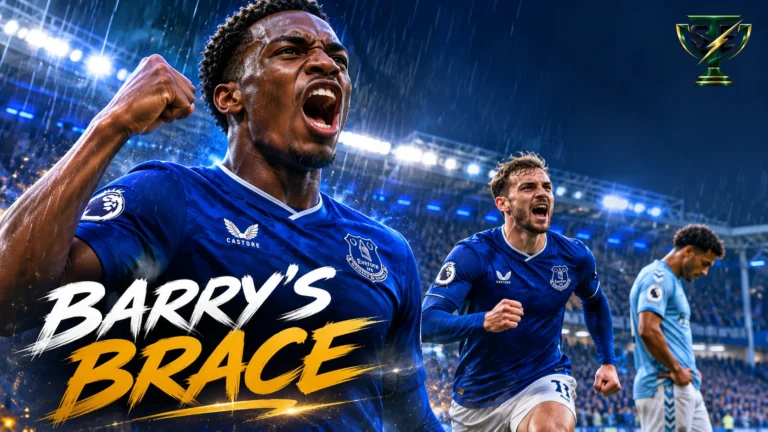
LIVERPOOL, England, November 6, 2026: Thierno Barry turned a potentially damaging night into another statement of Everton’s growing Premier League ambitions, scoring twice in five minutes before setting up Kiernan Dewsbury-Hall as David Moyes’ side came from behind to defeat Coventry City 3-1 at Hill Dickinson Stadium on Friday. Yann Gboho had given Frank Lampard’s visitors a deserved lead in the 52nd minute, but Barry equalized with a header four minutes later and bundled home a disputed second in the 61st. Dewsbury-Hall completed the comeback in the 81st minute, sending Everton into fifth place and extending their winning run to three matches.
The victory carried historical significance for Moyes, whose 592nd match in charge of Everton equaled Harry Catterick’s club managerial record. It also highlighted the transformation of Barry, who reached ten goals in all competitions after enduring a difficult first season following his move from Villarreal. Yet the final score did not tell the whole story. Coventry created substantial problems for Everton, had two penalty appeals rejected and saw Barry’s winning goal stand despite questions about a possible handball. Lampard’s promoted side left empty-handed, but the performance suggested they had been more competitive than the two-goal margin indicated.
Everton 3-1 Coventry City: Full Match Result and Key Details
The Premier League Matchweek 10 encounter took place at Hill Dickinson Stadium, where 52,395 spectators watched Everton recover from a difficult first half and a second-half deficit.
Coventry had legitimate reasons to believe they could take points from their first visit to Everton’s new stadium. They pressed effectively, disrupted the home side’s buildup and created opportunities before finally taking the lead.
Story at a glance
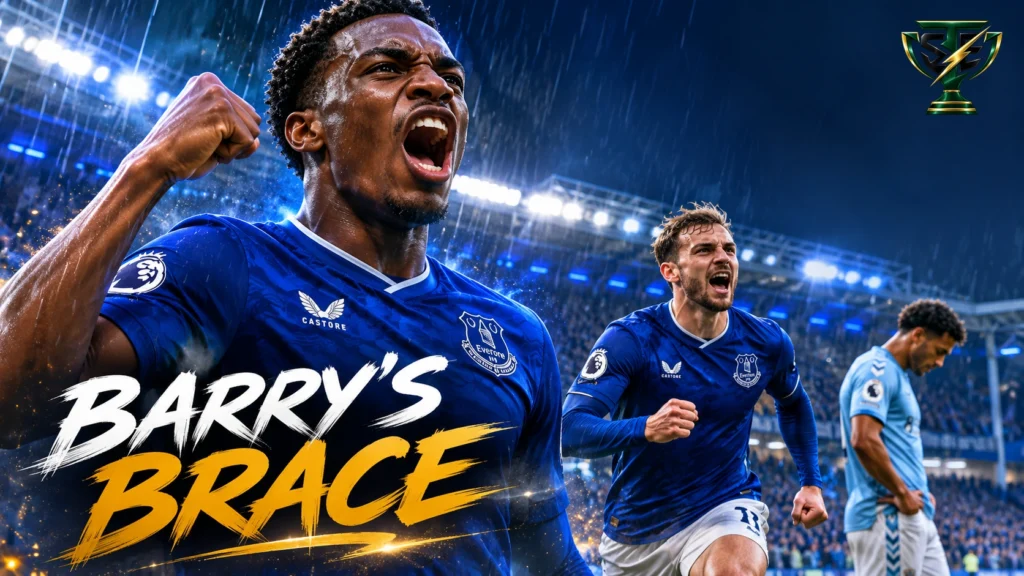
Everton 3-1 Coventry City: Full Match Result and Key Details
The Premier League Matchweek 10 encounter took place at Hill Dickinson Stadium, where 52,395 spectators watched Everton recover from a difficult first half and a second-half deficit.
How Did Everton Turn a 1-0 Deficit Into a 3-1 Victory?
The defining sequence occurred between the 52nd and 61st minutes.
Thierno Barry: Two Goals, One Assist and Everton’s New Attacking Leader
Barry’s contribution was the clearest difference between the teams.
Kiernan Dewsbury-Hall: The Midfielder Who Finally Found His Reward
Dewsbury-Hall’s night had been frustrating before his late goal.
Yann Gboho: Coventry’s Goal Rewarded Their Early Superiority
Coventry’s performance deserved more attention than the final score might suggest.
However, the visitors were unable to protect that advantage once Everton began delivering the ball into more dangerous areas.
| Match Detail | Information |
|---|---|
| Competition | Premier League 2026-27 |
| Round | Matchweek 10 |
| Date | Friday, November 6, 2026 |
| Venue | Hill Dickinson Stadium, Liverpool |
| Final score | Everton 3-1 Coventry City |
| Halftime | 0-0 |
| Everton scorers | Thierno Barry (56′, 61′), Kiernan Dewsbury-Hall (81′) |
| Coventry scorer | Yann Gboho (52′) |
| Referee | Stuart Attwell |
| Attendance | 52,395 |
| Everton manager | David Moyes |
| Coventry manager | Frank Lampard |
| Immediate league consequence | Everton moved into fifth place; Coventry remained 16th |
The victory was Everton’s third consecutive win in all competitions and confirmed the momentum established by their recent victories over Newcastle United.
The Sports Encounter’s earlier analysis of Everton’s 1-0 victory over Ipswich Town identified Barry’s goals and the team’s defensive organization as important components of their early-season progress.
Those qualities were tested more severely against Coventry, particularly during a first half in which Moyes’ team struggled to control the visitors’ movement through midfield.
How Did Everton Turn a 1-0 Deficit Into a 3-1 Victory?
The defining sequence occurred between the 52nd and 61st minutes.
For much of the opening half, Coventry had frustrated Everton and threatened to turn the contest into a difficult evening for the home supporters.
Gboho eventually broke the deadlock shortly after halftime.
Everton’s response was immediate and decisive.
Barry equalized in the 56th minute, completed the turnaround five minutes later and then supplied the final pass for Dewsbury-Hall’s goal.
Complete Goals and Turning-Points Timeline
| Minute | Incident | Score | Why It Mattered |
|---|---|---|---|
| First half | Coventry create several promising attacks | 0-0 | Visitors prevent Everton from establishing sustained control |
| 52′ | Yann Gboho scores following Jack Rudoni’s involvement | 0-1 | Coventry take a deserved lead |
| 56′ | Barry heads in Vitalii Mykolenko’s cross | 1-1 | Everton respond within four minutes |
| 61′ | Barry scores again after a defensive scramble | 2-1 | Everton complete a rapid turnaround |
| 73′ | Everton make three substitutions | 2-1 | Moyes adjusts the personnel while protecting the lead |
| 81′ | Dewsbury-Hall scores from Barry’s through ball | 3-1 | Everton establish a two-goal cushion |
| Full time | Everton secure all three points | 3-1 | Toffees move fifth in the Premier League |
TSE statistical finding: Everton turned a one-goal deficit into a one-goal lead in nine minutes, with Barry’s two goals arriving only five minutes apart.
From the moment Gboho scored until Barry’s second, the match swung by two goals.
That was the decisive period, although the result was ultimately secured through Dewsbury-Hall’s later finish.
The sequence demonstrates why Everton’s attacking efficiency, rather than sustained first-half dominance, determined the outcome.
Thierno Barry: Two Goals, One Assist and Everton’s New Attacking Leader
Barry’s contribution was the clearest difference between the teams.
The 24-year-old French forward entered the match enjoying a productive run of form and left it with another major contribution.
He scored twice and assisted the third goal, taking his overall tally to ten goals in all competitions this season.
That total already exceeds his scoring return from the entire 2025-26 campaign.
It is a remarkable change for a player who struggled to justify expectations following his arrival from Villarreal.
Barry’s First Goal: A Striker’s Movement at the Right Moment
Everton’s equalizer began with pressure from the right flank.
Tyler Dibling helped create the attacking situation, forcing Coventry to defend inside their own penalty area.
The visitors initially prevented a clear shooting opportunity, but failed to complete the clearance.
Vitalii Mykolenko recovered possession and delivered a cross into the danger area.
Barry moved between Coventry defenders Ethan Pinnock and Jay Dasilva, meeting the delivery with a powerful header beyond Carl Rushworth.
The finish illustrated an important aspect of his improved form.
Barry did not need to dominate the entire attacking move. His contribution came from identifying the space and arriving at the decisive moment.
For a striker, that combination of timing and conviction is often more important than the number of touches accumulated during a match.
Barry’s Second Goal: The Winning Finish Was Not Without Controversy
Five minutes later, Everton completed the comeback.
Tyrique George delivered from the left, placing Coventry’s defense under renewed pressure.
Jay Dasilva attempted to deal with the cross, but the ball struck Barry at close range and crossed the line.
The goal was awarded following a VAR check.
However, Coventry argued that the ball had made contact with Barry’s arm during the sequence.
The decision became one of the match’s major talking points because it transformed a 1-1 contest into a 2-1 Everton lead.
It would be inaccurate to claim that a handball infringement was conclusively established merely because television pictures raised questions.
The official match decision was that the goal stood.
The debate concerns whether that decision should have been different under the applicable handball interpretation.
Barry’s Assist for Dewsbury-Hall Completed the Performance
Barry’s best contribution may have come when he was not the goalscorer.
In the 81st minute, he recognized Dewsbury-Hall’s run and delivered a pass through the Coventry defense.
The midfielder advanced into the penalty area and beat Rushworth with a composed finish from a narrow angle.
It was Everton’s third goal and effectively ended Coventry’s realistic hopes of recovering.
For Barry, the assist provided evidence that his improved performances extend beyond finishing.
He influenced the match through movement, attacking presence and chance creation.
Three direct goal involvements in a 3-1 victory offer a clear measure of his contribution.
Kiernan Dewsbury-Hall: The Midfielder Who Finally Found His Reward
Dewsbury-Hall’s night had been frustrating before his late goal.
He attempted to connect Everton’s midfield with the forward line, but Coventry’s pressure and defensive organization prevented him from dominating the contest.
His opportunity eventually came through the movement of Barry.
As the striker drew defenders toward the ball, Dewsbury-Hall advanced into the space behind them.
Barry’s pass released him, and the midfielder finished decisively.
The goal mattered beyond the scoreline.
Dewsbury-Hall had been overlooked for England’s latest squad despite improving performances for Everton.
His club manager had spoken positively about that progress before the match.
Scoring on a night when Everton moved into fifth place strengthens the case for his importance to Moyes’ team, although it does not guarantee any future international selection.
Yann Gboho: Coventry’s Goal Rewarded Their Early Superiority
Coventry’s performance deserved more attention than the final score might suggest.
Frank Lampard’s side had been competitive from the opening stages.
They challenged Everton’s possession, worked the ball into dangerous positions and created opportunities that required interventions from Jordan Pickford and the home defense.
Gboho’s goal finally rewarded that approach.
Jack Rudoni helped release the attacking move as Everton struggled to clear their lines.
Gboho retained possession despite pressure from several defenders before getting his shot away.
The attempt took a deflection off James Tarkowski and beat Pickford.
Coventry had taken the lead through determination and the ability to exploit an unconvincing defensive sequence.
But the visitors were unable to maintain their defensive organization during the following nine minutes.
That failure ultimately proved more damaging than their inability to score again.
Why Did Coventry Lose After Playing So Well?
The central problem was the difference between creating dangerous situations and controlling what happened after taking the lead.
Coventry matched Everton’s attacking involvement in important statistical areas.
The visitors also created enough promising situations to make the result more competitive than the final margin suggested.
However, the defending became less reliable once Everton began delivering crosses into the penalty area.
Barry’s first goal exposed the space between defenders.
His second followed an unsuccessful attempt to deal with another cross.
The third came when the home side found enough room to play a through ball behind the defensive line.
Those incidents demonstrate three different ways a defensive structure can break down: marking inside the penalty area, dealing with a loose ball and protecting space behind the back line.
Everton vs. Coventry: Key Match Statistics
The following figures are taken from FotMob’s final match statistics. Some other data providers report slightly different totals for shots and expected goals because their event definitions and models differ.
| Statistic | Everton | Coventry City |
|---|---|---|
| Goals | 3 | 1 |
| Possession | 50% | 50% |
| Total shots | 16 | 15 |
| Expected goals (xG) | 2.25 | 1.40 |
| Touches in opposition penalty area | 29 | 29 |
| Second-half goals | 3 | 1 |
| Points earned | 3 | 0 |
The figures are revealing.
Possession was even, the shot totals were close and both teams registered 29 touches in the opposition penalty area.
Yet Everton generated considerably more expected goals and finished with three times Coventry’s actual goal total.
The difference between the teams was not simply how often they entered dangerous areas.
It was the quality of their opportunities and their ability to turn those moments into goals.
TSE information-gain calculation: Everton’s 2.25 xG from 16 attempts represents approximately 0.141 expected goals per shot. Coventry’s 1.40 from 15 attempts represents approximately 0.093.
On this model, Everton’s average chance quality was approximately 51% higher per attempt.
The calculation describes the available chances, not a permanent difference in the teams’ attacking ability.
It helps explain why similar shot totals produced different outcomes.
Two Penalty Appeals and a Disputed Goal: What Did VAR Decide?
Refereeing decisions became a major part of the postmatch discussion.
Coventry believed they had strong arguments for penalties in two separate incidents.
The first involved James Tarkowski during a contested aerial challenge.
The second involved Taiwo Awoniyi going down under a challenge from Vitalii Mykolenko shortly after halftime.
Referee Stuart Attwell and the video officials did not award either penalty.
The decision to allow Barry’s second goal added another source of frustration.
The Three Major Refereeing Controversies
| Incident | Coventry’s Concern | Official Outcome | Sporting Consequence |
|---|---|---|---|
| Tarkowski aerial challenge | Possible infringement involving Coventry players during an aerial contest | No penalty awarded | Match remained goalless at that stage |
| Mykolenko challenge on Awoniyi | Possible foul inside the Everton penalty area | Contact assessed outside the area; no penalty | Coventry did not receive a penalty opportunity |
| Barry’s 61st-minute winner | Possible contact with the attacking player’s arm | Goal allowed after review | Everton moved 2-1 ahead |
The decisions should be discussed without rewriting the match’s official record.
Everton’s second goal stands, and the final score is 3-1.
However, acknowledging that result does not require dismissing Coventry’s concerns.
Frank Lampard questioned the decisions after the match, particularly the circumstances surrounding the winning goal.
Everton manager David Moyes also expressed frustration about the inconsistency of refereeing decisions across matches.
The debate is not evidence that either manager’s interpretation is automatically correct.
It illustrates how close decisions can become decisive in matches where the margin between teams is small.
David Moyes Equals Harry Catterick’s 592-Match Everton Record
The result gave Moyes a memorable landmark.
His 592nd game as Everton manager brought him level with Harry Catterick’s club record.
Catterick remains one of Everton’s most celebrated managers, having guided the club to two English league titles and an FA Cup triumph.
Matching his appearance record does not mean Moyes has equaled his trophy achievements.
The distinction matters because the two managers worked in different footballing eras and under different competitive circumstances.
For Moyes, the achievement reflects longevity and repeated responsibility for a club that has experienced substantial changes since his first spell.
The milestone also arrived during a period when Everton appear to be moving away from years of uncertainty toward renewed competitiveness.
Why the Record Matters More With Everton in Fifth
Moyes did not reach the landmark during a routine defeat or an uneventful draw.
His team recovered from a deficit, produced three second-half goals and climbed into fifth place.
The result extended an encouraging run of performances.
Everton had already beaten Newcastle United twice in quick succession, including a Premier League victory at St James’ Park.
Earlier in the campaign, Moyes’ team demonstrated similar resilience through its Carabao Cup victory over Wolverhampton Wanderers, when substitute Charly Alcaraz scored the decisive goal in the 80th minute.
That history of finding match-winning contributions from different players provides an important point of continuity.
Barry’s goals are now attracting substantial attention, but Everton’s progress has also depended on organization, defensive work and contributions from midfield.
Frank Lampard Returns to Everton as Coventry Manager
Friday’s encounter also carried personal significance for Frank Lampard.
The former England midfielder previously managed Everton before leaving the club in January 2023.
He returned to Merseyside as manager of Coventry City, the team he guided back to the Premier League after more than two decades outside the top flight.
The match provided an opportunity to assess how far Coventry have progressed under his leadership.
They had begun the season poorly, losing their first four Premier League matches without scoring.
Results subsequently improved.
A first victory at Nottingham Forest was followed by an impressive 4-1 success against Newcastle United.
That transformation was examined in The Sports Encounter’s analysis of Coventry’s turnaround against Newcastle.
Coventry’s display at Hill Dickinson Stadium showed that some of those improvements remain evident.
The team looked capable of competing physically and tactically with Everton.
But the outcome also demonstrated how costly defensive lapses can become at Premier League level.
Coventry’s Progress Since Their 5-0 Brighton Defeat
Coventry’s season has involved considerable fluctuations.
The team’s early struggles raised serious questions about its ability to adjust after winning promotion from the Championship.
A 5-0 home defeat against Brighton was especially damaging.
Five different Brighton players scored, while Taiwo Awoniyi was dismissed during a difficult afternoon.
TSE’s detailed examination of Brighton’s five-goal demolition of Coventry identified the speed of Premier League attacks and defensive decision-making as important areas of concern.
Coventry have since made progress.
They have produced stronger attacking performances and shown greater confidence in possession.
The victory over Newcastle was particularly significant because it demonstrated that the promoted side could defeat established Premier League opposition.
Yet the defeat to Everton provides another reminder of the league’s demands.
Playing well for significant periods is not always sufficient.
Teams must remain effective when momentum changes, especially after conceding a goal.
The Overlooked Contributions That Shaped Everton’s Victory
Barry was the obvious standout performer, but several other players made important contributions.
Vitalii Mykolenko: The Cross That Changed the Match
Mykolenko delivered the cross for Barry’s equalizing header after Everton maintained pressure following an incomplete Coventry clearance.
The Ukrainian defender’s involvement showed the value of fullbacks contributing to attacking phases when the initial move has not succeeded.
His night also included the disputed challenge on Awoniyi, making him an important figure in both the attacking and refereeing narratives.
Tyrique George: A Dangerous Delivery Under Pressure
George’s cross helped create the scramble from which Barry scored his second goal.
Although the finish remained controversial, the delivery placed Coventry’s defenders under immediate pressure.
That contribution continued a promising period for Everton’s younger players.
The importance of integrating youth and experience was evident earlier in the season, when Everton’s progress featured in TSE’s opening-weekend Premier League analysis.
Jordan Pickford: Important Saves Before the Comeback
Pickford had to remain alert during periods when Coventry controlled the tempo.
His saves and interventions helped prevent the visitors from establishing a more comfortable lead.
The significance of those actions becomes clearer when considering how Everton eventually won.
Had Coventry built a two-goal advantage, Barry’s double would only have restored parity rather than put Everton ahead.
Goalkeeping contributions are often overlooked when the final report centers on attacking players.
In this case, Pickford’s work formed part of the conditions that made Everton’s comeback possible.
Jack Rudoni: Coventry’s Creative Influence
Rudoni played a prominent role in Coventry’s attacking work.
He helped create the situation leading to Gboho’s goal and remained involved in threatening movements through midfield.
His influence demonstrated why Coventry can trouble stronger sides when they move possession quickly into attacking areas.
The problem was not a complete absence of creativity.
It was the team’s inability to convert a competitive performance into points.
Everton and Coventry Starting XIs
Everton made one change from the team that defeated Newcastle in the Premier League, with Tyler Dibling coming into the starting lineup.
Merlin Röhl moved into the right-back position while Jake O’Brien began on the bench.
Coventry started Taiwo Awoniyi in attack, supported by Gboho, Rudoni and Tatsuhiro Sakamoto.
| Position Group | Everton | Coventry City |
|---|---|---|
| Goalkeeper | Jordan Pickford | Carl Rushworth |
| Defense | Merlin Röhl, James Tarkowski, Jarrad Branthwaite, Vitalii Mykolenko | Milan van Ewijk, Stephen Mfuni, Ethan Pinnock, Jay Dasilva |
| Midfield | James Garner, Harrison Armstrong, Kiernan Dewsbury-Hall | Victor Torp, Caleb Yirenkyi, Jack Rudoni |
| Attack | Tyler Dibling, Tyrique George, Thierno Barry | Tatsuhiro Sakamoto, Yann Gboho, Taiwo Awoniyi |
| Head coach | David Moyes | Frank Lampard |
| Broad starting structure | 4-2-3-1 | 4-2-3-1 |
The official Everton team announcement confirms the home lineup and the manager’s pre-match selection changes.
What Does Everton’s Victory Mean for the Premier League Table?
Everton moved into fifth place after reaching three consecutive victories.
The result also moved them above local rivals Liverpool before the remainder of Matchweek 10.
The position is significant because Everton have spent several recent seasons trying to establish greater stability.
A place among the leading clubs after ten league games represents encouraging progress.
However, fifth place at this stage does not guarantee European qualification.
The final qualification places will depend on the completed league standings and the applicable UEFA access arrangements.
Everton’s immediate objective must be sustaining their results across a longer period.
The club’s early progress was already visible in its 2026-27 Premier League season outlook, which examined Moyes’ challenge of improving stability while competing against financially stronger rivals.
Friday’s comeback provides evidence that those ambitions are becoming more realistic, although the tougher fixtures ahead will offer further tests.
What Does Defeat Mean for Coventry’s Survival Prospects?
Coventry remained 16th following the defeat.
The immediate consequence is three points lost after a match in which Lampard’s team had opportunities to produce a more favorable result.
The table position leaves Coventry needing further victories to move clear of pressure around the relegation places.
However, the performance also offered reasons for encouragement.
Coventry were not overwhelmed for ninety minutes.
They competed well before halftime, created opportunities and took the lead after the interval.
The problem was defending effectively once Everton increased the pressure.
The Sports Encounter’s report on Coventry’s opening-weekend defeat to Arsenal explored the difficult standard awaiting the newly promoted team.
Compared with that beginning, Coventry now appear more capable of causing problems for established opponents.
The challenge is turning that improvement into enough points across the season.
Why Coventry’s Promotion Story Still Matters
Coventry returned to the Premier League after a 25-year absence.
The promotion was a major achievement for Lampard and the club’s supporters.
However, the step into the top division exposed a gap between Championship dominance and Premier League consistency.
The Sports Encounter’s analysis of the Premier League’s record £3.46 billion summer transfer spending examined the financial pressures facing promoted clubs, including Coventry.
Those pressures provide important context for their season.
Coventry must compete against established teams with greater Premier League experience and often more extensive resources.
Yet financial differences do not excuse every defensive error.
Lampard’s task is to combine improved performances with consistency in the moments that decide matches.
Friday’s defeat demonstrated both the team’s progress and the areas still demanding attention.
Everton’s Next Fixtures: Brentford and the Merseyside Derby
The Premier League’s November international break gives Everton time before their next scheduled match.
Moyes’ side visit Brentford on Monday, November 23, before hosting Liverpool in the Merseyside derby on Sunday, November 29.
Both fixtures will test the team’s recent improvement.
Brentford represent an important challenge away from home.
Liverpool bring the additional emotional and competitive pressure of a local derby.
| Date | Fixture | Why It Matters |
|---|---|---|
| November 23 | Brentford vs Everton | Tests whether Everton can sustain their form away from Hill Dickinson Stadium |
| November 29 | Everton vs Liverpool | Merseyside derby and an important test against a direct rival |
| November 21 | Coventry City vs Crystal Palace | Opportunity for Coventry to recover from the Everton defeat |
| November 28 | Leeds United vs Coventry City | Another important test of the promoted club’s ability to collect points |
These fixtures are scheduled according to the Premier League’s official November fixture amendments.
The results of those games will provide clearer evidence of whether Everton can remain near the European qualification positions and whether Coventry can build a sustainable margin above the relegation zone.
Continue the Premier League Story
 Premier LeagueCoventry Thrash Newcastle 4-1 to Complete 36-Goal Premier League Weekend as Manchester City Pull Clear
 Premier LeagueHavertz Silences Anfield After 14 Years as Arsenal Go Top and Liverpool’s 17 Shots Expose a Title-Race Problem
 Premier LeagueManchester United Face a Relegation Fight, Manchester City Lose Invincibility: One City, Two Different Crises
Frequently Asked Questions About Everton vs Coventry
Who won Everton vs Coventry City on November 6, 2026?
Everton defeated Coventry City 3-1 at Hill Dickinson Stadium in Premier League Matchweek 10.
Who scored Everton’s goals?
Thierno Barry scored twice in the 56th and 61st minutes, while Kiernan Dewsbury-Hall scored the third in the 81st minute.
Who scored for Coventry?
Yann Gboho gave Coventry a 1-0 lead in the 52nd minute.
How many goals has Thierno Barry scored this season?
Barry reached ten goals in all competitions following his double against Coventry.
Who assisted Dewsbury-Hall’s goal?
Thierno Barry supplied the through ball for Dewsbury-Hall’s 81st-minute finish.
Why was Barry’s second goal controversial?
Questions were raised about possible contact between the ball and Barry’s arm during the goalmouth scramble. The goal stood following review.
Did Coventry have penalty appeals?
Yes. Coventry appealed during an aerial challenge involving James Tarkowski and following a challenge on Taiwo Awoniyi by Vitalii Mykolenko. Neither incident resulted in a penalty.
What record did David Moyes equal?
Moyes took charge of Everton for the 592nd time, equaling Harry Catterick’s club record.
Where are Everton in the Premier League table?
Everton moved into fifth place following the 3-1 victory, pending the remaining Matchweek 10 fixtures.
Where are Coventry City in the standings?
Coventry remained 16th following the defeat.
Who manages Coventry City?
Former Everton manager Frank Lampard is Coventry City’s head coach.
When does Everton play next?
Everton are scheduled to visit Brentford on November 23, followed by the Merseyside derby against Liverpool on November 29.
Everton’s Comeback Was Impressive, but Coventry Exposed Questions Moyes Must Answer
Everton’s 3-1 victory brought together several encouraging developments.
Barry continued his remarkable scoring form, Dewsbury-Hall provided an important midfield contribution, and Moyes celebrated a record-equalling appearance with a result that lifted his team into fifth place.
Yet the scoreline should not obscure Coventry’s performance.
Lampard’s side created dangerous situations, took the lead and had reasonable grounds to question several refereeing decisions.
The visitors ultimately failed to manage the crucial period after scoring.
Everton took advantage through Barry’s movement, finishing and involvement in the final goal.
The result demonstrates why the home side’s ambitions are increasing.
They now possess a striker capable of changing matches rapidly and a team showing enough resilience to recover when performances fall below expectations.
But there are still questions about defensive security and control against opponents who press aggressively.
Those concerns will become important when Everton face stronger teams later in the campaign.
Coventry, meanwhile, must take encouragement from their competitive approach without ignoring the defensive mistakes that turned a promising night into another defeat.
Moyes’ record-equalling evening ended with three points and another milestone in Everton’s recovery.
For Barry, the match supplied further evidence of his transformation into one of the team’s most influential players.
For Lampard, it was an uncomfortable return to Merseyside, made more frustrating by the knowledge that Coventry had been within reach of a very different result.