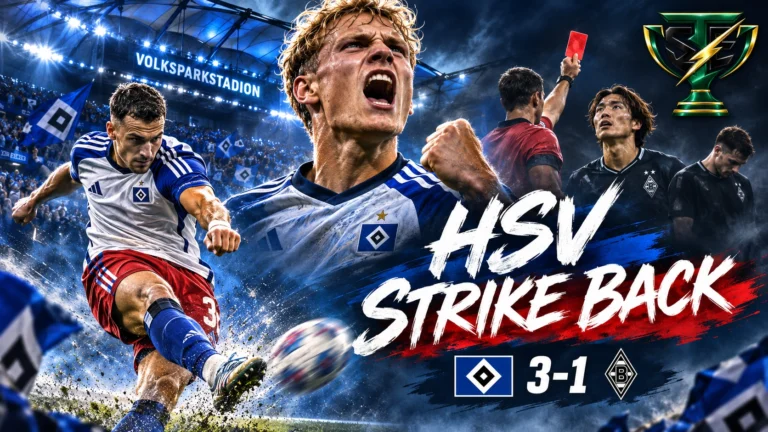
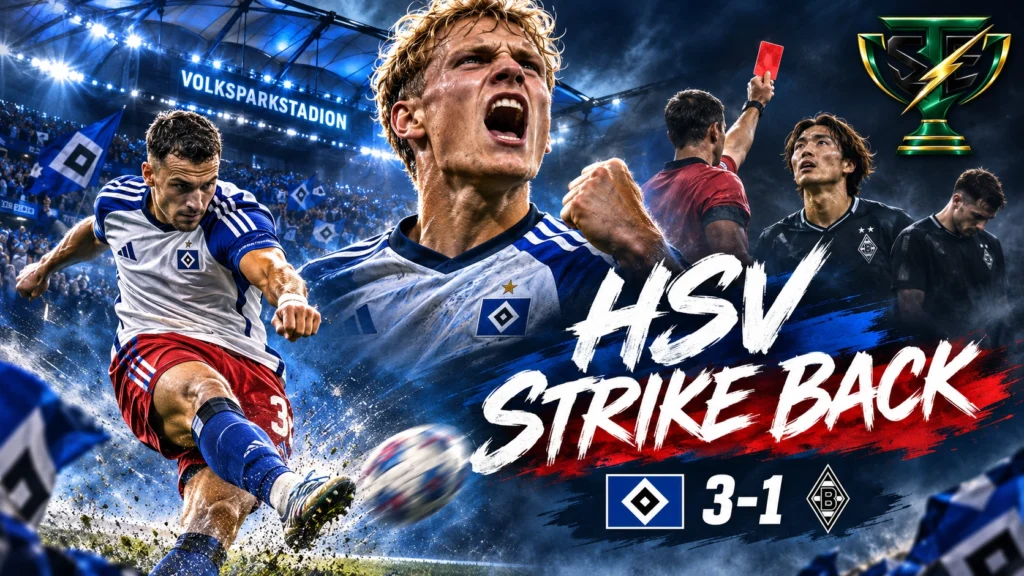
HAMBURG, Germany, November 6, 2026: Hamburger SV ended a three-match losing streak in spectacular fashion on Friday, defeating Borussia Mönchengladbach 3-1 at Volksparkstadion through stunning long-range goals from Miro Muheim and Albert Grønbæk and a decisive second-half finish from Shafiq Nandja. Muheim opened the scoring in the 11th minute with a 30-meter strike measured at 129.43 km/h, the fastest Bundesliga goal of the season, before Joe Scally equalized for Gladbach shortly before halftime. The match changed dramatically when Kō Itakura received a second yellow card in the 49th minute, leaving the visitors with ten men.
Hamburg took full advantage. Grønbæk created Nandja’s 60th-minute goal before firing an extraordinary long-range effort into the top corner ten minutes later, earning the Bundesliga’s Man of the Match recognition. The result lifted Merlin Polzin’s side from 15th to eighth in the provisional standings, while Gladbach remained bottom with only four points from nine matches. Yet the official expected-goals figures of 1.90 for Hamburg and 1.86 for Gladbach reveal a contest considerably closer than the final score suggests. Hamburg’s sharper finishing and ability to exploit their numerical advantage ultimately separated two teams fighting to escape the lower reaches of the Bundesliga.
Hamburg vs Borussia Mönchengladbach: Bundesliga Matchday 9 Result
Hamburg entered Friday’s game under considerable pressure after consecutive defeats against Paderborn and Eintracht Frankfurt, as well as another loss to Frankfurt in the DFB-Pokal.
Gladbach’s position was even more precarious. The visitors had collected just four points from eight Bundesliga matches and were already fighting to avoid becoming detached at the bottom of the table.
Story at a glance
Hamburg vs Borussia Mönchengladbach: Bundesliga Matchday 9 Result
Hamburg entered Friday’s game under considerable pressure after consecutive defeats against Paderborn and Eintracht Frankfurt, as well as another loss to Frankfurt in the DFB-Pokal.
Miro Muheim’s 129.43 km/h Rocket Gives Hamburg the Perfect Start
Gladbach began brightly despite arriving at Volksparkstadion as the Bundesliga’s bottom club.
Joe Scally Punishes Hamburg Before Halftime
Hamburg’s advantage did not end Gladbach’s attacking ambition.
Kō Itakura’s Red Card Changes the Match in the 49th Minute
The decisive turning point arrived almost immediately after the restart.
Hamburg vs Gladbach: Complete Goal and Turning-Point Timeline
TSE original calculation: Hamburg took only 21 minutes from Itakura’s dismissal in the 49th minute to Grønbæk’s goal in the 70th to turn a 1-1 contest into a 3-1 lead.
Both teams therefore had powerful reasons to pursue victory rather than settle for a draw.
That urgency produced an open first half, with opportunities at both ends, before Itakura’s dismissal changed the tactical balance.
| Match Detail | Confirmed Information |
|---|---|
| Competition | Bundesliga 2026-27 |
| Matchday | 9 |
| Date | Friday, November 6, 2026 |
| Venue | Volksparkstadion, Hamburg |
| Full-time result | Hamburg 3-1 Borussia Mönchengladbach |
| Halftime score | 1-1 |
| Hamburg goalscorers | Miro Muheim 11′, Shafiq Nandja 60′, Albert Grønbæk 70′ |
| Gladbach goalscorer | Joe Scally 44′ |
| Red card | Kō Itakura, 49′, second yellow |
| Referee | Sven Jablonski |
| Hamburg coach | Merlin Polzin |
| Gladbach coach | Alexander Blessin |
| Hamburg expected goals | 1.90 |
| Gladbach expected goals | 1.86 |
| Official Man of the Match | Albert Grønbæk |
The result and major incidents are confirmed by the official Bundesliga match center, which includes the live chronology, match statistics and player recognition.
Miro Muheim’s 129.43 km/h Rocket Gives Hamburg the Perfect Start
Gladbach began brightly despite arriving at Volksparkstadion as the Bundesliga’s bottom club.
Shuto Machino fired over in the fourth minute following an attacking move involving Robin Hack, providing an early reminder that the visitors were capable of troubling Hamburg’s defense.
Patson Daka then had an opportunity for the hosts but could not beat goalkeeper Daniel Batz.
The opening goal arrived in the 11th minute from a position that did not initially appear especially dangerous.
Albert Sambi Lokonga collected a loose ball and moved it into Muheim’s path.
The Swiss defender struck from approximately 30 meters, sending a powerful shot into the bottom corner.
Bundesliga tracking measured the effort at 129.43 km/h, identifying it as the fastest goal recorded in the competition during the 2026-27 season to that point.
The strike transformed the atmosphere at Volksparkstadion.
Hamburg had entered the match after three consecutive defeats in all competitions, but Muheim’s intervention offered an immediate change in momentum.
Why Muheim’s Goal Was More Than an Extraordinary Strike
Long-range goals are difficult to plan as a consistent attacking strategy because conversion rates from distance are generally lower than those from central positions closer to goal.
That made Muheim’s finish valuable in two ways.
First, it gave Hamburg an early advantage without requiring an extended buildup inside Gladbach’s penalty area.
Second, it forced the visitors to consider how aggressively they could close down players outside their defensive line.
For a team struggling to produce goals from open play, the full-back’s strike offered an important contribution from outside the conventional attacking positions.
The Sports Encounter has followed how Bundesliga teams use unexpected scorers to change matches, including Maximilian Beier’s decisive contribution in Dortmund’s narrow victory over Stuttgart.
Muheim’s goal was very different in execution, but it reinforced the importance of contributions beyond a team’s recognized strikers.
Joe Scally Punishes Hamburg Before Halftime
Hamburg’s advantage did not end Gladbach’s attacking ambition.
Wael Mohya continued to trouble the hosts with his movement and ability to carry the ball through midfield.
The 17-year-old had recently earned his first call-up to Germany’s senior national team, providing another layer of interest to his performance.
Gladbach also benefited from Daniel Batz’s goalkeeping as the visitors resisted opportunities that could have extended Hamburg’s lead.
The equalizer arrived in the 44th minute.
Lukas Ullrich delivered from the left, and Hamburg failed to complete the clearance.
Joe Scally collected the loose ball and sent an effort toward goal. The shot took a deflection on its way into the net.
The Bundesliga officially credits Scally with the goal.
Some other match reports identify Robin Hack as the scorer because of the apparent deflection. The official league attribution is used throughout this article.
That goal sent the teams into halftime level at 1-1.
The scoreline was significant because Gladbach had recovered from an early setback and placed themselves in position to challenge for a much-needed result.
Kō Itakura’s Red Card Changes the Match in the 49th Minute
The decisive turning point arrived almost immediately after the restart.
Itakura, making his first Bundesliga start in seven weeks, had already received a yellow card in the 38th minute.
In the 49th minute, he brought down David Møller Wolfe near the halfway line.
Referee Sven Jablonski showed him a second yellow card, followed by a red.
Gladbach were reduced to ten men with more than 40 minutes still to play.
The consequences were immediate.
A team that had been competing openly for possession and attacking opportunities suddenly needed to protect its defensive shape with one fewer player.
Hamburg could now stretch the visitors horizontally, circulate possession more comfortably and attack the spaces created by Gladbach’s reduced numbers.
Why the Timing of Itakura’s Dismissal Was So Damaging
The dismissal came just five minutes after Gladbach had equalized.
That distinction matters.
The visitors had worked their way back into the contest and were starting the second half with the score level.
Instead, they had to reorganize defensively before establishing any sustained attacking rhythm after the interval.
Hamburg did not need to chase an equalizer. They could attack against ten players while already knowing a single goal would restore their lead.
That tactical advantage became decisive.
Hamburg vs Gladbach: Complete Goal and Turning-Point Timeline
| Minute | Incident | Score or Consequence |
|---|---|---|
| 4′ | Shuto Machino fires over | Gladbach threaten early |
| 9′ | Patson Daka fails to beat Daniel Batz | Hamburg miss an opening |
| 11′ | Miro Muheim scores from approximately 30 meters | Hamburg lead 1-0 |
| 38′ | Kō Itakura booked | Gladbach defender under disciplinary pressure |
| 44′ | Joe Scally equalizes with a deflected effort | 1-1 |
| Halftime | Teams enter dressing rooms level | 1-1 |
| 49′ | Itakura receives second yellow card | Gladbach reduced to ten men |
| 60′ | Shafiq Nandja scores from Grønbæk’s pass | Hamburg lead 2-1 |
| 63′ | Hamburg introduce fresh players | Polzin adjusts personnel |
| 70′ | Grønbæk scores from distance | Hamburg lead 3-1 |
| 80′ | Grønbæk and Lokonga withdrawn | Hamburg protect advantage |
| Full time | Hamburg defeat Gladbach | 3-1 |
TSE original calculation: Hamburg took only 21 minutes from Itakura’s dismissal in the 49th minute to Grønbæk’s goal in the 70th to turn a 1-1 contest into a 3-1 lead.
The sequence does not prove that Gladbach would have avoided defeat with eleven players. It does demonstrate how quickly Hamburg converted the numerical advantage into a decisive scoreline.
Shafiq Nandja Scores His First Bundesliga Goal to Restore Hamburg’s Lead
Hamburg’s second goal arrived in the 60th minute.
Grønbæk identified a route through Gladbach’s defensive line and delivered a pass into the penalty area.
Nandja attacked the space and finished past Batz, restoring Hamburg’s advantage at 2-1.
It was the defender’s first Bundesliga goal.
The importance of the finish extended beyond the personal milestone.
Hamburg had created several openings before the red card without fully capitalizing on their opportunities.
Once Gladbach were reduced to ten players, they needed to demonstrate that the additional space could lead to clear scoring positions.
Grønbæk’s pass and Nandja’s finish provided that response.
The goal also exposed the difficulties of defending multiple attacking channels with one fewer player.
When Hamburg moved the ball into space quickly, Gladbach struggled to protect the central areas of the penalty box.
Albert Grønbæk Delivers the Goal That Ends Gladbach’s Resistance
Grønbæk had already assisted Nandja’s goal when his outstanding individual contribution arrived ten minutes later.
Gladbach failed to clear another loose ball, allowing the Danish midfielder to prepare an effort from outside the penalty area.
He struck into the top corner, leaving Batz with little chance.
The Bundesliga assigned the goal a probability of just 2%, making it one of the evening’s most exceptional finishes.
The strike completed Hamburg’s recovery from the disappointment of conceding immediately before halftime.
It also effectively ended Gladbach’s realistic hopes of rescuing a point.
Why Grønbæk Was Named Man of the Match
Grønbæk combined direct influence on the scoreboard with the ability to exploit Gladbach’s defensive weaknesses.
He assisted the goal that restored Hamburg’s lead and scored the third himself.
Those contributions arrived during the most important phase of the match.
His recognition as Man of the Match was therefore supported by more than the visual quality of his long-range goal.
| Player | Goals | Assists | Key Contribution |
|---|---|---|---|
| Miro Muheim | 1 | 0 | 129.43 km/h opening goal |
| Shafiq Nandja | 1 | 0 | First Bundesliga goal and match-winning strike |
| Albert Grønbæk | 1 | 1 | Assisted Nandja, scored spectacular third goal |
| Albert Sambi Lokonga | 0 | 1 | Created Muheim’s opener |
| Patson Daka | 0 | 0 | Attacking movement and chances created |
TSE statistical insight: Grønbæk directly contributed to two of Hamburg’s three goals, or 66.7% of the team’s scoring.
That calculation counts goals and assists rather than total involvement in attacking moves.
It highlights how central the midfielder became after Gladbach were reduced to ten men.
The Expected-Goals Numbers Reveal a Much Closer Match
The final score suggests Hamburg enjoyed a comfortable victory.
The official expected-goals figures offer a more nuanced interpretation.
Hamburg generated 1.90 xG, compared with 1.86 for Gladbach.
That is a difference of only 0.04 expected goals.
Yet Hamburg scored three times and Gladbach managed one.
| Measure | Hamburg | Gladbach |
|---|---|---|
| Actual goals | 3 | 1 |
| Expected goals | 1.90 | 1.86 |
| Goals minus xG | +1.10 | -0.86 |
| Share of combined xG | 50.5% | 49.5% |
| Actual goal difference | Hamburg +2 | |
| xG difference | Hamburg +0.04 | |
| Highest-impact disciplinary incident | Itakura sent off, 49th minute | |
TSE original statistical finding: Hamburg accounted for approximately 50.5% of the combined 3.76 xG, but scored 75% of the match’s four goals.
That 24.5-percentage-point difference is one way to describe the gap between chance probability and actual finishing.
It is not evidence that Gladbach deserved to win. Expected goals summarize estimated scoring probabilities and do not fully explain the tactical consequences of a red card or how a team’s approach changes with the score.
The Bundesliga’s official match analysis also records the extraordinary 2% goal probability for Grønbæk’s long-range strike.
That goal was a strong example of individual quality producing a result beyond the average expectation attached to the shooting position.
Why Hamburg’s Victory Matters in the Bundesliga Relegation Fight
The result brought immediate relief for Hamburg.
Polzin’s team entered the match in 15th place, only two points clear of the relegation zone.
Victory lifted them provisionally to eighth, although Saturday and Sunday’s results could change that position.
The three points were especially valuable after Hamburg had lost consecutive matches to Paderborn and Frankfurt.
There was also an important contrast with the team’s earlier form.
Hamburg lost their opening three Bundesliga games, recovered with three successive victories and then suffered another dip.
The win over Gladbach therefore interrupted a cycle of extended losing spells.
Earlier in the campaign, The Sports Encounter documented Hamburg’s first significant Bundesliga recovery during Matchday 4.
That result helped establish the possibility that Hamburg could compete effectively after a difficult start.
Friday’s victory strengthened that argument, although consistency over the coming matches remains essential.
Borussia Mönchengladbach Remain Bottom Despite Earlier Signs of Recovery
Gladbach entered Friday with four points from eight matches.
They had recently beaten Stuttgart 3-2 and followed that performance with a 0-0 draw against Paderborn.
Those results offered hope that the team might begin climbing the table.
But the defeat in Hamburg exposed the fragility of that recovery.
The Sports Encounter previously examined Gladbach’s first Bundesliga victory of the season against Stuttgart, when late drama finally ended a difficult opening run.
Friday provided another reminder of the challenges facing the club.
The team created opportunities and reached halftime level, but a disciplinary error left it unable to sustain the contest on equal terms.
The defeat keeps Gladbach rooted to the bottom with four points from nine matches.
They have taken only 14.8% of the 27 points available through nine games.
That calculation illustrates the severity of the position without attempting to predict relegation after less than a third of the season.
Gladbach’s Defensive Problems Are Not Limited to Itakura’s Red Card
Itakura’s dismissal was the decisive incident, but Gladbach had conceded a spectacular opening goal long before losing a player.
Hamburg also created several first-half opportunities that forced Batz into action.
The visitors were therefore not defensively secure simply because they reached halftime level.
What the red card did was remove their ability to reorganize with eleven players and continue competing for possession in the same way.
The second-half goals revealed how vulnerable the team became when Hamburg attacked spaces that were more difficult to protect.
That problem extends beyond one defender.
Gladbach need a structure capable of limiting dangerous opposition movement, protecting central areas and avoiding unnecessary disciplinary risks.
Those requirements will become even more important when they face stronger attacking opponents after the international break.
TSE’s early-season Bundesliga analysis involving Gladbach identified the club’s difficult start and the pressure already developing around its results.
The latest defeat shows that the concerns have not disappeared.
Wael Mohya Offers a Positive Story Amid Gladbach’s Difficult Night
Gladbach’s defeat should not obscure the performance of Wael Mohya.
The 17-year-old displayed confidence on the ball, attacking movement and the ability to escape pressure in tight spaces.
He had been called into Germany’s senior squad for the first time during the week.
That selection provided an important personal milestone at a time when his club was struggling.
Mohya showed why his development has attracted attention, including one first-half move in which he escaped several opponents before supplying Scally.
The resulting chance was not converted, but it demonstrated his ability to create opportunities from difficult positions.
For Gladbach, players capable of producing that kind of attacking movement could become valuable during the recovery effort.
However, the team must find ways to support its young talent without leaving defensive responsibilities exposed.
Starting Lineups: Hamburg vs Borussia Mönchengladbach
Hamburg made three changes from the defeat in Frankfurt, restoring Sebastiaan Bornauw, Zakaria El Ouahdi and Patson Daka to the starting lineup.
Gladbach brought Itakura into the side for the injured Daiki Hashioka.
| Hamburger SV | Borussia Mönchengladbach |
|---|---|
| Daniel Heuer Fernandes | Daniel Batz |
| Shafiq Nandja | Philipp Sander (c) |
| Sebastiaan Bornauw | Kō Itakura |
| Warmed Omari | Fabio Chiarodia |
| Zakaria El Ouahdi | Joe Scally |
| Martin Adeline | Zento Uno |
| Albert Sambi Lokonga (c) | Florian Neuhaus |
| Miro Muheim | Lukas Ullrich |
| David Møller Wolfe | Robin Hack |
| Patson Daka | Wael Mohya |
| Albert Grønbæk | Shuto Machino |
Polzin’s team operated with a three-player defensive base and wing-back support, allowing Muheim and El Ouahdi to contribute in advanced areas.
Gladbach also used a back-three system, with Scally and Ullrich providing width.
After Itakura’s red card, the visitors had to modify their defensive structure while attempting to retain enough attacking presence to trouble Hamburg.
How Hamburg’s Form Compares With the Wider Bundesliga
Hamburg’s victory came during a season in which several clubs have experienced significant fluctuations in form.
The Sports Encounter has documented Borussia Dortmund’s early title challenge, including the narrow victory over Stuttgart and the dramatic draw against Werder Bremen.
Continue the Bundesliga Story
 BundesligaGladbach Escape Historic Bundesliga Shame With Stunning 3-2 Win at Stuttgart Despite 34% Possession
 BundesligaKane Hits the Woodwork Twice as Fabio Silva Rescues Dortmund and Bayern Lose Their Grip on Der Klassiker
 BundesligaBundesliga: Freiburg Go Top, Dortmund Stay Perfect as Gladbach Collapse
Those matches illustrate how closely contested results can influence the standings.
At the other end of the table, Hamburg and Gladbach are fighting for different forms of stability.
Hamburg need to establish distance from the relegation zone.
Gladbach need to collect enough points to avoid becoming detached from the teams above them.
The league’s volatility was also apparent during Matchday 4, when Leverkusen, Leipzig, Paderborn and Schalke produced important results.
As the season progresses, the difference between a temporary recovery and sustained improvement will become clearer.
What Happens Next for Hamburg and Gladbach?
The international break gives both teams time to prepare for their next league fixtures.
Hamburg travel to Werder Bremen on November 22 for the northern derby.
Gladbach host Borussia Dortmund on November 21.
These matches present contrasting but demanding challenges.
Hamburg must determine whether the attacking confidence displayed against Gladbach can translate into another result away from home.
Gladbach face a Dortmund side with greater attacking quality and a stronger early-season position.
| Date | Fixture | Venue Status | Key Question |
|---|---|---|---|
| November 21 | Borussia Mönchengladbach vs Borussia Dortmund | Gladbach home | Can Gladbach respond after remaining bottom? |
| November 22 | Werder Bremen vs Hamburger SV | Hamburg away | Can Hamburg sustain its recovery in the northern derby? |
| November 27 | Werder Bremen vs Borussia Mönchengladbach | Gladbach away | Can the visitors collect valuable points away from home? |
| November 28 | Hamburger SV vs Bayern Munich | Hamburg home | How will Hamburg perform against elite opposition? |
The official Hamburg fixture schedule confirms the upcoming derby and Bayern Munich game.
Gladbach’s November program is listed in the German Football Association’s official competition data.
Hamburg’s match against Werder Bremen is especially interesting given the northern rivalry and Bremen’s recent results.
TSE previously covered Bremen’s recovery during the opening weeks, while the October 9 draw against Dortmund demonstrated the team’s ability to compete in difficult matches.
For Hamburg, the objective will be to carry Friday’s attacking efficiency into an environment where the home crowd is supporting the opposition.
Hamburg vs Borussia Mönchengladbach 3-1: Frequently Asked Questions
Who won Hamburg vs Borussia Mönchengladbach on November 6, 2026?
Hamburger SV defeated Borussia Mönchengladbach 3-1 at Volksparkstadion in Bundesliga Matchday 9.
Who scored for Hamburg against Gladbach?
Miro Muheim scored in the 11th minute, Shafiq Nandja in the 60th, and Albert Grønbæk in the 70th.
Who scored Gladbach’s only goal?
The Bundesliga officially credits Joe Scally with Gladbach’s 44th-minute equalizer.
Why was Kō Itakura sent off?
Itakura received a second yellow card in the 49th minute after fouling David Møller Wolfe near the halfway line.
How fast was Muheim’s goal?
The Bundesliga measured Muheim’s long-range strike at 129.43 km/h, identifying it as the fastest goal of the 2026-27 season to that point.
Who was Man of the Match?
Albert Grønbæk received the Bundesliga’s Man of the Match recognition after scoring once and assisting another goal.
Was it Shafiq Nandja’s first Bundesliga goal?
Yes. Nandja scored his first Bundesliga goal when he put Hamburg ahead 2-1 in the second half.
What were the expected goals for Hamburg and Gladbach?
Hamburg recorded 1.90 expected goals, compared with 1.86 for Borussia Mönchengladbach, according to Bundesliga data.
Where did Hamburg move in the Bundesliga table?
Hamburg climbed provisionally from 15th to eighth after the victory, subject to the remaining Matchday 9 results.
Where are Borussia Mönchengladbach in the Bundesliga standings?
Gladbach remained bottom with four points from nine matches immediately following the defeat.
When is Hamburg’s next Bundesliga match?
Hamburg travel to Werder Bremen on November 22, 2026.
Who do Gladbach play next?
Borussia Mönchengladbach host Borussia Dortmund on November 21, 2026.
TSE Verdict: Hamburg’s Precision Exposes Gladbach’s Fragility
Hamburg’s 3-1 victory will be remembered for two outstanding long-range strikes.
Muheim’s 129.43 km/h opener was extraordinary, while Grønbæk’s finish into the top corner provided a fitting conclusion to a commanding second-half display.
But the decisive story lies between those goals.
Gladbach had recovered to 1-1 by halftime and remained in the contest until Itakura’s second yellow card.
Once the visitors were reduced to ten men, Hamburg attacked with greater freedom and turned the numerical advantage into two goals inside 21 minutes.
Grønbæk was central to that transformation, creating Nandja’s goal and scoring the third.
His performance demonstrated how a creative midfielder can influence a match through both decision-making and finishing.
The expected-goals figures show that the result was not simply the product of overwhelming chance creation.
Hamburg produced 1.90 xG and scored three times. Gladbach created 1.86 xG but managed only one goal.
The difference came from the quality of the finishing, the timing of decisive contributions and the tactical consequences of the red card.
For Hamburg, the result offers relief and renewed confidence ahead of the northern derby against Werder Bremen.
For Gladbach, the defeat adds urgency to a season already defined by inconsistency and disciplinary vulnerability.
Both teams have difficult fixtures waiting after the international break.
Hamburg can approach those matches with evidence that its attacking players can produce decisive moments.
Gladbach must find a way to remain competitive for 90 minutes without allowing individual errors to undo an entire team’s work.
That difference explains why Hamburg leave Matchday 9 with renewed hope, while Borussia Mönchengladbach remain trapped at the bottom of the Bundesliga.