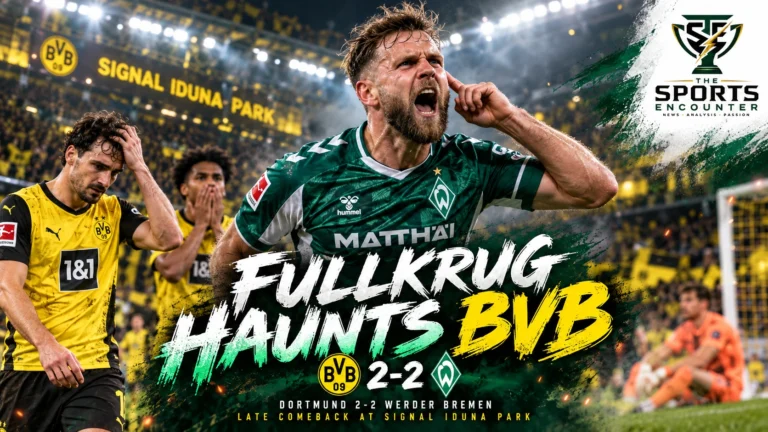
DORTMUND, Germany, October 9, 2026: Borussia Dortmund were five minutes away from celebrating a fifth consecutive Bundesliga victory when Nico Schlotterbeck put them 2-0 ahead against Werder Bremen. Instead, their perfect start ended in a remarkable 2-2 draw as Ludovit Reis scored in the 88th minute and former Dortmund striker Niclas Füllkrug equalized in the second minute of stoppage time at Signal Iduna Park. Daniel Svensson had opened the scoring in the 80th minute before Schlotterbeck appeared to settle the contest just five minutes later. Bremen responded with two goals in four minutes of playing time, turning a seemingly lost game into a valuable away point.
The collapse was especially painful for Niko Kovač’s side because Dortmund had dominated almost every major attacking statistic. They finished with 69 percent possession, attempted 18 shots, put 11 on target and completed the match with 616 recorded passes compared with Bremen’s 261. The visitors managed only three shots on target but converted two of them. Dortmund remain unbeaten and lead the provisional Bundesliga standings with 13 points from five matches, although Bayern Munich and Freiburg can now draw level after playing their fifth games. For Bremen, the result extended an increasingly remarkable pattern of late recoveries, including another comeback from 2-0 down against Augsburg in their previous league appearance.
Borussia Dortmund vs Werder Bremen: Final Score and Match Summary
| Match Detail | Information |
|---|---|
| Competition | Bundesliga 2026-27 |
| Matchday | 5 |
| Date | Friday, October 9, 2026 |
| Venue | Signal Iduna Park, Dortmund |
| Final Score | Borussia Dortmund 2-2 Werder Bremen |
| Halftime | 0-0 |
| Dortmund Goals | Daniel Svensson 80′, Nico Schlotterbeck 85′ |
| Werder Bremen Goals | Ludovit Reis 88′, Niclas Füllkrug 90+2′ |
| Dortmund Position | 1st, provisionally, 13 points |
| Werder Bremen Position | 4th, provisionally, 8 points |
| Dortmund’s League Record | 4 wins, 1 draw, 0 defeats |
| Bremen’s League Record | 2 wins, 2 draws, 1 defeat |
All Four Goals: Dortmund 2-2 Werder Bremen
| Minute | Scorer | Team | Score |
|---|---|---|---|
| 80′ | Daniel Svensson | Borussia Dortmund | 1-0 |
| 85′ | Nico Schlotterbeck | Borussia Dortmund | 2-0 |
| 88′ | Ludovit Reis | Werder Bremen | 2-1 |
| 90+2′ | Niclas Füllkrug | Werder Bremen | 2-2 |
All four goals arrived in the closing stages. Dortmund turned a goalless match into a two-goal lead within five minutes, but Bremen recovered before the final whistle.
How Dortmund Lost Two Points After Finally Breaking Bremen’s Resistance
The opening 79 minutes presented Dortmund with a familiar Bundesliga challenge.
Story at a glance
How Dortmund Lost Two Points After Finally Breaking Bremen’s Resistance
The opening 79 minutes presented Dortmund with a familiar Bundesliga challenge.
Niclas Füllkrug’s Dortmund Reunion Becomes Bremen’s Defining Moment
Füllkrug’s late equalizer carried a personal history that makes the result particularly memorable.
Werder Bremen Have Now Recovered From 2-0 Down in Consecutive Bundesliga Matches
Friday’s comeback becomes even more impressive when placed alongside Bremen’s previous result.
The 2022 Bremen Miracle Returns to Haunt Dortmund
There is an even more remarkable historical connection to Friday’s result.
Dortmund Had 69% Possession and 11 Shots on Target. Why Was That Not Enough?
One of the most revealing aspects of Friday’s draw is the statistical imbalance.
They controlled possession, moved the ball through midfield and repeatedly reached attacking positions. Bremen, meanwhile, concentrated on surviving the pressure and preserving a chance to threaten whenever possession changed hands.
Yet Dortmund could not convert their statistical advantage into a lead.
For a team that had won its first four league matches, the longer the score remained 0-0, the more important the opening goal became.
It eventually arrived through Daniel Svensson.
80th Minute: Daniel Svensson Finally Breaks the Deadlock
Svensson’s goal gave Dortmund the breakthrough they had spent most of the evening pursuing.
The Swedish international has become an important part of Kovač’s system because of his ability to operate along the left side while contributing in both attacking and defensive phases.
Against Bremen, his contribution arrived when Dortmund needed it most.
The 80th-minute goal transformed the match.
Until that point, Werder had survived despite facing sustained attacking pressure. Dortmund were now ahead with relatively little regulation time remaining.
The next responsibility was to protect the advantage without completely surrendering control of the game.
Instead, Dortmund continued attacking and found another goal.
85th Minute: Nico Schlotterbeck Makes It 2-0
Nico Schlotterbeck doubled the lead five minutes later.
His goal appeared to settle the contest.
Dortmund had scored twice in the space of five minutes, were playing at home and had allowed Bremen comparatively few accurate attempts.
A fifth successive victory seemed close enough for the home supporters to begin celebrating another important result.
Schlotterbeck’s contribution was also significant because the defender had entered the fixture following concerns about his recent fitness.
He returned to the starting lineup and captained Dortmund, providing an important presence in a back line that had been affected by injuries during the opening weeks.
His goal should have represented a memorable return.
Instead, the events that followed overshadowed it.
88th Minute: Ludovit Reis Gives Bremen Hope
Reis scored only three minutes after Dortmund’s second goal.
The immediate reply changed what both teams needed from the remaining minutes.
Dortmund were no longer defending a comfortable two-goal advantage. Bremen required only one further successful attack to escape with a point.
That distinction matters psychologically and tactically.
At 2-0, Bremen had needed two goals with very little time remaining. At 2-1, they could commit to attacking for an equalizer with renewed belief.
Dortmund’s challenge was to restore defensive organization and prevent the contest from becoming an uncontrolled exchange of late opportunities.
The home side failed to protect the margin.
90+2 Minute: Niclas Füllkrug Silences His Former Supporters
The equalizer arrived through the player whose return to Dortmund had already been one of Friday’s biggest talking points.
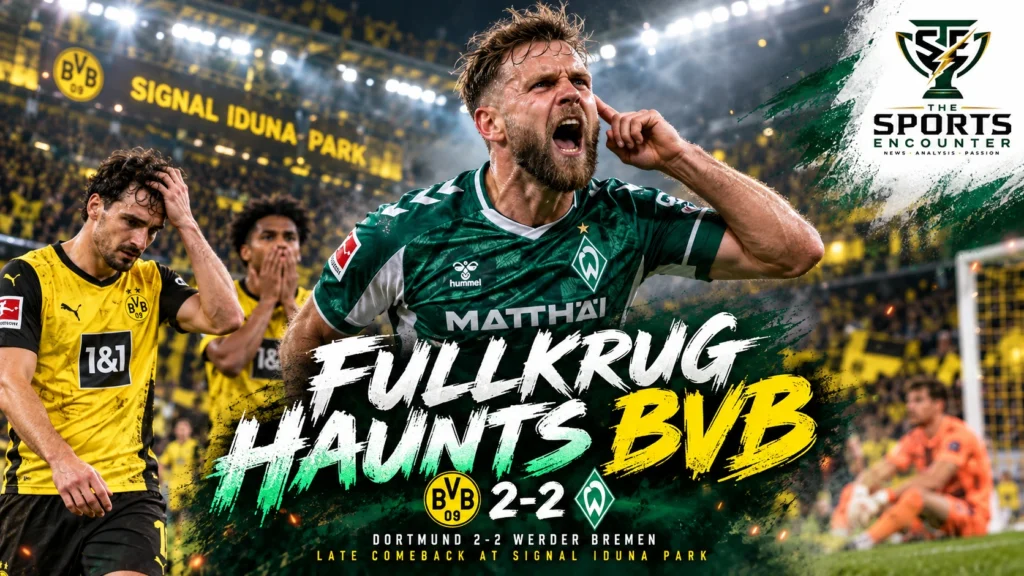
Niclas Füllkrug scored in the second minute of stoppage time to make it 2-2.
It was an especially painful finish for Dortmund.
The striker had previously represented the club before joining West Ham United in 2024, and Friday marked his first Bundesliga meeting with BVB since returning to Werder Bremen.
His goal completed a comeback that had appeared almost impossible seven minutes earlier.
Bremen had moved from 2-0 down in the 85th minute to level in stoppage time.
Dortmund were left with a draw from a match they had seemed certain to win.
Niclas Füllkrug’s Dortmund Reunion Becomes Bremen’s Defining Moment
Füllkrug’s late equalizer carried a personal history that makes the result particularly memorable.
The German striker joined Dortmund from Werder Bremen in 2023 and spent the 2023-24 season with BVB.
He subsequently moved to West Ham United, where his time in English football was affected by injuries and interruptions.
During the summer of 2026, he returned to Bremen on loan for a third spell with the club.
The decision reunited him with an organization closely associated with his development and some of the most productive periods of his career.
In September, Füllkrug spoke about how comfortable he felt returning to Bremen and how he now regarded himself as part of the club again.
The Bundesliga’s official feature on Füllkrug’s return documented both the personal significance of the move and his rapid impact on Werder’s early-season results.
Friday added another chapter to that story.
He had returned to Signal Iduna Park as an opponent, facing the club he had helped during its recent Champions League campaign.
His late goal was precisely the kind of contribution Bremen hoped to receive when they brought him back.
Füllkrug Has Already Rescued Bremen More Than Once This Season
The equalizer against Dortmund continued a strong start to Füllkrug’s latest Werder spell.
He scored in Bremen’s 3-1 victory over RB Leipzig on September 5, heading home the second goal in an important response to their opening defeat against Freiburg.
That performance featured in TSE’s Bundesliga Matchday 2 report, which examined how Werder’s victory over Leipzig changed the early direction of their season.
Füllkrug then scored the equalizer in a 1-1 draw against Cologne on September 12.
His next major contribution came against Augsburg, when Bremen recovered from a two-goal deficit.
He made it 2-2 in the 86th minute before Mitchell Weiser completed the 3-2 victory in stoppage time.
Now he has produced another late equalizer, this time against his former Dortmund teammates.
The pattern reveals why his experience matters to Daniel Thioune’s team.
Bremen have young attacking players capable of contributing through pace and movement, but difficult late-game situations also require calm decisions and a dependable goal threat.
Füllkrug has already demonstrated those qualities repeatedly.
Werder Bremen Have Now Recovered From 2-0 Down in Consecutive Bundesliga Matches
Friday’s comeback becomes even more impressive when placed alongside Bremen’s previous result.
Against Augsburg on September 19, Werder trailed 2-0 after 58 minutes.
Robin Fellhauer and Calvin Brackelmann had given Augsburg control of the scoreline.
Marco Grüll began Bremen’s recovery in the 66th minute.
Füllkrug equalized in the 86th.
Mitchell Weiser then scored the winner in the third minute of stoppage time.
The 3-2 victory became one of the outstanding comebacks of Matchday 4.
Our complete Bundesliga Matchday 4 report examined how Grüll’s goal and two assists helped transform Bremen’s apparent defeat into a remarkable victory.
The official Bundesliga account of the Augsburg comeback also confirmed the sequence of goals and Grüll’s decisive role.
Friday followed a strikingly similar pattern.
| Match | Situation | Recovery | Final Score |
|---|---|---|---|
| Bremen vs Augsburg, Sept. 19 | Trailing 0-2 after 58′ | Grüll 66′, Füllkrug 86′, Weiser 90+3′ | Won 3-2 |
| Dortmund vs Bremen, Oct. 9 | Trailing 0-2 after 85′ | Reis 88′, Füllkrug 90+2′ | Drew 2-2 |
Across those two league matches, Bremen have recovered from two-goal deficits to collect four points.
They scored five goals after falling two behind: three against Augsburg and two against Dortmund.
Füllkrug scored in both recoveries.
The recurrence is significant, although Bremen should not become comfortable relying on late rescues.
Recovering from two goals down is an admirable quality. Avoiding that position in the first place would give the team a more sustainable route to consistent results.
The 2022 Bremen Miracle Returns to Haunt Dortmund
There is an even more remarkable historical connection to Friday’s result.
On August 20, 2022, Borussia Dortmund hosted Werder Bremen at Signal Iduna Park and appeared to have secured victory after taking a 2-0 lead.
Julian Brandt and Raphaël Guerreiro scored for the home side.
Dortmund still led by two goals with the match approaching its final moments.
Then Bremen produced one of the most extraordinary late comebacks in modern Bundesliga history.
Lee Buchanan scored in the 89th minute.
Niklas Schmidt equalized in the third minute of stoppage time.
Oliver Burke completed the turnaround two minutes later.
Werder won 3-2.
It was a victory that became part of the club’s modern folklore because of how little time remained when the recovery began.
Four years later, Bremen have returned to Dortmund and produced another extraordinary late comeback from 2-0 down.
This time the result was a draw rather than a win.
The emotional damage for the home side will nevertheless feel familiar.
The Bundesliga had already revisited the 2022 encounter in an official historical feature published ahead of Friday’s match, recalling the late goals that transformed that previous meeting.
Few would have expected Bremen to reproduce so much of the same drama again.
How the Two Dortmund Collapses Compare
| Detail | August 2022 | October 2026 |
|---|---|---|
| Venue | Signal Iduna Park | Signal Iduna Park |
| Dortmund’s Advantage | 2-0 | 2-0 |
| First Bremen Goal | Lee Buchanan, 89′ | Ludovit Reis, 88′ |
| Equalizer | Niklas Schmidt, 90+3′ | Niclas Füllkrug, 90+2′ |
| Further Bremen Goal | Oliver Burke, 90+5′ | None |
| Final Result | Dortmund 2-3 Bremen | Dortmund 2-2 Bremen |
The comparison demonstrates how unusually persistent this particular matchup has become as a source of late drama.
In both contests, Dortmund seemed to have established enough of a cushion to win.
In both, Bremen scored their first goal with only minutes remaining.
And in both, a stoppage-time equalizer completely changed the emotional direction of the evening.
Dortmund Had 69% Possession and 11 Shots on Target. Why Was That Not Enough?
One of the most revealing aspects of Friday’s draw is the statistical imbalance.
Dortmund had significantly more possession, attempted almost twice as many shots and placed nearly four times as many efforts on target.
Yet both teams scored twice.
Borussia Dortmund vs Werder Bremen: Complete Match Statistics
| Statistic | Dortmund | Bremen |
|---|---|---|
| Goals | 2 | 2 |
| Total shots | 18 | 10 |
| Shots on target | 11 | 3 |
| Possession | 69% | 31% |
| Passes | 616 | 261 |
| Pass accuracy | 92% | 69% |
| Fouls | 10 | 10 |
| Yellow cards | 2 | 1 |
| Red cards | 0 | 0 |
| Offsides | 2 | 4 |
| Corners | 9 | 3 |
Dortmund Were More Accurate, but Bremen Made Their Accurate Shots Count
Dortmund placed 11 of 18 shots on target.
That represents approximately 61.1 percent shooting accuracy.
Bremen put three of 10 attempts on target, giving them a shooting accuracy of 30 percent.
In other words, Dortmund were far more likely to direct an attempt toward the goal.
But Bremen converted two of their three shots on target.
That is a conversion rate of approximately 66.7 percent from accurate attempts.
Dortmund converted only two of 11, approximately 18.2 percent.
| Attacking Measure | Dortmund | Bremen |
|---|---|---|
| Shots per goal | 9.0 | 5.0 |
| Shots on target per goal | 5.5 | 1.5 |
| Shot accuracy | 61.1% | 30.0% |
| Goals per shot on target | 18.2% | 66.7% |
These numbers explain why Dortmund can reasonably be disappointed despite producing considerably more attacking volume.
They generated repeated attempts but did not establish a lead until the closing ten minutes.
Bremen created fewer accurate attempts but punished Dortmund when the opportunity to recover finally appeared.
The conversion rates alone do not establish the underlying quality of every chance. Expected-goals data would be needed for a more complete assessment of chance difficulty.
However, they accurately describe the stark difference in how the teams converted their on-target shots into goals.
Dortmund’s Passing Control Disappeared When It Mattered Most
The passing statistics are equally striking.
Dortmund recorded 616 passes at 92 percent accuracy.
Bremen recorded 261 passes at 69 percent accuracy.
The difference of 355 passes demonstrates how heavily the game tilted toward Dortmund’s control of the ball.
Such dominance normally gives a home team substantial opportunities to dictate territory and tempo.
Dortmund also won nine corners compared with Bremen’s three.
The problem appeared in the closing minutes, when protecting the lead became more important than continuing to build attacks.
Once Reis made it 2-1, the game demanded immediate defensive concentration.
Dortmund needed to manage the remaining minutes, defend dangerous areas and prevent Bremen from turning desperation into another clear opportunity.
They were unable to do so.
Possession Control Is Not the Same as Defensive Security
The distinction matters for Kovač’s tactical assessment.
For most of the match, Dortmund controlled the ball.
That reduced the amount of time Bremen could spend constructing attacks.
But a team can dominate possession and still be vulnerable during the moments when possession changes hands or its defensive shape becomes unsettled.
Friday’s final score demonstrates the consequence of failing to protect those moments.
Without a complete event-by-event defensive breakdown, it would be speculative to blame a specific player, substitution or structural change for both Bremen goals.
The verified outcome is clear: Dortmund conceded twice after taking a two-goal lead and lost two points that would have extended their perfect start.
Nico Schlotterbeck’s Goal Cannot Hide Dortmund’s Late Defensive Breakdown
Schlotterbeck’s individual contribution deserves recognition.
The defender had been managing fitness concerns before returning to the lineup against Bremen.
He was also entrusted with the captaincy on Friday.
His 85th-minute goal should have provided a significant moment in an important home victory.
Instead, the final minutes turned the discussion toward Dortmund’s defensive organization.
There is a wider context to that concern.
Dortmund have repeatedly demonstrated an ability to win difficult matches under Kovač, including occasions when they have surrendered control for periods but found a decisive response.
Against Hoffenheim in September, BVB recovered from 2-0 down to win 3-2.
That comeback was examined in TSE’s Bundesliga Matchday 2 analysis, which identified Dortmund’s ability to respond under pressure as an important early strength.
Now they have experienced the same kind of turnaround from the opposite perspective.
That reversal should be valuable evidence for Kovač as he prepares the team for a demanding run of domestic and European fixtures.
Serhou Guirassy Could Not Provide the Late Solution This Time
Serhou Guirassy has repeatedly been Dortmund’s most decisive attacking player in difficult situations.
His contributions during the opening weeks helped Dortmund remain unbeaten across domestic and European competition.
He scored during the comeback against Hoffenheim and then struck twice in five minutes during the 3-2 Champions League victory over Villarreal.
That European performance was examined in TSE’s detailed analysis of Guirassy’s match-winning display against Villarreal.
Friday’s contest unfolded differently.
Dortmund’s goals came from Svensson and Schlotterbeck rather than their leading striker.
The variety of scorers is an encouraging sign because title contenders cannot depend on one player to produce every decisive goal.
But the defensive collapse also demonstrates that additional scorers do not guarantee victory.
Once Dortmund established a two-goal lead, their responsibility shifted toward protecting the advantage.
That is a collective challenge involving players throughout the team, regardless of which individuals scored.
Niko Kovač’s Perfect Start Ends, but Dortmund Remain Unbeaten
Before Friday, Dortmund had won all four Bundesliga matches.
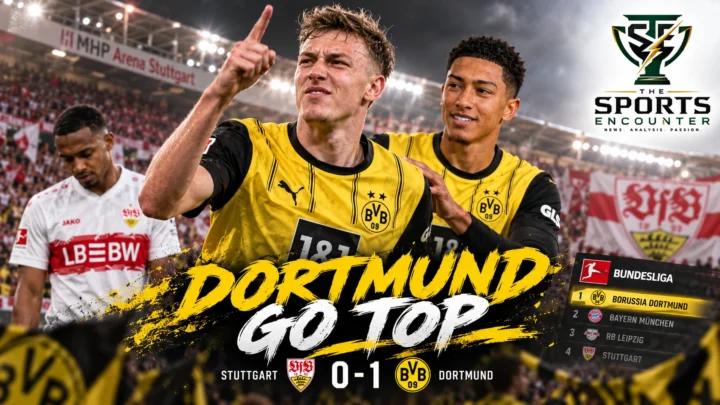
They had defeated Hamburg 2-0, Hoffenheim 3-2, Paderborn 3-0 and Stuttgart 1-0.
The victories had placed them above defending champions Bayern Munich and fellow early contender Freiburg.
The win at Stuttgart was particularly important because it came away from home against a dangerous opponent.
Maximilian Beier scored the winner in the 70th minute after Jobe Bellingham supplied the decisive pass.
Our report on Dortmund’s fourth consecutive Bundesliga victory examined how Kovač’s team had developed several ways to win.
They could recover from deficits, score late, rely on contributions from the bench and protect narrow advantages.
Bremen exposed a problem that had not previously cost them league points this season.
Dortmund finally took a commanding lead but could not protect it.
Dortmund’s First Five Bundesliga Results
| Matchday | Match | Result | Points Earned |
|---|---|---|---|
| 1 | Dortmund vs Hamburg | 2-0 | 3 |
| 2 | Hoffenheim vs Dortmund | 2-3 | 3 |
| 3 | Dortmund vs Paderborn | 3-0 | 3 |
| 4 | Stuttgart vs Dortmund | 0-1 | 3 |
| 5 | Dortmund vs Bremen | 2-2 | 1 |
| Total | Five Bundesliga matches | 4W, 1D, 0L | 13 |
Dortmund have scored 11 goals and conceded four across their opening five league matches.
They remain unbeaten.
Nevertheless, Friday represents the first interruption to the perfect sequence that had made them the early Bundesliga leaders.
Bayern Munich and Freiburg Can Punish Dortmund’s Dropped Points
Friday’s result also changed the immediate championship picture.
Dortmund remain first in the live standings with 13 points from five matches.
Bayern Munich and Freiburg each have 10 points but have played only four games.
That creates an opportunity for both teams to move level with Dortmund during the remainder of Matchday 5.
Both also possess superior goal differences going into their fifth fixtures.
The advantage Dortmund built before the international break is therefore vulnerable.
Bundesliga Top Five After Dortmund vs Bremen
| Position | Club | P | W | D | L | GF | GA | GD | Pts |
|---|---|---|---|---|---|---|---|---|---|
| 1 | Borussia Dortmund | 5 | 4 | 1 | 0 | 11 | 4 | +7 | 13 |
| 2 | Bayern Munich | 4 | 3 | 1 | 0 | 14 | 2 | +12 | 10 |
| 3 | SC Freiburg | 4 | 3 | 1 | 0 | 12 | 3 | +9 | 10 |
| 4 | Werder Bremen | 5 | 2 | 2 | 1 | 10 | 10 | 0 | 8 |
| 5 | FC Augsburg | 4 | 2 | 1 | 1 | 11 | 6 | +5 | 7 |
Standings note: These are the provisional positions immediately after Friday’s match. The remaining Matchday 5 fixtures may change the table.
Bayern’s Goal Difference Makes Dortmund’s Missed Victory More Costly
Bayern entered the weekend with a goal difference of plus 12, five better than Dortmund’s plus seven after the Bremen draw.
The champions have already demonstrated the attacking power capable of making that advantage significant.
They defeated Stuttgart 5-1 on opening night, with several players contributing goals.
That performance, covered in TSE’s report on Bayern’s dominant Bundesliga opener, established their early scoring strength.
Bayern later overwhelmed Union Berlin 7-0 as Michael Olise scored a hat trick and Harry Kane reached 100 Bundesliga goals in record time.
Our analysis of Bayern’s seven-goal victory over Union examined both Olise’s exceptional performance and the wider championship implications.
That attacking production may prove especially important if the leading teams remain close on points.
Dortmund had an opportunity to finish Friday with 15 points and preserve at least a two-point lead even if Bayern won their next match.
Instead, they have 13.
Two dropped points have changed the immediate pressure on the league leaders.
Werder Bremen’s Eight Points Show How Far They Have Progressed
The draw is also meaningful for Werder’s broader season.
Daniel Thioune’s team began the campaign with a heavy 4-1 defeat at Freiburg.
That result created legitimate questions about whether Bremen could avoid another difficult season after finishing 15th in 2025-26.
The response has been encouraging.
Werder defeated Leipzig 3-1, drew 1-1 with Cologne, recovered to beat Augsburg 3-2 and have now taken a point at Dortmund.
They have not lost since the opening match.
Eight points from five matches place them fourth in the provisional table.
Bremen’s First Five Bundesliga Matches
| Opponent | Result | Points |
|---|---|---|
| At Freiburg | Lost 1-4 | 0 |
| vs RB Leipzig | Won 3-1 | 3 |
| At Cologne | Drew 1-1 | 1 |
| vs Augsburg | Won 3-2 | 3 |
| At Borussia Dortmund | Drew 2-2 | 1 |
| Total | 2 wins, 2 draws, 1 defeat | 8 |
The improvement has been driven by more than one player.
Füllkrug has supplied important goals.
Grüll was influential in the victory over Augsburg.
Reis contributed the first goal of Friday’s late comeback.
Continue the Bundesliga Story
 BundesligaBundesliga: Dortmund Go Top, Bremen Complete Wild Comeback, While Mainz Win Seven-Goal Thriller
 BundesligaBundesliga: Freiburg Go Top, Dortmund Stay Perfect as Gladbach Collapse
 Premier LeagueSoccer Leagues Resume Action: Liverpool Face City, Real Chase Barca, Saudi and Cairo Giants Reactivated
Other members of the squad have helped maintain the team’s competitiveness despite injuries affecting several positions.
Thioune’s immediate task is to preserve that progress while reducing the number of occasions on which Bremen must chase a two-goal deficit.
What Does Dortmund’s Collapse Reveal About the Bundesliga Title Race?
The result is significant because Dortmund had appeared to be developing the consistency required to challenge Bayern over a full season.
Their opening four matches produced four victories through different types of performance.
They defeated Hamburg comfortably, recovered at Hoffenheim, overwhelmed Paderborn late and protected a narrow advantage at Stuttgart.
That variety made the unbeaten start convincing.
Against Bremen, they controlled most of the game and created more than enough attacking opportunities to expect a positive result.
The problem was failing to turn that dominance into three points.
Title races are decided by more than performances against direct rivals.
They are also influenced by matches in which a leading team appears to have done enough to win but fails to complete the task.
Dortmund have experienced precisely that type of setback.
The reaction will now matter more than the draw itself.
Kovač’s Next Challenge Is Restoring Defensive Composure
Dortmund have not suddenly become a poor defensive team because they conceded twice late against Bremen.
They had conceded only two goals during the opening four Bundesliga matches.
Friday doubled that season total to four.
That change is substantial when viewed across only five games, but it remains a small early-season sample.
The more important concern is the specific match situation.
Dortmund were leading 2-0 after 85 minutes.
Protecting that advantage should have required less attacking ambition and greater attention to defensive security.
Instead, Bremen found two goals.
Kovač will need to review how the team managed possession, defensive positioning and transitions during those final minutes.
That review can take place without reducing the entire performance to one moment of failure.
What Comes Next for Borussia Dortmund and Werder Bremen?
Dortmund return to Bundesliga action away against Union Berlin on October 17.
The match gives Kovač’s side an immediate opportunity to respond after dropping points for the first time this season.
They then host Eintracht Frankfurt on October 24 before traveling to Bayern Munich for one of the campaign’s most important early championship fixtures on October 31.
The Bayern meeting already promises to be significant.
Friday’s draw increases the importance of collecting points in the two league games before that encounter.
Werder Bremen Face Paderborn Next
Werder host Paderborn on October 17.
It is a very different challenge from playing Dortmund away.
Bremen will be expected to create more opportunities and take greater responsibility for attacking possession.
Their recent results have demonstrated admirable resilience.
However, continuing to climb the table will require strong performances against teams they are capable of beating without relying on another spectacular late comeback.
Three Lessons From Dortmund’s 2-2 Draw With Bremen
1. Dortmund’s Attacking Control Needs Better Protection
Sixty-nine percent possession, 616 passes and 11 shots on target should provide a strong foundation for winning a Bundesliga match.
Dortmund established that foundation but failed to protect the result.
The final minutes are therefore the most important part of the performance to analyze.
2. Füllkrug Is Already Giving Werder Bremen the Experience They Needed
Füllkrug has scored important goals against Leipzig, Cologne, Augsburg and now Dortmund.
His contribution against his former club was particularly valuable because it secured a point after Bremen had appeared beaten.
He is providing precisely the kind of late-game attacking presence that can make a difference across a long season.
3. The Bundesliga Title Race Has Become More Open
Dortmund remain first after five matches, but Bayern and Freiburg now have the opportunity to draw level.
The draw has also allowed Werder to strengthen their position among the early challengers.
The table is provisional, and the season remains young.
Friday nevertheless offered an important reminder that an early championship lead is only valuable if a team keeps converting its strongest positions into victories.
Why This Draw Will Stay With Both Clubs
Dortmund had completed their most successful Bundesliga start in 11 years and seemed close to extending the sequence to five victories.
Two goals in five minutes had given them what appeared to be a commanding lead.
Then Reis scored.
Füllkrug followed.
The former Dortmund striker’s return to Signal Iduna Park became another chapter in a fixture already famous for a late Bremen comeback.
For Werder, the draw will be remembered as a reward for refusing to abandon a difficult match.
For Dortmund, it will remain a missed opportunity to extend their early advantage over Bayern and Freiburg.
Kovač’s players are still unbeaten and still lead the provisional table.
But after Friday night, they can no longer claim to have taken every available point.
And Bremen have once again shown why a two-goal lead against them, even with only minutes remaining, is not necessarily enough.
Borussia Dortmund vs Werder Bremen: Frequently Asked Questions
What Was the Final Score Between Dortmund and Werder Bremen?
Borussia Dortmund drew 2-2 with Werder Bremen on October 9, 2026, at Signal Iduna Park in Bundesliga Matchday 5.
Who Scored for Borussia Dortmund?
Daniel Svensson scored in the 80th minute and Nico Schlotterbeck added the second goal in the 85th.
Who Scored Werder Bremen’s Goals?
Ludovit Reis scored in the 88th minute and Niclas Füllkrug equalized in the second minute of stoppage time.
Did Niclas Füllkrug Previously Play for Dortmund?
Yes. Füllkrug joined Borussia Dortmund from Bremen in 2023 before moving to West Ham United in 2024. He returned to Werder Bremen on loan in the summer of 2026.
How Did Dortmund Lose Their 2-0 Lead?
Dortmund went 2-0 ahead in the 85th minute, but Reis reduced the deficit three minutes later and Füllkrug scored the equalizer in stoppage time.
Are Borussia Dortmund Still Unbeaten in the Bundesliga?
Yes. Dortmund have four wins and one draw from their first five Bundesliga matches of the 2026-27 season.
Who Leads the Bundesliga After Dortmund vs Bremen?
Dortmund remain provisionally first with 13 points. Bayern Munich and Freiburg each have 10 points from four matches and can move level during the remaining Matchday 5 fixtures.
How Much Possession Did Dortmund Have?
Dortmund finished with 69 percent possession compared with Bremen’s 31 percent.
How Many Shots on Target Did Each Team Have?
Dortmund registered 11 shots on target from 18 attempts. Werder Bremen placed three of their 10 attempts on target.
Has Werder Bremen Come Back From 2-0 Down at Dortmund Before?
Yes. In August 2022, Bremen recovered from 2-0 down to win 3-2 at Signal Iduna Park, scoring three times from the 89th minute onward.
Who Do Borussia Dortmund Play Next?
Dortmund travel to Union Berlin on October 17, 2026, before hosting Eintracht Frankfurt on October 24 and visiting Bayern Munich on October 31.
Who Do Werder Bremen Play Next?
Werder Bremen host Paderborn on October 17, 2026.