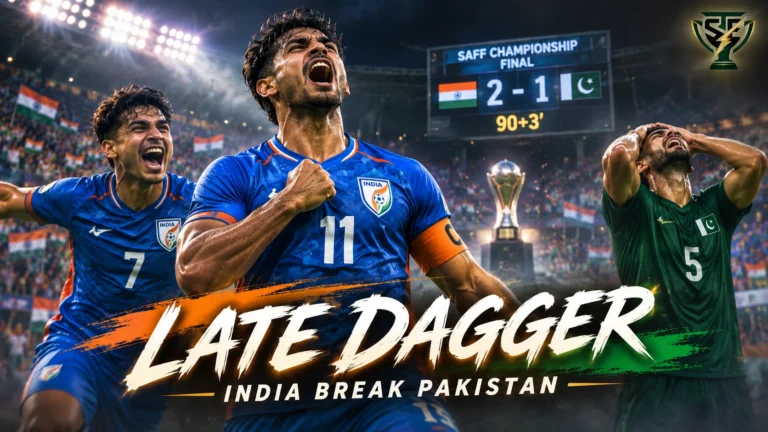
Dhaka, Bangladesh, November 17, 2026: For almost an hour, Pakistan were living a dream they had never experienced before. In their first SAFF Championship final, the Green Shirts had silenced India with a magnificent Alamgir Ghazi goal and were defending a lead that could have delivered the greatest achievement in their country’s regional soccer history. Then a red card changed everything. India equalized almost immediately through Suhail Ahmad Bhat, and Sandip Mandi headed home an 88th-minute winner to complete a 2-1 comeback, secure a record 10th South Asian title and become the first nation to win the competition three consecutive times.
The India vs Pakistan SAFF Championship final was decided by the smallest margins and one enormous disciplinary mistake. Pakistan had been the better side for much of the opening half, but Junaid Shah’s dismissal following a VAR review transformed the contest. India seized the numerical advantage, recovered from a goal down and delivered another regional championship under coach Naushad Moosa. For Pakistan, coached by former Peru international Nolberto Solano, the defeat brought an agonizing end to a groundbreaking campaign that had carried the national team into its first-ever final.
Key Takeaways
- Dhaka, Bangladesh, November 17, 2026: For almost an hour, Pakistan were living a dream they had never experienced before.
- The India vs Pakistan SAFF Championship final was decided by the smallest margins and one enormous disciplinary mistake.
- The All India Football Federation’s official final report confirms the result, goalscorers and historic championship achievement.
- Before this tournament, the Green Shirts had never reached a SAFF Championship final.
India vs Pakistan SAFF Championship Final: Scorecard and Match Details
| Match Information | Details |
|---|---|
| Competition | 2026 SAFF Championship |
| Fixture | India vs Pakistan, Final |
| Venue | National Stadium, Dhaka, Bangladesh |
| Date | November 17, 2026 |
| Final score | India 2-1 Pakistan |
| Halftime | India 0-1 Pakistan |
| India goals | Suhail Ahmad Bhat 60′, Sandip Mandi 88′ |
| Pakistan goal | Alamgir Ghazi 45+1′ |
| Red card | Junaid Shah, Pakistan, second half |
| Champions | India, 10th SAFF Championship title |
| Runners-up | Pakistan, first SAFF final appearance |
| India coach | Naushad Moosa |
| Pakistan coach | Nolberto Solano |
The All India Football Federation’s official final report confirms the result, goalscorers and historic championship achievement.
Story at a glance
India vs Pakistan SAFF Championship Final: Scorecard and Match Details
The All India Football Federation’s official final report confirms the result, goalscorers and historic championship achievement.
Pakistan Started Like a Team Determined to Make History
Pakistan arrived in Dhaka with an opportunity that previous generations of the national team had never enjoyed.
Alamgir Ghazi’s Brilliant Finish Gives Pakistan the Lead
The breakthrough arrived in first-half stoppage time.
The Red Card That Changed the SAFF Championship Final
Pakistan’s greatest problem emerged after halftime.
Suhail Ahmad Bhat Punishes Pakistan Almost Immediately
India’s response came through Bhat.
The scoreline tells only part of the story. Pakistan spent much of the first half creating opportunities and frustrating India’s attack. Only after being reduced to ten players did the balance turn decisively toward the defending champions.
Pakistan Started Like a Team Determined to Make History
Pakistan arrived in Dhaka with an opportunity that previous generations of the national team had never enjoyed.
Before this tournament, the Green Shirts had never reached a SAFF Championship final.
The achievement carried particular significance given the difficulties Pakistani soccer has experienced over the years, including interruptions to domestic competition, administrative uncertainty and inconsistent international exposure.
Solano had assembled a squad combining locally developed players with footballers based overseas. Their progress to the final suggested that the national team was beginning to benefit from a broader recruitment pool.
Pakistan had already demonstrated resilience during the tournament.
They defeated Maldives 3-0 during the group stage and subsequently overcame host nation Bangladesh 1-0 in the semifinals.
Abdul Samad Arshad scored the decisive semifinal goal, giving Pakistan the opportunity to challenge the region’s most successful national team.
Against India, Pakistan immediately showed that they were not prepared to settle for a respectable defeat.
Their attacking movement and willingness to press forward unsettled the defending champions.
India struggled to establish rhythm, particularly when attempting to progress from defense into midfield.
During the opening half-hour, Pakistan recorded nine attempts on goal, compared with only two from India.
That contrast reflected Pakistan’s willingness to attack and the difficulty India experienced in controlling the contest.
Alamgir Ghazi’s Brilliant Finish Gives Pakistan the Lead
The breakthrough arrived in first-half stoppage time.
Junaid Shah delivered a cross from the left, which took a slight deflection before reaching Ghazi inside the penalty area.
Ghazi controlled the opportunity and curled a right-footed finish beyond the Indian goalkeeper into the far corner.
Pakistan led 1-0.
For a team playing its first regional championship final, it was an extraordinary moment.
The goal rewarded Pakistan’s attacking approach and transformed the pressure on India.
The Blue Tigers were no longer simply trying to control an important final. They were chasing a match against opponents who could now defend their advantage.
Ghazi’s contribution was particularly meaningful because he had already scored against India during the group stage.
Pakistan lost that earlier meeting 3-2 after falling three goals behind, with Ghazi producing a spectacular late overhead kick.
In the final, he again demonstrated his ability to deliver against India’s defense.
This time, his goal appeared capable of producing a historic result.
The Red Card That Changed the SAFF Championship Final
Pakistan’s greatest problem emerged after halftime.
With the Green Shirts defending their narrow lead, Junaid Shah committed a challenge on Brison Fernandes that resulted in a straight red card following a VAR review.
The dismissal occurred shortly before the hour mark.
It was the defining disciplinary incident of the final.
Until then, Pakistan had successfully unsettled India and maintained the advantage established by Ghazi.
Suddenly, Solano’s team had to defend the remainder of the match with ten players.
The consequences were immediate.
Pakistan could no longer press and defend with the same numerical balance. India gained an extra outfield player and an opportunity to increase pressure in wide areas.
The match changed from a contest Pakistan had largely controlled into one in which India could commit more players forward.
Why Junaid Shah’s Dismissal Was the Turning Point
The importance of the incident becomes clearer when the match is divided into its decisive phases.
| Match Phase | Development | Competitive Consequence |
|---|---|---|
| Opening 30 minutes | Pakistan create more attacking opportunities | India struggle to control midfield and possession |
| 45+1′ | Alamgir Ghazi scores | Pakistan take a 1-0 lead into halftime |
| Shortly before 60′ | Junaid Shah sent off after VAR review | Pakistan reduced to ten players |
| 60′ | Suhail Ahmad Bhat equalizes | India immediately exploit their numerical advantage |
| 88′ | Sandip Mandi scores | India complete the comeback and move ahead |
| Full time | India win 2-1 | Record 10th title and first SAFF three-peat |
The sequence demonstrates how quickly a final can change.
Pakistan went from holding a one-goal advantage to defending with ten players and conceding an equalizer within minutes.
That does not mean a red card automatically guarantees defeat.
Teams frequently survive long periods with ten players through disciplined defending and effective substitutions.
But in this contest, India reacted before Pakistan could fully reorganize.
Suhail Ahmad Bhat Punishes Pakistan Almost Immediately
India’s response came through Bhat.
Following a free kick delivered by Lhungdim Khaiminthang, Macarton Nickson made contact with the ball before Bhat finished from close range.
The equalizer arrived in the 60th minute.
Pakistan’s defensive situation had changed completely.
Instead of protecting a lead, the Green Shirts were now attempting to survive the closing half-hour with one fewer player.
Bhat’s contribution continued an impressive tournament record against Pakistan.
He had scored twice during India’s 3-2 group-stage victory over the same opponents.
His goal in the final therefore gave him three goals across India’s two matches against Pakistan in the competition.
Those performances illustrate the importance of having a forward capable of converting opportunities against the same defensive structure in different match situations.
India had struggled for extended periods, but Bhat’s finishing ensured the champions were back in contention.
Solano’s Substitutions Could Not Prevent India’s Late Pressure
Pakistan attempted to respond after conceding.
Solano made changes to reorganize the team, including withdrawing Ghazi and Abdullah Iqbal during the second half.
The decision reflected the changing tactical demands.
Pakistan no longer had the personnel to maintain its earlier attacking approach without exposing additional space.
The priority became defensive organization, controlling India’s movement and preserving the possibility of extra time.
However, removing attacking players can create another problem.
When a team loses its ability to hold possession in advanced areas, the opposition can repeatedly regain the ball and sustain pressure.
Pakistan were forced to defend for increasingly long periods.
India continued searching for opportunities, particularly from deliveries into the penalty area.
The Green Shirts resisted until the final minutes.
Then came the moment that settled the championship.
Sandip Mandi’s 88th-Minute Header Breaks Pakistan Hearts
With extra time approaching, India found the decisive goal.
Defender Sandip Mandi met the ball with a header in the 88th minute.
It bounced off the turf, rose beyond goalkeeper Yousuf Butt and entered the top corner.
India led 2-1.
Mandi removed his shirt in celebration as his teammates rushed toward him.
For the defending champions, it was the culmination of a difficult evening and a remarkable recovery.
For Pakistan, it was devastating.
After leading at halftime and defending with ten players, the Green Shirts were now behind with almost no time remaining.
The final minutes were spent attempting to produce another equalizer.
But India maintained their advantage through stoppage time and completed the victory.
The late winner reinforced an important characteristic of successful knockout teams.
They do not always dominate from the opening whistle.
Sometimes their greatest strength is finding a way to win after the original match plan has failed.
What India Did Better After Pakistan Went Down to Ten
India’s comeback was not simply the product of having an extra player.
The champions still needed to use that numerical advantage effectively.
Several tactical changes became important.
| Tactical Area | Before the Red Card | After the Red Card |
|---|---|---|
| Midfield control | Pakistan able to contest possession aggressively | India gain more opportunities to circulate the ball |
| Defensive structure | Pakistan retain full outfield coverage | Ten players must cover the same attacking spaces |
| Attacking width | India struggle to create sustained pressure | More opportunities to attack from wide positions |
| Transitions | Pakistan threaten when recovering possession | Reduced ability to commit players forward safely |
| Set pieces and deliveries | India initially struggle to convert chances | Equalizer and late headed winner change the match |
The most decisive improvement was India’s ability to convert pressure into goals.
Bhat’s equalizer arrived shortly after the dismissal, while Mandi’s late header completed the turnaround.
Pakistan’s defensive problem became increasingly difficult because the side needed both to protect its penalty area and retain an outlet for counterattacks.
India’s numerical advantage reduced Pakistan’s ability to do both simultaneously.
India’s 10th SAFF Title Creates a Historic Three-Peat
The victory strengthened India’s status as the most successful team in SAFF Championship history.
India have now won ten editions of the tournament.
More significantly, this was the first occasion on which the national team claimed three consecutive SAFF titles.
India had entered the competition as defending champions but without its strongest possible senior squad.
Moosa assembled a younger, comparatively experimental group, creating opportunities for players who do not always receive extended international exposure.
The decision produced a successful tournament campaign.
The AIFF’s official pre-final assessment outlined the selection challenges and the significance of pursuing the record title.
The championship therefore offers evidence of India’s regional squad depth.
It does not, by itself, establish that India has solved the larger challenges facing its senior national team against stronger Asian opposition.
Those questions remain relevant.
The Sports Encounter explored India’s wider international preparation in its report on the November international friendlies and India’s New Zealand assignments.
Winning another regional title is important, but translating that success into greater competitiveness against stronger Asian teams remains the next challenge.
Pakistan Lose the Trophy but Reach a Historic Milestone
Pakistan’s defeat should not erase the significance of reaching the final.
The Green Shirts had never previously advanced to the SAFF Championship title match.
Their journey included a commanding victory over Maldives and a semifinal win against Bangladesh on the hosts’ home ground.
Those results demonstrated improvement against regional opposition.
They also offered evidence that a broader player pool can help Pakistan become more competitive.
However, the final exposed a problem that cannot be ignored.
Pakistan were leading and had created the stronger attacking opportunities during the opening half.
The red card then forced them into a defensive situation they could not manage successfully.
Discipline, tactical adjustment and the ability to protect a lead are essential components of tournament soccer.
Pakistan must now turn their progress into more consistent performances rather than treat reaching the final as the endpoint of their development.
Pakistan’s Tournament Journey and What It Reveals
| Stage | Match | Result | Principal Lesson |
|---|---|---|---|
| Group stage | Pakistan vs India | Lost 2-3 | Late attacking recovery could not erase an earlier three-goal deficit |
| Group stage | Pakistan vs Maldives | Won 3-0 | Demonstrated attacking effectiveness |
| Semifinal | Pakistan vs Bangladesh | Won 1-0 | Produced a decisive result under knockout pressure |
| Final | Pakistan vs India | Lost 1-2 | Red card and late defensive pressure proved decisive |
Pakistan scored against India in both meetings and came within minutes of winning the final.
That is evidence of growing competitiveness.
But both matches ended in defeat.
The immediate development priority should be converting competitive performances into positive results against the strongest opponents in the region.
What the Final Means for South Asian Soccer
The championship also matters beyond India and Pakistan.
Bangladesh hosted a tournament in which Pakistan reached a historic final, India completed a record three-peat, and VAR played an important role in the knockout stage.
These developments highlight both the progress and the challenges of regional soccer.
South Asian national teams need consistent competitive fixtures, improved domestic development structures and opportunities to test themselves against stronger opponents.
One regional championship cannot resolve those problems.
But the tournament offers a useful measure of how teams respond under pressure.
Pakistan’s progress shows the potential value of integrating overseas-based players.
India’s title demonstrates the importance of squad depth and players prepared to accept opportunities in a younger national-team lineup.
Bangladesh’s semifinal exit highlights how difficult home tournaments can become when expectations and knockout pressure converge.
The regional competitive landscape was also explored in The Sports Encounter’s analysis of the FIFA ASEAN Cup and South Asian guest nations, where Bangladesh and Pakistan were included in another international tournament structure.
Pakistan’s performances against regional opposition have also been examined through TSE’s report on the ASEAN Cup’s condensed qualification format and participating South Asian teams.
Those competitions provide different competitive environments, but the underlying development question remains similar.
Can teams turn occasional breakthroughs into sustained international progress?
The Post-Match Ceremony and a Moment of Sporting Respect
The final took place against the background of one of international sport’s most politically sensitive rivalries.
India and Pakistan rarely meet in competitive international soccer, making the championship match an important occasion for supporters on both sides.
However, the rivalry did not prevent gestures of respect after the result.
During the post-match presentation, Pakistani players walked past the Indian team while receiving their runners-up medals, exchanging handshakes and high-fives.
The interaction offered a reminder that fierce competition and sporting courtesy can coexist.
Reports also drew attention to the ceremonial recognition exchanged between the teams. However, the precise guard-of-honor arrangement described in separate coverage has not been independently established from an accessible primary source.
It would therefore be inappropriate to attribute political motives to the ceremony or claim that individual players took part in a particular gesture without stronger evidence.
What can be established is that the players participated in a post-match presentation in which visible expressions of respect took place.
That distinction matters in coverage of a rivalry that frequently attracts political interpretations extending beyond the sporting contest.
Five Moments That Decided India vs Pakistan
| Moment | What Happened | Why It Mattered |
|---|---|---|
| Pakistan’s opening pressure | India struggle against Pakistan’s early attacking play | Established Pakistan’s initial advantage |
| Ghazi’s stoppage-time goal | Pakistan lead 1-0 | Placed India under immediate pressure |
| Junaid Shah’s dismissal | Pakistan reduced to ten | Changed the numerical and tactical balance |
| Bhat’s equalizer | India respond in the 60th minute | Erased Pakistan’s advantage almost immediately |
| Mandi’s 88th-minute header | India score the winning goal | Secured the championship before extra time |
The distinction between the first and second halves is critical.
Pakistan demonstrated that they could trouble India when the teams had equal numbers.
India demonstrated that they could exploit a numerical advantage and continue applying pressure until a decisive opportunity emerged.
Both conclusions are supported by the match sequence.
The outcome should not be reduced to one player making one mistake, but the dismissal was undeniably the central turning point.
What India and Pakistan Must Do Next
India can take considerable confidence from winning the championship with an experimental squad.
Moosa’s players showed resilience after falling behind and demonstrated that younger members of the national setup can contribute in high-pressure matches.
The next challenge is ensuring those performances translate into opportunities beyond regional competition.
India must continue developing players capable of competing against stronger Asian opponents.
For Pakistan, the priorities are different.
Solano must preserve the progress made during the tournament while improving defensive discipline and match management.
The integration of overseas-based players offers potential benefits, but consistent preparation and domestic development remain important.
The historic final appearance should be used as a foundation for improvement.
Pakistan have demonstrated that reaching a regional final is possible.
The next objective is to become a team capable of returning to that stage and winning.
Continue the Soccer Story



Frequently Asked Questions About the SAFF Championship Final
Who won the India vs Pakistan SAFF Championship final?
India defeated Pakistan 2-1 on November 17, 2026, at the National Stadium in Dhaka, Bangladesh.
Who scored India’s winning goal?
Sandip Mandi headed home the winning goal in the 88th minute.
Who scored Pakistan’s goal?
Alamgir Ghazi scored in first-half stoppage time, giving Pakistan a 1-0 halftime lead.
Why did Pakistan receive a red card?
Junaid Shah was dismissed following a challenge on Brison Fernandes that resulted in a straight red card after a VAR review.
Who scored India’s equalizer?
Suhail Ahmad Bhat equalized in the 60th minute, shortly after Pakistan were reduced to ten players.
How many SAFF Championship titles has India won?
India have won ten SAFF Championship titles following their 2026 victory.
Was this Pakistan’s first SAFF final?
Yes. Pakistan reached the championship final for the first time in 2026.
Who coached India and Pakistan in the final?
Naushad Moosa coached India, while former Peru international Nolberto Solano coached Pakistan.
Did India and Pakistan meet earlier in the tournament?
Yes. India defeated Pakistan 3-2 during the group stage before winning the final 2-1.
What happened during the post-match presentation?
The players exchanged handshakes and high-fives during the presentation ceremony as Pakistan received their runners-up medals. The specific guard-of-honor arrangement requires further primary-source verification.
India Celebrate History, Pakistan Confront a Painful Lesson
For India, the final will be remembered through Mandi’s late header, Bhat’s equalizer and an unprecedented third consecutive championship.
The Blue Tigers have strengthened their record as South Asia’s most successful national team.
For Pakistan, the memories will be more complicated.
Ghazi’s brilliant first-half goal brought the team closer to a major championship than any previous Pakistan side had reached in this competition.
For almost an hour, the possibility of a historic victory was real.
Then the red card transformed the match.
India responded with the ruthlessness expected of a team accustomed to winning regional titles.
Pakistan defended courageously for long periods but could not prevent the decisive late header.
The final establishes two important conclusions.
India remain the standard against which other South Asian national teams are measured.
Pakistan have taken a meaningful step toward becoming a more competitive regional force, even though the championship ended in defeat.
The most important question now is whether both teams can build on what happened in Dhaka.
India must translate regional success into greater progress against stronger continental opposition.
Pakistan must turn its first final appearance into a foundation for sustained development.
India leave Dhaka with another trophy and a new record. Pakistan leave without the title, but with evidence that a different future may be possible.