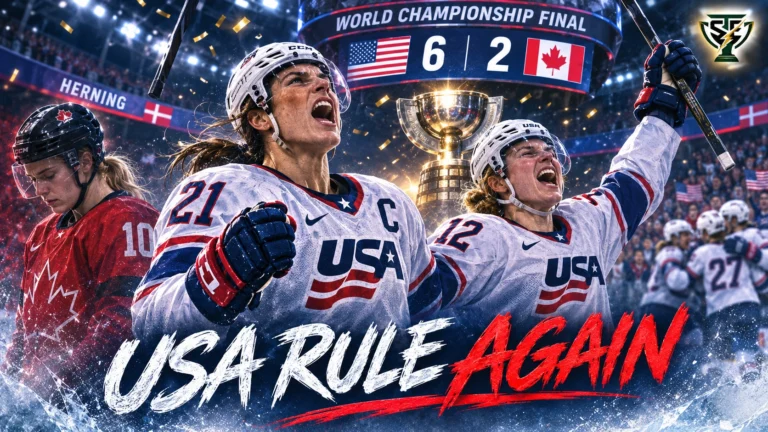
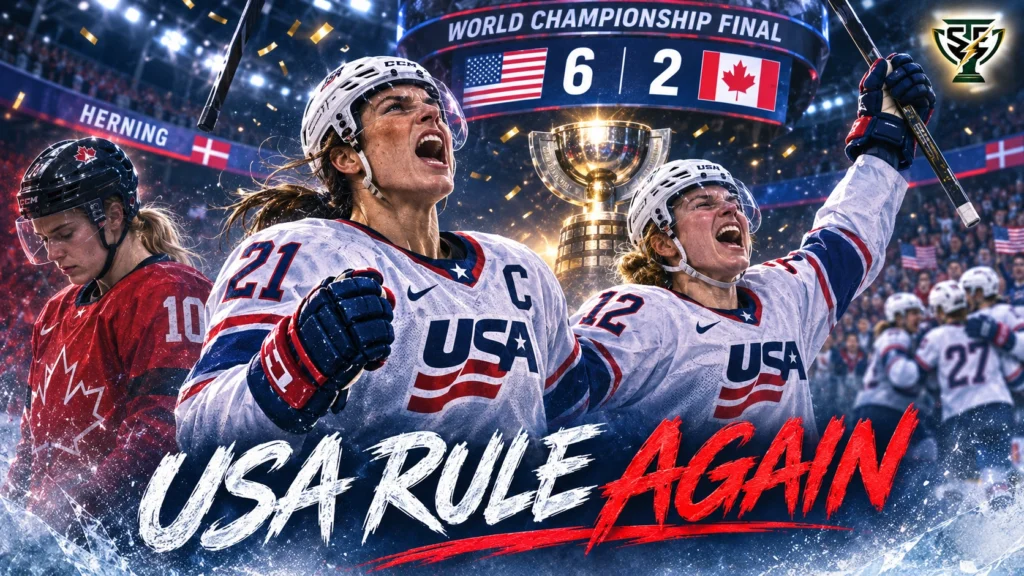
Herning, Denmark, November 16, 2026: Hilary Knight and Kelly Pannek scored twice each as the United States defeated Canada 6-2 to retain the IIHF Women’s World Championship, overcoming its first deficit of the tournament before delivering a commanding performance in the gold-medal game. The Americans claimed their 12th world title, their second consecutive championship and an Olympic-world championship double.
The USA vs Canada women’s hockey final initially belonged to Sarah Fillier, whose opening-period goal threatened to interrupt the Americans’ unbeaten campaign. But Knight equalized, Pannek put the United States ahead, and three American goals spanning the second and third periods established a lead Canada could not overcome. The victory also underlined the extraordinary influence of a veteran captain who finished the tournament with nine goals.
Key Takeaways
- The USA vs Canada women’s hockey final initially belonged to Sarah Fillier, whose opening-period goal threatened to interrupt the Americans’ unbeaten campaign.
- At 37, Knight remains one of international hockey’s most influential players.
- The United States now holds 12 Women’s World Championship titles, one fewer than Canada’s 13.
- The championship demonstrated the depth of the United States program.
USA vs Canada Women’s Hockey Final: Complete Scorecard
| Team | 1st | 2nd | 3rd | Final |
|---|---|---|---|---|
| United States | 1 | 2 | 3 | 6 |
| Canada | 1 | 0 | 1 | 2 |
Competition: IIHF Women’s World Championship, gold-medal game
Story at a glance
USA vs Canada Women’s Hockey Final: Complete Scorecard
Competition: IIHF Women’s World Championship, gold-medal game
Hilary Knight Delivers Another Championship Performance
At 37, Knight remains one of international hockey’s most influential players.
Kelly Pannek Changes the Game With Two Goals
Pannek’s contribution deserves particular attention because her goals arrived at moments when the Americans needed to establish control.
Sarah Fillier Gives Canada Hope but Receives Too Little Support
Canada’s defeat should not overshadow Fillier’s individual performance.
Caroline Harvey and Taylor Fox Set the Championship Standard
The gold-medal game was decided by experienced forwards, but the tournament’s broader story included outstanding contributions from younger American players.
Venue: Hockey Arena Herning, Denmark
Champions: United States, 12th world title
Leading scorers: Hilary Knight and Kelly Pannek, two goals each; Sarah Fillier, two goals
U.S. goaltender: Aerin Frankel, 18 saves
The scoreline represented a substantial departure from the narrow margins that have often characterized the rivalry. The Americans had won the previous world championship final and the Olympic gold-medal game against Canada in overtime, but this time established a four-goal winning margin.
How the USA vs Canada Women’s Hockey Final Turned
Canada struck first at 11:03 of the opening period through Fillier, who finished a move involving Jessie Eldridge and Rosalie Tremblay. Fillier controlled Tremblay’s pass while under pressure and beat Frankel with a backhand shot.
It was the first time the United States had trailed during the championship. The Americans had conceded only two goals across their previous six games, making Canada’s opener a meaningful test of their response under pressure.
Knight supplied that response at 16:26. Tessa Janecke’s shot created a rebound, and the American captain converted from close range to level the game before the intermission.
The second period produced the decisive shift.
At 11:33, Hayley Scamurra created a two-on-one opportunity and passed to Pannek, who finished past Canadian goaltender Ann-Renée Desbiens for a 2-1 lead.
Knight then scored on the power play at 17:51, converting a setup involving Megan Keller and Taylor Fox to make it 3-1.
The Americans carried that advantage into the third period and effectively settled the contest with another rapid attacking sequence.
Pannek redirected Cayla Barnes’ shot into the Canadian net just 1:29 after the restart. Lacey Eden added another goal 79 seconds later, extending the lead to 5-1.
Fillier answered at 3:28, but Canada’s recovery stopped there. Hayley Scamurra scored into an empty net at 16:33 to complete the victory.
The IIHF’s official gold-medal report confirms the scoring sequence and the Americans’ response after conceding first.
Hilary Knight Delivers Another Championship Performance
At 37, Knight remains one of international hockey’s most influential players.
Her two goals against Canada carried different importance. The first prevented the early Canadian advantage from developing into sustained scoreboard pressure. The second established a two-goal cushion before the final intermission.
She also assisted on Scamurra’s empty-net goal, finishing the championship game with three points.
Knight ended the tournament with nine goals, a personal best at the Women’s World Championship. She also reached 76 career goals in the competition, extending a scoring record built over an extraordinary international career.
The American captain’s achievement is particularly significant because it followed the country’s Olympic triumph earlier in the year.
Winning both major championships in the same calendar year requires consistency across separate tournaments, different opponents and distinct competitive environments.
Knight has been central to both phases of that success.
The latest American victory also adds another chapter to a broader U.S.-Canada ice hockey rivalry. At the men’s Winter Olympics, the United States defeated Canada for gold behind an outstanding performance from goaltender Connor Hellebuyck, whose Olympic form was examined in The Sports Encounter’s analysis of his contrasting international and NHL performances.
The competitions and athletes are different, but both results demonstrate the competitive intensity of international hockey between the neighboring countries.
Kelly Pannek Changes the Game With Two Goals
Pannek’s contribution deserves particular attention because her goals arrived at moments when the Americans needed to establish control.
Her first goal broke a 1-1 tie midway through the second period.
The play began with Scamurra carrying the puck forward before identifying Pannek during a two-on-one attack. The finish gave the United States its first lead of the final.
Her second goal arrived early in the third period and widened the advantage to three.
Those two finishes changed Canada’s immediate priorities. Instead of searching for one equalizer, the Canadians were required to chase a widening deficit against a team that had conceded very little throughout the tournament.
Pannek’s performance also illustrated how the American roster combines established international players with emerging talent.
While much of the tournament’s attention centered on younger players, the final’s most productive scorers were experienced forwards capable of performing in a high-pressure championship environment.
Sarah Fillier Gives Canada Hope but Receives Too Little Support
Canada’s defeat should not overshadow Fillier’s individual performance.
The forward opened the scoring and later added another goal, accounting for both Canadian finishes.
Her first goal was particularly important because it created the Americans’ first deficit of the entire competition.
Fillier had also missed Canada’s opening two games because of an injury sustained before the tournament, making her subsequent scoring contribution more significant.
She returned to become a central part of Canada’s attack, including a decisive performance in the semifinal victory over Sweden.
However, two goals from one forward could not compensate for the defensive problems Canada encountered as the final developed.
The Americans repeatedly turned opportunities into goals, particularly during the passage spanning Knight’s second-period power-play finish and Eden’s early third-period strike.
Canada also entered the championship without veteran captain Marie-Philip Poulin, who had undergone surgery following a serious knee injury.
Her absence removed an experienced leader from a team already undergoing a generational transition.
It would be too simplistic to attribute the defeat entirely to that absence. The United States produced superior finishing at decisive moments, while Canada could not sustain its early attacking advantage.
Caroline Harvey and Taylor Fox Set the Championship Standard
The gold-medal game was decided by experienced forwards, but the tournament’s broader story included outstanding contributions from younger American players.
Defender Caroline Harvey was named tournament Most Valuable Player and Best Defender.
She also received a place on the media-selected All-Star Team, recognizing her impact throughout the competition.
Harvey’s attacking production from defense made her particularly valuable to an American team capable of generating offense through multiple positions.
Fox established another important tournament milestone.
Her assist on Knight’s second goal was her 13th of the competition, surpassing the previous single-tournament record of 12 set by Cindy Curley in 1990.
That contribution is significant because assists measure an important part of the attacking process that can be overshadowed by goals.
Fox repeatedly helped create scoring opportunities for teammates, demonstrating that the Americans’ offensive strength extended well beyond their most recognizable finishers.
The IIHF’s official individual-awards announcement also named Frankel Best Goalkeeper and Knight Best Forward.
Those awards recognize contributions across different areas of the team rather than relying exclusively on goal scoring.
What the Victory Means for the Women’s Hockey Rivalry
The United States now holds 12 Women’s World Championship titles, one fewer than Canada’s 13.
Continue the NHL Story



That narrowing historical gap is an important consequence of consecutive American victories.
Canada remains the most successful nation by total championships, but the Americans have established a powerful recent record against their principal rivals.
The latest result also contrasts with the 2025 World Championship final, when the United States required overtime to secure a 4-3 victory.
In Herning, the Americans won by four goals, having controlled the game after Canada’s opening breakthrough.
The score does not mean every future meeting will follow the same pattern. International hockey rivalries are influenced by player availability, team selection, form and individual performances.
Nevertheless, the evidence from this championship is substantial. The United States won all seven of its games and demonstrated the ability to respond decisively when challenged in the final.
For broader international hockey context, TSE’s coverage of the inaugural 3ICE World Cup examines a separate international competition featuring the United States, Canada and several European nations. Its three-on-three format differs from the IIHF championship, but offers another perspective on international hockey competition.
Sweden Wins Bronze as Finland Falls Short
The championship’s other medal game produced a significant result for Sweden.
Sweden defeated Finland 2-1 following a shootout to secure bronze and end a World Championship medal drought dating back to 2007.
Finland had taken the lead through Michelle Karvinen before Lina Ljungblom equalized on the power play late in regulation.
Hilda Svensson then delivered the decisive shootout goal.
The result completed a podium featuring the United States, Canada and Sweden.
For Sweden, bronze represented tangible progress in an international competition historically dominated by the two North American powers.
Why the Americans’ Latest Gold Medal Matters
The championship demonstrated the depth of the United States program.
Knight supplied elite finishing and leadership. Pannek contributed two crucial goals in the final. Harvey controlled important phases of play from defense, while Fox established a tournament assist record.
Frankel gave the Americans reliability in goal throughout their championship campaign.
The combination created a team capable of overcoming different challenges rather than depending on one method of winning.
That balance is relevant to the wider development of elite hockey. International tournaments demand contributions from goaltenders, defenders, playmakers and specialist scorers, while domestic leagues provide the competitive environment in which those skills develop.
The Sports Encounter’s NHL season preview examines the professional men’s league’s competitive structure, while its recent reports on McDavid’s historic production and Kucherov’s scoring performances provide separate examples of how elite hockey achievements are measured. These are distinct competitions, not comparisons of equivalent player records.
The USA vs Canada women’s hockey final ultimately reinforced the Americans’ position as the current benchmark in international women’s ice hockey.
They conceded first, recovered through Knight, took the lead through Pannek and established control before Canada could mount a sustained comeback. Their 12th world title brings them closer to Canada’s historical championship total and completes a remarkable calendar year following their Olympic gold-medal victory.