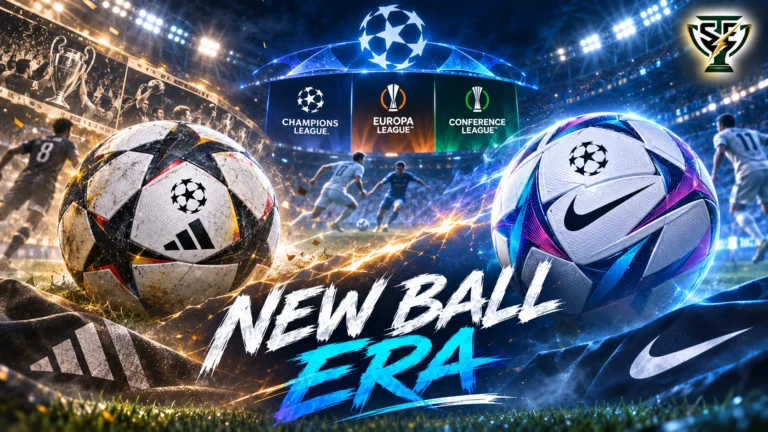
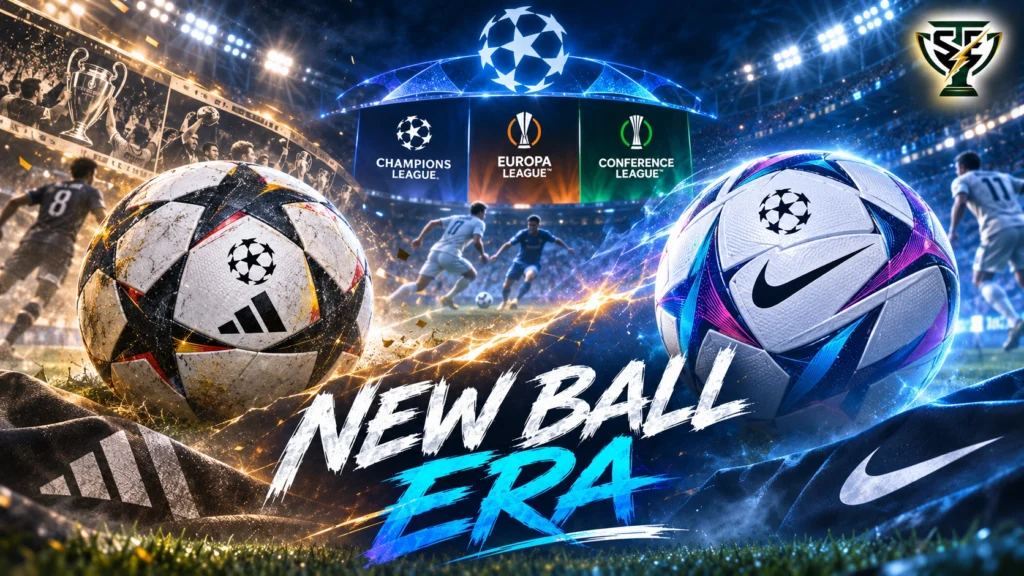
Nyon, Switzerland, November 16, 2026: Nike will replace Adidas as the official Champions League ball supplier from the 2027-28 season, ending a 26-year partnership that made Adidas’ star-patterned football one of European soccer’s most recognizable symbols. UEFA confirmed the four-season agreement on Monday, bringing the Champions League, Europa League and Conference League under a single match ball manufacturer for the first time.
The agreement extends beyond those three competitions. Nike will also provide balls for the UEFA Super Cup, UEFA Youth League and UEFA Futsal Champions League through 2031. Adidas will complete its existing Champions League contract, while the future appearance of the famous starball remains uncertain. UEFA has not unveiled Nike’s designs, leaving one of the competition’s most familiar visual traditions facing its biggest change in a generation.
Key Takeaways
- The decision follows a competitive tender launched in March 2026 by UC3, the commercial organization jointly established by UEFA and European Football Clubs, together with its agency Relevent Football Partners.
- Adidas began supplying Champions League match balls in 2001, introducing the Finale design and establishing a visual relationship that continued through multiple generations of players.
- The deal marks Nike’s return to a role it held between 1997 and 2001, before Adidas began its long tenure.
- The confirmed outcome is straightforward: Nike has won a four-season supply agreement covering six UEFA men’s club competitions, and Adidas’ 26-year Champions League association will conclude after the current season.
Why UEFA Changed the Champions League Ball Supplier
The decision follows a competitive tender launched in March 2026 by UC3, the commercial organization jointly established by UEFA and European Football Clubs, together with its agency Relevent Football Partners.
Story at a glance
Why UEFA Changed the Champions League Ball Supplier
The decision follows a competitive tender launched in March 2026 by UC3, the commercial organization jointly established by UEFA and European Football Clubs, together with its agency Relevent Football Partners.
Adidas’ Starball Era Comes to an End
Adidas began supplying Champions League match balls in 2001, introducing the Finale design and establishing a visual relationship that continued through multiple generations of players.
Will Nike Keep the Famous Champions League Starball Design?
That remains the most interesting unanswered question for supporters.
Nike Returns to a Competition It Previously Supplied
The deal marks Nike’s return to a role it held between 1997 and 2001, before Adidas began its long tenure.
What Happens to the Europa League and Conference League?
These competitions are central to understanding the agreement’s significance.
Previously, the Champions League ball supplier operated under a separate agreement from those covering UEFA’s other major men’s club competitions. Adidas provided the Champions League ball, while Decathlon’s Kipsta brand supplied the Europa League and Conference League.
Nike’s appointment consolidates those arrangements into a single four-season agreement covering six competitions.
According to UEFA’s official announcement, the arrangement is the first in which the Champions League, Europa League and Conference League will share one official match ball provider.
The change also reflects the increasing coordination of European club soccer’s commercial operations. UC3 manages commercial rights for UEFA’s elite club competitions, while Relevent supports their worldwide marketing and commercial sales.
For clubs, the competitions’ sporting structures remain unchanged by the supplier announcement. The three European league phases will continue to operate under their respective competition regulations. The new agreement concerns the equipment used across those tournaments and the associated commercial rights.
What the Champions League Ball Supplier Deal Actually Changes
The immediate consequence is commercial rather than competitive. No rule change, scoring adjustment or competition-format revision has been announced alongside the contract.
What UEFA gains is a unified supplier relationship spanning its principal men’s club tournaments, rather than separate arrangements involving multiple manufacturers.
That distinction matters because the Champions League and its two companion competitions attract different audiences, clubs and commercial partners. A supplier operating across all three receives a broader European platform, although UEFA has not publicly disclosed the agreement’s financial terms.
The deal does not mean every competition will necessarily use an identical ball design. UEFA confirmed a common manufacturer, not a single design shared across all tournaments.
Adidas’ Starball Era Comes to an End
Adidas began supplying Champions League match balls in 2001, introducing the Finale design and establishing a visual relationship that continued through multiple generations of players.
The distinctive star pattern reflected the competition’s identity and remained recognizable even as Adidas modified colors, materials, construction methods and graphics.
The ball became associated with celebrated Champions League moments, including Zinedine Zidane’s volley for Real Madrid against Bayer Leverkusen in the 2002 final and Lionel Messi’s defining European performances with Barcelona.
Its significance extended beyond individual matches. The starball linked different tournament editions through a recognizable design that supporters could identify almost instantly.
In September 2024, UEFA extended its Adidas agreement through 2027, continuing a relationship that had already lasted more than two decades.
Adidas subsequently celebrated the partnership’s 25th anniversary with a special ball inspired by its original Finale design.
The closing chapter of that relationship is unfolding during the current Champions League campaign, where the familiar star-patterned ball remains part of European nights involving clubs such as Real Madrid, Barcelona, Bayern Munich, Liverpool and Paris Saint-Germain.
Those European encounters continue to produce their own stories, from Real Madrid’s victory over Inter Milan to PSG’s record-breaking attacking performance against Villarreal.
Will Nike Keep the Famous Champions League Starball Design?
That remains the most interesting unanswered question for supporters.
Earlier reporting indicated that Adidas holds rights to the familiar star-panel design, creating a potential obstacle to Nike reproducing the existing ball’s appearance.
UEFA’s November announcement did not confirm whether the incoming manufacturer would retain any recognizable elements of the current pattern. It stated that further design details would be disclosed later.
Consequently, claims that Nike has already selected a replacement design or finalized the starball’s appearance would be premature.
The distinction between the Champions League’s visual identity and Adidas’ particular match ball design is important. The competition’s official branding is separate from the manufacturer’s product design, even though the two have become closely associated in supporters’ minds.
Nike has an opportunity to introduce a new visual identity for the ball while maintaining a recognizable connection to the competition. Whether it chooses continuity or a more substantial redesign remains to be seen.
Nike Returns to a Competition It Previously Supplied
The deal marks Nike’s return to a role it held between 1997 and 2001, before Adidas began its long tenure.
The American manufacturer therefore has previous experience supplying the competition, although the Champions League has changed considerably since its earlier involvement.
The modern tournament features a 36-team league phase, expanded commercial operations and a broader international audience. Its format creates matchups that were impossible under the previous group-stage structure, a development examined in The Sports Encounter’s analysis of the Champions League draw and its toughest routes.
Nike Football vice president and general manager Camilo Andrade described the contract as a long-term commitment, emphasizing athlete feedback, innovation and respect for the competitions’ traditions.
UC3 co-managing director Guy-Laurent Epstein also welcomed the company’s sporting heritage and international reach.
Neither announcement identified specific technical improvements that the new ball would deliver. Claims about superior flight characteristics, greater accuracy or improved control must therefore await actual specifications and independent performance evidence.
What Happens to the Europa League and Conference League?
These competitions are central to understanding the agreement’s significance.
The Champions League attracts the greatest attention, but Nike’s appointment also replaces the existing Kipsta arrangements for the Europa League and Conference League.
Continue the UEFA Champions League 2026-27 Story
 UEFA Champions League 2026-27Champions League Chaos: Valverde Rescues Real Madrid, Liverpool Collapse at Fenerbahce as Como Hit Nine
 UEFA Champions League 2026-27Champions League: PSG Rewrite the Record Books, Bayern Silence Atlético, and Cunha’s Wild Double Rescues Manchester United
 UEFA Champions League 2026-27PSG Score Four in 16 Minutes to Smash Real Madrid’s Champions League Record as Villarreal Collapse 6-0
For UEFA, combining the contracts creates a more consistent commercial framework across its three major men’s club tournaments.
For Nike, it extends the company’s presence beyond the Champions League into competitions involving clubs with different sporting ambitions, budgets and audiences.
The different league-phase structures across UEFA competitions highlight that diversity: Champions League and Europa League clubs play eight opponents during the league phase, while Conference League clubs play six.
A single supplier can now serve all three tournaments while accommodating their individual identities. Whether UEFA and Nike pursue noticeably different ball designs for each competition will become clear when the products are unveiled.
What Happens Before Nike Takes Over?
Adidas remains responsible for the Champions League match ball throughout the 2026-27 season.
Its current product was unveiled in August, with the design drawing inspiration from players’ preparation and the unseen work behind elite performances.
According to UEFA’s official ball presentation, the latest Adidas edition uses thermally bonded seamless construction intended to support consistent performance and control.
The manufacturer will retain its existing role through the current competition before Nike assumes responsibility at the beginning of the following season.
The agreement announced on Monday specifically concerns UEFA’s men’s club competitions. It does not establish that Nike will also replace Adidas as the Women’s Champions League match ball provider.
Supporters following the competition’s final Adidas season can also revisit the latest Champions League results and decisive performances as the current campaign progresses.
A Commercial Decision With a Lasting Visual Consequence
The confirmed outcome is straightforward: Nike has won a four-season supply agreement covering six UEFA men’s club competitions, and Adidas’ 26-year Champions League association will conclude after the current season.
The larger question concerns the competition’s identity. Few pieces of sporting equipment become recognizable symbols of an entire tournament, yet Adidas achieved precisely that with its starball.
Nike now inherits the challenge of developing a successor that satisfies the demands of elite players while establishing its own place in European soccer’s most prominent club competition.
For the incoming Champions League ball supplier, the test will extend beyond securing an important commercial contract. The new ball must eventually prove itself on the pitch, while earning recognition among supporters who have associated the existing design with Champions League nights for more than a quarter-century.
Nike
- Nike Replaces Adidas as Champions League Ball Supplier
- Why Keely Hodgkinson’s Black Speed Suit Became ATHLOS London’s Biggest Talking Point
- Kylian Mbappé Leaves Nike After 20 Years as On Enters Football With Thierry Henry
- Carlos Alcaraz Returns with a Win as Travis Scott and Nike Turn His US Open Comeback Into a Cultural Event