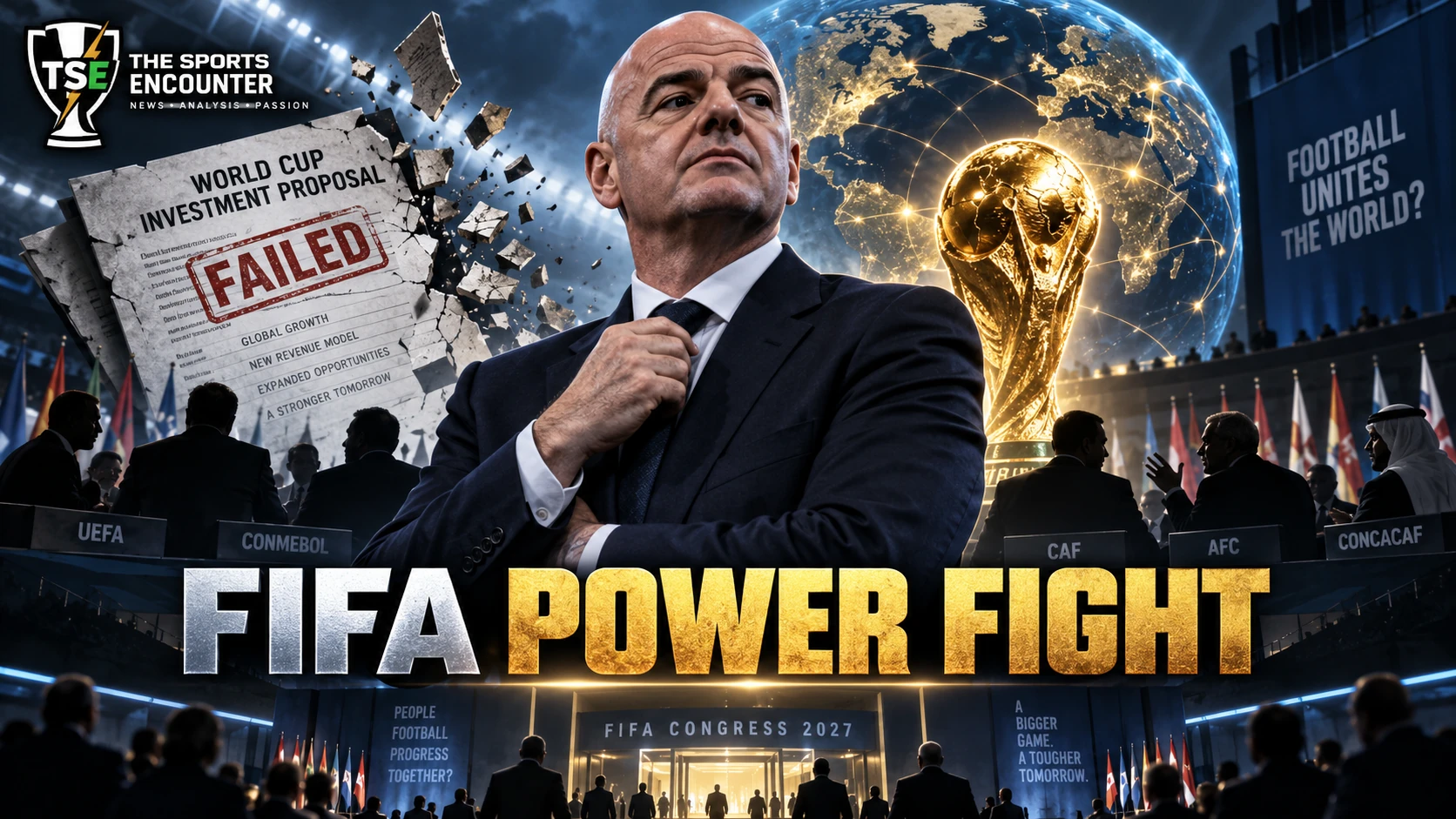
ZURICH, Switzerland, November 16, 2026: Gianni Infantino’s bid for another term as FIFA president faces a major new challenge after UEFA-backed national associations unanimously endorsed French Football Federation president Philippe Diallo for the March 2027 election. The 63-year-old French administrator accepted the invitation following a meeting chaired by UEFA president Aleksander Čeferin, turning months of institutional opposition into a direct electoral challenge to a leader who appeared virtually certain of reelection earlier this year.
The FIFA presidency now faces an unusually competitive contest, with Diallo emerging alongside Japanese administrator Kohzo Tashima and former Tottenham defender Ramon Vega as potential alternatives to Infantino. The decisive issue is whether opposition to FIFA’s abandoned World Cup commercial investment scheme can be transformed into a majority among the organization’s 211 member associations. UEFA’s endorsement provides Diallo with an influential political platform, but Infantino retains substantial support across other confederations, and the presence of multiple challengers could complicate efforts to remove him.
Key Takeaways
- Gianni Infantino’s bid for another term as FIFA president faces a major new challenge after UEFA-backed national associations unanimously endorsed French Football Federation president Philippe Diallo for the March 2027 election.
- The FIFA presidency now faces an unusually competitive contest, with Diallo emerging alongside Japanese administrator Kohzo Tashima and former Tottenham defender Ramon Vega as potential alternatives to Infantino.
- For months, European national associations had criticized Infantino’s handling of major commercial and governance decisions.
- The dispute intensified during the October 15 FIFA Council meeting in Zurich.
FIFA Presidency: Key Takeaways
- UEFA-backed national associations unanimously endorsed Philippe Diallo to challenge Gianni Infantino in the March 2027 FIFA presidential election.
- Diallo accepted the invitation, although the French Football Federation Executive Committee must formally ratify his candidacy on November 17.
- The presidential election is scheduled for March 18, 2027, in Rabat, Morocco.
- The nomination deadline is November 18, 2026, and candidates require written backing from at least five FIFA member associations.
- The challenge follows FIFA’s withdrawal of a controversial proposal to bring private investors into a commercial entity associated with its major competitions.
- Japan’s Kohzo Tashima and former Swiss international Ramon Vega have also emerged as challengers to Infantino.
- Infantino retains substantial political support outside Europe, making cross-confederation alliances central to the election.
- The result will influence FIFA’s governance, commercial strategy, development funding and relationships with clubs, confederations and national associations.
FIFA Presidential Election 2027: Key Information
| Election Detail | Confirmed Information |
|---|---|
| Election | FIFA presidential election |
| Date | March 18, 2027 |
| Location | Rabat, Morocco |
| Event | 77th FIFA Congress |
| Incumbent | Gianni Infantino |
| UEFA-backed challenger | Philippe Diallo |
| Other challengers | Kohzo Tashima and Ramon Vega |
| Nomination deadline | November 18, 2026 |
| Minimum nomination support | Five member associations |
| FIFA membership | 211 associations |
| Diallo’s next procedural step | FFF Executive Committee ratification, expected November 17 |
These details establish the immediate electoral timetable. They do not establish that all prospective candidates have completed every nomination and eligibility requirement.
Story at a glance
FIFA Presidential Election 2027: Key Information
These details establish the immediate electoral timetable. They do not establish that all prospective candidates have completed every nomination and eligibility requirement.
UEFA Chooses Philippe Diallo as Its Alternative to Infantino
The decision represents a significant development in the dispute between UEFA and FIFA’s current leadership.
Who Is Philippe Diallo and Why Has UEFA Chosen Him?
Diallo is a longtime French football administrator whose career spans club representation, professional league governance, international dispute resolution and national federation leadership.
How Infantino’s World Cup Investment Plan Created the Crisis
The confrontation did not begin with Monday’s endorsement.
France’s Withdrawal of Support Was the Warning Sign
Diallo’s emergence as a challenger is not an abrupt reversal without warning.
UEFA Chooses Philippe Diallo as Its Alternative to Infantino
The decision represents a significant development in the dispute between UEFA and FIFA’s current leadership.
For months, European national associations had criticized Infantino’s handling of major commercial and governance decisions.
However, finding a candidate capable of challenging him proved more difficult than identifying reasons to oppose him.
That uncertainty ended on Monday when representatives of national associations serving on UEFA’s Executive Committee and the FIFA Council endorsed Diallo.
The meeting was chaired by Čeferin, whose organization has played a central role in opposition to Infantino’s commercial investment proposal.
UEFA said its representatives wanted to restore trust and strengthen cooperation across world soccer.
The governing body also emphasized that football development should remain central to FIFA’s mission and that major decisions should reflect stronger governance standards.
Diallo accepted the invitation.
But an important procedural distinction remains.
The unanimous endorsement came from the national associations represented at Monday’s meeting. It should not automatically be interpreted as a binding voting commitment from every one of UEFA’s 55 member associations.
Nor does it guarantee support from federations outside Europe.
The official UEFA announcement confirming Diallo’s endorsement also states that his candidacy is due to be formally ratified by the French federation on Tuesday.
Who Is Philippe Diallo and Why Has UEFA Chosen Him?
Diallo is a longtime French football administrator whose career spans club representation, professional league governance, international dispute resolution and national federation leadership.
He became interim president of the French Football Federation in January 2023 following Noël Le Graët’s departure.
He subsequently secured the presidency and was reelected in December 2024 for another four-year term.
Before taking charge of French football, Diallo held senior responsibilities representing professional clubs.
He also served on the board of France’s professional league and within FIFA’s dispute resolution structures.
His administrative experience gives him direct familiarity with the competing demands placed on football’s governing bodies.
Clubs want commercially sustainable competitions and predictable calendars.
National associations depend on international tournaments and development funding.
Players and coaches face increasingly demanding schedules.
Confederations want meaningful participation in decisions affecting their regions.
Diallo’s challenge will be to convince these groups that his experience can deliver reforms without undermining the financial support and international competition structures on which many federations depend.
Diallo’s Experience and Its Relevance to FIFA
| Experience | Role | Potential Relevance |
|---|---|---|
| Professional club representation | Led an organization representing French professional clubs | Understanding of club finances and competition structures |
| Domestic league governance | Served on the professional league board | Experience balancing league and federation interests |
| FIFA dispute resolution | Worked within international football’s dispute-resolution framework | Familiarity with governance and regulatory processes |
| French Football Federation | President since 2023 | Leadership of a major national football association |
| UEFA Executive Committee | Member since 2023 | Direct participation in European football governance |
Diallo’s international credibility will depend on whether he can move beyond being perceived as Europe’s candidate.
FIFA is a global organization, and many associations outside Europe have development needs that differ substantially from those of the continent’s wealthiest football nations.
His appeal therefore cannot rest entirely on criticism of Infantino.
He must provide a credible alternative for football development in Africa, Asia, the Americas and Oceania.
In an October interview, Diallo discussed the importance of integrity, institutional responsibility and football’s wider development. His views are documented in UEFA’s official profile of the French football president.
How Infantino’s World Cup Investment Plan Created the Crisis
The confrontation did not begin with Monday’s endorsement.
Its immediate origins lie in FIFA Forward Enterprise, the commercial investment proposal advanced during 2026.
The plan involved creating a new commercial structure connected to revenue-generating activities associated with FIFA competitions, including the World Cup.
Outside investors would have been able to acquire an economic interest in that business.
Supporters of the concept argued that additional capital could accelerate commercial development and provide more resources for football.
Opponents questioned whether private investors should be given an interest in revenue associated with competitions administered on behalf of FIFA’s member associations.
They also challenged the consultation process and the extent of oversight exercised by football’s existing governing bodies.
The backlash developed rapidly.
UEFA and its member associations threatened nonparticipation in FIFA competitions while the investment proposal remained active.
That escalation was examined in The Sports Encounter’s report on UEFA’s unanimous boycott threat.
Infantino subsequently abandoned the proposal on July 31.
But withdrawing the commercial plan did not resolve the underlying disagreement.
For UEFA and several national associations, the controversy raised broader questions about how major decisions were developed, presented and authorized.
The central issue shifted from whether FIFA should accept a particular investment to whether its leadership structures provided adequate consultation and accountability.
Why Abandoning the Plan Did Not Restore Trust
The withdrawal removed the immediate threat of a long-term private investment structure.
However, critics continued asking why such a consequential proposal had advanced without what they regarded as sufficient institutional participation.
They also wanted clarity about the financial assumptions supporting the transaction.
The distinction matters.
An organization can abandon an unpopular proposal without demonstrating that the decision-making process which produced it has been improved.
That became the central governance dispute facing Infantino.
In September, he proposed independent scrutiny of FIFA’s major decision-making processes and a stronger consultation framework.
TSE’s analysis of Infantino’s proposed independent governance review examined whether those measures could address the institutional concerns.
The proposed reforms were an important response, but they did not persuade UEFA’s critics that the leadership dispute was settled.
France’s Withdrawal of Support Was the Warning Sign
Diallo’s emergence as a challenger is not an abrupt reversal without warning.
In September, the French Football Federation withdrew its backing for Infantino’s reelection.
Diallo argued that confidence in FIFA’s leadership had been damaged.
He also indicated that European associations should be prepared to identify an alternative presidential candidate.
That decision mattered because France had previously supported Infantino.
It demonstrated that opposition was extending beyond federations already critical of his administration.
As other European associations expressed dissatisfaction, the possibility of an organized electoral challenge became increasingly credible.
TSE’s September analysis of Greece’s withdrawal of support and Europe’s search for an alternative identified the central challenge that remained unresolved at the time: finding a candidate with international reach.
Monday’s endorsement supplies an answer to the candidate question.
Whether Diallo possesses sufficient worldwide support remains unknown.
The FIFA Council Confrontation Made the Election Unavoidable
The dispute intensified during the October 15 FIFA Council meeting in Zurich.
Senior European officials questioned the governing body’s decision-making processes and the explanations provided for the withdrawn investment plan.
FIFA also considered substantial development funding and governance reforms, showing how closely financial policy and political support had become connected.
The Council meeting established a working group to examine governance issues.
However, critics continued calling for more substantive institutional changes.
TSE’s report on the October FIFA Council confrontation documented the dispute over development funding, institutional oversight and disciplinary procedures.
That meeting exposed the underlying political calculation.
Infantino could attempt to restore confidence through governance reforms and additional development resources.
His opponents could continue demanding new leadership.
UEFA’s endorsement of Diallo confirms that its leading critics have chosen to pursue the second option through the March election.
Infantino Still Has a Powerful Global Support Base
UEFA’s decision is politically significant, but Infantino remains a formidable incumbent.
He became FIFA president in 2016 and won reelection without opposition in 2023.
He has overseen major increases in the scale and commercial value of FIFA competitions.
His administration has also emphasized increased development funding for national associations.
For smaller football federations, these resources can support facilities, coaching education, youth competitions, women’s football and administrative capacity.
Infantino’s supporters can argue that global development should be assessed through these tangible investments rather than only through disagreements between FIFA and UEFA.
He has also maintained backing from influential officials and associations outside Europe.
That makes a purely European campaign unlikely to succeed.
Even if Diallo ultimately receives support from all 55 UEFA members, that would represent only about 26.1% of FIFA’s 211 member associations.
The calculation illustrates the scale of the challenge.
Infantino would still have considerable room to assemble a winning coalition.
FIFA has defended its governance framework and emphasized that presidential elections must take place under its established democratic procedures.
Its institutional position is set out in FIFA’s statement defending its statutory election processes.
Can Diallo Defeat Infantino? The Electoral Mathematics
The FIFA presidency is decided by member associations, not the number of supporters attending UEFA meetings or the prominence of public criticism.
Each eligible FIFA member association has one vote.
With 211 associations in the organization, a candidate must build a substantial international coalition.
The presidential election rules depend on how many candidates ultimately appear on the ballot.
In a two-candidate contest, a simple majority of valid votes is required.
In a contest involving three or more candidates, the applicable FIFA statutes require a two-thirds majority in the first ballot.
Subsequent rounds eliminate the lowest-ranked candidate until the required threshold is met or two candidates remain.
For illustration, if all 211 members are eligible and cast valid votes in a two-candidate contest, 106 votes would constitute a simple majority.
Actual thresholds depend on the number of eligible members present and valid votes cast.
What the Voting Numbers Mean
| Electoral Measure | Number | Interpretation |
|---|---|---|
| Total FIFA associations | 211 | Potential voting membership |
| UEFA associations | 55 | Approximately 26.1% of FIFA membership |
| Required nomination endorsements | 5 | Minimum support to propose a candidate |
| Illustrative two-candidate winning total | 106 | Assumes 211 eligible valid votes |
| Additional votes beyond 55 | 51 | Illustrative minimum needed if all UEFA members back one candidate and 211 vote |
| Three or more candidates, first ballot | Two-thirds | Higher threshold before elimination rounds |
This calculation is illustrative, not a prediction.
It assumes full UEFA unity, complete participation by FIFA members and valid votes from all eligible associations.
None of those assumptions should be treated as guaranteed.
It nevertheless reveals why alliances outside Europe will determine whether Diallo has a realistic path to the presidency.
Could Multiple Challengers Help Infantino?
Diallo is not the only person seeking to challenge the incumbent.
Japanese football official Kohzo Tashima announced his intention to enter the race earlier in November.
Former Tottenham defender and Swiss international Ramon Vega has also declared his intention to stand.
Their campaigns create a difficult strategic question for the opposition.
If each attracts support from different associations, anti-Infantino votes could be divided during the opening ballot.
That could strengthen the incumbent’s relative position.
However, FIFA’s elimination system means votes are not necessarily lost permanently when a candidate is removed from contention.
Associations may change their choices in later rounds.
The crucial issue is whether opposition candidates and their supporters can cooperate effectively after the opening ballot.
Potential Presidential Candidates
| Candidate | Background | Political Position | Principal Challenge |
|---|---|---|---|
| Gianni Infantino | FIFA president since 2016 | Incumbent seeking reelection | Restoring confidence following governance disputes |
| Philippe Diallo | French federation president | Endorsed by UEFA-backed representatives | Winning substantial non-European support |
| Kohzo Tashima | Veteran Japanese football administrator | Announced presidential challenger | Building a distinct international coalition |
| Ramon Vega | Former Switzerland and Tottenham defender | Declared intention to challenge | Obtaining required nominations and broader backing |
The final certified candidate list may differ once all nomination, endorsement and eligibility requirements have been assessed.
It is therefore premature to describe the election as a confirmed four-candidate contest.
FIFA’s Commercial Future Is at the Center of the Election
The FIFA presidency controls far more than ceremonial responsibilities.
The governing body’s leadership influences major international competitions, commercial strategy, development funding and relationships across the football industry.
The abandoned FIFA Forward Enterprise proposal demonstrated how quickly disagreements about commercial ownership can become constitutional and political disputes.
Supporters of greater commercial innovation may argue that FIFA needs flexible structures to raise revenue and invest in football.
Opponents want stronger guarantees that long-term competition rights will not be placed under private investor influence without clear institutional approval.
The next president will need to reconcile those priorities.
Another unresolved issue concerns access to documents underlying the withdrawn commercial proposal.
FIFA subsequently offered Council members access to relevant records, but questions remained about the extent of that access.
TSE’s investigation into FIFA’s restricted document-access process examined whether that step could satisfy demands for transparency.
Diallo now has an opportunity to make stronger institutional oversight a central feature of his campaign.
Infantino can respond by pointing to existing reforms, commercial growth and development investment.
The eventual election may therefore become a contest between two competing approaches to FIFA governance rather than simply a referendum on one abandoned investment proposal.
Why Africa, Asia and the Americas Could Decide the Election
European soccer contains many of the world’s most commercially powerful clubs, leagues and national teams.
But that does not translate into a majority of FIFA’s votes.
National associations in Africa, Asia, North and Central America, South America and Oceania collectively account for most of the voting membership.
These regions have different priorities.
Some associations depend heavily on FIFA development support.
Others prioritize opportunities to qualify for expanded international tournaments.
Still others want greater representation in FIFA’s governing institutions.
Diallo must demonstrate how his approach would address these concerns.
A campaign dominated by grievances from Europe’s wealthiest football countries could struggle to persuade associations whose most immediate challenge is funding community facilities and national development programs.
Conversely, a credible commitment to transparent funding, equitable opportunities and stronger consultation could broaden his appeal.
The decisive political question is whether opposition to Infantino’s leadership is strong enough across these regions to overcome existing alliances.
No verified count of pledged votes establishes that Diallo currently possesses such a majority.
What Happens Next in the FIFA Presidential Race?
The next procedural steps will determine whether Monday’s announcement produces a formally confirmed candidacy.
Diallo requires ratification from the French Football Federation Executive Committee.
His nomination must then satisfy FIFA’s submission deadline and eligibility requirements.
Other challengers face their own formal requirements.
Once the final candidate list is established, the campaign will shift toward securing support among national associations ahead of the March Congress.
FIFA Presidential Election Timeline
| Date | Event | Status |
|---|---|---|
| July 31, 2026 | FIFA withdraws Forward Enterprise proposal | Completed |
| September 2026 | France withdraws support for Infantino | Completed |
| October 15, 2026 | FIFA Council discusses governance and funding | Completed |
| November 16, 2026 | UEFA-backed representatives endorse Diallo | Completed |
| November 17, 2026 | Expected FFF ratification of Diallo’s candidacy | Pending |
| November 18, 2026 | Deadline for presidential nominations | Upcoming |
| March 18, 2027 | 77th FIFA Congress and presidential election in Rabat | Scheduled |
The timetable means Diallo has only a short period to complete the nomination process.
But the more difficult work will continue for several months: persuading associations beyond UEFA to support an alternative president.
What Would Change Under a Diallo Presidency?
Diallo has not yet published a comprehensive presidential manifesto covering every major FIFA policy.
It would therefore be speculative to describe specific tournament reforms, funding reallocations or administrative appointments as established campaign commitments.
However, UEFA’s endorsement identifies several areas likely to become prominent in the debate.
| Policy Area | Existing Dispute | Question for Diallo |
|---|---|---|
| Institutional governance | Extent of presidential decision-making authority | What enforceable checks would be introduced? |
| Commercial rights | Future role of private investment in competition revenues | How would commercial development remain accountable? |
| Development funding | Distribution and oversight of FIFA resources | Would funding remain predictable across all confederations? |
| International calendar | Pressure on clubs, players and competitions | How would competing sporting interests be reconciled? |
| Member participation | Consultation before major strategic decisions | How would smaller associations gain meaningful influence? |
These questions provide a framework for judging Diallo’s eventual manifesto.
They also offer a fair standard for assessing Infantino’s reelection campaign.
Criticism of governance should be supported by workable proposals.
Claims of successful development should be supported by measurable outcomes and transparent financial information.
Continue the FIFA World Cup 2026 Story
 FIFA World Cup 2026FIFA Opens Files on Scrapped $20B World Cup Deal, but UEFA’s Fight With Infantino Is Far From Over
 FIFA World Cup 2026Asia Backs Infantino After FIFA World Cup Rights Revolt, Transforming His 2027 Re-Election Battle
 FIFA World Cup 2026Infantino Says Sorry, Critics Demand the Files as FIFA Puts $6.35 Billion on the Table
Frequently Asked Questions About the FIFA Presidency
Who is challenging Gianni Infantino for FIFA president?
French Football Federation president Philippe Diallo has accepted UEFA-backed representatives’ invitation to challenge Infantino in the March 2027 election. Kohzo Tashima and Ramon Vega have also announced intentions to contest the presidency.
When is the next FIFA presidential election?
The election is scheduled for March 18, 2027, at the 77th FIFA Congress in Rabat, Morocco.
Why is UEFA supporting Philippe Diallo?
UEFA-backed representatives want changes in FIFA governance, stronger institutional cooperation and greater emphasis on worldwide football development following controversy over the abandoned Forward Enterprise proposal.
Has Philippe Diallo’s candidacy been formally approved?
Diallo accepted UEFA’s invitation on November 16. His candidacy is expected to be ratified by the French Football Federation Executive Committee on November 17, subject to the required process.
What is FIFA Forward Enterprise?
It was a proposed commercial structure connected to FIFA competitions that could have allowed private investors to acquire an economic interest in a business associated with major tournament revenues. FIFA withdrew the proposal in July 2026.
How many votes are needed to become FIFA president?
The threshold depends on the number of candidates and valid votes. With two candidates, a simple majority is required. With three or more candidates, the election initially uses a two-thirds threshold and subsequent elimination rounds.
How many FIFA member associations can vote?
FIFA has 211 member associations, each with one vote subject to eligibility and election procedures.
Can UEFA alone elect Philippe Diallo?
No. UEFA has 55 member associations, substantially fewer than the number required to guarantee victory across FIFA’s worldwide membership.
Does Gianni Infantino still have support?
Yes. Infantino retains backing from influential associations and confederation leaders outside Europe despite significant opposition to his governance decisions.
When must FIFA presidential candidates submit nominations?
The nomination deadline is November 18, 2026. Candidates need the backing of at least five national associations and must satisfy FIFA’s eligibility requirements.
What It Means: Europe Has a Challenger, but Not Yet a Winning Coalition
The significance of Monday’s announcement is that opposition to Infantino has moved from institutional criticism into an organized presidential campaign.
For months, UEFA’s representatives challenged his approach to commercial investment, governance and consultation.
They now have a candidate prepared to contest his authority through FIFA’s electoral process.
That is a substantial political development.
But it should not be confused with an electoral victory.
Diallo must still secure formal approval, complete the nomination process and convince associations outside Europe that he offers a credible alternative.
Infantino retains the advantages of incumbency, established relationships and a record of commercial expansion and development funding that appeals to many member federations.
The presence of other challengers also means the opposition cannot assume that every vote cast against the incumbent will immediately benefit Diallo.
The next phase of the campaign will determine whether competing reform movements can coordinate their efforts or whether divided opposition ultimately strengthens Infantino.
The FIFA presidency now faces a genuine political test.
UEFA has chosen its challenger. What remains to be seen is whether the rest of world soccer is prepared to follow.
UEFA
- UEFA Backs Philippe Diallo Against Infantino in the Biggest FIFA Presidency Election Test
- FIFA Opens Files on Scrapped $20B World Cup Deal, but UEFA’s Fight With Infantino Is Far From Over
- Infantino Says Sorry, Critics Demand the Files as FIFA Puts $6.35 Billion on the Table
- Infantino Faces FIFA’s Reckoning as Revolt Reaches Zurich, and Now $6 Billion Reserves Enter the Fight
- Portugal Reach Nations League QFs, Netherlands Go Top, Germany Stall, But Denmark Punish Wales