Key Takeaways
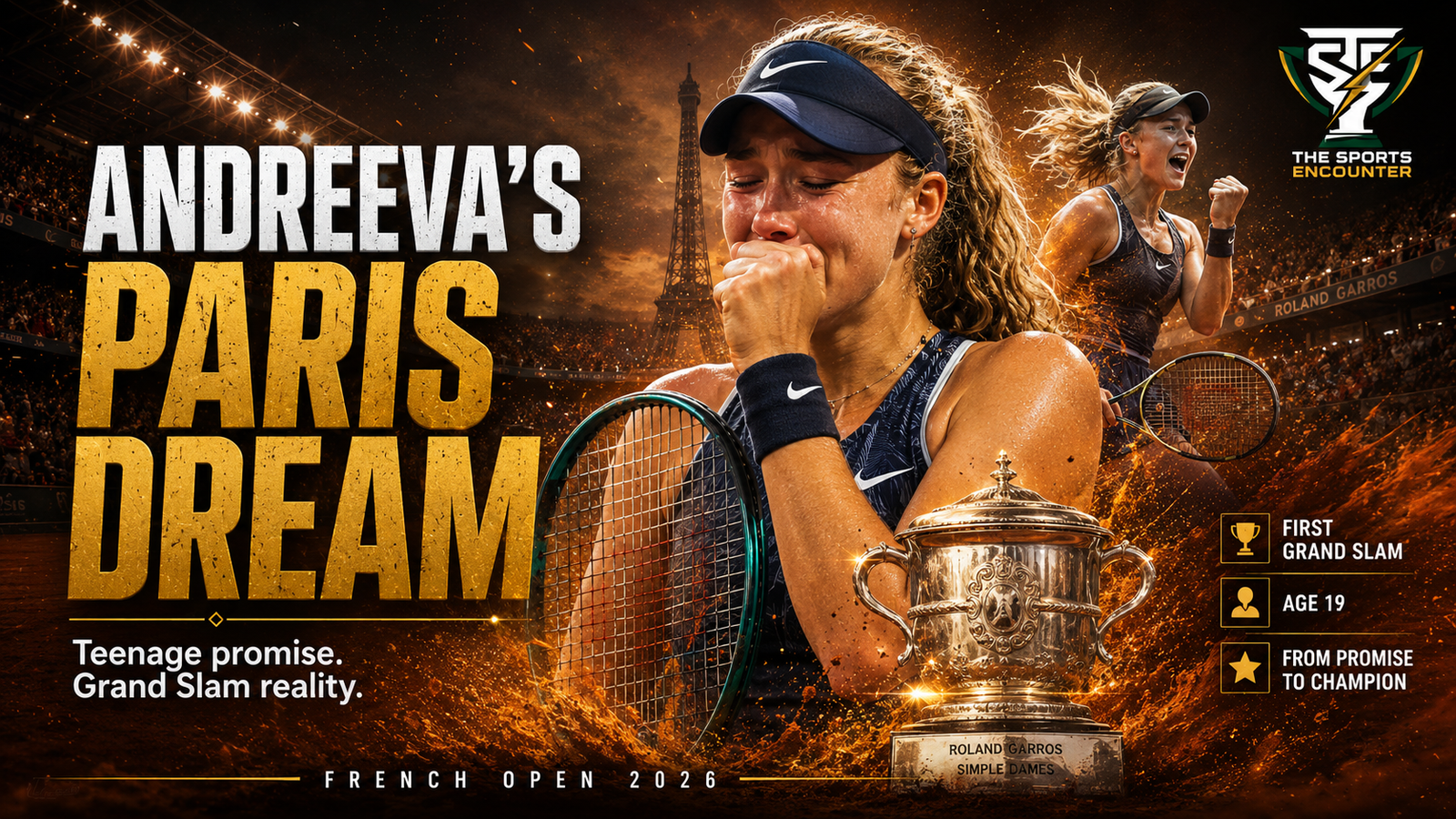
- TL;DR: Andreeva won 50 matches, three titles and her first major in 2026, but her season also produced two final defeats and a US Open heartbreak.
- Andreeva was born in Krasnoyarsk on April 29, 2007.
- The most efficient summary is simple: three titles from five finals, 50 match wins and a first Grand Slam singles championship.
- The official draw placed Andreeva in Group 2 with Aryna Sabalenka, Elina Svitolina and Karolína Muchová.
INDIAN WELLS, United States, November 4, 2026: Mirra Andreeva is only 19, but the next chapter of her career begins under the expectations usually reserved for a veteran champion. The Russian won her first Grand Slam singles title at Roland-Garros, collected the Adelaide and Linz trophies, and finished the regular WTA season with 50 victories against 16 defeats. She rose to world No. 3, reached five singles finals, and secured a debut appearance at the WTA Finals in Indian Wells. After a season that turned promise into silverware, she must now face a new challenge: winning repeatedly against opponents who already know what makes her dangerous.
Andreeva’s rise has not been uninterrupted. She reached the Madrid and Beijing finals but lost both, suffered a painful US Open quarterfinal defeat to Coco Gauff after holding two match points, and struggled to build momentum at Wimbledon. Her opening group includes Aryna Sabalenka, Elina Svitolina and Karolína Muchová, an unusually varied collection of opponents who will probe her power, patience and decision-making. At the November 8–15 championship, Andreeva will discover whether a breakthrough season has equipped her for the concentrated demands of the eight-player finale.
Mirra Andreeva in 2026: Key Facts
| Category | Detail |
|---|---|
| Name | Mirra Andreeva |
| Born | April 29, 2007 |
| Age | 19 |
| Birthplace | Krasnoyarsk, Siberia, Russia |
| Height | 1.75 m (5 feet, 9 inches) |
| Plays | Right-handed |
| Coach | Conchita Martínez |
| Sister | Erika Andreeva, professional tennis player |
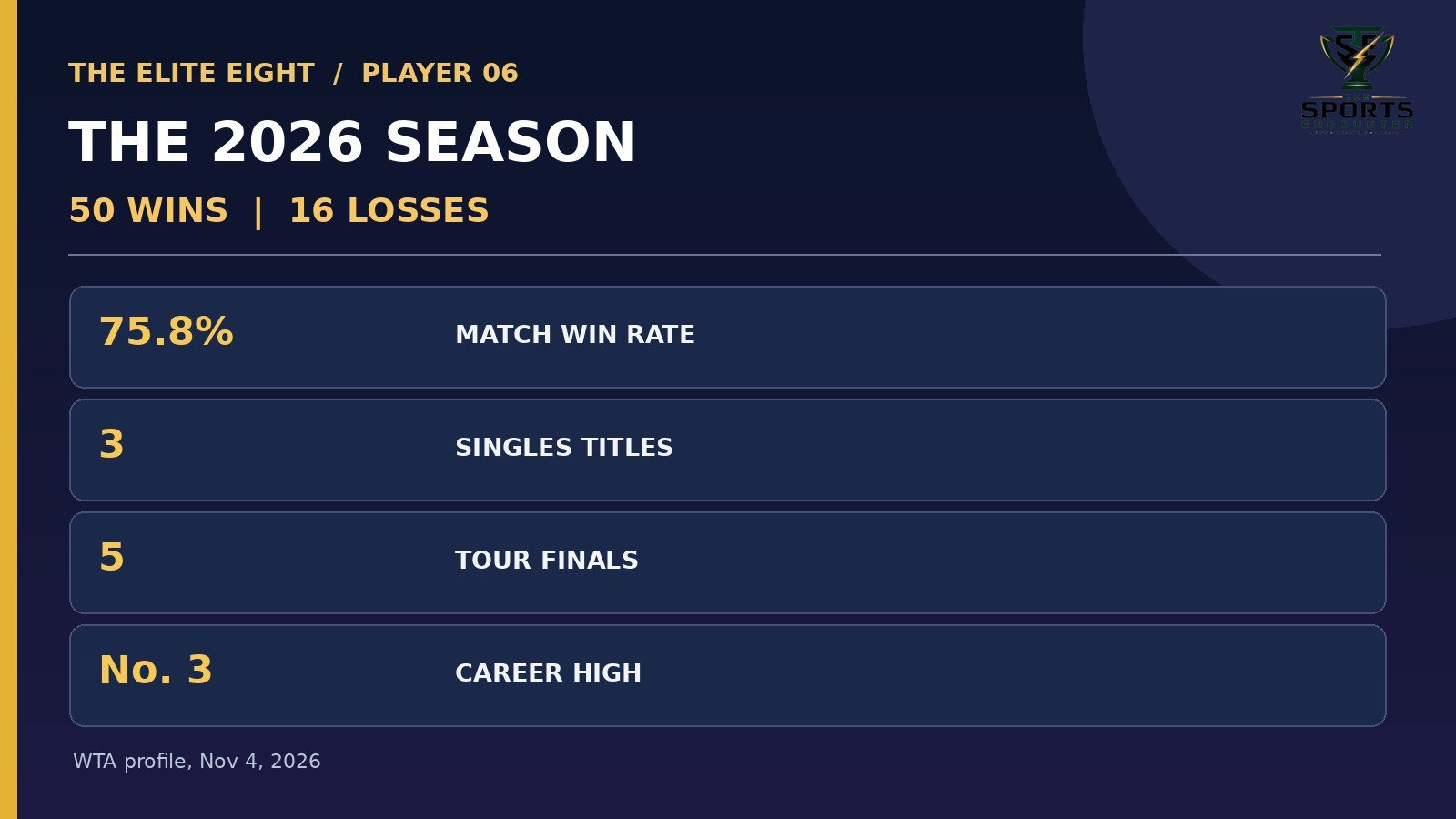
| Singles ranking | World No. 3 |
| 2026 singles record | 50–16 |
| 2026 winning rate | 75.8% |
| 2026 singles titles | Roland-Garros, Adelaide, Linz |
| Career singles titles | Six |
| 2026 singles finals | Five |
| Previous WTA Finals singles appearances | None |
| 2026 WTA Finals seed | No. 3 |
| WTA Finals group | Group 2 with Sabalenka, Svitolina and Muchová |
TL;DR: Andreeva won 50 matches, three titles and her first major in 2026, but her season also produced two final defeats and a US Open heartbreak. The 19-year-old world No. 3 debuts at the WTA Finals against Sabalenka, Svitolina and Muchová. Her path to the semifinals depends on protecting her serve, varying pace and managing the crucial points that slipped away in New York.
Story at a glance
Mirra Andreeva in 2026: Key Facts
TL;DR: Andreeva won 50 matches, three titles and her first major in 2026, but her season also produced two final defeats and a US Open heartbreak. The 19-year-old world No. 3 debuts at the WTA Finals against Sabalenka, Svitolina and Muchová. Her path to the semifinals depends on protecting her serve, varying pace and managing the crucial points that slipped away in New York.
Who Is Mirra Andreeva? Childhood, Family and Her Sister Erika
Andreeva was born in Krasnoyarsk on April 29, 2007. She began playing tennis at six and developed alongside her older sister Erika, herself a professional player. Their early training journey took them to Sochi and later Cannes, France, as they pursued higher-level coaching and competition. That move illustrates the commitment required to develop professional tennis players long before rankings and prize money became part of the conversation.
What Andreeva Achieved in 2026
The most efficient summary is simple: three titles from five finals, 50 match wins and a first Grand Slam singles championship. Yet those headline numbers only reveal part of her development. The season included the hard-court success of Adelaide, the indoor championship in Linz, the defining Roland-Garros triumph and further final appearances in Madrid and Beijing.
Adelaide and Linz: The Titles That Prepared Her for Paris
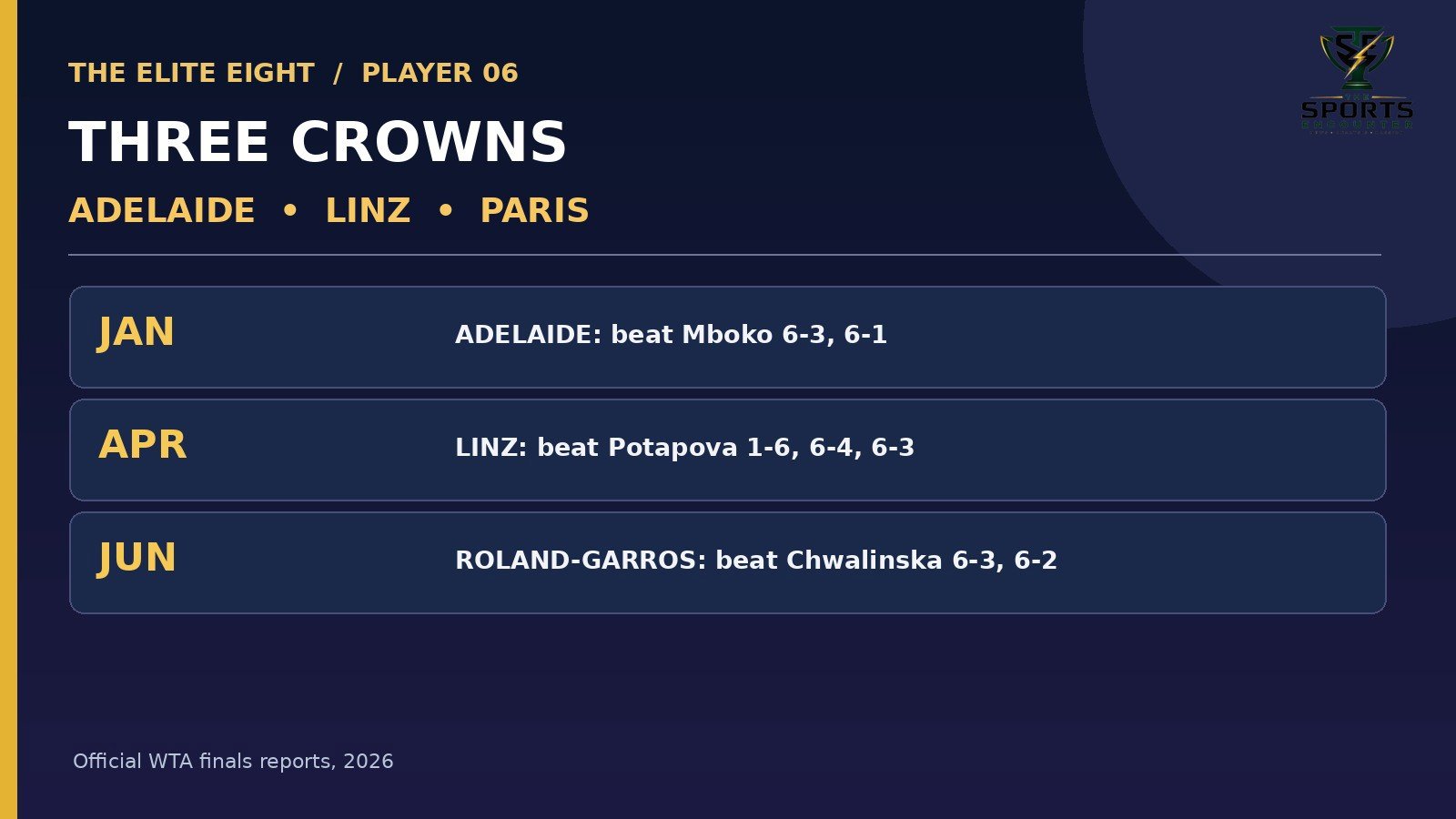
Before Roland-Garros changed her career, Andreeva had already won two WTA 500 singles titles in 2026. Adelaide gave her a strong start to the year, while Linz confirmed that her game could succeed indoors as well as outdoors. Neither championship carries the historical status of a Grand Slam, but both mattered because they gave her repeated experience of protecting leads and finishing tournaments.
Roland-Garros 2026: The Championship That Changed Everything
Winning Roland-Garros at 19 transformed Andreeva’s status. She was no longer simply the young player expected to win a major one day. She had done it. The title also made her the first player born in 2007 to win a Grand Slam singles championship, a meaningful marker of the generational shift taking place in women’s tennis.
Read next Jessica Pegula’s Relentless 2026: 50 Wins, Five Finals, and the Crown That Still Eludes Her
Who Is Mirra Andreeva? Childhood, Family and Her Sister Erika
Andreeva was born in Krasnoyarsk on April 29, 2007. She began playing tennis at six and developed alongside her older sister Erika, herself a professional player. Their early training journey took them to Sochi and later Cannes, France, as they pursued higher-level coaching and competition. That move illustrates the commitment required to develop professional tennis players long before rankings and prize money became part of the conversation.
Her progress through junior tennis was followed by an unusually rapid transition to professional competition. Unlike many teenage prospects, she demonstrated a mature understanding of when to defend, when to change direction and when to attack. Her varied baseline game, controlled changes of pace and willingness to absorb difficult rallies distinguished her from players who depended almost exclusively on raw hitting power.
Former Wimbledon champion Conchita Martínez became her coach and has helped turn that versatility into more consistent tactical execution. Martínez’s own career offers an instructive example of winning with patience, court craft and an understanding of the opponent rather than simply striking harder. Andreeva has already won across different levels of the professional tour, including WTA 1000 titles in Dubai and Indian Wells in 2025.
Why Her Development Has Been So Rapid
Andreeva has three qualities that help explain the speed of her ascent. She reads the game early, makes relatively sophisticated decisions for her age and can change a rally’s pace without abandoning defensive structure. Those skills travel reasonably well between hard courts and clay. But they also require discipline under pressure, which is why matches such as her US Open quarterfinal provide useful evidence about the next phase of her development.
What Andreeva Achieved in 2026
The most efficient summary is simple: three titles from five finals, 50 match wins and a first Grand Slam singles championship. Yet those headline numbers only reveal part of her development. The season included the hard-court success of Adelaide, the indoor championship in Linz, the defining Roland-Garros triumph and further final appearances in Madrid and Beijing.
| 2026 measure | Result | What it means |
|---|---|---|
| Match record | 50–16 | 66 completed singles matches |
| Winning percentage | 75.8% | 50 divided by 66, rounded to one decimal |
| Titles | Three | Adelaide, Linz and Roland-Garros |
| Finals reached | Five | Three wins, two defeats |
| Final conversion | 60% | Three championships from five finals |
| Career singles trophies | Six | Includes three won during 2026 |
| Ranking | No. 3 | Career-high standing |
| WTA Finals | Debut | First appearance in the singles championship |
Why Fifty Wins Matter
Fifty victories across 66 matches indicate that Andreeva was not dependent on one extraordinary fortnight in Paris. Her championship form translated into other tournaments, surfaces and parts of the calendar. She tied Jessica Pegula’s pre-Finals win total, providing evidence that her emergence is supported by the consistency needed to remain near the top of the rankings.
Still, her two runner-up finishes are important. Sustaining a run through several rounds is different from producing a complete performance on the final day. The distinction is particularly relevant at Indian Wells, where there is no easy opening opponent and the round-robin format can punish a lapse in concentration.
Adelaide and Linz: The Titles That Prepared Her for Paris
Before Roland-Garros changed her career, Andreeva had already won two WTA 500 singles titles in 2026. Adelaide gave her a strong start to the year, while Linz confirmed that her game could succeed indoors as well as outdoors. Neither championship carries the historical status of a Grand Slam, but both mattered because they gave her repeated experience of protecting leads and finishing tournaments.
| Event | Level | 2026 finish | Significance |
|---|---|---|---|
| Adelaide | WTA 500 | Champion | Early-season momentum on hard courts |
| Linz | WTA 500 | Champion | Indoor success and additional ranking points |
| Madrid | WTA 1000 | Runner-up | Reached a major clay-court final |
| Roland-Garros | Grand Slam | Champion | First Grand Slam singles trophy |
| Beijing | WTA 1000 | Runner-up | Confirmed strong late-season form |
The surface variety makes her results especially noteworthy. A player who succeeds in contrasting conditions usually has more than one effective tactical pattern. Andreeva can defend patiently and redirect the ball, but she can also generate attacking depth and change direction when an opponent leaves the court exposed.
Roland-Garros 2026: The Championship That Changed Everything
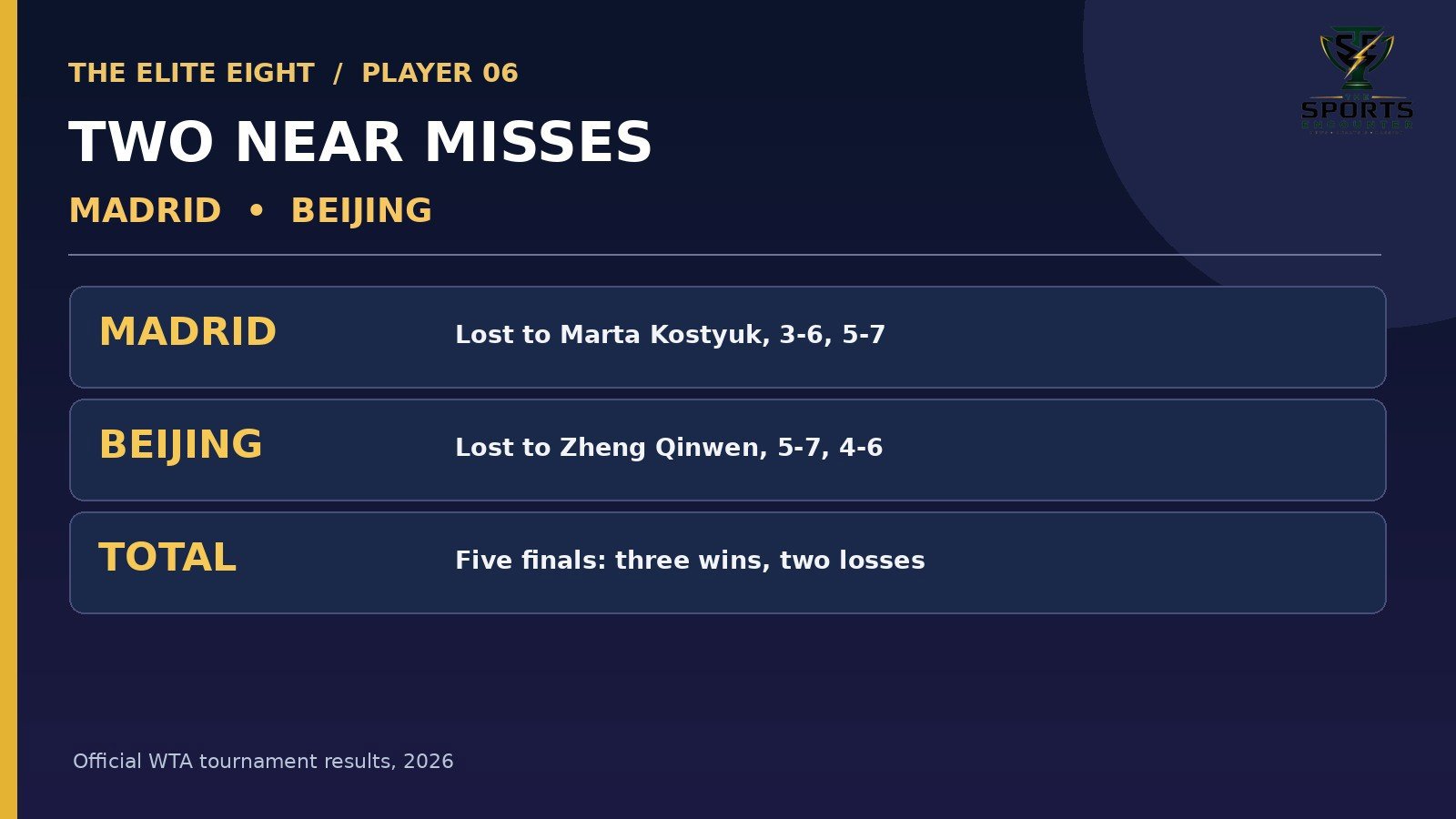
Winning Roland-Garros at 19 transformed Andreeva’s status. She was no longer simply the young player expected to win a major one day. She had done it. The title also made her the first player born in 2007 to win a Grand Slam singles championship, a meaningful marker of the generational shift taking place in women’s tennis.
Clay rewards movement, patience and point construction. These conditions suited Andreeva’s ability to blend defense with sudden attacking changes. The French Open title therefore showcased qualities that had been visible during her development, but now under the sustained pressure of seven matches at a Grand Slam.
What the Victory Proved
It showed that she could win over two weeks, adjust between matches and handle the emotional demands of a Grand Slam championship. One title cannot guarantee that the same performance will return at every major, but it removes the uncertainty about whether she has the necessary standard of play.
The Sports Encounter covered Andreeva’s French Open breakthrough when the championship established her among tennis’ leading young players.
The Other Side of the Breakthrough: Madrid and Beijing
Andreeva’s two additional final appearances should not be dismissed because they ended in defeat. They demonstrate she could contend for trophies on multiple occasions while carrying the expectations that followed her major breakthrough. But their significance is also analytical: reaching a final is evidence of sustained performance, while winning it requires one more effective match against an opponent in equally strong form.
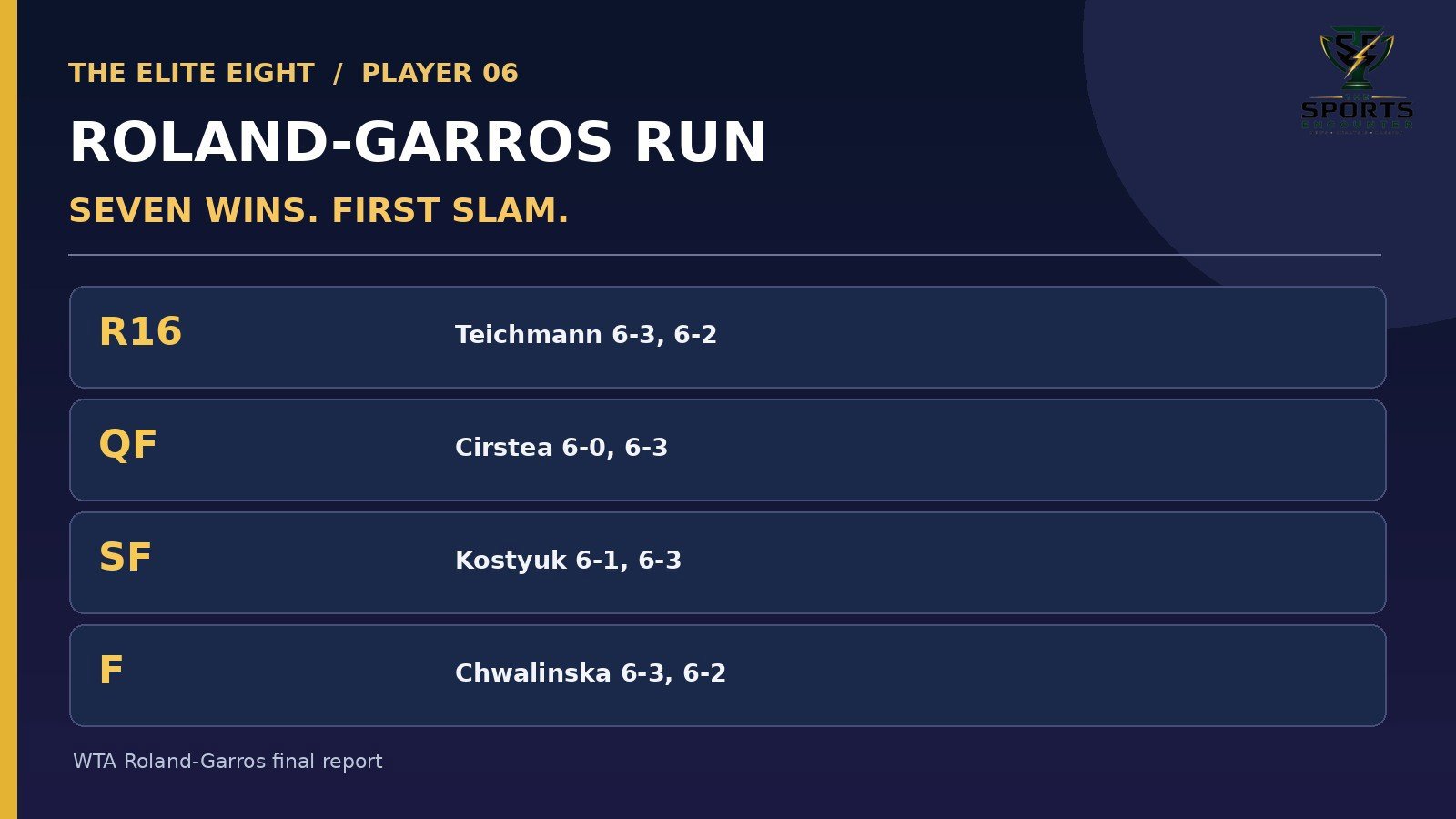
| Championship category | Finals | Titles | Conversion |
|---|---|---|---|
| Grand Slam | 1 | 1 | 100% |
| WTA 1000 | 2 | 0 | 0% |
| WTA 500 | 2 | 2 | 100% |
| Total | 5 | 3 | 60% |
These figures describe one season and should not be treated as a prediction that she will always perform differently at different event levels. The useful observation is that the WTA 1000 finals remained the missing category in her otherwise excellent 2026 campaign, despite having won two WTA 1000 titles during 2025.
The US Open Quarterfinal: Two Match Points Against Coco Gauff
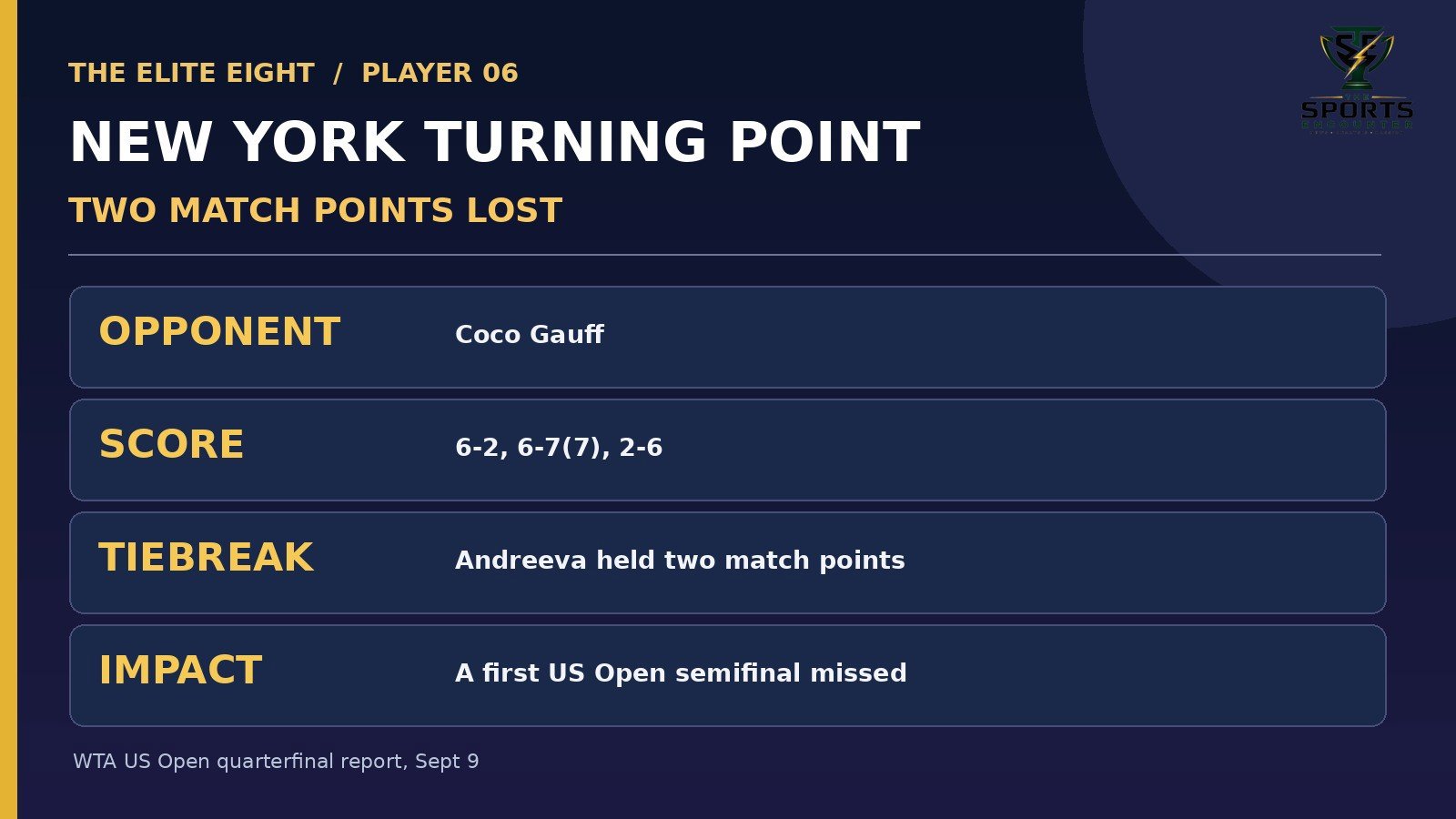
One of Andreeva’s most instructive matches came in New York. She pushed Coco Gauff to the brink in their US Open quarterfinal, taking the first set and creating two match points in the second-set tiebreak. Gauff saved both, forced a third set and completed a 2-6, 7-6(7), 6-2 victory from her perspective.
That result should not be reduced to a simple failure of nerve. Gauff is a major champion and one of the best defenders in the game. She can force opponents into uncomfortable additional shots even when a rally appears to be under control. But from Andreeva’s perspective, the narrow margin at match point became a central question about her ability to execute the right decision at the most important instant.
| Match turning point | Confirmed event | Lesson for the WTA Finals |
|---|---|---|
| First set | Andreeva won 6-2 | Her game can dictate terms against Gauff |
| Second-set tiebreak | Andreeva held two match points | Execution in decisive moments remains critical |
| Tiebreak outcome | Gauff won 9-7 | Momentum can reverse quickly |
| Third set | Gauff won 6-2 | Emotional and tactical reset matters after a setback |
| Final score | Gauff won 2-6, 7-6(7), 6-2 | Closing difficult matches is a distinct skill |
Our report on Gauff’s extraordinary US Open escape against Andreeva examines the comeback. The match also forms an important chapter in Gauff’s 2026 season profile.
What Her Four Grand Slam Performances Tell Us
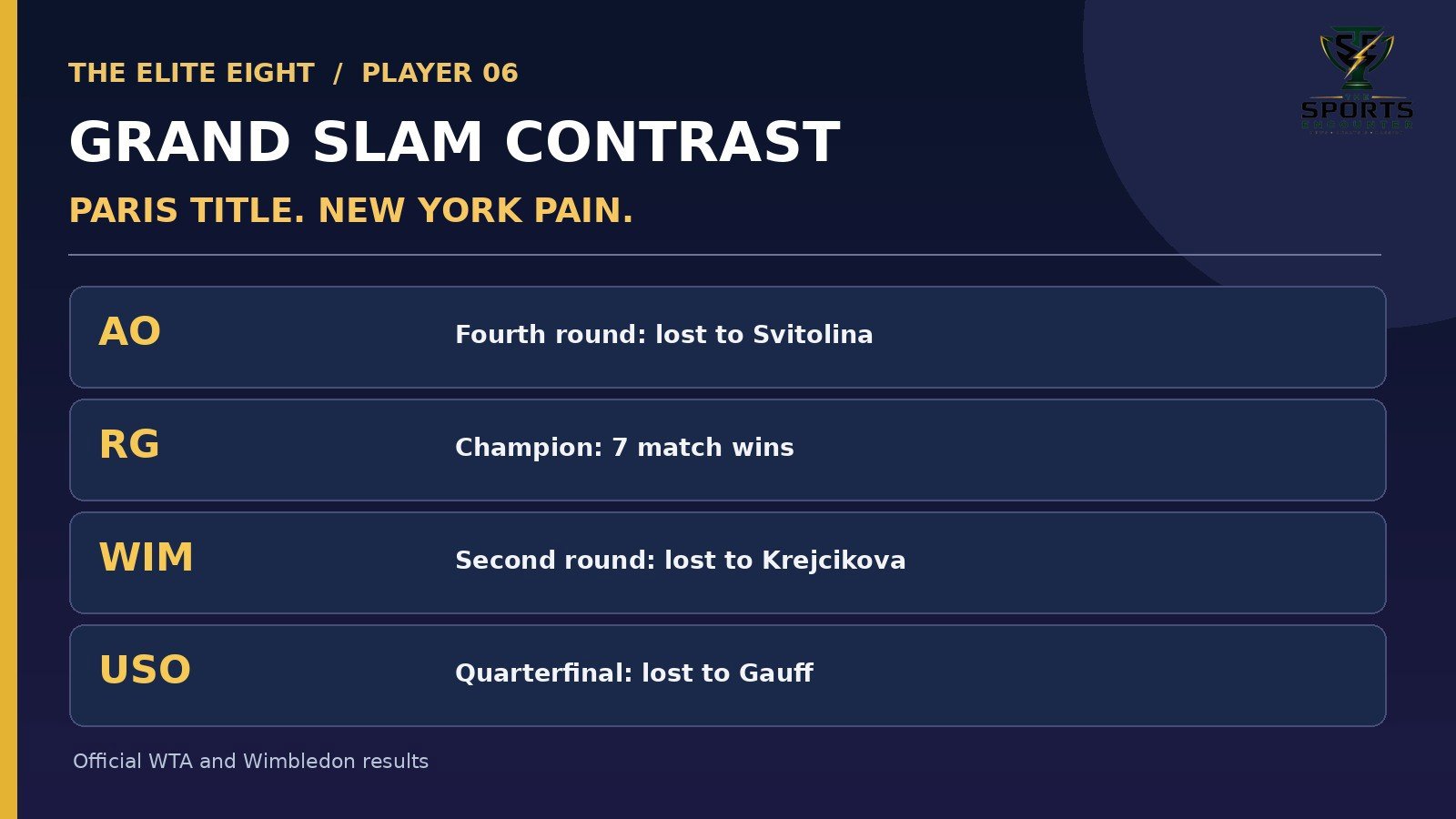
Her French Open title was the standout performance, but the US Open quarterfinal also reinforced her hard-court credentials. Wimbledon did not produce a comparable run. The contrasting outcomes show why a major championship and a full season of dominance are not the same achievement.
| Grand Slam | 2026 finish | Season significance |
|---|---|---|
| Australian Open | Fourth round | Started the major season with a second-week appearance |
| Roland-Garros | Champion | First Grand Slam singles title |
| Wimbledon | Early exit | Grass remained a difficult challenge in 2026 |
| US Open | Quarterfinal | Lost to Gauff after holding two match points |
The question for Andreeva is whether she can use her clay-court success as a foundation without expecting the same tactical balance to work automatically on every surface. Hard-court opponents can attack the second serve earlier, use the ball’s flatter trajectory and deny her the time available on clay.
Conchita Martínez and the Evolution of Andreeva’s Game
Martínez’s influence is worth examining because Andreeva’s rise is not built on one spectacular shot. She has learned to change spin, absorb pace and recognize when a defensive rally offers an opening. This matters enormously against powerful hitters such as Sabalenka, who can often dominate opponents who attempt to exchange force for force.
Technical development is only one element. Equally important is learning to separate the last point from the next. A missed match point, a lost tiebreak or an opponent’s sudden run must not become a reason to abandon an otherwise effective game plan.
At 19, Andreeva has time to improve these skills. At the WTA Finals, however, she must use the tools she already possesses. There is no opportunity for a lengthy technical rebuild between three round-robin matches.
Her WTA Finals Group: Three Opponents, Three Different Problems
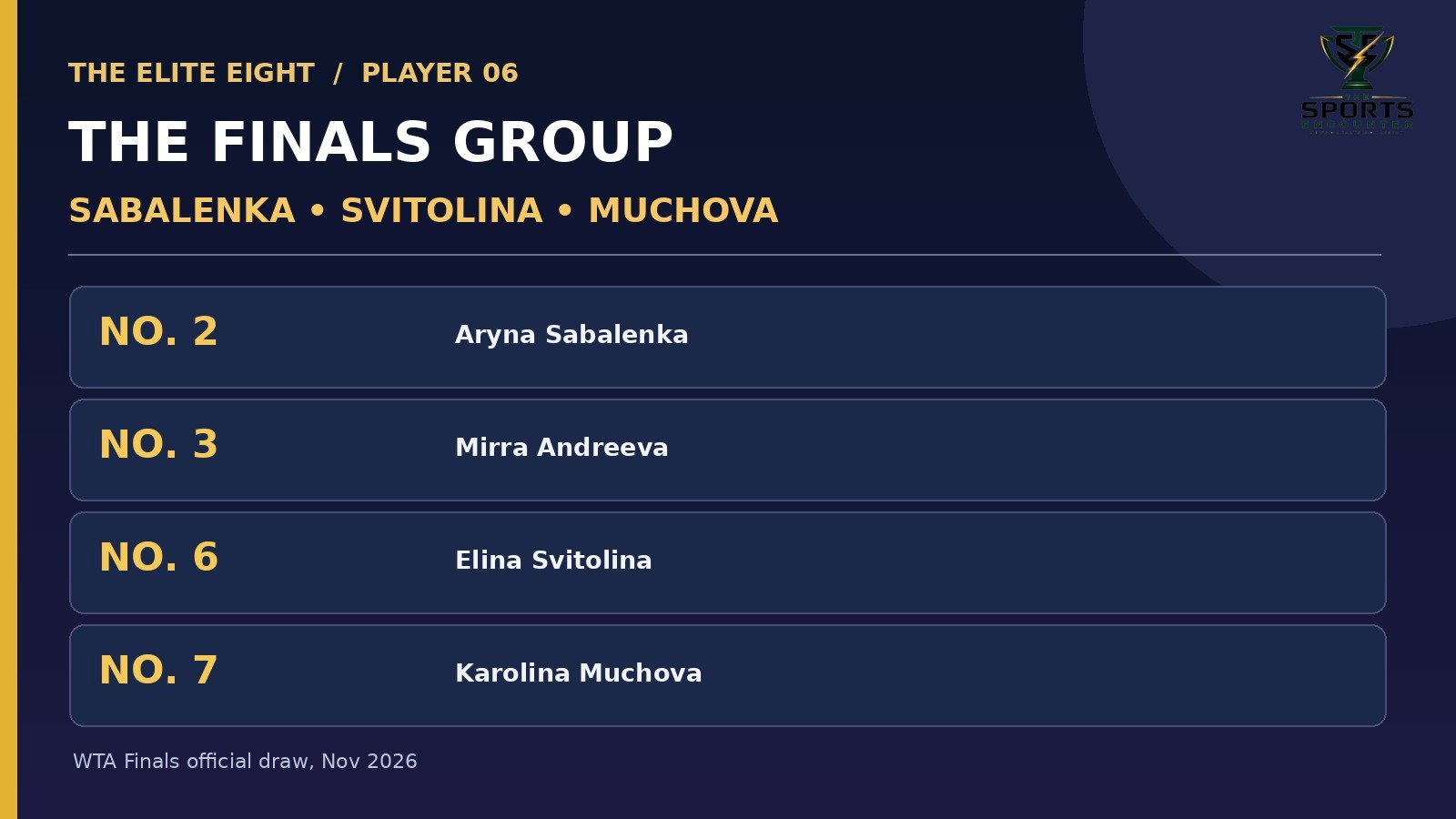
The official draw placed Andreeva in Group 2 with Aryna Sabalenka, Elina Svitolina and Karolína Muchová. The group-stage matchdays are November 9, 11 and 13. The top two advance to the semifinals.
| Opponent | Primary challenge | Andreeva’s tactical response |
|---|---|---|
| Aryna Sabalenka | Serve and first-strike power | Return with depth; resist rushed changes of direction |
| Elina Svitolina | Court coverage, patience and controlled aggression | Build points carefully and finish openings decisively |
| Karolína Muchová | Variety, net transitions and unpredictable patterns | Read the approach early and avoid repetitive crosscourt exchanges |
Aryna Sabalenka: Can Andreeva Resist the Power?
Sabalenka’s serve and aggressive baseline game can deprive opponents of time. Andreeva must protect her own second serve and return with enough depth to prevent the Belarusian from stepping inside the court at will. Defensive skill is valuable, but simply absorbing endless attacks is unlikely to be a winning strategy.
Elina Svitolina: A Test of Patience
Svitolina brings the experience of winning the WTA Finals in 2018 and showed exceptional adaptability during her 2026 Rome championship. She is comfortable extending rallies but has also improved her willingness to attack. Andreeva must resist the temptation to force winners before creating a genuine opening. Read Svitolina’s full 2026 profile for the details of her comeback and 20th career title.
Karolína Muchová: An Opponent Who Changes the Picture
Muchová can slice, redirect, vary pace and move forward. That variety can prevent Andreeva from settling into the same rhythm that makes her so effective on clay. The Czech’s 2026 campaign included titles in Doha and Bad Homburg, as well as a Wimbledon final. Explore Muchová’s return to the elite for the wider context.
Can Andreeva Reach the Semifinals?
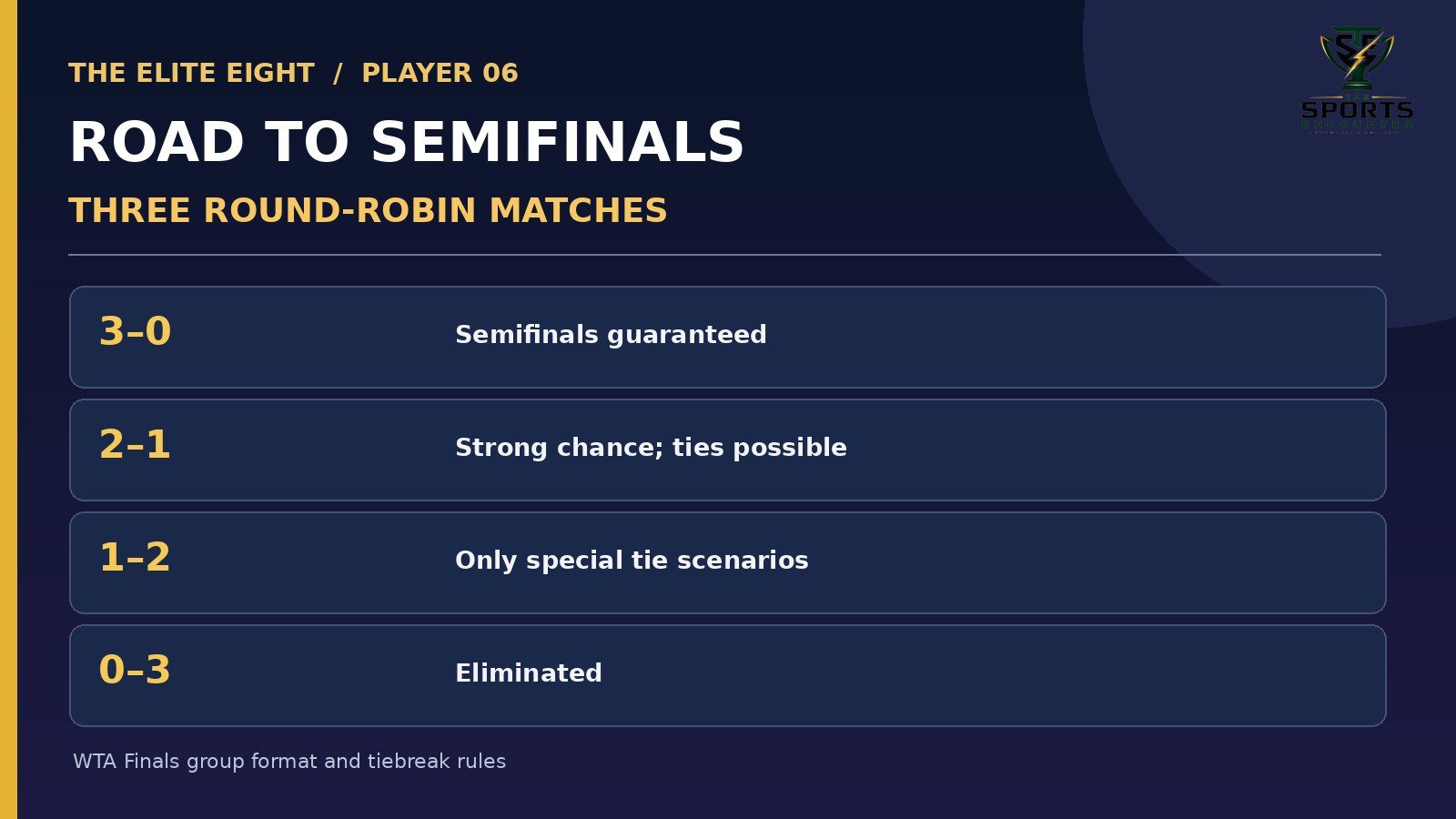
The round-robin format creates several possibilities. Three victories guarantee qualification. Two generally place a player in strong contention, but ties and official tiebreak procedures can influence the final table. One victory can sometimes be enough only in particular combinations of other results; zero wins mean elimination.
| Round-robin record | Qualification outlook | What to watch |
|---|---|---|
| 3–0 | Guaranteed semifinalist | Strongest possible group performance |
| 2–1 | Strong position, not automatically guaranteed | Possible tied records and official tiebreaks |
| 1–2 | Only possible in limited scenarios | Other matches and set or game percentages |
| 0–3 | Eliminated | Cannot finish in the top two |
Andreeva’s immediate priority is to establish confidence in her first group match against Svitolina on November 9. Avoiding a slow start matters when only three matches are guaranteed. Readers can follow the WTA Finals 2026 schedule, group tables and results at The Sports Encounter, along with our analysis of the official group draw.
Why Her First WTA Finals Appearance Matters
Andreeva narrowly missed the 2025 WTA Finals and later acknowledged that she had mishandled part of her tournament scheduling. Her qualification in 2026 is therefore a measurable step forward. She has turned a season of considerable potential into one that includes a major title and a place among the eight most successful singles players of the year.
Unlike a standard knockout tournament, the WTA Finals can require a player to recover from a defeat without being eliminated. That format rewards emotional discipline. It is also an opportunity for a teenager who has already shown she can win under Grand Slam pressure to learn how to maintain her standard across several matches against Top 10 opposition.
The Sports Encounter Verdict: A Champion Still Learning to Close
Mirra Andreeva’s best argument for success at Indian Wells is that she has already won matches at virtually every level of professional tennis. Her 2026 season brought 50 victories and a Grand Slam trophy, while her 2025 WTA 1000 championships demonstrated hard-court pedigree. She should not be treated as an outsider simply because this is her first WTA Finals appearance.
Her greatest uncertainty is how she responds when elite opponents challenge her tactical decisions on the most important points. The US Open loss to Gauff is one example, but it is not a verdict on her future. At 19, Andreeva has already accumulated more high-level experience than many players possess years later.
Our assessment: Andreeva has a credible route to the semifinals if she protects her service games, mixes defensive patience with timely aggression and stays composed after momentum shifts. Sabalenka is the most formidable first-strike threat, while Svitolina and Muchová present different tactical problems. A title would be another extraordinary achievement, but even a competitive semifinal run would confirm that her major-winning season represents lasting progress.
Continue the WTA Finals Story
 WTA FinalsElina Svitolina’s Defiant 2026: 20 Titles, a Wimbledon Collapse and One More Shot at WTA Finals Glory
 WTA FinalsKarolína Muchová’s 2026 Revival: 2 Titles, Wimbledon Heartbreak and the Long Road to the WTA Finals
 WTA FinalsLinda Nosková’s Remarkable 2026: Wimbledon Glory, Personal Loss and a WTA Finals Dream
Frequently Asked Questions About Mirra Andreeva
How Old Is Mirra Andreeva?
She was born on April 29, 2007, and is 19 as of November 2026.
Where Is Mirra Andreeva From?
She was born in Krasnoyarsk, Siberia, Russia, and later trained in Sochi and Cannes, France.
Who Is Mirra Andreeva’s Coach?
Former Wimbledon champion Conchita Martínez coaches Andreeva.
Is Erika Andreeva Her Sister?
Yes. Erika is her older sister and is also a professional tennis player.
How Many Grand Slam Singles Titles Has Mirra Andreeva Won?
One, the 2026 French Open at Roland-Garros.
What Was Her 2026 Win-Loss Record?
She recorded 50 wins and 16 losses before the WTA Finals, a winning percentage of approximately 75.8%.
How Many WTA Singles Titles Has Andreeva Won?
Six career titles, including Adelaide, Linz and Roland-Garros in 2026.
Who Is in Andreeva’s WTA Finals Group?
Group 2 consists of Andreeva, Aryna Sabalenka, Elina Svitolina and Karolína Muchová.
Has Andreeva Played the WTA Finals Before?
No. The 2026 event is her singles debut.
When Will Andreeva Start at the 2026 WTA Finals?
Her group begins play on November 9, with subsequent Group 2 sessions scheduled for November 11 and 13.
Official Sources
Primary references include the official WTA player profile, the WTA’s 2026 season review, and the official WTA Finals draw.
This is Article 6 of The Elite Eight: Road to the WTA Finals 2026, The Sports Encounter’s eight-profile series examining the season, background, playing style and championship chances of every singles qualifier.
Mirra Andreeva
- Mirra Andreeva’s Historic 2026: Roland-Garros Glory, 50 Wins, and the Battle to Become Tennis’ Next Queen
- Andreeva Survives Two Tiebreaks as Bartunkova Crushes Muchova to Set Up China Open Semifinal
- China Open 2026: Muchova Survives Osaka, Andreeva Cruises, While Bartunkova Continues to Break Through
- Bartunkova Stuns Sabalenka, Osaka Survives, and Andreeva Takes Control as Beijing Draw Opens Up
- Leylah Fernandez Beats Mirra Andreeva 6-2, 7-5, Extends 3-0 Hard-Court Edge to Reach Singapore SFs