Connect with us

Breaking News

French Open 2026: Mirra Andreeva Becomes a Grand Slam Reality

Jovana Zlatova | The Sports Encounter

Published

on

French Open 2026 Mirra Andreeva Becomes a Grand Slam Reality | The Sports Encounter

Loading

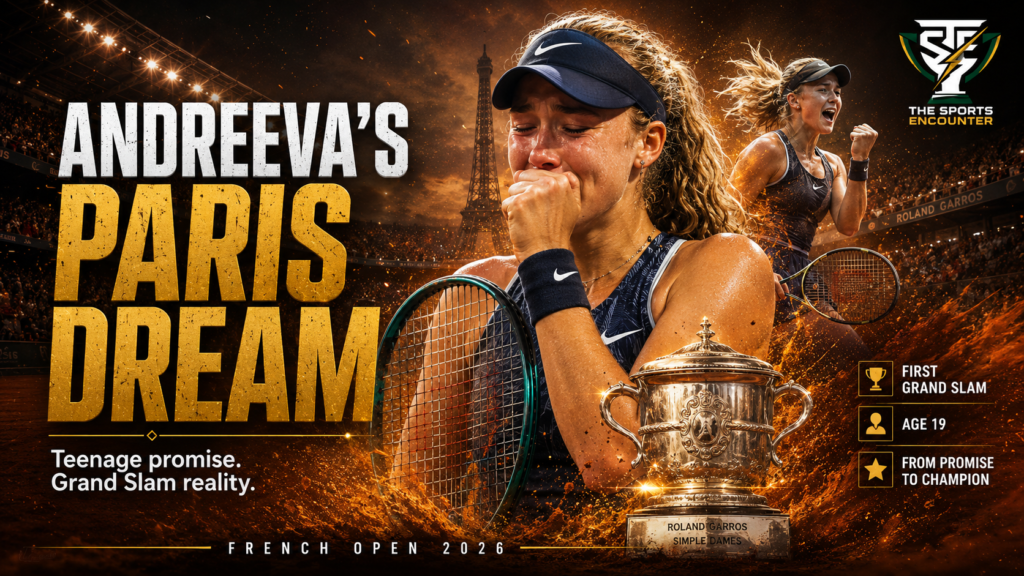
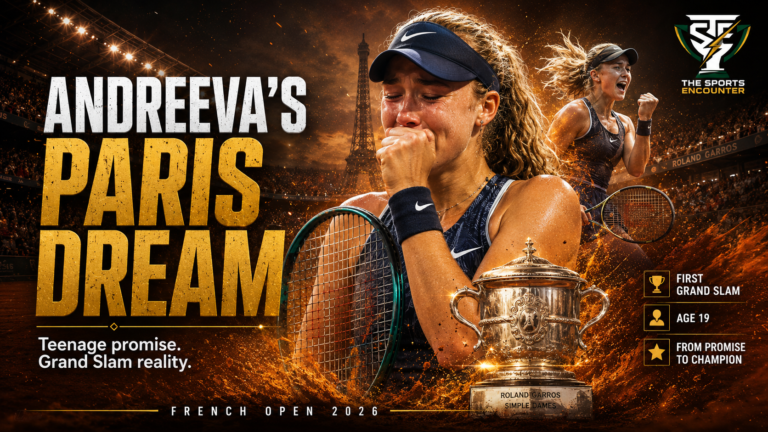
Mirra Andreeva relived the memories of Monica Seles on Super Sunday at Roland Garros to lift her maiden French Open title in front of a packed crowd.

An exclusive story by Jovana Zlatova.

Every few years, tennis gets a teenager who looks different.

Not just talented. Not just fast. Different.

Mirra Andreeva had carried that feeling for some time. She had the timing, the feel, the court sense, and the fearlessness that make people look up from their phones and say, “Watch this one.” But promise can be a tricky thing in tennis. It gets praised early, then questioned quickly. The attention overwhelms experience. It turns every loss into a debate about whether the player is ready.

At the French Open 2026, Andreeva stopped being only the future.

She became a Grand Slam champion.

The 19-year-old defeated Polish qualifier Maja Chwalinska 6-3, 6-2 in the Roland-Garros final to win her first major title. She became the youngest women’s singles champion in Paris since Monica Seles in 1992 and the first Russian woman to win a Grand Slam singles title since Maria Sharapova in 2014.

That is history.

But the real story is more human than the record book.

Mirra Andreeva French Open 2026 triumph was about a teenager learning how to carry pressure without letting it swallow her personality. It was about turning expectation into clarity. It was about proving that youth does not have to mean emotional chaos.

Mirra Andreeva’s French Open 2026 journey showed the full range of a young champion: early composure, one real comeback test, growing confidence, and a fearless finish in her first Grand Slam final.

Mirra Andreeva’s Road to French Open 2026 Glory

RoundOpponentResultScoreKey takeaway
Round 1Fiona FerroWon6-3, 6-3Calm start in front of the Paris crowd
Round 2Marina Bassols RiberaWon3-6, 6-1, 6-1Lost the first set, then showed serious mental strength
Round 3Marie BouzkovaWon6-4, 6-2Controlled a tricky opponent with clean, disciplined tennis
Round 4Jil TeichmannWon6-3, 6-2Stayed composed and moved closer to the deep rounds
QuarterfinalSorana CirsteaWon6-0, 6-3Produced one of her most dominant performances
SemifinalMarta KostyukWon6-1, 6-3Played with maturity beyond her age to reach the final
FinalMaja ChwalinskaWon6-3, 6-2Sealed her first Grand Slam title with controlled aggression

From Talent to Champion: The Road Had Already Started

Andreeva’s rise did not begin with the final.
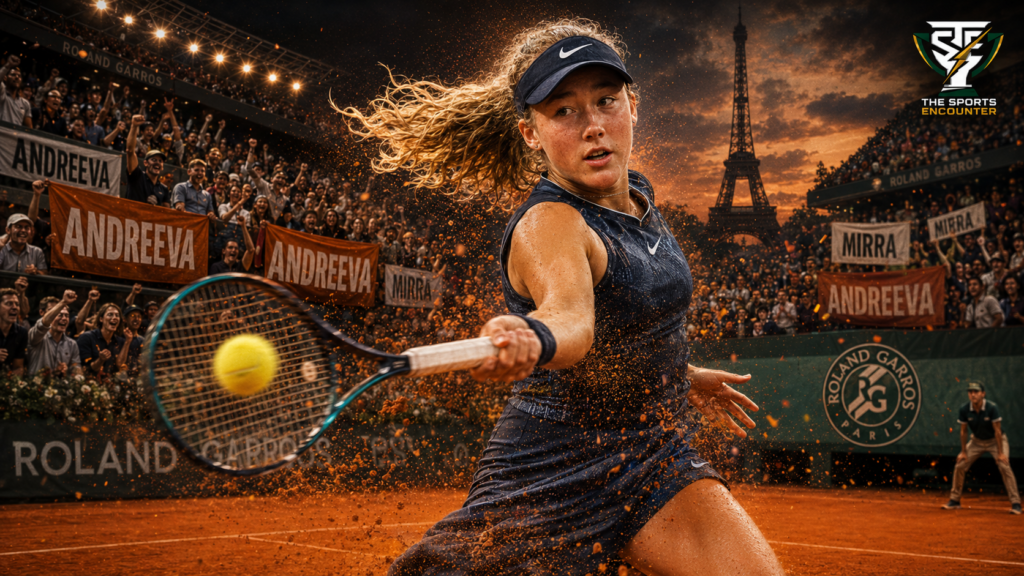
She had already announced herself as one of tennis’ most exciting young players before Paris 2026. She reached the Australian Open girls’ final in 2023, qualified for her first Grand Slam main draw at Roland-Garros that same year, and later made a breakout run to the French Open semifinals in 2024.

That semifinal run mattered.

It showed that Paris suited her game. Clay rewards players who can think, adjust, build points, defend, and attack at the right time. Andreeva has those layers. She can absorb pressure from the baseline, change direction early, and create openings without forcing every shot.

But promise alone does not win majors.

By 2026, she had added something more important: emotional control.

Teenage tennis can be wild. One moment looks brilliant. The next looks rushed. Andreeva had shown fiery edges in earlier stages of her career, but at Roland-Garros 2026 she looked more settled. Not emotionless. Just more aware of when to breathe, when to reset, and when to let the point go.

That growth made the difference.

Mirra Andreeva French Open 2026 Route to the Title

Andreeva’s path to the title included wins over Fiona Ferro, Marina Bassols Ribera, Marie Bouzkova, Jil Teichmann, Sorana Cirstea, Marta Kostyuk, and Maja Chwalinska.

That route tested different parts of her game.

Early rounds at a Grand Slam can be uncomfortable for a seeded player. The public expects progress. The opponent plays with freedom. Every set carries the risk of a headline. Andreeva managed those rounds with the professionalism of someone older than 19.

The middle rounds asked more of her patience.

Opponents tried to vary height, rhythm, and rally length. Clay-court tennis often turns into a mental negotiation: how much risk is enough, how much defense is too passive, how much aggression can the court accept? Andreeva kept finding the answer.

By the time she reached the final stages, her game had a calm shape.

She dropped only one set across seven matches, according to reports, and moved through the tournament with increasing authority. That is the sign of a champion who is not just surviving the draw but growing through it.

Mirra Andreeva French Open 2026 Route to the Title | The Sports Encounter

The semifinal win over Marta Kostyuk sharpened the story. Kostyuk had the experience and the power to make Andreeva uncomfortable. Andreeva responded with controlled aggression and strong emotional discipline, giving herself a first Grand Slam final.

Then came Chwalinska, the tournament’s other great story.

The Final Against Maja Chwalinska Was a Test of Nerve

The French Open women’s final had a rare feeling.

Both players were chasing a first Grand Slam title. Andreeva was the higher-ranked player and the favorite. Chwalinska was the qualifier whose run had captured attention across the tournament. She had come through qualifying, won nine matches to reach the final, and built one of the most unexpected Roland-Garros stories in recent memory.

That made the match dangerous for Andreeva.

Favorites in first major finals can tighten up. The mind knows the opportunity is real. The body knows history is close. The opponent has nothing to lose. The crowd senses a story.

Andreeva handled it beautifully.

She won the first set 6-3 and then pushed ahead in the second with the kind of calm that makes a young player look suddenly grown. Chwalinska fought, chased, and tried to stretch the match into something more complicated, but Andreeva kept returning to the basics: clean timing, early ball control, smart movement, and no unnecessary panic.

The 6-3, 6-2 scoreline looked simple.

The moment was not.

Winning a first Grand Slam final requires more than tennis. It requires a player to walk onto the court with a childhood dream in one hand and a global audience in the other, then still swing freely.

Andreeva did that.

Why Mirra Andreeva French Open 2026 Title Feels Inspirational

Andreeva’s title is inspiring because it shows that youth and maturity can meet earlier than expected.

The easy story is that she is a teenage prodigy. That is true, but it is not enough. Many prodigies arrive with talent. Fewer learn how to manage expectation before it damages them.

Andreeva did not win Roland-Garros by playing like someone untouched by pressure. She won by accepting pressure and still choosing the right shots.

That distinction matters.

For young athletes, pressure often feels like proof that something is wrong. In reality, pressure is proof that something meaningful is happening. Andreeva looked like a player who had learned that lesson quickly. She did not run from the size of the occasion. She played inside it.

There is also a lesson in how she handled the attention around her.

Teenage stars can be pushed into becoming brands before they become adults. Andreeva still carries a natural sense of humor and honesty that makes her relatable. Reports around her tournament spoke about simple routines, mental work, and the support of coach Conchita Martinez. Those details matter because they show the human side of elite sport.

A Grand Slam is won by forehands and backhands, but it is also won by the people who steady you when your own thoughts get loud.

Chwalinska’s Run Made Andreeva’s Win Even More Meaningful

It would be wrong to tell Andreeva’s story without respecting Chwalinska’s.

The Polish qualifier produced one of the most remarkable runs of the tournament. She arrived at Roland-Garros far outside the usual title conversation and reached the final after winning through qualifying and the main draw. Her run reminded fans why Grand Slams remain powerful: because the draw still has room for stories nobody predicted.

That made Andreeva’s task harder.

She was not facing only an opponent. She was facing momentum, emotion, and a crowd-ready fairytale. Chwalinska had already beaten expectations many times before the final. Players in that position can be dangerous because they feel free.

Andreeva had to stop the story without getting caught inside it.

She did.

That is championship maturity.

Andreeva Turned the Impossible Into the Inevitable

Mirra Andreeva French Open 2026 triumph will be remembered as a breakthrough, but it may also become the start of something larger.

She did not steal the title. She built it.

Round by round, she looked more comfortable with who she was becoming. Mirra did not need to overpower every opponent. She did not need to perform for drama. She trusted her game, managed her emotions, and stayed present long enough for the dream to become real.

That is the part fans should hold onto.

Impossible tasks rarely become possible in one giant leap. They become possible through small, repeated acts of belief. One hold of serve. One calm response after a bad point. One conversation with a coach. One practice session after a painful loss. One decision to stop being afraid of the stage.

At 19, Andreeva showed that greatness does not always wait for permission.

She walked into Roland-Garros as one of tennis’ brightest young talents. She left as a Grand Slam champion.

For readers, young athletes, and tennis fans, her story carries a simple message: being early does not mean being unready. Sometimes the dream arrives before the world expects it, and the only thing left is to meet it with courage.

In Paris, Mirra Andreeva did exactly that.

Sports Writer, Europe. Jovana Zlatova covers European sports for The Sports Encounter, with a focus on major events, match-day atmosphere, athlete stories, fan culture, and the human side of competition across the continent. Her coverage includes tennis, football, international tournaments, European sports culture, and feature-led reporting from the region. Coverage areas: European sports, tennis, football, major events, athlete stories, fan culture.

Breaking News

Spurs Stun Knicks in Game 3 to Keep 2026 NBA Finals Alive

Jawad Hussain | The Sports Encounter

Published

on

Spurs Stun Knicks in Game 3 to Keep the 2026 NBA Finals Alive | The Sports Encounter

Loading

The 2026 NBA Finals needed a pivot point, and Game 3 delivered it Monday night.

The San Antonio Spurs walked into Madison Square Garden under the kind of pressure that can swallow a young team whole. They had already lost the first two games at home. They had blown leads, and a bitter history against them. Victor Wembanyama had taken heat after his late mistake in Game 2.

On the other hand, the New York Knicks were riding a 13-game postseason winning streak, returning to a home Finals atmosphere their fans had waited nearly three decades to experience.

A Knicks win would have made it 3-0. In NBA Finals language, that would have sounded almost like a closing argument.

Instead, San Antonio won 115-111, cut the series to 2-1, ended New York’s playoff winning streak, and turned Game 4 into the most important game of the season so far.

This was not just a road win. It was a survival statement.

Here is the quarter-by-quarter score table for the 2026 NBA Finals Game 3: San Antonio Spurs vs New York Knicks. The Spurs won 115-111, cutting the Knicks’ series lead to 2-1.

TeamQ1Q2Q3Q4Final
San Antonio Spurs33243523115
New York Knicks22422720111

Quarter flow: Spurs started fast, Knicks exploded with a 42-point second quarter, but San Antonio’s 35-27 third quarter flipped the game back before they closed it out in the fourth.

Why Game 3 of the 2026 NBA Finals Mattered So Much

The best-of-seven Finals format gives teams room to adjust, but only up to a point. A 2-0 deficit is dangerous. A 3-0 deficit is close to fatal.

That is why Game 3 carried more emotional and tactical weight than a normal Finals game. The Spurs were not only trying to win one game. They were trying to stop the series from becoming a coronation for the Knicks.

New York had already stolen Games 1 and 2 in San Antonio. That meant the Knicks had flipped home-court advantage and entered Game 3 with a chance to put the Spurs in a historic hole. The Garden was loud, hungry, and ready to push the Knicks within one win of their first NBA championship since 1973.

San Antonio answered with maturity beyond its years.

The Spurs did not play a perfect game. They lost control during a wild second quarter. They had to survive another Knicks surge. They had to execute late under brutal pressure. But that is exactly what made the win important. They did not need a clean game. They needed proof that they could take a punch, reset, and finish.

Game 3 gave them that proof.

The Turning Point: San Antonio’s Third-Quarter Response

The Knicks looked ready to take over in the second quarter.

After San Antonio started fast and built another double-digit lead, New York exploded for 42 points in the second period. The Knicks turned the building into a pressure chamber, flipped the game, and carried a 64-57 lead into halftime.

At that point, the Spurs were staring at a familiar problem. They had already lost big leads earlier in the series. Game 3 was becoming another test of nerve.

Then came the response.

San Antonio opened the third quarter with better spacing, cleaner ball movement, and sharper defensive focus. The Spurs scored 35 points in the period and took a 92-91 lead into the fourth quarter. That third quarter changed the game because it changed the rhythm. The Knicks had turned the first half into their kind of fight. The Spurs used the third to make it theirs again.

The importance of that stretch cannot be overstated. Young teams often lose Finals games in the minutes after halftime, especially on the road. San Antonio did the opposite. They used halftime to calm the game down, get organized, and attack.

That was the difference between going home wounded and staying alive.

Victor Wembanyama Delivers His Signature Finals Performance

Victor Wembanyama needed this game.

After Game 2, the conversation around him was not only about talent. It was about composure. Could he respond after a costly late-game moment? Could he handle the Garden? Could he dominate when the Spurs needed him most?

He answered with 32 points, eight rebounds, six assists, two steals, and three blocks.

This was the kind of performance that explains why Wembanyama changes the entire geometry of a basketball game. He scored in different ways. He passed out of pressure. He protected the rim. He forced New York to rethink possessions before they even developed.

His late fourth-quarter stretch mattered most. With the game tightening and the Garden waiting for another Knicks push, Wembanyama finished an alley-oop from De’Aaron Fox, then drew contact and made free throws to stretch the Spurs’ lead. Those plays gave San Antonio breathing room when every possession felt like a season-defining moment.

This was not just a big stat line. It was a leadership game.

Stephon Castle Gives Spurs the Secondary Punch They Needed

Wembanyama was the headline, but Stephon Castle gave the Spurs something they had badly needed in the series: reliable secondary creation.

Castle finished with 23 points, five rebounds, and five assists. He was especially important when San Antonio needed someone other than Wembanyama to carry stretches of the offense.

His most important play came late in the fourth quarter. With New York cutting into the lead and the Garden roaring again, Castle hit a massive three late in the shot clock. That shot pushed San Antonio’s lead to seven and quieted the building at exactly the right moment.

Then, with the Knicks still fighting in the final seconds, Castle made the free throws that helped seal the game.

For a young player in a Finals road environment, that is serious growth.

De’Aaron Fox Finds the Right Moment

De’Aaron Fox did not control the entire night, but he made one of the biggest shots of the game.

With the Spurs protecting a narrow lead in the final seconds, Fox hit a stepback jumper to give San Antonio a five-point cushion. It was the kind of late-game shot that matters beyond the box score because it changes the emotional temperature of a series.

Fox’s biggest value in Game 3 was not volume. It was timing.

He helped organize San Antonio after the second-quarter chaos. He attacked when the Spurs needed downhill pressure. He trusted Wembanyama and Castle. And when the game demanded one calm shot, he delivered it.

Knicks’ Stars Leave Questions for Game 4

The Knicks still lead the series, but Game 3 exposed pressure points.

Jalen Brunson fought late and hit a big fourth-quarter three, but his overall night was uneven. He struggled with efficiency and turnovers, and San Antonio’s length bothered him more than it had in earlier games.

Karl-Anthony Towns had a quiet night by his standards. The Knicks need him to be more assertive in Game 4, especially if San Antonio continues to pressure Brunson and crowd New York’s main actions.

Mikal Bridges also had a poor offensive game. For a Knicks team built on balance, that matters. New York can survive one cold stretch from a key player, but not many silent nights when the Finals tighten.

OG Anunoby was New York’s best two-way performer. He gave the Knicks scoring, physicality, and a clutch corner three late in the fourth quarter that briefly brought the Garden back to life. His performance gives New York something to build on, but it also highlights the problem: too much of the supporting cast faded when the game became a half-court battle.

2026 NBA Finals: Key Moments from Game 3

The first key moment came early. San Antonio jumped out fast, with Wembanyama and Castle giving the Spurs immediate confidence. The Spurs looked loose, aggressive, and ready to attack before the Knicks settled into the game.

2026 NBA Finals Key Moments from Game 3 | The Sports Encounter

The second key moment came during New York’s second-quarter avalanche. The Knicks scored 42 points in the period and turned a double-digit deficit into a seven-point halftime lead. For a while, it looked like the Spurs had lost control again.

The third key moment came after halftime. San Antonio scored 35 points in the third quarter, forced mistakes, moved the ball better, and regained the lead. That was the championship response.

The fourth key moment came late in the fourth quarter when Castle hit a huge three to stretch the lead. New York had cut into the deficit and the crowd was fully engaged. Castle’s shot gave San Antonio control again.

The fifth key moment came in the final seconds. Fox hit a stepback jumper, Anunoby answered with a corner three, then Castle made the closing free throws. The Spurs did not collapse. That may be the biggest takeaway of all.

How Game 3 Sets Up the Rest of the Series

The Knicks still control the series mathematically. They lead 2-1 and still have Game 4 at Madison Square Garden.

But the emotional balance has shifted.

Before Game 3, the Knicks looked like a team rolling toward history. After Game 3, they look like a team that has to solve real problems. San Antonio has found a formula: attack early, keep Wembanyama involved as both scorer and playmaker, trust Castle, and keep enough pressure on Brunson to make New York’s offense work harder.

Game 4 of the 2026 NBA Finals series now becomes a swing game.

If the Knicks win, they take a 3-1 lead and push San Antonio to the edge. That would restore their control and make Game 3 feel like a brief Spurs response.

If the Spurs win, the Finals become a 2-2 series. At that point, everything changes. New York’s early advantage disappears, San Antonio regains home-court leverage, and the series becomes a three-game sprint.

That is why Game 4 carries huge stakes.

What to Look for in Game 4

1. Can the Knicks Reignite Brunson Without Overloading Him?

Brunson remains New York’s engine, but San Antonio made him work for everything. The Knicks need cleaner spacing, faster decisions, and more off-ball movement to stop the Spurs from loading up on him.

If Brunson has to create everything late in the clock, San Antonio will live with that.

What to Look for in Game 4 of the 2026 NBA Finals series | The Sports Encounter

2. Will Towns Play With More Force?

Towns cannot drift through Game 4. The Knicks need him as a scoring threat, a rebounder, and a pressure point against San Antonio’s frontcourt. If he plays passively again, Wembanyama’s defensive influence grows even bigger.

3. Can the Spurs Repeat Their Third-Quarter Execution?

Game 3 turned because San Antonio came out of halftime with purpose. The question now is whether that was a one-game adjustment or the start of a real series solution.

Their ball movement, transition control, and shot quality after halftime will be critical in Game 4.

4. Castle’s Confidence Could Become a Series Factor

Castle’s Game 3 was not a cameo. It may have been a breakout. If he gives the Spurs another strong scoring and playmaking performance, the Knicks can no longer defend San Antonio as a Wembanyama-first, Fox-second team.

Castle changes the math.

5. The Garden Pressure Cuts Both Ways

Madison Square Garden helped fuel New York’s second-quarter run, but pressure also grows heavier at home when momentum turns. If San Antonio starts fast again, the Knicks will need to manage the emotional swings of the building.

Game 4 will test New York’s composure as much as its execution.

Who Will Win the 2026 NBA Finals?

Game 3 did not take the Finals away from the Knicks. It did something more interesting.

It made the series alive.

The Knicks still lead 2-1. They still have home court in Game 4. They still have Brunson, Towns, Anunoby, Bridges, and the Garden behind them.

But San Antonio now has belief. Wembanyama has his signature Finals game. Castle has announced himself as a real pressure player. Fox has made a late shot that can settle him. And the Spurs have shown they can win in New York even after absorbing a massive Knicks run.

That is how a Finals series changes.

Not always with a blowout. Not always with one historic shot.

Sometimes it changes when a young team walks into the loudest building in basketball, takes the hit, and still walks out alive.

Source notes: San Antonio won Game 3 115-111, cutting New York’s series lead to 2-1. NBA.com identified the Spurs’ 35-27 third quarter as the decisive response after New York’s 42-point second quarter, and noted Wembanyama’s 32 points, eight rebounds, six assists, two steals, and three blocks. Reuters also framed the game as a must-win for San Antonio, quoting Spurs coach Mitch Johnson on the team’s “attack mode” response. The Guardian live report highlighted Castle’s 23 points, five rebounds, five assists, Fox’s late jumper, Anunoby’s late corner three, and the end of New York’s 13-game postseason winning streak.

Continue Reading

Breaking News

Alexander Zverev Beats Flavio Cobolli, Agony to Lift Maiden French Open Title

Jovana Zlatova | The Sports Encounter

Published

on

Alexander Zverev Beats Flavio Cobolli, Agony to Lift Maiden French Open Title

Loading

Paris, France – June 7, 2026: While some titles are won in two weeks, Alexander Zverev took years of frustration, injury, pressure, criticism, and painful near-misses to finally clinch the French Open 2026 title here at Roland Garros on Sunday.

An exclusive story by Jovana Zlatova.

The demons of failure seemed to follow him from one Grand Slam season to another over the years. However, Zverev was in no mood to let his fate decided by years of agony anymore.

When Alexander Zverev defeated Flavio Cobolli 6-1, 4-6, 6-4, 6-7(5), 6-1 in the Roland-Garros final, the scoreline told only part of the story. Yes, it was a five-set final. It gave him his first Grand Slam title. Yes, it made him Germany’s first men’s Grand Slam singles champion since Boris Becker won the Australian Open in 1996.

But the deeper story was about a player who had carried one of the heaviest labels in modern tennis: the best player not to win a major.

That label can sound harmless from the outside. In reality, it follows a player into every press conference, every tight set, every missed break point, and every late-stage Grand Slam match. It turns talent into a question, consistency into an accusation, and tells a player that everything he has done still has one missing line.

At the French Open 2026, Zverev finally erased that line.

The Impossible Weight Behind Alexander Zverev French Open 2026 Journey

Alexander Zverev did not arrive in Paris as a romantic underdog.

He was the No. 2 seed, ranked among the world’s best, and already the owner of a decorated career. He had won Olympic gold, lifted ATP Finals titles, reached major finals, and spent years as a permanent presence near the top of the game.

That is exactly why the pressure was so brutal.

Alexander Zverev’s title run was not built on one perfect match. It was built round by round, with enough control, pressure management, and late-tournament resilience to finally turn years of Grand Slam pain into a career-defining victory.

Alexander Zverev’s Road to French Open 2026 Glory

RoundOpponentResultScoreKey takeaway
Round 1Benjamin BonziWon6-3, 6-4, 6-2Clean opening win with no early drama
Round 2Tomas MachacWon6-4, 6-2, 6-2Raised his level and controlled the match from the baseline
Round 3Quentin HalysWon6-4, 6-3, 5-7, 6-2First dropped set, but recovered quickly
Round 4Jesper De JongWon7-6(7-3), 6-4, 6-1Managed pressure in the first set, then took full control
QuarterfinalRafael JodarWon7-6(7-3), 6-1, 6-3Survived a tight opener before dominating
SemifinalJakub MensikWon7-5, 6-2, 3-6, 6-3Dropped the third set but answered like a champion
FinalFlavio CobolliWon6-1, 4-6, 6-4, 6-7(5), 6-1Won his first Grand Slam after a five-set test

For some players, reaching the second week of a major feels like success. For Zverev, anything short of the trophy had started to feel incomplete. He had already lost three Grand Slam finals before Roland-Garros 2026. He had also suffered one of the most painful injuries of his career on the same Paris clay in 2022, when an ankle injury forced him out during a semifinal battle with Rafael Nadal.

That moment became part of his tennis identity.

Paris had given him pain before it gave him peace.

Every return to Roland-Garros carried the memory of what had gone wrong. The physical recovery was only one part of it. The harder part was walking back onto the same stage and telling himself that the court did not own the final word.

That is what makes Alexander Zverev French Open 2026 story powerful. He did not simply win a tournament. He reclaimed a place that had once broken him.

Zverev’s Route to the Roland-Garros Title

Zverev’s title run was built on patience, control, and survival.

His path included wins over Benjamin Bonzi, Tomas Machac, Quentin Halys, Jesper De Jong, Rafael Jodar, Jakub Mensik, and then Cobolli in the final. On paper, some will argue the draw opened up after major contenders fell earlier than expected. That is how tennis works. Every champion needs opportunity. The great ones know what to do with it.

Zverev did not apologize for the draw. He handled it.

That is often the hardest part.

When the field opens, pressure does not disappear. It increases. Suddenly, a player is expected to win. Every match becomes a trap, every opponent plays with freedom, every missed chance begins to sound like the start of another familiar collapse.

Zverev’s greatest victory in Paris was not only technical. It was emotional. He had to keep his level stable while everyone around him waited to see whether the old story would return.

Against Jakub Mensik in the semifinal, he dropped the third set but recovered to close the match in four. That mattered. Grand Slam champions rarely avoid difficult moments. They identify them early, manage them, and prevent a bad spell from becoming a bad day.

Then came Cobolli.

The Final Against Flavio Cobolli Tested Everything

The French Open 2026 final could have been simple after the first set.

Zverev raced through the opener 6-1 and looked ready to turn the final into a statement. His serve was sharp, his baseline control looked heavy, and Cobolli seemed overwhelmed by the occasion.

Then the match changed.

The Final Against Flavio Cobolli Tested Everything Alexander Zverev Knew and Learned.

Cobolli fought back, took the second set 6-4, and reminded Zverev that Grand Slam finals never hand out gifts. Zverev regained control in the third, but the Italian pushed again in the fourth and won the tiebreak. Suddenly, the match had become dangerous.

For Zverev, this was the mental trap.

He had been here before. Close to the trophy. Close to the release. Almost there to feel the old fear crawling back in.

The fifth set showed why this version of Zverev was different.

He did not fade, did not rush, did not let the fourth-set disappointment define the final. He reset, trusted his serve, controlled the longer rallies, and took the decider 6-1.

That was not just a set of tennis.

That was a statement of emotional maturity.

Why Alexander Zverev French Open 2026 Title Inspires Fans

Fans often talk about champions as if they are born with certainty.

Zverev’s journey proves something more honest.

Great careers are rarely clean. They include injuries, criticism, bad timing, public pressure, tactical flaws, physical setbacks, and matches that stay in the memory for the wrong reasons. For years, Zverev’s career looked full of everything except the one thing that mattered most.

Then he kept going.

That is the part tennis fans should remember.

Alexander did not quit after major final defeats. He did not disappear after the 2022 ankle injury. The German did not allow the “best without a Slam” label to become a permanent identity. He went back to work, came back to Paris, and kept putting himself in the same high-pressure places where he had been hurt before.

That is courage.

Not the loud kind. The quiet kind. The kind that shows up in training when nobody is clapping. The kind that returns to the same court with the same ghosts and refuses to blink first.

The German Tennis Significance

Zverev’s win also mattered beyond one player.

German men’s tennis had waited decades for another Grand Slam singles champion after Boris Becker. Becker’s shadow still stretches across German tennis because he won early, won boldly, and became a global figure. For every German player after him, the comparison was impossible to avoid.

Zverev had long carried that national expectation.

Now he has his own line in history.

He did not win the French Open by copying Becker. He won it in his own way, through baseline endurance, serving power, clay-court patience, and years of slow emotional construction.

That matters for the next generation of German tennis players. They now have a modern champion who shows that greatness does not always arrive early, clean, or perfectly timed. Sometimes it arrives after the world has already started doubting whether it will ever come.

Paris Finally Gave Zverev His Answer

Alexander Zverev French Open 2026 victory was not perfect because his career has never been perfect.

That is why it worked.

He had to lose before he won; had to break before he rebuilt. He had to hear the same question for years before he finally answered it on the biggest clay court in the world.

For young tennis players, this is the lesson. Talent opens doors, but persistence keeps you in the building long enough to find the right room. Zverev had the game for years. What he found in Paris was the final layer: belief under pressure when history is leaning on your shoulders.

The final image was not only a champion lifting a trophy.

It was a man dropping years of emotional weight.

The impossible task became real because Zverev stayed close enough to the dream to suffer for it, and strong enough to return after every failed attempt.

That is what made the 2026 French Open men’s final more than a tennis match.

It was proof that a career can change in one afternoon, but only after years of refusing to walk away.

Continue Reading

Breaking News

Knicks Boss Spurs to Take Control of NBA Finals 2026

Hamad Hussain | The Sports Encounter

Published

on

Knicks Boss Spurs to Take Control of NBA Finals 2026 | The Sports Encounter

Loading

The 2026 NBA Finals have shifted quickly from a balanced matchup into a pressure test for the San Antonio Spurs.

The New York Knicks arrived in San Antonio, took both road games, and now return to Madison Square Garden with a 2-0 lead. That alone changes the whole emotional temperature of the series. The Spurs are no longer trying to protect home court. They are trying to keep the Finals alive before the series slips into territory few teams ever escape.

Game 1 gave New York a strong opening statement. The Knicks won 105-95 by controlling the rhythm, forcing the Spurs into difficult possessions, and keeping the game within their preferred physical style.

Game 2 hurt San Antonio more.

The Spurs had their chances. They were at home. They had enough momentum to level the series. Yet the Knicks again found the sharper late-game answers and escaped with a 105-104 win. That one-point result may end up defining the series if San Antonio fails to respond in Game 3.

Now the Spurs must win at Madison Square Garden, where the Knicks will play their first NBA Finals home game since 1999. That building will not feel like an ordinary arena. It will feel like 50 years of frustration trying to burst through the roof.

Why the Knicks Are in Control

The Knicks are not ahead by accident. They have been tougher in the moments that decide Finals games.

New York has leaned on three things better than San Antonio so far: late-game composure, physical defense, and the Brunson-Towns scoring structure.

Jalen Brunson gives the Knicks a late-clock organizer who can slow the game down when possessions get messy. That matters in the Finals, where clean offense becomes harder to find. Brunson does not need everything to look perfect. He can create a shot, draw help, or force the defense into a mistake when the possession seems broken.

Karl-Anthony Towns has also become a huge matchup problem. His scoring, spacing, and size have pulled San Antonio into uncomfortable defensive choices. If the Spurs guard him straight up, he can punish them. If they send help, New York’s wings get cleaner looks. If Wembanyama gets dragged into repeated defensive decisions, San Antonio’s entire back line becomes easier to bend.

That has been the Knicks’ biggest edge. They have made the Spurs think on every possession.

In a Finals series, that mental tax adds up.

The Spurs Have Talent, But Talent Alone Is Not Enough Now

San Antonio still has enough quality to make this series competitive. Victor Wembanyama is already one of the most difficult players in basketball to solve. De’Aaron Fox gives the Spurs speed, pressure, and veteran edge. Stephon Castle, Devin Vassell, Harrison Barnes, and the supporting cast give San Antonio enough flexibility to adjust.

The problem is timing.

The Finals do not wait for young teams to learn slowly. San Antonio cannot spend another game “figuring things out.” The Spurs need sharper execution immediately.

Wembanyama has produced numbers, but the Knicks have made him work hard for his rhythm. At times, he has looked dangerous. At other times, New York has pushed him away from the spots where he can fully control the game. That is the difference between impact and dominance.

For San Antonio to bounce back, Wembanyama must start Game 3 with intent. He cannot wait for the game to come to him. He needs early touches, quick decisions, rim pressure, and cleaner passing reads when the Knicks send help.

The Spurs also need Fox to play with controlled aggression. He cannot simply attack for his own points. He has to force New York’s defense to collapse, then create easier shots for others. San Antonio’s best version is fast, connected, and decisive. Its worst version is young, rushed, and stuck in late-clock improvisation.

The Knicks have already punished the second version twice.

Can the Spurs Bounce Back After Two Consecutive Losses?

Yes, the Spurs can bounce back. But the more honest answer is this: they can bounce back only if Game 3 looks different from the first two games.

San Antonio cannot rely on a simple motivational response. The “we will play harder” answer rarely wins Finals games. Everyone plays hard in June. The difference comes from structure, execution, and emotional control.

The Spurs need four clear fixes.

First, Wembanyama must touch the ball earlier and closer to the paint. If he starts possessions too far from the rim, the Knicks can load up, crowd his handle, and force lower-percentage shots.

Second, San Antonio must improve late-game execution. Game 2 was there to be won. Finals teams do not get unlimited chances like that. The Spurs need cleaner spacing, better shot selection, and fewer rushed decisions in the final five minutes.

Third, they need to make Towns defend without fouling themselves into trouble. The Spurs should attack him in pick-and-roll, drag him into space, and make him work on both ends. If Towns stays comfortable, the Knicks’ offense remains too stable.

Fourth, San Antonio must win the transition battle. The Spurs are younger and faster. If Game 3 becomes a half-court grind, New York benefits. If San Antonio can run after misses, push off turnovers, and create early offense before the Knicks set their defense, the series can shift.

The bounce-back is possible. The margin for error is brutal.

Game 3 Is More Than a Must-Win

Game 3 is not officially an elimination game, but it carries elimination-level pressure for the Spurs.

A 2-1 series still feels alive. A 3-0 deficit feels almost final. That is why the first quarter matters so much. San Antonio cannot spend the opening 12 minutes absorbing the Garden atmosphere. The Spurs need to hit first, settle their nerves, and show the Knicks that the series has not moved into celebration mode.

For New York, the mission is simple: do not give San Antonio belief.

The Knicks do not need to play a perfect game. They need to keep the Spurs under emotional pressure. Every Brunson bucket, every Towns mismatch, every second-chance possession, and every defensive stop will carry extra weight inside Madison Square Garden.

The Knicks have a chance to turn a competitive Finals into a near-lock within three games. That is rare air for a franchise that has waited decades for this moment.

The Key Matchup: Wembanyama vs New York’s Defensive Wall

Wembanyama remains the biggest swing factor.

If he dominates Game 3, the Spurs can change the series. If he has another mixed night, the Knicks can move within one win of the championship.

New York’s defense has not stopped Wembanyama completely, but it has disrupted his comfort. That is a meaningful distinction. Great players usually find numbers. The real question is whether those numbers control the game.

For Wembanyama, Game 3 is about authority. He needs to dictate possessions instead of reacting to them. That means punishing switches, making quick reads, protecting the rim without fouling, and controlling the glass.

For the Knicks, the job is to keep him working. Make him catch the ball farther out. Send help from smart angles. Force him into traffic. Make every shot feel crowded.

If New York does that again, San Antonio’s comeback hopes will shrink quickly.

Prediction: Spurs Fight Back, But Knicks Still Hold the Edge

The Spurs should respond better in Game 3. Two straight losses usually force a young team to simplify its approach, and San Antonio has enough talent to make the Knicks uncomfortable.

Expect Wembanyama to be more aggressive early. Expect Fox to push the pace. Expect the Spurs to use more movement, quicker decisions, and smaller lineups to stretch the floor around Wembanyama.

But New York still has the stronger position.

The Knicks have already proved they can win different kinds of games in this series. They won by double digits in Game 1 and survived a one-point fight in Game 2. That matters. It shows they can control a game and also survive chaos.

San Antonio’s path is narrow but real. The Spurs need their best collective game of the Finals, not just a big Wembanyama stat line.

If they get it, the series becomes interesting again.

If they do not, the Knicks may start preparing for a championship celebration that New York has waited more than five decades to see.

Final read: The Spurs can bounce back in Game 3, but the Knicks deserve to remain favorites unless San Antonio fixes its late-game execution and gets a more commanding Wembanyama performance from the opening quarter.

Continue Reading

Breaking News