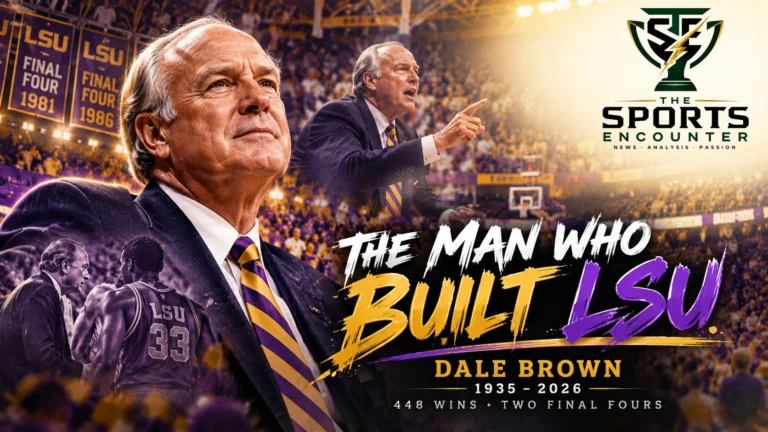
BATON ROUGE, United States, October 24, 2026: Dale Brown, the Hall of Fame basketball coach who transformed Louisiana State University into a national contender, led two unforgettable NCAA Final Four teams and helped develop Shaquille O’Neal, died Friday, October 23, at the age of 90. LSU confirmed the death of its winningest men’s basketball coach, whose 448 victories across 25 seasons established a legacy that extended well beyond the basketball court.
Brown’s death came just days after he learned that he would receive the 2027 John R. Wooden Legends of Coaching Award, with O’Neal contributing a video tribute to the announcement. From an obscure appointment in 1972 to Final Four appearances in 1981 and 1986, Brown turned LSU into a program capable of competing with college basketball’s established powers. His 1986 team, seeded 11th, became the lowest-seeded team to reach the Final Four at that time, completing a remarkable run that remains one of March Madness’ defining underdog stories.
Dale Brown Dies at 90: LSU Confirms the Death of Its Winningest Basketball Coach
LSU announced Brown’s death on Friday through its athletics department.
The university did not specify a cause of death in its initial announcement.
Story at a glance
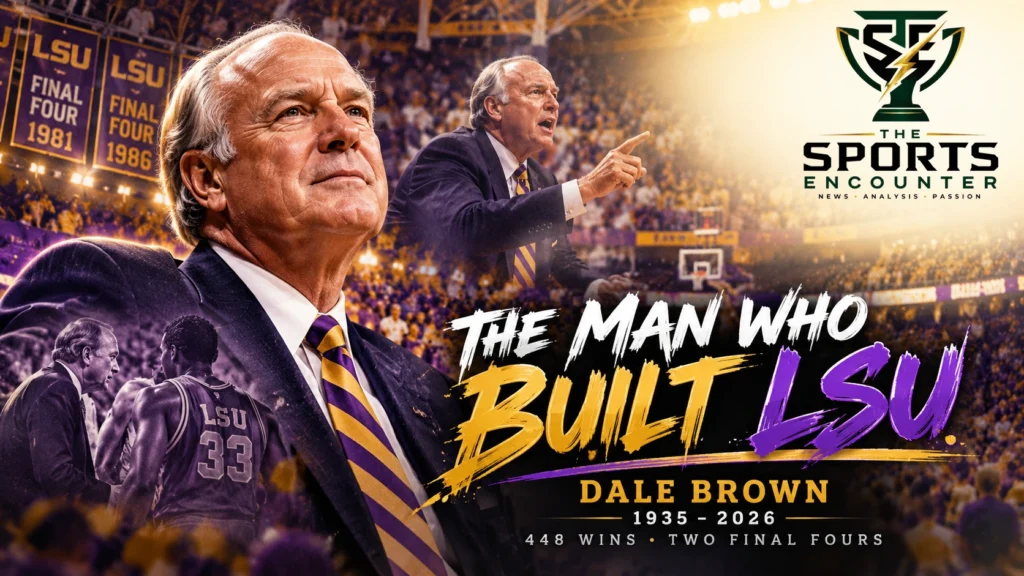
Dale Brown Dies at 90: LSU Confirms the Death of Its Winningest Basketball Coach
LSU announced Brown’s death on Friday through its athletics department.
Dale Brown’s Career: 448 Wins, Two Final Fours and 25 Seasons at LSU
Brown became LSU’s head coach in 1972 and remained in charge until 1997.
How an Unknown Coach Made Basketball Matter in Louisiana
When LSU appointed Brown in March 1972, football dominated the university’s sporting identity.
The 1981 Final Four: Brown Builds a 31-Win National Power
The 1980-81 season represented the clearest expression of Brown’s original ambition.
The 1986 Miracle: How an 11th Seed Reached the Final Four
Brown’s 1986 LSU team remains one of the most compelling underdog stories in NCAA Tournament history.
Brown was born on October 31, 1935, in Minot, North Dakota, and died eight days before his 91st birthday.
His family remembered a man whose relationships mattered as much as his coaching achievements.
In its statement, the family said Brown consistently put others first, cared deeply about people and formed an enduring connection with Louisiana.
“He always led with the heart,” the family said.
That description captures an important part of Brown’s reputation.
His players knew him as an energetic, demanding coach who also took a personal interest in their lives. He could be emotional, outspoken and intensely competitive, but his influence often survived long after his players left LSU.
The official LSU Athletics announcement of Brown’s death includes the family’s statement and a detailed account of his coaching career.
Dale Brown’s Career: 448 Wins, Two Final Fours and 25 Seasons at LSU
Brown became LSU’s head coach in 1972 and remained in charge until 1997.
During those 25 seasons, his teams won 448 games and lost 301.
He guided the Tigers to four Southeastern Conference regular-season championships, an SEC Tournament title and 13 appearances in the NCAA Tournament.
His teams reached the Final Four twice, in 1981 and 1986.
| Category | Achievement |
|---|---|
| LSU coaching tenure | 1972-1997, 25 seasons |
| Career record | 448 wins, 301 losses |
| Winning percentage | 59.8% |
| NCAA Tournament appearances | 13 |
| Consecutive NCAA appearances | 10, from 1984 through 1993 |
| Final Four appearances | 1981 and 1986 |
| SEC regular-season championships | 1979, 1981, 1985 and 1991 |
| SEC Tournament championship | 1980 |
| National Coach of the Year | 1981 |
| SEC Coach of the Year awards | 1973, 1979, 1981 and 1989 |
| National Collegiate Basketball Hall of Fame | Inducted in 2014 |
Brown’s record remains the highest victory total by a head coach in LSU men’s basketball history.
But the scale of his achievement becomes clearer when examining the program he inherited.
How an Unknown Coach Made Basketball Matter in Louisiana
When LSU appointed Brown in March 1972, football dominated the university’s sporting identity.
The basketball program had experienced extraordinary individual brilliance through Pete Maravich, but it had not established itself as a consistent national contender.
Brown arrived without the national reputation normally associated with a coach expected to transform a major university program.
He had played basketball, football and competed in track at Minot State before beginning his coaching career in schools.
He subsequently worked as an assistant at Utah State and Washington State.
LSU offered him an opportunity to build something that had not yet existed in Baton Rouge: a basketball program capable of attracting national attention year after year.
Brown understood that recruiting talented players was only part of the challenge.
He also needed to persuade Louisiana’s sporting public that basketball deserved the same passion it reserved for football.
He traveled throughout the state, spoke with supporters and promoted a vision of LSU competing regularly against college basketball’s leading teams.
His first major statement came during the 1972-73 season.
In his home debut, LSU upset third-ranked Memphis State.
That victory gave supporters an early reason to believe that Brown’s ambition might become reality.
His first team finished 9-9 in SEC play and won him the conference’s Coach of the Year award.
What began as an uncertain appointment gradually became the foundation of LSU’s modern basketball identity.
The 1981 Final Four: Brown Builds a 31-Win National Power
The 1980-81 season represented the clearest expression of Brown’s original ambition.
LSU won 31 games, captured the SEC regular-season championship and reached the NCAA Final Four.
The Tigers had developed from an emerging conference program into a national contender.
Rudy Macklin, one of the finest players in LSU history, became a central figure in that transformation.
Brown’s team combined exceptional talent with the confidence that came from repeated success against strong opponents.
The Tigers advanced through the NCAA Tournament before losing to eventual national champion Indiana in the national semifinals.
The defeat ended their championship hopes, but it did not diminish what the season established.
LSU had reached the Final Four for the first time since 1953.
The achievement also connected Brown’s generation to the earlier basketball tradition established by Bob Pettit.
Pettit had helped take LSU to the 1953 Final Four before becoming the NBA’s first Most Valuable Player and one of the greatest power forwards in league history.
The Sports Encounter’s tribute to Bob Pettit, published following his death in September 2026, explores how the former LSU star influenced the NBA and led the St. Louis Hawks to the 1958 championship.
Brown’s 1981 team did not win the national championship, but it restored LSU’s place among college basketball’s elite programs.
Five years later, he would reach the same stage through an entirely different route.
The 1986 Miracle: How an 11th Seed Reached the Final Four
Brown’s 1986 LSU team remains one of the most compelling underdog stories in NCAA Tournament history.
The Tigers entered March Madness as the No. 11 seed in the Southeast Region.
They had struggled during the closing weeks of the regular season and received an at-large tournament invitation despite an inconsistent record.
Few observers considered LSU a realistic Final Four contender.
But the Tigers had an important advantage during the opening rounds.
Under the tournament arrangements then in place, LSU hosted first- and second-round games at its own Assembly Center.
The venue became an intimidating environment for visiting opponents.
LSU first defeated sixth-seeded Purdue 94-87 after two overtimes.
Two days later, Anthony Wilson scored at the buzzer to beat third-seeded Memphis State 83-81.
The Tigers then defeated second-seeded Georgia Tech 70-64 in the regional semifinals.
That set up an Elite Eight meeting with top-seeded Kentucky, a team that had already beaten LSU three times during the season.
Brown’s players finally overcame the Wildcats 59-57.
The victory sent LSU to its second Final Four under Brown.
| Round | Opponent | Score | Significance |
|---|---|---|---|
| First round | No. 6 Purdue | LSU won 94-87, 2OT | Survived double overtime |
| Second round | No. 3 Memphis State | LSU won 83-81 | Anthony Wilson’s winning basket |
| Sweet 16 | No. 2 Georgia Tech | LSU won 70-64 | Another higher seed eliminated |
| Elite Eight | No. 1 Kentucky | LSU won 59-57 | Reached the Final Four |
| Final Four | Louisville | LSU lost 77-88 | Run ended against eventual champions |
LSU became the first No. 11 seed to reach the men’s NCAA Final Four.
The record was particularly significant because the modern tournament seeding system had made lower-seeded teams’ paths to the national semifinals easier to measure.
LSU had beaten the region’s No. 6, No. 3, No. 2 and No. 1 seeds in succession.
The run ended against Louisville, which went on to win the national championship.
But the Tigers had already achieved something that changed expectations about how far a lower-seeded team could travel in March Madness.
LSU revisited the run in its official historical retrospective of the 1986 Final Four team, documenting the famous victories, unusual circumstances and players who helped make it possible.
Brown’s ‘Freak Defense’ Was More Than a Tactical Gimmick
The 1986 Tigers did not possess the same conventional advantages as Brown’s 1981 team.
Injuries, illness and inconsistent late-season performances had forced the coach to reconsider how he could compete against more highly rated opponents.
Brown responded with tactical flexibility.
His unconventional defensive approach became known as the “freak defense.”
Rather than remain committed to a single predictable structure, LSU changed defensive looks, disrupted passing patterns and forced opponents to adjust.
Brown also moved players into unfamiliar roles.
Ricky Blanton, a 6-foot-6 player who had been used as a guard, took on important interior responsibilities.
That flexibility proved especially valuable against Kentucky, whose frontcourt represented a formidable challenge.
The approach did not eliminate LSU’s physical disadvantages.
It helped the Tigers compete despite them.
TSE’s historical assessment: The contrast between 1981 and 1986 reveals two different forms of coaching excellence. Brown’s first Final Four team showed what he could build with an established, talented roster. His second demonstrated how far he could take a team by adapting to its limitations.
Other basketball coaches have also challenged conventional assumptions about what a successful lineup or system should look like.
TSE’s tribute to Don Nelson examines how the former NBA coach used unconventional tactical ideas that later became influential across professional basketball.
Brown and Nelson worked in different competitive environments, and their systems should not be treated as identical.
What connects their coaching histories is a willingness to change familiar methods when a different approach offered a better chance of winning.
1981 vs. 1986: Two Final Four Teams That Reveal Brown’s Real Strength
Brown’s two most celebrated LSU teams arrived at the Final Four with radically different expectations.
| Measure | 1981 Tigers | 1986 Tigers |
|---|---|---|
| Competitive position | Established national contender | No. 11 regional seed |
| Season record | 31-5 | 26-12 after Final Four loss |
| Route to national relevance | Consistent winning | Four consecutive NCAA upsets |
| Coaching emphasis | Maximizing a powerful roster | Adapting roles and defensive structures |
| Final Four opponent | Indiana | Louisville |
| Tournament outcome | National semifinal defeat | National semifinal defeat |
| Lasting historical importance | Restored LSU to the Final Four | First No. 11 seed to reach Final Four |
Neither team won the national championship.
That absence is part of Brown’s record, but it does not erase the scale of either achievement.
In 1981, he demonstrated that LSU could compete with college basketball’s leading programs over an entire season.
In 1986, he showed that a lower-seeded team could overcome repeated disadvantages and reach the same stage.
The combination explains why Brown deserves recognition beyond his victory total.
Modern college basketball provides other examples of coaches whose achievements are best understood through the programs they developed.
TSE’s analysis of Dana Altman’s retirement at Oregon considers the legacy of another coach who became his university’s all-time wins leader and guided his team to the Final Four.
Brown’s accomplishments belong within that wider tradition of program builders who changed how their universities were perceived nationally.
Shaquille O’Neal and the Player Development Legacy That Outlived Brown’s Coaching Career
Brown’s influence reached well beyond LSU’s two Final Four appearances.
He recruited and coached several players who would become important figures in college basketball and the NBA.
None became more famous than Shaquille O’Neal.
O’Neal played three seasons at LSU from 1989-90 through 1991-92.
He developed into one of the nation’s most dominant college players before Orlando selected him first overall in the 1992 NBA Draft.
He went on to become a four-time NBA champion, league MVP and one of the greatest centers in basketball history.
O’Neal’s college years did not produce a national championship.
LSU reached the NCAA Tournament during each of his three seasons but failed to advance beyond the second round.
That distinction matters when assessing Brown’s coaching legacy fairly.
His impact on O’Neal cannot be measured solely through the team’s NCAA Tournament results.
Brown helped develop a player whose influence later transformed professional basketball.
Their relationship also continued long after O’Neal left Baton Rouge.
O’Neal remained publicly affectionate toward his former coach, and Brown frequently spoke about his pride in the player’s development and achievements.
The relationship helps explain why the announcement of Brown’s final major coaching honor carried such emotional weight.
Brown Coached Six LSU All-Americans
O’Neal was part of a wider group of outstanding players Brown recruited or developed.
| Player | All-America Recognition | Career Significance |
|---|---|---|
| Al Green | 1979 | Part of LSU’s emergence as an SEC power |
| Rudy Macklin | 1980-81 | Key figure in the 1981 Final Four team |
| Ethan Martin | 1981 | Important contributor to LSU’s national rise |
| Howard Carter | 1982-83 | One of LSU’s standout scorers |
| Mahmoud Abdul-Rauf | 1989-90 | Elite college scorer and future NBA player |
| Shaquille O’Neal | 1991-92 | Future NBA MVP and four-time champion |
Abdul-Rauf, then known as Chris Jackson, became one of college basketball’s most electrifying guards.
Macklin helped establish the program’s national credibility before O’Neal arrived.
Brown’s success recruiting players across different generations was an important reason LSU remained competitive after its initial breakthrough.
The influence of college basketball programs on professional careers remains a central part of basketball history.
TSE’s remembrance of Georgetown standout Michael Sweetney explores another athlete whose college achievements and subsequent coaching work deserve recognition beyond his NBA statistics.
Days Before His Death, Brown Learned He Would Receive the 2027 Wooden Coaching Honor
One of the most moving details of Brown’s final week was the timing of a major recognition.
On October 20, the Los Angeles Athletic Club and the John R. Wooden Award announced Brown as the 2027 recipient of the Legends of Coaching Award.
LSU published its announcement on October 21.
The honor recognizes coaching achievement alongside leadership, character and dedication to student-athletes.
Brown was scheduled to receive the award formally during the April 2027 Wooden Award ceremony in Los Angeles.
He died before that presentation could take place.
But he had already been informed of the recognition.
The announcement included a special video message from O’Neal, who reflected on his former coach’s influence.
For Brown, the recognition placed him among coaches whose legacies extend beyond tournament victories and championship totals.
The award’s previous recipients include Dean Smith, Mike Krzyzewski, Pat Summitt, Geno Auriemma, Tara VanDerveer and Dawn Staley.
The official LSU announcement of Brown’s Wooden coaching award documents the honor, O’Neal’s tribute and the planned 2027 ceremony.
The timing gives the award a significance nobody could have anticipated when it was announced.
Brown lived long enough to know that another generation of basketball officials and former players valued what he had contributed to the sport.
John Wooden Saw Something Beyond Brown’s Coaching Results
Brown maintained a longstanding friendship with legendary UCLA coach John Wooden.
Wooden was renowned for building one of the greatest dynasties in American college sports, but his influence also came through a philosophy emphasizing preparation, discipline and character.
In remarks preserved by LSU, Wooden described Brown as an unusually enthusiastic individual whose personality contained considerable depth.
He said Brown was “much more than a basketball coach.”
That observation helps explain why Brown’s reputation endured through changes in players, coaches and competitive standards.
He became known for motivational speaking, mentoring young people and charitable work after retiring from LSU.
His Dale Brown Foundation supported educational opportunities for students, including those facing physical disabilities or financial hardship.
Brown’s public reputation was built partly on his willingness to challenge authority and defend his understanding of athletes’ interests.
That approach earned admiration, but it also produced disagreements and controversy.
Brown’s Battles With the NCAA Were Part of a Complicated Legacy
A complete assessment of Brown’s career must also address the controversies that surrounded LSU basketball during his tenure.
Brown frequently criticized the NCAA’s regulation of college athletes and argued that some rules placed unfair restrictions on student-athletes.
The disputes were not exclusively philosophical.
LSU received scholarship-related penalties in 1986 after the NCAA identified 16 violations.
Another investigation followed allegations involving a payment of approximately $5,000 from an LSU booster to former player Lester Earl.
Brown retired in 1997 during the period surrounding that investigation.
Importantly, investigators did not establish that Brown was directly involved in the booster payment.
Those distinctions should remain part of the historical record.
The NCAA controversies affected how some observers assessed his program, while supporters regarded him as a coach willing to challenge rules he considered unfair.
Neither perspective removes the documented violations or Brown’s achievements.
Both belong in a serious appraisal of his 25 years at LSU.
The question of how to assess successful college coaches whose careers include controversy also appears in TSE’s examination of Bob Huggins’ 935-win career, which considers his achievements, later controversies and lasting influence at Cincinnati and West Virginia.
Brown’s career deserves the same commitment to historical accuracy.
The ‘Deaf Dome’ Became a Symbol of Brown’s Connection With Louisiana
Brown did not transform LSU basketball solely through recruiting and tactical decisions.
He helped create a stronger relationship between the team and its supporters.
As LSU became nationally competitive, crowds at the Pete Maravich Assembly Center grew increasingly passionate.
The arena developed a reputation for extraordinary noise and earned the nickname “Deaf Dome.”
For visiting teams, the atmosphere became another challenge to overcome.
For Brown’s players, it represented evidence that basketball had become important to the university community.
In January 2022, LSU formally unveiled the Dale Brown Court name inside the Pete Maravich Assembly Center.
The recognition gave his accomplishments a permanent place within the building where much of his legacy had developed.
The honoring of Brown’s court later expanded to recognize legendary LSU women’s coach Sue Gunter as well.
Sports institutions preserve history through these decisions.
Retired numbers, named courts and Hall of Fame inductions help connect today’s audiences with people whose contributions shaped earlier generations.
TSE’s analysis of Kevin Garnett’s planned jersey retirement in Minnesota examines how another basketball organization has sought to permanently recognize the individual who helped establish its modern identity.
Continue the NBA Story



Brown’s recognition at LSU carries a similar importance.
The arena bears the memory of a coach who spent decades persuading Louisiana that basketball belonged alongside football at the center of its sporting culture.
Brown’s Place Among College Basketball’s Great Program Builders
Brown’s 448 victories do not place him among the sport’s highest-volume winners.
Several major college coaches accumulated substantially more career victories.
But historical importance cannot be measured through wins alone.
The position of the program before a coach arrived, the resources available, the players developed and the standards left behind all matter.
Brown inherited an LSU program that had reached the NCAA Tournament only twice before his appointment.
He subsequently guided the Tigers into the tournament 13 times.
His teams produced a decade of consecutive NCAA appearances between 1984 and 1993.
He helped transform the program’s recruiting profile, encouraged stronger public support and demonstrated that LSU could compete with nationally established basketball institutions.
His impact is most persuasive when considered against the starting point.
A coach who inherits a national powerhouse is expected to win.
Brown had to convince an entire university community that a national powerhouse could be created.
He did not accomplish every goal he pursued. LSU never won the national championship under him.
But the program became far more important to the national basketball conversation than it had been when he arrived.
That remains one of the strongest arguments for Brown’s place in college basketball history.
What the Numbers Reveal About Dale Brown’s Career
Brown’s career statistics provide a useful way to measure the consistency behind his two famous Final Four runs.
| Measure | Calculation | Result |
|---|---|---|
| Total games coached | 448 wins + 301 losses | 749 |
| Career winning percentage | 448 divided by 749 | 59.8% |
| Average victories per season | 448 divided by 25 | 17.9 |
| Average games per season | 749 divided by 25 | 30.0 |
| Share of seasons reaching NCAA Tournament | 13 divided by 25 | 52.0% |
| Consecutive NCAA appearances | 1984 through 1993 | 10 |
| Final Four appearances | 1981 and 1986 | 2 |
TSE statistical insight: Brown took LSU to the NCAA Tournament in more than half of his seasons despite inheriting a program that had made only two tournament appearances before he became head coach.
His strongest stretch was even more significant.
From 1984 through 1993, LSU reached the tournament every year.
The sustained qualification record demonstrates that the Tigers were not merely an occasional March Madness surprise.
They had become a regular participant in the national postseason.
That consistency makes the 1986 Cinderella run more interesting rather than less.
The Tigers were an established tournament program, but that particular team entered as an underdog and reached the Final Four through one upset after another.
Brown’s legacy contains both forms of achievement.
What Happens Next as LSU Prepares to Honor Dale Brown?
LSU has confirmed Brown’s death and published the family’s statement.
Details of funeral arrangements, memorial services and any additional university tributes had not been established in the initial official announcement.
The 2027 John R. Wooden Legends of Coaching Award remains another important part of his legacy, although the arrangements for its formal presentation following his death have not been confirmed.
Further announcements may clarify how LSU, the award organizers and Brown’s family intend to commemorate his life.
His former players, assistant coaches and the generations of supporters who followed the Tigers will have their own memories of the coach.
The public record already preserves the achievements that made him an important figure in American college basketball.
For continuing coverage of major basketball figures, readers can follow The Sports Encounter’s NBA Hub and the publication’s basketball news and historical features.
Dale Brown: Frequently Asked Questions
When did Dale Brown die?
Dale Brown died on Friday, October 23, 2026, according to Louisiana State University.
How old was Dale Brown when he died?
Brown was 90. He was born on October 31, 1935, and died eight days before his 91st birthday.
What was Dale Brown’s cause of death?
LSU’s initial announcement did not disclose a cause of death.
How many games did Dale Brown win at LSU?
Brown recorded 448 wins and 301 losses across 25 seasons, from 1972 through 1997.
How many Final Fours did Dale Brown reach?
He guided LSU to two NCAA Final Four appearances, in 1981 and 1986.
Did Dale Brown coach Shaquille O’Neal?
Yes. Brown coached O’Neal at LSU from the 1989-90 through 1991-92 seasons, before Orlando selected him first overall in the 1992 NBA Draft.
What made LSU’s 1986 Final Four run historic?
LSU reached the Final Four as a No. 11 seed, becoming the lowest-seeded team to accomplish that feat at the time. The Tigers defeated Purdue, Memphis State, Georgia Tech and Kentucky to advance.
What award was Dale Brown selected to receive before his death?
Brown was named the 2027 recipient of the John R. Wooden Legends of Coaching Award. The announcement came just days before his death and included a tribute from former LSU star Shaquille O’Neal.
Final Tribute: The Coach Who Gave Louisiana a Reason to Believe
Dale Brown spent 25 seasons building a basketball program in a state where football traditionally commanded the greatest attention.
He arrived in Baton Rouge with ambition, enthusiasm and little national recognition.
He left with 448 victories, four SEC regular-season championships, 13 NCAA Tournament appearances and two Final Four teams.
The 1981 Tigers proved LSU could stand alongside college basketball’s elite.
The 1986 Tigers proved that even an 11th seed could reach the national semifinals through courage, preparation, tactical invention and collective belief.
Then came the players whose influence extended far beyond Baton Rouge.
Shaquille O’Neal became one of the most recognizable athletes in basketball history. Mahmoud Abdul-Rauf brought exceptional scoring talent to the NBA. Rudy Macklin helped establish LSU’s place among the nation’s leading programs.
For Brown, those players were more than names on a recruiting list.
They were part of the community he built and continued to care about after his coaching career ended.
The 2027 Wooden coaching honor arrived at an unexpectedly poignant moment. Brown learned that another generation still respected his achievements and influence, and O’Neal was among those who celebrated him.
Eight days before his 91st birthday, the coach who helped make LSU basketball a national name died.
But the evidence of his life remains visible in the program he built, the athletes he mentored, the court bearing his name and the memories of two extraordinary March Madness journeys.
Dale Brown (1935-2026): 448 victories, 25 seasons, two Final Fours, and a basketball legacy that helped change Louisiana State University forever.