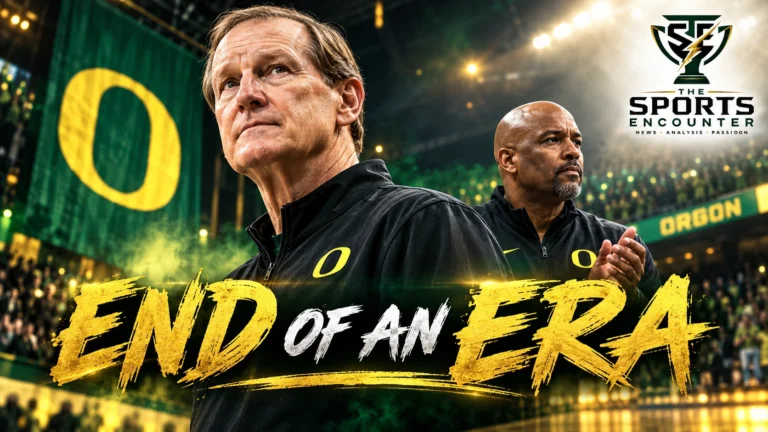
EUGENE, United States, October 7, 2026: Dana Altman built enough history at Oregon to make almost any retirement date significant. Choosing this one changes the story.
Altman retired Wednesday after 16 seasons, 382 victories, nine NCAA Tournament appearances and a Final Four, leaving the winningest coaching record in Oregon men’s basketball history only eight days before the Ducks play their first exhibition of the 2026-27 season.
Assistant coach Tony Stubblefield will take over immediately and remain interim head coach for the entire season. Oregon will wait until the campaign ends before beginning a national search for Altman’s permanent successor.
That gives the Ducks continuity in one sense and immediate disruption in another.
Story at a glance
Why Is the Timing of Dana Altman’s Retirement So Unusual?
Because Oregon is effectively already inside the new season.
Did Altman Explain Why He Is Retiring Now?
Not beyond saying the timing feels right.
How Great Was Dana Altman’s Oregon Career?
The numbers place him alone at the top of the program’s coaching history.
Why Does the 2017 Final Four Still Define the Peak?
Because it reconnected Oregon with basketball history that had been dormant for almost eight decades.
Why Was Altman’s Final Season So Different?
Because almost every pattern that had defined his Oregon tenure broke at once.
Altman leaves behind the staff structure he built, a longtime lieutenant who understands his program and a history few Oregon coaches in any sport can match. He also leaves after the first losing season of his tenure, with preseason preparation already underway and the competitive calendar about to begin.
The University of Oregon’s official announcement confirmed that the 68-year-old coach is stepping away effective immediately.
Why Is the Timing of Dana Altman’s Retirement So Unusual?
Because Oregon is effectively already inside the new season.
The Ducks play Seattle in an exhibition at Matthew Knight Arena on October 15. They visit Utah for another exhibition six days later, host Stanford on October 25 and open the regular season against Montana on November 2.
| Milestone | Date | Time From Altman’s Retirement |
|---|---|---|
| Dana Altman retires | October 7 | Day 0 |
| Seattle exhibition | October 15 | 8 days |
| Utah exhibition | October 21 | 14 days |
| Stanford exhibition | October 25 | 18 days |
| Regular-season opener vs. Montana | November 2 | 26 days |
The timing is even more striking because Oregon announced its television schedule and game times only one day before Altman’s retirement.
The official Oregon schedule shows how little transition time Stubblefield has before the basketball itself begins.
October retirements happen in college sports, but a longtime head coach stepping away after the roster, staff, schedule and preseason plan have already been built creates a particularly unusual succession problem.
Oregon cannot conduct a conventional coaching search now without further destabilizing the season.
The university’s decision to give Stubblefield the full campaign therefore makes practical sense.
Did Altman Explain Why He Is Retiring Now?
Not beyond saying the timing feels right.
Oregon’s announcement did not identify a health issue, disciplinary matter or another specific external reason for the decision.
Altman described leaving as one of the two hardest professional decisions of his life, alongside leaving Creighton for Oregon in 2010.
His clearest explanation was also the simplest:
“But I know this is the right thing to do at this time.”
That leaves room for questions because the calendar makes the decision surprising.
It does not create evidence for explanations Altman or Oregon have not provided.
The responsible reading is therefore limited to what has actually been announced: Altman has chosen to retire, believes now is the correct time, and leaves the program immediately.
How Great Was Dana Altman’s Oregon Career?
The numbers place him alone at the top of the program’s coaching history.
| Category | Dana Altman at Oregon |
|---|---|
| Seasons | 16 |
| Record | 382-182 |
| Winning percentage | .677 |
| NCAA Tournament appearances | 9 |
| Sweet Sixteen appearances | 5 |
| Elite Eight appearances | 2 |
| Final Four appearances | 1 |
| Pac-12 regular-season titles | 4 |
| Pac-12 Tournament titles | 4 |
| 20-win seasons | 15 |
Altman’s 382 victories are 147 more than Ernie Kent, who ranks second in Oregon history with 235.
That gap captures the scale of his tenure better than one tournament run can.
Altman did not build one exceptional Oregon team and spend the rest of his time trying to recreate it. For 15 consecutive seasons, the Ducks won at least 20 games.
That consistency matters when evaluating coaching careers. TSE recently examined a similar question from another part of basketball in its retrospective on Don Nelson’s 1,335-win coaching legacy. Longevity acquires meaning when the coach continues adapting while the sport around him changes.
Altman spent Oregon’s Pac-12 years surviving roster turnover, transfers, injuries and changing offensive personnel. He then guided the Ducks into the Big Ten when conference realignment changed the geography and competitive structure of the program.
Why Does the 2017 Final Four Still Define the Peak?
Because it reconnected Oregon with basketball history that had been dormant for almost eight decades.
The 2016-17 Ducks won a school-record 33 games and reached the Final Four for the first time since Oregon won the inaugural NCAA championship in 1939.
Altman and Howard Hobson remain the only coaches to take Oregon that far.
The season before that run had already changed the program’s ceiling. Oregon swept the Pac-12 regular-season and tournament championships and earned the first No. 1 NCAA Tournament seed in school history.
The Ducks then reached the Elite Eight in consecutive seasons.
For a program that had rarely lived among college basketball’s national elite for sustained stretches, those years established a different expectation.
Winning became normal.
March became normal.
Deep March runs became plausible.
Why Was Altman’s Final Season So Different?
Because almost every pattern that had defined his Oregon tenure broke at once.
The Ducks finished 12-20 overall and 5-15 in the Big Ten during 2025-26.
It was Altman’s first losing season in Eugene and the first time his Oregon team failed to reach 20 victories.
The official Oregon season statistics show a team that scored 70.8 points per game while allowing 73.9, producing a negative 3.1 scoring margin.
| Season | Record | Context |
|---|---|---|
| 2024-25 | 25 wins | First Big Ten season, NCAA Tournament second round |
| 2025-26 | 12-20 | First losing season under Altman |
That is a 13-win drop in one season.
The contrast gives Altman’s retirement an uncomfortable final chapter, but it should not become the lens through which 16 years are judged.
TSE’s coverage of Michael Sweetney’s Georgetown career and later basketball life made a similar point about sporting legacies: the final phase rarely contains enough information to explain everything that came before it.
Altman’s final Oregon team failed.
His Oregon tenure did not.
Why Is Tony Stubblefield the Logical Interim Choice?
Because nobody available to Oregon knows Altman’s program better.
Stubblefield was part of Altman’s original Oregon staff in 2010. Across two spells, he has spent 13 seasons working under him.
During Stubblefield’s first Oregon stint, the Ducks reached eight NCAA Tournaments, five Sweet Sixteens, two Elite Eights and the 2017 Final Four.
He left in 2021 to become DePaul’s head coach, going 28-54 across two-plus seasons before being dismissed in January 2024. He returned to Oregon later that year.
That history gives Stubblefield two very different forms of experience.
He knows how Altman’s successful Oregon teams operated.
He also knows what it feels like when a program under his own control does not produce enough victories.
Neither guarantees success this season.
Together, they make him a more logical emergency successor than an outside coach arriving days before the first exhibition.
What Will Stubblefield Actually Be Allowed to Change?
Probably less than a normal first-year coach would prefer.
The roster was assembled for Altman.
The staff was assembled under Altman.
Preseason installation had already begun under Altman.
The schedule was built months before the coaching change.
Stubblefield therefore inherits an operational system rather than an empty program.
His smartest early approach may involve preserving enough familiar language and structure that players are not forced to relearn basketball in October, while gradually identifying the areas where his own judgment needs to take over.
This is one reason coaching transitions can be harder than the résumé of the replacement suggests. TSE’s look at Don Nelson’s coaching career showed repeatedly how scheme, personnel and organizational fit can determine whether good basketball ideas work in practice.
Stubblefield does not have an offseason to create that fit.
He has days.
Why Does Player Development Matter to Altman’s Oregon Legacy?
Because Oregon became a legitimate route toward professional basketball during his tenure.
Players who reached the NBA after playing for Altman in Eugene include Dillon Brooks, Payton Pritchard, Chris Duarte, Jordan Bell, Chris Boucher, Bol Bol, Troy Brown Jr., Louis King, Eugene Omoruyi and N’Faly Dante.
Brooks became a Pac-12 Player of the Year at Oregon before building a long NBA career. TSE recently examined Brooks’ development into a $73 million Phoenix Suns starter, another reminder of how far the careers of Altman-era Ducks have traveled.
Pritchard became Oregon’s first consensus first-team All-American in 80 years and won the Bob Cousy Award in 2020. He later became part of Boston’s championship-era core, appearing in TSE’s recent analysis of the Celtics’ long-term roster around Pritchard, Jayson Tatum and Derrick White.
Chris Duarte became the No. 13 pick in the 2021 NBA Draft, the highest selection of Altman’s Oregon tenure.
That development record helps explain why Altman’s influence will continue appearing in professional basketball even after he stops coaching.
Readers can follow those careers through The Sports Encounter’s NBA Hub and latest NBA coverage.
What Does Oregon Lose Beyond 382 Wins?
Predictability.
Altman gave Oregon an unusually long period in which the identity of the men’s basketball program did not depend on the coach’s future.
Sixteen years is an eternity in modern college sports.
Players transferred.
Conferences changed.
Name, image and likeness rules transformed recruiting.
The transfer portal accelerated roster movement.
Oregon left the Pac-12 for the Big Ten.
Altman remained.
That continuity allowed Oregon basketball to accumulate an identity around one coaching voice.
Legacy stories frequently become easier to understand after that voice disappears. TSE has explored that idea elsewhere in basketball, including the permanence behind Kevin Garnett’s long-awaited Timberwolves jersey retirement.
Oregon will now discover which parts of its basketball identity belonged to Altman personally and which can survive him.
Why Is Waiting Until After the Season to Hire the Next Coach Important?
Because Oregon avoids conducting two transitions at once.
The Ducks could have opened a national search immediately and created months of speculation around Stubblefield, his staff and every player on the roster.
Instead, the university has drawn a clear line.
Stubblefield coaches this season.
The permanent search begins afterward.
Continue the NBA Story


That arrangement gives players clarity, even if it gives Stubblefield no guarantee beyond March.
It also gives Oregon an entire season to decide what it wants after Altman.
The next coach will inherit expectations created by the 2010-26 period rather than the Oregon basketball program Altman inherited in 2010.
That distinction changes the job.
What Does Altman’s Full Division I Career Look Like?
| Program | Years | Key Achievement |
|---|---|---|
| Marshall | 1989-90 | Southern Conference Coach of the Year |
| Kansas State | 1990-94 | 1993 NCAA Tournament appearance |
| Creighton | 1994-2010 | 327 wins, seven NCAA Tournament appearances |
| Oregon | 2010-26 | 382 wins, nine NCAA Tournaments, 2017 Final Four |
Altman finishes 792-425 across 37 Division I seasons.
Oregon lists him 15th in NCAA Division I career victories and fifth among active coaches immediately before his retirement.
He produced 27 seasons with at least 20 wins.
Those numbers place the Oregon chapter inside a much longer coaching life rather than making it the whole story.
That type of longevity belongs to a shrinking category in modern basketball. TSE’s tribute to Don Nelson’s decades across several NBA eras explored how rare it is for one coach to remain relevant while the sport repeatedly changes around him.
What Happens Next for Oregon Basketball?
The first answer arrives quickly.
Seattle visits Matthew Knight Arena on October 15.
That game is an exhibition, but it will matter more than a normal exhibition because it will provide the first visible evidence of how Oregon responds to losing the coach around whom the entire offseason was built.
Then comes Utah.
Then Stanford.
Then Montana on November 2, when the results begin counting.
The larger answer will take months.
Does Stubblefield stabilize the team?
Can Oregon recover from 12-20?
Do players respond to a coach they already know?
Does the university eventually prioritize continuity or pursue a completely different basketball identity?
Those questions now define Oregon’s season before its first competitive possession has even been played.
Dana Altman Retirement FAQs
Why Did Dana Altman Retire From Oregon?
Altman said leaving was difficult but that he believed it was the right time to step away. Oregon did not announce a more specific reason.
How Old Is Dana Altman?
Altman is 68 years old.
What Was Dana Altman’s Record at Oregon?
Altman finished 382-182 in 16 seasons at Oregon, a .677 winning percentage.
Is Dana Altman Oregon’s Winningest Basketball Coach?
Yes. His 382 victories are the most in program history and 147 more than second-place Ernie Kent’s 235.
How Many NCAA Tournaments Did Oregon Reach Under Altman?
Oregon reached nine NCAA Tournaments during Altman’s tenure.
Did Dana Altman Take Oregon to the Final Four?
Yes. Oregon reached the 2017 Final Four after winning a school-record 33 games.
Who Is Replacing Dana Altman at Oregon?
Assistant coach Tony Stubblefield will serve as interim head coach throughout the 2026-27 season.
Will Oregon Hire a Permanent Coach During the Season?
No. Oregon says its national search for a permanent men’s basketball coach will begin after the 2026-27 season.
When Does Oregon Basketball Play Its First Game Without Altman?
Oregon hosts Seattle in an exhibition on October 15. The regular-season opener is November 2 at home against Montana.
What Was Altman’s Career Division I Record?
Altman finished 792-425 over 37 seasons at Marshall, Kansas State, Creighton and Oregon.