
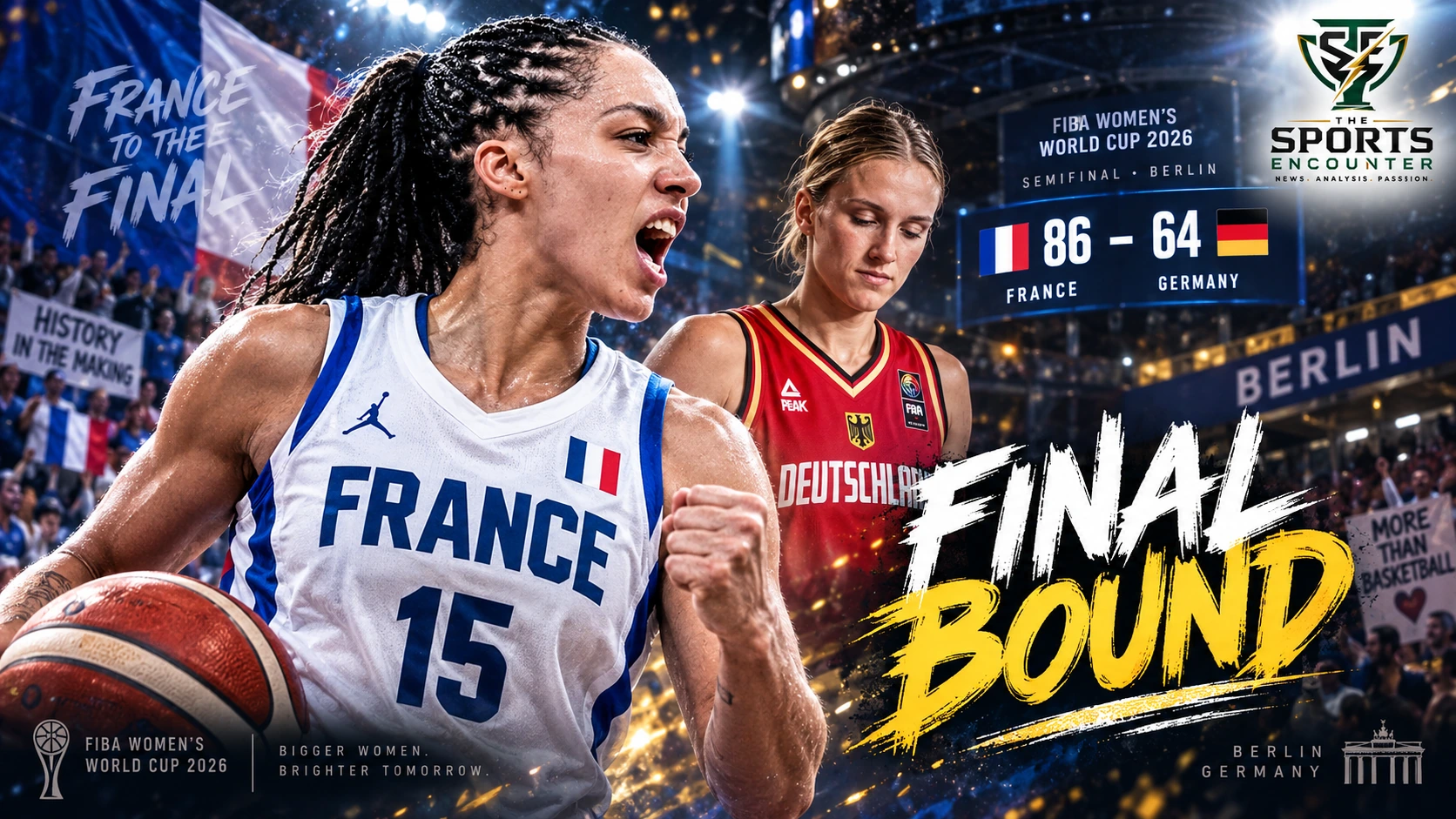
BERLIN, GERMANY, September 12, 2026: France reached the FIBA Women’s Basketball World Cup final for the first time in program history after defeating host Germany 86-64 in Berlin, turning relentless defensive pressure and extraordinary ball security into a historic semifinal victory.
Gabby Williams led France with 22 points, five rebounds, four assists and five steals as Les Bleues stayed unbeaten at the tournament and ended Germany’s dream of playing for gold on home soil.
The final score suggests a comfortable French victory. The more revealing numbers explain how France created it.
Germany actually won the rebounding battle 41-31 and shot 43 percent from the field, only slightly below France’s 45 percent. Yet the hosts committed 25 turnovers while France gave the ball away only six times.
That 19-turnover differential changed the geometry of the semifinal. France finished with 65 field-goal attempts to Germany’s 56, made 10 three-pointers to Germany’s seven, and scored 18 points at the free-throw line compared with nine for the hosts.
Germany could compete physically. It could not survive that many lost possessions.
The result completes the next step in a story The Sports Encounter examined before the semifinals, when Germany entered the final four chasing unprecedented home history while France pursued its first championship-game appearance.
France vs Germany: FIBA Women’s World Cup Semifinal at a Glance
| Match Detail | France | Germany |
|---|---|---|
| Final Score | 86 | 64 |
| Quarter 1 | 25 | 23 |
| Quarter 2 | 20 | 15 |
| Quarter 3 | 19 | 12 |
| Quarter 4 | 22 | 14 |
| Field Goals | 29/65, 45% | 24/56, 43% |
| Three-Pointers | 10/27, 37% | 7/22, 32% |
| Free Throws | 18/21, 86% | 9/15, 60% |
| Rebounds | 31 | 41 |
| Turnovers | 6 | 25 |
| Tournament Record | 5-0 | 4-2 |
The full statistical picture is available through the official FIBA France-Germany game page and the ESPN game summary.
Germany Stayed Close Early, but France Kept Adding Pressure
The first quarter gave Germany reason to believe its home World Cup run could continue.
France led only 25-23 after 10 minutes. Germany matched France physically, stayed competitive on the glass and resisted the early defensive pressure that had overwhelmed other French opponents during the tournament.
The difficulty was sustaining that control.
France won the second quarter 20-15 to take a 45-38 halftime lead. The margin was still manageable, but Germany was already beginning to pay for loose possessions.
The third quarter changed the match.
France outscored Germany 19-12, pushing the advantage to 64-50. By then the hosts were no longer simply trying to execute their offense. They were trying to execute it while being rushed, crowded and forced into decisions before the defense wanted to allow them.
The fourth quarter produced the same pattern. France won it 22-14 and closed the semifinal without allowing Germany any meaningful route back.
France therefore won all four quarters, but the progression matters. The opening period was separated by only two points. The remaining three quarters were won by seven, seven and eight.
This was not one explosive French run followed by game management. It was steady separation.
The 25 Turnovers Were Germany’s Real Defeat
Germany’s 41-31 rebounding advantage would usually be the foundation of a competitive knockout game.
Instead, it became almost irrelevant because the hosts continually surrendered possessions before shots could be created.
Germany committed 25 turnovers.
France committed six.
That is a 19-possession difference before offensive rebounds, fouls and shot selection even enter the equation.
The contrast with Germany’s quarterfinal performance was striking.
Two days earlier, the hosts had produced arguably the greatest night in German women’s basketball history, defeating European champion Belgium 93-74 and winning every quarter. The Sports Encounter detailed how Germany controlled Belgium 93-74 to reach its first World Cup semifinal.
Against France, the rhythm disappeared.
France Created More Shots Despite Losing the Rebounding Battle
This is where the turnover differential becomes especially important.
Germany collected 10 more rebounds than France.
France still attempted nine more field goals.
That should almost never happen to the team dominating the boards.
France’s 65 shot attempts compared with Germany’s 56 show how completely turnovers canceled Germany’s rebounding advantage.
The hosts repeatedly did the hard work of securing possessions, then gave too many of them back before reaching a shot.
Gabby Williams Controlled Both Ends
Williams supplied the individual performance France needed when the game still carried uncertainty.
She finished with 22 points and five rebounds while affecting the match far beyond scoring. Her five steals repeatedly disrupted German possessions, and her four assists helped France move from defensive stops into organized offense.
Janelle Salaün added a double-double with 14 points and 11 rebounds, while Marine Johannès scored 13 points and made three three-pointers.
That distribution is important.
France did not need Williams to score 35 points or dominate every possession. Her performance worked because the team around her maintained enough offensive balance to stop Germany from loading its defense toward one player.
France entered the semifinal already showing that depth. Its quarterfinal victory over China came by 90-61 after a controlled performance in which several players contributed rather than one scorer carrying the offense.
The broader progression had already been visible during the group stage, when France featured prominently in The Sports Encounter’s opening-day Women’s World Cup coverage.
France Is 5-0 and Has Not Needed a Close Finish Yet
| France Match | Result | Winning Margin |
|---|---|---|
| vs Hungary | 99-53 | 46 |
| vs South Korea | 95-69 | 26 |
| vs Nigeria | 111-56 | 55 |
| vs China | 90-61 | 29 |
| vs Germany | 86-64 | 22 |
France has won all five games by at least 22 points.
The combined margin is 178 points, an average victory of 35.6 points per game.
Germany therefore became the first team at this World Cup to hold France below 90 points.
It still lost by 22.
That may be the most intimidating statistic France carries into the final.
Germany’s Run Still Changed the Program
The semifinal defeat should not erase what Germany achieved in Berlin.
The hosts began the tournament badly, losing 83-53 to Spain on opening day. That result could easily have broken the confidence of a team playing under the expectations of a home World Cup.
Instead, Germany responded.
The Sports Encounter followed that recovery through the group stage, including the turnaround described in our report on Spain winning Group A while Germany rebuilt momentum against Mali.
Germany then beat South Korea 94-56 to reach the quarterfinals before stunning Belgium 93-74.
The semifinal appearance was already the best World Cup run in program history.
Germany now still has an opportunity to complete the tournament with its first Women’s World Cup medal in the third-place game.
France’s First World Cup Final Ends a 73-Year Wait for Another Medal
France’s appearance in the semifinals was already historically significant.
According to FIBA, France had not reached the Women’s World Cup final four since the inaugural edition in 1953. The country had subsequently lost six consecutive quarterfinal appearances before finally breaking through against China in Berlin.
The official FIBA semifinal announcement described the France-Germany matchup as a guarantee that one nation would reach the final for the first time.
France took that opportunity.
The program has now secured its first World Cup final appearance and its first medal since 1953.
The Final Could Reopen France’s Olympic Wound
France will face the winner of the United States-Spain semifinal in Sunday’s championship game.
If the United States advances, the matchup would immediately revive one of the most painful recent moments in French basketball.
France lost the 2024 Paris Olympic final to the Americans by a single point.
Team USA entered the knockout rounds chasing a fifth consecutive World Cup title, with its depth and talent already evident in our coverage of the Americans’ 94-61 victory over China.
The United States later scored 105 against Czechia, part of the wider Group D picture examined in our USA-Czechia and China-Italy World Cup report.
Before the tournament, The Sports Encounter also examined why Berlin represented Caitlin Clark’s first major global test with Team USA.
If Spain advances instead, France will face a team that has already demonstrated its ability to punish opponents in Berlin. Spain eliminated Australia 89-66 in the quarterfinals, a result covered in our analysis of Spain’s dominant quarterfinal victory.
TSE Analysis: France Won the Match Germany Wanted to Control
Germany did many of the things teams are supposed to do in a major semifinal.
It rebounded aggressively. It shot a respectable percentage. It kept France below 90 points for the first time in the tournament.
None of those advantages mattered enough because Germany could not protect the basketball.
France’s six turnovers may be the most impressive number in the entire box score.
Against a host team playing with a loud Berlin crowd behind it, France rarely gave Germany the easy transition opportunities that can transform atmosphere into momentum.
At the other end, French pressure generated repeated extra possessions.
The result was a strange statistical imbalance: Germany won the boards by 10 but France still generated more shots, more threes, more made free throws and ultimately 22 more points.
France arrived in Berlin trying to reach a World Cup final for the first time.
Five games later, it is unbeaten, has won every game by at least 22 points and is one victory from becoming world champion.
Frequently Asked Questions
What was the France vs Germany score at the 2026 FIBA Women’s World Cup?
France defeated Germany 86-64 in the semifinal in Berlin.
Is this France’s first Women’s Basketball World Cup final?
Yes. France reached the championship game for the first time in program history.
Who led France against Germany?
Gabby Williams scored 22 points and added five rebounds, four assists and five steals.
How many turnovers did Germany commit?
Germany committed 25 turnovers compared with only six for France. That 19-turnover gap was one of the biggest factors in the game.
Did Germany outrebound France?
Yes. Germany won the rebounding battle 41-31, but France still attempted nine more field goals because the hosts lost so many possessions through turnovers.
Who will France face in the World Cup final?
France will face the winner of the United States-Spain semifinal in the championship game on September 13 in Berlin.