
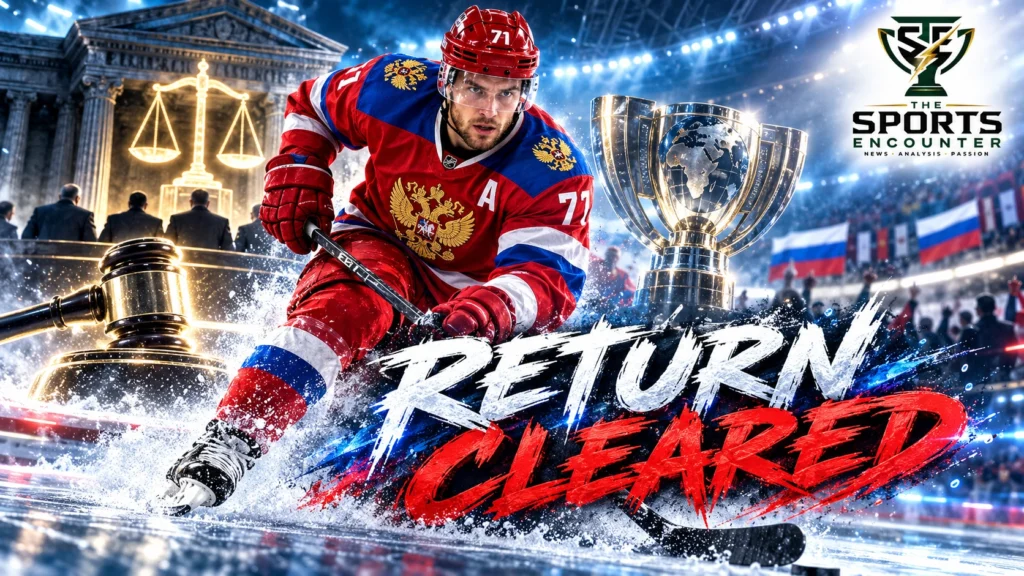
LAUSANNE, Switzerland, October 30, 2026: Russia has won a landmark legal battle to return to international ice hockey after the Court of Arbitration for Sport (CAS) overturned the International Ice Hockey Federation’s (IIHF) exclusion of Russian national teams from competitions during the 2026–27 season. The ruling opens the door to Russia’s participation in the 2027 men’s and women’s World Championships, ending a legal obstacle that had kept the country outside major IIHF tournaments since its invasion of Ukraine in February 2022.
The decision immediately creates a new challenge for hockey’s world governing body. Although the IIHF has confirmed it will respect the ruling, it strongly disagrees with the court’s assessment of its safety concerns. Germany, which will host the 2027 Men’s World Championship, and several other European hockey federations oppose Russia’s return. Meanwhile, crucial questions about tournament formats, team eligibility arrangements, national symbols, travel restrictions and participant security remain unresolved.
TL;DR: What the CAS Ruling Means for Russian Ice Hockey
- Russia’s exclusion overturned: CAS ruled in favor of appeals by the Russian Ice Hockey Federation against the IIHF’s 2026–27 competition restrictions.
- Five championships affected: The decision covers men’s, women’s, junior and under-18 IIHF World Championships.
- First major test: The 2027 World Junior Championship begins in Canada on December 26, 2026.
- IIHF accepts legal authority: The governing body says it will comply while continuing to dispute the court’s safety assessment.
- Major uncertainties remain: National symbols, tournament structures, travel arrangements and security protocols have not been finalized.
Why CAS Overturned Russia’s International Hockey Ban
The central issue in the appeal was whether the IIHF had adequately justified the continued exclusion of Russian national teams from its competitions.
CAS concluded that the federation’s safety, security and other arguments were not supported by sufficient evidence to sustain the exclusion under the applicable rules.
Story at a glance
Why CAS Overturned Russia’s International Hockey Ban
The central issue in the appeal was whether the IIHF had adequately justified the continued exclusion of Russian national teams from its competitions.
Five World Championships Face Changes After Russia’s Appeal Victory
The IIHF has identified five championships affected by the ruling.
IIHF Rejects the Court’s Safety Assessment but Promises Compliance
The IIHF responded to the decision with disappointment, maintaining that its restrictions were necessary to protect participants and preserve the integrity of its competitions.
Germany Opposes Russia’s Return Ahead of the 2027 Men’s World Championship
The opposition from Germany makes the ruling particularly sensitive.
Russia Celebrates a Victory After More Than Four Years Outside International Hockey
Russian officials welcomed the decision as an important reversal of the country’s exclusion.
That distinction matters.
The court did not rule that the war in Ukraine had ended, that security risks no longer existed, or that international sporting bodies were prohibited from considering those risks.
Instead, the decision addressed whether the IIHF’s specific exclusion measures could be legally justified on the evidence presented.
In effect, CAS found that the federation had not met the necessary evidentiary standard.
For Russia, the judgment represents a major legal victory after more than four years away from the World Championships.
For the IIHF, it presents a difficult regulatory lesson: security concerns capable of restricting national-team participation must be supported by evidence sufficient to satisfy the governing legal framework.
The Court of Arbitration for Sport is the independent sports arbitration body responsible for resolving such disputes.
What CAS Did Not Decide
The ruling does not settle every question about Russian participation.
CAS did not determine whether Russia must compete under a neutral designation, whether the national flag and anthem may be used, or how organizers must modify competitions that have already been planned.
These are not minor administrative details. They influence the way Russian teams can be admitted, presented and accommodated at international tournaments.
| Question | Ruling or Current Position | What Remains Unresolved |
|---|---|---|
| Can Russia enter IIHF championships? | CAS overturned the 2026–27 exclusion decisions. | Practical entry arrangements. |
| Were the IIHF’s security arguments sufficient? | CAS found insufficient evidence to sustain the exclusion. | Future event-specific safety assessments. |
| Can Russia use its national flag? | Not decided by CAS. | Rules governing national symbols. |
| Can existing championship formats change? | Not prescribed by CAS. | How teams will be incorporated. |
| Must the IIHF comply? | The IIHF has stated it will respect the ruling. | Timing and implementation measures. |
The difference between a legal entitlement to participate and a finalized tournament entry arrangement is essential to understanding this story.
Five World Championships Face Changes After Russia’s Appeal Victory
The IIHF has identified five championships affected by the ruling.
The most immediate challenge concerns the World Junior Championship, which starts on December 26, 2026, in Canada. Organizers have limited time to resolve Russia’s participation arrangements.
| Championship | Competition Timing | Immediate Challenge |
|---|---|---|
| IIHF World Junior Championship 2027 | Begins December 26, 2026 | Incorporating Russia into an imminent tournament. |
| IIHF Men’s World Championship 2027 | May 14–30, 2027 | Competition structure and host-country arrangements in Germany. |
| IIHF Women’s World Championship 2027 | November 2027 | Determining Russia’s participation arrangements in Canada. |
| IIHF U18 Women’s World Championship 2027 | 2027 | Reviewing entry and organizational arrangements. |
| IIHF U18 Men’s World Championship 2027 | 2027 | Reviewing entry and competition arrangements. |
Note: The table identifies tournaments named in the IIHF’s October 30 statement. It does not imply that Russia has already received an approved schedule, group allocation or finalized participation conditions.
Why the December 26 Deadline Is Especially Difficult
The first affected championship is scheduled to begin just 57 days after the ruling.
That leaves less than two months for the governing body and tournament organizers to address a potentially substantial change in participation.
The compressed preparation period is particularly important because international hockey championships require arrangements involving multiple national federations, host authorities, team delegations and broadcasters.
Changing a tournament’s composition is not equivalent to adding one more name to a fixture list.
A new entrant can affect the structure of groups, competition schedules, accommodation requirements and sporting fairness for teams that have already planned their participation.
IIHF Rejects the Court’s Safety Assessment but Promises Compliance
The IIHF responded to the decision with disappointment, maintaining that its restrictions were necessary to protect participants and preserve the integrity of its competitions.
The governing body nevertheless acknowledged the authority of CAS and committed to acting in accordance with its decision.
Its official response emphasized the organizational difficulties created by changing competition participation at an advanced stage of preparation.
Those difficulties include tournament formats, scheduling, travel, accommodation and security planning.
Read the IIHF’s October 30 statement on the CAS decision.
The IIHF’s Next Decisions Could Be as Important as the Ruling
The federation must now translate a legal judgment into arrangements that national associations and tournament organizers can implement.
Several critical decisions remain open.
| Implementation Issue | Why It Matters | Potential Consequence |
|---|---|---|
| Tournament entry | Existing participation structures have already been planned. | Entry procedures or competition structures may require changes. |
| Scheduling | Additional fixtures may affect match sequences and rest periods. | Organizers may need to revise schedules. |
| Travel and visas | Host-country requirements must be satisfied. | Delegation travel may require additional coordination. |
| Security | Federations have raised concerns about participant safety. | Additional protective measures may be considered. |
| National symbols | CAS did not settle flag or anthem conditions. | Further regulations or decisions are required. |
| Sporting integrity | Changes can affect existing participating teams. | Entry decisions may create competitive and procedural disputes. |
None of these possible consequences should be mistaken for an officially announced implementation decision.
Germany Opposes Russia’s Return Ahead of the 2027 Men’s World Championship
The opposition from Germany makes the ruling particularly sensitive.
Germany is due to host the 2027 Men’s World Championship from May 14 to 30. Its national hockey federation has publicly rejected the return of Russian national teams under current circumstances.
The German position creates a direct conflict between the legal outcome of the appeal and the objections of a federation responsible for hosting one of the sport’s most important international competitions.
Germany is not alone.
Hockey authorities in the Czech Republic, Sweden, Finland and Austria have also criticized the prospect of Russia’s return while the war continues.
These objections cannot simply be dismissed as an ordinary disagreement over competitive strength.
They concern security, international relations, the responsibilities of event organizers and the wider implications of bringing Russian teams back into tournaments involving other European countries.
Ukraine’s Qualification Adds Another Layer of Complexity
Ukraine has qualified for the 2027 Men’s World Championship in Germany.
That creates the possibility that Russian and Ukrainian national teams could be entered in the same championship while the war between their countries continues.
It does not mean that a Russia-Ukraine game has been scheduled.
No verified group allocation or fixture arrangement resulting from the CAS ruling has been established.
Nevertheless, the possibility of both countries participating makes security planning, tournament scheduling and diplomatic coordination especially sensitive.
Ukraine’s hockey federation has condemned the ruling, maintaining that the threats that led to Russia’s exclusion have not disappeared.
Its position raises a fundamental question for the IIHF: how should the federation balance a legally established right to participate against concerns expressed by other member associations?
Russia Celebrates a Victory After More Than Four Years Outside International Hockey
Russian officials welcomed the decision as an important reversal of the country’s exclusion.
Sports Minister Mikhail Degtyaryov portrayed the ruling as a victory against discrimination, while the Russian Ice Hockey Federation indicated its willingness to work toward restoring national-team participation.
The decision has symbolic significance because Russia has historically been one of international ice hockey’s most successful nations.
Since competing as an independent country after the dissolution of the Soviet Union, Russia has won five men’s IIHF World Championship titles.
Its exclusion since 2022 removed an established hockey power from tournaments that traditionally included several of the sport’s strongest national programs.
Yet the legal victory does not automatically guarantee sporting success.
Russia must still navigate the practical arrangements governing participation and eventually assemble teams capable of competing against opponents who have continued playing regular international championship hockey.
Could Russian NHL Stars Return to the World Championship Stage?
The ruling also raises questions about the future availability of Russian players competing professionally in North America.
Players such as Kirill Kaprizov, Nikita Kucherov, Artemi Panarin and Alexander Ovechkin have demonstrated the extraordinary level of Russian talent competing in the NHL.
However, the CAS decision does not select players for Russia or guarantee that individual NHL stars will participate in the 2027 World Championship.
Availability depends on national-team selection, eligibility, health, club commitments, the timing of the NHL playoffs and the final tournament arrangements.
A Russian team competing in an IIHF tournament should therefore not automatically be treated as a team containing every available Russian NHL superstar.
For readers following North American hockey, The Sports Encounter’s NHL hub provides broader coverage of players, performance trends, contracts and the international implications of major hockey developments.
International Hockey and the NHL Operate Under Different Structures
Another important distinction is that the CAS ruling concerns IIHF competition restrictions, not the status of Russian players in the NHL.
Russian players have continued appearing in the NHL during the period of international exclusion.
The ruling changes the legal position of Russian national teams within IIHF events. It does not by itself change NHL eligibility rules, contractual obligations or playoff schedules.
That separation matters when assessing the possible competitive impact of Russia’s return.
For context on the talent and performance levels shaping the current NHL season, readers can revisit Connor McDavid’s record-breaking start to 2026–27 and our analysis of Edmonton’s dramatic victory over Carolina.
Why Russia’s Return Could Change the Competitive Balance
A fully competitive Russian national team has the potential to strengthen the overall talent level of an international championship.
Russia’s historic strengths include elite forwards, skillful puck movement and a deep professional hockey tradition.
However, its actual competitiveness in 2027 cannot be measured until the roster, coaching arrangements and participation conditions are known.
The country has been absent from recent IIHF championship competition, making direct comparisons with active international teams less reliable.
There is also a difference between possessing elite individual talent and building an effective national team.
Successful international teams require defensive organization, special-teams execution, goaltending, tactical coordination and the ability to perform within short tournament schedules.
That point is reflected in our recent analysis of NHL goal differential and underlying team performance, which explains why scoring strength alone does not guarantee success.
The influence of goaltending is equally important. Our report on three goaltenders winning despite facing 123 combined shots provides another example of how defensive and goaltending performances can determine results.
Four Scenarios for Russia’s Return to International Hockey
The ruling has established a legal obligation, but the final arrangements remain unsettled.
The following scenarios are analytical possibilities, not decisions announced by CAS or the IIHF.
| Scenario | What It Could Involve | Main Uncertainty |
|---|---|---|
| Russia enters under its national identity. | Participation with Russian national symbols, subject to applicable rules. | Whether national symbols are permitted. |
| Russia enters under neutral conditions. | Participation subject to restrictions on national symbols. | Whether a neutral framework will be adopted. |
| Championship formats are modified. | Changes to tournament structures to accommodate participation. | Sporting fairness and organizational feasibility. |
| Implementation disputes continue. | Further disagreements concerning entry arrangements or practical measures. | How quickly the IIHF and affected parties resolve them. |
At this stage, assigning probabilities to these scenarios would be speculative.
The most useful indicators will be official IIHF announcements, tournament-specific arrangements and responses from the national associations and host authorities involved.
The Bigger Question: Can International Hockey Reconcile Legal Rights With Security?
The ruling exposes a tension that extends beyond ice hockey.
International sports federations are expected to apply their rules consistently, protect athletes, maintain competitive integrity and address risks affecting participating countries.
Those responsibilities can come into conflict during international crises.
Russia’s position is that its teams should no longer be excluded. CAS has accepted the Russian federation’s appeal against the particular IIHF decisions under review.
The IIHF and several European federations maintain that serious concerns remain.
Ukraine argues that the continuing war makes the return of Russian teams unacceptable under current circumstances.
These competing positions explain why the judgment, although legally decisive on the exclusion issue, has not produced an equally straightforward operational solution.
A durable response will need to do more than acknowledge the ruling. It must address legitimate safety questions, establish transparent participation conditions and ensure that affected teams understand how the governing rules will be applied.
What Must Happen Before Russia Plays Its First World Championship Game?
Three developments will determine what comes next.
1. The IIHF Must Announce How the Decision Will Be Implemented
The governing body has acknowledged that it must assess the time and steps required to comply.
That assessment will need to produce workable arrangements for the affected tournaments.
2. Host Authorities and National Federations Must Address Practical Concerns
Event security, visas, transport, accommodation and the responsibilities of organizing committees require coordination.
Opposition from host and participating federations makes that process especially sensitive.
3. Tournament Formats and Participation Conditions Must Be Finalized
Organizers must establish how Russia will be incorporated and whether any additional participation conditions apply.
Until those decisions are confirmed, specific claims about Russian group assignments, opponents or national symbols would be premature.
Fans following developments across the sport can continue with The Sports Encounter’s NHL coverage, including our reports on October 29’s extraordinary 82-goal NHL schedule, the shutout victories by Arturs Silovs and Michael DiPietro, and the injury challenges facing several NHL teams.
Continue the Hockey Story



Frequently Asked Questions About Russia’s CAS Victory
Has Russia’s international ice hockey ban been overturned?
Yes. On October 30, 2026, CAS overturned IIHF exclusion decisions affecting Russian teams during the 2026–27 competition season.
Will Russia participate in the 2027 IIHF Men’s World Championship?
The ruling establishes that the previous exclusion cannot stand, opening the way for Russian participation. However, the IIHF has not yet finalized the practical arrangements for incorporating Russia into the championship.
Where will the 2027 Men’s World Championship take place?
Germany is scheduled to host the tournament from May 14 to 30, 2027.
Will Russia be allowed to use its flag and national anthem?
That remains unresolved. CAS did not determine the rules concerning national symbols or neutral participation.
Why did CAS reject the IIHF’s arguments?
The court found that the federation had not presented sufficient evidence to support the security and related arguments used to justify Russia’s continued exclusion.
Will Russia face Ukraine at the 2027 World Championship?
Ukraine has qualified for the men’s tournament, and the ruling opens the way for Russia’s participation. However, no specific Russia-Ukraine fixture has been established through the decision.
Does this ruling automatically bring Russian players into the Olympics?
No. The decision concerns the challenged IIHF competition restrictions. It does not independently determine eligibility for future Olympic tournaments.
Final Analysis: Russia Has Won in Court, but International Hockey’s Hardest Decisions Are Ahead
Russia’s legal victory is one of the most consequential developments in international ice hockey since the country was excluded from IIHF championships in 2022.
CAS has removed the legal foundation of the exclusion decisions under review, delivering a significant result for the Russian Ice Hockey Federation.
But the judgment has also transferred enormous responsibility to the IIHF.
The governing body must now find a way to comply with the ruling while managing opposition from several member federations, addressing security concerns and protecting the integrity of tournaments that are already approaching.
The possibility of Russia and Ukraine appearing in the same 2027 Men’s World Championship adds exceptional sensitivity to those decisions.
From a sporting perspective, Russia’s eventual return could restore an established international hockey power to the championship stage.
From an organizational perspective, it presents a test of whether international sport can reconcile legal obligations, competitive fairness and the consequences of an ongoing war.
The October 30 ruling has answered one fundamental question: the IIHF’s continued exclusion of Russia cannot stand on the evidence presented in this appeal.
It has not answered the next question.
How will international hockey bring Russia back without creating a new crisis before the first puck is dropped?