
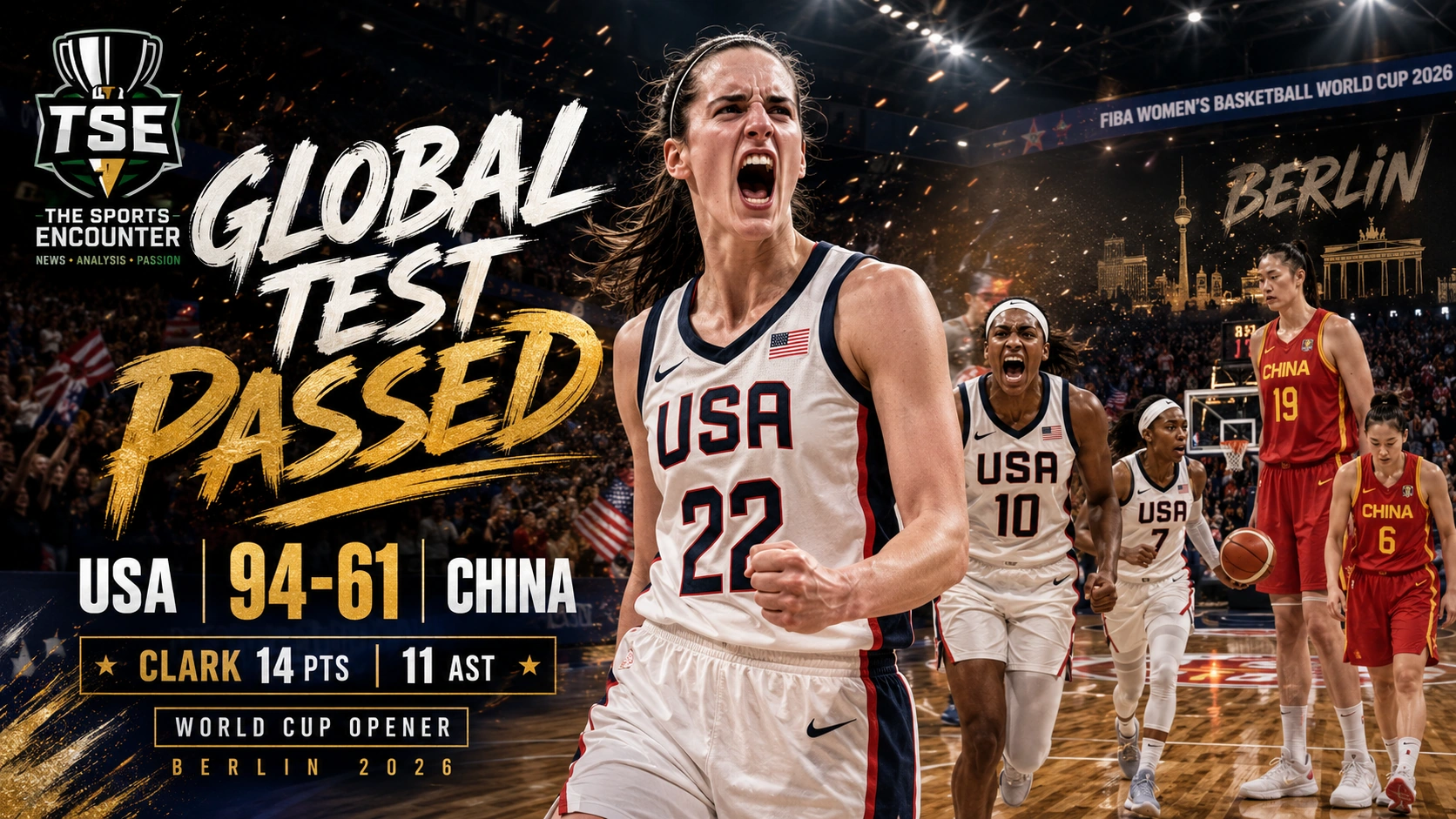
Caitlin Clark Answers the Global Test as New-Look USA Crush China 94-61 in World Cup Opener
Caitlin Clark delivered 14 points and 11 assists in her FIBA Women’s Basketball World Cup debut as the United States crushed China 94-61 in Berlin. The victory extended USA’s World Cup winning streak to 31 games and offered an early glimpse of how the next American generation may shape the tournament.

BERLIN, September 4, 2026: Caitlin Clark arrived at her first FIBA Women’s Basketball World Cup carrying one of the most interesting questions surrounding the United States in Berlin.
Could the most visible member of USA Basketball’s next generation turn domestic stardom into immediate production on the biggest international stage?
Her first answer was emphatic.
Clark delivered 14 points and 11 assists as the United States overwhelmed China 94-61 at Max-Schmeling-Halle, extending its extraordinary Women’s World Cup winning streak to 31 games and opening the defense of its title with a 33-point victory over the team it defeated in the 2022 final.
Rhyne Howard also scored 14 points, Jackie Young added 12, and the Americans used their depth, speed and passing to gradually break down a Chinese team built around some of the most imposing size in international women’s basketball.
China’s 7-foot-3 teenager Zhang Ziyu finished with 13 points in her World Cup debut, while 6-foot-10 Han Xu recorded 11 points and 10 rebounds. Their presence briefly forced the United States into uncomfortable half-court possessions, particularly when China paired both centers in the third quarter.
The Americans adjusted rather than panicked.
Clark, Paige Bueckers and Angel Reese helped drive a decisive 17-5 surge late in the third quarter, and a game that had threatened to become an intriguing tactical examination quickly returned to American control.
The Sports Encounter had framed Clark’s arrival in Berlin as the first genuine global test of the next stage of her career. Her World Cup debut supplied an important early answer because she affected the game without needing to dominate the shot count.
Fourteen points were useful.
Eleven assists told the bigger story.
USA 94-61 China: World Cup Opener at a Glance
| Match Detail | Information |
|---|---|
| Competition | FIBA Women’s Basketball World Cup 2026 |
| Stage | Group D |
| Venue | Max-Schmeling-Halle, Berlin |
| Date | September 4, 2026 |
| Result | USA beat China 94-61 |
| USA First Quarter | 27 points |
| China First Quarter | 14 points |
| Halftime | USA 49-29 China |
| Caitlin Clark | 14 points, 11 assists |
| Rhyne Howard | 14 points |
| Jackie Young | 12 points |
| Zhang Ziyu | 13 points |
| Han Xu | 11 points, 10 rebounds |
| USA World Cup Winning Streak | 31 games |
Official match information, historical meetings and tournament data are available through the FIBA USA-China match center.
The 33-Point Margin Only Tells Part of the Story
A 94-61 final score suggests a routine performance by the defending champions.
The context makes the victory considerably more revealing.
USA Basketball arrived in Berlin only days after losing two players who had originally been expected to provide major championship experience. A’ja Wilson withdrew from the World Cup, while Kelsey Plum was also ruled out, forcing Sonia Citron and Kiki Iriafen into the final roster.
The Sports Encounter examined how those changes accelerated USA Basketball’s generational transition before the opening tip.
Wilson’s absence removed the most dominant interior player from the original roster construction. Plum’s absence reduced the amount of experienced perimeter creation available to head coach Kara Lawson.
That placed greater responsibility on Clark, Bueckers, Howard, Reese, Aliyah Boston, Iriafen and the other younger players.
China provided exactly the sort of opponent capable of exposing any uncertainty.
The 2022 World Cup runners-up brought extraordinary size, experienced international players and a young center in Zhang whose 7-foot-3 frame changes the geometry around the basket.
Instead, the American rotation looked comfortable enough to turn a potentially awkward first game into a convincing opening statement.
Caitlin Clark’s 11 Assists Were More Important Than Her 14 Points
Clark’s first World Cup performance showed why judging her international contribution primarily through scoring could miss much of her value.
She scored 14 points, tying Howard for the team lead, but her 11 assists revealed how quickly she found passing windows against a defense designed to shrink the paint.
China’s size made direct interior attacks difficult at various stages. Zhang could remain close to the basket and discourage drives simply through her reach. Han added another enormous defensive presence when the two shared the floor.
That type of structure creates a choice for opposing guards.
They can force difficult shots into length, or they can move the defense until a cleaner opportunity appears somewhere else.
Clark repeatedly chose the second option.
Her passing helped USA attack before China could organize its half-court size, while her ability to create from the perimeter prevented the game from becoming a slow sequence of possessions directed into the Chinese frontcourt.
That performance followed a strong qualifying campaign earlier this year, when Clark averaged 11.6 points and a tournament-best 6.4 assists while earning MVP honors in San Juan.
Our earlier analysis of the original USA World Cup roster featuring Clark and Bueckers identified playmaking as one of the skills capable of translating most naturally from Clark’s WNBA game into international basketball.
Berlin immediately supplied evidence.
USA’s First Quarter Put China Under Pressure Immediately
The United States did not give China the slow opening the Asian side needed.
USA controlled the first quarter 27-14, establishing pace before Zhang and Han could fully impose themselves around the rim.
Clark, Bueckers and Reese all began the game outside the starting lineup, another sign of the extraordinary depth available to Lawson.
The three were eventually on the floor together to close the opening quarter.
That lineup carried symbolism as well as tactical value.
Clark, Bueckers and Reese entered professional basketball through different paths and already occupy enormous spaces within American women’s basketball culture. Their presence together in a World Cup game gave USA Basketball an early view of a combination that could remain relevant deep into the 2028 Olympic cycle.
The trio had already become central to American basketball discussion before Berlin. The Sports Encounter’s 2026 WNBA All-Star analysis showed just how heavily Clark, Bueckers, Reese and the rest of this generation are beginning to shape league interest and fan attention.
The World Cup now gives them a different responsibility.
Popularity can bring people into an arena or toward a television.
International basketball still demands execution.
The opening quarter suggested USA’s younger group is ready to provide both.
Zhang Ziyu Gave China a Different Kind of Weapon
For all the attention surrounding Clark, one of the most fascinating players on the floor was wearing China’s colors.
Zhang Ziyu stands 7-foot-3 and entered the tournament at only 19 years old.
Her first World Cup basket pulled China within 33-25 during the second quarter, and her physical dimensions immediately changed the way USA attacked the paint.
Zhang could remain near the basket defensively and obstruct finishing angles without travelling far from the rim. On offense, the Americans frequently sent additional defensive attention toward her whenever she received the ball in scoring position.
She finished with 13 points and converted nine of her 10 free throws.
Those numbers do not suggest domination, but they demonstrate that Zhang could still produce while receiving significant defensive attention.
China’s challenge will involve building enough perimeter creation around her to prevent opponents from collapsing inward whenever she catches the ball.
Against the United States, that supporting pressure was inconsistent.
The 16-4 Run Before Halftime Changed the Direction of the Game
China’s best stretch of the first half arrived when Zhang began influencing possessions at both ends.
Her first basket helped reduce the deficit to 33-25 with 6:21 remaining before halftime.
An eight-point margin gave China life.
USA answered immediately.
The Americans closed the half on a 16-4 run, turning 33-25 into a 49-29 halftime lead.
Jackie Young contributed a three-point play during the surge, while Breanna Stewart scored the final four points before the break.
That sequence showed the primary problem opponents face when trying to stay with the United States.
Stopping one player rarely stops the offense.
Howard can score.
Young can attack.
Stewart can take over individual possessions.
Clark can organize.
Chelsea Gray can control tempo.
Bueckers provides another creator, while Reese, Boston and Iriafen add athleticism, rebounding and interior pressure.
A team can defend several of those options correctly and still find another one creating the next run.
China Tried the Zhang-Han Twin-Tower Lineup
The third quarter produced one of the most interesting tactical moments of the game.
China paired Zhang with 6-foot-10 Han Xu.
The combination created a huge defensive wall around the basket and forced USA to reconsider how directly it wanted to attack the interior.
Han brought far more experience to the partnership. She finished with 11 points and 10 rebounds, completing a double-double and giving China one of its more reliable performers.
For a period, the lineup worked.
China cut the American advantage to 53-37.
The deficit had fallen to 16, and the game briefly regained competitive tension.
USA then found the answer.
Clark, Bueckers and Reese Powered the Run That Ended China’s Challenge
The younger American group drove a 17-5 run to close the third quarter.
That burst took the score from 53-37 to 70-42 and effectively removed China’s realistic path back into the game.
The significance goes beyond the points.
USA Basketball entered Berlin facing legitimate questions about how quickly a roster containing so many World Cup newcomers could establish roles.
The original roster already represented a generational transition. Late withdrawals accelerated it.
Clark, Bueckers and Reese then found themselves responsible for one of the decisive stretches of the first game.
They responded by widening the lead against one of the most physically unusual lineups in the tournament.
That gives Lawson something useful to build on.
Quarter-by-Quarter: How USA Built the 94-61 Win
| Quarter | USA | China | Game State |
|---|---|---|---|
| First | 27 | 14 | USA established pace and early control |
| Second | 22 | 15 | China cut deficit before USA closed half with 16-4 run |
| Third | 21 | 13 | Zhang-Han lineup created problems before USA’s 17-5 finish |
| Fourth | 24 | 19 | USA protected and extended a commanding advantage |
| Final | 94 | 61 | USA won by 33 |
Rhyne Howard Quietly Matched Clark’s Scoring
Clark naturally generated much of the attention, but Rhyne Howard provided another indication of USA’s depth.
Howard scored 14 points, matching Clark for the team lead.
Her contribution matters because this roster cannot become dependent on one perimeter creator, especially after Plum’s withdrawal.
Howard gives Lawson another player capable of scoring without requiring the offense to revolve around her for long stretches.
That balance is valuable during international tournaments where rotations can change quickly based on foul trouble, defensive matchups and compressed schedules.
Jackie Young Gave USA Exactly What an Experienced Guard Should
Young contributed 12 points and helped drive the important surge before halftime.
She belongs to the experienced side of this transitional roster.
While Clark, Bueckers, Reese and several others are making their first senior World Cup appearances, Young has already operated inside major championship environments.
Her presence allows Lawson to place younger players around a guard who understands how quickly international games can swing.
That mixture of established players and newcomers was always supposed to define USA’s tournament.
The withdrawals before Berlin simply moved more responsibility toward the younger half of the roster.
USA Have Now Won 31 Consecutive World Cup Games
The victory extends one of the most remarkable streaks in international team sport.
The United States entered Berlin with 30 consecutive Women’s World Cup victories.
Its previous loss came against Russia in the 2006 semifinal.
USA then defeated Brazil in the bronze-medal game and has not lost a World Cup contest since.
China becomes the 31st consecutive opponent to fall during that run.
The streak spans multiple generations of players, coaching changes and entirely different versions of USA Basketball.
This latest version may eventually become one of the most interesting because the roster is being forced to transition while protecting the same historical standard.
USA-China Has Become a Measuring Stick for Both Programs
The matchup also carries important historical context.
USA had won all 15 previous FIBA meetings with China entering Friday’s opener.
The most recent game before Berlin was the 2022 World Cup final in Sydney.
USA won that championship game 83-61.
Four years later, China once again finished on exactly 61 points.
The difference came at the other end.
The Americans scored 94 this time, 11 more than they managed in the 2022 final.
| World Cup Meeting | USA | China | Margin |
|---|---|---|---|
| 2022 Final | 83 | 61 | USA by 22 |
| 2026 Group D | 94 | 61 | USA by 33 |
China has changed significantly since Sydney, particularly with Zhang entering its frontcourt structure.
USA has changed too.
Clark, Bueckers, Reese and Howard represent a generation that was not central to the 2022 championship team.
The score suggests that the balance of power remains heavily American even as the personnel evolves.
The Win Gives USA an Important Early Advantage in Group D
The 2026 World Cup format makes group position particularly valuable.
Sixteen teams are divided into four groups of four. Every team plays the other three countries in its group.
The group winner advances directly to the quarterfinals.
The teams finishing second and third must play an additional qualification game, while the fourth-place team is eliminated.
The official FIBA competition guide confirms that structure.
That gives USA a clear incentive to win Group D rather than simply qualify.
A direct quarterfinal place removes an entire elimination game from the route to the title.
For a roster already affected by late withdrawals, reducing tournament risk wherever possible has obvious value.
Group D After USA’s Opening Statement
USA shares Group D with China, Italy and Czechia.
The 33-point victory gives the defending champions an excellent first result, although two group games remain and first place has not been decided.
| Team | Opening Situation | What Matters Next |
|---|---|---|
| USA | Beat China 94-61 | Can build toward direct quarterfinal qualification |
| China | Lost to USA by 33 | Needs response against Czechia and Italy |
| Italy | Group campaign continues in Berlin | USA matchup could influence top-three order |
| Czechia | Group campaign continues in Berlin | China matchup becomes immediately important |
USA’s Roster Transition Passed Its First Real Examination
The result is particularly encouraging because USA Basketball had to alter its roster immediately before the tournament.
Sonia Citron and Kiki Iriafen were added after Wilson and Plum became unavailable.
The official USA Basketball roster update confirmed both additions before Berlin.
Late replacements can affect rotations, chemistry, defensive assignments and offensive spacing.
Against China, USA looked deeper than the disruption suggested.
That does not mean the Wilson problem has disappeared.
Knockout games against Belgium, Australia, France or another elite opponent could create much harder situations around the rim.
The opener simply showed that USA possesses enough collective talent to redistribute responsibility.
Clark’s World Cup Debut Also Points Toward LA28
Berlin is a championship event in its own right, but every meaningful performance by this American generation also influences the conversation around the 2028 Los Angeles Olympics.
Clark will be 26.
Bueckers will be 26.
Reese and Boston will also be entering years normally associated with athletic prime.
Howard should remain firmly within her own prime window.
The Sports Encounter has already examined how basketball is emerging as one of the major audience stories around LA28.
The players proving themselves in Berlin will arrive in Los Angeles with something training camps cannot provide: experience in games where national expectations and elimination pressure are real.
Clark has taken the first step.
The Clark-Boston Connection Still Gives USA a Built-In Shortcut
One of USA Basketball’s structural advantages is the amount of existing WNBA familiarity within the roster.
Clark and Aliyah Boston already understand each other through Indiana.
Clark knows Boston’s screening angles and preferred timing around the rim. Boston understands where Clark wants space and how quickly she can turn a defensive rebound into transition offense.
Those relationships matter because national teams receive far less preparation time than club teams.
Clark’s WNBA season has also repeatedly demonstrated how productive she can be when the offense flows through both scoring and passing.
Her 26-point, 11-assist performance against Chicago earlier this season was another example of that dual-threat profile.
Against China, the scoring total fell to 14.
The passing impact remained enormous.
Women’s Basketball Is Entering a Different Visibility Era
The World Cup opener also arrived during a period of extraordinary growth around women’s professional basketball.
Clark, Bueckers and Reese bring large individual audiences.
The WNBA continues adding markets, events and commercial attention.
The Sports Encounter recently examined how San Francisco landing the 2027 WNBA All-Star Game reflects the league’s expanding footprint.
Berlin now gives international basketball access to the same audience growth.
A fan who arrives because of Clark may leave having discovered Zhang.
Another may become interested in China, Belgium, France, Australia or one of the many other teams attempting to break USA’s hold on the tournament.
That is one reason this World Cup carries significance beyond the medal table.
What China Can Take From the Defeat
A 33-point loss creates obvious concerns, particularly in a format where every group result carries weight.
China still found useful evidence inside the defeat.
Zhang showed she can score at senior World Cup level despite constant defensive attention.
Han produced a double-double.
The twin-tower lineup briefly disrupted the American offense and helped China reduce the gap during the third quarter.
The next step involves finding more reliable perimeter scoring and enough defensive mobility to prevent opponents from escaping whenever the interior matchup becomes favorable.
China remains capable of progressing from Group D.
The response after this defeat will tell us considerably more about its tournament than the final minutes of a game that had already slipped away.
What USA Can Take From the Victory
The Americans learned several things in one afternoon.
- Clark’s passing translates immediately against elite international size.
- The young lineup can create decisive runs rather than simply preserve veteran-built leads.
- Howard can provide substantial scoring without dominating possession.
- Young remains an important bridge between generations.
- China’s extreme size can be attacked through pace, movement and decision-making.
- The roster still has enough depth to function after losing Wilson and Plum.
Much tougher challenges may arrive later in Berlin.
The first test, however, went far better than USA could reasonably have demanded.
The Sports Encounter Verdict
Caitlin Clark’s first World Cup game will be remembered as a double-double.
The more interesting part of the performance was how naturally it fitted what USA Basketball currently needs.
She did not have to score 30 points.
She did not need every possession.
She created, moved the defense, accelerated the game and helped other elite players find easier opportunities.
That is the version of Clark that could make this American roster especially difficult to stop.
China entered the opener with the size to ask uncomfortable questions. Zhang Ziyu and Han Xu briefly did exactly that.
USA answered through depth.
Howard scored.
Young attacked.
Stewart provided veteran control.
Clark, Bueckers and Reese drove the decisive third-quarter run.
The result became 94-61, extending the United States’ World Cup winning streak to 31 games and moving the defending champions into an early position of strength in Group D.
Two days before the tournament began, Clark’s Berlin challenge was still theoretical.
Now she has a World Cup stat line beside her name: 14 points, 11 assists and a 33-point victory over the 2022 runners-up.
The global test has started.
Her first answer was very good.
Follow continuing international basketball, WNBA and major player coverage through The Sports Encounter Basketball and NBA Hub.
Frequently Asked Questions
Who won USA vs China at the 2026 FIBA Women’s Basketball World Cup?
The United States defeated China 94-61 in their Group D opener in Berlin on September 4, 2026.
How many points did Caitlin Clark score against China?
Caitlin Clark scored 14 points in her senior FIBA Women’s Basketball World Cup debut.
How many assists did Caitlin Clark have against China?
Clark recorded 11 assists, completing a points-assists double-double with her 14 points.
How did Zhang Ziyu perform against Team USA?
The 7-foot-3 Chinese center scored 13 points in her first Women’s World Cup appearance and made nine of her 10 free throws.
How did Han Xu perform against USA?
Han Xu recorded 11 points and 10 rebounds for China.
Who led Team USA in scoring against China?
Caitlin Clark and Rhyne Howard shared the team scoring lead with 14 points each. Jackie Young added 12.
How many consecutive World Cup games has Team USA won?
The win over China extended the United States’ Women’s World Cup winning streak to 31 games. USA’s last World Cup defeat came against Russia in the 2006 semifinals.
When did USA last play China at the Women’s World Cup before 2026?
The teams met in the 2022 World Cup final, when USA defeated China 83-61 to win the championship.
How does the 2026 Women’s Basketball World Cup group format work?
Each of the four group winners advances directly to the quarterfinals. Teams finishing second and third play qualification games for the remaining quarterfinal places, while fourth-place teams are eliminated.
Who are USA’s other Group D opponents?
The United States is in Group D with China, Italy and Czechia.







Breaking News
Clark, Hayashi, Meesseman, and Park Light Up Day 1 of FIBA Women’s World Cup 2026 in Berlin
The 2026 FIBA Women’s Basketball World Cup opened with records, statement victories and major individual performances. Saki Hayashi rewrote the three-point record book, Caitlin Clark posted a double-double on debut, Emma Meesseman dominated for Belgium, Park Ji-hyun powered Korea past Nigeria, and Spain, Australia and Italy all made important early moves in their groups.

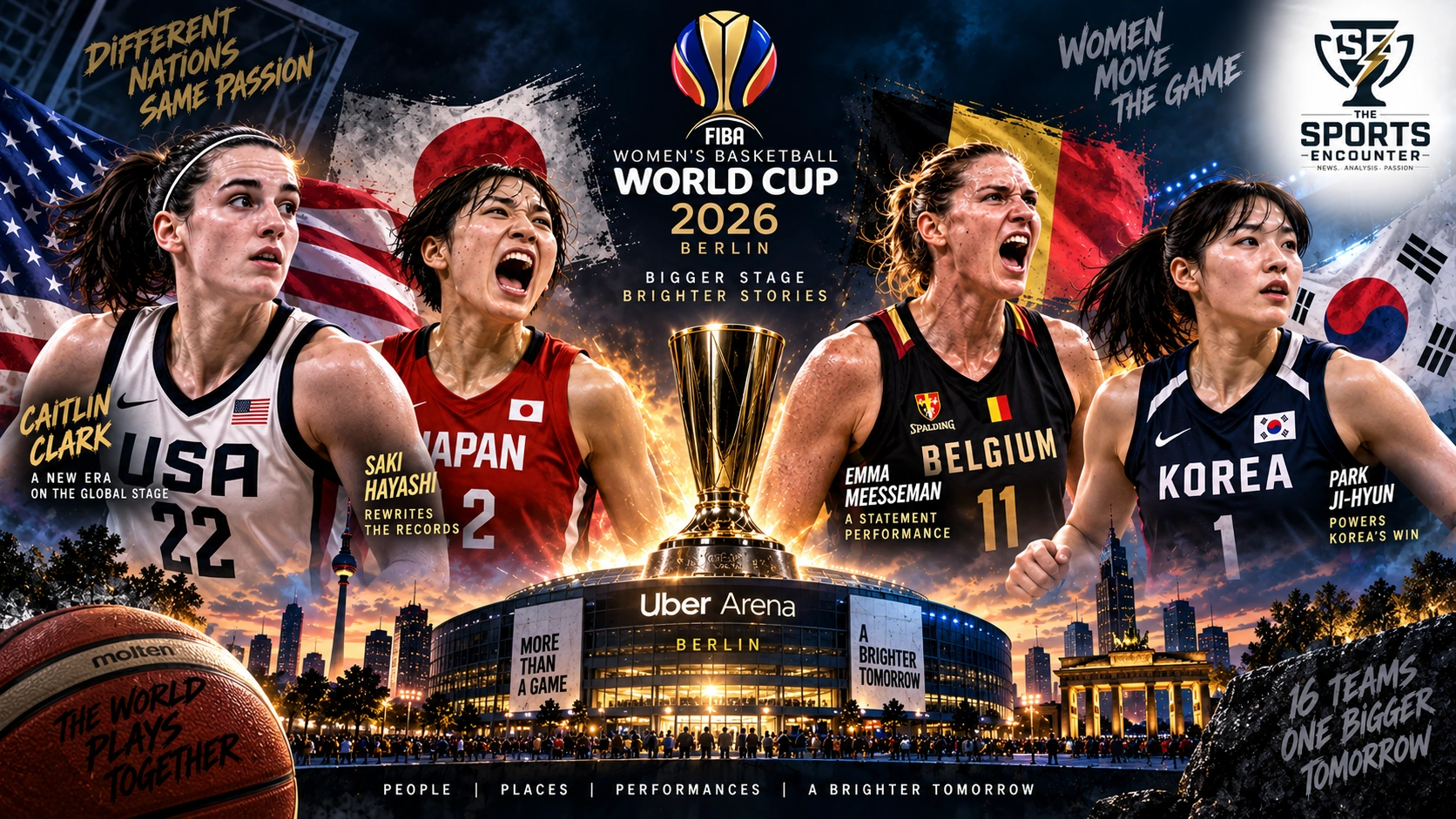
BERLIN, September 4, 2026: The expanded FIBA Women’s Basketball World Cup needed only one day to show why this tournament may be considerably deeper than a simple question about whether anyone can stop the United States.
Japan broke two World Cup three-point records while surviving Mali. Caitlin Clark produced a points-assists double-double on her senior World Cup debut. Emma Meesseman opened Belgium’s campaign with the highest-scoring World Cup performance of her career. Park Ji-hyun powered Korea past African champions Nigeria. Spain overwhelmed host nation Germany in front of a sold-out Berlin Arena. Australia found a way through a difficult Puerto Rican challenge, and Italy opened Group D with a valuable defensive victory over Czechia.
The United States still delivered the most emphatic message among the established favorites, beating China 94-61 and extending its extraordinary World Cup winning streak to 31 games. Yet opening day belonged to far more than one team.
Several individual performances immediately changed the shape of their groups, while the expanded 16-team format made first-place positioning important from the first possession. Under the 2026 competition system, each group winner advances directly to the quarterfinals, while the teams finishing second and third must survive an additional elimination game.
That makes victories such as Korea’s over Nigeria, Italy’s over Czechia and Japan’s comeback against Mali more valuable than an ordinary opening-round result.
For continuing tournament coverage, follow The Sports Encounter’s basketball and NBA hub, where the World Cup will be tracked through daily wraps, individual performances, records, qualification scenarios and knockout analysis.
FIBA Women’s Basketball World Cup 2026 Day 1 Results
| Group | Match | Result | Key Story |
|---|---|---|---|
| A | Japan vs Mali | Japan 102-97 Mali | Saki Hayashi hit a World Cup-record nine three-pointers as Japan set a team record with 20 |
| C | Australia vs Puerto Rico | Australia 70-54 Puerto Rico | Steph Talbot scored 19 as Australia survived a third-quarter Puerto Rico push |
| D | USA vs China | USA 94-61 China | Caitlin Clark recorded 14 points and 11 assists on her World Cup debut |
| B | Korea vs Nigeria | Korea 99-81 Nigeria | Park Ji-hyun scored 27 as Korea pulled away with a 31-point fourth quarter |
| C | Belgium vs Türkiye | Belgium 89-75 Türkiye | Emma Meesseman produced 27 points, nine rebounds and five assists |
| A | Spain vs Germany | Spain 83-53 Germany | Awa Fam scored 17 as Spain spoiled the hosts’ opening night |
| D | Czechia vs Italy | Italy 63-54 Czechia | Italy turned a one-point halftime deficit into an important Group D victory |
| B | Hungary vs France | Live at time of publication | France had established a commanding advantage by the latest verified update |
The official FIBA Women’s Basketball World Cup 2026 hub provides the full schedule, standings, team pages and official match information.
Japan 102-97 Mali: Saki Hayashi Changes the World Cup Record Book
Opening day began with the kind of game that immediately justified the expanded tournament.
Mali pushed Japan deep into the contest and held the advantage for significant stretches, but Japan eventually found a route through one of the most extreme perimeter shooting performances in Women’s World Cup history.
Saki Hayashi finished with 27 points and made nine three-pointers from 15 attempts.
Nine is a new single-game Women’s World Cup record.
The previous benchmark was eight, shared by Korea’s Beon Yeon-Ha and Cuba’s Gricel Herrera Mendez.
Japan went even further collectively.
The team made 20 three-pointers, breaking the previous World Cup team record of 18.
The Sports Encounter has already examined the performance in depth in our report on Saki Hayashi’s record-breaking shooting and Japan’s historic 20-three night.
Kokoro Tanaka gives Japan another major reason for optimism
Hayashi understandably owned the historical headline, but Kokoro Tanaka’s World Cup debut may prove equally important for Japan’s long-term tournament prospects.
Tanaka finished with 18 points, seven assists and three rebounds.
Her willingness to attack created openings for Japan beyond the three-point line and helped prevent the offense from becoming entirely dependent on Hayashi’s shooting.
That matters because opponents will adjust quickly.
Japan cannot reasonably expect to make 20 three-pointers every night. A guard capable of creating off the bounce provides another solution when the perimeter percentage falls back toward normal levels.
What the result means for Group A
Japan’s five-point victory becomes more valuable after Spain’s later destruction of Germany.
Spain and Japan now have early wins in a group where only the winner receives a direct quarterfinal berth.
Mali showed enough offensive quality to make future opponents uncomfortable, but dropping the opener places greater pressure on the games against Spain and Germany.
Australia 70-54 Puerto Rico: Steph Talbot Stops an Upset From Developing
Australia’s 16-point winning margin makes the opener look more comfortable than it felt during the third quarter.
The Opals led 31-24 at halftime, only for Puerto Rico to attack the game after the break and close within a single point at 37-36.
That was the moment Australia needed an experienced player to take control.
Steph Talbot did exactly that.
Talbot finished with 19 points, eight rebounds, three assists and two steals, shooting efficiently and making four of six attempts from three-point range.
Her timely scoring helped Australia answer Puerto Rico’s best run and rebuild a double-digit advantage.
Ezi Magbegor contributed 11 points and nine rebounds, while Jade Melbourne added 10.
Alanna Smith’s fitness becomes the concern
The victory came with an uncomfortable development.
Alanna Smith had 10 points and eight rebounds but did not return after halftime because of what appeared to be a lower-leg issue.
Her availability could become important quickly.
Australia still have to face Türkiye and European champions Belgium, and the Belgium game may ultimately determine who earns the direct quarterfinal berth from Group C.
The Opals therefore gained two things from the opener: two standings points and an early reminder that their margin for error may depend partly on Smith’s health.
USA 94-61 China: Caitlin Clark’s First Global Answer
The most scrutinized World Cup debut of the day delivered almost everything Team USA could have wanted.
Caitlin Clark scored 14 points and handed out 11 assists as the defending champions dismantled China by 33 points.
Rhyne Howard matched Clark with 14 points, Jackie Young added 12, and the Americans turned what briefly looked like an interesting tactical test against China’s enormous frontcourt into another comfortable World Cup victory.
China received 13 points from 7-foot-3 teenager Zhang Ziyu, while Han Xu finished with 11 points and 10 rebounds.
The Sports Encounter had framed Berlin as Clark’s first genuine global test with the senior national team.
Our full USA-China match analysis explains why the 11 assists may ultimately matter more than her scoring total.
Clark’s passing changes the shape of this USA team
Clark did not need to chase a huge scoring night.
She stretched China’s defense, moved the ball early and repeatedly created opportunities before China could organize its interior size.
That becomes particularly important because Team USA entered Berlin without A’ja Wilson and Kelsey Plum.
Their withdrawals, analyzed in The Sports Encounter’s report on the late USA roster changes, placed more creative responsibility on Clark, Paige Bueckers, Chelsea Gray and Jackie Young.
Opening day suggested the Americans have enough options to absorb that disruption.
31 consecutive World Cup wins
USA’s victory extended its Women’s World Cup winning streak to 31 games.
The last American defeat in the competition came against Russia in the 2006 semifinals.
The streak now spans several generations of players, and the first Berlin performance suggested that the current transition toward Clark, Bueckers, Angel Reese, Aliyah Boston and Rhyne Howard has not lowered the immediate championship standard.
That transition began before the tournament, when Clark and Bueckers were initially named to a star-heavy USA World Cup roster.
Korea 99-81 Nigeria: Park Ji-hyun Produces the First Major Group B Shift
South Korea’s win may carry the largest qualification consequence of any result from the first half of opening day.
Nigeria entered Berlin as the reigning African champion and a team with legitimate ambitions of reaching the knockout rounds.
Korea beat them by 18.
Park Ji-hyun produced one of the best individual performances of opening day with 27 points, six rebounds and six steals.
Leeseul Kang added 20 points and seven assists, while Isaem Choi scored 19.
Nigeria stayed close for three quarters.
Korea led only 68-62 entering the fourth.
Then the game changed completely.
The Koreans scored 31 points in the final period compared with Nigeria’s 19 and turned a six-point contest into a decisive victory.
Amy Okonkwo and Murjanatu Musa could not save Nigeria
Amy Okonkwo scored 22 points and added seven rebounds for Nigeria, while Murjanatu Musa produced a 15-point, 13-rebound double-double.
The individual output was not enough because Korea created too much damage through perimeter scoring and forced Nigeria into costly turnovers.
This result matters because France were widely expected to control Group B.
If that expectation holds, Korea’s victory over Nigeria gives the Asian side a major advantage in the fight for second or third place.
Nigeria now face Hungary with considerably less room for error.
Belgium 89-75 Türkiye: Emma Meesseman Starts With a Personal World Cup Best
Belgium entered Berlin as the reigning European champions and one of the teams most capable of challenging the traditional global powers.
Emma Meesseman wasted no time reinforcing that argument.
Meesseman scored 27 points, the highest total of her World Cup career and a new single-game World Cup scoring record for a Belgian player.
She also contributed nine rebounds, five assists and two blocks.
Her all-around performance produced an efficiency rating of 31 and earned her Player of the Game honors.
The third quarter separated Belgium from Türkiye
Türkiye actually led 45-44 at halftime.
Belgium then produced the game’s decisive stretch.
The European champions won the third quarter 27-9, and Meesseman scored nine points during the closing two minutes of the period.
That changed the game from a one-point Turkish advantage into a contest Belgium could control.
Kennedy Burke led Türkiye with 15 points, but the Turkish defense never found a sustainable answer once Meesseman began influencing almost every possession.
Belgium-Australia already looks enormous
Both Group C favorites now have opening victories.
Australia beat Puerto Rico by 16.
Belgium beat Türkiye by 14.
Their meeting on September 7 could become one of the most important games of the entire group stage because first place carries a direct route to the quarterfinals.
Meesseman’s performance suggests Belgium have arrived prepared to chase more than simple qualification.
Spain 83-53 Germany: Awa Fam Silences a Sold-Out Berlin Arena
The emotional centerpiece of the opening night belonged to the hosts.
A crowd of 12,550 packed Berlin Arena to watch Germany begin its home World Cup against Spain.
Spain removed the suspense quickly.
The Spanish won 83-53, shooting above 50 percent from the field while holding Germany below 30 percent.
Awa Fam led Spain with 17 points and four rebounds.
Leonie Fiebich was Germany’s leading scorer with 13.
Spain’s 30-point margin immediately matters
The result gives Spain the strongest point differential in Group A after one game.
Japan have two standings points after beating Mali 102-97, but Spain’s 30-point victory establishes an early tiebreak advantage should group positioning eventually reach deeper criteria.
The direct quarterfinal place therefore gives Spain an immediate incentive to protect that margin while continuing to win.
Germany, meanwhile, face Japan next.
That matchup has become considerably more dangerous after Hayashi and Tanaka’s opening-day performance.
Italy 63-54 Czechia: A Quiet Result With Major Group D Consequences
Italy’s 63-54 victory may receive less international attention than Clark’s debut or Spain’s destruction of Germany, but its effect on Group D could become enormous.
Czechia led 17-14 after the opening quarter and held a narrow 32-31 advantage at halftime.
Italy turned the game after the break.
The Italians won the third quarter 19-13 and then held Czechia to only nine points in the fourth.
| Quarter | Czechia | Italy |
|---|---|---|
| Q1 | 17 | 14 |
| Q2 | 15 | 17 |
| Q3 | 13 | 19 |
| Q4 | 9 | 13 |
| Final | 54 | 63 |
Italy are appearing at the Women’s World Cup for the first time in 32 years.
Starting that return with a victory becomes particularly useful in a group containing USA and China.
The Americans are expected to control the group. That makes the results among Italy, Czechia and China potentially decisive in determining who reaches the qualification round.
Italy have already banked the first of those head-to-head victories.
France Were Turning the Final Game Into Another Group B Warning
At the latest verified live update available during publication, France were in overwhelming control against Hungary.
Les Bleues had built a 61-20 halftime lead and moved further ahead early in the third quarter.
The final score had not yet been officially verified when this article was prepared, so it has deliberately not been presented as a completed result.
The early pattern nevertheless reinforced the pre-tournament expectation that France may be USA’s strongest challenger in Berlin.
France entered the competition ranked No. 2 in the world, carrying Gabby Williams, Marine Johannes, Dominique Malonga, Janelle Salaun and an unusually deep collection of guards and forwards.
If the second half confirms the direction of the first, Korea’s win over Nigeria becomes even more significant because France would immediately occupy the expected position at the top of Group B.
This section should be updated with the official final score and leading performers once FIBA confirms the result.
Opening-Day Performers Who Changed Their Team’s Tournament
| Player | Team | Performance | Why It Matters |
|---|---|---|---|
| Saki Hayashi | Japan | 27 points, World Cup-record 9 threes | Powered Japan’s comeback and set an individual tournament record |
| Caitlin Clark | USA | 14 points, 11 assists | Showed immediate senior World Cup playmaking impact |
| Emma Meesseman | Belgium | 27 points, 9 rebounds, 5 assists, 2 blocks | Produced a Belgian World Cup scoring record and drove decisive third quarter |
| Park Ji-hyun | Korea | 27 points, 6 rebounds, 6 steals | Helped Korea beat African champions Nigeria in a pivotal Group B result |
| Steph Talbot | Australia | 19 points, 8 rebounds, 3 assists | Stopped Puerto Rico’s comeback when Australia were under pressure |
| Awa Fam | Spain | 17 points, 4 rebounds | Led a 30-point win over the host nation |
| Kokoro Tanaka | Japan | 18 points, 7 assists, 3 rebounds | Gave Japan a second creator beyond its record-breaking perimeter shooting |
| Murjanatu Musa | Nigeria | 15 points, 13 rebounds | Produced a double-double despite Nigeria’s damaging opening defeat |
What Day 1 Changed in Group A
Spain and Japan have immediately separated themselves from Germany and Mali.
Spain own the stronger scoring margin after beating the hosts by 30, while Japan possess the more difficult opening victory after surviving Mali’s challenge.
Saturday becomes important almost immediately.
Spain face Mali, while Germany meet Japan.
A second victory for Spain or Japan could put either team very close to securing at least a top-three finish and strengthen the race for the direct quarterfinal berth.
What Day 1 Changed in Group B
Korea’s victory over Nigeria is the result that matters most here before France’s opener is completed.
The Koreans entered the tournament ranked below Nigeria and without star center Park Ji-soo.
They still scored 99 points.
Nigeria now face Hungary knowing that another defeat could place the African champions in serious elimination danger before the final group game against France.
Korea, by contrast, have already gained the head-to-head advantage over one of their likely qualification rivals.
What Day 1 Changed in Group C
The expected contenders both won.
Australia survived Puerto Rico.
Belgium eventually broke Türkiye.
The margin between those victories was similar enough that the Belgium-Australia matchup already looks capable of deciding first place.
Australia’s concern is Smith.
Belgium’s encouragement is Meesseman.
The reigning European MVP looked entirely comfortable on the global stage.
What Day 1 Changed in Group D
USA immediately placed itself in control through a 33-point victory.
Italy then gained a valuable head-to-head win over Czechia.
That leaves China under considerably more pressure than the identity of its opening opponent might suggest.
Losing to the United States was hardly unexpected.
The important games for China may be Czechia and Italy.
Italy already have two standings points. Czechia have now lost one of the games they would have viewed as winnable.
USA’s next meeting with Italy therefore carries two different questions: whether the Americans can continue cruising toward first place, and whether Italy can remain competitive enough to strengthen its position behind them.
The 16-Team Format Already Looks Like a Good Decision
FIBA expanded the Women’s World Cup from 12 teams in Sydney 2022 to 16 in Berlin.
Opening day immediately produced evidence for why the larger field can improve the tournament.
Mali pushed Japan to 102-97.
Puerto Rico came within a point of Australia during the third quarter.
Korea beat the reigning African champions.
Italy returned after a 32-year absence and won its first game.
Only some of the favorites enjoyed uncomplicated afternoons.
The official FIBA competition guide confirms that group winners advance directly to the quarterfinals, while second- and third-place teams enter the qualification round.
That structure rewards dominance without making the rest of the group stage meaningless.
The World Cup Is Also Becoming a Showcase for Women’s Basketball’s New Audience
Clark, Bueckers and Reese brought enormous American attention into Berlin.
Opening day immediately broadened the conversation.
Hayashi became a global record-holder.
Tanaka introduced herself to a larger audience.
Park Ji-hyun produced one of the tournament’s best two-way games.
Meesseman reminded viewers why Belgium believe a first global medal is possible.
Fam gave Spain another emerging player to build around.
This is the larger opportunity for the competition.
The WNBA has already demonstrated how rapidly women’s basketball audiences can grow when recognizable stars, competitive games and compelling individual stories intersect. The Sports Encounter’s 2026 WNBA All-Star analysis documented the enormous fan interest surrounding Clark and Bueckers earlier this summer.
Berlin now allows that audience to discover an entire international player pool.
The Sports Encounter Verdict
The United States remains the team everyone must eventually solve.
Opening day made the road toward that challenge considerably more interesting.
Japan discovered that a record-breaking perimeter offense can rescue a difficult game.
Australia learned that Puerto Rico will punish sloppy stretches and that Smith’s fitness may matter later.
Korea produced a result that could reshape Group B before France had even completed its opener.
Belgium received exactly the type of performance it needs from Meesseman if a first global medal is going to become realistic.
Spain walked into a sold-out arena belonging to the host nation and won by 30.
Italy quietly collected one of the most strategically valuable victories of the day.
USA showed that its generational transition can work immediately, with Clark creating 11 assists in her first World Cup game.
And the tournament produced two major records before the first afternoon was finished.
That is a strong beginning for a competition expanded to 16 teams and entering a period of unprecedented attention around women’s basketball.
Day 1 gave us stars, records, tactical problems, emerging players and immediate qualification consequences.
The next round of games now has something opening day did not.
Pressure.
Frequently Asked Questions
What were the main results on Day 1 of the FIBA Women’s Basketball World Cup 2026?
Japan beat Mali 102-97, Australia defeated Puerto Rico 70-54, USA beat China 94-61, Korea defeated Nigeria 99-81, Belgium beat Türkiye 89-75, Spain defeated Germany 83-53 and Italy beat Czechia 63-54. Hungary vs France was still awaiting a verified final result at the time of publication.
Who was the best performer on opening day?
Several players produced major performances. Saki Hayashi scored 27 points and set a World Cup record with nine three-pointers, Emma Meesseman had 27 points, nine rebounds and five assists, and Park Ji-hyun scored 27 points with six rebounds and six steals.
How did Caitlin Clark perform in her first World Cup game?
Clark recorded 14 points and 11 assists as the United States beat China 94-61.
What record did Saki Hayashi break?
Hayashi made nine three-pointers against Mali, the most by any player in a single Women’s Basketball World Cup game.
What record did Japan set against Mali?
Japan made 20 three-pointers, establishing a new single-game team record at the Women’s World Cup.
How did Emma Meesseman perform against Türkiye?
Meesseman scored 27 points with nine rebounds, five assists and two blocks in Belgium’s 89-75 victory.
Who led Korea against Nigeria?
Park Ji-hyun led Korea with 27 points, six rebounds and six steals in the 99-81 victory.
Who led Australia against Puerto Rico?
Steph Talbot led Australia with 19 points, eight rebounds and three assists.
Who was Spain’s leading scorer against Germany?
Awa Fam scored 17 points as Spain defeated host nation Germany 83-53.
How does qualification work at the 2026 Women’s Basketball World Cup?
The winner of each four-team group advances directly to the quarterfinals. Teams finishing second and third play qualification games for the remaining quarterfinal places, while the fourth-place team is eliminated.
Breaking News
Al Wasl 5-2 Khorfakkan: Five-Goal Response Restores Momentum Before Al Ain and Asia
Al Wasl responded strongly to their first league defeat of the season by beating Khorfakkan 5-2 at Zabeel Stadium. Sékou Sidibé, Nicolás Giménez, Pedro Malheiro and Renato Júnior all scored as Rui Vitória’s side moved back to nine points ahead of a tougher run against Al Ain and in Asia.


DUBAI, September 4, 2026: Al Wasl entered Matchweek 4 needing a response after losing their perfect league record against Shabab Al Ahli.
They produced one with authority.
Sékou Sidibé and Nicolás Giménez scored inside the opening 23 minutes before Pedro Malheiro, an Akram Naqash own goal and Renato Júnior completed a 5-2 victory over Khorfakkan at Zabeel Stadium.
Junior Flemmings scored twice for the visitors, but Al Wasl repeatedly found another goal whenever Khorfakkan threatened to make the contest uncomfortable.
The result takes Rui Vitória’s side to nine points from four matches and restores them to second place in the early ADNOC Pro League standings. More importantly, it gives Al Wasl exactly the kind of attacking confidence they wanted before a demanding sequence that includes defending champions Al Ain and AFC Champions League Elite opposition.
The Sports Encounter had already identified Al Wasl as one of the teams capable of shaping the early UAE Pro League title race. Friday’s performance reinforces that assessment because it showed how quickly they can recover after a setback.
Al Wasl 5-2 Khorfakkan: Match at a Glance
| Match Detail | Information |
|---|---|
| Competition | ADNOC Pro League 2026-27 |
| Matchweek | 4 |
| Venue | Zabeel Stadium, Dubai |
| Date | September 4, 2026 |
| Result | Al Wasl 5-2 Khorfakkan |
| Al Wasl scorers | Sékou Sidibé 17′, Nicolás Giménez 23′ pen, Pedro Malheiro 61′, Akram Naqash 77′ og, Renato Júnior 90+2′ |
| Khorfakkan scorers | Junior Flemmings 51′, 88′ |
| Al Wasl points after Matchweek 4 | 9 |
| Khorfakkan points | 3 |
The latest competition standings, fixtures and official information are available through the UAE Pro League website.
Al Wasl Needed a Response After the Shabab Al Ahli Defeat
The context matters because Al Wasl entered this match carrying their first league setback of the season.
They had won their opening two matches before losing 1-0 to Shabab Al Ahli at Zabeel Stadium in Matchweek 3.
The Sports Encounter’s early title-race analysis had highlighted that fixture as Al Wasl’s first major test because both teams entered with perfect records.
Shabab Al Ahli won it.
That result did not damage Al Wasl’s season, but it created an immediate question around how the team would respond once the early momentum was interrupted.
Rui Vitória made his priorities clear before facing Khorfakkan. In the club’s official pre-match press conference, he said Al Wasl had already moved on from the Shabab Al Ahli defeat and wanted only the three points.
Soufiane Bouftini added another layer, describing Khorfakkan as an opportunity to stay near the top before the upcoming matches against Al Ain and Al Qadsiah.
That made Friday’s game much more important than a routine home fixture.
Al Wasl needed to rebuild momentum quickly.
Sékou Sidibé Starts the Recovery in the 17th Minute
The opening goal arrived through Sékou Sidibé after 17 minutes.
That breakthrough gave Al Wasl the match structure they wanted.
Khorfakkan had arrived after beating Al Dhafra in the previous round, and the visitors could reasonably have hoped that Al Wasl’s defeat against Shabab Al Ahli might create some early uncertainty.
Sidibé removed much of that possibility.
Once Al Wasl moved ahead, Khorfakkan had to take more risks rather than protect a compact defensive shape.
Six minutes later, the gap doubled.
Nicolás Giménez Makes It 2-0 From the Penalty Spot
Giménez converted from the penalty spot in the 23rd minute to make it 2-0.
Two goals inside six minutes changed the entire tactical direction of the evening.
Al Wasl no longer needed to force the game.
Khorfakkan did.
That distinction is important because Al Wasl already possess players capable of attacking space once opponents are forced to step higher.
The hosts could move the ball with less urgency while waiting for opportunities to attack a Khorfakkan side that could no longer remain entirely conservative.
Khorfakkan Refuse to Let the Game Drift Away
The visitors deserve credit for their response after halftime.
Junior Flemmings pulled one back in the 51st minute, reducing the deficit to 2-1 and briefly changing the mood inside Zabeel Stadium.
That goal mattered because a match that had appeared comfortable was suddenly one mistake away from becoming level.
Khorfakkan had already shown resilience during the opening weeks of the campaign.
They lost heavily to Shabab Al Ahli after leading at halftime in Matchweek 1, were beaten by Al Ain, then responded by defeating Al Dhafra before travelling to Dubai.
They were therefore not arriving without evidence that they could compete.
Flemmings’ first goal gave them another opportunity to prove it.
Pedro Malheiro Restores the Two-Goal Cushion
Al Wasl’s response was immediate enough to prevent the match from developing into a prolonged period of uncertainty.
Pedro Malheiro scored in the 61st minute to make it 3-1.
That goal may have been the most important of the second half.
Flemmings had given Khorfakkan hope.
Malheiro took much of it away only 10 minutes later.
This is often where stronger sides distinguish themselves.
They do not simply create more chances over 90 minutes.
They answer dangerous moments before those moments become larger problems.
Akram Naqash Own Goal Pushes Al Wasl Further Clear
The fourth goal arrived in the 77th minute when Akram Naqash put the ball into his own net.
By then the match had moved firmly back under Al Wasl’s control.
A 4-1 score effectively removed the pressure surrounding the final phase and allowed the home side to manage the remaining minutes without chasing the game unnecessarily.
For Khorfakkan, the own goal was particularly damaging because it came after they had already worked hard to reduce the deficit earlier in the half.
Junior Flemmings Scores Again, but Renato Júnior Has the Last Word
Flemmings completed an impressive individual performance by scoring his second in the 88th minute.
The brace gave Khorfakkan something positive to take from an otherwise difficult night.
It also briefly changed the score to 4-2.
Al Wasl responded once more.
Renato Júnior scored in the second minute of stoppage time to complete the 5-2 victory.
The sequence captured the central pattern of the match.
Khorfakkan repeatedly found ways to threaten.
Al Wasl repeatedly found another goal.
Seven Goals, but the Match Was Really About Al Wasl’s Response
| Minute | Scorer | Team | Score |
|---|---|---|---|
| 17′ | Sékou Sidibé | Al Wasl | 1-0 |
| 23′ | Nicolás Giménez, penalty | Al Wasl | 2-0 |
| 51′ | Junior Flemmings | Khorfakkan | 2-1 |
| 61′ | Pedro Malheiro | Al Wasl | 3-1 |
| 77′ | Akram Naqash, own goal | Al Wasl | 4-1 |
| 88′ | Junior Flemmings | Khorfakkan | 4-2 |
| 90+2′ | Renato Júnior | Al Wasl | 5-2 |
The goals make the match look chaotic.
The larger story is more controlled.
Al Wasl entered after a defeat and needed evidence that their first two league wins had not simply been a short opening burst.
Five goals provide that evidence.
Al Wasl Move Back to Nine Points and Second Place
The victory takes Al Wasl to nine points after four matches.
That is significant because the top of the ADNOC Pro League remains congested.
Al Ain, Shabab Al Ahli and Al Jazira all entered Matchweek 4 with nine points, while Al Wasl began the round on six after losing to Shabab Al Ahli.
Friday’s victory immediately puts Al Wasl back into the leading group.
They moved into second place when their match concluded, although other Matchweek 4 results can still change the exact order.
This is where the early season begins becoming more informative.
Al Wasl have now shown they can win convincingly against lower-ranked opponents and recover after losing a major head-to-head test.
Khorfakkan Stay on Three Points
Khorfakkan remain on three points from four matches.
Their position is less comfortable, but the season is still young enough to avoid overreaction.
The problem is the type of defeats they have already suffered.
They conceded five against Shabab Al Ahli.
They lost to defending champions Al Ain.
Now they have conceded five more against Al Wasl.
That means Khorfakkan have already faced several of the strongest teams in the league.
The schedule therefore provides some explanation for the early points total.
It does not remove the defensive concern.
Junior Flemmings Gives Khorfakkan a Positive to Build Around
Flemmings’ two goals matter because Khorfakkan need attacking players capable of producing even when the broader match is going against them.
His first goal gave the visitors a real route back into the contest.
His second came too late to change the result but still showed individual persistence.
A struggling team needs players who continue attacking even when the scoreline becomes difficult.
Flemmings provided that.
Why This Result Matters Before Al Ain
Al Wasl’s next domestic challenge is considerably harder.
They face Al Ain on September 10.
That fixture will provide another direct measurement against the strongest current standard in UAE football.
Al Ain won last season’s title and have started the new campaign perfectly again.
The Sports Encounter recently examined how Al Ain are also preparing for a demanding AFC Champions League Elite campaign against back-to-back Asian champions Al Ahli.
Al Wasl cannot afford to approach that match while carrying uncertainty from the Shabab Al Ahli defeat.
Five goals against Khorfakkan should help remove some of it.
Rui Vitória Gets the Reaction He Asked For
Vitória’s pre-match message was direct.
He wanted the team to forget the previous result and take three points.
The players did more than that.
They restored attacking rhythm.
Scoring five goals spreads confidence across a squad in a way that a narrow 1-0 response cannot always achieve.
Sidibé scored.
Giménez scored.
Malheiro scored.
Renato Júnior scored.
That distribution matters because Al Wasl do not want their attacking output to become dependent on one player.
Al Wasl’s Early Season Still Looks Structurally Strong
Before losing to Shabab Al Ahli, Al Wasl had already produced one of the strongest attacking starts in the league.
The Sports Encounter’s Matchweek 3 title-race preview noted that Al Wasl had scored eight goals across their first two matches.
The opening round included a 5-1 victory over newly promoted United.
Friday’s result now adds another five-goal performance.
That gives the team a clear attacking identity during the opening month.
The UAE Title Race Is Becoming More Competitive
The broader league context makes Al Wasl’s response even more important.
Defending champions Al Ain remain strong.
Shabab Al Ahli have already beaten Al Wasl directly.
Al Jazira have started well and continue strengthening their squad, with The Sports Encounter tracking their pursuit of Inter midfielder Kristjan Asllani.
Al Nasr have also shown they can grind out difficult results, including the 1-0 victory over Al Wahda built around Chris Bedia’s penalty.
That means there is little room for extended losing runs near the top.
One defeat can be absorbed.
Two or three in succession can quickly create separation.
Al Wasl prevented that possibility immediately.
The Asian Schedule Makes Domestic Momentum More Valuable
Al Wasl are also preparing for AFC Champions League Elite football.
That creates a second layer to the September schedule.
The strongest UAE clubs are not competing only against each other.
They will also be measured against leading clubs from Saudi Arabia, Qatar and the rest of West Asia.
The Sports Encounter’s Gulf Champions League analysis has already shown how often UAE teams will be compared directly with their regional rivals this season.
Al Nasr and Ajman will represent the Emirates in that competition, while Al Wasl, Al Ain and Shabab Al Ahli operate at the continental level above it.
Domestic form therefore has regional consequences.
Al Wasl’s Attack Will Be Tested Differently by Al Ain
Khorfakkan gave Al Wasl opportunities because the visitors had to chase the game after conceding twice in the opening 23 minutes.
Al Ain are unlikely to provide the same spaces so easily.
The defending champions are more comfortable controlling matches from a compact structure and punishing errors in transition.
That means the next fixture will tell us whether Al Wasl’s attacking numbers can translate against elite domestic opposition.
The Shabab Al Ahli game suggested that this remains the unresolved question.
Why Khorfakkan’s Defensive Record Needs Attention
Khorfakkan can point to a difficult schedule.
They cannot ignore how often the stronger teams have broken through them.
Five goals conceded against Shabab Al Ahli and five against Al Wasl create an obvious defensive trend.
Those results suggest the team struggles once matches become stretched.
The first goal is therefore particularly important for Khorfakkan.
When they can stay level or move ahead, they can remain compact.
Once they fall behind, the spaces appear and stronger opponents have repeatedly punished them.
The Result Fits a Wider Gulf Football Story
The UAE Pro League is operating in an increasingly competitive regional environment.
Saudi clubs continue raising the standard through investment and squad depth, while the UAE, Qatar and other Gulf leagues are strengthening in response.
The Sports Encounter has been tracking that movement through stories such as NEOM’s 3-0 victory over Al Khaleej and the wider development of the Saudi Pro League.
For UAE clubs, strong domestic performance therefore matters twice.
It helps them compete for trophies at home and prepares them for a regional landscape where the margin between leagues is becoming a major story in its own right.
What Comes Next for Al Wasl?
The calendar now becomes more demanding.
Al Ain are next in the league.
Al Qadsiah then await in AFC Champions League Elite competition.
That sequence will provide much stronger evidence of Al Wasl’s ceiling than a 5-2 victory over Khorfakkan can provide on its own.
Friday’s job was simpler.
Recover from defeat.
Score goals.
Collect three points.
Al Wasl completed all three.
What Comes Next for Khorfakkan?
Khorfakkan need to prevent the heavy defeats from defining the opening phase of their season.
Flemmings’ brace gives them an attacking positive.
The larger issue is defensive control.
Conceding five goals twice within four league matches places enormous pressure on the attacking players to keep rescuing games.
No team can rely on scoring three or four every week simply to stay competitive.
The Sports Encounter Verdict
Al Wasl’s 5-2 victory matters because of when it arrived.
The team had just lost its perfect start.
Another weak performance would have changed the tone around the opening month and created uncomfortable questions before Al Ain and continental football.
Instead, Al Wasl scored twice inside 23 minutes and never allowed Khorfakkan’s comeback attempts to become sustained pressure.
Flemmings made it 2-1.
Malheiro restored the cushion.
Flemmings scored again late.
Renato Júnior answered in stoppage time.
That ability to respond within the match may prove more important than the five goals themselves.
Al Wasl are back on nine points and back near the top of the table.
Now comes the harder question.
Can they produce the same attacking confidence against Al Ain?
For continuing UAE, Gulf and international football coverage, visit The Sports Encounter Soccer Hub.
Frequently Asked Questions
Who won Al Wasl vs Khorfakkan?
Al Wasl defeated Khorfakkan 5-2 at Zabeel Stadium in Matchweek 4 of the 2026-27 ADNOC Pro League.
Who scored for Al Wasl against Khorfakkan?
Sékou Sidibé, Nicolás Giménez, Pedro Malheiro and Renato Júnior scored for Al Wasl, while Akram Naqash also put through his own net.
Who scored Khorfakkan’s goals?
Junior Flemmings scored both Khorfakkan goals, finding the net in the 51st and 88th minutes.
Did Nicolás Giménez score a penalty?
Yes. Giménez converted a penalty in the 23rd minute to give Al Wasl a 2-0 lead.
How many points do Al Wasl have after four matches?
Al Wasl have nine points from four ADNOC Pro League matches.
Where are Al Wasl in the table?
Al Wasl moved into second place when their Matchweek 4 victory over Khorfakkan was completed, although the exact order can change as the rest of the round is played.
How many points do Khorfakkan have?
Khorfakkan remain on three points after four league matches.
Who do Al Wasl play next?
Al Wasl are scheduled to face defending champions Al Ain in their next league match on September 10.
Are Al Wasl playing in the AFC Champions League Elite?
Yes. Al Wasl are competing in the 2026-27 AFC Champions League Elite and are also preparing to face Al Qadsiah.
Where was Al Wasl vs Khorfakkan played?
The match was played at Zabeel Stadium in Dubai.
Breaking News
Kalba 0-2 Al Ain: Traoré and Ilou Make It Four Wins From Four as Champions Take Early Control
Al Ain maintained their perfect start to the 2026-27 ADNOC Pro League with a 2-0 win over Kalba. Abdoul Traoré and Baba Bello Ilou scored in the first half as the defending champions moved to 12 points from four matches, while Kalba remained on one point.

KALBA, UAE, September 4, 2026: Al Ain needed little more than 11 first-half minutes to turn another potentially awkward ADNOC Pro League assignment into a fourth consecutive victory.
Abdoul Traoré opened the scoring in the 21st minute before Baba Bello Ilou doubled the advantage in the 32nd as the defending champions beat Kalba 2-0 at Ittihad Kalba Club Stadium and maintained their perfect start to the 2026-27 season.
The result moves Al Ain to 12 points from four matches, provisionally taking them above the other early leaders before the rest of Matchweek 4 is completed. They have now scored 10 league goals and conceded only three.
Kalba remain at the opposite end of the early table.
They have collected only one point from four matches and are still searching for their first victory of the campaign. Yet the final score conceals how much resistance they offered after falling two goals behind.
Kalba finished with 17 shots, eight on target and exactly 50 percent possession. Al Ain had 18 attempts, seven on target and 27 touches inside the opposition box compared with Kalba’s 22.
The difference came where title-winning teams so often separate themselves from struggling opponents.
Al Ain converted their strongest first-half moments. Kalba could not convert theirs.
That left goalkeeper Khalid Eisa central to another victory for Vladimir Ivić’s side, while the champions once again demonstrated that they can win through attacking quality and defensive resistance within the same match.
The Sports Encounter had already identified Al Ain as one of the central teams shaping the early UAE Pro League title race. Four matches into their defense, that assessment looks even stronger.
Kalba 0-2 Al Ain: Match at a Glance
| Match Detail | Information |
|---|---|
| Competition | ADNOC Pro League 2026-27 |
| Matchweek | 4 |
| Venue | Ittihad Kalba Club Stadium |
| Date | September 4, 2026 |
| Result | Kalba 0-2 Al Ain |
| Al Ain scorers | Abdoul Traoré 21′, Baba Bello Ilou 32′ |
| Ilou assist | Georgios Giakoumakis |
| Possession | Kalba 50% – 50% Al Ain |
| Total shots | Kalba 17 – 18 Al Ain |
| Shots on target | Kalba 8 – 7 Al Ain |
| Touches in opposition box | Kalba 22 – 27 Al Ain |
| Al Ain league record | 4 wins from 4 matches |
| Al Ain points | 12 |
| Kalba points | 1 |
The complete competition schedule and standings can be followed through the official UAE Pro League website.
Traoré Breaks Kalba’s Resistance After 21 Minutes
Kalba entered the match knowing that another defeat would turn a difficult start into something much more concerning.
They had collected only one point from their opening three matches, while Al Ain arrived with nine points from nine.
The contrast in confidence became visible once the game settled.
Kalba initially competed well enough to prevent the champions from establishing immediate control. Their midfield stayed compact, and Al Ain did not simply walk through the opening exchanges.
The breakthrough arrived after 21 minutes.
Traoré found the opening goal and changed the tactical requirements for both sides.
Kalba could no longer remain patient and wait for Al Ain to make the first mistake. They needed to become more adventurous.
That shift created more room for the champions.
Baba Bello Ilou Doubles the Lead Before Kalba Can Recover
Al Ain required only another 11 minutes to capitalize.
Georgios Giakoumakis helped create the second goal, providing the assist for Ilou in the 32nd minute.
The goal effectively divided the match into two very different contests.
The first 32 minutes were about whether Kalba could keep the champions within reach.
The remaining hour became a test of whether Al Ain could manage a two-goal advantage while Kalba increased the volume of their attacks.
That is where the defending champions showed another useful quality.
They did not need to dominate possession or spend the entire second half forcing a third goal.
Instead, they protected the important areas and trusted Eisa when Kalba found shooting opportunities.
Kalba Created Enough to Make the Scoreline Uncomfortable
The raw attacking numbers show that Kalba were far from passive.
Seventeen total attempts would normally suggest that a side spent significant periods threatening its opponent.
Eight shots on target reinforce that conclusion.
Al Ain actually finished with fewer efforts on target despite winning by two goals.
| Key Match Stat | Kalba | Al Ain |
|---|---|---|
| Possession | 50% | 50% |
| Total shots | 17 | 18 |
| Shots on target | 8 | 7 |
| Touches in opposition box | 22 | 27 |
| Goals | 0 | 2 |
This is where the result becomes more revealing than the score alone.
Kalba generated activity.
Al Ain generated goals.
That difference is particularly damaging for a team already struggling for points because encouraging passages of football have limited value when they repeatedly produce nothing on the scoreboard.
Khalid Eisa Makes the Clean Sheet Matter
Khalid Eisa’s contribution deserves specific attention.
Kalba directed eight attempts on target and still finished without a goal.
That meant the goalkeeper had to remain involved even after Traoré and Ilou had apparently given Al Ain control.
Eisa’s performance allowed the champions to avoid the moment that could have changed the second half.
A Kalba goal at 2-0 would have transformed the atmosphere, increased the pressure on the Al Ain defense and given the hosts a genuine route back into the game.
That goal never arrived.
It is easy to associate Al Ain’s domestic dominance with their attacking quality, particularly after a championship season built on overwhelming consistency.
Matches like this show the value of defensive reliability as well.
Al Ain Have Now Won Their First Four League Matches
Four wins from four matches puts the defending champions exactly where they wanted to be at the beginning of September.
Before Matchweek 3, five clubs still held perfect records.
The field has already started to narrow.
Al Ain defeated Al Nasr 2-1 in Matchweek 3 after earlier victories over Bani Yas and Khorfakkan. Friday’s victory in Kalba extends that sequence to four.
| Al Ain 2026-27 League Start | Result |
|---|---|
| vs Bani Yas | Won 4-2 |
| vs Khorfakkan | Won 2-0 |
| vs Al Nasr | Won 2-1 |
| at Kalba | Won 2-0 |
That gives Al Ain 10 goals scored, three conceded and two clean sheets from their opening four league matches.
The sequence also shows several different winning profiles.
They have survived a six-goal contest.
They have produced comfortable clean-sheet victories.
They have beaten an unbeaten Al Nasr side.
Now they have handled an away match against an opponent desperate for its first win.
The Champions Are Beginning to Look Like the Standard Again
Al Ain entered the season carrying a different burden from most of their rivals.
They are defending a championship won with two rounds remaining in 2025-26.
That campaign produced their 15th UAE league title and sixth during the professional era.
The important question entering the new season was therefore not whether Al Ain possessed enough quality.
It was whether they could reproduce the hunger required to dominate another domestic campaign while also preparing for continental football.
The first four rounds have provided an encouraging answer.
Al Ain have not dropped a point.
Their next challenge will be maintaining that standard once the schedule becomes more congested.
The club is also preparing for a major AFC Champions League Elite campaign. The Sports Encounter previously examined how Al Ain’s meeting with back-to-back Asian champions Al Ahli gives the continental season an immediate heavyweight matchup.
That makes domestic efficiency increasingly valuable.
Why Four Early Wins Matter Before Asia Begins
Continental football changes the demands placed on title contenders.
Travel increases.
Rotation becomes unavoidable.
Players have less recovery time.
Domestic opponents know that the strongest clubs may arrive between major Asian fixtures.
Every point collected before that congestion develops gives Al Ain additional room later in the season.
This is also why the UAE title race remains important beyond domestic bragging rights.
Al Ain, Al Wasl and Shabab Al Ahli will all carry UAE expectations in Asian competition, while other Emirati clubs face regional tests elsewhere.
The Sports Encounter’s Gulf Champions League analysis highlighted how Al Nasr and Ajman will also be measured against clubs from Saudi Arabia, Qatar, Iraq and the wider Gulf.
Domestic competition is increasingly part of a broader regional comparison.
Kalba’s One Point From Four Is Becoming the Bigger Concern
Al Ain can look at the table with satisfaction.
Kalba have to confront a much less comfortable picture.
They entered Matchweek 4 with one point.
They leave it with the same total.
Their opening league run has now produced no victories from four matches.
The problem cannot be reduced entirely to Friday’s finishing.
Kalba had already shown difficulty turning competitive passages into results before meeting Al Ain.
Their earlier 2-2 draw with Al Nasr offered some encouragement, and The Sports Encounter later examined Al Nasr’s progress when Chris Bedia’s goal helped them defeat Al Wahda.
Kalba’s challenge is now converting effort into wins before the lower end of the standings begins creating psychological pressure of its own.
Kalba’s Second-Half Changes Could Not Alter the Result
Head coach Víctor Sánchez acted immediately after halftime.
Saman Ghoddos and Marwan Fahad Hamza were introduced at the break, while additional changes followed during the second half.
Ali Salmeen entered in the 58th minute.
Koray Günter followed in the 65th.
Benjamin Tetteh was introduced after 72 minutes as Kalba searched for a way back into the game.
The substitutions changed personnel but never changed the score.
That is another reason the eight shots on target matter.
Kalba created enough opportunities to force Eisa into work but could not find the moment that would have justified their pressure.
Al Ain’s 5-3-2 Gave Them Protection Without Killing Their Attack
Vladimir Ivić selected a 5-3-2 structure with Eisa behind Marcel Ratnik, Rami Rabia, Yahya Ben Khaleq, Valentino Lazaro and Rafael Rodrigues.
Traoré joined Matías Palacios and Alejandro Romero through midfield, while Ilou partnered Giakoumakis in attack.
The structure gave Al Ain several benefits.
They could defend with numbers when Kalba advanced.
Lazaro and Rodrigues could still provide width.
Traoré and Romero had enough support around them to influence transitions.
Giakoumakis offered a focal point, illustrated by his assist for Ilou’s goal.
The formation did not produce territorial domination.
It produced control of the moments that mattered.
Alejandro Romero Quietly Controlled the Middle
The goals naturally draw attention toward Traoré and Ilou, while Eisa’s clean sheet provides another obvious headline.
Alejandro Romero was equally important to the structure.
His role helped Al Ain move between defensive security and progressive possession without exposing the back line unnecessarily.
That kind of midfield control becomes particularly valuable after taking an early two-goal lead.
The temptation can be to keep chasing attacking moments and allow the match to become unnecessarily open.
Al Ain were comfortable allowing Kalba to take shots because the visitors generally protected the central areas well enough to avoid losing overall control.
The Early UAE Title Race Is Already Becoming More Serious
Before the round, Al Ain, Shabab Al Ahli and Al Jazira had all taken nine points from three matches.
The official UAE Pro League Matchweek 4 preview identified the pressure at the top before Friday’s games began.
Al Ain have now completed their side of the assignment.
Twelve points from four matches means their rivals know exactly what is required to keep pace.
This is where early-season results begin producing consequences beyond individual matches.
A rival dropping points once is manageable.
Dropping them repeatedly while the champions continue winning creates a gap.
Al Ain have already demonstrated last season how dangerous they become once they establish that type of rhythm.
UAE Clubs Are Entering a More Competitive Regional Cycle
The timing of Al Ain’s domestic start also matters because Gulf football is becoming increasingly interconnected.
UAE clubs are competing for domestic trophies while simultaneously being judged against Saudi, Qatari and other regional opponents.
The Sports Encounter has been following that changing landscape closely.
Al Jazira’s attempt to strengthen through the European market, including the club’s pursuit of Inter midfielder Kristjan Asllani, reflects how ambitious UAE teams are becoming.
Elsewhere, Saudi clubs continue setting a demanding regional standard. Recent results such as NEOM’s 3-0 victory over Al Khaleej underline the depth developing across neighboring competitions.
Al Ain’s response is ultimately measured on the field.
Four league victories from four is a strong beginning.
What Comes Next for Al Ain?
The immediate challenge is maintaining the domestic pace while preparing for a different level of tactical and physical examination in Asia.
The defending champions have already demonstrated that they can score freely when matches open up and defend effectively when opponents push back.
That balance will become increasingly important once continental fixtures begin.
The early standings remain fluid because Matchweek 4 is still unfolding.
Al Ain have nevertheless done the most important thing available to them.
They have taken every point.
What Comes Next for Kalba?
Kalba’s performance contains enough positive elements to avoid describing the situation as hopeless.
Seventeen shots against the champions show that they can reach attacking areas.
Eight on target show that those attacks were not entirely speculative.
The difficulty is obvious.
Football tables reward goals and results rather than shot volume.
One point from four matches means Kalba need to turn those promising numbers into something more tangible quickly.
The Sports Encounter Verdict
Al Ain did not produce a 90-minute attacking exhibition in Kalba.
They produced something arguably more useful for a defending champion.
They recognized their moments and punished them.
Traoré struck after 21 minutes.
Ilou followed after 32.
Eisa then ensured Kalba’s pressure never changed the scoreboard.
The statistics show a competitive match. Possession was level. Kalba recorded 17 shots to Al Ain’s 18 and actually produced one more effort on target.
The result shows the gap that matters.
Al Ain scored twice.
Kalba scored none.
That efficiency moves the champions to 12 points from 12 and keeps their title defense exactly on course as the UAE season prepares to intersect with continental competition.
Kalba leave with another frustrating lesson and only one point to show for four rounds.
The championship cannot be won in early September.
Al Ain are already making sure nobody else receives an easy path toward it.
Follow continuing UAE, Gulf and international football coverage through The Sports Encounter Soccer Hub.
Frequently Asked Questions
Who won Kalba vs Al Ain in the UAE Pro League?
Al Ain defeated Kalba 2-0 at Ittihad Kalba Club Stadium in Matchweek 4 of the 2026-27 ADNOC Pro League.
Who scored for Al Ain against Kalba?
Abdoul Traoré scored in the 21st minute before Baba Bello Ilou doubled Al Ain’s lead in the 32nd minute.
Who assisted Baba Bello Ilou’s goal?
Georgios Giakoumakis provided the assist for Ilou’s 32nd-minute goal.
How many points do Al Ain have after four matches?
Al Ain have 12 points from four matches after winning all four of their opening ADNOC Pro League fixtures.
Have Al Ain lost a league match this season?
No. The defending champions have started the 2026-27 ADNOC Pro League season with four consecutive victories.
How many points do Kalba have?
Kalba remain on one point after four league matches and are still searching for their first victory of the season.
How many shots did Kalba have against Al Ain?
Kalba recorded 17 shots, including eight on target. Al Ain finished with 18 shots and seven on target.
Who was Al Ain’s goalkeeper against Kalba?
Khalid Eisa started in goal for Al Ain and kept a clean sheet despite Kalba registering eight shots on target.
What formation did Al Ain use against Kalba?
Al Ain started in a 5-3-2 formation under Vladimir Ivić, with Baba Bello Ilou and Georgios Giakoumakis leading the attack.
Are Al Ain playing in the AFC Champions League Elite this season?
Yes. Al Ain are participating in the 2026-27 AFC Champions League Elite while also defending their UAE league championship.


FIFA Accuses UEFA of “Smear Campaign” as Infantino Fight Enters US Courts
FIFA has accused UEFA of using U.S. court proceedings as part of a smear campaign against Gianni Infantino as the...


FIFA Hits Argentina with Heavy World Cup Sanctions as Paredes Gets 10-Game Ban
FIFA has handed Argentina major disciplinary sanctions after the 2026 World Cup final brawl, including a 10-game suspension for Leandro...


Can FIFA Oust Gianni Infantino? Regional Powerhouses Now Weigh Historic No-Confidence Vote
Gianni Infantino is facing the most serious political challenge of his FIFA presidency as UEFA, the AFC and CONCACAF discuss...


AFC-Qatar Rift Deepens as Infantino Crisis Divides Asian Football
AFC President Sheikh Salman bin Ebrahim Al-Khalifa has hit back at Qatar after its football federation challenged the confederation’s stance...


Why FIFA COO Kevin Lamour Was Shown the Exit Way
FIFA COO Kevin Lamour has left the organization weeks after accusing staff of being deceived over the abandoned FIFA Forward...


Ireland Turns on Infantino as FIFA Election Revolt Spreads Beyond Europe’s Heavyweights
Ireland has withdrawn its support for Gianni Infantino’s re-election as FIFA president, adding another national association to a widening governance...


Donald Trump Comes to Gianni Infantino’s Rescue as FIFA Crisis Turns Political
Donald Trump has thrown his support behind Gianni Infantino as UEFA, AFC and CONCACAF deepen their challenge to the FIFA...


UEFA, AFC and CONCACAF Turn on Infantino as FIFA Crisis Becomes a Fight for His Presidency
UEFA, the AFC and CONCACAF have jointly accused FIFA President Gianni Infantino of breaking trust over the abandoned World Cup...


FIFA Says Infantino Is Being Undermined as Leadership Crisis Turns Into a Battle Over Legitimacy
FIFA has escalated its defense of Gianni Infantino, warning of a concerted effort to undermine its president as the fallout...


When Will Lionel Messi Retire? Argentina President Says Only Messi Has the Answer
Lionel Messi’s retirement remains an open question after his eight-goal 2026 World Cup. Argentina president Claudio Tapia says only Messi...


English FA Turns Its Back on Gianni Infantino, Withdraws Support for Re-Election
The English FA has formally withdrawn its support for Gianni Infantino’s bid for another term as FIFA president, adding major...


FIFA President Apologizes to Member Nations After FIFA World Cup Selloff Plan Fails to Inspire
FIFA has apologized to its member associations after abandoning a controversial plan to sell a 20% stake in a new...


Infantino in Survival Mode After World Cup Stake Sale Idea Results in Global Revolt
Gianni Infantino’s abandoned World Cup commercial rights proposal has triggered an internal FIFA revolt, lost European support, and drawn a...


Crisis Plagues FIFA as Wenger, Grafstrom and Federations Break Ranks
Gianni Infantino’s grip on FIFA is under growing pressure after senior officials, European federations and former allies distanced themselves from...


Infantino Looks to Smaller Nations After UEFA, CONCACAF Snub
Gianni Infantino’s FIFA future may depend on smaller and emerging nations after UEFA and CONCACAF lost confidence in his leadership....


FIFA’s World Cup Stake Plan Failed in Three Days. The Damage to Gianni Infantino May Last Much Longer
FIFA’s attempt to sell a 20% stake in a new World Cup commercial entity collapsed within days after a global...


Cristiano Ronaldo’s World Cup Career: Goals, Records and Final Farewell
Cristiano Ronaldo became the first man to score in six FIFA World Cups, but football’s greatest tournament never gave him...


The Golden Generation Saying Goodbye After the FIFA World Cup 2026
The 2026 World Cup did more than crown a champion. It marked the emotional farewell of a generation that shaped...


Neymar’s World Cup Career: Skill, Pain, and the Rainbow Flick Legacy
Neymar carried Brazil’s World Cup hopes across four tournaments, producing unforgettable goals while enduring injuries, criticism and elimination heartbreak. His...


Is the FIFA World Cup 2030 Not for Sale Anymore?
FIFA’s proposal to sell a minority stake in a $20 billion World Cup commercial company appears to have collapsed after...


Vietnam Survive Thailand’s Best Fightback to Retain ASEAN Championship 2026
Thailand pushed Vietnam into their most uncomfortable night of the tournament, but a missed penalty and two own goals helped...


Vietnam Hold the Lead, but Thailand Still Have 90 Minutes to Change the ASEAN Final
Vietnam carry a 2-0 lead into the ASEAN Championship final second leg, but Thailand still have attacking weapons capable of...


ASEAN Championship 2026 Top 10 Players: The Performers Who Shaped the Road to the Final
From Nguyễn Xuân Son’s semifinal goals to Ilhan Fandi’s decisive strikes and Ubaidullah Shamsul’s defensive work, these 10 players have...


Premier League’s £3.46 Billion Summer: Why Record Spending Is Reshaping English Football
Premier League clubs spent approximately £3.46 billion in the summer 2026 transfer window, with Manchester City alone committing around £458...


Man City Agree £125m Enzo Fernández Deal as Deadline Day Redraws Premier League’s Midfield Power
Manchester City have agreed a £125 million fee with Chelsea for Enzo Fernández in a deadline-day move that would equal...


Bukayo Saka Punishes Aston Villa as Arsenal Win 1-0 and Leave Emery Searching for Answers
Bukayo Saka’s 59th-minute goal gave Arsenal a 1-0 win at Aston Villa, keeping the defending champions perfect through two Premier...


Cherki Ends Crystal Palace Revival as Haaland Brace Sends Manchester City Top
Manchester City beat Crystal Palace 4-1 at Selhurst Park as Erling Haaland and Rayan Cherki struck twice each. Palace briefly...


Carabao Cup: Bradford Stun Burnley as Everton, Spurs and Brentford Light Up the Night
Bradford City knocked Burnley out on penalties, Thierno Barry hit a hat-trick for Everton, Tottenham scored five and Brentford struck...


Rangers Bet on Tolvanen, Devils Buy Evangelista: Two Metro Rivals Reveal Very Different NHL Plans
The New York Rangers added Eeli Tolvanen on a low-risk one-year deal while the New Jersey Devils paid premium draft...


Draisaitl and Peterka Are Going Home as NHL Expands Germany Push
The NHL is expanding its push into Germany with four regular-season games in 2027-28. The Edmonton Oilers will play in...


Ron Duguay Walks Without a Walker as Stage 4 Cancer Fight Enters a New Treatment Phase
Ron Duguay has reached an encouraging rehabilitation milestone after his recent hospitalization, walking without a walker as his Stage 4...


Anze Kopitar Becomes Immortal in Los Angeles as Kings Retire No. 11 and Build His Statue
The Los Angeles Kings will retire Anze Kopitar’s No. 11 and unveil a bronze statue outside Crypto.com Arena, cementing the...


Ville Koivunen’s Eight-Year, $32M Penguins Deal Is a Bet on Pittsburgh’s Next Era
The Pittsburgh Penguins have committed to their future by signing 23-year-old forward Ville Koivunen to an eight-year, $32 million contract...


The Hundred Set for Fifth Overseas Player in 2027: Why the Real Story Is Availability, Not Five Foreigners in the XI
The Hundred is expected to let franchises carry a fifth overseas player from 2027, giving teams greater cover for injuries,...


Tim Seifert Sets the Stage Before Liam Dawson Seals The Hundred 2026 Final
Tim Seifert powered Manchester Super Giants toward the title before Mohammad Amir’s late burst created panic and Liam Dawson settled...


Crawley’s Costly Blunder Helps Super Giants Reach The Hundred Final
Paul Walter and Heinrich Klaasen powered Manchester Super Giants to 186 before Josh Tongue’s four wickets and Zak Crawley’s costly...


MI London Beat Birmingham Phoenix by Two Runs but Miss Hundred Eliminator on Net Run Rate
MI London survived a remarkable Birmingham Phoenix comeback to win by two runs at Edgbaston, but the victory was nowhere...


Tim Seifert Blows Sunrisers Leeds Away as Manchester Super Giants Surge Toward Hundred Eliminator
Tim Seifert hammered an unbeaten 80 from 40 balls as Manchester Super Giants chased 128 in just 67 legal deliveries,...


Wimbledon 2026 Withstands FIFA World Cup Clash, Breaks Attendance Record
Wimbledon attracted a record 550,151 spectators and generated 4.8 billion social media impressions in 2026. Dry weather, Arthur Fery’s semifinal...


Wimbledon Men’s Singles Champions: How Triumph on Grass Changed Their Careers
From Spencer Gore and William Renshaw to Roger Federer, Novak Djokovic, Carlos Alcaraz, and Jannik Sinner, discover how every Wimbledon...


Guo Hanyu and Kristina Mladenovic Turn Trust Into Wimbledon 2026 Glory
Guo Hanyu and Kristina Mladenovic turned a new partnership into Wimbledon glory, defeating Gabriela Dabrowski and Luisa Stefani in a...


Jannik Sinner’s Wimbledon Defense Against Novak Djokovic and Alexander Zverev
Jannik Sinner’s Wimbledon 2026 defense began with a five-set escape and ended with victories over Novak Djokovic and Alexander Zverev....


Muchova, Noskova Turn Wimbledon Women’s Singles Final Into an All-Czech Affair
Karolina Muchova saved match point to beat Coco Gauff in a Centre Court thriller, while Linda Noskova handled Marta Kostyuk...


Swiatek Sweeps Aside Rybakina to Claim Toronto Crown Ahead of US Open
Iga Swiatek swept aside Elena Rybakina 6-2, 6-3 to claim the 2026 National Bank Open title in Toronto, securing her...


Brandon Nakashima Beats Jodar to Reach First Masters 1000 Final
Brandon Nakashima held off Rafael Jodar 7-6(3), 6-4 to reach the first Masters 1000 final of his career at the...


National Bank Open: Iga Swiatek, Elina Svitolina Reach Semifinals as Montreal Enters QF Stage
Iga Swiatek and Elina Svitolina became the first confirmed National Bank Open 2026 semifinalists in Toronto, while Montreal’s men’s draw...


When Paris Welcomed Two New French Open Champions
Paris, France – June 9, 2026: There are days at Roland Garros when tennis feels like a sport. Then there...


French Open 2026: Mirra Andreeva Becomes a Grand Slam Reality
Mirra Andreeva relived the memories of Monica Seles on Super Sunday at Roland Garros to lift her maiden French Open...


Galle Gallants Are LPL 2026 Champions After 5-Wicket Revenge Win Over Jaffna Kings
Galle Gallants are the 2026 Lanka Premier League champions after defeating Jaffna Kings by five wickets, chasing 124 in 15.5...


LPL 2026 Final Preview: Galle Seek Revenge as Jaffna Chase a Fifth Crown
Galle Gallants and Jaffna Kings meet in the Lanka Premier League 2026 final after three dramatic clashes this season, with...


Harper and Asalanka Punish Colombo’s Chaos as Galle Reach LPL Final
Sam Harper’s commanding 77 and Charith Asalanka’s composed 59 carried Galle Gallants past Colombo Kaps and into the LPL 2026...


McDermott and Neesham Set the Trap Before Sahan Ends Kandy’s LPL Run
Colombo Kaps eliminated Kandy Royals by 68 runs after McDermott and Neesham powered them past 200 before Sahan and Dahani...


Mishara’s Unbeaten 108 Sends Jaffna Kings Into LPL Final After 470-Run Assault
Kamil Mishara’s unbeaten century carried Jaffna Kings into the LPL 2026 final after Galle Gallants fell 14 runs short in...


Guyana Amazon Warriors Defend 85 to Break San Francisco Hearts and Retain Global Super League Title
Guyana Amazon Warriors recovered from 29 for eight, defended a total of 85, and defeated San Francisco Unicorns by six...


Tim Robinson Explodes as Unicorns Thump Vipers to Enter the Global Super League Final
Tim Robinson struck an unbeaten 68 as San Francisco Unicorns defeated Desert Vipers by eight wickets in the Global Super...


Perth Find Their Missing Finish as Spin Silences Guyana
Brody Couch rescued Perth Scorchers XI with 43 before five spin options dismantled Guyana Amazon Warriors for 121 in a...


Akeal Hosein Nearly Steals It, but Desert Vipers Escape in Final Over
Rilee Rossouw mastered a difficult Providence pitch before Desert Vipers survived Akeal Hosein’s four-wicket fightback to beat Perth Scorchers XI...


Shadab Khan and Zachary Carter Rescue Desert Vipers’ GSL Campaign
Shadab Khan dismantled San Francisco’s middle order before 19-year-old Zachary Carter launched a fearless chase, helping Desert Vipers secure their...


LeBron James Partners With PGA Tour for Akron Golf Event as Firestone Gets New Life
LeBron James is bringing professional golf back to Akron through a new PGA Tour-backed Invitational at Firestone Country Club, combining...


Lakers’ $12.5B Sale Confirms a New Reality: This Is Luka Dončić’s Team Now
The Lakers are entering another major transition, with a reported $12.5 billion ownership deal arriving as LeBron James departs and...


NBA 2026-27 Schedule Is Here: Opening Night, Christmas Games and Biggest Dates to Watch
The NBA has released its full 2026-27 schedule, with LeBron James opening his 76ers career against the defending champion Knicks,...


LeBron James to Challenge NBA Champions Knicks to Kick Off His 76ers Era
LeBron James will begin his Philadelphia 76ers era against the defending champion New York Knicks at Madison Square Garden before...


LeBron James Says No to LA 2028, but Team USA Is Reportedly Saving Him a Seat
LeBron James says he plans to watch the 2028 Los Angeles Olympics, but USA Basketball is reportedly prepared to give...


Michael Wilson Lands $75M Cardinals Extension: Why Arizona Is Betting His Breakout Was Only the Beginning
The Arizona Cardinals have locked in Michael Wilson through 2029 with a reported three-year, $75 million extension after his breakout...


Why Did the NFL Pick Australia for Week 1? Inside the Strategy Behind the Historic Melbourne Game
The NFL's first regular-season game in Australia is about far more than taking football to a new country. Week 1...


NFL Week 1: Lions Wait on Branch and Joseph, Hurts Addresses A.J. Brown Split, Raiders Make Mendoza Wait
Detroit will open the season without Brian Branch and Kerby Joseph, Jalen Hurts has addressed his changing relationship with A.J....



Cobolli’s Stunning Tweener Lob Lights Up US Open Comeback as Eala and Fritz Surge
Flavio Cobolli produced one of the shots of the tournament during his comeback win over Tristan Schoolkate, while Alexandra Eala...


Dane Sweeny Upsets No 13 Lorenzo Musetti to Reach US Open Third Round
Dane Sweeny produced the biggest win of his career by beating No. 13 seed Lorenzo Musetti 3-6, 6-1, 6-2, 6-2...


Iga Swiatek Beats Nadia Podoroska at US Open, Extends a Grand Slam Streak That Is Becoming Historic
Iga Swiatek moved into the US Open third round with a 6-3, 6-2 win over Nadia Podoroska, extending her run...
-

 Editor's Choice4 weeks ago
Premier League 2026–27 Curtain Raiser: Fixtures, Teams, Title Contenders, Transfers and Season Predictions
-
Editor's Choice4 weeks ago
When Will Lionel Messi Retire? Argentina President Says Only Messi Has the Answer
-

 Editor's Choice4 weeks ago
Which of Last Season’s Premier League Top 10 Can Actually Win the 2026-27 Title?