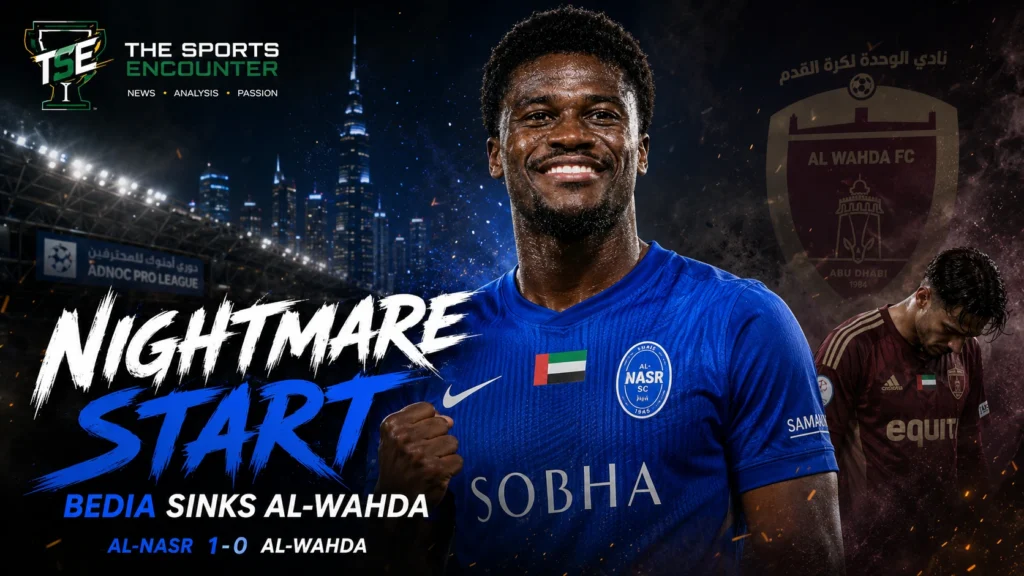
Al-Wahda Hit Historic Low as Chris Bedia Sends Al-Nasr Up the UAE Pro League Table
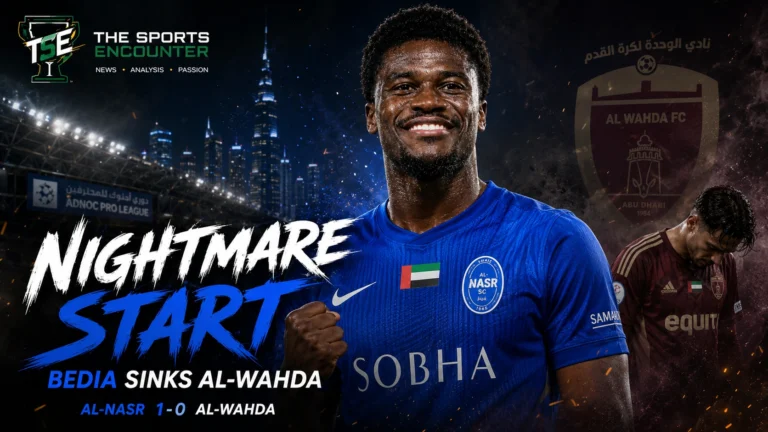
Chris Bedia’s second-half penalty gave Al-Nasr a 1-0 win over Al-Wahda, leaving the Abu Dhabi side without a point after two ADNOC Pro League matches.
Chris Bedia converted a second-half penalty as Al-Nasr defeated Al-Wahda 1-0 at Al Maktoum Stadium, leaving the Abu Dhabi club without a point after the opening two rounds of the 2026-27 ADNOC Pro League season.
The decisive moment arrived in the 54th minute when Bedia scored from the penalty spot after Al-Nasr had already endured the frustration of seeing an earlier penalty sequence wiped out following a VAR review.
Al-Wahda tried to respond with a wave of second-half changes, but Al-Nasr protected the lead and completed their first league victory of the campaign after opening with a 2-2 draw against Kalba.
The result moves Al-Nasr onto four points from two matches. Al-Wahda remain on zero after following their opening 3-2 home defeat to Ajman with another loss in Dubai.
For an Al-Wahda side expected to compete much higher up the table, the concern is already bigger than the points total. Two matches have exposed problems at both ends of the pitch, and the pressure to respond will now increase quickly.
Follow The Sports Encounter’s soccer coverage for more football news, match analysis and stories from across the Middle East and the wider game.
Al-Nasr 1-0 Al-Wahda: Match at a Glance
- Competition: ADNOC Pro League, Matchweek 2
- Result: Al-Nasr 1-0 Al-Wahda
- Venue: Al Maktoum Stadium, Dubai
- Goal: Chris Bedia, 54′ penalty
- Al-Nasr points: 4 from two matches
- Al-Wahda points: 0 from two matches
- Al-Wahda opening result: Lost 3-2 to Ajman
- Al-Nasr opening result: Drew 2-2 with Kalba
Chris Bedia Makes the Difference From the Spot
The match was decided by a penalty, but Al-Nasr’s route to that moment was more complicated than the final score suggests.
The hosts had already been awarded a spot kick before halftime. Abdoulaye Touré saw the penalty saved, and Zayed Sultan converted the rebound, only for the goal to be cancelled after a VAR review because of an infringement during the penalty sequence.
That could easily have become a turning point in Al-Wahda’s favor.
Instead, Al-Nasr kept their composure.
Nine minutes into the second half, another penalty decision gave them a second opportunity. This time Bedia stepped up and converted, putting the Dubai club ahead in the 54th minute.
Sharjah 24 confirmed Bedia as the scorer of the only goal in the 1-0 Al-Nasr victory.
Al-Wahda Had the Ball but Could Not Find the Goal
The scoreline alone does not explain why this defeat should concern Al-Wahda.
They were not completely overwhelmed. The visitors produced 13 attempts compared with Al-Nasr’s nine and created enough possession around the final third to believe an equalizer was possible.
The problem was what happened once those attacks reached the decisive areas.
Only two of Al-Wahda’s attempts were on target. Omar Khribin provided creativity and movement around the attacking third, while Renne Rivas and Asher Agbinone also tried to stretch the hosts, but the pressure rarely became the type of clear chance that forces a goalkeeper into repeated emergency saves.
Al-Nasr, by comparison, generated fewer attempts but four of them tested the target.
That difference in efficiency ultimately mattered more than the overall shot count.
Al-Wahda’s Opening Two Matches Have Exposed a Bigger Problem
The opening defeat to Ajman already raised questions.
Al-Wahda conceded after only five minutes in that match, fell 2-0 behind early in the second half and eventually lost 3-2 despite late goals from Mohammad Ghorbani and Brahima Diarra.
Ajman striker Victor Henrique scored twice, including what proved to be the decisive third goal in the 83rd minute. Sharjah 24 described the result as a historic opening victory for Ajman against Al-Wahda.
The first game therefore highlighted defensive vulnerability.
The second exposed the other side of the problem.
Al-Wahda conceded only once against Al-Nasr, yet still could not take anything from the game because their attacking possession produced no goal.
When those two performances are placed together, the concern becomes clearer. Al-Wahda have already experienced one match in which they could not control the damage defensively and another in which they could not convert pressure into a response.
Omar Khribin Can Create, but Al-Wahda Need More Around Him
Khribin remains one of Al-Wahda’s most important attacking players.
His ability to find pockets between midfield and defense, connect passes around the penalty area and create opportunities gives the Abu Dhabi club a dependable source of attacking intelligence.
Against Al-Nasr, however, individual creativity was not enough.
Khribin registered several key passes but could not turn the match himself. Christian Benteke was also unable to find the equalizer as Al-Wahda searched for a way through a compact Al-Nasr defense.
The broader challenge is creating better connections between the midfield, wide areas and central striker.
Al-Wahda can have technically capable players around the box and still struggle if their attacks become predictable. Possession needs movement ahead of the ball, quicker combinations and more players arriving in scoring positions.
That was missing too often in Dubai.
Al-Nasr Showed Why Game Management Matters
Al-Nasr deserve credit for more than Bedia’s penalty.
After taking the lead, the hosts managed the game with greater discipline than Al-Wahda managed the chase.
They defended the central areas, reduced the quality of the visitors’ shooting opportunities and avoided turning the closing stages into a chaotic exchange.
That matters because Al-Nasr had experienced a very different type of meeting with Al-Wahda only a few months earlier.
In April, the same fixture ended 2-2 after Cheickna Doumbia scored in the 98th minute to rescue Al-Nasr at Al Maktoum Stadium. The UAE Pro League’s official report from that match noted that Al-Wahda had led 2-1 before being denied at the end.
This time, Al-Nasr controlled the decisive phase more effectively.
Four Points Give Al-Nasr a Useful Early Platform
Four points from two matches will not define Al-Nasr’s season, but it gives them a useful foundation.
The opening 2-2 draw with Kalba meant this game carried additional importance. Another failure to win would have left them chasing momentum immediately.
Instead, Bedia’s goal turned a solid start into an encouraging one.
The result also matters in the wider context of a league where Al Ain, Shabab Al Ahli, Al Wasl and several other clubs have ambitions near the top of the table.
The official UAE Pro League website is tracking another competitive season after defending champions Al Ain entered 2026-27 seeking to protect the title they won last term.
Every early point matters because the margin for recovering from a slow opening can disappear quickly once the stronger teams build rhythm.
TSE Analysis: The Bigger Warning Is Al-Wahda’s Lack of a Clear Identity
Two defeats do not make a crisis, but they can reveal whether a team already understands what it wants to be.
That is the uncomfortable question facing Al-Wahda.
Against Ajman, they chased the game after allowing an opponent to build a two-goal advantage. Against Al-Nasr, they had enough territory to compete but lacked the final action needed to turn possession into goals.
Those are different types of defeats.
That makes them more concerning.
A team can fix one specific weakness more easily than a group showing different structural problems from week to week.
Al-Wahda now need to establish whether they want to dominate through possession, play more directly toward Benteke, use Khribin closer to goal or create more aggressively through the wide areas.
Until those roles become clearer, the individual names in the lineup may matter less than expected.
Al-Wahda’s Recent League Form Adds to the Pressure
The difficult start also follows an uneven end to last season.
Al-Wahda finished the 2025-26 ADNOC Pro League campaign in fifth place with 40 points after losing 1-0 to Al Dhafra on the final day.
That defeat allowed Al Dhafra to secure survival, while Al-Wahda closed the season outside the league’s leading positions. The UAE Pro League’s official report confirmed Karim El Berkaoui’s 82nd-minute goal as the decisive moment.
There had been better performances before that, including a 2-0 victory over Sharjah in April, but the new campaign was supposed to provide a fresh start.
Instead, Al-Wahda have lost their first two matches and already find themselves needing a response.
Middle East Football Is Becoming a Bigger Part of the Regional Sports Story
The result also deserves attention beyond the UAE because Gulf club football is becoming increasingly interconnected.
The Sports Encounter has been following that development across the region, including Al-Ittihad’s 1-0 victory over Al-Qadsiah, where Tijjani Reijnders made his Saudi Pro League debut after joining from Manchester City.
Saudi recruitment remains one of the biggest forces reshaping the regional market. Thomas Partey’s move to Al-Shabab provided another example of experienced European-based players moving into Gulf football.
At Al-Nassr, Cristiano Ronaldo has returned to competitive action, scoring as the champions beat Al-Riyadh 4-0 to continue their perfect start.
The UAE’s clubs will also intersect directly with Saudi football in Asia. Al Ain and Shabab Al Ahli are part of the broader AFC Champions League Elite picture, increasing the importance of domestic form before continental fixtures begin.
The regional stakes extend beyond club competition. The Sports Encounter has also examined the evolving political balance inside Asian football through the AFC-Qatar dispute surrounding Gianni Infantino and the wider FIFA leadership struggle involving the AFC, UEFA and CONCACAF.
Together, those developments show why Gulf football can no longer be viewed as a collection of isolated domestic leagues.
What Comes Next for Al-Wahda?
Al-Wahda’s next league match now carries more pressure than anyone at the club would have wanted this early in the season.
The immediate priority is simple: get points on the board.
How they do it will matter almost as much.
A narrow win would ease the table pressure, but a more convincing performance would provide evidence that the tactical problems exposed in the first two rounds are being addressed.
Al-Wahda need better defensive control than they showed against Ajman and greater attacking efficiency than they produced against Al-Nasr.
That balance will determine whether this opening becomes an early-season warning or the beginning of something more difficult.
What Comes Next for Al-Nasr?
Al-Nasr leave this match in a much healthier position.
Four points from two games provides momentum, and Bedia’s decisive contribution gives the attack an early focal point.
The next test will show whether this victory represents progress or simply a useful home result.
Al-Nasr will eventually be judged against the teams expected to fight for the championship and continental positions. For now, however, they have avoided the type of poor start that can create pressure before a season has properly settled.
Readers can follow more regional football through The Sports Encounter’s Soccer section and visit The Sports Encounter homepage for the latest sports news, analysis and match coverage.
Frequently Asked Questions
Who won Al-Nasr vs Al-Wahda?
Al-Nasr defeated Al-Wahda 1-0 in Matchweek 2 of the 2026-27 ADNOC Pro League.
Who scored for Al-Nasr against Al-Wahda?
Chris Bedia scored the only goal of the match from the penalty spot in the 54th minute.
Where was Al-Nasr vs Al-Wahda played?
The match was played at Al Maktoum Stadium in Dubai.
How many points do Al-Nasr have?
Al-Nasr have four points from their opening two ADNOC Pro League matches after drawing with Kalba and beating Al-Wahda.
How many points do Al-Wahda have?
Al-Wahda remain without a point after losing their first two league matches against Ajman and Al-Nasr.
What happened in Al-Wahda’s opening match?
Al-Wahda lost 3-2 at home to Ajman in Matchweek 1 despite scoring twice during the closing stages.
Did Al-Nasr have another penalty against Al-Wahda?
Yes. Al-Nasr had an earlier penalty saved, with the subsequent rebound goal cancelled after a VAR review. Bedia later converted the second penalty in the 54th minute.
Who are the defending ADNOC Pro League champions?
Al Ain entered the 2026-27 season as defending ADNOC Pro League champions after winning their 15th league title in 2025-26.

Breaking News
NFL Injury Blow: Seahawks Lose Jake Bobo as Ravens Face Center Crisis After Danny Pinter Tear
The Seahawks may be without Jake Bobo for an extended period after a serious knee injury, while the Ravens face a center crisis after Danny Pinter tore his patellar tendon during joint practice.
SEATTLE/BALTIMORE, August 22, 2026: Two NFL teams were dealt significant training-camp blows within 48 hours as Seattle Seahawks wide receiver Jake Bobo suffered a serious right knee injury and Baltimore Ravens center Danny Pinter sustained a torn patellar tendon that is expected to sideline him for an extended period.
The injuries affect very different parts of two rosters, but both carry consequences beyond losing a single player.
Seattle may have lost one of its most trusted depth receivers and special-teams contributors just weeks before beginning its Super Bowl title defense. Baltimore, meanwhile, could be forced to rethink one of the most important positions on its offensive line after Pinter had emerged as a leading candidate to start at center.
The timing is particularly cruel.
Both injuries happened during joint practices, the exact environment teams use to simulate regular-season intensity without exposing starters to a full preseason game.
Instead, Seattle and Baltimore now leave those sessions with significant roster problems to solve.
Jake Bobo and Danny Pinter Injuries: What We Know
| Player | Team | Injury | Current Status |
|---|---|---|---|
| Jake Bobo | Seattle Seahawks | Serious right knee injury | Potentially long-term absence |
| Danny Pinter | Baltimore Ravens | Torn right patellar tendon | Expected to miss extended time, with reports indicating the season could be lost |
The Seattle Seahawks confirmed that Bobo suffered the injury during Friday’s joint practice with the Tennessee Titans.
Baltimore has also confirmed that Pinter will miss extended time following his injury during the Ravens’ joint practice with the Minnesota Vikings.
Jake Bobo’s Injury Looked Serious Immediately
Bobo went down while attempting to make a catch near the sideline during Seattle’s practice with Tennessee.
He required a cart to leave the field.
Seahawks head coach Mike Macdonald later described the injury as serious and indicated that the team feared a potentially long-term absence.
A full timetable will depend on additional medical evaluation, but Seattle’s public reaction made clear that this was not being treated as a minor preseason setback.
That distinction matters because Bobo has built his NFL career around availability, reliability and doing several jobs well enough to earn repeated trust from the coaching staff.
Bobo’s Numbers Do Not Fully Explain His Value
Looking only at Bobo’s regular-season receiving production can make his role appear relatively small.
Since entering the league in 2023, he has recorded 34 receptions for 323 yards and three touchdowns across 45 regular-season games.
Those numbers do not tell the whole story.
Bobo has been useful as a blocker, special-teams contributor and situational receiver.
He has also delivered important catches when his opportunities have increased.
Last season, he appeared in 11 regular-season games and remained part of Seattle’s postseason rotation.
His most memorable contribution came on the biggest stage.
Bobo caught a touchdown during the Seahawks’ Super Bowl LX victory over the New England Patriots.
That alone helps explain why Seattle valued him enough to keep him during the offseason.
Seattle Had Already Invested in Keeping Bobo
Bobo’s place in Seattle’s plans became clearer earlier this year.
Jacksonville reportedly offered him a contract worth $5.5 million, but Seattle matched the offer to retain him.
That was not the type of move teams make for a player they consider expendable.
The Seahawks clearly saw Bobo as part of their depth structure entering a season in which expectations are naturally higher after winning the Super Bowl.
Now that plan may have to change before Week 1.
Seattle’s Problem Is Bigger Than Replacing Receptions
If Bobo misses significant time, the Seahawks will not simply need somebody to reproduce a handful of catches.
They will need to replace several layers of roster value.
- Wide receiver depth
- Blocking from the receiver position
- Special-teams snaps
- Red-zone and situational receiving experience
- Postseason-tested depth
Players who occupy those roles are rarely the biggest names on a roster, but they become important over a 17-game season when injuries, matchups and special-teams requirements constantly change personnel usage.
Seattle’s coaching staff now has to decide whether the replacement can come internally or whether the front office needs to look outside the organization.
The Super Bowl Champions Are Learning How Quickly Depth Can Change
Seattle enters 2026 in a different position from a year ago.
The Seahawks are no longer simply building toward contention.
They are defending a championship.
That changes the importance of every depth decision.
A roster built to survive four playoff games and win a Super Bowl needs capable players beyond the starting 22.
Bobo had become part of that structure.
His potential absence immediately forces younger receivers and special-teamers to take on responsibilities that Seattle may not have expected them to carry this early.
The Sports Encounter has been tracking how quickly injuries can reshape NFL depth charts during August. Our recent NFL training camp roundup examined similar problems for Chicago, Denver and Jacksonville after injuries forced teams to reconsider both immediate practice reps and longer-term roster construction.
Danny Pinter’s Injury Creates a More Direct Starting-Lineup Problem
Baltimore’s situation may be even more urgent.
Pinter suffered a torn patellar tendon in his right leg during a joint practice with Minnesota.
The injury is severe enough that reports indicate he is likely to miss the entire 2026 season, although the Ravens have publicly described the timeline more broadly as an extended absence.
Pinter had been doing far more than competing for a backup role.
He had been taking the majority of Baltimore’s first-team center repetitions and was considered a leading candidate to replace Pro Bowl center Tyler Linderbaum.
That makes the injury a structural problem for the offense.
Why Center Matters So Much to Baltimore
Center is one of the least glamorous positions in football and one of the most important.
The player must snap the ball cleanly, identify fronts, communicate protections and help organize the interior offensive line before almost every play.
That responsibility becomes even more important for a team with championship ambitions.
Baltimore cannot afford persistent communication breakdowns or interior pressure because the center position remains unsettled.
Pinter had spent training camp building that chemistry.
Those repetitions are now gone.
Pinter Had Put Himself in Position to Start
The 30-year-old entered Baltimore with meaningful NFL experience.
Originally selected by Indianapolis in the fifth round of the 2020 NFL Draft, Pinter appeared in 77 games with 10 starts from 2020 through 2025.
He missed the entire 2023 campaign after suffering a broken ankle but returned and played all 17 games for the Colts last season.
That experience helped make him a realistic candidate for Baltimore’s starting center job rather than simply emergency depth.
He started the Ravens’ preseason opener and had continued receiving significant work with the first-team offense.
The competition now changes completely.
Baltimore’s Immediate Center Options
The Ravens still have alternatives.
Veteran Ethan Pocic becomes an obvious candidate.
Pocic has substantial NFL starting experience after previous spells with Seattle and Cleveland.
Baltimore can also evaluate Jovaughn Gwyn and other interior linemen during the remaining preseason period.
| Center Option | What He Offers |
|---|---|
| Ethan Pocic | Extensive NFL starting experience and immediate veteran stability |
| Jovaughn Gwyn | Younger internal option with opportunity to earn additional reps |
| External signing | Potential veteran competition if Baltimore is not satisfied internally |
The presence of Pocic prevents the situation from becoming a complete emergency.
It does not erase the disruption.
Pinter had already accumulated first-team repetitions and developed communication with the rest of Baltimore’s offensive line.
Whoever replaces him effectively has to restart part of that process with the regular season approaching.
A Patellar Tendon Tear Is a Major Injury for an Offensive Lineman
Pinter’s injury is particularly serious because offensive-line play depends so heavily on lower-body power.
Centers must explode out of their stance, absorb contact from defensive tackles and redirect their weight almost immediately after snapping the football.
A torn patellar tendon directly affects that chain of movement.
Even beyond the immediate recovery period, rebuilding strength, balance and confidence can require significant rehabilitation.
That is why reports pointing toward a season-long absence are unsurprising.
Baltimore will have to plan as though Pinter may not be available in 2026.
Joint Practices Are Becoming One of August’s Biggest Risk-Reward Decisions
Both injuries occurred during joint practices.
That coincidence highlights one of the NFL preseason’s most uncomfortable realities.
Coaches increasingly value joint practices because they can control situations more precisely than preseason games.
Teams can schedule red-zone periods.
They can repeat third-down situations.
Starters can receive high-quality repetitions without playing through an entire game.
Coaches can stop a period if tempers rise or workloads become excessive.
The physical risk never disappears.
Bobo was injured during a football action near the sideline.
Pinter was injured while preparing against another NFL defensive front.
Neither team was being reckless simply by practicing.
Football itself carries the risk.
August Injuries Hurt Differently Because Rosters Are Still Being Built
An injury in October usually forces a team to adjust a roster whose hierarchy is already established.
August is different.
Position battles remain open.
Young players are still being evaluated.
Coaches are deciding which combinations work.
The final 53-man roster has not yet settled.
One major injury can therefore alter several decisions at once.
Seattle may have to change how many receivers it carries.
Baltimore may have to reconsider which interior offensive linemen make the roster.
Practice repetitions will immediately be redistributed.
Front offices may begin calling available veterans.
The Sports Encounter’s earlier NFL injury roundup showed the same dynamic with Green Bay, New York and Tennessee, where even less severe training-camp injuries immediately affected preseason planning.
Bobo’s Injury Could Create Opportunity for Seattle’s Younger Receivers
Every injury creates an unwanted opening.
For Seattle’s younger receivers, Bobo’s absence means additional practice snaps and preseason opportunities.
Those repetitions matter.
A receiver who previously needed several injuries to reach the active gameday group may suddenly be fighting for a meaningful role.
Special teams will be equally important.
A young receiver who can contribute only offensively may struggle to replace Bobo’s roster value.
A player capable of covering kicks, blocking and handling rotational receiving snaps becomes much more attractive.
Baltimore’s Center Decision Will Affect More Than the Offensive Line
The Ravens’ replacement decision could influence the entire offense.
A center who communicates protections confidently allows the quarterback to operate faster.
A center who struggles with assignments can force additional adjustments before the snap.
Interior pressure is also one of the fastest ways to disrupt an offense because quarterbacks have less space to escape when defenders penetrate directly through the middle.
Baltimore therefore cannot treat this as merely filling an empty starting spot.
The replacement must become part of the offense’s communication system.
Why Veteran Experience May Win Baltimore’s Competition
That is where Pocic’s experience becomes valuable.
He has spent nine NFL seasons working in different offensive systems and has extensive experience as a starter.
At this stage of the calendar, experience can matter more than developmental upside.
The Ravens do not have months to teach somebody how to organize an NFL offensive line.
They need the position stabilized before Week 1.
If Pocic performs adequately through the remainder of camp, Baltimore may prefer continuity over searching aggressively outside the organization.
The Injuries Also Show Why NFL Depth Cannot Be Judged in June
Offseason depth charts often look comfortable.
There are multiple players at every position.
Young prospects appear ready to develop.
Veterans provide insurance.
Then training camp begins.
One injury removes a receiver.
Another removes a potential starting center.
A third injury elsewhere forces another roster decision.
By September, the depth chart can look entirely different from the version discussed after the draft.
That is why teams continue signing players throughout August even when their rosters appear full.
The Sports Encounter examined that process in our NFL roster and injury roundup, where teams were already making late personnel adjustments in response to season-ending setbacks.
TSE Analysis: Baltimore Faces the Bigger Tactical Problem
Both injuries hurt.
Baltimore’s may be more difficult to absorb structurally.
Seattle has lost a valuable depth player, but Bobo was not expected to be the primary receiver in the offense.
The Seahawks can distribute his receiving snaps while replacing his special-teams work across multiple players.
Baltimore potentially lost its starting center.
That is one position with one player on every offensive snap.
There is no committee solution once the ball is placed at the line of scrimmage.
Someone must make the snap.
Someone must handle protection communication.
Someone must deal with powerful interior defenders play after play.
The Ravens have experienced alternatives, which protects them from panic.
They still lost valuable preparation time at one of the offense’s most communication-heavy positions.
Seattle’s Concern Is More About Depth Over a Full Season
The Seahawks face a different problem.
Championship defenses often depend on surviving attrition.
Seattle knows this after navigating an entire postseason last season.
Bobo was the type of player who could move between supporting roles without demanding offensive touches.
Those players become particularly valuable when injuries occur later in the year.
Losing one before the season begins reduces Seattle’s margin for error before the first regular-season snap.
The Human Cost Should Not Be Lost in Roster Analysis
Training-camp injury stories quickly become depth-chart discussions.
There is another side to them.
Bobo had earned his place in Seattle’s plans after developing from an undrafted player into a Super Bowl contributor.
Pinter had worked back from a broken ankle that cost him an entire season and positioned himself for another opportunity to start.
Both players entered August with meaningful roles ahead of them.
One practice changed everything.
For coaches and fans, the next question is who replaces them.
For the players, the next question is rehabilitation.
What Happens Next for Jake Bobo?
Seattle will wait for the full medical diagnosis before establishing a formal rehabilitation timetable.
Macdonald’s initial assessment suggests the Seahawks are preparing for a substantial absence.
If further testing confirms a major structural knee injury, Seattle could place Bobo on injured reserve and explore additional receiver depth.
The club will also spend the remaining preseason practices evaluating which players can absorb his special-teams responsibilities.
What Happens Next for Danny Pinter?
Baltimore’s approach is more immediate.
The Ravens must redistribute starting-center repetitions now.
Pocic and Gwyn should receive additional opportunities while coaches evaluate whether an external addition is necessary.
Because a torn patellar tendon typically requires surgery and lengthy rehabilitation, Baltimore has little reason to wait before preparing for the season without Pinter.
The final decision will likely depend on how comfortable the coaching staff becomes with its existing options over the next several practices.
Another Warning From a Brutal NFL August
The 2026 preseason has already produced several significant injuries across the league.
Matt Henningsen suffered another Achilles tear in Denver.
Jalon Walker was lost for the season in Atlanta.
Other teams have managed injuries involving important starters, rookies and depth players throughout camp.
Bobo and Pinter now join that list.
August games may not count in the standings.
August injuries count immediately.
Final Verdict
Seattle and Baltimore leave this week facing two very different tests of roster depth.
The Seahawks must determine how to replace a trusted receiver and special-teams contributor whose value became especially visible during their Super Bowl run.
The Ravens must solve a more fundamental problem after losing the player who had been taking most of the first-team repetitions at center.
Neither injury should be treated as a reason to dramatically change expectations for the season by itself.
Both expose how quickly those expectations can become more difficult to meet.
Seattle matched a $5.5 million offer to keep Bobo because it understood his value.
Baltimore gave Pinter substantial first-team work because it believed he could become its starting center.
Those plans lasted until training camp contact turned into medical uncertainty.
Now the Super Bowl champions need another depth player to emerge, while the Ravens need someone capable of taking control of the middle of their offensive line before the games begin to matter.
The NFL season is still approaching.
For Bobo and Pinter, it has already changed dramatically.
Frequently Asked Questions
What happened to Jake Bobo?
Seattle Seahawks wide receiver Jake Bobo suffered a serious right knee injury during a joint practice with the Tennessee Titans on August 21. He was carted from the field, and head coach Mike Macdonald indicated the injury could require a long-term recovery.
How long will Jake Bobo be out?
Seattle has not announced a definitive recovery timetable. The Seahawks have described the injury as serious, and further medical evaluation will determine how long Bobo is unavailable.
Did Jake Bobo play in Super Bowl LX?
Yes. Bobo contributed during Seattle’s postseason run and caught a touchdown in the Seahawks’ Super Bowl LX victory over the New England Patriots.
What happened to Danny Pinter?
Baltimore Ravens center Danny Pinter suffered a torn patellar tendon in his right leg during a joint practice with the Minnesota Vikings.
Will Danny Pinter miss the 2026 NFL season?
Reports indicate that Pinter is likely to miss the season because of the torn patellar tendon. The Ravens have publicly said he will miss extended time.
Was Danny Pinter expected to start for Baltimore?
Pinter was a leading candidate for the Ravens’ starting center position and had been taking most of the first-team repetitions during training camp.
Who could replace Danny Pinter at center?
Veteran Ethan Pocic is one of Baltimore’s leading internal options, while Jovaughn Gwyn can also receive additional repetitions. The Ravens could explore the veteran market if they want more competition.
How serious is a torn patellar tendon?
A torn patellar tendon is a major lower-body injury that generally requires significant rehabilitation. For an offensive lineman, it directly affects the explosive leg strength and stability required for blocking.
Why are NFL teams using joint practices?
Joint practices allow teams to create controlled competitive situations against another roster, including red-zone, third-down and two-minute drills. They can provide valuable preparation while allowing coaches more control than a preseason game, although injury risk remains.
Where can fans follow official updates on the injuries?
The latest confirmed information will be available through the Seattle Seahawks and Baltimore Ravens official websites as medical evaluations and roster decisions continue.
Breaking News
Shakhtar at Stamford Bridge: How War Has Turned Chelsea’s Home Into a Champions League Lifeline
Shakhtar Donetsk will stage their 2026-27 Champions League home matches at Stamford Bridge, adding another extraordinary chapter to a decade of displacement from Donetsk while Chelsea sit outside Europe.
LONDON, August 22, 2026: Stamford Bridge will host Champions League football this season after all, but Chelsea will not be the team playing it.
Shakhtar Donetsk have confirmed that they will stage their 2026-27 UEFA Champions League league-phase home matches at Stamford Bridge, subject to the required regulatory approvals.
The arrangement gives the Ukrainian champions a high-profile European base in London after more than a decade of displacement from their true home.
Shakhtar have not been able to play at the Donbas Arena in Donetsk since 2014. Russia’s full-scale invasion of Ukraine in 2022 deepened that displacement, forcing the club to build an extraordinary European existence across different cities, countries and temporary home grounds.
Now, one of the most recognizable stadiums in English football will become the latest stop in that journey.
The symbolism is difficult to miss.
Chelsea finished 10th in the Premier League last season and failed to qualify for Europe. Their absence has created the stadium availability that Shakhtar now need. At the same time, Stamford Bridge carries its own complicated history with Ukraine because Chelsea spent nearly two decades under Roman Abramovich before his ownership ended following UK sanctions imposed after Russia’s invasion.
For Shakhtar, however, the immediate issue is much simpler.
They need somewhere capable of feeling like a European home.
Stamford Bridge may be the closest thing they have found in years.
Shakhtar at Stamford Bridge: What Has Been Confirmed?
| Detail | Confirmed Information |
|---|---|
| Club | Shakhtar Donetsk |
| Competition | UEFA Champions League 2026-27 |
| Temporary home venue | Stamford Bridge, London |
| Matches covered | Champions League league-phase home games |
| Venue owner | Chelsea Football Club |
| Chelsea in Europe this season? | No |
| Shakhtar’s true home stadium | Donbas Arena, Donetsk |
| Unable to play there since | 2014 |
| Regulatory status | Subject to approvals |
Chelsea officially announced the arrangement, saying the club would work closely with Shakhtar to ensure that matchdays run safely and smoothly for the Ukrainian side and its supporters.
Shakhtar described the opportunity as special and said playing at Stamford Bridge would provide memorable experiences for Ukrainian and English supporters.
This Is the Latest Chapter in Shakhtar’s Long Search for a Home
Shakhtar’s displacement did not begin in 2022.
It began much earlier.
The club stopped playing at Donbas Arena in 2014 after conflict reached the Donetsk region.
Since then, Shakhtar have been forced to build an identity that most major European clubs never have to contemplate.
A normal Champions League club develops rhythms around the same stadium.
Players know the dressing room.
Supporters know the routes to the ground.
Families attend from the same neighborhoods.
Commercial partners build matchday activation around the same city.
Home advantage becomes partly psychological because thousands of tiny routines repeat every season.
Shakhtar lost all of that.
Over the years, they have staged home fixtures in cities including Kyiv, Lviv, Warsaw, Hamburg, Gelsenkirchen, Krakow and Ljubljana.
That history turns Stamford Bridge into more than a rental agreement.
It becomes another attempt to manufacture stability in a situation where stability has been almost impossible.
Why Stamford Bridge Makes Sense
There are practical reasons for choosing London.
Stamford Bridge is a Champions League-standard venue with established security, broadcast, hospitality and operational infrastructure.
It is located in one of Europe’s largest football markets.
London also has a significant Ukrainian community and a large international population capable of supporting European matchdays involving a neutral or visiting club.
Most importantly, Chelsea do not have European home fixtures to accommodate this season.
The Sports Encounter’s Premier League 2026-27 preview documented the unusual position Chelsea find themselves in after finishing 10th last season and missing European qualification despite another extensive rebuild.
That failure has now created an unexpected opportunity for Shakhtar.
Chelsea’s Absence From Europe Creates a Strange Contrast
Stamford Bridge has spent much of the modern era associated with elite European nights.
Chelsea have won the Champions League twice.
The stadium has hosted some of the most dramatic knockout matches of the competition’s modern era.
This season, however, Chelsea will watch another club carry the Champions League branding into their own ground.
That contrast says a great deal about Chelsea’s current position.
The Sports Encounter’s ranking of the Premier League title contenders placed Chelsea outside the leading championship group precisely because the club is still trying to turn enormous talent into reliable results.
The squad is expensive.
The ambition remains enormous.
European football is absent.
For several months, Stamford Bridge will therefore host Champions League football that Chelsea supporters cannot call their own.
Shakhtar Earned Their Champions League Place
Shakhtar are not entering the league phase through a special exemption created by their displacement.
They qualified through UEFA’s competition structure.
UEFA confirmed in May that Shakhtar received automatic entry into the 2026-27 Champions League league phase following competition rebalancing.
That decision was based on UEFA’s access system and club coefficient rules after the 2025-26 Champions League finalists had already qualified domestically.
Shakhtar therefore arrive in London as a legitimate Champions League participant with substantial European history.
The club won the UEFA Cup in 2009 and has spent much of the last two decades competing regularly against Europe’s strongest teams.
Their official UEFA Champions League profile again lists them in the 2026-27 competition.
Playing Away From Home Changes More Than the Atmosphere
The sporting effect of displacement can be difficult to quantify because there is no single statistic for what a club loses when its home disappears.
The disadvantages accumulate.
Travel becomes more complicated.
Support becomes less predictable.
Training and match logistics change.
Commercial operations must adjust repeatedly.
Players can spend seasons representing a city where they rarely perform.
Young supporters grow up without the same matchday relationship previous generations experienced.
Shakhtar have managed to remain competitive despite those conditions.
That deserves more attention than it usually receives.
Can Stamford Bridge Actually Become a Home Advantage?
That is the sporting question worth watching.
A famous stadium does not automatically become a home ground simply because one team is listed first on the fixture sheet.
Shakhtar will need people inside it.
A Champions League evening with 35,000 to 40,000 engaged supporters would feel very different from a sparsely attended neutral-site fixture.
London offers a better chance of building that atmosphere than many temporary locations.
Ukrainian supporters living in Britain can attend.
Neutral football fans may be attracted by the chance to watch Champions League football at Stamford Bridge.
Supporters of Shakhtar’s opponents already based in England or Western Europe may also travel easily.
That last point creates a potential complication.
Some nights could become unusually balanced in the stands.
Shakhtar may be the home team administratively without enjoying the overwhelming crowd advantage normally associated with one.
The London Factor Could Help Shakhtar Commercially
The arrangement also carries a business dimension.
Champions League exposure in London places Shakhtar inside one of football’s richest media and sponsorship markets.
Corporate hospitality at Stamford Bridge is already designed around elite football.
International sponsors understand the venue.
Broadcasters understand the logistics.
Potential partners can reach the stadium far more easily than many of Shakhtar’s previous temporary homes.
For a displaced club trying to sustain elite European operations, those factors matter.
Football discussions about temporary stadiums often focus only on crowd noise.
The financial ecosystem around the venue can be just as important.
Chelsea’s Own Transformation Adds Another Layer
The Stamford Bridge of 2026 is also not the Stamford Bridge of the Abramovich era.
Chelsea’s ownership structure changed dramatically in 2022.
The club has since pursued an aggressive recruitment model centered heavily on young players, long contracts and future resale value.
The Sports Encounter has followed that evolution through stories such as Chelsea’s long-term move for Geovany Quenda and our analysis of the Premier League’s most expensive transfers, which included Chelsea’s record investment in Morgan Rogers.
The scale of the rebuild makes the absence of European football even more striking.
Shakhtar will enter Stamford Bridge as Champions League participants while Chelsea’s latest squad focuses exclusively on domestic competitions.
The Abramovich History Makes the Venue Choice Unavoidably Symbolic
It would be artificial to discuss Shakhtar playing at Stamford Bridge without acknowledging the history surrounding the stadium.
Roman Abramovich bought Chelsea in 2003 and transformed the club into one of Europe’s dominant football powers.
His ownership ended in 2022 after the UK government imposed sanctions following Russia’s invasion of Ukraine.
Chelsea were subsequently sold to an American-led ownership group.
The Sports Encounter recently examined another part of that previous era when Chelsea received a £10 million fine and suspended transfer ban over Abramovich-era agent payments.
Four years after the ownership change, a Ukrainian club displaced by war will now use Stamford Bridge for Champions League home matches.
No one at either club needs to exaggerate the symbolism.
It is already there.
Football Has Been Forced to Adapt to War Before
Shakhtar’s situation is unusually prolonged, but football has repeatedly been affected by political conflict, security concerns and national emergencies.
Matches have been moved.
Teams have played behind closed doors.
National sides have adopted temporary home grounds.
Competitions have adjusted qualification and scheduling systems.
What makes Shakhtar different is the length of the displacement.
More than a decade has passed since their last normal season at Donbas Arena.
That means temporary arrangements are no longer a short emergency phase.
They have become part of the club’s modern identity.
Shakhtar Have Maintained European Relevance Despite Everything
The most remarkable part of the story may be that Shakhtar remain here at all.
UEFA’s historical records show a club that has continued appearing in European competitions across multiple generations.
Shakhtar reached the Champions League quarterfinals in 2010-11 and have repeatedly advanced from group or league-stage competition since.
They have developed and sold high-level international players while continuing to compete domestically under circumstances no comparable major Western European club has experienced.
That resilience is why Stamford Bridge should not be treated as a novelty story.
It is the latest mechanism keeping a displaced football institution connected to the highest level of the sport.
London Supporters Could See Unexpected Champions League Matchups
The league-phase draw will determine exactly who visits Stamford Bridge.
That creates genuine intrigue for London-based football supporters.
Shakhtar could draw some of Europe’s biggest clubs.
Each home fixture would then become a strange combination of neutral spectacle, Shakhtar home match and London Champions League event.
The atmosphere could be especially compelling if Shakhtar draw a club with a large supporter base in Britain.
There is also the possibility of facing English opposition.
If that happens, Stamford Bridge could host a Champions League match involving a Premier League club while Chelsea themselves remain outside Europe.
Could Chelsea Benefit From the Arrangement?
The agreement is primarily designed to help Shakhtar, but Chelsea also gain something.
Stamford Bridge remains active on European nights.
The club maintains operational experience around UEFA-level matchdays.
The venue generates additional use during a season without European fixtures of its own.
Chelsea also gain reputational value from providing infrastructure to a displaced club.
None of those factors will compensate supporters for missing the Champions League themselves.
They do make the arrangement rational from Chelsea’s perspective.
The Deal Reflects a Broader Change in European Football
Modern elite football increasingly operates across borders.
Domestic clubs play league matches overseas during preseason.
European competitions use new formats designed around expanded commercial reach.
Owners control multi-club networks.
Global fanbases often exceed local ones.
Shakhtar’s case is different because the movement is not strategic expansion.
It is forced displacement.
Still, it illustrates how football infrastructure can now be shared across countries when political reality makes ordinary home-and-away structures impossible.
The Sports Encounter’s broader soccer coverage has increasingly followed these institutional questions alongside matches and transfers because modern football cannot always be understood only through what happens on the pitch.
UEFA’s Competition Structure Made Shakhtar’s Return Possible
Shakhtar’s direct place in the league phase also reflects the growing importance of UEFA coefficients under the expanded Champions League format.
UEFA awarded the Ukrainian champions the available league-phase berth because of their position within the access-list rebalancing system.
That decision removed the uncertainty of qualification rounds and gave Shakhtar more time to solve the practical problem of where their home games would be played.
For a club already dealing with extraordinary logistical complexity, automatic league-phase qualification carried value beyond sporting prestige.
TSE Analysis: Stamford Bridge Cannot Replace Donetsk
That is the most important distinction in this story.
Stamford Bridge is a world-class stadium.
London is an outstanding football city.
The arrangement makes logistical and commercial sense.
None of it turns west London into Donetsk.
A club’s home is not simply the building where UEFA permits it to play.
It is geography, memory, routine and community.
Shakhtar lost that normality years ago.
Every temporary stadium since has solved the practical problem without solving the emotional one.
Stamford Bridge will be no different in that respect.
But temporary homes can still matter.
They can provide a crowd.
They can preserve revenue.
They can give players a stable environment.
They can keep a club visible internationally.
Most importantly, they allow Shakhtar to continue behaving like the elite European club they were before displacement changed everything around them.
This Could Become One of the Season’s Most Human Champions League Stories
The league phase will eventually be dominated by the usual questions.
Who finishes in the top eight?
Which giants struggle?
Which players score?
Who survives the playoff round?
Shakhtar’s matches at Stamford Bridge will carry another question underneath all of those.
What does home mean when a football club has spent more than a decade without one?
That gives every Shakhtar night in London a context much larger than the result.
What It Means for Chelsea Supporters
For Chelsea fans, the situation will inevitably feel unusual.
The club has spent heavily and rebuilt again under Xabi Alonso, yet its stadium will host the Champions League without Chelsea participating.
Our full Premier League season preview identified Chelsea’s lack of Europe as both an embarrassment and a potential competitive advantage domestically.
Alonso will have more uninterrupted training weeks than several rivals.
Shakhtar, meanwhile, will bring European football back to the Bridge on selected nights.
The visual will be familiar.
The badge on the home dressing-room door will not be.
The Arrangement Also Highlights Chelsea’s Fall and Opportunity
There is another side to Chelsea missing Europe.
Fewer matches mean fewer scheduling complications.
No Champions League travel means more training time.
A squad that finished 10th gets an unusual opportunity to rebuild without continental fatigue.
The Sports Encounter’s title-race assessment still viewed Chelsea as an outsider because of the size of the gap they need to close.
If Alonso turns the lighter calendar into a major domestic improvement, Chelsea could return to Europe quickly.
Until then, Shakhtar will temporarily occupy the European stage at their stadium.
What Happens Next?
The arrangement remains subject to the necessary regulatory approvals.
Once those processes are completed, attention will shift to the Champions League league-phase draw and the identity of Shakhtar’s opponents.
UEFA’s official Shakhtar competition page will carry the club’s fixtures, results and standings throughout the tournament.
Chelsea and Shakhtar will also need to coordinate ticketing, security, supporter access, hospitality, staffing and stadium branding before the first European night.
Those details are routine for Stamford Bridge.
The identity of the home club is anything but routine.
Final Verdict
Shakhtar Donetsk playing Champions League football at Stamford Bridge is one of those stories that initially sounds strange and then makes more sense the longer it is examined.
Chelsea have the stadium.
Shakhtar need one.
London offers infrastructure, supporters, commercial access and a venue already built for Champions League nights.
The practical logic is strong.
The emotional reality remains complicated.
Shakhtar have lived without their true home since 2014.
They have crossed borders, changed stadiums and rebuilt matchday life repeatedly while remaining competitive enough to keep qualifying for European football.
Stamford Bridge is another temporary solution.
It may also become one of the best temporary solutions they have found.
For Chelsea, the sight will be uncomfortable in a different way. Champions League branding will return to Stamford Bridge months after the club’s own 10th-place finish removed them from Europe.
For Shakhtar, those same nights will represent survival, continuity and the determination to remain connected to elite football despite circumstances far beyond anything happening on the pitch.
The Champions League is built around the idea of Europe’s best clubs defending their homes.
Shakhtar have spent more than a decade proving that sometimes the bigger achievement is continuing to compete when home itself has been taken away.
Frequently Asked Questions
Why are Shakhtar Donetsk playing at Stamford Bridge?
Shakhtar cannot currently play Champions League matches at their traditional Donbas Arena in Donetsk. Chelsea have made Stamford Bridge available for Shakhtar’s 2026-27 Champions League league-phase home fixtures, subject to regulatory approvals.
Will Chelsea play in the Champions League in 2026-27?
No. Chelsea finished 10th in the 2025-26 Premier League season and did not qualify for European competition.
When did Shakhtar last play regularly at Donbas Arena?
Shakhtar have been unable to play regularly at Donbas Arena since 2014 because of conflict in the Donetsk region.
Where have Shakhtar played home matches since leaving Donetsk?
Shakhtar have staged matches in several cities and countries, including Kyiv, Lviv, Warsaw, Hamburg, Gelsenkirchen, Krakow and Ljubljana.
Did Shakhtar qualify directly for the 2026-27 Champions League league phase?
Yes. UEFA confirmed that Shakhtar received an automatic league-phase place through Champions League access-list rebalancing and their club coefficient position.
How many Champions League home matches will Shakhtar play at Stamford Bridge?
The agreement covers Shakhtar’s league-phase home matches. The exact fixtures will depend on the Champions League draw and UEFA scheduling.
Can Shakhtar supporters attend the Stamford Bridge matches?
The clubs expect supporters to attend, with detailed ticketing and matchday arrangements to be confirmed closer to the fixtures.
Why is Stamford Bridge available?
Chelsea did not qualify for European competition in 2026-27, leaving the stadium without its usual midweek UEFA schedule.
Has Shakhtar played European matches outside Ukraine before?
Yes. The club has repeatedly used temporary venues outside Ukraine while continuing to participate in UEFA competitions.
Where can fans follow Shakhtar’s Champions League fixtures?
Fixtures, results and competition standings will be available through UEFA’s official Champions League pages and Shakhtar’s club channels once the league-phase schedule is confirmed.
Breaking News
DeMar DeRozan Joins Denver: Why the Nuggets Bet on Veteran Scoring Around Nikola Jokić
DeMar DeRozan has agreed to join the Denver Nuggets on a one-year veteran-minimum deal worth $3.9 million, adding proven half-court scoring and late-game experience around Nikola Jokic and Jamal Murray.
DENVER, August 22, 2026: DeMar DeRozan has agreed to join the Denver Nuggets on a one-year contract worth the veteran minimum of $3.9 million, giving Nikola Jokic another proven scorer as Denver tries to reopen a championship window that has narrowed considerably since its 2023 title.
The agreement, which had not yet been formally announced by the Nuggets at the time of publication, will take the six-time All-Star into his 18th NBA season and place him on the fifth team of his career.
At 37, DeRozan is no longer the perennial 20-point scorer who carried enormous offensive workloads in Toronto, San Antonio and Chicago. He averaged 18.4 points, 4.1 assists and 2.9 rebounds across 77 games for Sacramento in 2025-26, according to his official NBA statistics.
What Denver needs from him is different.
The Nuggets already have one of basketball’s greatest offensive organizers in Jokic and a proven perimeter creator in Jamal Murray. DeRozan gives them another player who can generate a quality shot when possessions become ugly, defenses switch everything, or Jokic is forced to give up the ball late in games.
That matters because Denver’s latest move comes immediately after the departure of Peyton Watson, a 23-year-old wing whose athleticism, defense and improving shooting had made him an important part of the Nuggets’ long-term roster.
Denver is effectively exchanging youth and two-way upside for a combination of future draft capital and short-term veteran offense.
That tells us a lot about where the Nuggets believe they are in the Nikola Jokic era.
DeMar DeRozan to Denver Nuggets: Deal at a Glance
| Detail | Information |
|---|---|
| Player | DeMar DeRozan |
| New team | Denver Nuggets |
| Contract | One year |
| Reported salary | $3.9 million veteran minimum |
| Age | 37 |
| NBA season | 18th |
| Career All-Star selections | 6 |
| 2025-26 scoring average | 18.4 points per game |
| Previous team | Sacramento Kings |
| Primary role in Denver | Secondary scoring and late-game shot creation |
Why Denver Wanted DeRozan After Losing Peyton Watson
The timing makes this signing more interesting than the contract itself.
Denver has just sent Watson to Cleveland in a sign-and-trade after failing to reach a new agreement with the restricted free agent. The NBA reported that Denver received an unprotected 2031 Cleveland first-round pick and a 2032 Sacramento second-round pick in the deal.
Watson was coming off his best NBA season. He averaged 14.6 points, 4.9 rebounds and 2.1 assists, started 40 games and had begun to look like the type of athletic wing every contender wants.
Losing him therefore creates a basketball cost even if Denver likes the future assets.
DeRozan does not replace Watson defensively. He does not replace his youth. He will not provide the same open-floor athleticism or positional flexibility.
What he gives Denver is something Watson had not yet fully developed: reliable half-court shot creation.
Denver’s Problem Was Not Regular-Season Offense
The Nuggets finished 2025-26 with a 54-28 record and ranked among the NBA’s most productive offensive teams. Jokic remains capable of turning ordinary possessions into elite offense simply through passing, screening, post creation and decision-making.
The problem becomes different in the playoffs.
Defenses prepare for seven-game series. Opponents become more willing to switch. Jokic sees repeated doubles from unfamiliar angles. Murray gets chased through actions more aggressively. Transition opportunities disappear, and possessions increasingly end with one player needing to create a shot against a set defense.
That is where DeRozan still has value.
The Sports Encounter’s wider NBA coverage has repeatedly shown how postseason roster construction differs from regular-season roster construction. Depth matters across 82 games, but playoff possessions eventually expose which teams have enough players capable of creating something when the original action breaks down.
Denver now has another one.
DeRozan’s Mid-Range Game Suddenly Makes More Sense Beside Jokic
Modern NBA roster building generally prioritizes three-point shooting, rim pressure and defensive versatility.
DeRozan has spent much of his career succeeding without fitting neatly into that template.
He remains one of the league’s most experienced mid-range scorers. He understands angles, footwork, defensive balance and how to manufacture fouls when an offense has stalled.
Those skills could become more efficient beside Jokic because DeRozan should receive cleaner opportunities than he did while carrying larger creation responsibilities elsewhere.
Jokic forces defenders to make uncomfortable choices.
Help too aggressively and Denver creates a passing lane.
Stay home and Jokic can score.
Switch a smaller defender onto him and Denver can attack the mismatch.
DeRozan becomes another problem within that structure because he can attack defenders who are already rotating rather than having to create every advantage himself.
The Two-Man Possibilities With Jokic Are Fascinating
DeRozan has spent years operating effectively from the elbows and mid-post, areas of the floor where Jokic also controls defenses.
That overlap could create spacing challenges if Denver uses them unimaginatively.
It could also create an unusually intelligent two-man game.
Imagine DeRozan receiving at the elbow while Jokic screens, slips or relocates. If the defense switches, Jokic can punish a smaller player. If the defender stays attached to Jokic, DeRozan can attack the resulting space.
Reverse the action and Jokic can operate as the passer while DeRozan cuts into the middle of the floor.
Neither player relies solely on speed.
Both understand timing.
That can become extremely difficult to defend late in games.
Denver Now Has Three Proven Half-Court Creators
| Player | Primary Offensive Value |
|---|---|
| Nikola Jokic | Post creation, passing, screening, mismatch control |
| Jamal Murray | Pick-and-roll scoring, pull-up shooting, playoff shot creation |
| DeMar DeRozan | Mid-range scoring, isolation creation, foul drawing, late-clock offense |
Denver does not need DeRozan to dominate possessions.
It needs him to absorb the possessions that previously placed too much pressure on Jokic and Murray.
That could mean running bench-heavy units while Jokic rests, controlling difficult stretches when Murray is unavailable, or simply giving Denver another credible option during the final five minutes of a playoff game.
DeRozan Could Finally Play Without Carrying an Entire Offense
There is another reason the fit deserves a chance.
DeRozan has rarely spent his prime years as the third offensive option on a team featuring a player as dominant as Jokic.
Toronto asked him to become a franchise scorer.
San Antonio asked him to create and facilitate after Kawhi Leonard’s departure.
Chicago relied heavily on his isolation scoring and fourth-quarter offense.
Sacramento still required significant creation from him.
Denver should be different.
Jokic remains the system.
Murray remains the primary perimeter partner.
DeRozan can choose his moments.
That reduction in responsibility could make a 37-year-old version of DeRozan more useful than his raw statistics suggest.
The Contract Changes the Risk Completely
The most attractive part of the signing is the price.
Denver is reportedly committing only $3.9 million for one season.
That changes how the move should be judged.
If DeRozan were arriving on a large multiyear contract, his age, defensive limitations and shooting profile would create serious concerns.
At the veteran minimum, Denver does not need him to perform like a star.
The Nuggets need useful minutes, secondary offense, experience and a few playoff possessions that otherwise might have ended badly.
That is a far more realistic assignment.
The NBA offseason has repeatedly shown how contenders now search for value around expensive cores. The Sports Encounter examined the same roster-economics problem in our analysis of why Oklahoma City moved Aaron Wiggins, where financial flexibility became almost as important as the player being traded.
Denver is confronting its own version of that problem around Jokic.
But the Defensive Question Is Real
DeRozan does not arrive without weaknesses.
The biggest one is obvious.
Denver just lost one of its younger and more versatile defenders in Watson and replaced some of his minutes with a 37-year-old scorer who has never built his reputation around defense.
Playoff opponents will test that.
They will involve DeRozan in pick-and-rolls.
They will force him to defend quicker guards in switches.
They will try to make him chase shooters through movement.
The Nuggets will need enough defensive size and discipline around him to prevent those matchups from becoming fatal.
DeRozan’s role therefore cannot be evaluated by points alone.
Denver must win his minutes.
He Also Does Not Solve Denver’s Three-Point Question
DeRozan has never been a high-volume three-point shooter, which creates another potential tension.
Jokic is at his most destructive when the floor around him is stretched.
Defenders who can help off non-shooters make the geometry easier.
Denver will have to be deliberate about which lineups feature DeRozan, particularly if another limited shooter is on the floor.
The fit should look better beside reliable perimeter threats than in units where several players prefer operating inside the arc.
This is where coaching will matter.
The Nuggets are acquiring another weapon, but weapons still need the right spacing.
The Bigger Story Is Nikola Jokic’s Championship Clock
Denver’s decision becomes easier to understand when viewed through Jokic rather than DeRozan.
The Nuggets won the championship in 2023.
They have since suffered three consecutive earlier-than-desired postseason exits, including a first-round loss to Minnesota last season.
Jokic remains one of the best players in basketball.
That means every season during his prime carries enormous value.
A franchise with a player capable of being the best performer in any playoff series cannot behave as though development alone is enough.
The Sports Encounter’s early look at the 2026-27 title race showed Denver opening well behind teams such as San Antonio, Oklahoma City, Boston and defending champion New York in the championship market.
DeRozan will not single-handedly close that gap.
He gives Denver another option for trying.
Jokic’s Contract Situation Adds Another Layer
Jokic has reiterated his desire to remain in Denver, but his next major extension decision still sits in the background.
The three-time MVP can potentially sign a significantly larger long-term deal by waiting until next summer.
That does not mean Denver faces an immediate Jokic crisis.
It does mean the organization has every reason to demonstrate that it remains serious about building a championship-level roster around him.
Trading Watson for future assets could have looked like a move toward patience.
Adding DeRozan immediately sends a different message.
Denver still wants to compete now.
DeRozan Is Chasing the One Thing Missing From His Career
The basketball fit is only half the story.
The other half is personal.
DeRozan has been an NBA All-Star six times.
He has scored more than 26,000 career points.
He has represented Toronto, San Antonio, Chicago and Sacramento across a career that began when the Raptors selected him ninth overall in 2009.
He has never won an NBA championship.
He has never even reached the NBA Finals.
At 37, the number of realistic opportunities is shrinking.
That gives this move a different emotional weight from a normal veteran signing.
DeRozan is choosing a team built around Jokic because Denver can offer something rebuilding teams cannot: a plausible route toward June.
That late-career championship chase fits a broader NBA trend The Sports Encounter has followed throughout the summer. Veteran stars are increasingly evaluating destinations through the question of whether one more serious run remains. We explored that dynamic when Golden State explored veteran-star possibilities around its aging core and again during LeBron James’ final major free-agency decision.
Denver Is Betting That Experience Still Has Playoff Value
The league has become younger, faster and more athletic.
That makes it easy to view any 37-year-old acquisition through the lens of decline.
Playoff basketball remains a little different.
Possessions slow down.
Scouting becomes more detailed.
Defenses remove first options.
Players who understand how to create a reasonable shot without panicking can remain valuable long after their athletic peak.
DeRozan has spent nearly two decades learning those situations.
Denver is betting that the experience can still translate when surrounded by a stronger championship structure.
How DeRozan Could Fit Into Denver’s Rotation
His role does not need to be fixed from opening night.
| Situation | Possible DeRozan Role |
|---|---|
| Starting lineup | Secondary creator beside Jokic and Murray |
| Jokic resting | Primary half-court scorer for bench-heavy units |
| Murray resting | Additional ball-handler and late-clock creator |
| Close games | Mid-range isolation and foul-drawing option |
| Playoff matchup problems | Flexible scoring weapon depending on defensive fit |
One of the most sensible uses may be staggering his minutes with Jokic and Murray.
Denver has often experienced an offensive decline when Jokic leaves the floor. Asking DeRozan to stabilize those possessions could preserve some of Denver’s offensive structure without requiring him to dominate alongside the starters.
The Western Conference Will Not Wait for Denver
The Nuggets are making these decisions inside an increasingly unforgiving conference.
Oklahoma City remains deep.
San Antonio has already reached an NBA Finals with Victor Wembanyama and should continue developing.
Minnesota just eliminated Denver.
Other contenders continue reshaping their rosters.
The broader 2026-27 championship picture makes clear that Denver no longer enters a new season with the unquestioned status it enjoyed immediately after winning the 2023 title.
The Nuggets have to earn that status again.
DeRozan’s Arrival Makes Denver More Interesting, Not Automatically Better
That distinction matters.
A famous name can make an offseason look stronger than it actually is.
Denver still has real roster questions.
Watson’s defense is gone.
The Nuggets have entered the restrictive second-apron environment.
Some of their supporting pieces must remain healthy.
The roster needs enough perimeter defense and shooting around Jokic, Murray and DeRozan.
None of that disappears because a six-time All-Star has arrived.
What changes is the range of offensive solutions available to the coaching staff.
What This Means for Denver’s Championship Case
The Nuggets do not need DeRozan to become the player who once averaged close to 28 points per game.
If they need that version, the roster has bigger problems.
They need approximately 20 productive minutes on some nights, perhaps more on others, enough creation to keep bench units alive, and another trustworthy scorer when defenses force Jokic or Murray away from their preferred actions.
At $3.9 million, even modest success could make the signing valuable.
That is what separates this from the kind of veteran gamble that can paralyze a roster.
The contract is small.
The possible payoff is much larger.
TSE Analysis: Denver Is Buying a Playoff Skill, Not a Superstar
The most useful way to understand this move is to ignore DeRozan’s six All-Star selections for a moment.
Denver is acquiring a specific playoff skill at a remarkably low financial cost.
When a possession breaks down, DeRozan can still get to a spot he understands and manufacture a shot.
That skill has limitations. Mid-range attempts are mathematically less efficient than open threes or shots at the rim. DeRozan can be targeted defensively, and his spacing must be managed carefully.
But postseason basketball eventually creates possessions where efficiency models meet reality.
There are 11 seconds left.
The original action failed.
The opponent switched everything.
Somebody needs to create something.
Denver has spent years trusting Jokic and Murray in those moments.
Now DeRozan can take some of them.
That is a useful addition for a team that still believes it can win another championship.
The Nuggets Are Choosing the Present
Trading Peyton Watson could initially be interpreted as Denver giving up a 23-year-old contributor because the price of retaining him became uncomfortable.
The DeRozan agreement clarifies the strategy.
The Nuggets appear willing to sacrifice some long-term athletic upside while trying to remain competitive around Jokic right now.
The approach carries risk.
Watson could blossom in Cleveland.
DeRozan could decline quickly at 37.
Denver could still find itself short of the conference’s best teams.
But there is logic behind the urgency.
A franchise does not receive unlimited seasons with a player as transformative as Nikola Jokic.
The Sports Encounter has seen similar urgency elsewhere this offseason, from Philadelphia building around LeBron James for an immediate championship run to the debate over whether the 76ers now possess the NBA’s strongest starting five.
Contending windows create uncomfortable decisions.
Denver has made one.
Why This Could Become One of the Offseason’s Best Value Signings
Most veteran-minimum contracts barely move the championship conversation.
This one might.
DeRozan does not need to outperform a massive salary.
He needs to outperform a minimum contract.
For a player who still averaged 18.4 points across 77 games last season, that is an unusually low threshold.
The downside is manageable.
If the fit becomes poor, Denver is not committed long term.
If DeRozan adapts to a smaller role and provides playoff scoring, the Nuggets may have acquired meaningful postseason value without surrendering another asset.
That is the kind of asymmetric bet contenders should be looking for.
Final Verdict
DeMar DeRozan joining Denver will attract attention because of his name, his career scoring and his six All-Star appearances.
The more important reason to watch the move is what Denver is asking him to become.
He no longer needs to carry a franchise.
He does not need 20 shots every night.
He does not need to become an All-Star again.
Denver needs him to make difficult possessions easier, stabilize minutes when its primary creators rest, punish mismatches and provide enough late-game scoring to prevent every critical possession from falling onto Nikola Jokic and Jamal Murray.
There are defensive and spacing concerns, and losing Peyton Watson removes an athletic dimension that DeRozan cannot reproduce.
The financial risk, however, is minimal.
A one-year, $3.9 million investment for a player with DeRozan’s scoring history is the kind of gamble a contender can justify.
For DeRozan, the stakes are even clearer.
After 17 NBA seasons without a championship, he is placing one of the final major bets of his career on Nikola Jokic and the Denver Nuggets.
Denver is betting that he still has enough basketball left to help Jokic reach June again.
For both sides, that makes considerably more sense than the price tag alone suggests.
Frequently Asked Questions
Has DeMar DeRozan joined the Denver Nuggets?
DeMar DeRozan has agreed to sign with Denver on a one-year contract, according to multiple reports. The agreement had not yet been formally announced by the Nuggets at the time of publication.
How much will DeMar DeRozan earn with the Nuggets?
DeRozan has reportedly agreed to a one-year veteran-minimum contract worth approximately $3.9 million.
How old is DeMar DeRozan?
DeRozan turned 37 in August 2026 and is preparing for his 18th NBA season.
How many points did DeRozan average last season?
DeRozan averaged 18.4 points per game across 77 appearances for Sacramento during the 2025-26 regular season.
How many NBA All-Star selections does DeRozan have?
DeRozan is a six-time NBA All-Star.
Has DeMar DeRozan ever won an NBA championship?
No. DeRozan has never won an NBA championship and is still chasing the first title of his career.
Why did Sacramento release DeMar DeRozan?
The Kings released DeRozan in July, making him an unrestricted free agent. The NBA confirmed his release after two seasons in Sacramento.
Why did Denver trade Peyton Watson?
Denver and Watson were unable to agree on a new contract. Watson subsequently joined Cleveland through a sign-and-trade, with the Nuggets receiving future draft assets.
What role could DeRozan play for Denver?
DeRozan can provide secondary shot creation, mid-range scoring, late-clock offense and additional playmaking alongside Nikola Jokic and Jamal Murray. He could also help stabilize bench-heavy lineups when one of Denver’s primary stars rests.
Are the Nuggets still NBA title contenders?
Denver remains dangerous because Nikola Jokic gives the team one of the strongest foundations in basketball. However, the Nuggets enter 2026-27 facing a deep Western Conference and trying to recover from three consecutive postseason exits earlier than they wanted after winning the championship in 2023.
-
Cricket3 weeks agoIs The Hundred Losing Its Oomph Among English Cricket Fans?
-
Editor's Choice2 weeks agoPremier League 2026–27 Curtain Raiser: Fixtures, Teams, Title Contenders, Transfers and Season Predictions
-
Editor's Choice3 weeks agoUS Open 2026 Curtain-Raiser: Players, Schedule, Title Contenders, New York Storylines and Everything Fans Need to Know