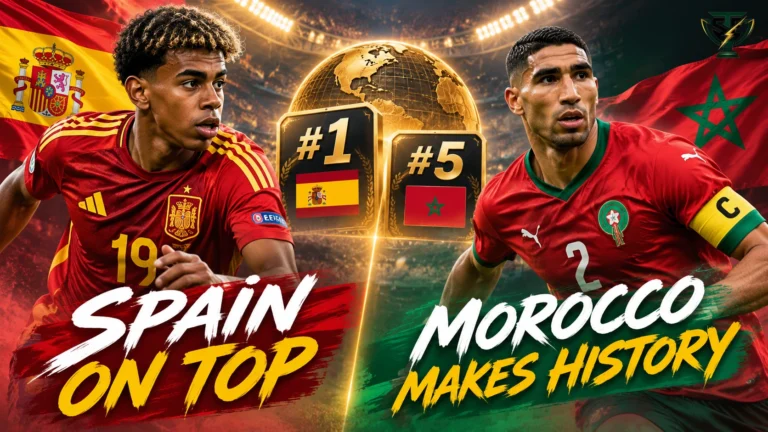
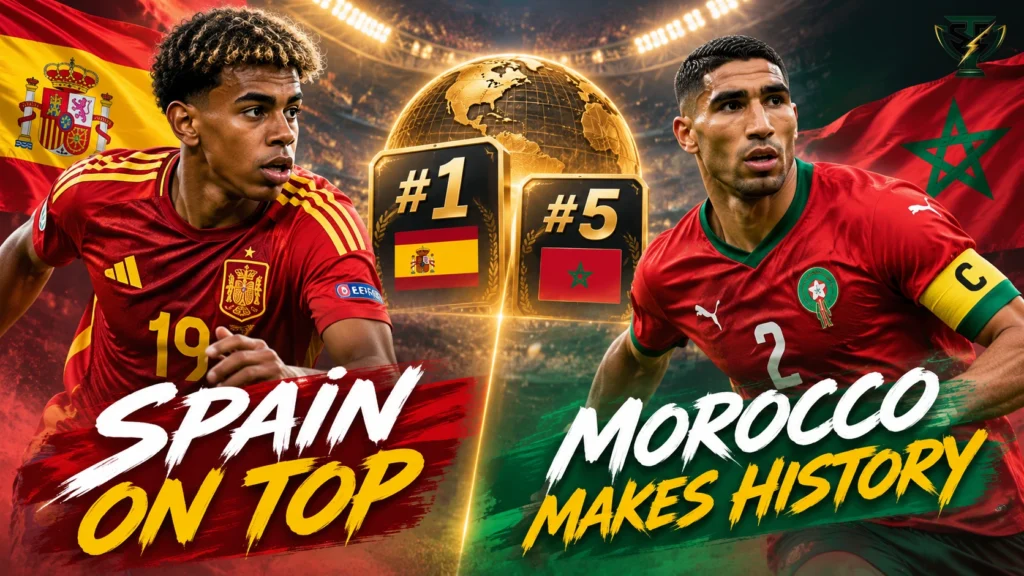
ZURICH, Switzerland, November 19, 2026: Spain has retained first place in the final FIFA men’s world ranking release of the year with 2,004.48 points, despite losing 3-2 at home to England in the UEFA Nations League. Argentina remains second, followed by France and England, but the most consequential movement came immediately below them. Morocco climbed two places to fifth, matching the highest position ever achieved by an African men’s national team.
The latest FIFA world rankings reveal an unusual contrast between individual results and accumulated performance. Spain’s first defeat in 43 matches was insufficient to dislodge the world champions, while Morocco’s two victories over Niger generated only 4.03 additional ranking points but carried the Atlas Lions above Portugal and Brazil. Colombia returned to the top 10, Canada reached a national record of 25th, and San Marino remained last despite a rare two-goal performance against Finland.
Key Takeaways
- Spain has retained first place in the final FIFA men’s world ranking release of the year with 2,004.48 points, despite losing 3-2 at home to England in the UEFA Nations League.
- The November 18 update covers 169 eligible international fixtures since the previous ranking release, involving UEFA Nations League matches, Africa Cup of Nations qualifiers, Concacaf competition and international friendlies.
- Spain, Argentina, France and England retained their positions, while Morocco produced the biggest movement inside the top 10.
- One of the more unusual consequences of the November update concerns the 2030 FIFA World Cup.
FIFA World Rankings: The Complete Top 10
The November 18 update covers 169 eligible international fixtures since the previous ranking release, involving UEFA Nations League matches, Africa Cup of Nations qualifiers, Concacaf competition and international friendlies.
Story at a glance
FIFA World Rankings: The Complete Top 10
The November 18 update covers 169 eligible international fixtures since the previous ranking release, involving UEFA Nations League matches, Africa Cup of Nations qualifiers, Concacaf competition and international friendlies.
Spain Loses to England but Retains Its World No. 1 Position
Spain’s continued leadership is particularly notable because its latest international window ended with a defeat against one of its closest rivals.
Morocco Equals Nigeria’s Historic African Ranking Record
Morocco’s rise to fifth is the most historically significant development in the latest standings.
Spain, Portugal and Morocco Now Occupy Three of the Top Six Places
One of the more unusual consequences of the November update concerns the 2030 FIFA World Cup.
Portugal and Brazil Discover How Narrow the Top-Five Race Has Become
Portugal’s decline from fifth to sixth is an instructive reversal.
Spain, Argentina, France and England retained their positions, while Morocco produced the biggest movement inside the top 10.
| Rank | Country | Points | Change |
|---|---|---|---|
| 1 | Spain | 2,004.48 | Unchanged |
| 2 | Argentina | 1,966.13 | Unchanged |
| 3 | France | 1,950.82 | Unchanged |
| 4 | England | 1,938.90 | Unchanged |
| 5 | Morocco | 1,809.37 | Up 2 |
| 6 | Portugal | 1,801.28 | Down 1 |
| 7 | Brazil | 1,800.91 | Down 1 |
| 8 | Belgium | 1,790.37 | Unchanged |
| 9 | Netherlands | 1,774.06 | Unchanged |
| 10 | Colombia | 1,738.36 | Up 1 |
Source: FIFA/Coca-Cola Men’s World Ranking, November 18, 2026. The complete standings are available through FIFA’s official ranking database.
The most revealing comparison lies between fifth and seventh. Morocco leads Portugal by 8.09 points, while Portugal holds a margin of only 0.37 points over Brazil.
These margins demonstrate why apparently modest results can change positions in a crowded section of the standings. Teams do not need enormous points gains to climb when several competitors are separated by narrow differences.
Spain Loses to England but Retains Its World No. 1 Position
Spain’s continued leadership is particularly notable because its latest international window ended with a defeat against one of its closest rivals.
England won 3-2 in Madrid on November 15, ending Spain’s 43-match unbeaten sequence and reversing the result of the teams’ September meeting at Wembley.
The defeat concluded a period of remarkable consistency for Luis de la Fuente’s side, which won the 2026 FIFA World Cup after defeating Argentina 1-0 in the final.
Yet Spain’s ranking remained secure.
The world champions finished the previous ranking period with 2,011.57 points and fell to 2,004.48, a reduction of 7.09. Argentina also lost ranking points, leaving Spain’s lead over second place at 38.35.
That gap is smaller than before the November window, but still substantial enough to preserve Spain’s position.
England’s victory, meanwhile, increased its points total to 1,938.90 without lifting it from fourth.
The contrast illustrates how the ranking system evaluates accumulated performances rather than treating the result of one match as a direct exchange of positions.
The Sports Encounter’s examination of Spain’s Nations League squad detailed the depth available to De la Fuente and the importance of the England fixture within an otherwise successful campaign.
Spain’s position is therefore supported by a broader period of performance, including its World Cup championship and earlier Nations League victories.
Why the FIFA World Rankings Do Not Automatically Reward England
FIFA uses a points-based system derived from the Elo rating model. The calculation considers the importance of each match, its result and the relative strength of the competing teams.
Unlike a conventional league table, the rankings do not award the same fixed number of points for every victory.
A team can defeat a higher-ranked opponent without immediately overtaking it if the gap in accumulated points remains too large.
This explains England’s situation. Thomas Tuchel’s side earned a significant result in Madrid, but its overall score remained below those of Spain, Argentina and France.
The official FIFA ranking methodology explains how points are added or deducted after eligible international matches.
England’s progress should still be regarded as meaningful. The victory demonstrated that Spain’s dominance could be challenged on the field, even if the rankings did not immediately reflect a change in the hierarchy.
That developing rivalry was already apparent in TSE’s earlier analysis of the Spain-England Nations League contest, which followed their competition for control of the group.
Morocco Equals Nigeria’s Historic African Ranking Record
Morocco’s rise to fifth is the most historically significant development in the latest standings.
The Atlas Lions moved above Portugal and Brazil after consecutive victories over Niger in qualifying for the 2027 Africa Cup of Nations.
Those results secured Morocco’s place at the continental tournament and raised its FIFA ranking score from 1,805.34 to 1,809.37.
The 4.03-point improvement appears small when compared with the total of more than 1,800 points. But Morocco’s position relative to its nearest competitors changed enough to produce a two-place rise.
There is an important historical distinction: Morocco has not established an outright African record. It has equaled the fifth-place position achieved by Nigeria in April 1994.
Nigeria reached that level following its rise as one of Africa’s leading international sides, during a period that included its Africa Cup of Nations triumph and an impressive debut at the 1994 World Cup.
Morocco is now the first African men’s team to reach fifth since the Super Eagles achieved that benchmark more than three decades ago.
The achievement continues a transformation that became internationally prominent when Morocco reached the semifinals of the 2022 World Cup in Qatar, becoming the first African nation to advance that far in the men’s competition.
The Atlas Lions have since demonstrated that their rise is not confined to a single tournament.
They finished 2025 ranked 11th, reached eighth in January and have now entered the world’s top five.
That progression is particularly relevant because Morocco has developed a competitive identity built around defensive organization, tactical discipline and the ability to compete against established international powers.
The rankings do not prove that Morocco would defeat Portugal or Brazil in a direct meeting. They do, however, recognize a sustained body of results that places the country alongside the world’s leading national teams.
Spain, Portugal and Morocco Now Occupy Three of the Top Six Places
One of the more unusual consequences of the November update concerns the 2030 FIFA World Cup.
Spain, Portugal and Morocco will jointly host that tournament, and all three now stand among the world’s six highest-ranked men’s national teams.
| 2030 host | World ranking | Points |
|---|---|---|
| Spain | 1 | 2,004.48 |
| Morocco | 5 | 1,809.37 |
| Portugal | 6 | 1,801.28 |
This represents an unusual concentration of highly ranked football nations within a single future hosting arrangement.
It also gives Morocco an increasingly prominent sporting profile within a tournament whose organizational arrangements have already attracted political attention.
TSE previously examined the disagreement surrounding the proposed location of the 2030 World Cup final, including political pressure in Spain and Morocco’s ambitions to stage the showpiece.
Morocco’s rise strengthens its sporting credentials but does not determine where the final will be played. Hosting decisions follow FIFA’s tournament arrangements and organizational requirements, rather than the men’s national team ranking.
Similarly, the current positions do not automatically establish the teams’ eventual tournament seedings. Those depend on the applicable regulations and the rankings used at the relevant time.
For now, the achievement is a measure of competitive development, not an administrative advantage.
Portugal and Brazil Discover How Narrow the Top-Five Race Has Become
Portugal’s decline from fifth to sixth is an instructive reversal.
In October, Portugal climbed two positions after an impressive opening sequence in the UEFA Nations League, moving ahead of both Brazil and Morocco.
That rise was documented in The Sports Encounter’s report on Portugal reaching fifth.
Only one ranking release later, Morocco has overtaken both countries.
Brazil now occupies seventh, despite remaining within less than one ranking point of Portugal.
The positions reveal a more competitive landscape than the reputations of these national teams might suggest.
Brazil has won five men’s World Cups, more than any other nation, while Portugal has regularly produced some of Europe’s outstanding players.
Neither historical success nor the reputation of an individual generation guarantees a favorable contemporary ranking.
The system rewards results within its established calculation, which means historically successful countries can fall when their more recent performances are insufficient.
Portugal’s narrow advantage over Brazil also suggests that future rankings could change significantly after only a small number of competitive matches.
That is a mathematical possibility, not a prediction about which country will move next.
Colombia Returns to the World’s Top 10 as Mexico Slips
Colombia’s movement deserves attention because the final position in the top 10 changed hands.
The South American side climbed one place to 10th, its first appearance among the world’s leading 10 national teams since October 2024.
Mexico fell three positions to 13th, creating the opening for Colombia’s return.
Colombia’s improvement is significant within a region traditionally dominated by Argentina and Brazil.
Although Argentina remains second and Brazil seventh, Colombia’s presence in 10th gives South America three teams in the leading group.
Its latest ranking reflects the broader development of a side capable of competing consistently against high-level opposition rather than relying solely on isolated tournament results.
Mexico’s decline is equally noteworthy after the country co-hosted the 2026 World Cup alongside the United States and Canada.
Hosting a major tournament does not provide permanent ranking protection. Subsequent international results continue to determine how teams gain or lose points.
Colombia’s return and Mexico’s decline therefore illustrate how quickly the balance within the Americas can shift after a competitive international window.
Canada Reaches 25th as Its Rise Continues Beyond the World Cup
Canada’s climb to 25th is another historic result.
The national team moved up two places after consecutive victories against Guatemala secured qualification for the Concacaf Nations League finals.
Continue the Soccer Story


It is the highest position Canada has achieved since FIFA introduced its men’s rankings in 1993.
The development matters because the country’s progress can now be assessed beyond the visibility generated by hosting the World Cup.
Major tournaments provide exposure and commercial opportunities, but sustained ranking improvement depends on competitive results.
Canada’s victories over Guatemala delivered measurable progress and advanced the team in a separate regional competition.
That achievement offers a more meaningful indicator of continued development than simply treating World Cup participation as an endpoint.
For Canada, the challenge will be converting that improvement into consistent performances against stronger opponents.
The country’s new ranking creates an encouraging benchmark, but future results will determine whether it can remain there or continue climbing.
San Marino Scores Twice but Remains Last
At the opposite end of the standings, San Marino remains 211th.
The microstate’s position has not improved despite scoring twice in a 7-2 defeat away to Finland in the UEFA Nations League on November 15.
The two goals were a notable achievement for a national team that has historically struggled to score regularly against European opponents.
Nicola Nanni scored both goals, producing a rare individual attacking milestone for San Marino.
However, the result also demonstrated the difference between a memorable achievement and an outcome capable of improving ranking points.
San Marino conceded seven goals and lost the match.
Under FIFA’s ranking methodology, scoring twice does not independently provide points that compensate for a defeat.
The calculation is based primarily on the result, the importance of the match and the relative strength of the opponents.
San Marino’s experience shows why the rankings cannot fully describe every meaningful achievement made by a developing national team.
A rare two-goal performance can carry considerable sporting significance even when it produces no improvement in the official standings.
What the Final FIFA World Rankings Actually Tell Us
The latest rankings provide a useful snapshot of international football, but they should not be treated as a definitive hierarchy of which team would defeat another in a single match.
Spain remains the highest-ranked country despite losing to England. Morocco has entered the top five after comparatively small numerical gains. Colombia has benefited from movement around the 10th position, while Canada has established a new national benchmark.
Those outcomes illustrate how different elements contribute to ranking changes: accumulated performance, recent results, match importance and the relative positions of competing teams.
The November update also creates several meaningful reference points for future analysis. Spain must demonstrate that its recent defeat does not indicate a longer-term decline. Morocco must sustain its place among the leading teams. Portugal and Brazil remain separated by an exceptionally narrow margin, while Colombia and Canada have opportunities to consolidate their progress.
There is one broader historical conclusion that stands above the routine movement of positions.
Morocco has joined Nigeria as the highest-ranked African men’s national team in FIFA ranking history, and three countries preparing to host the 2030 World Cup now occupy places inside the world’s top six.
The final FIFA world rankings of 2026 therefore reflect both continuity and change. Spain still leads international football’s statistical hierarchy, but Morocco’s rise demonstrates that the established order is becoming more competitive beyond Europe’s and South America’s traditional powers.