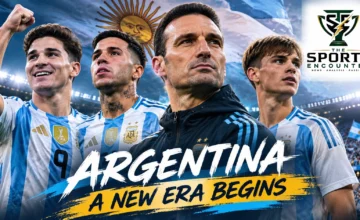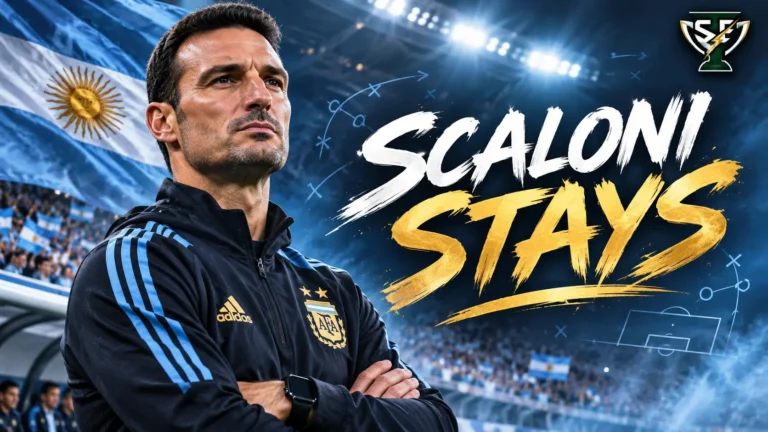
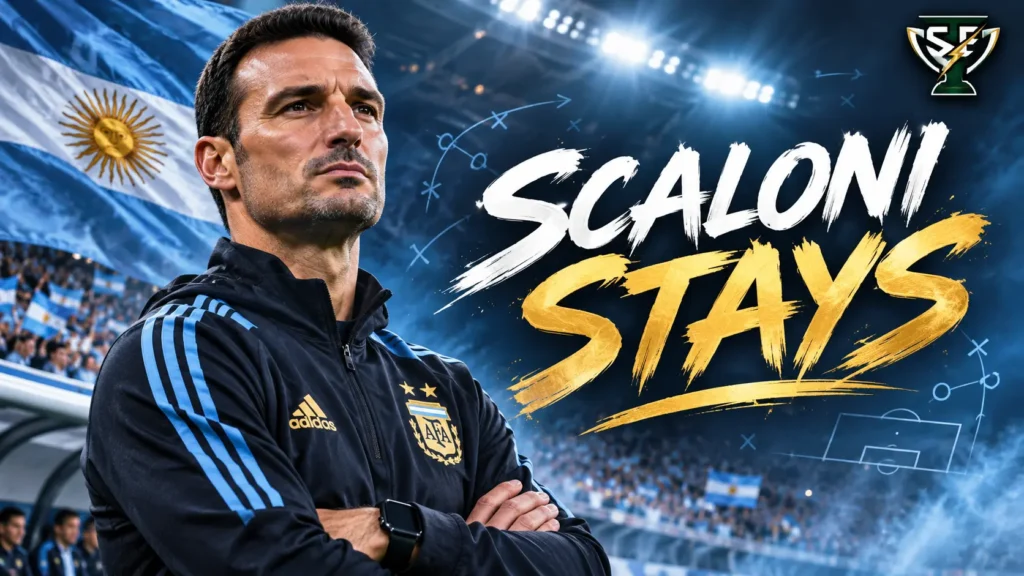
BUENOS AIRES, Argentina, November 12, 2026: Lionel Scaloni has extended his contract as Argentina head coach through July 2030, ending months of uncertainty over his future and committing himself to rebuilding the national team after Lionel Messi’s international retirement. The Argentine Football Association (AFA) confirmed the agreement on Thursday, securing the services of the coach who delivered the 2022 World Cup, two Copa América titles and a place in the 2026 World Cup final.
The extension represents an important decision for Argentina following its defeat to Spain in July’s World Cup final, when Scaloni openly questioned whether he had the motivation to continue. The 48-year-old has now committed to another international cycle, with the 2028 Copa América and the centenary World Cup providing two major objectives. His immediate challenge, however, is unfamiliar: constructing a competitive Argentina side without Messi, the player around whom much of his greatest success was built.
Key Takeaways
- Lionel Scaloni has extended his contract as Argentina head coach through July 2030, ending months of uncertainty over his future and committing himself to rebuilding the national team after Lionel Messi’s international retirement.
- The extension represents an important decision for Argentina following its defeat to Spain in July’s World Cup final, when Scaloni openly questioned whether he had the motivation to continue.
- Scaloni took charge in 2018 following Argentina’s elimination from the World Cup in Russia.
- Before the World Cup, Scaloni must prepare his team for the 2028 Copa América.
Lionel Scaloni Extends Argentina Contract Through July 2030
The AFA announced the agreement following discussions between Scaloni and federation president Claudio Tapia, resolving uncertainty that had persisted since the World Cup final.
Story at a glance
Lionel Scaloni Extends Argentina Contract Through July 2030
The AFA announced the agreement following discussions between Scaloni and federation president Claudio Tapia, resolving uncertainty that had persisted since the World Cup final.
Scaloni’s Argentina Record Shows Why the AFA Wanted Him to Stay
Scaloni took charge in 2018 following Argentina’s elimination from the World Cup in Russia.
World Cup Defeat to Spain Nearly Ended Scaloni’s Argentina Tenure
The extension appeared considerably less certain immediately after Argentina lost the World Cup final to Spain.
Argentina’s Post-Messi Era Begins With a Familiar Coach but a Different Team
Messi’s international retirement has changed the central challenge facing Argentina.
Scaloni’s First Post-Messi Squad Offers Early Clues
Argentina’s upcoming international friendlies against Uruguay and Costa Rica provide an immediate opportunity to evaluate the new squad.
Scaloni’s previous contract was scheduled to expire in December. His extension keeps him in charge through July 2030 and provides continuity as Argentina prepares for another major international tournament cycle.
The agreement also covers the national team’s coaching structure, reflecting the federation’s desire to preserve the methods and working relationships that helped Argentina become one of international soccer’s most successful teams.
According to Reuters’ report on the contract extension, Tapia welcomed the agreement as an important development for both the federation and Argentina’s supporters.
Scaloni also expressed renewed enthusiasm for the position, explaining that he remained motivated to continue and regarded the agreement as the beginning of another phase in the national team’s development.
The decision gives Argentina a degree of stability that would have been difficult to achieve through a managerial change immediately after Messi’s departure.
Scaloni’s Argentina Record Shows Why the AFA Wanted Him to Stay
Scaloni took charge in 2018 following Argentina’s elimination from the World Cup in Russia.
Initially regarded as an interim appointment, he gradually established a team built on tactical discipline, collective responsibility and a strong relationship between experienced internationals and younger players.
The results transformed Argentina’s standing.
| Competition | Achievement | Significance |
|---|---|---|
| Copa América 2021 | Champions | Ended Argentina’s 28-year major international trophy drought |
| Finalissima 2022 | Champions | Defeated European champions Italy |
| FIFA World Cup 2022 | Champions | Argentina’s first World Cup title since 1986 |
| Copa América 2024 | Champions | Successfully defended the continental title |
| FIFA World Cup 2026 | Runners-up | Reached a second consecutive World Cup final |
Scaloni’s record includes four major international titles and consecutive World Cup final appearances.
His teams also produced a 36-match unbeaten sequence, demonstrating consistency across competitive fixtures and international friendlies.
That achievement was particularly valuable because Argentina combined results with a clearly recognizable playing identity.
Rather than building a system dependent entirely on individual brilliance, Scaloni organized a team capable of protecting central areas, pressing intelligently and adapting to different opponents.
Messi remained the most influential attacking player, but Argentina’s success also depended on contributions from midfielders, defenders and players willing to accept demanding tactical responsibilities.
Those foundations help explain the AFA’s decision to retain the coach rather than introduce a different approach during a major generational transition.
World Cup Defeat to Spain Nearly Ended Scaloni’s Argentina Tenure
The extension appeared considerably less certain immediately after Argentina lost the World Cup final to Spain.
Having guided Argentina to the 2022 title, Scaloni came within one match of becoming a consecutive World Cup-winning coach.
Spain’s victory prevented that achievement and left the Argentine coach visibly disappointed.
In the aftermath, he suggested that he might leave when his existing contract expired, prompting speculation about whether the emotional demands of managing Argentina had become too great.
The defeat was especially significant because it marked the final World Cup appearance of several established players and came shortly before Messi’s international retirement.
The Sports Encounter examined the decisive moments in its report on Spain’s victory over Argentina in the World Cup final.
For Scaloni, the disappointment created two separate questions.
The first concerned whether he wanted to continue after an exceptionally demanding period that had brought nearly every major international honor available.
The second involved whether Argentina could sustain its competitive standards without the influential core that had delivered those achievements.
The new contract answers the first question. The second will be tested over the next four years.
Argentina’s Post-Messi Era Begins With a Familiar Coach but a Different Team
Messi’s international retirement has changed the central challenge facing Argentina.
The former captain concluded his international career after the October friendly against Benin, ending more than two decades of involvement with the national team.
His departure removes not only Argentina’s most productive and influential attacking figure but also a player whose understanding of Scaloni’s system had become fundamental to the team’s success.
The Sports Encounter previously examined the implications in its report on Messi’s international retirement.
Replacing Messi requires more than selecting another attacking midfielder or forward.
Argentina must redistribute several responsibilities that he performed exceptionally well, including progressing possession through central areas, creating opportunities between defensive lines and dictating the tempo during crucial moments.
The team will also need other players to assume greater leadership responsibilities.
Cristian Romero has emerged as an important figure in the new leadership structure, while Enzo Fernández and Julián Álvarez are expected to remain central to the team’s competitive future.
Scaloni’s challenge is to develop an attacking system that provides creativity without depending on a single player to solve difficult situations.
That may require adjustments to Argentina’s positional structure and the way its midfielders support attacking movements.
The Squad Must Replace Messi’s Functions, Not Imitate His Playing Style
Messi’s ability to receive possession under pressure and create opportunities from crowded central areas gave Argentina tactical options that few international teams possess.
Trying to replicate those qualities through one younger player would create unnecessary expectations.
A more sustainable approach would distribute creative responsibilities among several players while retaining the collective organization that made Scaloni’s teams successful.
Fernández can contribute through progressive passing and midfield control. Álvarez provides movement, pressing and goalscoring potential, while Nico Paz and Franco Mastantuono represent emerging creative options.
The most important question is how those players function together.
Argentina’s future attacking system must maintain sufficient balance to prevent opposing teams from exploiting spaces when possession is lost.
This challenge was explored in TSE’s analysis of Argentina’s potential successors to Messi and the national team’s next generation.
Scaloni’s First Post-Messi Squad Offers Early Clues
Argentina’s upcoming international friendlies against Uruguay and Costa Rica provide an immediate opportunity to evaluate the new squad.
Scaloni has selected 28 players for the matches, including Chelsea defender Aaron Anselmino, who has received his first senior international call-up.
Gonzalo Montiel and Mariano Troilo have also returned to the selection.
The squad reflects the beginning of a transition rather than a completely rebuilt team.
Established internationals remain important, but opportunities are opening for younger players to demonstrate whether they can become regular contributors.
| Player | Position | Role in Argentina’s Next Phase |
|---|---|---|
| Cristian Romero | Center back | Defensive leadership and organization |
| Enzo Fernández | Midfielder | Ball progression and central control |
| Julián Álvarez | Forward | Attacking movement, pressing and finishing |
| Nico Paz | Attacking midfielder | Creative development and attacking combinations |
| Franco Mastantuono | Attacking midfielder | Long-term technical and creative potential |
| Aaron Anselmino | Defender | Opportunity to establish himself at senior international level |
Editorial distinction: These are analytical assessments of potential roles, not a confirmed starting lineup or a statement that every player will feature in both November friendlies.
The Sports Encounter previously examined the selection changes in its report on Scaloni’s first post-Messi squad and the Uruguay and Costa Rica fixtures.
The upcoming matches should reveal how Argentina intends to structure possession, create chances and organize its defensive transitions without its former captain.
They will not provide a definitive answer to every question, but they represent an important starting point.
Argentina Already Have a Place at the 2030 World Cup
One significant advantage for Scaloni is that Argentina will not need to qualify for the next World Cup through the traditional South American qualifying competition.
Argentina has already secured automatic qualification because it will stage one of the centenary celebration matches marking 100 years of the FIFA World Cup.
The competition will be primarily hosted by Spain, Portugal and Morocco, with one celebratory match each in Argentina, Uruguay and Paraguay.
According to FIFA’s official explanation of the 2030 World Cup hosting and qualification arrangements, all six participating host nations qualify automatically.
That detail has considerable implications for Argentina’s preparation.
Scaloni can use the coming international windows to develop the squad without needing to prioritize qualification points.
However, automatic qualification also removes some of the competitive pressure normally associated with CONMEBOL’s demanding qualification process.
The coaching staff must therefore identify suitable international opponents and ensure that the team faces enough meaningful tests before the tournament.
Friendly victories alone cannot provide the same evidence as high-pressure championship matches.
Why the Centenary Match Matters
Argentina’s role in the centenary celebrations carries historical significance.
The first World Cup took place in Uruguay in 1930, with Argentina losing the final to the host nation.
A century later, Argentina will host a World Cup match as part of FIFA’s recognition of South America’s role in establishing the competition.
The arrangement gives Scaloni the opportunity to lead Argentina into a World Cup that includes a meaningful home appearance.
It also creates expectations that the team will arrive capable of challenging for another title rather than merely participating in a historic occasion.
Scaloni’s extension ensures that the same coach who delivered the 2022 championship will be responsible for preparing Argentina for that challenge.
The Copa América Will Be the First Major Test of the New Argentina
Before the World Cup, Scaloni must prepare his team for the 2028 Copa América.
Argentina won the continental tournament in 2021 and successfully defended its title in 2024, making another strong campaign an important objective.
The next edition will provide a competitive test of the squad’s progress after Messi’s departure.
It will also help determine which younger players are ready to assume larger responsibilities in major tournaments.
By that stage, Scaloni should have a clearer understanding of his preferred midfield combinations, attacking partnerships and defensive leadership structure.
The tournament could also reveal weaknesses that are less apparent during international friendlies.
Continue the Soccer Story
A successful Copa América campaign would strengthen confidence in the rebuilding process, although it would not guarantee similar results at the World Cup.
Conversely, disappointing performances would provide valuable evidence about areas requiring improvement before 2030.
Argentina’s Coaching Stability Contrasts With a Changing International Landscape
Several leading national teams have recently made important decisions about their long-term coaching arrangements.
Spain, the team that defeated Argentina in the World Cup final, has committed to Luis de la Fuente through 2032.
The Spanish federation’s decision reflects confidence in the coach responsible for maintaining the country’s recent competitive success.
The Sports Encounter examined the implications in its report on Spain’s long-term commitment to De la Fuente.
Argentina’s decision to retain Scaloni follows a comparable principle: preserving an established coaching structure while preparing for another major international cycle.
Yet the circumstances are different.
Spain’s challenge is sustaining a successful generation that has already demonstrated its quality on the biggest stage.
Argentina must maintain its competitive standing while replacing the influence of its greatest player and accommodating the gradual departure of other experienced internationals.
The extension offers institutional stability, but the demands of rebuilding remain substantial.
What Scaloni Must Achieve Before the Next World Cup
Scaloni’s new contract removes uncertainty over the identity of Argentina’s head coach, but it also establishes clear expectations.
The first priority is integrating younger players without undermining the collective structure that delivered major trophies.
The second is developing leadership within a squad no longer organized around Messi.
The third is creating a reliable attacking approach that works against opponents with different tactical strengths.
The fourth is managing the transition from established veterans to emerging internationals while preserving competitive standards.
Finally, Argentina must remain capable of performing under pressure in major tournaments.
The defeat against Spain demonstrated that even an experienced and successful side can be overcome when an opponent executes its strategy more effectively.
Scaloni must use that setback as part of his evaluation rather than treating the previous championship-winning formula as permanently sufficient.
Scaloni’s Extension Secures Argentina’s Leadership, Not Its Future Success
Argentina’s decision to retain Lionel Scaloni is a vote of confidence in a coach who has already delivered one of the most successful periods in the national team’s history.
His achievements include two Copa América titles, the Finalissima, a World Cup triumph and another appearance in the sport’s biggest final.
Few international coaches can match that record.
But the challenge ahead is different from the one he inherited in 2018.
Argentina no longer has Messi available to transform difficult matches through individual brilliance. The next team must develop its own identity, leaders and methods of creating decisive moments.
Scaloni now has the security of a contract through 2030 and the opportunity to guide that process without an immediate managerial succession hanging over the federation.
The next four years will determine whether Argentina can turn that continuity into another competitive generation.
For now, the uncertainty over the coach has ended. The much more demanding work of building Argentina after Messi has only begun.
Lionel Scaloni
- Lionel Scaloni Commits to Argentina Through 2030 as Post-Messi Rebuild Begins
- Life After Messi in Argentina: Anselmino Arrives, De Paul Drops Out, as Scaloni Faces His Biggest Rebuild
- Argentina After Messi: Who Replaces Him and What Comes Next?
- Lionel Messi Pulls Plug on a Historic 20-Year Argentina Career
- FIFA Hits Argentina with Heavy World Cup Sanctions as Paredes Gets 10-Game Ban