BALI, Indonesia, November 12, 2026: Plans to expand the ICC World Test Championship to all 12 Full Member nations face significant opposition as cricket’s governing body meets in Bali, raising the prospect that Afghanistan, Ireland and Zimbabwe could remain excluded from the competition’s next cycle. A nine-team championship is reportedly the most likely outcome, although a compromise allowing Zimbabwe to become the tenth participant remains under consideration.
The debate reaches beyond three countries seeking admission to Test cricket’s premier competition. ICC officials are examining the next international schedule, the financial sustainability of bilateral cricket, the future of one-day internationals and governance reforms that could reshape how the sport operates. The ICC has confirmed that proposed WTC matchups for the 2027–29 and 2029–31 cycles are on the agenda, but no expansion decision has been formally announced.
Key Takeaways
- The World Test Championship currently consists of nine nations: Australia, Bangladesh, England, India, New Zealand, Pakistan, South Africa, Sri Lanka and the West Indies.
- Afghanistan, Ireland and Zimbabwe have Full Member status and are eligible to play Test cricket, but none has participated in the championship since its introduction in 2019.
- However, ESPNcricinfo journalists Tristan Lavalette and Firdose Moonda reported on November 12 that the proposal had encountered substantial resistance.
- The ICC meetings will also consider the next Future Tours Programme, covering international cricket from 2027 to 2031.
Why the World Test Championship Expansion Plan Is in Trouble
The World Test Championship currently consists of nine nations: Australia, Bangladesh, England, India, New Zealand, Pakistan, South Africa, Sri Lanka and the West Indies.
Story at a glance

Why the World Test Championship Expansion Plan Is in Trouble
The World Test Championship currently consists of nine nations: Australia, Bangladesh, England, India, New Zealand, Pakistan, South Africa, Sri Lanka and the West Indies.
Nine, Ten or Twelve Teams: What Each Format Would Mean
The central decision concerns which countries would participate and how their matches would contribute to championship qualification.
Zimbabwe Have the Strongest Immediate Case for Admission
Zimbabwe appear to be the most realistic candidate for an additional WTC place.
Afghanistan Face a More Complicated Route Into the Championship
Afghanistan’s position illustrates why the expansion debate cannot be resolved through playing ability alone.
Ireland’s Problem Is the Cost of Playing Test Cricket
Ireland represent another challenge because Test participation can involve significant financial exposure without guaranteeing equivalent revenue.
Afghanistan, Ireland and Zimbabwe have Full Member status and are eligible to play Test cricket, but none has participated in the championship since its introduction in 2019.
A proposal to bring all 12 teams into a single competition had gained support during discussions over the next WTC cycle. It offered the possibility of placing every Test-playing nation within the same championship structure rather than maintaining separate groups of participating and non-participating Full Members.
However, ESPNcricinfo journalists Tristan Lavalette and Firdose Moonda reported on November 12 that the proposal had encountered substantial resistance. According to their reporting, retaining nine teams is now considered the likeliest outcome, with a ten-team format involving Zimbabwe still possible.
The England and Wales Cricket Board is reportedly opposed to a full expansion because additional international commitments could increase travel and place pressure on England’s limited home-season window.
That concern reflects a broader scheduling problem. A championship involving more countries may create additional sporting opportunities, but it also requires agreement over opponents, venues, bilateral commitments, broadcasting arrangements and the financial responsibilities of participating boards.
The ICC’s official Bali meeting announcement confirms that proposals for the next two WTC cycles will be discussed between November 11 and 15.
The ICC has not publicly endorsed the reported preference for nine teams, confirmed Zimbabwe’s admission or announced that the 12-team proposal has been rejected.
Nine, Ten or Twelve Teams: What Each Format Would Mean
The central decision concerns which countries would participate and how their matches would contribute to championship qualification.
| Proposed Format | Participants | Main Consequence | Current Status |
|---|---|---|---|
| Nine teams | Existing WTC participants | Zimbabwe, Afghanistan and Ireland remain outside | Reportedly the most likely outcome |
| Ten teams | Existing nine plus Zimbabwe | Zimbabwe gains entry; Afghanistan and Ireland remain excluded | Reported compromise possibility |
| Twelve teams | All ICC Full Members | Every Full Member participates in the championship | Expansion proposal facing resistance |
These are competing possibilities rather than approved formats. The exact match requirements, qualification rules and schedule for an expanded championship remain unresolved.
There is also a mathematical consequence that deserves attention.
In a single round-robin structure, nine teams create 36 distinct pairings, ten teams create 45, and 12 teams create 66. Those figures are calculated using the number of unique pairs among participating teams.
Expanding from nine to 12 would therefore increase the possible pairings by 30, or approximately 83.3%.
That does not mean the ICC would necessarily schedule 83.3% more matches. The current WTC does not require every team to play every other participant during each cycle.
However, the calculation demonstrates why expansion cannot be judged solely by adding three names to a competition table. Administrators must decide whether to increase the number of series, maintain selective opponents or fundamentally redesign the championship’s fixture structure.
If the schedule remains uneven, questions about competitive fairness will become more complicated as the number of participants grows.
Zimbabwe Have the Strongest Immediate Case for Admission
Zimbabwe appear to be the most realistic candidate for an additional WTC place.
The country has made clear its desire to participate in the championship and has argued that expanding the competition would create more reliable opportunities to play Test cricket.
Zimbabwe played ten Tests in 2025, demonstrating an appetite for the longest format despite considerable financial and scheduling challenges.
Its current series against Afghanistan offers another example of both its commitment and its growing competitiveness.
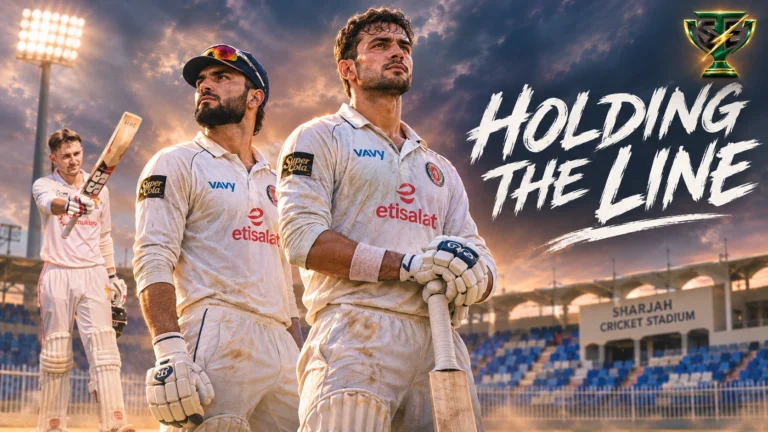
In the opening Test at Sharjah, Zimbabwe became the first side in Test history to score more than 500 runs in both innings of the same match. The visitors made 504 and 523/5, while Afghanistan responded with 514 in a high-scoring draw.
Brendan Taylor, Brian Bennett, Craig Ervine and Wessly Madhevere all registered centuries, with Ervine producing an unbeaten double hundred.
The batting performance followed Zimbabwe’s promising opening day, when Taylor’s 131 put the visitors in a commanding position. That innings and the initial bowling challenges were examined in The Sports Encounter’s first-day report from Sharjah.
Zimbabwe eventually reached 504 before Afghanistan began their recovery, as detailed in TSE’s second-day analysis.
One extraordinary batting performance cannot establish that Zimbabwe are stronger than existing WTC participants. However, it demonstrates that the country remains capable of producing substantial Test performances against international opposition.
Zimbabwe’s larger argument is about access.
A predictable championship schedule could help the board negotiate broadcasting arrangements, secure commercial partnerships, develop players and plan meaningful Test campaigns across multiple seasons.
The concern is that exclusion can become self-reinforcing. Teams that play relatively few Tests have fewer opportunities to develop specialist red-ball players, improve their rankings or build a reliable audience for the format.
Without a formal place in the WTC, Zimbabwe would remain dependent on bilateral agreements with other boards, regardless of whether its Test performances improve.
Afghanistan Face a More Complicated Route Into the Championship
Afghanistan’s position illustrates why the expansion debate cannot be resolved through playing ability alone.
The country has developed into a formidable international cricket team, particularly in limited-overs formats, and its Test batting has shown encouraging progress.
Afghanistan scored 514 against Zimbabwe in Sharjah, with centuries from Rahmat Shah, Sediqullah Atal and debutant Rahmanullah Zadran.
However, its logistical and political circumstances differ substantially from those of most established Test nations.
Afghanistan cannot host international matches at home and relies on neutral venues, including grounds in the United Arab Emirates.
Staging five-day cricket abroad creates costs involving ground rental, accommodation, travel, staffing and broadcasting production. Those expenses can be difficult to recover when the opposition and format attract limited commercial demand.
Afghanistan also faces restrictions on bilateral cricket with certain countries because of the Taliban government’s treatment of women and girls.
England and Australia have declined bilateral engagement with Afghanistan, creating an additional obstacle to any championship model requiring predictable participation among all members.
That creates a difficult distinction between the ambitions of Afghanistan’s male cricketers and the responsibilities of international cricket administrators toward women’s participation and human rights.
A future WTC structure would need to address both concerns rather than treating one as a reason to disregard the other.
The practical questions include which countries would agree to play Afghanistan, how neutral venues would be funded, and whether a meaningful championship schedule could be constructed despite bilateral restrictions.
Those questions remain unanswered.
Ireland’s Problem Is the Cost of Playing Test Cricket
Ireland represent another challenge because Test participation can involve significant financial exposure without guaranteeing equivalent revenue.
The country’s cricket administrators have previously acknowledged that joining the championship would require serious consideration of funding, scheduling and the number of Test matches they could realistically support.
Hosting a Test requires far more than assembling a national squad. Grounds must remain available for several days, specialist playing facilities must be prepared, and broadcasters, officials and operational staff must be engaged.
Weather interruptions can further reduce commercial returns, particularly in a country where the suitable playing window is relatively limited.
There is also the question of whether championship membership would create enough additional revenue to offset the costs of playing more matches.
Ireland’s situation exposes a weakness in the argument that universal participation is automatically beneficial.
Admission would provide greater competitive recognition, but meaningful participation would also require a sustainable financial model.
If members are required to stage fixtures that consistently lose money, expansion could create pressure on the very countries it is intended to support.
Can One-Off Tests Provide a Practical Compromise?
One of Zimbabwe’s reported proposals would allow single Tests to count toward the World Test Championship.
The idea addresses a straightforward scheduling problem.
Some boards may be willing to host or tour for one Test but struggle to accommodate two- or three-match series because of limited budgets or congested calendars.
Allowing one-off matches to contribute to championship qualification could make participation more manageable for countries that cannot regularly commit to longer series.
However, administrators would need to establish clear rules governing points distribution, the minimum number of matches and differences in the strength of opposition.
The current WTC ranks teams by the percentage of available points earned rather than simply by total wins. That system helps account for differing numbers of scheduled matches, although it does not completely eliminate the impact of fixture difficulty.
Expanding the role of one-off Tests would make those questions more important.
A country playing a small number of difficult away Tests should not automatically be compared with a side enjoying a considerably easier schedule without examining how qualification fairness is preserved.
Nor should expansion create a situation in which a single unexpected result has a disproportionate influence on championship standings.
The ICC would need to decide whether greater accessibility justifies a revised qualification structure.
Why England’s Scheduling Concerns Matter
England’s reported opposition to a 12-team championship reflects the competing demands placed on commercially established cricket boards.
The English domestic summer must accommodate international Tests, limited-overs series, county competitions and major franchise events.
Additional overseas tours could also place greater demands on players and reduce flexibility in an already crowded international calendar.
Yet England’s reported willingness to play Zimbabwe and Ireland in occasional Tests outside the WTC suggests its objection is not necessarily to every additional bilateral fixture.
The disagreement concerns the obligations that championship membership could impose.
That distinction matters because the WTC is simultaneously a sporting competition and a system built around bilateral scheduling agreements.
A larger championship would require member boards to accept a more demanding structure or agree to a selective fixture model.
The ICC cannot assume that commercial pressures, existing broadcasting obligations and player workloads will disappear simply because a more inclusive tournament is desirable.
The Future Tours Programme Could Decide More Than WTC Membership
The ICC meetings will also consider the next Future Tours Programme, covering international cricket from 2027 to 2031.
The FTP determines much of the framework within which bilateral series can take place. Although individual boards negotiate many details, the overall calendar influences opportunities for countries across all three formats.
According to the reporting ahead of the Bali meetings, England could tour Zimbabwe in 2028 for a series potentially including at least one Test.
South Africa are also expected to play Test cricket against Zimbabwe in 2027, while Australia have plans to visit during the next FTP cycle, although the inclusion of a Test remains uncertain.
Those details should be treated as reported scheduling expectations until the relevant boards publish confirmed fixtures.
The underlying issue is whether occasional high-profile tours are enough to sustain smaller Test-playing nations.
One prestigious series can attract attention and commercial interest, but a predictable sequence of matches is more useful for long-term player development.
Teams need opportunities to evaluate emerging cricketers, retain experienced specialists and develop bowling attacks capable of taking 20 wickets in different conditions.
That challenge is relevant even within the current WTC. Pakistan’s recent red-ball difficulties have prompted substantial changes to its Test squad, examined in TSE’s analysis of Pakistan’s young Test prospects.
Meanwhile, the competitive stakes remain substantial for established participants. South Africa’s victory over Australia has strengthened its ambitions of reaching another championship final, as detailed in The Sports Encounter’s World Test Championship qualification analysis.
The contrast is important. Existing participants are competing for championship points and final qualification, while three other Full Members are still seeking access to the competition itself.
Cricket’s Strategic Review Could Reshape the ODI Calendar
The Bali meetings are also expected to consider a broader strategic review of international cricket conducted by consulting firm McKinsey.
According to the source reporting, the review examines the balance between Tests, one-day internationals and T20 cricket, alongside potential changes to the sport’s commercial model.
ODI cricket is a particularly sensitive subject because bilateral 50-over matches face competition from franchise leagues and the growing number of T20 international events.
There is an expectation that ODI scheduling could become less frequent during parts of the next FTP cycle, with greater concentration around the buildup to the 2031 Cricket World Cup.
That remains a reported possibility, not an announced ICC decision.
The implications extend to Associate nations.
Twenty countries currently hold men’s ODI status, including eight Associate Members. Any reduction could affect the opportunities those countries have to develop international teams, negotiate fixtures and build commercial audiences.
Proposals to expand ODI status have also circulated, reflecting the competing priorities of financial sustainability and global participation.
Continue the Cricket Story

But the number of countries holding ODI status is only one part of the issue. The more meaningful question is whether those teams receive enough competitive fixtures to justify and sustain that status.
International scheduling must also accommodate the commercial influence of franchise cricket. That tension is becoming increasingly apparent through proposals to expand or reposition major domestic competitions.
The consequences were explored in TSE’s examination of proposals to move the IPL into January, where player availability, international windows and competing franchise leagues emerged as significant obstacles.
The ICC’s strategic challenge is therefore broader than deciding which international format should receive more matches. It must create a calendar in which national teams, domestic competitions and commercial partners can operate without making international participation unaffordable.
Revenue Distribution and Governance Remain Critical
Changes to the ICC’s revenue model could prove as consequential as the format decisions.
Smaller cricket boards depend heavily on international distributions and bilateral income to fund development programs, domestic structures and national-team commitments.
A reduction in available funding would make it harder for those countries to expand their Test schedules, even if the ICC provided additional championship places.
Conversely, an increase in funding would not guarantee stronger international cricket unless boards could invest it in dependable facilities, player development and competitive opportunities.
The ICC’s Governance Review Committee, established during the annual conference in July, is expected to submit its initial recommendations in Bali.
The review addresses the governing body’s structures and the way decisions affecting its membership are made.
These issues also have a wider connection to cricket’s commercial sustainability. Bangladesh’s recent decision to pause its Premier League over concerns involving governance, finances and competition standards illustrates how institutional weaknesses can affect sporting operations, as examined in TSE’s analysis of the BPL suspension.
The ICC’s global responsibilities are different from those of a national league, but the underlying questions of financial accountability, governance and credible competition structures are relevant to both.
Afghan Refugee Women’s Cricket Is Also on the Agenda
Another important item concerns the development pathway for Afghan refugee women cricketers.
The ICC established a special task force to support training, competitive opportunities and a possible pathway into international qualification events.
At its July annual conference, the governing body endorsed the continuation of the development program and reconstituted the task force to prepare a roadmap toward potential participation in qualification pathways by 2030.
That decision was confirmed in the ICC’s official announcement on Afghan refugee women’s cricket.
The task force is expected to present further recommendations during the Bali meetings.
For Afghan women who have been denied opportunities to play organized sport under Taliban rule, the program represents a potential route back into structured competition.
However, the existence of a development pathway should not be confused with the formal recognition of an Afghanistan national women’s team or confirmed entry into ICC qualification events.
Those outcomes depend on further decisions, eligibility arrangements and the implementation of an operational competition structure.
The issue creates a significant governance test for the ICC as it considers the future participation of Afghanistan’s men’s Test team.
The governing body must navigate the sporting interests of Afghan male players while addressing restrictions that have prevented Afghan women from participating in cricket at home.
What Will Determine the Outcome of the Bali Meetings?
The ICC faces a choice between competing priorities that cannot all be satisfied through a simple change in membership numbers.
A nine-team WTC would preserve the existing structure and avoid some of the immediate scheduling complications associated with expansion. However, it would leave three Full Members outside the championship.
A ten-team model could provide Zimbabwe with greater certainty and represent a limited step toward inclusion, but it would still leave Afghanistan and Ireland without a championship pathway.
A 12-team competition would provide universal Full Member participation while requiring administrators to address additional fixture, funding and bilateral relationship challenges.
The most useful measure of success would be whether the chosen format provides an equitable and financially workable schedule, not simply whether it contains more teams.
Cricket has already demonstrated that strong Test performances are possible outside the WTC, including Zimbabwe’s remarkable batting achievement against Afghanistan in Sharjah.
The question is whether those performances can lead to sustained opportunities or whether the same countries will continue relying on occasional bilateral invitations.
The ICC’s Bali meetings conclude on November 15. Until the governing body announces a decision, the future composition of the World Test Championship remains unresolved.
For Zimbabwe, Afghanistan and Ireland, that uncertainty concerns far more than participation in a trophy competition. It affects the number of Tests they can realistically plan, the commercial value of those matches and the opportunities available to the next generation of red-ball cricketers.
The decision will show how far international cricket is prepared to extend its premier Test competition beyond the established nine nations, and whether the sport can make broader participation financially sustainable.
World Test Championship
- World Test Championship Expansion Faces Resistance as ICC Weighs Cricket’s Future
- Talks of Minus-Marnus Gather Pace: Why Australia Still Need Labuschagne in Their Test Plans
- South Africa Recall De Zorzi and Hamza for Bangladesh Tests, but Bedingham’s Omission Raises a Big Question
- Australia Face a Marnus Labuschagne Reckoning as McDonald Orders Selection Review Before NZ Tests
- South Africa’s Australian Comeback Puts WTC Final Within Reach, But Anything’s Possible Yet