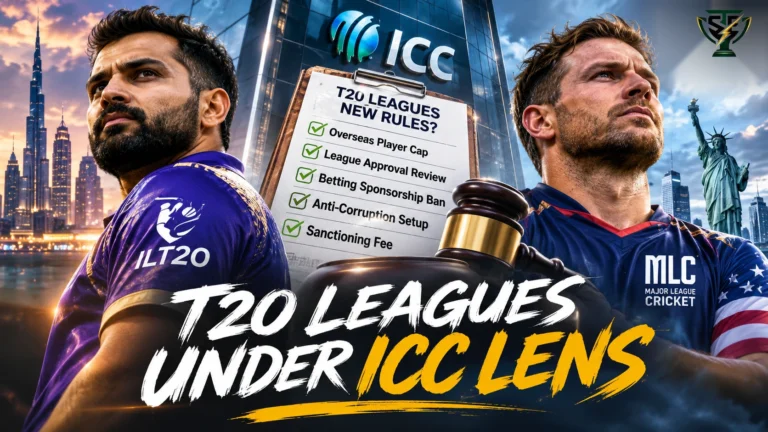
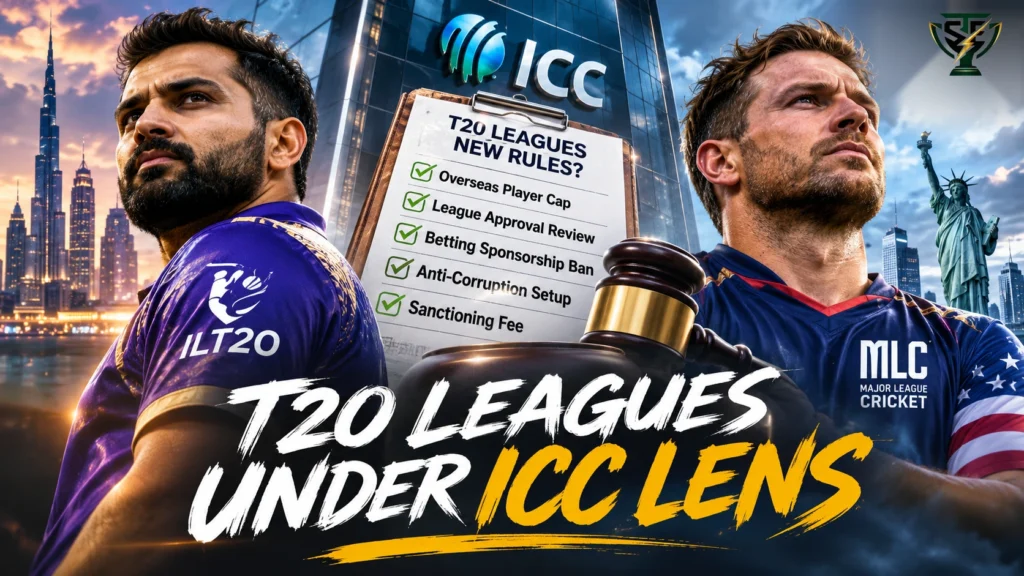
BALI, Indonesia, November 12, 2026: The International Cricket Council is considering sweeping new powers to regulate T20 franchise leagues, with proposals that could force the UAE’s ILT20 and America’s Major League Cricket to overhaul their playing XIs, expose domestic leagues to direct ICC intervention and impose tougher financial and anti-corruption requirements on organizers. The recommendations, prepared by the ICC’s Franchise League Review Group, are being examined during the governing body’s meetings in Bali.
The most contentious proposal would enforce a maximum of four overseas players in a franchise playing XI, potentially ending exemptions that have allowed the ILT20 to field up to nine and MLC up to six. Other recommendations would give the ICC authority to review or withdraw approvals issued by national boards, restrict betting-related sponsorships, require approved anti-corruption arrangements and introduce sanctioning fees. None of these proposed changes has received final approval, but their combined effect could fundamentally alter how international franchise cricket is organized.
Key Takeaways
- The most contentious proposal would enforce a maximum of four overseas players in a franchise playing XI, potentially ending exemptions that have allowed the ILT20 to field up to nine and MLC up to six.
- The ICC’s official announcement of the Bali meetings confirms that the Franchise League Review Group is presenting its initial recommendations to cricket administrators.
- Major League Cricket has developed its identity around the combination of international experience, emerging American talent and relationships with established franchise organizations.
- The recommendations will be considered by the ICC Chief Executives’ Committee, with matters requiring formal approval potentially progressing to the board.
What Are the ICC’s Proposed T20 Franchise League Rules?
The recommendations were developed by a review group established at the ICC’s annual conference in July. The committee is chaired by Bangladesh Cricket Board president Tamim Iqbal and includes England and Wales Cricket Board chief executive Richard Gould, Cricket Australia chief executive Todd Greenberg and BCCI secretary Devajit Saikia.
Story at a glance
What Are the ICC’s Proposed T20 Franchise League Rules?
The recommendations were developed by a review group established at the ICC’s annual conference in July. The committee is chaired by Bangladesh Cricket Board president Tamim Iqbal and includes England and Wales Cricket Board chief executive Richard Gould, Cricket Australia chief executive Todd Greenberg and BCCI secretary Devajit Saikia.
Four Overseas Players: Why ILT20 and MLC Face the Biggest Threat
The overseas-player proposal carries the most immediate competitive and commercial consequences.
MLC’s Growth Strategy Could Face a Different Kind of Pressure
Major League Cricket has developed its identity around the combination of international experience, emerging American talent and relationships with established franchise organizations.
ICC Wants the Power to Review and Withdraw League Approvals
Perhaps the most significant governance proposal concerns who ultimately controls the approval of domestic franchise competitions.
Anti-Corruption Rules Would Become a Condition of Approval
The review group’s integrity proposals respond to concerns that the growth of franchise competitions has outpaced the safeguards available to monitor them.
According to a committee paper obtained and reported by ESPNcricinfo, the group wants a more consistent international regulatory framework for domestic franchise competitions.
The ICC’s official announcement of the Bali meetings confirms that the Franchise League Review Group is presenting its initial recommendations to cricket administrators.
| Proposed Change | Practical Consequence |
|---|---|
| Four overseas players per XI | Leagues operating under exemptions could be required to significantly increase local-player representation. |
| ICC review of Full Member sanctions | The ICC could intervene if a national board improperly approves a league or serious integrity concerns emerge. |
| Restrictions on betting sponsorship | Leagues and franchises could lose sponsorship arrangements linked to illegal betting or surrogate promotion. |
| Approved anti-corruption arrangements | Organizers would need to use the ICC’s integrity unit or another ICC-approved provider. |
| Sanctioning fees | League approval could require payment toward regulatory and due diligence costs. |
| Stronger financial checks | National boards would face greater scrutiny over league funding, ownership and player-payment safeguards. |
The review group has also identified additional matters requiring discussion, including standardized solidarity payments, regulation of legends competitions and possible limits on the number of franchise leagues operating within one country.
These measures are not identical in status. The main recommendations have been put forward for consideration, while the additional questions require further deliberation before any formal regulatory framework can emerge.
Four Overseas Players: Why ILT20 and MLC Face the Biggest Threat
The overseas-player proposal carries the most immediate competitive and commercial consequences.
The ILT20 has operated with permission to field up to nine overseas players in its starting XI, including an Associate Member representative. MLC has been permitted six.
Both competitions received exemptions when the ICC addressed overseas-player restrictions in 2023.
Removing those exemptions would change the foundation on which their franchises have recruited players, built squads and marketed their competitions.
Under a strict four-overseas-player limit, an ILT20 franchise using the current maximum of nine would need to replace five overseas players with locally eligible cricketers. An MLC side fielding six would need to replace two.
That is a substantial difference, particularly for the ILT20.
| League | Current Overseas Maximum | Proposed Maximum | Change in an XI Using Current Maximum |
|---|---|---|---|
| ILT20, UAE | 9 | 4 | 5 fewer overseas players |
| Major League Cricket, USA | 6 | 4 | 2 fewer overseas players |
For the ILT20, the overseas allowance would fall by approximately 55.6%. For MLC, the reduction would be 33.3%.
These percentages measure the reduction in permitted overseas places, not predicted changes in revenue or profitability.
They also assume that the reported four-player restriction is enforced without a renewed exemption or transitional arrangement.
The commercial implications could be serious. Both leagues have built considerable parts of their audience appeal around recognizable international players, with several franchises maintaining close ownership connections to Indian Premier League organizations.
Five of the six ILT20 ownership groups have links to the IPL or Women’s Premier League, while four MLC teams are associated with IPL ownership groups.
Those relationships help franchises attract experienced players, develop recognizable brands and establish international commercial connections.
But if overseas recruitment becomes substantially more restricted, existing contracts, team balance and marketing assumptions may require reassessment.
The ILT20 is particularly exposed because its fifth season is scheduled to begin on November 22, with six teams competing across 34 matches.
The tournament’s international recruitment strategy, including major player signings and its broader commercial ambitions, was examined in The Sports Encounter’s detailed ILT20 season preview.
A major regulatory change introduced without sufficient transition time could leave franchises facing difficult squad decisions after significant recruitment commitments have already been made.
However, the ICC has not announced an implementation date, a transitional arrangement or a final decision on existing exemptions.
MLC’s Growth Strategy Could Face a Different Kind of Pressure
Major League Cricket has developed its identity around the combination of international experience, emerging American talent and relationships with established franchise organizations.
A four-overseas-player restriction would require teams to allocate a greater share of playing positions to locally eligible cricketers.
That could create additional opportunities for players developed through the United States cricket system, potentially strengthening the domestic talent pathway over time.
The challenge is whether the supply of appropriately prepared local cricketers can expand quickly enough to meet the expectations of a league recruiting high-profile international talent.
The transition would also require franchises to adjust how they distribute their overseas places between specialist batters, fast bowlers, spinners and all-rounders.
MLC’s competitive appeal was demonstrated by the Los Angeles Knight Riders’ dramatic one-run victory over Washington Freedom in the championship final, covered in TSE’s report on the MLC title decider.
The league’s commercial development has nevertheless encountered difficult choices.
New Zealand Cricket withdrew from a proposed MLC franchise venture after deciding to prioritize domestic cricket and its high-performance system, a decision examined in TSE’s analysis of the abandoned partnership.
A stricter overseas-player limit would introduce another consideration for potential investors.
The decisive question is whether MLC can maintain sufficient competitive quality and commercial demand while increasing the share of local players in its starting lineups.
That outcome cannot be established simply from the proposed numerical restriction. It would depend on implementation, player development and the league’s response.
ICC Wants the Power to Review and Withdraw League Approvals
Perhaps the most significant governance proposal concerns who ultimately controls the approval of domestic franchise competitions.
Under the existing framework, Full Member national boards normally exercise primary sanctioning authority over domestic leagues within their territories.
The ICC has a more direct approval role in certain competitions operating under Associate Member jurisdictions.
The ICC’s published explanation of its sanctioning regulations describes the additional requirements that apply to specified domestic events held in Associate Member territories.
The proposed reforms would expand ICC oversight to situations where a Full Member board has approved a league without properly fulfilling its regulatory obligations.
According to the reported committee paper, the ICC could review a national board’s approval and potentially assume sanctioning authority if serious compliance failures were identified.
That intervention could include rejecting an application or withdrawing an existing approval.
The proposal represents an important shift in the balance of responsibility between cricket’s global regulator and its national governing bodies.
A Full Member board could no longer assume that issuing domestic approval would necessarily settle every regulatory question.
At the same time, the suggested powers raise legitimate questions about procedural fairness.
Organizers and investors would need clarity about what constitutes a serious breach, which authority can initiate a review, what evidence is required and whether an affected league can appeal.
Without those safeguards, broader oversight could introduce uncertainty into leagues that have already secured commercial contracts and player commitments.
The committee reportedly sought external legal advice about changing the regulations, particularly regarding the ILT20 and MLC exemptions.
That advice was described as supporting the legal defensibility of the proposed changes. It should not be interpreted as a court ruling or a guarantee that future legal challenges would fail.
Anti-Corruption Rules Would Become a Condition of Approval
The review group’s integrity proposals respond to concerns that the growth of franchise competitions has outpaced the safeguards available to monitor them.
ICC anti-corruption officials have reported increasing approaches to players involved in franchise leagues, raising questions about whether every competition has adequate resources to investigate suspicious activity.
The proposed framework would require organizers to engage either the ICC’s Anti-Corruption Unit or another integrity provider approved by the governing body.
Where a league is assessed as presenting a particularly high corruption risk, the ICC’s unit could become directly involved, with the organizers covering its costs on a not-for-profit basis.
If satisfactory safeguards cannot be established, sanctioning could be refused.
The proposal attempts to move integrity protection earlier in the approval process.
Instead of waiting for corruption concerns to emerge during a tournament, regulators would assess whether adequate preventive measures existed before granting permission to operate.
The ICC’s published anti-corruption framework already addresses conduct such as match manipulation, misuse of confidential information, prohibited betting and failures to report corrupt approaches.
The proposed reforms would strengthen the conditions under which franchise organizers demonstrate their ability to enforce those principles.
Greater oversight could improve confidence among players, sponsors and broadcasters. However, the cost of professional integrity services may place additional pressure on smaller competitions.
That makes transparent risk assessment important. A credible regulatory system should distinguish adequately resourced, well-managed leagues from competitions whose financial or operational weaknesses create serious vulnerabilities.
Betting Sponsorship Restrictions Could Affect SA20 and Smaller Leagues
Another proposal would restrict sponsorship arrangements involving betting companies and businesses used to promote betting indirectly.
The concern includes sponsorships that enable or encourage customers to access betting services in countries where those activities are illegal.
Such arrangements can create both regulatory and reputational risks for national boards and tournament organizers.
South Africa’s SA20 could face scrutiny because betting-related commercial partnerships have featured in the competition’s sponsorship environment.
Smaller franchise leagues may be even more exposed where betting-related sponsorship represents an important source of operating revenue.
The exact commercial effect would depend on how broadly the ICC defines prohibited sponsors and whether legitimate businesses with related branding are included.
Clear definitions would be essential to distinguish direct betting promotion, surrogate advertising and unrelated commercial sponsorship.
The proposal also creates a difficult financial trade-off.
Removing risky sponsorship arrangements could strengthen cricket’s integrity protections, but leagues may require time to replace affected revenue with compliant commercial partners.
The ICC has not yet published a final list of prohibited sponsorship categories, an enforcement procedure or a transition timetable.
New Sanctioning Fees and Financial Checks Could Raise Operating Costs
The review group also recommends introducing a fee for obtaining league approval.
According to the reported proposal, the application would not be considered until the required payment had been made.
The revenue could help finance independent due diligence, ownership checks and investigations connected to regulatory compliance.
The proposal is part of a wider push to ensure leagues demonstrate adequate financial resources before receiving permission to operate.
That could include closer examination of ownership funding, financial guarantees and mechanisms protecting players from unpaid contractual obligations.
Player-payment protection is particularly important because financial problems within smaller leagues can leave athletes carrying commercial risks they did not create.
However, the committee has not announced a proposed fee amount or confirmed whether charges would vary according to league size and risk.
A uniform fee could be relatively manageable for established competitions but burdensome for emerging tournaments.
A risk-based structure might distribute costs more proportionately, although that would require clear and consistently applied assessment criteria.
Solidarity Payments Could End National-Board Negotiation Disputes
One unresolved issue concerns solidarity payments made to the national boards responsible for developing overseas players.
Such payments recognize the role of national cricket systems in identifying, coaching and supporting cricketers who later earn money in overseas leagues.
The ICC’s existing framework already recognizes solidarity payments, but the amount can be negotiated between relevant members.
The review group has raised the possibility of making those payments mandatory under standardized terms, potentially using a fixed percentage.
The practical value of greater consistency is demonstrated by the recent dispute between the Pakistan Cricket Board and Abu Dhabi T10 organizers.
Sixteen Pakistani cricketers faced uncertainty over their participation after reports emerged of a proposed $10,000 payment for each No-Objection Certificate.
A subsequent agreement reportedly eased the immediate dispute, but the episode exposed the difficulties created when financial terms remain unresolved close to a tournament’s opening.
The circumstances, affected players and unresolved settlement questions were documented in The Sports Encounter’s investigation into the PCB-Abu Dhabi T10 agreement.
A standardized solidarity payment could make costs easier for leagues to anticipate and provide national boards with a predictable form of compensation.
But administrators would still need to establish who pays the fee, how it is calculated and whether it applies equally to every overseas player.
The payment proposal remains a discussion point, not an approved universal rate.
Could the ICC Limit How Many Leagues One Country Hosts?
The committee has also asked administrators to consider restricting the number of franchise leagues permitted within a single member territory.
The objective would be to prevent excessive competition for calendar space, playing facilities, commercial attention and professional players.
Such a limit could have particular implications for the UAE, which hosts the ILT20 and Abu Dhabi T10 alongside international cricket and other domestic competitions.
Continue the Cricket Story
Those competitions operate under different playing formats, and the exact reach of any proposed numerical restriction has not been established.
Nevertheless, the question highlights the pressure created when several tournaments compete for similar resources and commercial opportunities.
The Abu Dhabi T10’s latest edition, including its franchise structure and international recruitment, was examined in TSE’s tournament preview.
Restricting the number of leagues could reduce scheduling congestion, but it might also limit opportunities for new organizers and investors to enter the market.
Administrators would need to determine whether protecting existing competitions justifies restricting the development of new ones.
Legends Leagues Present Another Regulatory Challenge
The review group has requested further consideration of leagues involving retired international cricketers.
These competitions can create uncertainty over whether participants should remain subject to the same regulatory requirements as active professional players.
The distinction becomes particularly important when a cricketer participates in a legends event and subsequently returns to recognized domestic or international competition.
The committee has identified integrity concerns surrounding these events and is seeking clearer guidance about their place within the ICC’s sanctioning system.
One possible approach would involve bringing suitable competitions within an explicit regulatory framework. Another would require clearer rules governing the eligibility and obligations of participants who move between legends leagues and other cricket.
No final approach has been confirmed.
Franchise Growth and the International Calendar Remain in Conflict
The proposed regulations also reflect a broader debate over how much influence franchise cricket should have on the international calendar.
Private leagues have created substantial earning opportunities for players, attracted investment and introduced cricket to new markets.
But their expansion can produce competing demands on player availability, national-team schedules and the commercial windows available for international series.
The tension has become apparent through proposals to reconsider the IPL’s traditional scheduling window.
Suggestions involving a January start or an extended season could overlap with other major competitions and change the availability of international players.
Those proposals and their potential consequences were examined in TSE’s analysis of the IPL calendar debate.
The ICC’s current recommendations do not establish a new international calendar or directly resolve those competing scheduling demands.
Instead, they seek to strengthen the regulatory conditions under which franchise competitions operate.
That distinction matters. Restricting overseas numbers could alter recruitment incentives, but it would not automatically prevent scheduling clashes between international cricket and domestic leagues.
Player release arrangements, national-board agreements and long-term fixture planning would still require coordination.
What Happens to the Proposed Rules at the ICC Meeting?
The recommendations will be considered by the ICC Chief Executives’ Committee, with matters requiring formal approval potentially progressing to the board.
Administrators must determine which recommendations are legally workable, commercially proportionate and appropriate for existing leagues.
Particular attention is likely to fall on whether the ILT20 and MLC retain their previous overseas-player exemptions.
There are also unresolved questions about how the ICC would exercise new sanctioning powers, what qualifies as a serious integrity breach and whether existing competitions would receive time to comply.
The review group’s proposals combine measures with different implications.
Better payment guarantees and stronger anti-corruption systems could address recognizable weaknesses in poorly regulated competitions.
The proposed overseas-player limit, by contrast, would directly alter the competitive and commercial structure of leagues that have already invested in international recruitment.
Expanded ICC intervention could strengthen regulatory accountability, but it would also require transparent procedures to avoid undermining confidence in national-board approvals.
Cricket’s administrators therefore face a choice about how firmly the global governing body should supervise an industry that has grown considerably through private investment.
The outcome will depend on decisions made in Bali and any subsequent regulatory amendments.
Until those decisions are announced, the ILT20, MLC and other franchise competitions remain subject to their existing approvals and applicable regulations.
The proposals have exposed the scale of the ICC’s ambition. Whether they become enforceable rules, and how existing leagues would be expected to adapt, are now the questions that matter most.
ICC
- ICC’s Proposed T20 League Rules Put ILT20 and MLC in the Spotlight
- India vs Pakistan World Cup Clash Draws 8.4M Ticket Requests as ICC World Cup Demand Crosses 120M
- LA28 Cricket Qualifiers Shift to 2028, but the Ranking Race Cannot Wait
- Lazy Pakistan Lose 11 More WTC Points as England Whitewash Becomes a 19-Point Discipline Crisis
- ICC Clears Gaddafi Stadium Pitch, and Pakistan’s Australia ODI Critics Have Some Explaining to Do