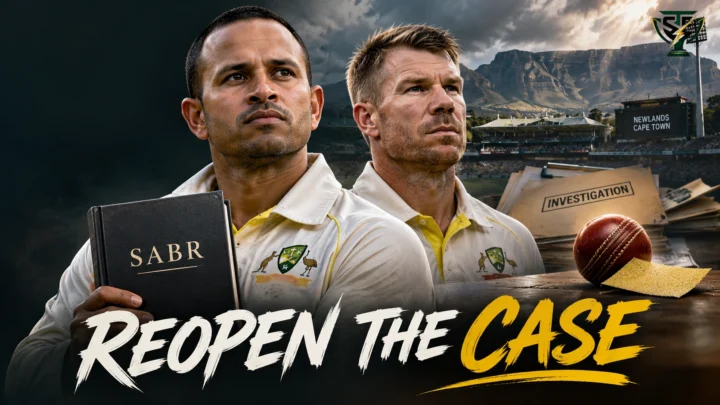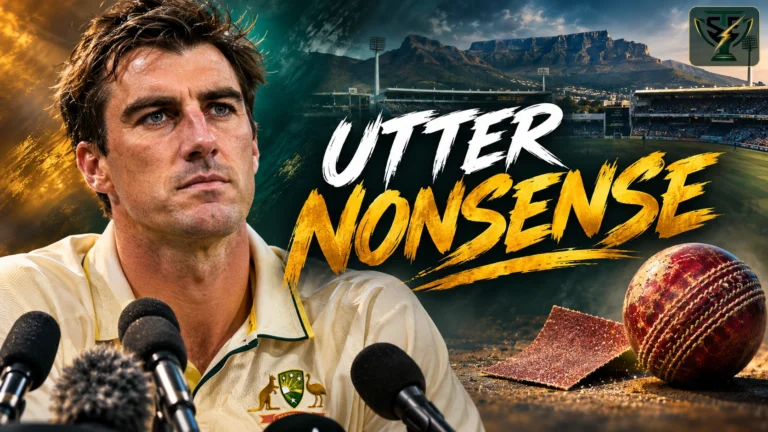
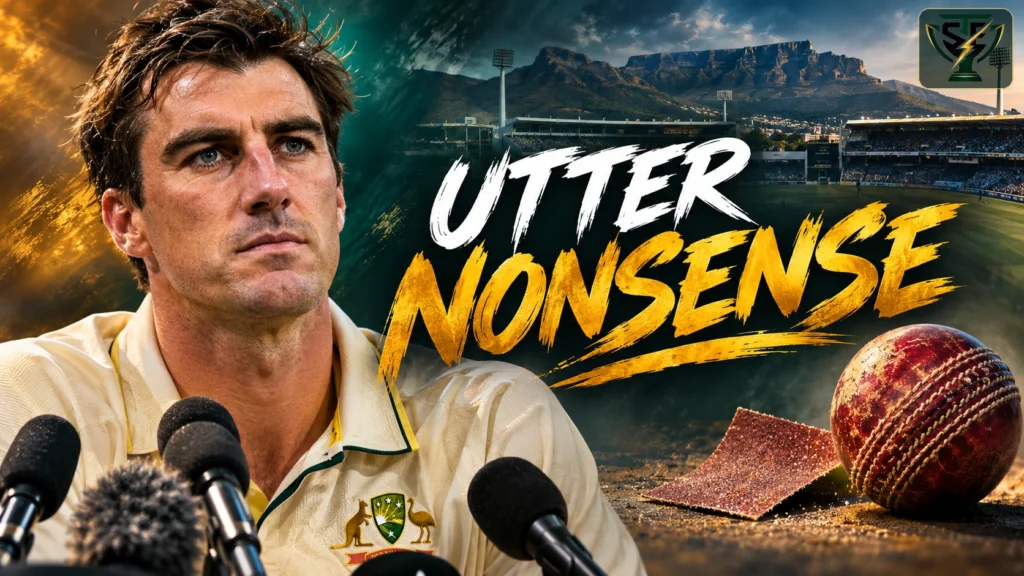
SYDNEY, Australia, November 13, 2026: Australia Test captain Pat Cummins has emphatically denied Usman Khawaja’s claims about wider involvement in the 2018 ball-tampering scandal, describing the suggestion that he helped plan the use of sandpaper as “complete and utter nonsense.” Speaking at Cricket Central in Sydney on Friday, Cummins insisted he had no prior knowledge that sandpaper would be taken onto the field during the Cape Town Test against South Africa and rejected the account presented in Khawaja’s autobiography, Sabr.
The Sandpapergate allegations have reopened one of Australian cricket’s most damaging controversies, placing Cummins and Khawaja in direct disagreement over what players knew and whether the original investigation identified everyone responsible. David Warner has publicly supported Khawaja’s account, while Mitchell Starc has reiterated his denial of prior knowledge. Cricket Australia maintains that there is no compelling reason to reinvestigate, leaving fundamental questions about witness testimony, collective responsibility and the completeness of the 2018 findings unresolved.
Key Takeaways
- He said he had been genuinely surprised by the allegations and maintained that his understanding of the Cape Town incident had remained unchanged for eight years.
- Usman Khawaja’s autobiography has revived controversy surrounding Australia’s third Test against South Africa at Newlands in March 2018.
- Cricket Australia chief executive Todd Greenberg has maintained that the governing body has no compelling reason to reopen the 2018 investigation.
- The original Sandpapergate scandal prompted extensive discussion about Australia’s competitive culture and the boundaries between aggressive cricket and unacceptable conduct.
Sandpapergate Allegations Put Cummins and Khawaja in Direct Conflict
Cummins approached his first media appearance on the controversy with a firm rejection of Khawaja’s central claims.
Story at a glance
Sandpapergate Allegations Put Cummins and Khawaja in Direct Conflict
Cummins approached his first media appearance on the controversy with a firm rejection of Khawaja’s central claims.
What Khawaja Claims in Sabr
Usman Khawaja’s autobiography has revived controversy surrounding Australia’s third Test against South Africa at Newlands in March 2018.
David Warner Supports Khawaja While Starc Maintains His Denial
David Warner’s public intervention has complicated the dispute.
Cummins Says Khawaja’s Account Has Damaged Reputations
Cummins also expressed concern about the personal consequences of the allegations.
Cricket Australia Continues to Reject a New Investigation
Cricket Australia chief executive Todd Greenberg has maintained that the governing body has no compelling reason to reopen the 2018 investigation.
He said he had been genuinely surprised by the allegations and maintained that his understanding of the Cape Town incident had remained unchanged for eight years.
His most important clarification concerned the distinction between discussing reverse swing and knowing that an illegal abrasive material would be used to alter the ball.
The captain rejected the suggestion that the entire Australian dressing room knew sandpaper would be taken onto the field.
He also denied participating in any organized plan involving players collectively deciding to tamper with the ball.
According to Cummins, there was no team meeting or coordinated arrangement in which the bowling group instructed teammates to use illegal methods.
The Reuters report on Cummins’ denial documents the captain’s response to the controversy that has followed publication of Khawaja’s memoir.
His statements introduce an important distinction into the debate.
Knowledge that a team is attempting to obtain reverse swing is not equivalent to knowledge that a particular player possesses sandpaper or intends to use it illegally.
Both descriptions involve the condition of the ball, but only the latter establishes awareness of the specific prohibited method exposed by television cameras in Cape Town.
This distinction deserves serious consideration because the allegations now extend beyond general criticism of Australia’s team culture.
They concern whether particular individuals knew about, encouraged or participated in conduct that breached cricket’s rules.
Why the Sandpapergate Allegations Require Precise Evidence
Cummins’ response identifies a weakness in treating every form of knowledge as evidence of direct involvement.
Players may discuss swing bowling, ball maintenance and ways of making a cricket ball more effective without agreeing to unlawful tampering.
However, the existence of legitimate discussions does not automatically disprove separate allegations about illegal conduct.
An accurate assessment must establish what was said, who was present, what actions followed and whether any player knew that sandpaper would be used.
Those questions cannot be answered through assumptions about what bowlers normally understand concerning the condition of a cricket ball.
Equally, Cummins’ denial should not be dismissed simply because he was part of the bowling attack during the series.
The burden remains on anyone alleging additional wrongdoing to provide credible evidence supporting the allegation.
What Khawaja Claims in Sabr
Usman Khawaja’s autobiography has revived controversy surrounding Australia’s third Test against South Africa at Newlands in March 2018.
During that match, television cameras captured Cameron Bancroft attempting to alter the ball with sandpaper.
Cricket Australia’s subsequent investigation resulted in 12-month bans for then-captain Steve Smith and vice-captain David Warner. Bancroft received a nine-month suspension.
The original inquiry did not establish that other members of the playing squad participated in the plot.
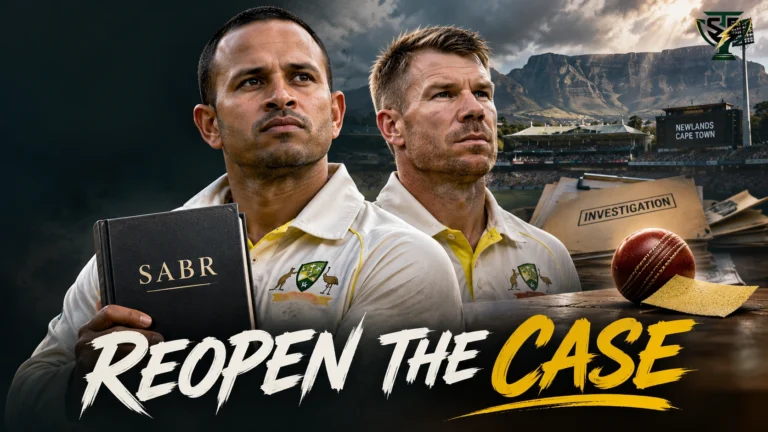
In Sabr: Finding My Way in Cricket and Life, Khawaja challenges the narrow allocation of responsibility.
He alleges that discussions surrounding the treatment of the ball involved a wider group and that the use of sandpaper was not confined to the Cape Town Test.
His account also raises questions about events during the preceding Test in Port Elizabeth.
The allegations have particular significance because Khawaja was a member of the Australian touring squad and is describing circumstances from inside the team’s environment.
However, a firsthand account still requires corroboration when it directly conflicts with other participants’ recollections.
Khawaja has also expressed reluctance to identify individual teammates publicly, emphasizing his belief that the squad should take collective responsibility.
That approach reflects his stated view of the team’s culture, but it leaves important questions about individual knowledge unanswered.
Collective responsibility for an unhealthy environment is different from individual responsibility for committing or knowingly arranging a specific offense.
Confusing the two risks unfairly implicating players without establishing what each person actually knew or did.
David Warner Supports Khawaja While Starc Maintains His Denial
David Warner’s public intervention has complicated the dispute.
Warner, one of the three players suspended in 2018, endorsed Khawaja’s account and criticized the original investigation.
He has questioned whether Cricket Australia interviewed everyone who could have supplied relevant information, including Khawaja.
Warner’s position deserves consideration because he was directly involved in the original disciplinary proceedings.
At the same time, his personal stake in the outcome makes independent corroboration important.
Mitchell Starc has taken the opposite position.
He reiterated that he did not know sandpaper had been taken onto the field and said his recollection remained consistent with earlier public statements.
In 2021, Starc, Cummins, Josh Hazlewood and Nathan Lyon jointly denied prior knowledge that a foreign substance had been brought onto the field to alter the cricket ball.
Cummins’ latest response reinforces that earlier position rather than replacing it with a substantially different explanation.
Former Australian coach Darren Lehmann and batting coach Graeme Hick have also rejected suggestions that they knew about the alleged wider scheme.
The AFP’s report from Cummins’ media appearance records those competing responses and Cricket Australia’s continued refusal to reopen the investigation.
The present dispute therefore involves several individuals expressing fundamentally different recollections of events from the same tour.
That conflict is an evidentiary problem, not proof that one side is deliberately misleading the public.
Cummins Says Khawaja’s Account Has Damaged Reputations
Cummins also expressed concern about the personal consequences of the allegations.
He described Khawaja as a friend but argued that public accusations involving other people’s lives and reputations carry responsibilities.
His criticism introduces an important human dimension to the controversy.
The 2018 scandal resulted in widespread public condemnation, loss of professional opportunities and substantial consequences for the players who were punished.
New allegations can affect individuals who were not found culpable in the original investigation, particularly when the public discussion does not distinguish allegations from established facts.
Cummins said he supported Khawaja’s right to tell his story while maintaining that the claims about his own involvement were incorrect.
Both positions can coexist.
Khawaja is entitled to describe what he believes happened, and Cummins is equally entitled to contest allegations affecting his professional standing.
The obligation of responsible reporting is to represent both accounts accurately and avoid converting disputed recollections into findings of guilt.
The dispute has also demonstrated how quickly an unresolved sporting controversy can become personal.
That makes transparent investigative procedures more valuable than attempts to settle the matter through competing interviews or social media statements.
Cricket Australia Continues to Reject a New Investigation
Cricket Australia chief executive Todd Greenberg has maintained that the governing body has no compelling reason to reopen the 2018 investigation.
Chairman David Boon has supported that position and expressed confidence in Cummins’ leadership.
The board argues that the original investigation dealt with the incident and that revisiting conflicting recollections eight years later would offer limited benefit.
Those concerns cannot be dismissed entirely.
Older investigations face challenges involving the reliability of memory, access to documents, witness availability and the application of disciplinary procedures.
But the passage of time is not, by itself, sufficient reason to reject every request for scrutiny.
The central question is whether Khawaja’s disclosures introduce material evidence that was unavailable, overlooked or inadequately examined in 2018.
Cummins has defended the original investigative process, saying he answered the questions put to him at the time.
That statement is relevant evidence in support of his position.
It does not establish whether every potentially important witness was interviewed or whether the original investigators had access to all relevant information.
Those are separate questions about the completeness of the process.
Cricket Australia’s confidence in its original conclusions should therefore be distinguished from an independently established finding that no additional evidence warrants examination.
The continuing debate over integrity and accountability also reflects issues explored in The Sports Encounter’s analysis of Australia’s return to South Africa eight years after Sandpapergate.
The original incident remains an important part of the national team’s history because its consequences extended far beyond the result of a single Test match.
Does Cummins’ Denial Settle the Question of Responsibility?
Cummins has now offered a detailed public explanation of his position.
He denies knowing that sandpaper would be used and rejects the suggestion that he participated in a coordinated plan.
His account is consistent with the position previously taken by Australia’s four frontline bowlers.
That consistency strengthens the importance of considering his testimony fairly.
However, consistency alone cannot resolve every conflicting account.
Repeated statements may accurately reflect a person’s recollection, but investigators normally assess them alongside documents, other witnesses and contemporaneous evidence.
Similarly, Khawaja’s account cannot be treated as conclusively correct merely because Warner has endorsed it.
The relevant distinctions are summarized below.
| Issue | Confirmed Position | What Remains Unresolved |
|---|---|---|
| Use of sandpaper at Cape Town | Bancroft was caught attempting to alter the ball, and three players were sanctioned | Whether anyone else had prior knowledge or participated |
| Cummins’ involvement | Cummins categorically denies advance knowledge or participation | Whether independent evidence supports or contradicts the competing accounts |
| Earlier alleged tampering | Khawaja alleges misconduct before Cape Town | Whether the specific allegations can be corroborated |
| Original investigation | Cricket Australia maintains confidence in the outcome | Whether material witnesses or evidence were omitted |
| Additional disciplinary action | No new sanctions have been announced | Whether any separately established misconduct could be prosecuted under applicable rules |
The table illustrates why the public controversy has not produced a definitive resolution.
There are confirmed historical facts, individual denials, allegations and questions about investigative procedure.
Each category requires a different evidentiary standard.
Why an Independent Evidence Review Still Makes Sense
The case for renewed scrutiny does not depend on assuming Cummins or another previously cleared player is guilty.
A narrowly defined independent review could determine whether the original investigation considered all material evidence and whether Khawaja’s new account introduces information requiring further examination.
That process would not need to begin with another public disciplinary hearing against the entire touring party.
An independent reviewer could first examine the original interview records, identify the witnesses consulted and establish whether available documents support any material omissions.
The reviewer could then assess whether there is a credible basis for reopening particular findings.
If none exists, Cricket Australia could explain the conclusion and provide a stronger basis for public confidence.
If significant new evidence emerges, the relevant questions could be investigated through appropriate procedures.
Such a review must also respect procedural fairness, applicable time limits and the penalties already served by Smith, Warner and Bancroft.
Continue the Cricket Story

No person should be punished merely because another participant has offered a conflicting recollection.
The need for proportionate accountability is consistent with wider questions about professionalism and misconduct examined in TSE’s coverage of a separate cricket cheating disciplinary case.
Different offenses and jurisdictions cannot be treated as directly equivalent, but fair investigation and credible evidence remain essential principles.
Australian Cricket Faces Another Test of Its Leadership Culture
The original Sandpapergate scandal prompted extensive discussion about Australia’s competitive culture and the boundaries between aggressive cricket and unacceptable conduct.
Cummins has acknowledged that the team environment in 2018 had troubling characteristics, even while firmly denying involvement in the sandpaper scheme.
That distinction allows the discussion to address two separate questions.
One concerns the responsibility of individuals for a particular prohibited act.
The other concerns whether the broader team culture encouraged behavior that placed victory ahead of acceptable standards.
The answers need not be identical.
A player can acknowledge that a team environment required improvement without admitting involvement in a specific offense.
Likewise, organizational responsibility for an unhealthy culture does not automatically establish that every member of the squad committed a disciplinary breach.
That distinction is important as Australia’s senior playing group approaches another period of transition.
TSE’s analysis of Australia’s changing Test generation examined the leadership and succession questions surrounding several established players.
Cummins remains central to the team’s immediate direction, and Cricket Australia’s confidence in him has not wavered.
The renewed controversy nevertheless demonstrates how difficult it can be to separate past institutional failures from the careers of players who remain involved in the national setup.
Why the Dispute Matters Ahead of Australia’s International Summer
Cummins’ media appearance comes as Australia prepares to begin its white-ball series against England.
He has been rested from the limited-overs assignments, with Mitchell Marsh leading the side.
Marsh has declined to revisit his recollections of the South Africa tour in detail, saying his immediate focus is the upcoming cricket.
That decision should not be interpreted as an admission or as evidence that he possesses undisclosed information.
However, the controversy has become an unavoidable subject for Australian players and administrators ahead of an important home season.
The timing was already identified in The Sports Encounter’s Australia-England ODI series preview, which examined the growing attention surrounding Khawaja’s book.
The same controversy has also revived debate about the relationship between the Australian team’s competitive identity and its approach to opposition players.
TSE’s examination of aggression and sportsmanship in the Australia-South Africa rivalry provides context for why the 2018 incident continues to shape public perceptions.
Australia have achieved substantial success since Cape Town, but those results do not independently resolve the accuracy of conflicting accounts about the original scandal.
At the same time, renewed scrutiny should not erase the legitimate achievements of players against whom no additional misconduct has been proven.
What Must Happen Before Sandpapergate Can Finally Be Resolved?
Cummins has now answered one of the most important questions surrounding the renewed controversy.
He has publicly denied prior knowledge of sandpaper being taken onto the field and rejected any suggestion that he helped arrange its use.
That statement deserves to be recorded accurately and considered alongside the accounts of Khawaja, Warner and other participants.
But a press conference cannot independently settle the completeness of an investigation carried out eight years earlier.
Cricket Australia’s continued refusal to review the case means the public must rely on the original findings and the competing recollections that have emerged since.
An independent evidence review would offer a more credible way to determine whether those findings still withstand scrutiny.
It could also protect those who deny involvement by establishing a transparent process for assessing the claims against them.
The Sandpapergate allegations have created a serious disagreement between former teammates about the events leading to one of Australian cricket’s most damaging episodes. Cummins has made his position unequivocal, and nothing in the present public record establishes that he committed additional wrongdoing. Cricket Australia should nevertheless be prepared to test whether the original investigation was complete, because a defensible conclusion requires evidence, fair treatment and a process that can command confidence beyond the governing body’s own assurances.