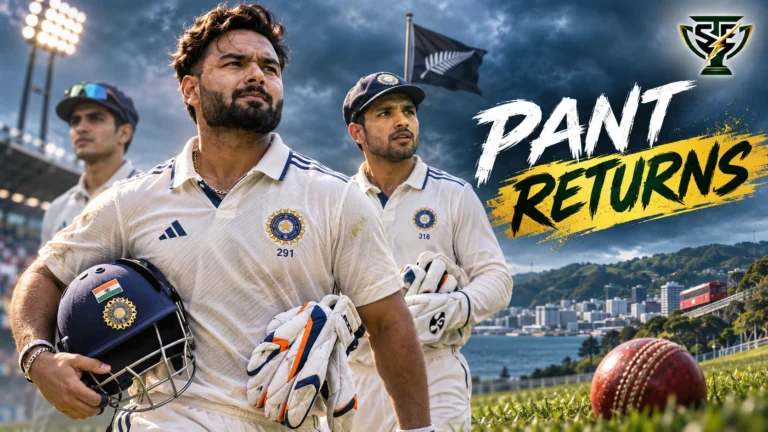
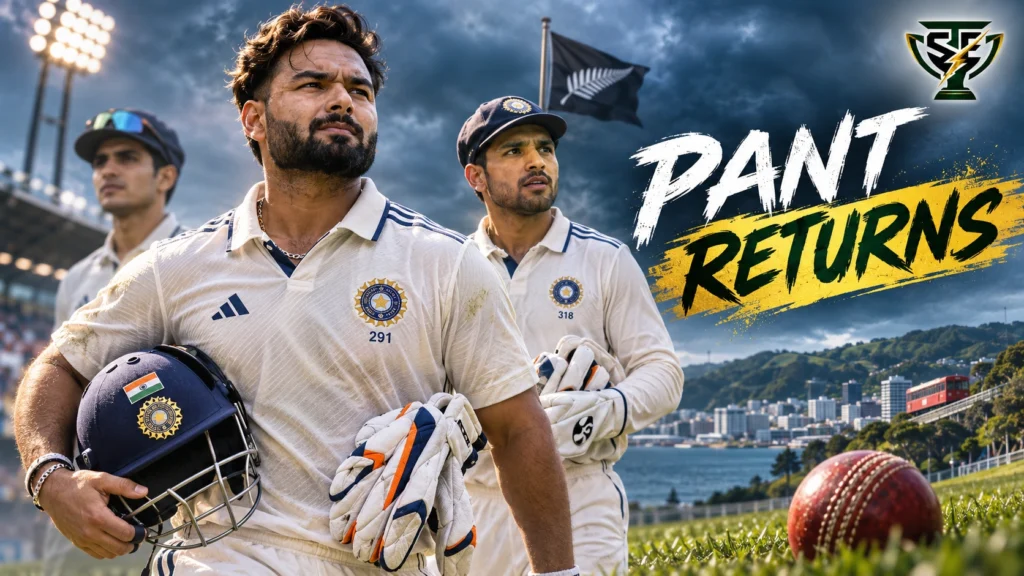
NEW DELHI, India, November 12, 2026: Rishabh Pant has received medical clearance from the BCCI Centre of Excellence and departed for New Zealand, ending weeks of uncertainty over his availability for India’s two-Test series beginning in Wellington on November 19. The wicketkeeper-batter, who suffered a side strain during the Irani Trophy, is expected to join Shubman Gill’s squad in Wellington on Friday after completing an extended rehabilitation program in Bengaluru.
Pant’s recovery strengthens India’s middle order at a critical stage of the World Test Championship, but his return introduces a genuine selection dilemma. Dhruv Jurel has reinforced his case with a century and a half-century against New Zealand A, while Devdutt Padikkal and Sai Sudharsan have also produced substantial runs during the preparatory series. With only two Tests available to improve India’s championship position, Gill must decide whether to accommodate both wicketkeepers, prioritize an additional specialist batter or use the extra batting flexibility to strengthen his attack.
Key Takeaways
- Rishabh Pant has received medical clearance from the BCCI Centre of Excellence and departed for New Zealand, ending weeks of uncertainty over his availability for India’s two-Test series beginning in Wellington on November 19.
- The 29-year-old suffered a side strain while captaining Rest of India against Jammu and Kashmir in the Irani Trophy, played in Srinagar from October 1 to 4.
- He subsequently reported to the BCCI Centre of Excellence in Bengaluru on October 23, where medical staff supervised his rehabilitation and assessed his readiness to resume competitive cricket.
- India enter the two-match series fourth in the ICC World Test Championship standings with 68 points from 11 matches and a points percentage of 51.52.
Rishabh Pant Clears Fitness Test After Extended Rehabilitation
Pant’s clearance comes after a recovery process that proved longer than initially anticipated.
Story at a glance
Rishabh Pant Clears Fitness Test After Extended Rehabilitation
Pant’s clearance comes after a recovery process that proved longer than initially anticipated.
Pant’s Return Creates a Selection Problem India Cannot Ignore
Before Pant received clearance, the wicketkeeping decision appeared relatively straightforward.
Dhruv Jurel’s New Zealand A Century Makes Him Hard to Leave Out
Jurel’s strongest argument is that he has already adapted to the conditions awaiting India’s senior team.
Padikkal and Sudharsan Have Strengthened India’s Batting Options
The selection competition extends beyond Pant and Jurel.
Three Selection Scenarios for India’s Wellington Test
India’s management has not announced its preferred wicketkeeping arrangement. The following are possible combinations based on the selected squad and recent performances.
The 29-year-old suffered a side strain while captaining Rest of India against Jammu and Kashmir in the Irani Trophy, played in Srinagar from October 1 to 4.
He subsequently reported to the BCCI Centre of Excellence in Bengaluru on October 23, where medical staff supervised his rehabilitation and assessed his readiness to resume competitive cricket.
Pant had already been selected for India’s New Zealand Test squad, but the selectors made his participation conditional upon receiving medical clearance.
He was also included in the India A arrangements for three four-day matches against New Zealand A, although his recovery prevented him from joining the preparatory fixtures.
Pant missed the first two matches and had been considered for the third, played from November 7 to 10. His rehabilitation was extended because medical staff wanted additional time to evaluate his recovery.
Reports from India indicate that Pant initially failed to receive clearance at the beginning of November but subsequently completed further assessments and match-simulation exercises.
He left India on Thursday, November 12, traveling via Singapore toward Wellington.
The medical clearance removes the principal obstacle to his participation, although it does not guarantee that he will appear in the first Test.
That distinction matters. Being fit to resume cricket and being ready for the specific demands of a five-day international match are closely related, but the final playing XI will also depend on preparation, conditions and the balance selected by India’s management.
The BCCI’s official touring squad announcement originally listed Pant subject to fitness clearance. His successful assessment now changes the selection calculation that existed when India named its 16-player squad.
Pant’s Return Creates a Selection Problem India Cannot Ignore
Before Pant received clearance, the wicketkeeping decision appeared relatively straightforward.
Dhruv Jurel was the other specialist wicketkeeper in India’s squad and had already gained valuable experience against New Zealand A.
Now India can choose between playing Pant as the principal wicketkeeper, retaining Jurel as a specialist batter or selecting a different batting combination.
The difficulty is that Jurel has done considerably more than provide temporary cover during Pant’s absence.
He captained India A against New Zealand A and produced a century and a half-century across four innings, strengthening his case through performance rather than reputation alone.
India have previously accommodated both players in the Test XI, with Jurel contributing as a specialist batter while Pant handled wicketkeeping duties.
During India’s second Test against Sri Lanka in Colombo, Jurel scored an unbeaten 115 as the visitors declared at 503/9. Pant contributed 63 in the same innings.
That combination allowed India to retain two accomplished wicketkeeper-batters without sacrificing their batting contribution.
As The Sports Encounter’s Colombo Test report explained, Jurel’s innings helped India build a 213-run first-innings lead and enforce the follow-on, although Sri Lanka ultimately saved the match.
India therefore have evidence that the two players can operate successfully in the same XI.
The unresolved question is whether that arrangement provides the strongest balance in New Zealand, where conditions and bowling requirements could differ considerably from those encountered in Sri Lanka.
Dhruv Jurel’s New Zealand A Century Makes Him Hard to Leave Out
Jurel’s strongest argument is that he has already adapted to the conditions awaiting India’s senior team.
The 25-year-old scored 105 from 171 deliveries in the second unofficial Test against New Zealand A at Hagley Oval in Christchurch.
India A had fallen to 160/6 before Jurel organized a lower-order recovery, eventually helping the visitors reach 346.
He added 62 runs with Manav Suthar and another 75 with Akash Deep, demonstrating his ability to manage the strike and build partnerships when established batters had already been dismissed.
The circumstances of that innings are particularly relevant to the senior series.
India may encounter movement and uneven scoring opportunities in Wellington and Christchurch, where lower-order partnerships can become decisive if the top order struggles.
Jurel’s performance showed that he could absorb pressure rather than simply accumulate runs on a comfortable surface.
The Rajasthan Royals’ official report on Jurel’s century confirms the score, his 171-ball innings and the partnerships that rescued India A.
His experience against New Zealand A also gives him an advantage in immediate preparation.
Pant will arrive in Wellington without having played any of the three four-day warm-up matches. Jurel, meanwhile, has spent time batting and keeping wicket in local conditions against bowlers familiar with those surfaces.
That does not automatically make Jurel the stronger international selection. Pant brings a different level of proven Test experience and attacking ability.
It does, however, make the decision more complicated than simply restoring a senior player to the position he occupied before injury.
Padikkal and Sudharsan Have Strengthened India’s Batting Options
The selection competition extends beyond Pant and Jurel.
Devdutt Padikkal scored 199 and 80 during his India A appearances against New Zealand A, while Sai Sudharsan registered scores of 91 and 88.
Those performances have given India’s selectors strong alternatives when constructing the top and middle order.
Padikkal entered the New Zealand tour with considerable confidence after an outstanding Test series in Sri Lanka.
He made 167 in Galle and 117 in Colombo, demonstrating an ability to build large innings and provide the foundation for substantial first-innings totals.
India’s 165-run victory in Galle was built around its first-innings advantage, with Padikkal’s century playing a central role. The match’s closing stages were examined in TSE’s report on India’s decisive position against Sri Lanka.
Padikkal’s subsequent performances in New Zealand suggest that his success was not confined to home or subcontinental conditions.
Sudharsan’s recent scores are also important because he offers another specialist batting option without requiring India to alter its wicketkeeping arrangements.
The choice therefore involves competing priorities.
Playing both Pant and Jurel may provide batting depth and flexibility. Selecting Padikkal and Sudharsan alongside Pant could give India a different distribution of specialist batters.
Neither approach is automatically superior.
The correct decision depends on the preferred batting order, the number of bowling options required and the conditions expected at Basin Reserve.
Three Selection Scenarios for India’s Wellington Test
India’s management has not announced its preferred wicketkeeping arrangement. The following are possible combinations based on the selected squad and recent performances.
| Selection Approach | Potential Advantage | Main Trade-Off |
|---|---|---|
| Pant keeps, Jurel plays as a batter | Retains both wicketkeeper-batters and their contrasting scoring approaches | Creates stronger competition for remaining specialist batting positions |
| Pant keeps, specialist batters prioritized | Offers greater flexibility to select Padikkal or Sudharsan in the preferred batting order | Jurel’s form and local preparation may go unrewarded |
| Jurel keeps, Pant plays primarily as a batter | Uses Jurel’s wicketkeeping preparation while retaining Pant’s batting | Would depend on Pant’s approved role and the balance preferred by management |
These are tactical possibilities rather than confirmed team plans.
The third arrangement would require particular clarity about Pant’s readiness and role, but there is no verified indication that India’s medical staff have recommended restricting him to batting duties.
Medical clearance should not be interpreted as evidence of either a continuing physical limitation or guaranteed readiness for every possible workload.
Why Pant’s Absence From the Warm-Up Matches Still Matters
Pant’s recovery has been completed in time for the series, but the delayed arrival leaves him with relatively little opportunity to experience New Zealand’s current playing conditions before the opening Test.
The first match begins on November 19, giving him approximately one week between his departure from India and the start of the series.
That period will include travel, acclimatization and any preparation arranged by the team.
His previous experience in New Zealand provides some familiarity with the environment. During India’s 2020 Test tour, however, Pant struggled for runs, failing to reach 25 in any of his four innings.
The record does not determine what he will achieve in this series, particularly given the development of his Test batting since then.
It does illustrate why overseas preparation cannot be dismissed simply because a player has already succeeded in other countries.
Pant’s attacking style is among India’s most distinctive batting resources.
His ability to score quickly can alter a match when bowlers have established control, and his left-handedness changes the angles opposition attacks must defend.
But against a moving ball, attacking intent must be supported by sound shot selection.
The challenge will be finding that balance without the competitive red-ball preparation his teammates received against New Zealand A.
India’s Bowling Balance Makes the Wicketkeeping Decision More Important
India have selected a pace-heavy squad for the two Tests, including Jasprit Bumrah, Mohammed Siraj, Prasidh Krishna, Akash Deep and Anshul Kamboj.
Nitish Kumar Reddy offers another seam-bowling possibility, while Ravindra Jadeja, Washington Sundar and Kuldeep Yadav provide different spin options.
The composition reflects the importance of adapting to New Zealand conditions rather than automatically retaining the balance India used in Sri Lanka.
Bumrah’s return is especially significant because he missed the Sri Lanka Test series.
As TSE’s original New Zealand Test squad analysis explained, his availability gives Gill an experienced attacking option capable of operating with the new ball and returning during difficult periods.
India could select three specialist seamers, use an additional seam-bowling all-rounder or choose a different combination depending on the pitch.
Every decision affects the batting lineup.
If India believe the surface requires an additional specialist bowler, they may have fewer places available for players selected principally for their batting.
Pant’s return could help create flexibility because he combines wicketkeeping with the ability to score rapidly in the middle order.
Jurel’s batting record offers similar value, albeit with a different style and level of international experience.
The team’s preferred balance may therefore matter more than the identity of the first-choice wicketkeeper alone.
India’s Preparations Differ From New Zealand’s Injury Concerns
New Zealand have their own selection questions ahead of the series.
Continue the Cricket Story



Rachin Ravindra and Mark Chapman were unavailable for the preceding ODI series because of shoulder and hamstring injuries, respectively, while other players have required fitness monitoring.
The circumstances were detailed in TSE’s analysis of New Zealand’s changing squad.
Those white-ball absences should not automatically be treated as confirmed Test withdrawals. New Zealand have named a separate red-ball squad, and individual availability will depend on subsequent assessments.
The hosts also face a longer-term transition following Kane Williamson’s retirement from international cricket.
Williamson’s achievements included leading New Zealand to the inaugural World Test Championship title, making his absence significant both in batting terms and in the experience available to the team.
The Sports Encounter’s tribute to Williamson examined his influence on New Zealand’s Test identity and the challenge of replacing his contribution.
Nevertheless, the Black Caps remain a strong Test side, particularly at home, and India’s returning players will face an opponent with considerable experience of New Zealand conditions.
World Test Championship Pressure Raises the Stakes of Pant’s Return
India enter the two-match series fourth in the ICC World Test Championship standings with 68 points from 11 matches and a points percentage of 51.52.
New Zealand lead the standings at 72.22%, followed by South Africa at 71.43% and Australia at 69.23%.
The difference makes the coming series especially consequential.
A victory would strengthen India’s points percentage while denying a direct rival the opportunity to collect the same result.
A defeat would leave Gill’s team with greater pressure to recover during its remaining championship fixtures.
The ICC’s official World Test Championship standings confirm that teams receive 12 points for a victory, four for a draw and six for a tie, with applicable over-rate penalties affecting the final totals.
India have seven Tests remaining in the cycle, including two in New Zealand and five at home against Australia.
The importance of the qualifying race was also evident when South Africa’s victory over Australia changed the championship hierarchy. TSE’s analysis of South Africa’s WTC position detailed how closely the leading contenders are grouped.
India’s immediate task is to improve its own results rather than depend on other countries dropping points.
Pant’s clearance helps because it restores an experienced Test batter, but it does not remove the challenges of scoring against New Zealand’s attack or taking 20 wickets in unfamiliar conditions.
India vs New Zealand Test Schedule
| Match | Dates | Venue | Scheduled Start |
|---|---|---|---|
| First Test | November 19–23 | Wellington | 11:00 a.m. local / 3:30 a.m. IST |
| Second Test | November 27–December 1 | Christchurch | 11:00 a.m. local / 3:30 a.m. IST |
Captain Gill, vice-captain KL Rahul and Anshul Kamboj have also moved toward Test preparation after their involvement in the ODI squad.
India’s management must use the remaining preparation period to assess the batting order, final bowling combination and the roles of Pant and Jurel.
Medical Clearance Settles One Question, but Gill Faces a Harder Decision
Pant’s arrival will provide India with an experienced wicketkeeper-batter at a time when the team needs strong performances to improve its WTC qualification position.
His recovery removes the possibility that India must automatically rely on Jurel because of injury.
But Jurel has already made a compelling case through his performances against New Zealand A, while Padikkal and Sudharsan have reinforced the strength of India’s available batting options.
Gill therefore faces a selection decision shaped by form, preparation and tactical requirements rather than availability alone.
Restoring Pant as wicketkeeper would be a logical possibility given his established Test record. Accommodating Jurel alongside him also has precedent and recent performance-based justification.
Neither arrangement has been confirmed.
The challenge is choosing an XI that can withstand New Zealand’s bowling conditions while retaining enough attacking resources to pursue a result.
Pant has cleared the medical hurdle. His next task is to establish his readiness in Wellington, where India must decide how best to use a returning match-winner without overlooking the players who strengthened their claims during his absence.
Rishabh Pant
- Rishabh Pant Cleared for New Zealand Tests as India Face Selection Dilemma
- Bumrah Returns, Pant Faces Fitness Test as India Load Up on Pace for New Zealand Tour
- India Take a Stranglehold in Colombo Test as Jurel, Pant and Late Wickets Leave Sri Lanka in a Fix
- India Strangulate Sri Lanka in Galle, Six Wickets Away from a Memorable Test Win