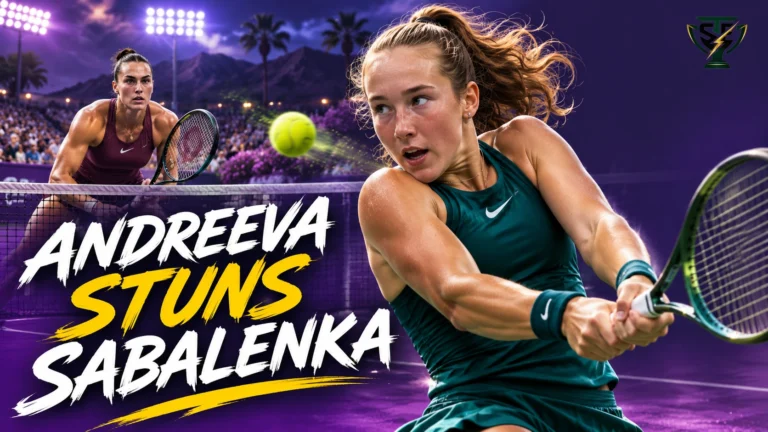
INDIAN WELLS, United States, November 11, 2026: Mirra Andreeva produced the most emphatic victory of the WTA Finals so far, recovering from an early deficit to dismantle world No. 2 Aryna Sabalenka 6-4, 6-0 and secure a place in the semifinals. The 19-year-old Russian won the final 11 games in just 62 minutes at Indian Wells Tennis Garden, becoming the youngest WTA Finals semifinalist since Caroline Wozniacki in 2009. Her victory also eliminated Karolina Muchova and left Sabalenka facing a decisive final group match against Elina Svitolina.
Svitolina had earlier kept her campaign alive by defeating Muchova 3-6, 6-2, 6-2. In doubles, Gabriela Dabrowski and Luisa Stefani secured their semifinal qualification with a hard-fought victory over Guo Hanyu and Kristina Mladenovic, while Hsieh Su-wei and Jelena Ostapenko recovered from an opening defeat to beat Elise Mertens and Zhang Shuai. The four results reshaped both qualification races, with two singles semifinal places and two doubles semifinal places now confirmed across the tournament.
Key Takeaways
- Mirra Andreeva produced the most emphatic victory of the WTA Finals so far, recovering from an early deficit to dismantle world No. 2 Aryna Sabalenka 6-4, 6-0 and secure a place in the semifinals.
- All four contests were played during the November 11 session in California, extending into the early hours of November 12 in Pakistan.
- With Linda Noskova already qualified from Singles Group 1, Andreeva becomes the second confirmed singles semifinalist.
- Andreeva’s victory settled the top position in Singles Group 2 and eliminated Muchova.
WTA Finals Results: Andreeva, Svitolina and Doubles Winners
All four contests were played during the November 11 session in California, extending into the early hours of November 12 in Pakistan.
Story at a glance
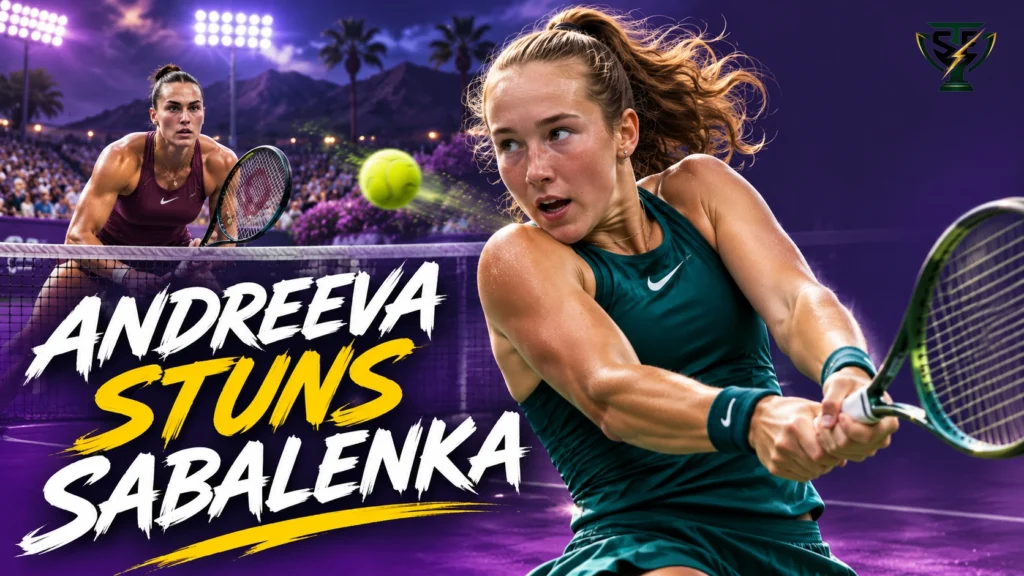
WTA Finals Results: Andreeva, Svitolina and Doubles Winners
All four contests were played during the November 11 session in California, extending into the early hours of November 12 in Pakistan.
Andreeva Turns a 4-1 Deficit Into an 11-Game Rout Against Sabalenka
Sabalenka appeared to have the early advantage when she established a 4-1 lead in the opening set. Her powerful baseline game initially put Andreeva under pressure, and the Belarusian seemed positioned to take control of a contest between two unbeaten Group 2 players.
Svitolina Ends Muchova’s Remarkable Winning Record After Losing First Set
Before Andreeva’s victory took center stage, Svitolina delivered the session’s most important comeback.
Sabalenka vs Svitolina Now Decides the Remaining Group 2 Semifinal Place
Andreeva’s victory settled the top position in Singles Group 2 and eliminated Muchova. The remaining qualification contest is now between Sabalenka and Svitolina.
Dabrowski and Stefani Reach Doubles Semifinals After Three-Set Battle
In doubles, Gabriela Dabrowski and Luisa Stefani strengthened their status as championship contenders by defeating Guo Hanyu and Kristina Mladenovic 7-6(5), 4-6, [10-5].
| Event | Winners | Opponents | Score | Significance |
|---|---|---|---|---|
| Singles Group 2 | Mirra Andreeva | Aryna Sabalenka | 6-4, 6-0 | Andreeva qualifies as group winner |
| Singles Group 2 | Elina Svitolina | Karolina Muchova | 3-6, 6-2, 6-2 | Svitolina stays alive; Muchova eliminated |
| Doubles Group 1 | Gabriela Dabrowski / Luisa Stefani | Guo Hanyu / Kristina Mladenovic | 7-6(5), 4-6, [10-5] | Dabrowski and Stefani reach semifinals |
| Doubles Group 1 | Hsieh Su-wei / Jelena Ostapenko | Elise Mertens / Zhang Shuai | 7-5, 6-3 | Hsieh and Ostapenko remain in contention |
With Linda Noskova already qualified from Singles Group 1, Andreeva becomes the second confirmed singles semifinalist. The competition’s remaining group matches will determine their opponents and complete the knockout field.
Readers can follow every confirmed result, updated group position and upcoming fixture in The Sports Encounter’s WTA Finals results, draw and standings hub.
Andreeva Turns a 4-1 Deficit Into an 11-Game Rout Against Sabalenka
Sabalenka appeared to have the early advantage when she established a 4-1 lead in the opening set. Her powerful baseline game initially put Andreeva under pressure, and the Belarusian seemed positioned to take control of a contest between two unbeaten Group 2 players.
What followed was an extraordinary reversal.
Andreeva recovered the early break, moved ahead and never allowed Sabalenka to win another game. She took five consecutive games to steal the opening set 6-4, then swept through the second without conceding a game.
The turnaround was remarkable for its speed and completeness. Sabalenka went from leading 4-1 to losing 6-4, 6-0, while Andreeva won 45 of the final 55 points.
According to the WTA’s official match analysis, Andreeva completed the victory in 62 minutes and became the first player in tournament history to win a 6-0 set in each of her opening two WTA Finals matches.
The Statistical Collapse That Defined Sabalenka’s Defeat
Sabalenka’s loss was not simply the result of losing a close first set. Once Andreeva gained momentum, the match became increasingly one-sided.
| Match Measure | Andreeva’s Performance |
|---|---|
| Final score | 6-4, 6-0 |
| Match duration | 62 minutes |
| Position after five games | Trailing 1-4 |
| Games won thereafter | 11 consecutive |
| Points won in final 55 | 45 |
| Share of final 55 points | 81.8% |
| Second-set games conceded | 0 |
TSE statistical insight: Andreeva’s 45 points from the final 55 represent an 81.8% success rate during the decisive passage. That figure is calculated directly from the WTA’s published point totals. It captures how completely the competitive balance shifted after Sabalenka’s early lead.
Andreeva also finished with 16 winners and only six unforced errors, a strikingly efficient return against one of the tour’s most aggressive players.
Her success came through sustained pressure rather than a brief burst of spectacular hitting. She extended rallies when necessary, forced Sabalenka to play additional balls and increasingly dictated exchanges once she found her timing.
Sabalenka, meanwhile, struggled to halt the run. The lack of a single game won across the final 11 games meant she could not interrupt Andreeva’s rhythm or rebuild scoreboard pressure.
The performance also reinforced the progress Andreeva demonstrated in her opening 6-4, 6-0 victory over Svitolina. She has now won four consecutive sets at Indian Wells, with two of them ending 6-0.
That consistency was absent from much of the uncertainty surrounding the pre-tournament favorites. In TSE’s analysis of the championship’s endurance demands, the central question was whether the established contenders could sustain their level against elite opposition across consecutive matches.
Andreeva has answered that question more convincingly than anyone in her group.
Why Andreeva’s Victory Matters Beyond the Score
At 19, Andreeva has reached the semifinals on her WTA Finals debut. She is the youngest player to progress that far since Wozniacki 17 years ago and joins a select group of teenagers to reach the semifinals under the round-robin format introduced in 2003.
Her achievement gains additional significance because she has defeated both Svitolina, the 2018 champion, and Sabalenka, a two-time tournament runner-up, without dropping a set.
Andreeva has also secured first place in Group 2. Her remaining round-robin meeting against Muchova will not determine whether she advances, although maintaining her form and physical freshness remains important before the knockout stage.
For Sabalenka, the setback is severe but not terminal. She remains in contention for the second semifinal position and must recover against Svitolina in her final group match.
Svitolina Ends Muchova’s Remarkable Winning Record After Losing First Set
Before Andreeva’s victory took center stage, Svitolina delivered the session’s most important comeback.
The Ukrainian recovered from a difficult opening set to defeat Muchova 3-6, 6-2, 6-2 and secure her first WTA Finals victory since 2019.
Muchova initially controlled the contest with the variety that makes her such a difficult opponent. She mixed changes of pace with drop shots, angled groundstrokes and approaches to the net, preventing Svitolina from settling into a comfortable baseline rhythm.
That approach helped the Czech claim the opening set 6-3.
Svitolina responded by improving her shot selection and becoming more assertive in extended exchanges. Rather than allowing Muchova to dictate through variety, she began applying more sustained pressure from the back of the court.
The adjustment transformed the match.
Svitolina won the second set 6-2 and repeated the score in the decider, securing multiple breaks while restricting Muchova to four games across the final two sets.
The Adjustment That Changed the Contest
The WTA’s official match report identified a measurable improvement in Svitolina’s attacking efficiency between the opening two sets.
| Svitolina’s Performance | First Set | Second Set |
|---|---|---|
| Winners | 5 | 12 |
| Unforced errors | 14 | 11 |
| Winner-to-error differential | -9 | +1 |
| Games won | 3 | 6 |
TSE analysis: Svitolina improved her winner-to-unforced-error differential by 10 between the first and second sets. That swing reflected a more effective balance between attacking intent and shot discipline, helping explain the recovery more precisely than the final score alone.
The result also ended one of the season’s more impressive records.
Muchova had won all 32 matches in which she captured the opening set during the current season. Svitolina became the first player to defeat her from that position.
That achievement is particularly notable because Muchova entered the contest with a strong record in deciding sets. Svitolina nevertheless maintained her improved level through the third set, preventing the Czech from mounting another recovery.
The victory improved Svitolina’s record in three-set matches this season to 19-5 and delivered her 11th career match win at the WTA Finals.
It also carried personal significance. Svitolina returned to the season-ending championship after a seven-year absence, having navigated motherhood, injuries and surgery during the intervening period.
Her comeback victory ensured that return would remain competitive beyond the first two group matches.
Sabalenka vs Svitolina Now Decides the Remaining Group 2 Semifinal Place
Andreeva’s victory settled the top position in Singles Group 2 and eliminated Muchova. The remaining qualification contest is now between Sabalenka and Svitolina.
| Player | Record | Status |
|---|---|---|
| Mirra Andreeva | 2-0 | Qualified as group winner |
| Aryna Sabalenka | 1-1 | Faces Svitolina for remaining semifinal berth |
| Elina Svitolina | 1-1 | Faces Sabalenka for remaining semifinal berth |
| Karolina Muchova | 0-2 | Eliminated |
Sabalenka and Svitolina meet in their final round-robin match on November 13. With both players holding one victory and one defeat, their head-to-head contest will determine who joins Andreeva in the semifinals.
Sabalenka must find a way to restore the first-strike authority that disappeared against Andreeva. Svitolina, by contrast, will approach the meeting with renewed confidence after successfully adjusting to Muchova’s tactical variety.
Andreeva will face Muchova in the other Group 2 fixture, with her semifinal qualification already secure.
Dabrowski and Stefani Reach Doubles Semifinals After Three-Set Battle
In doubles, Gabriela Dabrowski and Luisa Stefani strengthened their status as championship contenders by defeating Guo Hanyu and Kristina Mladenovic 7-6(5), 4-6, [10-5].
The top-seeded pair faced considerably greater resistance than in their opening victory over Elise Mertens and Zhang Shuai.
Dabrowski and Stefani claimed the first-set tiebreak 7-5, but Guo and Mladenovic fought back to take the second set 6-4 and force a deciding match tiebreak.
The Canadian-Brazilian partnership recovered the initiative in the final phase, winning the match tiebreak 10-5 to complete their second consecutive group victory.
The result secured their qualification for the semifinals with one round-robin match remaining.
Their position reflects an outstanding season as a partnership. They arrived at the WTA Finals with six titles, including victories at major WTA 1000 events, and have continued to demonstrate their ability to win tight matches against elite opponents.
Guo and Mladenovic, who produced an extraordinary comeback from 0-6 down in a match tiebreak during their opener, could not repeat that escape. Their record now stands at 1-1, leaving their qualification hopes dependent on the final round of group play.
The background to their dramatic opening victory was covered in TSE’s report on Guo and Mladenovic’s four-match-point escape.
Hsieh and Ostapenko Revive Their Campaign With Straight-Sets Victory
Hsieh Su-wei and Jelena Ostapenko responded to their opening defeat by beating Elise Mertens and Zhang Shuai 7-5, 6-3.
The result was essential for a pair that had suffered one of the tournament’s most painful losses in their first match.
Against Guo and Mladenovic, Hsieh and Ostapenko had led 6-0 in a deciding match tiebreak and held four match points before losing 12-10.
Their response against Mertens and Zhang demonstrated an ability to recover from that setback.
Continue the WTA Finals Story
 WTA FinalsGuo and Mladenovic Save Four Match Points as Sabalenka and Andreeva Make Winning WTA Finals Starts
 WTA FinalsRybakina Outdid Sabalenka When It Mattered the Most: Can Either Survive the WTA Finals Pressure Cooker?
 WTA FinalsMirra Andreeva’s Historic 2026: Roland-Garros Glory, 50 Wins, and the Battle to Become Tennis’ Next Queen
The opening set was competitive, with Hsieh and Ostapenko eventually securing the decisive advantage at 7-5. They then controlled the second more effectively, completing a straight-sets victory to move to 1-1 in Group 1.
Hsieh’s exceptional touch and court awareness complement Ostapenko’s aggressive groundstrokes, creating a partnership capable of changing the tempo of exchanges rapidly.
That combination was particularly important against opponents with considerable doubles experience and strong credentials at major championships.
The victory means Hsieh and Ostapenko remain contenders for the second semifinal position from Group 1. Mertens and Zhang, meanwhile, have lost both opening matches.
Four Semifinal Places Confirmed as the WTA Finals Reach a Critical Stage
Across singles and doubles, four semifinal berths have now been decided.
Linda Noskova secured the first singles qualification from Group 1 after defeating Coco Gauff 6-3, 6-3. Andreeva has joined her following her emphatic victory over Sabalenka.
In doubles, Sara Errani and Jasmine Paolini became the first team to advance, with Dabrowski and Stefani now securing another knockout position.
The latest results build on the developments covered in TSE’s report on Noskova’s qualification and the Italian pair’s doubles breakthrough.
Group 1 singles remains particularly intriguing. Jessica Pegula and Coco Gauff both enter their final matches with 1-1 records, while Noskova is already qualified and Marta Kostyuk has been eliminated.
Pegula revived her campaign by defeating Kostyuk 6-2, 7-5, making her final group meeting with Noskova crucial. That recovery was examined in TSE’s analysis of Pegula’s qualification prospects.
The remaining match results will settle the final group positions, with the exact qualification order subject to the competition’s applicable round-robin tiebreak rules.
What the Remaining Matches Mean for the WTA Finals
The remaining group fixtures now carry different levels of pressure.
For Andreeva, Noskova, Errani and Paolini, and Dabrowski and Stefani, the priority is preparing for the semifinals while completing their round-robin commitments.
For Sabalenka and Svitolina, the situation is more immediate. Their final group encounter will determine whether either player advances, making it one of the most consequential remaining singles matches.
Gauff and Pegula must also navigate their final Group 1 fixtures, with the American contenders hoping to claim the remaining qualification position.
In doubles, the contest remains open for the teams still capable of advancing behind the confirmed group leaders.
The WTA Finals semifinals are scheduled for November 14, followed by the singles and doubles championship matches on November 15.
Andreeva enters the closing stages with perhaps the strongest momentum of anyone in the singles field. Her two victories have required just four sets, and she has conceded only eight games across those matches.
Her performance against Sabalenka has also altered the competitive expectations surrounding the tournament. The 19-year-old is no longer merely an emerging challenger to the established favorites. She has already beaten two experienced contenders decisively and secured a place among the final four.
Whether she can sustain that standard through the knockout rounds remains the central question. But after an 11-game winning streak against Sabalenka, the rest of the field has a compelling reason to take notice.
WTA Finals
- Andreeva Crushes Sabalenka as Svitolina Fights Back at WTA Finals
- Pegula Saves WTA Finals Campaign With Straight-Sets Win as Kostyuk Exits Semifinal Race
- Guo and Mladenovic Save Four Match Points as Sabalenka and Andreeva Make Winning WTA Finals Starts
- Gauff Survives Pegula Thriller as Nosková and Italian Doubles Pair Make WTA Finals Statements