Key Takeaways
- TL;DR: Elena Rybakina won the Australian Open and US Open in 2026, added Stuttgart and Ningbo championships, and secured her first year-end world No. 1 ranking.
- Elena Rybakina was born in Moscow on June 17, 1999.
- Rybakina’s change of sporting nationality in 2018 followed an offer of support from the Kazakhstan Tennis Federation.
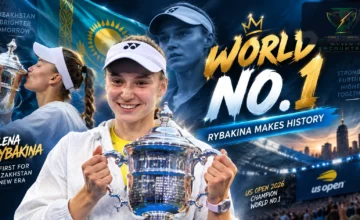
- Rybakina first became world No. 1 during the US Open in September.
INDIAN WELLS, United States, November 5, 2026: Elena Rybakina has already won almost everything that matters in women’s tennis this year. She defeated Aryna Sabalenka to capture the Australian Open, beat the same opponent to win the US Open, became world No. 1 for the first time, and secured the year-end top ranking before arriving at the WTA Finals. Four titles, six finals and 54 match victories tell the story of a player who has transformed herself from an occasional threat to an almost permanent presence at the business end of major tournaments. Yet one enormous challenge remains. Twelve months after winning the season-ending championship in Riyadh, the 27-year-old Kazakhstani returns to defend her crown against seven opponents determined to prevent her from completing an extraordinary year with another trophy.
Rybakina enters the November 8–15 championship at Indian Wells as the No. 1 seed and defending champion, having already won the Australian Open, Stuttgart, US Open and Ningbo. Her opponents in Group 1 are Coco Gauff, Jessica Pegula and Linda Nosková, three players whose contrasting strengths will test her serve, movement and ability to dictate rallies. The greatest threat may eventually come from another group, where Sabalenka, the woman Rybakina defeated in two Grand Slam finals this year, is attempting to recover the dominance she enjoyed earlier in 2026. Rybakina has won the ranking battle. Now she wants to finish the season by winning its final tournament.
Elena Rybakina in 2026: The Essential Facts
| Category | Details |
|---|---|
| Full name | Elena Andreyevna Rybakina |
| Date of birth | June 17, 1999 |
| Age | 27 |
| Birthplace | Moscow, Russia |
| Country represented | Kazakhstan |
| Height | 184 cm (6 feet) |
| Playing hand | Right-handed |
| Coaching team | Stefano Vukov and Stanislav Khmarskyi |
| Current world ranking | No. 1 |
| 2026 year-end ranking | No. 1, confirmed |
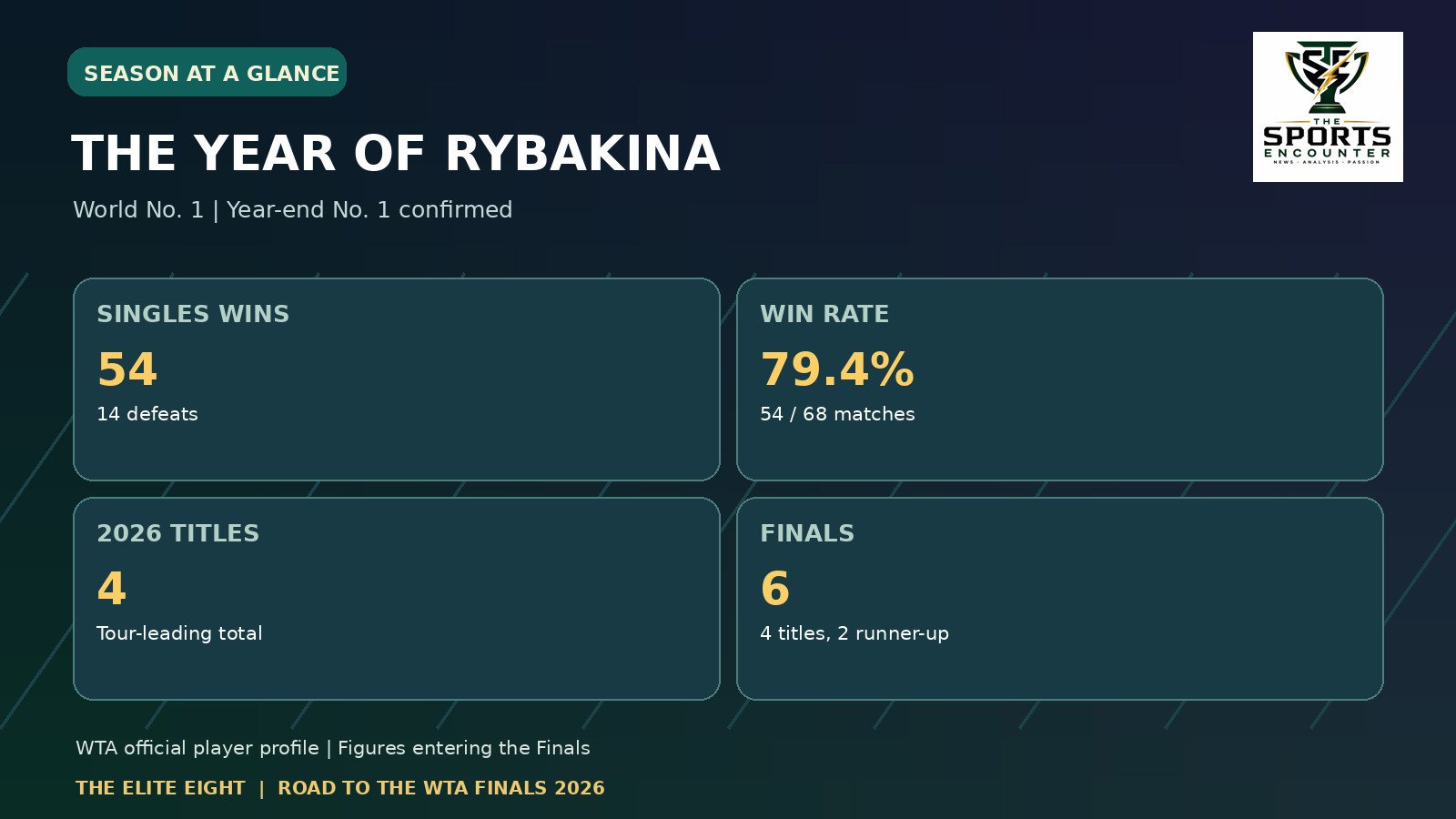
| 2026 singles record | 54–14 |
| 2026 winning percentage | 79.4% |
| 2026 singles titles | Four |
| 2026 singles finals | Six |
| Career singles titles | 15 |
| Grand Slam singles titles | Three |
| 2026 Grand Slam titles | Australian Open, US Open |
| WTA Finals titles | One, 2025 |
| 2026 WTA Finals seed | No. 1 |
| 2026 WTA Finals group | Group 1 |
| Group opponents | Coco Gauff, Jessica Pegula, Linda Nosková |
TL;DR: Elena Rybakina won the Australian Open and US Open in 2026, added Stuttgart and Ningbo championships, and secured her first year-end world No. 1 ranking. Her 54–14 record and four titles make her one of the strongest contenders for the WTA Finals. She is defending the title she won undefeated in 2025, beginning Group 1 against Linda Nosková before facing the additional challenges of Coco Gauff and Jessica Pegula.
Story at a glance
Elena Rybakina in 2026: The Essential Facts
TL;DR: Elena Rybakina won the Australian Open and US Open in 2026, added Stuttgart and Ningbo championships, and secured her first year-end world No. 1 ranking. Her 54–14 record and four titles make her one of the strongest contenders for the WTA Finals. She is defending the title she won undefeated in 2025, beginning Group 1 against Linda Nosková before facing the additional challenges of Coco Gauff and Jessica Pegula.
Who Is Elena Rybakina? Childhood, Family and Her Decision to Represent Kazakhstan
Elena Rybakina was born in Moscow on June 17, 1999. She began playing tennis at the age of five, developing her skills in a city with an established tradition of producing elite professional players.
The Rise of Elena Rybakina: From Wimbledon Champion to World No. 1
Rybakina first established herself as a major champion at Wimbledon in 2022.
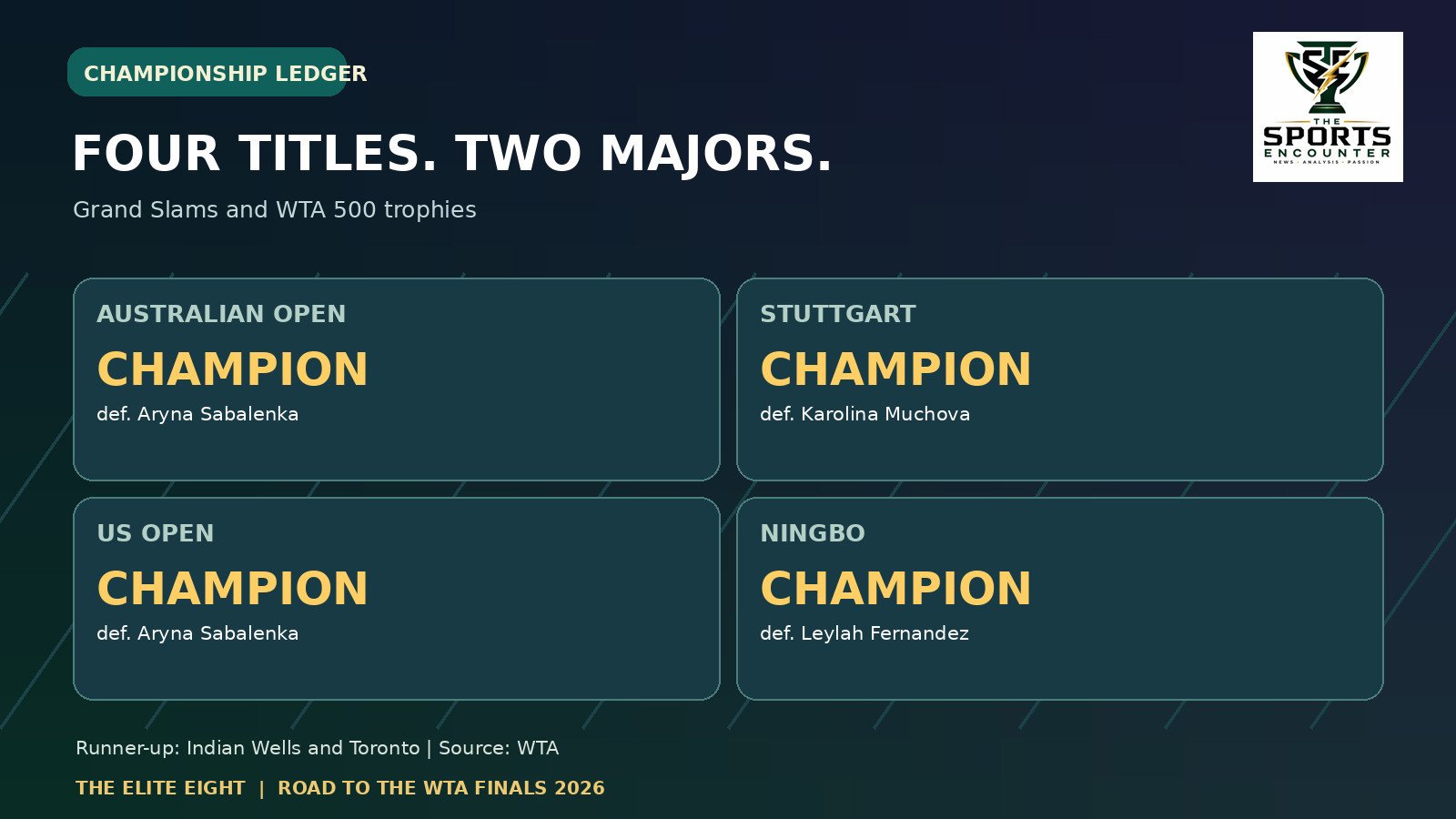
Elena Rybakina’s 2026 Titles: Four Championships Across a Remarkable Season
Rybakina entered the WTA Finals with four singles championships, more than any other player on the tour during the regular season.
Australian Open 2026: How Rybakina Overturned a 3-0 Deficit Against Sabalenka
The Australian Open final provided the first defining moment of Rybakina’s season.
Who Is Elena Rybakina? Childhood, Family and Her Decision to Represent Kazakhstan
Elena Rybakina was born in Moscow on June 17, 1999. She began playing tennis at the age of five, developing her skills in a city with an established tradition of producing elite professional players.
As a junior, she trained at Moscow’s Spartak Tennis Club. Her early coaches included Andrei Cheshnokov and Evgenia Kulikovskaya, whose experience provided an important foundation for the powerful baseline game that would eventually make her one of the most difficult opponents on the WTA Tour.
Rybakina initially represented Russia in international tennis. In 2018, however, she switched her sporting nationality to Kazakhstan, a decision that played an important role in supporting her professional development.
She has represented Kazakhstan ever since, becoming the country’s most successful Grand Slam singles champion.
Why Did Elena Rybakina Switch From Russia to Kazakhstan?
Rybakina’s change of sporting nationality in 2018 followed an offer of support from the Kazakhstan Tennis Federation.
At that stage of her career, sustained financial and professional backing was particularly important. Developing players must cover substantial expenses related to coaching, training, travel and international competition before major prize money becomes reliable.
The move helped Rybakina pursue a full-time professional career. Four years later, she won Wimbledon in 2022, delivering Kazakhstan its first Grand Slam singles championship.
Her Australian Open and US Open victories in 2026 have added two more major titles to that history.
What Is Known About Rybakina’s Family and Private Life?
Rybakina has generally maintained a relatively private personal life compared with many internationally recognized sports stars.
She rarely makes family relationships or romantic matters central to her public identity. Her professional interviews are more commonly focused on preparation, performance, coaching and the demands of competing at the highest level.
That privacy has remained consistent even as her profile has expanded following her Grand Slam achievements.
Her public reputation is built primarily on her tennis, particularly her powerful serve, measured demeanor and ability to remain outwardly composed during difficult matches.
The Rise of Elena Rybakina: From Wimbledon Champion to World No. 1
Rybakina first established herself as a major champion at Wimbledon in 2022.
She defeated Ons Jabeur in the final to become Kazakhstan’s first Grand Slam singles winner.
That victory confirmed the effectiveness of her game on grass, where her flat groundstrokes and penetrating serve could be especially difficult to neutralize.
Yet winning Wimbledon did not immediately transform her into the dominant player of women’s tennis.
She reached the Australian Open final in 2023 but lost to Aryna Sabalenka.
Later that year, she won WTA 1000 championships at Indian Wells and Rome, demonstrating that her game could produce major results across different surfaces.
The following seasons contained more titles, interruptions and periods when she struggled to sustain her best level.
Her breakthrough at the very top of the rankings arrived in 2026.
By defeating Sabalenka in both the Australian Open and US Open finals, Rybakina reversed the result of their 2023 Melbourne meeting and established herself as the leading player of the season.
Her September rise to world No. 1 was followed by confirmation of the year-end ranking in October.
Read The Sports Encounter’s detailed analysis of Rybakina’s rise toward the world No. 1 ranking for the background to that achievement.
Elena Rybakina’s 2026 Titles: Four Championships Across a Remarkable Season
Rybakina entered the WTA Finals with four singles championships, more than any other player on the tour during the regular season.
Two were Grand Slam trophies. Two came at WTA 500 events.
She also reached the finals of Indian Wells and Toronto, both WTA 1000 tournaments, but finished runner-up.
| Tournament | Level | Surface | Final opponent | Result |
|---|---|---|---|---|
| Australian Open | Grand Slam | Hard | Aryna Sabalenka | Won 6-4, 4-6, 6-4 |
| Indian Wells | WTA 1000 | Hard | Aryna Sabalenka | Lost 6-3, 3-6, 6-7(6) |
| Stuttgart | WTA 500 | Indoor clay | Karolína Muchová | Won 7-5, 6-1 |
| Toronto | WTA 1000 | Hard | Iga Świątek | Lost 2-6, 4-6 |
| US Open | Grand Slam | Hard | Aryna Sabalenka | Won 6-4, 5-7, 6-2 |
| Ningbo | WTA 500 | Hard | Leylah Fernandez | Won 6-2, 6-2 |
Her championship conversion rate was 66.7%, with four victories from six finals.
That figure becomes more meaningful when the level of competition is considered. Both Grand Slam finals ended with Rybakina defeating Sabalenka, while her two runner-up finishes came against players with multiple major titles.
The evidence shows that Rybakina’s success was not restricted to one outstanding tournament or a favorable draw.
She repeatedly reached championship matches and produced her strongest performances when the highest-ranking rewards were available.
Australian Open 2026: How Rybakina Overturned a 3-0 Deficit Against Sabalenka
The Australian Open final provided the first defining moment of Rybakina’s season.
Her opponent, Aryna Sabalenka, had already won the tournament twice and had defeated Rybakina in the 2023 final.
This time, the outcome was reversed.
Rybakina won the opening set 6-4, using her serve and aggressive baseline play to apply pressure from the beginning.
Sabalenka recovered to take the second set 6-4 and then established a 3-0 lead in the deciding set.
At that stage, the Belarusian appeared positioned to claim another Australian Open championship.
But Rybakina refused to surrender.
She recovered her service rhythm, increased the pressure on Sabalenka’s return games and won six of the next seven games.
The comeback secured a 6-4, 4-6, 6-4 victory after two hours and 18 minutes.
Why the Comeback Was So Important
Rybakina had already demonstrated that she could win Grand Slam finals, but recovering from a three-game deficit against the world No. 1 in a deciding set required a different kind of competitive resilience.
It also challenged the perception that her relatively restrained court demeanor reflected limited emotional intensity.
Her response was built on disciplined shot selection and the ability to execute under extreme pressure.
The victory delivered her second Grand Slam singles title and first Australian Open championship.
It also established a psychological foundation for another showdown with Sabalenka later in the season.
Indian Wells 2026: The Championship Point That Escaped
Rybakina and Sabalenka met again in the Indian Wells final.
It was another three-set contest, but this time Rybakina could not complete the victory.
She won the opening set 6-3 before Sabalenka recovered to take the second by the same margin.
The deciding set reached a tiebreak.
Rybakina held championship point but was unable to convert it.
Sabalenka recovered to win 3-6, 6-3, 7-6(6), securing her first Indian Wells title.
For Rybakina, the defeat was painful because the match had been within reach.
Nevertheless, her ability to reach another major hard-court final confirmed that the Australian Open triumph was not an isolated achievement.
What the Defeat Revealed
Rybakina’s greatest weapon is her ability to dominate short rallies through precise serving and deep, flat groundstrokes.
Against Sabalenka, however, those advantages are less predictable because the Belarusian possesses comparable first-strike power.
When both players serve well, a small number of points can determine an entire set.
Indian Wells illustrated that reality.
Rybakina was close enough to winning that a single successful championship point would have changed the season’s narrative.
Instead, Sabalenka used the victory as the foundation for completing the Sunshine Double in Miami.
Stuttgart 2026: Rybakina’s Clay-Court Statement Against Karolína Muchová
Rybakina’s Stuttgart championship demonstrated that she was not dependent exclusively on outdoor hard courts.
She defeated Karolína Muchová 7-5, 6-1 in the final to win the Porsche Tennis Grand Prix.
It was her second Stuttgart title, following her previous championship in 2024.
More importantly, it represented the first time she had won the same WTA tournament twice.
Her path to the championship was not straightforward.
During the quarterfinals, she saved two match points against Leylah Fernandez in a demanding three-hour contest.
That escape became a turning point.
She subsequently produced a commanding performance in the final, winning the second set 6-1 against an opponent renowned for tactical variety and intelligent court positioning.
Muchová’s ability to change pace and move forward makes her a difficult opponent for power-based players.
Rybakina’s victory showed that she could maintain sufficient control without relying exclusively on free points from her serve.
Toronto 2026: Why Iga Świątek Exposed Rybakina’s Physical Limits
Rybakina’s Toronto campaign was one of the most physically demanding of her season.
She reached the final after playing four three-set matches.
By the time she faced Iga Świątek, she had spent approximately 685 minutes on court during the tournament.
That amounted to nearly 11 and a half hours of competitive tennis.
Świątek took advantage of the circumstances, using exceptional court coverage and disciplined returning to defeat Rybakina 6-2, 6-4.
The final lasted considerably less time than several of Rybakina’s earlier matches.
Afterward, she acknowledged that she had struggled with energy.
The Physical Cost of Winning Difficult Matches
The Toronto final provides an important lesson heading into the WTA Finals.
Winning consecutive three-set matches can create a physical burden that becomes increasingly difficult to overcome against elite opponents.
At Indian Wells, every competitor will be capable of extending rallies and forcing difficult service games.
For Rybakina, managing energy will therefore matter almost as much as winning individual matches.
The Sports Encounter covered Świątek’s victory over Rybakina in the Toronto final, examining how the Polish player’s performance ended the Kazakhstani’s title hopes.
US Open 2026: The Victory That Made Rybakina World No. 1
The US Open was the second defining moment of Rybakina’s extraordinary season.
She entered New York pursuing her first championship at Flushing Meadows and another opportunity to establish herself as the leading player in women’s tennis.
Her path included victories over Naomi Osaka, Zheng Qinwen and Coco Gauff during the latter stages of the tournament.
Those results carried a particularly important consequence.
Rybakina secured the world No. 1 ranking during the tournament, ending Sabalenka’s 99-week reign.
Yet winning the ranking battle was not enough.
She still wanted the championship.
Defeating Coco Gauff in the Semifinals
Gauff entered the semifinal with the defensive ability and athleticism to challenge Rybakina’s attacking game.
Rybakina nevertheless found the solutions required to advance, setting up another Grand Slam final against Sabalenka.
That victory reinforced the importance of her serve, but also showed how much her return game and baseline consistency had developed.
Read The Sports Encounter’s report on Rybakina’s US Open semifinal against Coco Gauff for further analysis.
The Final Against Sabalenka
Rybakina won the opening set 6-4.
Sabalenka responded by taking the second 7-5, forcing a deciding set.
It was their third Grand Slam final against each other, and all three had required a deciding set.
Rybakina then delivered her strongest tennis of the match.
She won the third set 6-2 to complete a 6-4, 5-7, 6-2 victory after two hours and 21 minutes.
The result ended Sabalenka’s attempt to win a third consecutive US Open title.
It also delivered Rybakina’s third career Grand Slam singles championship and second major title of 2026.
Her victory completed an extraordinary sequence: she had begun the Grand Slam calendar by defeating Sabalenka in Melbourne and ended it by defeating the same opponent in New York.
For detailed coverage, revisit Rybakina’s US Open championship victory over Sabalenka and our analysis of her two-major season.
Elena Rybakina’s Grand Slam Results in 2026
Rybakina’s major results were unusually polarized.
She won both hard-court Grand Slams but exited much earlier at Roland-Garros and Wimbledon.
That contrast should not be overlooked simply because she finished the season with two major trophies.
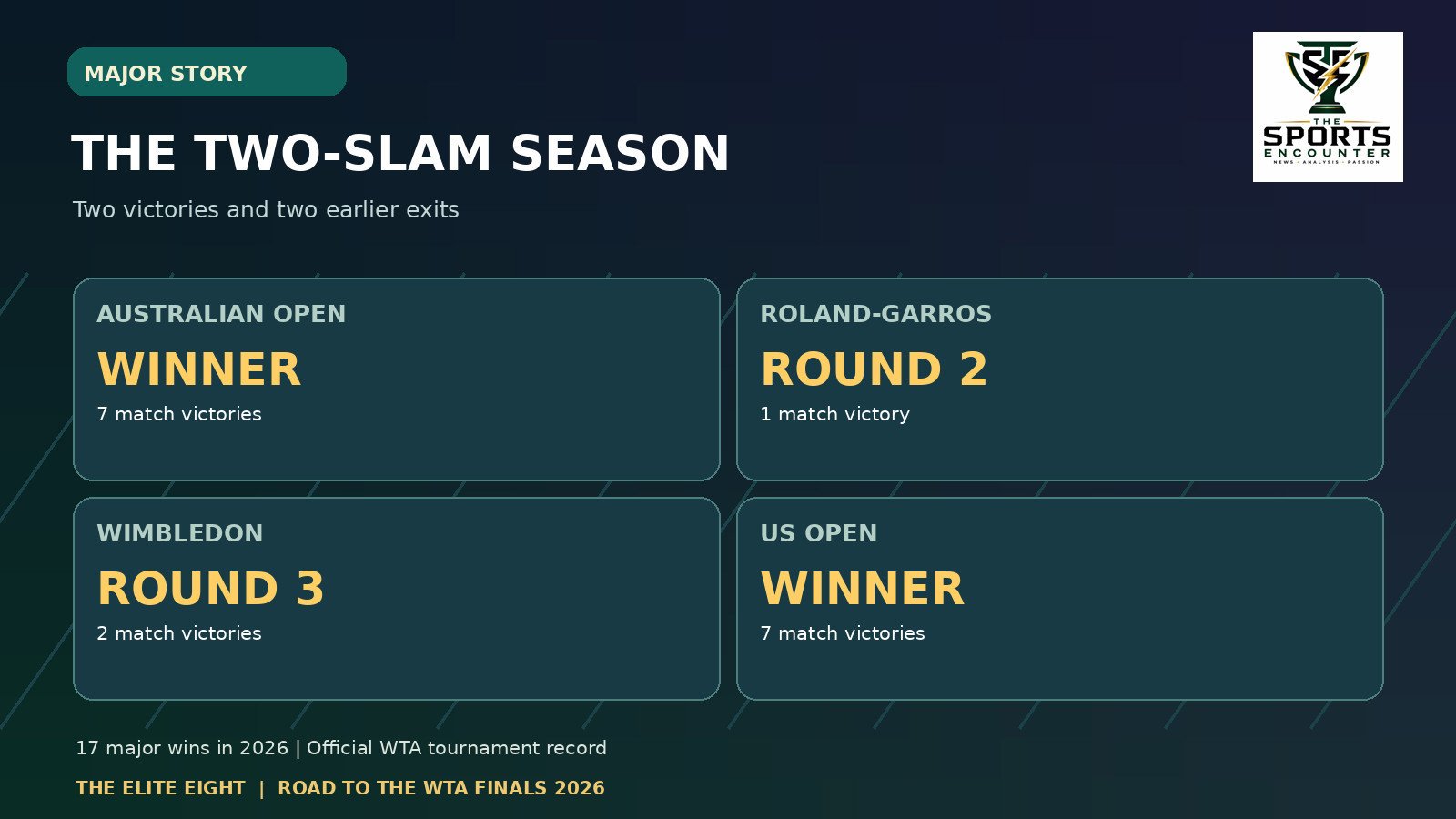
| Grand Slam | 2026 finish | Match wins | Key significance |
|---|---|---|---|
| Australian Open | Champion | 7 | Defeated Sabalenka in the final |
| Roland-Garros | Second round | 1 | Early clay-court setback |
| Wimbledon | Third round | 2 | Failed to repeat her 2022 championship run |
| US Open | Champion | 7 | Defeated Sabalenka and became world No. 1 |
| Total | Two major titles | 17 | 19 matches, 89.5% win rate |
TSE Statistical Insight: Two Majors Produced 82% of Her Grand Slam Victories
Rybakina won 17 Grand Slam singles matches in 2026.
Fourteen of those victories came at the Australian Open and US Open.
That means approximately 82.4% of her major victories were earned during the two tournaments she won.
The statistic illustrates the concentration of her success.
Rather than producing four consistently deep runs, she delivered two complete championship performances while failing to progress beyond the early rounds at the other two majors.
It also demonstrates why assessing a player’s season requires more than counting trophies.
Rybakina’s hard-court dominance was exceptional, but her results on clay and grass left room for improvement.
Rybakina vs. Sabalenka: The Rivalry That Defined Women’s Tennis in 2026
Rybakina’s rivalry with Aryna Sabalenka has become one of the most compelling contests in women’s tennis.
Both possess exceptional serving power and the ability to dictate rallies from the baseline.
Neither relies primarily on defensive endurance.
Their matches are frequently decided by small differences in first-serve effectiveness, return positioning and execution during deciding sets.
In 2026, they met in three especially significant finals.
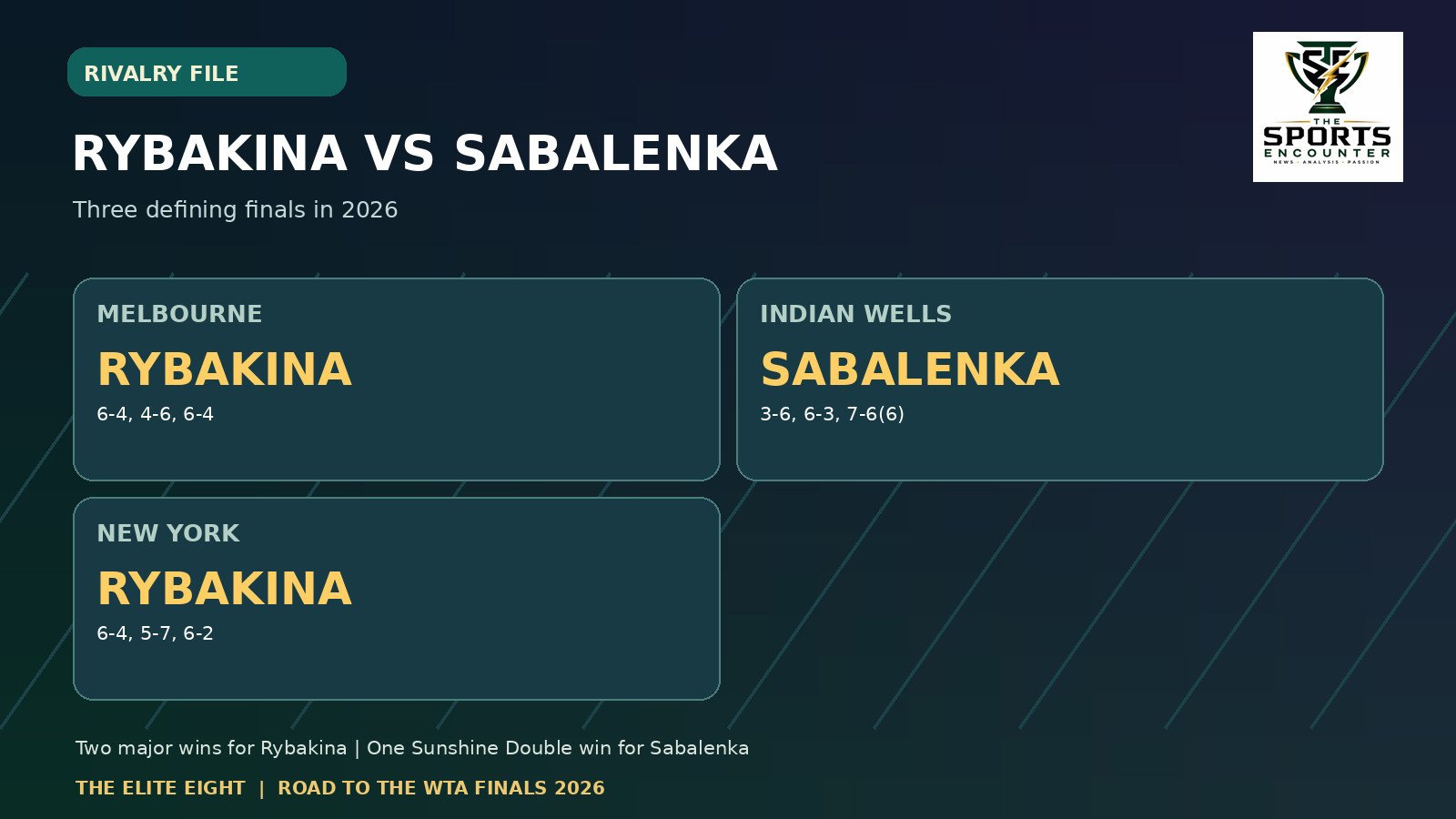
| Tournament | Winner | Score | Defining moment |
|---|---|---|---|
| Australian Open | Elena Rybakina | 6-4, 4-6, 6-4 | Recovered from 0-3 in the deciding set |
| Indian Wells | Aryna Sabalenka | 3-6, 6-3, 7-6(6) | Saved championship point |
| US Open | Elena Rybakina | 6-4, 5-7, 6-2 | Controlled the deciding set |
Rybakina won two of the three finals, both at Grand Slam tournaments.
Sabalenka’s Indian Wells victory prevented a complete sweep.
All three finals required deciding sets, illustrating the competitive balance between the players.
Why Rybakina Has Won the Biggest Matches
Rybakina’s serve remains one of the most effective weapons in women’s tennis.
When she lands a high percentage of first serves, opponents have fewer opportunities to attack her service games.
Her flat groundstrokes also limit the time opponents have to recover their court position.
Sabalenka possesses similar weapons, making tactical discipline particularly important.
Rybakina has been especially effective at sustaining her shot quality deep into deciding sets.
Her Australian Open comeback and US Open final victory provide clear evidence.
That does not guarantee future victories against Sabalenka. Their Indian Wells final demonstrated how quickly the momentum can change.
But Rybakina enters the WTA Finals knowing she has already defeated her greatest rival in two of the season’s most important matches.
For the opposing perspective, read Aryna Sabalenka’s complete 2026 season profile.
Ningbo 2026: The Title Defense That Confirmed Her Year-End Dominance
Rybakina’s Ningbo championship carried more importance than its WTA 500 classification might suggest.
She had won the tournament in 2025, shortly before capturing her first WTA Finals title in Riyadh.
Returning as the defending champion in 2026, she successfully retained the title for the first time in her career.
Rybakina defeated Leylah Fernandez 6-2, 6-2 in the final.
The victory was her fourth singles title of the season and 15th overall.
It also helped her surpass 50 match victories for the second consecutive year.
Why Ningbo Was a Valuable Preparation Tournament
The late-season Asian swing can test players who have already accumulated months of competition, travel and physical strain.
Rybakina had experienced a disappointing opening match in Beijing and missed Wuhan because of injury.
Her Ningbo performance therefore demonstrated that she could recover competitive momentum rather than allow earlier setbacks to define the final months of her season.
She had previously escaped a difficult quarterfinal situation earlier in the tournament before progressing to the championship match.
The Sports Encounter followed her progress through the Ningbo quarterfinal stage and her subsequent semifinal qualification.
The title also provided a useful psychological connection to 2025. Once again, Rybakina arrived at the WTA Finals after winning in Ningbo.
How Rybakina Secured the Year-End World No. 1 Ranking
Rybakina first became world No. 1 during the US Open in September.
Her title in New York strengthened her position in the rankings race, but securing the year-end No. 1 ranking required maintaining the advantage through the remaining regular-season tournaments.
She accomplished that during the Tokyo tournament in October.
Her opening victory over Yulia Putintseva confirmed that she would finish 2026 at the top of the WTA rankings regardless of what happened at the season-ending championship.
The achievement made Rybakina the first Kazakhstani player to secure the WTA year-end singles No. 1 ranking.
She will receive the Chris Evert WTA World No. 1 Trophy during a presentation at Indian Wells.
Why Year-End No. 1 Is Different From Reaching No. 1
Reaching the top ranking demonstrates that a player has accumulated enough points over the relevant ranking period to surpass every competitor.
Finishing a season at No. 1 adds another achievement: maintaining the required advantage through the end of the regular-season rankings race.
For Rybakina, securing both milestones in 2026 reflects the scale of her success.
She was not simply the best player during one tournament.
Her results across the season were sufficient to establish her as the leading singles player in the year-end standings.
The Sports Encounter examined the milestone in its report on Rybakina officially becoming world No. 1.
Defending the WTA Finals: Can Rybakina Repeat Her 2025 Triumph?
Rybakina won the WTA Finals in Riyadh in 2025 without losing a match.
She completed the group stage with three victories before winning her semifinal and final.
In the championship match, she defeated Aryna Sabalenka.
Her undefeated campaign delivered a record-setting $5.235 million prize money payout.
That triumph has become an important part of her career because it demonstrated her ability to maintain a consistently high level against elite opposition over several matches.
The challenge in 2026 is different.
She arrives as the defending champion and world No. 1, with every opponent aware of the threat she represents.
Her ranking and recent performances make her a leading contender, but defending the title requires starting the process again.
WTA Finals Group 1: Rybakina, Gauff, Pegula and Nosková
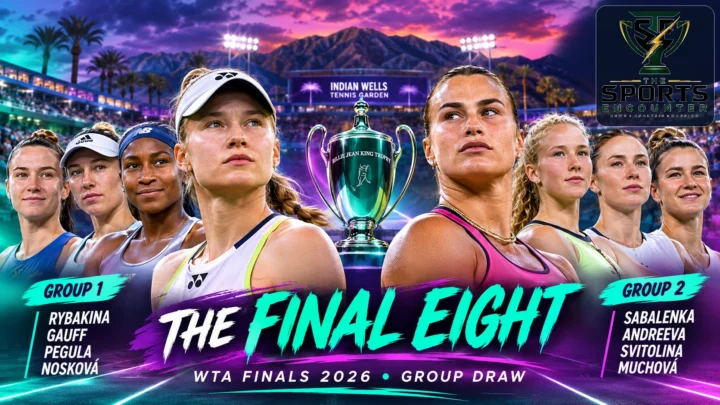
The official draw placed Rybakina in Group 1 alongside Coco Gauff, Jessica Pegula and Linda Nosková.
The four players will contest round-robin matches on November 8, 10 and 12.
The top two advance to the semifinals.
Rybakina’s opening opponent is Nosková.
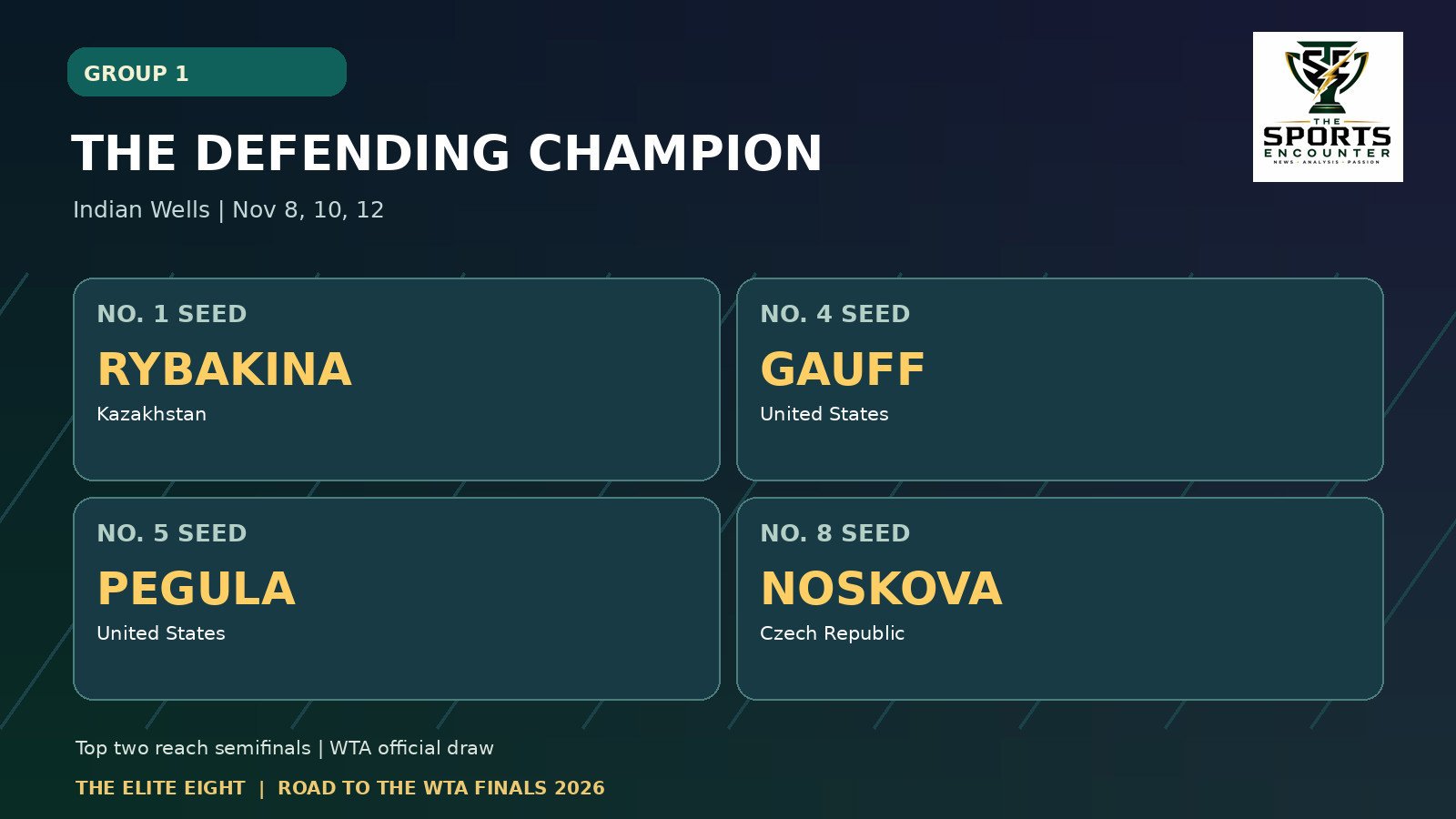
| Player | Seed | Country | Principal threat |
|---|---|---|---|
| Elena Rybakina | 1 | Kazakhstan | Powerful serve and first-strike tennis |
| Coco Gauff | 4 | United States | Elite defense, movement and improved serving |
| Jessica Pegula | 5 | United States | Consistency, early ball striking and tactical discipline |
| Linda Nosková | 8 | Czech Republic | Aggressive baseline play and powerful serving |
Linda Nosková: A Dangerous Opening Opponent
Nosková enters the WTA Finals after a breakthrough season that included a Wimbledon title and a growing reputation as one of the most dangerous young players on the tour.
Her powerful serve and attacking groundstrokes can challenge even the strongest opponents.
For Rybakina, the opening match will be about establishing control early rather than allowing Nosková to settle into an aggressive rhythm.
Explore Linda Nosková’s 2026 season profile for the complete story of her rise.
Coco Gauff: The Defender Who Can Turn Attacks Into Errors
Gauff presents one of the most demanding defensive challenges in women’s tennis.
She can recover balls that appear to be winners and force opponents into additional shots.
Her improved serving in 2026 has also made it more difficult for opponents to attack her service games.
Rybakina defeated Gauff during her run to the US Open title, providing a useful recent reference point.
But the American’s movement and competitive resilience mean that another meeting could follow a different pattern.
Read Coco Gauff’s complete 2026 profile for further analysis.
Jessica Pegula: The Consistency Test
Pegula enters Indian Wells after recording 50 match victories and reaching five singles finals during 2026.
Her ability to strike the ball early and maintain a reliable level across long exchanges makes her an especially demanding opponent.
She can redirect pace without needing exaggerated swings, reducing the time available for opponents to recover.
Rybakina’s serve offers a potential advantage, but Pegula’s returning consistency can challenge that strength.
Learn more in Jessica Pegula’s 2026 season profile.
How Can Rybakina Qualify for the WTA Finals Semifinals?
The round-robin stage consists of three matches per player.
Winning all three guarantees a place in the semifinals.
Two victories generally provide a strong position, but qualification can still depend on the results of other matches.
A single victory leaves only limited pathways to advancement.
Three defeats eliminate a player.
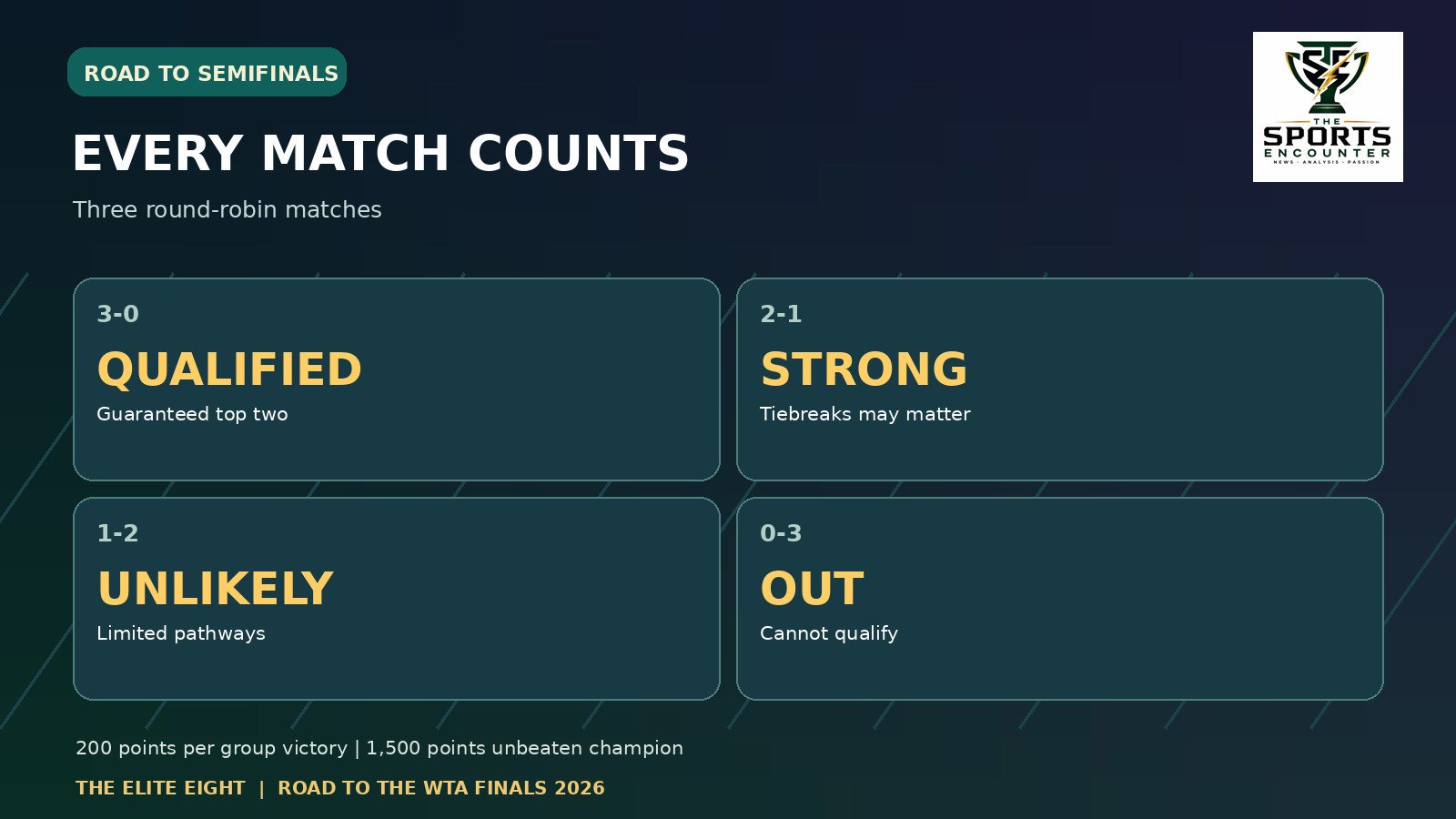
| Group record | Qualification outlook | Important consideration |
|---|---|---|
| 3–0 | Guaranteed | Qualifies for semifinals |
| 2–1 | Strong position | Other results and tiebreaks may matter |
| 1–2 | Limited possibilities | Depends on remaining results and tiebreaks |
| 0–3 | Eliminated | Cannot finish among the top two |
Each round-robin victory is worth 200 ranking points.
A semifinal victory adds 400 points, while winning the championship match provides another 500.
An undefeated champion therefore earns 1,500 ranking points.
Rybakina has already secured the year-end No. 1 ranking, so the ranking implications are less immediate for her than for some other competitors.
Nevertheless, another undefeated championship would reinforce her dominance and further strengthen her position ahead of 2027.
For the complete schedule, group tables and results, follow The Sports Encounter’s WTA Finals 2026 live hub and our analysis of the confirmed tournament draw.
What Makes Rybakina So Difficult to Beat?
A Serve That Changes the Geometry of a Match
Rybakina’s serve is among the most effective in women’s tennis.
Her height allows her to create favorable angles, while her timing and ball placement make it difficult for opponents to establish a consistent return position.
When her first serve is functioning well, she can shorten service games and conserve energy.
That becomes particularly important during tournaments requiring several matches against elite opposition.
Flat Groundstrokes That Take Time Away
Rybakina’s forehand and backhand are most effective when she makes early contact and drives the ball deep.
Her relatively flat trajectory can keep opponents behind the baseline and reduce their time to prepare.
Against defensive players, this creates the possibility of finishing rallies before the opponent can establish a preferred rhythm.
Composure During High-Pressure Moments
Rybakina often displays little visible emotion during matches.
That outward calm does not guarantee effective decision-making, but her Australian Open and US Open results show that she can execute under enormous pressure.
Her ability to recover from 0-3 in the Australian Open deciding set was particularly impressive.
A Growing Ability to Adapt
Her 2026 victories were not all achieved under identical conditions.
She won major hard-court championships, an indoor clay-court title and a late-season Asian hard-court event.
The different environments required adjustments in movement, timing and tactical choices.
That adaptability is an important reason she enters the WTA Finals as the leading seed.
What Could Prevent Rybakina From Defending Her Title?
Despite her remarkable season, Rybakina is not without vulnerabilities.
Her early exits at Roland-Garros and Wimbledon demonstrate that even a player capable of winning two Grand Slams can suffer unexpected defeats.
Toronto exposed another concern: accumulated physical fatigue.
Playing repeated three-set matches against strong opposition can reduce the effectiveness of her movement and attacking timing.
At the WTA Finals, those risks are particularly relevant because every match is against a player who has qualified among the season’s elite.
Another challenge is the pressure of defending a championship.
In 2025, Rybakina entered the tournament seeking to end her season strongly.
In 2026, she arrives as the defending champion and year-end No. 1.
The expectations have changed considerably.
Can Rybakina Complete One of the Greatest Seasons of Her Career?
Rybakina’s 2026 campaign already ranks as the most decorated Grand Slam season of her career.
She won two majors during the same year, secured her first world No. 1 ranking and claimed a tour-leading four titles.
She also retained her Ningbo championship and reached six finals overall.
Those achievements would make the season extraordinary even without another WTA Finals victory.
But defending the year-end championship would add an important dimension.
It would show that Rybakina could sustain her dominance through the final event of a demanding calendar.
It would also represent another major achievement against a field containing the leading competitors of the season.
The Sports Encounter Verdict: Rybakina Has Earned the Favorite’s Status
Elena Rybakina enters the WTA Finals with the strongest overall case for the championship.
She has won more titles than any other player during the regular season, captured both hard-court Grand Slams and secured the year-end No. 1 ranking.
She also possesses the experience of winning the tournament undefeated in 2025.
Her most significant rival, Aryna Sabalenka, remains capable of defeating her, as demonstrated at Indian Wells.
Coco Gauff, Jessica Pegula and Linda Nosková present different challenges in the group stage.
Yet the evidence from the season suggests that Rybakina has developed the combination of technical power, tactical discipline and competitive resilience required to overcome those challenges.
Our assessment: Rybakina is the leading candidate to win the 2026 WTA Finals. Her greatest advantages are her serve, first-strike game and proven ability to win major championship matches. The principal risks are physical fatigue, occasional lapses against determined returners and the pressure of defending her title. If she maintains her serving consistency and avoids prolonged three-set battles during the group stage, she has a realistic path to another championship.
Another WTA Finals trophy would not simply provide a memorable ending to her season.
It would reinforce the argument that 2026 marked the moment Elena Rybakina became the defining player of women’s tennis.
Continue the WTA Finals Story
 WTA FinalsAryna Sabalenka’s Bitter-Sweet 2026: Sunshine Double Glory, Two Grand Slam Heartbreaks, and One Last Shot at Redemption
 WTA FinalsMirra Andreeva’s Historic 2026: Roland-Garros Glory, 50 Wins, and the Battle to Become Tennis’ Next Queen
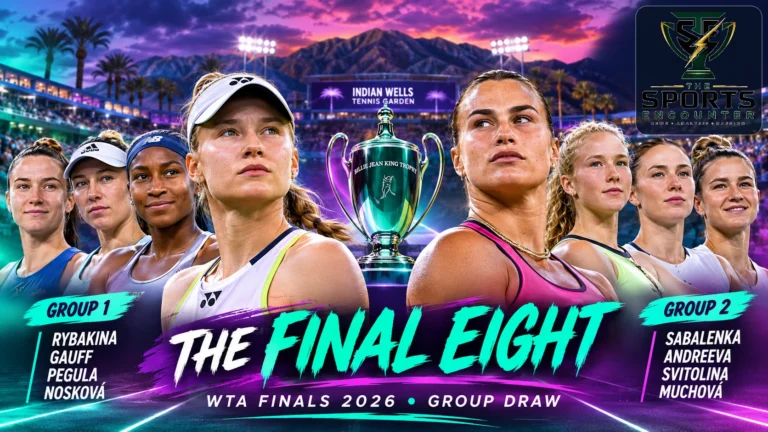 WTA FinalsWTA Finals 2026 Draw: Rybakina Faces Gauff, Pegula and Nosková as Sabalenka Gets Andreeva, Svitolina and Muchová
Frequently Asked Questions About Elena Rybakina
How Old Is Elena Rybakina?
Elena Rybakina was born on June 17, 1999. She is 27 years old as of November 2026.
Where Was Elena Rybakina Born?
She was born in Moscow, Russia.
Why Does Elena Rybakina Represent Kazakhstan?
Rybakina changed her sporting nationality from Russia to Kazakhstan in 2018 after receiving support from the Kazakhstan Tennis Federation.
How Tall Is Elena Rybakina?
She is 184 centimeters, approximately six feet tall.
Who Coaches Elena Rybakina?
Her coaching team includes Stefano Vukov and Stanislav Khmarskyi.
How Many Grand Slam Titles Has Elena Rybakina Won?
She has won three Grand Slam singles titles: Wimbledon in 2022, the Australian Open in 2026 and the US Open in 2026.
Which Tournaments Did Rybakina Win in 2026?
She won the Australian Open, Stuttgart, US Open and Ningbo.
What Was Rybakina’s 2026 Win-Loss Record?
She entered the WTA Finals with 54 singles victories and 14 defeats, a winning percentage of approximately 79.4%.
Is Elena Rybakina World No. 1?
Yes. She became world No. 1 during the 2026 US Open and subsequently secured the year-end No. 1 ranking.
Did Rybakina Beat Sabalenka at the Australian Open 2026?
Yes. Rybakina defeated Aryna Sabalenka 6-4, 4-6, 6-4 in the final after recovering from 0-3 in the deciding set.
Did Rybakina Win the US Open 2026?
Yes. She defeated Aryna Sabalenka 6-4, 5-7, 6-2 to claim her first US Open title.
Has Elena Rybakina Won the WTA Finals Before?
Yes. She won the 2025 WTA Finals in Riyadh without losing a match.
Who Is in Rybakina’s WTA Finals Group?
She is in Group 1 alongside Coco Gauff, Jessica Pegula and Linda Nosková.
When Is Rybakina’s First WTA Finals Match?
Her opening match is scheduled against Linda Nosková on November 8, 2026.
When Will the WTA Finals 2026 Championship Be Decided?
The final is scheduled for November 15, 2026, at Indian Wells Tennis Garden in California.
Official Sources and Further Reading
The official WTA player profile provides Rybakina’s career records, biography and season statistics. The WTA has also confirmed her first year-end world No. 1 ranking and published the official WTA Finals group draw.
This is Article 8, the concluding installment of The Elite Eight: Road to the WTA Finals 2026, The Sports Encounter’s eight-part series examining the backgrounds, performances, major achievements and championship prospects of all eight singles qualifiers.
Elena Rybakina
- Elena Rybakina’s Extraordinary 2026: Two Grand Slams, World No. 1, and the Crown She Refuses to Surrender
- Aryna Sabalenka’s Bitter-Sweet 2026: Sunshine Double Glory, Two Grand Slam Heartbreaks, and One Last Shot at Redemption
- WTA Finals 2026 Draw: Rybakina Faces Gauff, Pegula and Nosková as Sabalenka Gets Andreeva, Svitolina and Muchová
- WTA Finals 2026: 8 Women, One Crown, and the Rivalries That Define Tennis’s Biggest Season Finale
- Zverev’s Long Wait for World No. 1 Ends in Vienna as Rybakina Seals Historic Year-End Crown in Tokyo