Key Takeaways
- TL;DR: Aryna Sabalenka won three tournaments and 47 matches in 2026, including the historic Indian Wells-Miami Sunshine Double.
- Aryna Sabalenka was born in Minsk, Belarus, on May 5, 1998.
- Sabalenka began 2026 by winning Brisbane and subsequently collected consecutive WTA 1000 championships at Indian Wells and Miami.
- Sabalenka arrived in New York having won the US Open in both 2024 and 2025.
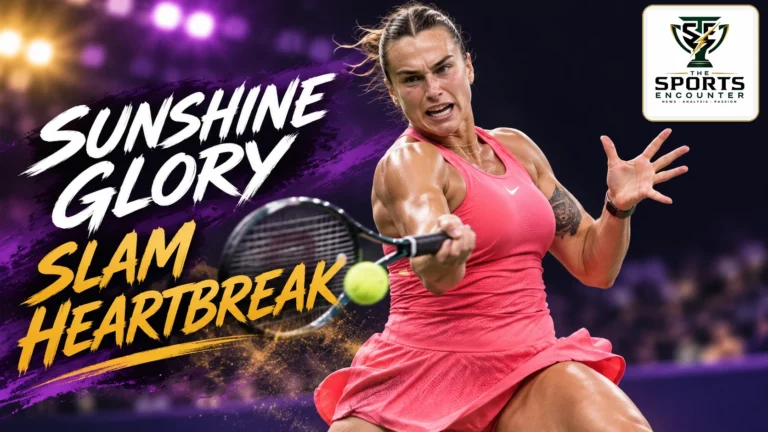
INDIAN WELLS, United States, November 5, 2026: Aryna Sabalenka appeared almost unstoppable when she completed the Sunshine Double in March. The Belarusian had won Brisbane, conquered Indian Wells after saving a championship point against Elena Rybakina, and defeated Coco Gauff to retain her Miami Open title. She was world No. 1, had assembled a 15-match winning streak, and had joined an exclusive group of women who conquered both major American spring tournaments in the same season. Seven months later, the picture is considerably more complicated. Sabalenka enters the WTA Finals ranked world No. 2, without a Grand Slam title in 2026, and with two painful major-final defeats against the opponent who displaced her from the top of the rankings.
Sabalenka’s 47–11 season record, three titles and five final appearances establish that she remains among the world’s strongest competitors. Yet Elena Rybakina defeated her in the Australian Open and US Open finals, ended her 99-week reign as world No. 1, and enters Indian Wells as the defending WTA Finals champion. Sabalenka’s challenge from November 8 to 15 is therefore about more than collecting another trophy. She must overcome the inconsistencies that disrupted her season after Miami, navigate a group containing Mirra Andreeva, Elina Svitolina and Karolína Muchová, and prove that the game’s most explosive attacking player can deliver her strongest tennis when the biggest prize is at stake.
Aryna Sabalenka in 2026: Biography, Rankings and Key Statistics
| Category | Details |
|---|---|
| Full name | Aryna Sabalenka |
| Born | May 5, 1998 |
| Age | 28 |
| Birthplace | Minsk, Belarus |
| Nationality | Belarusian |
| Height | 182 cm |
| Playing hand | Right-handed |
| Coach | Anton Dubrov |
| Career-high singles ranking | World No. 1 |
| Ranking entering WTA Finals 2026 | World No. 2 |
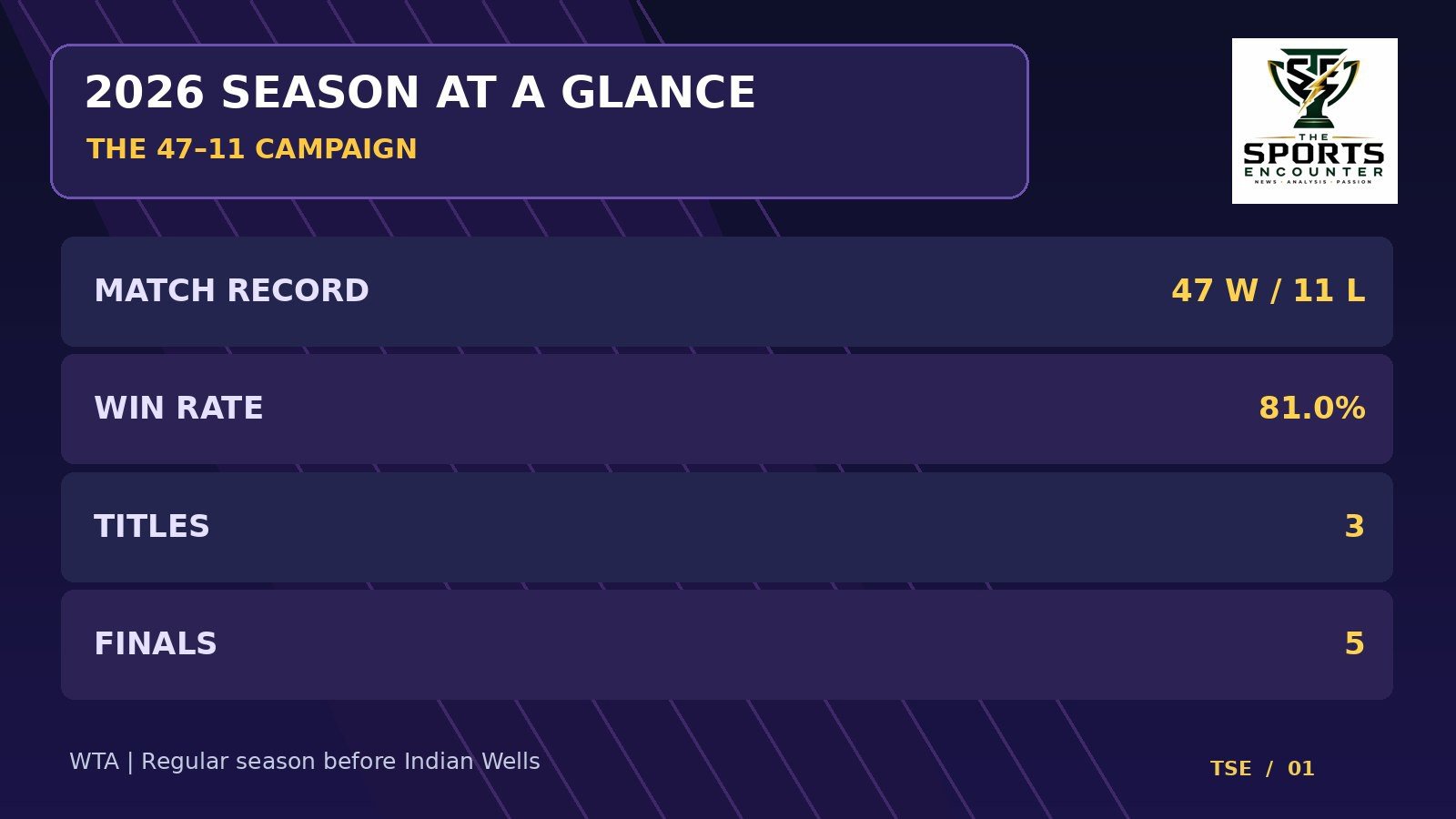
| 2026 singles record | 47 wins, 11 losses |
| 2026 winning percentage | 81.0% |
| 2026 singles titles | Brisbane, Indian Wells, Miami |
| 2026 finals reached | Five |
| Career singles titles | 24 |
| Grand Slam singles titles | Four |
| 2026 Grand Slam finals | Australian Open and US Open |
| Best WTA Finals result | Runner-up, 2022 and 2025 |
| 2026 WTA Finals appearance | Sixth consecutive |
| WTA Finals group | Group 2 |
| Group opponents | Mirra Andreeva, Elina Svitolina, Karolína Muchová |
TL;DR: Aryna Sabalenka won three tournaments and 47 matches in 2026, including the historic Indian Wells-Miami Sunshine Double. However, Elena Rybakina defeated her in the Australian Open and US Open finals and overtook her as world No. 1. Sabalenka also suffered unexpected losses at Roland-Garros and Wimbledon. She enters the WTA Finals seeking her first championship after finishing runner-up in 2022 and 2025.
Story at a glance
Aryna Sabalenka in 2026: Biography, Rankings and Key Statistics
TL;DR: Aryna Sabalenka won three tournaments and 47 matches in 2026, including the historic Indian Wells-Miami Sunshine Double. However, Elena Rybakina defeated her in the Australian Open and US Open finals and overtook her as world No. 1. Sabalenka also suffered unexpected losses at Roland-Garros and Wimbledon. She enters the WTA Finals seeking her first championship after finishing runner-up in 2022 and 2025.
Who Is Aryna Sabalenka? Childhood, Parents and Early Tennis Career
Aryna Sabalenka was born in Minsk, Belarus, on May 5, 1998. Her introduction to tennis was unusually accidental.
From Serving Problems to Four Grand Slam Championships
Sabalenka’s path to the top was not free of technical problems.
Sabalenka’s Five Finals in 2026: Three Titles and Two Major Heartbreaks
Sabalenka began 2026 by winning Brisbane and subsequently collected consecutive WTA 1000 championships at Indian Wells and Miami.
Indian Wells 2026: Saving Championship Point Against Elena Rybakina
Sabalenka’s Indian Wells victory was one of the defining achievements of her year.
Who Is Aryna Sabalenka? Childhood, Parents and Early Tennis Career
Aryna Sabalenka was born in Minsk, Belarus, on May 5, 1998. Her introduction to tennis was unusually accidental.
According to her official WTA biography, Sabalenka began playing at approximately six years old after her father, Sergey, drove past a tennis court and suggested that she try the sport.
That seemingly ordinary moment eventually helped produce one of the most powerful competitors in modern women’s tennis.
Sabalenka developed her professional game around aggressive baseline hitting, a powerful serve and an unusual willingness to attack under pressure.
Unlike players who depend primarily on defensive movement, Sabalenka attempts to control points from the opening exchanges. Her forehand and backhand can produce winners from positions where opponents are still trying to construct a rally.
That attacking philosophy creates enormous opportunities, but it also carries risks when timing, confidence or concentration deteriorate.
Her Father’s Influence
Sabalenka has spoken publicly about the important role her father played in her tennis ambitions.
Sergey Sabalenka died in 2019, a loss that profoundly affected her. His encouragement remained a source of motivation as she progressed toward the highest levels of professional tennis.
Her subsequent achievements, including reaching world No. 1 and winning four Grand Slam singles championships, form an important part of that personal journey.
Why Is Aryna Sabalenka Nicknamed The Tiger?
Sabalenka has a tiger tattoo on her left arm, which helped establish her nickname, The Tiger.
It also reflects the aggressive, fearless competitive image associated with her playing style.
Her public personality is often animated and expressive, but she has also discussed the importance of improving her emotional control during difficult matches.
That development became especially relevant during the 2026 season.
From Serving Problems to Four Grand Slam Championships
Sabalenka’s path to the top was not free of technical problems.
Earlier in her career, her serve was sometimes undermined by double faults and inconsistent mechanics.
She worked extensively to improve the motion and develop greater reliability without sacrificing the power that made it such an effective weapon.
The improvements contributed to a sustained period of success.
She won the Australian Open in 2023 and 2024, then claimed the US Open in 2024 and 2025.
Her progression also included multiple WTA 1000 championships and extended periods at world No. 1.
By the beginning of 2026, Sabalenka had established herself as one of the defining players of her generation.
But maintaining that position required dealing with increasingly strong opponents, including Elena Rybakina, Coco Gauff, Iga Świątek and an emerging group of younger contenders.
Sabalenka’s Five Finals in 2026: Three Titles and Two Major Heartbreaks
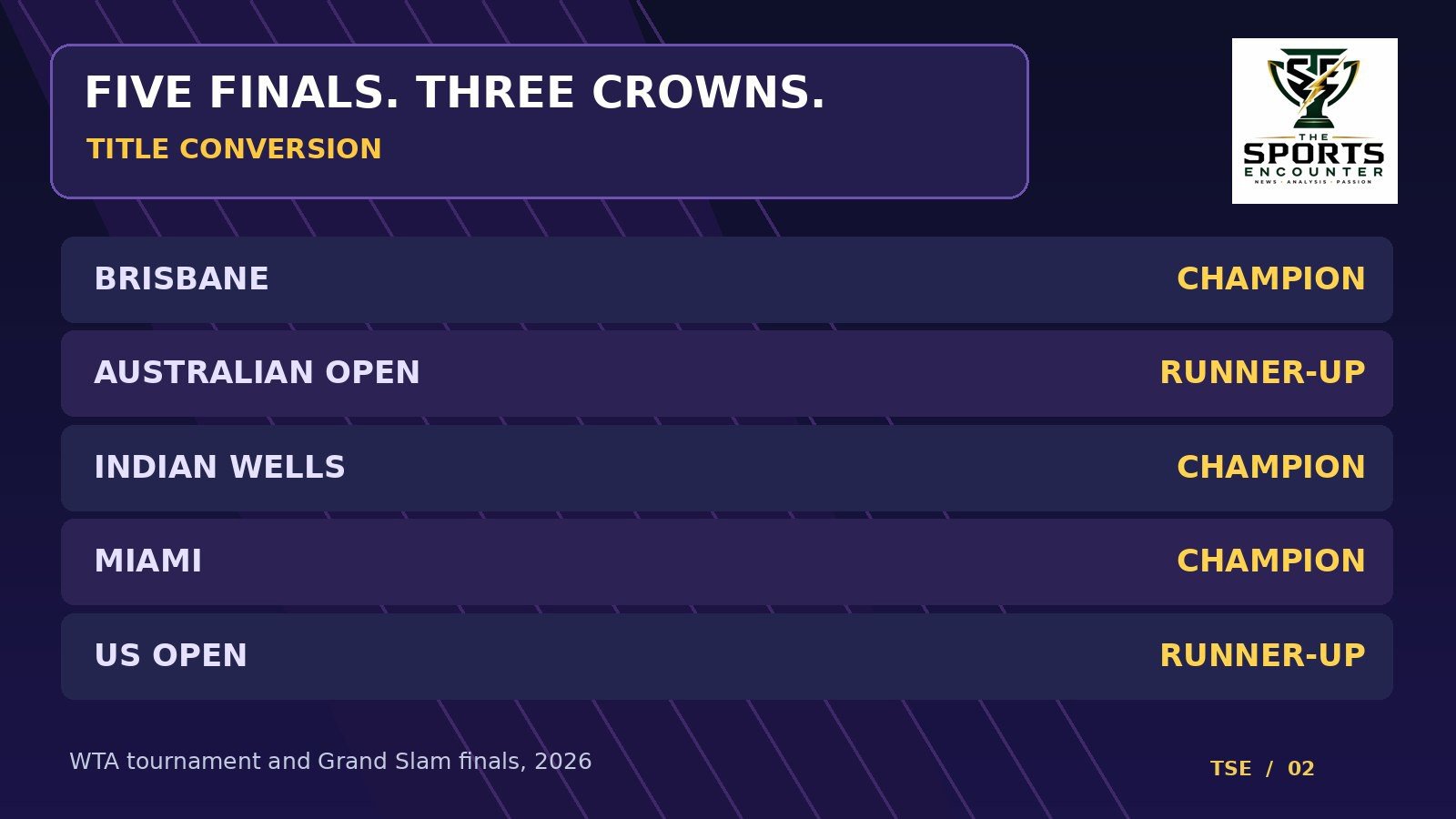
Sabalenka began 2026 by winning Brisbane and subsequently collected consecutive WTA 1000 championships at Indian Wells and Miami.
She reached five singles finals overall, including the Australian Open and US Open championship matches.
Her three titles represent a 60% conversion rate from five final appearances.
| Tournament | Surface | Finish | Significance |
|---|---|---|---|
| Brisbane | Hard | Champion | Opened the season with a title |
| Australian Open | Hard | Runner-up | Lost to Elena Rybakina |
| Indian Wells | Hard | Champion | Saved championship point against Rybakina |
| Miami | Hard | Champion | Completed the Sunshine Double |
| Roland-Garros | Clay | Quarterfinal | Lost to Diana Shnaider |
| Berlin | Grass | Semifinal | Lost to Jessica Pegula |
| Wimbledon | Grass | Fourth round | Lost to Naomi Osaka |
| Toronto | Hard | Fourth round | Lost to Ekaterina Alexandrova |
| Cincinnati | Hard | Fourth round | Lost to Sára Bejlek |
| US Open | Hard | Runner-up | Lost to Elena Rybakina |
| Beijing | Hard | Second round | Lost to Nikola Bartůňková |
The contrast between the spring and the remainder of the season is striking.
Sabalenka won three championships before the end of March but did not collect another singles title during the subsequent regular-season calendar.
She remained competitive enough to reach the US Open final, yet the consistency of her opening months became more difficult to reproduce.
Indian Wells 2026: Saving Championship Point Against Elena Rybakina
Sabalenka’s Indian Wells victory was one of the defining achievements of her year.
She entered the tournament having lost two previous finals at the venue, in 2023 and 2025.
Her opponent in the 2026 final was Elena Rybakina, who had defeated her in the Australian Open championship match earlier in the season.
The matchup carried considerable significance because Rybakina had become one of Sabalenka’s most difficult rivals in major finals.
Rybakina won the opening set 6-3. Sabalenka responded by taking the second 6-3.
The deciding set reached a tiebreak, where Rybakina held championship point.
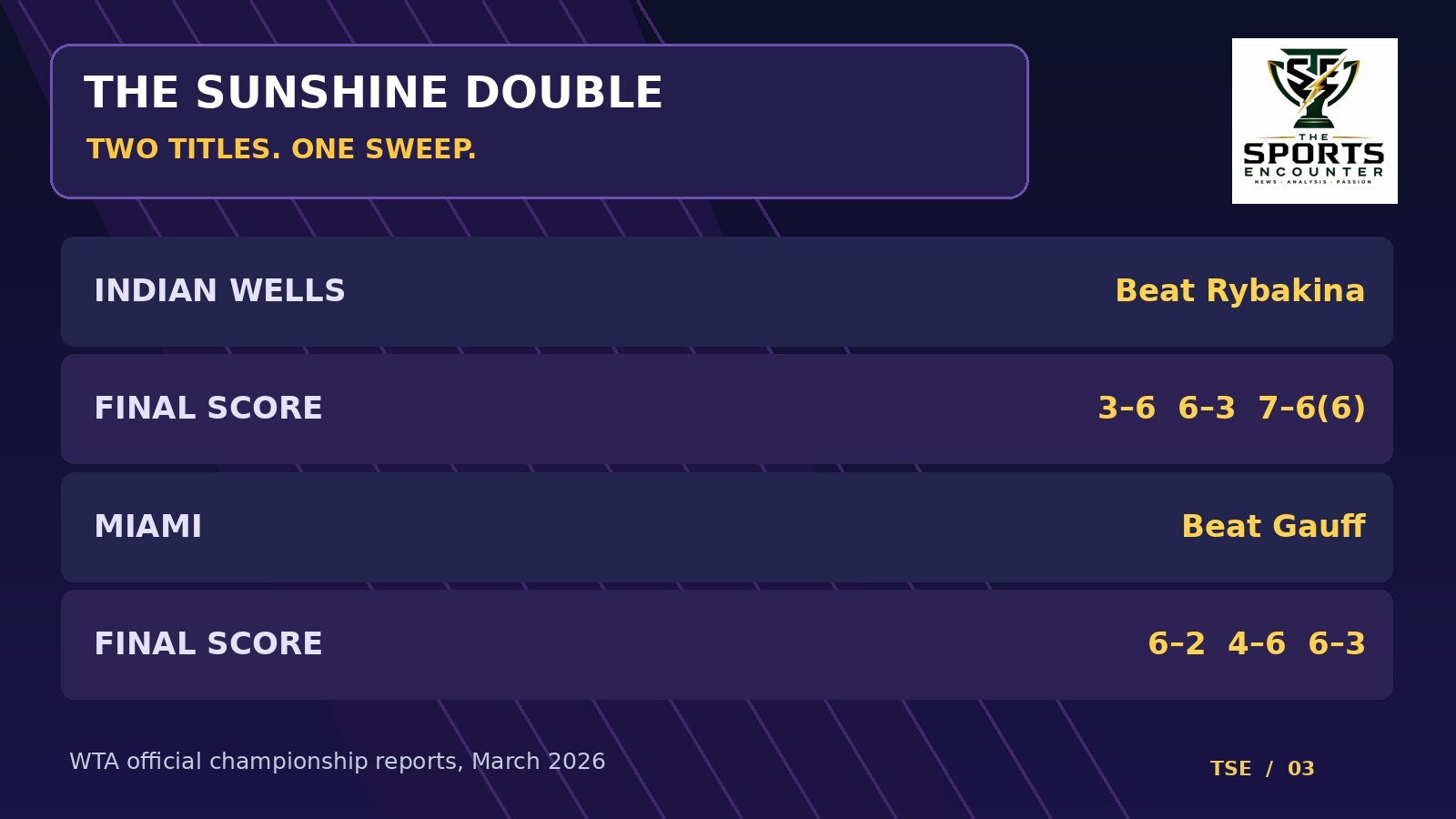
Sabalenka survived and eventually claimed a 3-6, 6-3, 7-6(6) victory after more than two and a half hours.
The Decisive Moment
Saving championship point in a final against an opponent who had repeatedly beaten her in major championship matches demonstrated significant resilience.
Sabalenka had been close to another defeat, but she maintained enough composure to recover.
The victory also ended a sequence of four consecutive WTA final defeats against Rybakina.
It was Sabalenka’s first Indian Wells championship and the 23rd WTA singles title of her career.
Miami 2026: The Sunshine Double That Put Sabalenka in Historic Company
Winning Indian Wells and Miami in the same season is among the most demanding achievements in professional tennis.
The tournaments are played consecutively, with different conditions, large draws and strong fields.
Sabalenka completed the Sunshine Double by defeating Coco Gauff 6-2, 4-6, 6-3 in the Miami final.
She became only the fifth woman to win both tournaments in the same season since they became consecutive events on the calendar in 1989.
The other players to accomplish the feat were Steffi Graf, Kim Clijsters, Victoria Azarenka and Iga Świątek.
How Sabalenka Won Miami
The final against Gauff presented a different tactical challenge from Indian Wells.
Rybakina’s greatest weapon was her serve and first-strike power. Gauff presented elite defensive movement, an outstanding backhand and the ability to extend rallies that appeared finished.
Sabalenka won the opening set 6-2. Gauff recovered to take the second 6-4.
Sabalenka responded by breaking early in the deciding set and securing a 6-3 finish.
The victory was particularly important because the American had previously defeated Sabalenka in Grand Slam finals.
This time, the Belarusian maintained sufficient control through the closing stages.
Two Thousand Ranking Points From Two Championships
Winning both WTA 1000 events earned Sabalenka 2,000 ranking points.
She also completed a 15-match winning streak, equaling her career-best sequence.
| Sunshine Double comparison | Indian Wells | Miami |
|---|---|---|
| Final opponent | Elena Rybakina | Coco Gauff |
| Final score | 3-6, 6-3, 7-6(6) | 6-2, 4-6, 6-3 |
| Sets played in final | Three | Three |
| Title significance | First Indian Wells title | Successful Miami title defense |
| Career WTA title number | 23 | 24 |
| Ranking points awarded | 1,000 | 1,000 |
The Sunshine Double demonstrated that Sabalenka could defeat two very different elite opponents in consecutive championship matches.
It also provided a powerful response to the disappointment of losing the Australian Open final.
Australian Open 2026: A 3-0 Lead Disappears Against Rybakina
Sabalenka entered the Australian Open as one of the favorites.
She had won the tournament in 2023 and 2024, and her powerful game had repeatedly proved effective on Melbourne’s hard courts.
She reached the final after defeating Elina Svitolina 6-2, 6-3 in the semifinals.
Her championship opponent was Elena Rybakina.
The final became a three-set contest in which control changed dramatically.
Rybakina took the opening set 6-4. Sabalenka recovered to win the second 6-4.
She then established a 3-0 lead in the deciding set.
At that point, the championship appeared to be moving toward the Belarusian.
But Rybakina recovered and won six of the next seven games to secure a 6-4, 4-6, 6-4 victory.
Why the Final Was Lost
Sabalenka’s third-set lead was significant, but a three-game advantage is not decisive against a player with Rybakina’s serving ability.
Once Rybakina regained control of her service games and began applying pressure on return, the match changed.
The result illustrated the difference between controlling part of a final and maintaining control until championship point.
For Sabalenka, the defeat was particularly painful because she had created a promising position to win her fifth Grand Slam singles title.
Roland-Garros 2026: Diana Shnaider Ends the Clay-Court Campaign
After her successful American hard-court swing, Sabalenka entered the clay-court season with considerable momentum.
However, Roland-Garros ended in a quarterfinal defeat to Diana Shnaider.
Sabalenka won the opening set 6-3, but Shnaider recovered to take the second 7-5.
The deciding set became increasingly one-sided.
Shnaider won it 6-0, completing a 3-6, 7-5, 6-0 comeback.
The match was an important warning about the limits of relying on power alone.
When an opponent successfully absorbs pace, redirects shots and lengthens rallies, Sabalenka can be forced into increasingly difficult attacking decisions.
Berlin and Wimbledon: Two Grass-Court Setbacks
Jessica Pegula’s Remarkable Berlin Comeback
Sabalenka faced Jessica Pegula in the Berlin semifinals.
Pegula won the opening set 6-4 before Sabalenka claimed the second-set tiebreak.
A lengthy rain delay disrupted the contest during the second set.
Despite recovering to force a deciding set, Sabalenka lost the third 6-0.
Pegula’s 6-4, 6-7(4), 6-0 victory showed how quickly momentum could shift against the former world No. 1.
The Sports Encounter’s Jessica Pegula season profile examines that victory and the American’s broader campaign.
Naomi Osaka Eliminates Sabalenka at Wimbledon
Wimbledon offered Sabalenka another opportunity to secure a major title.
She advanced through the first three rounds but met Naomi Osaka in the fourth.
Osaka won 6-2, 7-6(2).
The defeat ended Sabalenka’s title hopes before the quarterfinals.
It also demonstrated that her vulnerability was not confined to one opponent or surface.
US Open 2026: Rybakina Denies Sabalenka a Historic Three-Peat
Sabalenka arrived in New York having won the US Open in both 2024 and 2025.
A third consecutive championship would have placed her alongside an exceptionally small group of women who had achieved the feat during the Open Era.
She reached the final after defeating Jessica Pegula 7-5, 6-2 in the semifinals.
Once again, Elena Rybakina stood between Sabalenka and a major trophy.
Rybakina had already secured the No. 1 ranking and was preparing to take over the position Sabalenka had occupied for 99 consecutive weeks.
How the US Open Final Unfolded
Rybakina won the opening set 6-4.
Sabalenka recovered to take the second 7-5, forcing another deciding set between the two leading hard-court competitors.
But Rybakina established control in the third.
She won the deciding set 6-2, completing a 6-4, 5-7, 6-2 victory.
The result ended Sabalenka’s 19-match US Open winning streak.
Rybakina also became the player responsible for both of Sabalenka’s Grand Slam final defeats in 2026.
What the Defeat Revealed
Sabalenka had competed strongly enough to reach two Grand Slam finals.
She had also extended both championship matches against Rybakina into deciding sets.
Yet neither ended with the trophy in her hands.
That distinction provides the strongest evidence for the central theme of Sabalenka’s season.
She remained among the world’s most successful players but repeatedly struggled to finish the most consequential matches against her greatest rival.
The Sports Encounter reported on Sabalenka’s US Open semifinal victory over Jessica Pegula as she pursued her third consecutive title.
Aryna Sabalenka’s 2026 Grand Slam Results Compared
The four majors tell an important story.
Sabalenka reached two finals but did not win a Grand Slam singles championship for the first time since 2022.
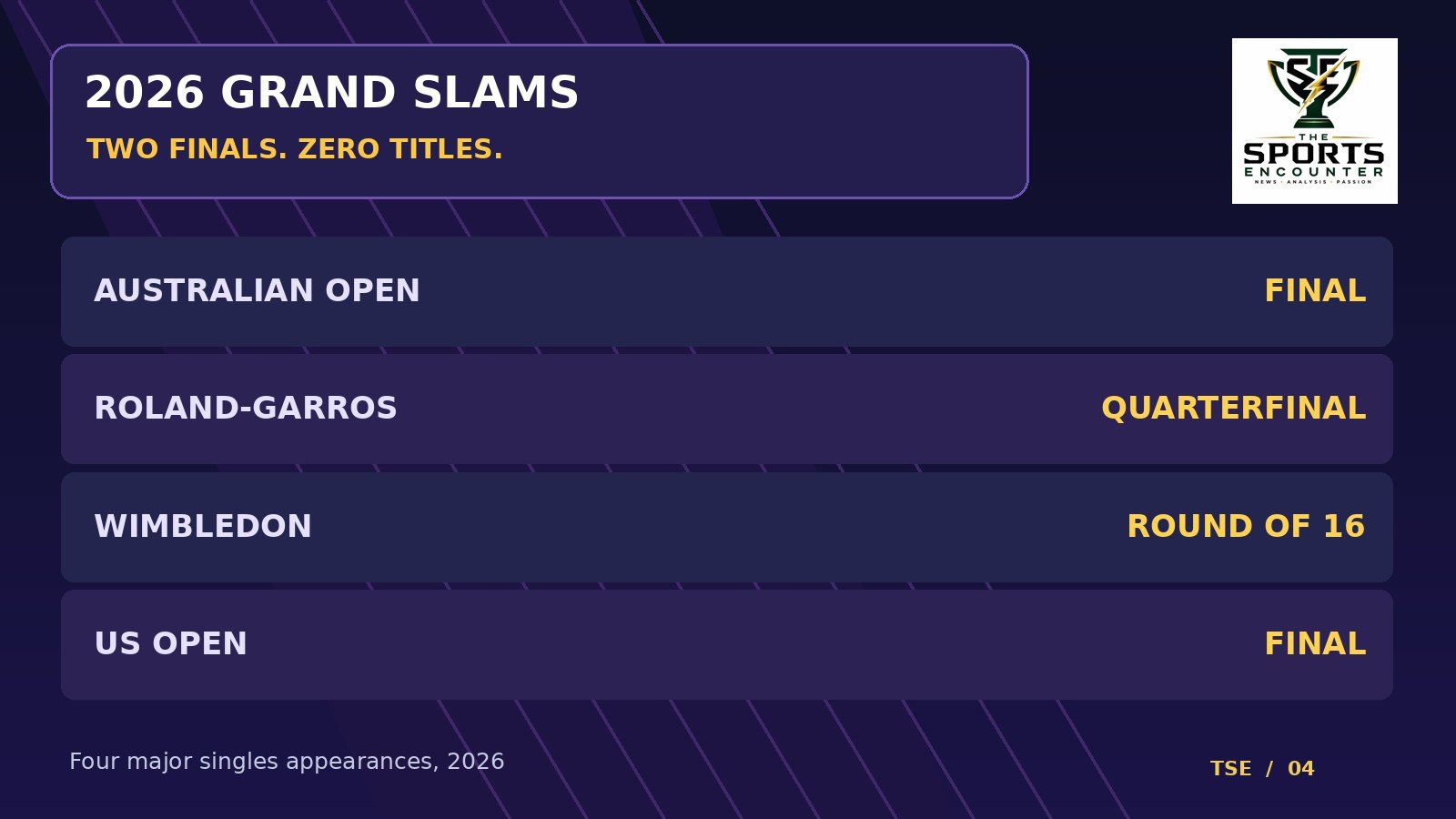
| Grand Slam | Finish | Match wins | Eliminating opponent | Result |
|---|---|---|---|---|
| Australian Open | Runner-up | 6 | Elena Rybakina | Lost 4-6, 6-4, 4-6 |
| Roland-Garros | Quarterfinal | 4 | Diana Shnaider | Lost 6-3, 5-7, 0-6 |
| Wimbledon | Fourth round | 3 | Naomi Osaka | Lost 2-6, 6-7(2) |
| US Open | Runner-up | 6 | Elena Rybakina | Lost 4-6, 7-5, 2-6 |
| Total | Four majors | 19 | Four defeats | 82.6% match-winning rate |
A TSE Statistical Insight: Nineteen Major Wins Without a Championship
Sabalenka won 19 of her 23 Grand Slam singles matches in 2026.
That produces a winning percentage of approximately 82.6%.
It is an outstanding record over four major tournaments.
Yet she finished the season without a Grand Slam singles title.
The contrast illustrates a fundamental limitation of using overall winning percentage as a measure of championship success.
Sabalenka won enough matches to reach two major finals but lost the final match at both tournaments.
Her problem was not a lack of success across the major calendar. It was the inability to convert the most important opportunities into trophies.
Sabalenka vs. Rybakina: The Rivalry That Defined 2026
No opponent influenced Sabalenka’s season more than Elena Rybakina.
Their meetings included the Australian Open final, Indian Wells final and US Open final.
Rybakina won the two Grand Slam championships. Sabalenka won Indian Wells after saving championship point.
Those three matches demonstrate how closely matched the players can be, even when their results appear to favor one competitor.
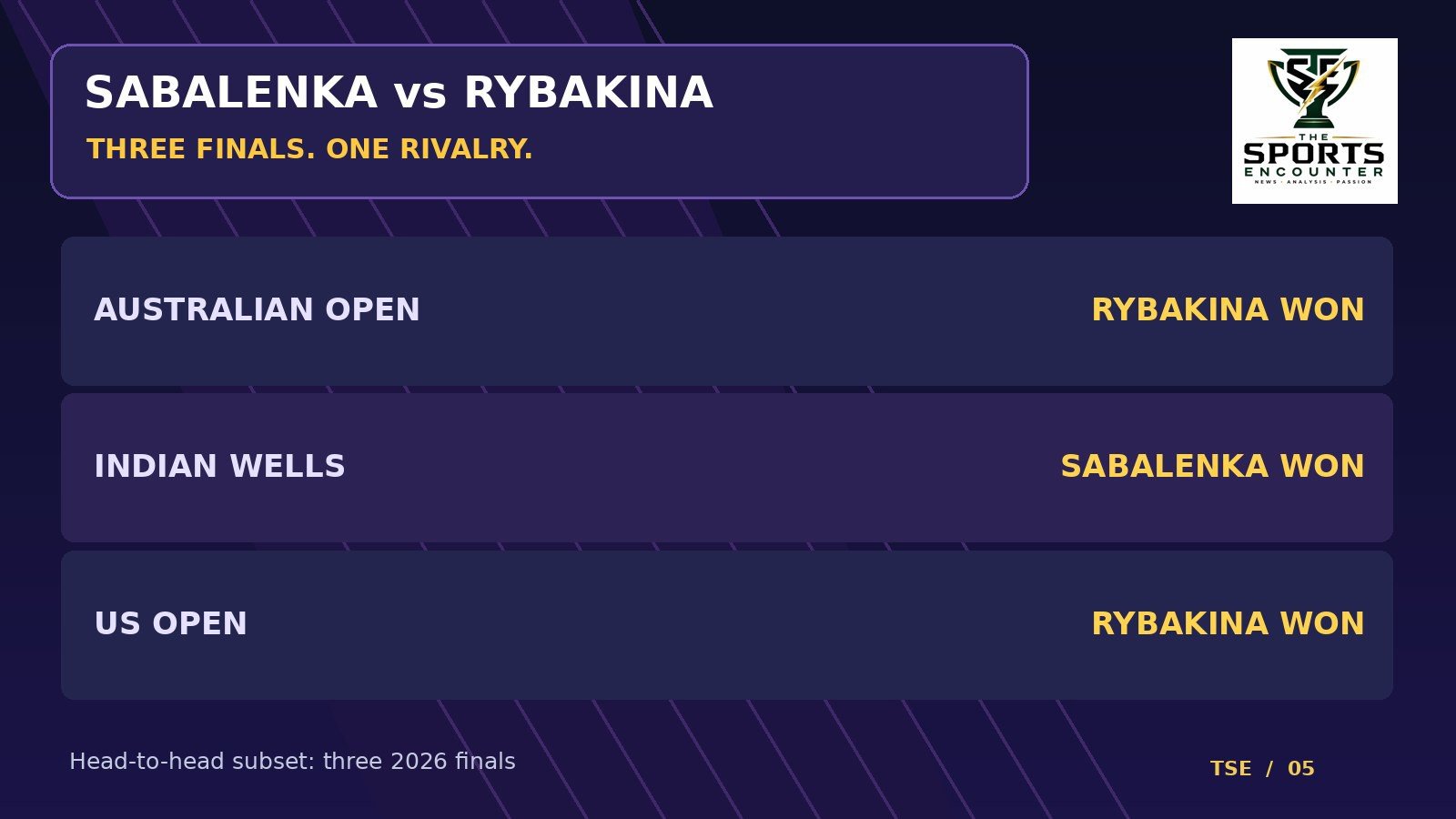
| Tournament | Winner | Score | Consequence |
|---|---|---|---|
| Australian Open final | Elena Rybakina | 6-4, 4-6, 6-4 | Sabalenka denied a fifth major |
| Indian Wells final | Aryna Sabalenka | 3-6, 6-3, 7-6(6) | Sabalenka saved championship point |
| US Open final | Elena Rybakina | 6-4, 5-7, 6-2 | Rybakina secured another major and the No. 1 ranking |
Why Rybakina Is So Difficult for Sabalenka
Both players possess exceptional serves and powerful groundstrokes.
Neither depends primarily on retrieving balls until an opponent makes an error.
Their contests often turn on the opening shots of a rally.
When Rybakina serves effectively, she can prevent Sabalenka from establishing the aggressive return position that makes her dangerous.
When Sabalenka takes control early, she can force Rybakina into defensive situations and dictate the direction of exchanges.
The competition between them is therefore closely connected to service quality, return positioning and the ability to remain composed during deciding sets.
For background on the rankings battle, read The Sports Encounter’s analysis of Elena Rybakina’s rise to world No. 1.
What Happened to Sabalenka After the Sunshine Double?
The contrast between March and the remainder of the season is considerable.
After Miami, Sabalenka continued to perform strongly at major tournaments but did not maintain her earlier championship-winning rhythm.
She lost from promising positions at Roland-Garros, Berlin and Cincinnati.
Her Cincinnati defeat to Sára Bejlek was especially revealing.
Sabalenka had led 5-1 in the opening-set tiebreak and 4-1 in the second set but lost 7-6(7), 6-4.
The match was another example of a strong position becoming a defeat.
Repeated losses from winning positions do not automatically establish a psychological weakness.
They do, however, demonstrate that maintaining tactical discipline and executing key points had become increasingly important.
Sabalenka’s Greatest Strengths Entering the WTA Finals
One of the Most Powerful Serves in Women’s Tennis
Sabalenka’s first serve allows her to win relatively short points and create attacking opportunities immediately.
Against opponents with weaker return games, it can produce sustained control of service games.
At the WTA Finals, however, every opponent has enough quality to challenge her second serve.
Maintaining first-serve consistency will therefore be particularly important.
Attacking From Both Wings
Her forehand and two-handed backhand can generate winners from almost any position near the baseline.
That makes it difficult for opponents to identify a consistently safe side to attack.
But aggressive shot selection also requires judgment.
Attempting low-percentage winners too early can surrender control to opponents who are prepared to extend rallies.
Experience in Major Finals
Sabalenka has contested numerous Grand Slam and WTA 1000 finals.
She understands the demands of playing major championship matches.
That experience can be valuable in the WTA Finals, where the field consists entirely of elite competitors.
Nevertheless, experience alone does not guarantee success.
Her 2026 defeats demonstrate that even established champions must continually adapt.
WTA Finals 2026: Sabalenka’s Three Group Opponents
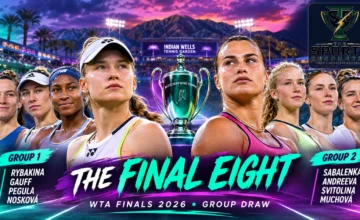
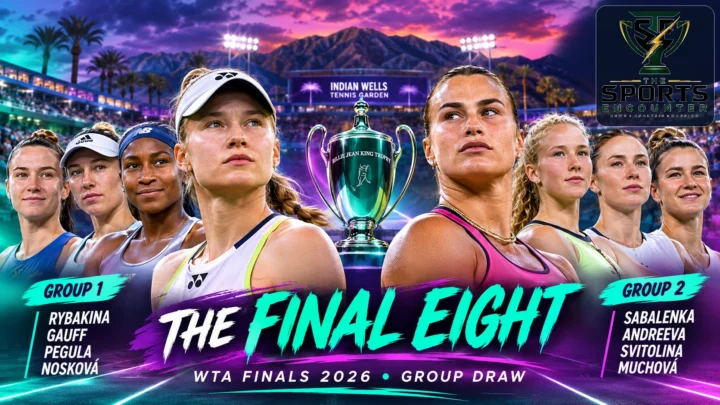
Sabalenka has been placed in Group 2 with Mirra Andreeva, Elina Svitolina and Karolína Muchová.
The group combines three different tactical challenges.
Andreeva is a young Grand Slam champion with strong defensive instincts and the ability to redirect pace.
Svitolina is an experienced former WTA Finals champion whose movement and tactical discipline have contributed to a remarkable comeback.
Muchová offers variety, attacking transitions and a willingness to approach the net.
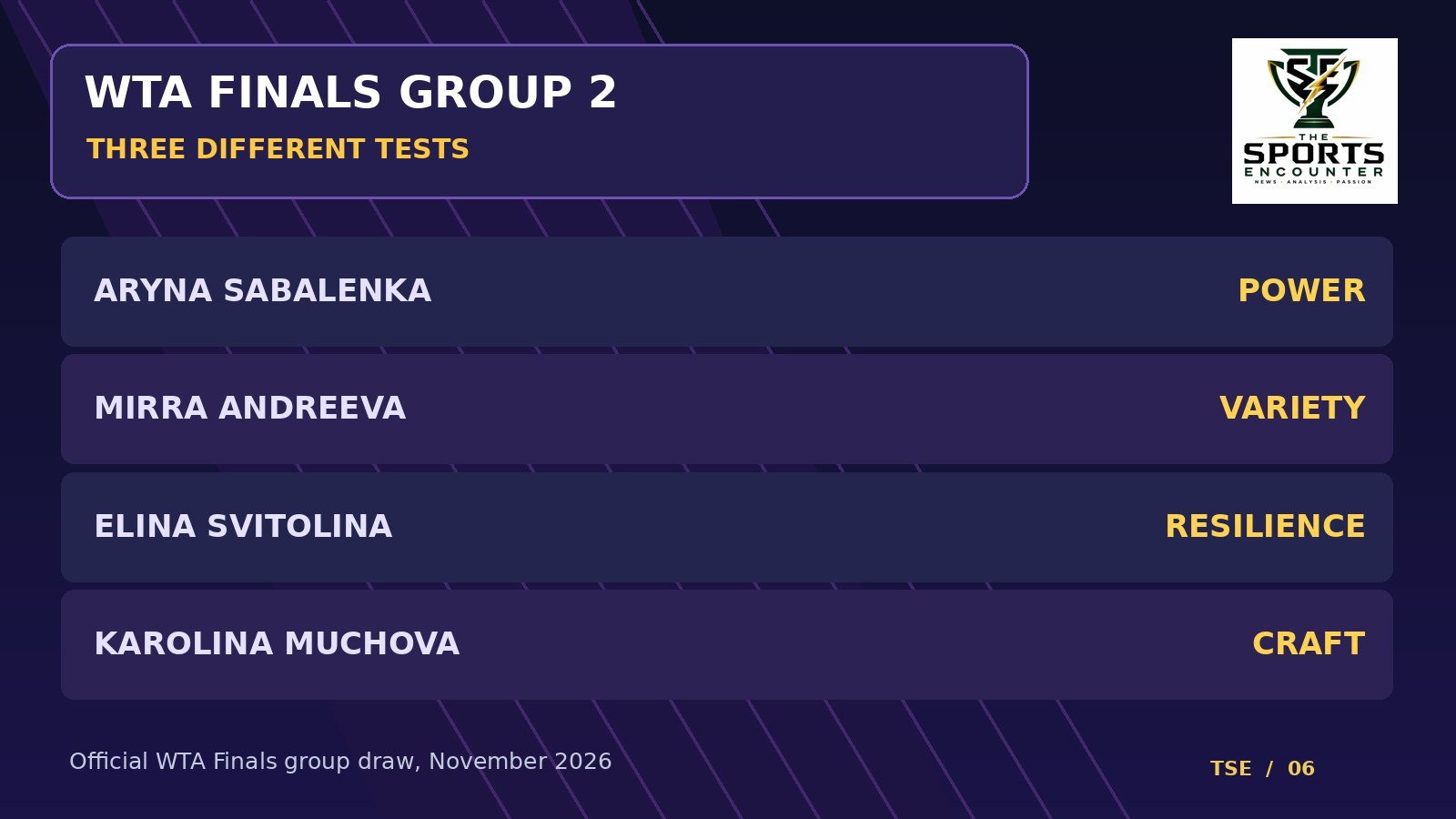
| Opponent | 2026 achievement | Main tactical threat | Sabalenka’s priority |
|---|---|---|---|
| Mirra Andreeva | Roland-Garros champion | Variety, movement and tactical intelligence | Control rallies without rushing attacks |
| Elina Svitolina | Rome and Auckland champion | Defense, counterattack and experience | Maintain depth and avoid impatient errors |
| Karolína Muchová | Doha and Bad Homburg champion | Net play, slice and changes of pace | Keep Muchová behind the baseline |
Mirra Andreeva: A Young Champion Who Can Absorb Power
Andreeva won Roland-Garros at 19 and entered the WTA Finals ranked world No. 3.
Her defensive movement and tactical intelligence make her dangerous against aggressive opponents.
Sabalenka must avoid assuming that consistently hitting harder will automatically win the match.
Read The Sports Encounter’s report on Andreeva’s Roland-Garros breakthrough for additional context.
Elina Svitolina: A Familiar Challenge
Sabalenka defeated Svitolina in the Australian Open semifinals earlier in 2026.
But the Ukrainian subsequently won Rome and reached 20 career singles titles.
Svitolina’s improved attacking intent makes her a more varied opponent than a purely defensive description would suggest.
Our Elina Svitolina 2026 profile examines her resurgence and championship prospects.
Karolína Muchová: The Opponent Who Changes the Rhythm
Muchová’s strengths include slicing, approaching the net and altering the tempo of rallies.
Those qualities can disrupt players who prefer a consistent baseline rhythm.
Sabalenka must prevent Muchová from regularly moving forward and finishing points at the net.
Read Karolína Muchová’s 2026 revival for a detailed look at her playing style and return to the elite.
How Can Sabalenka Qualify for the WTA Finals Semifinals?
Each player competes in three round-robin matches.
The top two finishers in each group advance to the semifinals.
A player who wins all three matches guarantees qualification.
Two wins usually provide a strong position, although tiebreak procedures can determine the final order when players finish level.
One victory can be sufficient only in specific combinations of results.
Three defeats result in elimination.
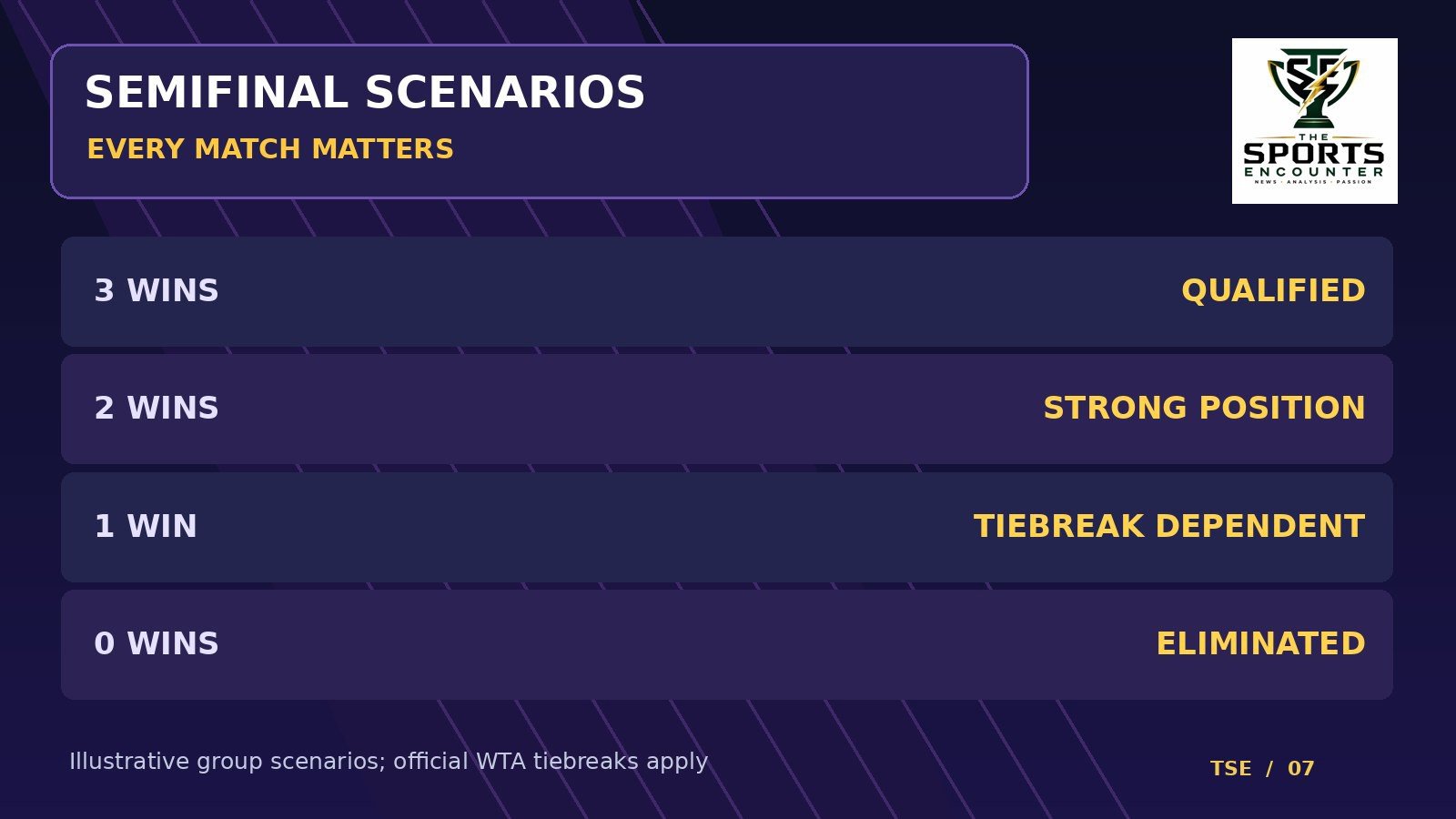
| Group record | Qualification outlook | Important consideration |
|---|---|---|
| 3–0 | Guaranteed qualification | Highest possible group record |
| 2–1 | Strong chance | Other results and tiebreaks may matter |
| 1–2 | Possible in limited scenarios | Depends on other matches and tiebreak calculations |
| 0–3 | Eliminated | Cannot finish among the top two |
The first Group 2 matches are scheduled for November 9, followed by further sessions on November 11 and 13.
The semifinals are scheduled for November 14, with the championship match on November 15.
For the complete draw, results, group standings and match schedule, visit The Sports Encounter’s WTA Finals 2026 hub.
Can Sabalenka Win Her First WTA Finals Championship?
Sabalenka has already reached the WTA Finals championship match twice.
She finished runner-up in 2022 and again in 2025.
Her most recent final ended in defeat to Elena Rybakina, who won the championship in Riyadh.
That result adds another dimension to their rivalry.
If both qualify from their respective groups, another meeting is possible during the knockout stage.
But Sabalenka must first navigate the demanding round-robin competition.
Andreeva, Svitolina and Muchová each possess the ability to challenge her under different conditions.
The Case for Sabalenka
Her attacking power remains among the most formidable in women’s tennis.
She has won three championships in 2026 and defeated elite opposition across hard-court tournaments.
Her Indian Wells victory over Rybakina demonstrated the ability to recover even when facing championship point.
She also possesses extensive experience in major finals.
The Case Against Sabalenka
Her season has included several defeats from strong positions.
She lost both Grand Slam finals to Rybakina and failed to win another tournament after March.
At the WTA Finals, opponents may attempt to exploit moments when her aggression becomes hurried or her emotional control deteriorates.
The challenge is therefore not simply producing powerful tennis.
It is maintaining the right balance between aggression and discipline through multiple matches against elite opponents.
The Sports Encounter Verdict: A Champion Seeking the Missing Trophy
Aryna Sabalenka’s 2026 season illustrates why sporting success is rarely straightforward.
She won 47 matches, claimed three titles and completed one of the most prestigious achievements in women’s hard-court tennis.
Yet she finished the regular season without a Grand Slam singles championship and lost the world No. 1 ranking to Elena Rybakina.
Those developments do not diminish the quality of her campaign.
They demonstrate the exceptionally high standards against which she is now judged.
For many players, two Grand Slam finals and a Sunshine Double would represent the greatest season of their careers.
For Sabalenka, the year has been accompanied by questions about missed opportunities.
Our assessment: Sabalenka remains one of the leading contenders for the 2026 WTA Finals title. Her powerful serve, aggressive baseline game and experience provide a realistic path to the championship. However, success will depend on controlling errors, maintaining composure during momentum shifts and showing the tactical patience required against opponents who can absorb her pace.
A first WTA Finals title would offer a fitting conclusion to a season that produced both extraordinary achievement and considerable disappointment.
For further context, read our analysis of the confirmed WTA Finals groups and our complete eight-player championship preview.
Continue the WTA Finals Story
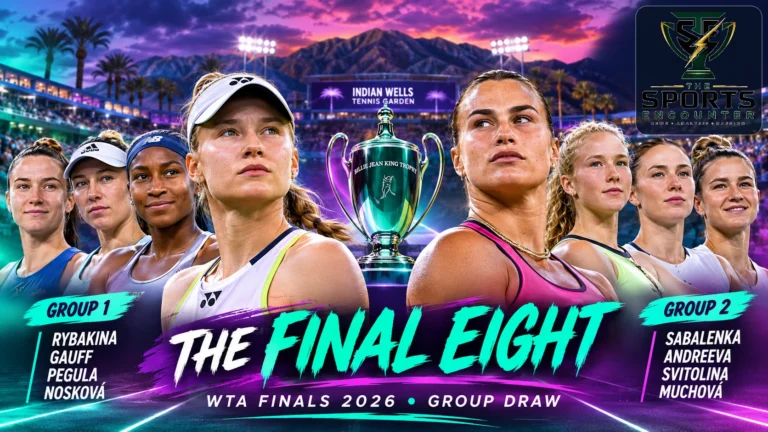 WTA FinalsWTA Finals 2026 Draw: Rybakina Faces Gauff, Pegula and Nosková as Sabalenka Gets Andreeva, Svitolina and Muchová
 WTA FinalsWTA Finals 2026: 8 Women, One Crown, and the Rivalries That Define Tennis’s Biggest Season Finale
 WTA FinalsElena Rybakina’s Extraordinary 2026: Two Grand Slams, World No. 1, and the Crown She Refuses to Surrender
Frequently Asked Questions About Aryna Sabalenka
How Old Is Aryna Sabalenka?
Sabalenka was born on May 5, 1998, and is 28 years old as of November 2026.
Where Is Aryna Sabalenka From?
She was born in Minsk, Belarus.
Who Coaches Aryna Sabalenka?
Anton Dubrov is her coach.
Why Is Aryna Sabalenka Called The Tiger?
She has a tiger tattoo on her left arm, which inspired her nickname.
How Many Grand Slam Singles Titles Has Sabalenka Won?
She has won four Grand Slam singles championships: the Australian Open in 2023 and 2024 and the US Open in 2024 and 2025.
Did Sabalenka Win a Grand Slam in 2026?
No. She reached the Australian Open and US Open finals but lost both to Elena Rybakina.
Which Tournaments Did Sabalenka Win in 2026?
She won Brisbane, Indian Wells and Miami.
What Is the Sunshine Double?
The Sunshine Double refers to winning the Indian Wells and Miami WTA 1000 tournaments in the same season.
What Was Sabalenka’s 2026 Win-Loss Record?
She entered the WTA Finals with 47 victories and 11 defeats, a winning percentage of approximately 81.0%.
Who Beat Sabalenka at the Australian Open 2026?
Elena Rybakina defeated her 6-4, 4-6, 6-4 in the final.
Who Beat Sabalenka at Wimbledon 2026?
Naomi Osaka defeated her 6-2, 7-6(2) in the fourth round.
Who Beat Sabalenka at the US Open 2026?
Elena Rybakina defeated her 6-4, 5-7, 6-2 in the final.
Has Aryna Sabalenka Won the WTA Finals?
No. Her best results were runner-up finishes in 2022 and 2025.
Who Is in Sabalenka’s WTA Finals Group?
She is in Group 2 alongside Mirra Andreeva, Elina Svitolina and Karolína Muchová.
When Does the WTA Finals 2026 Begin?
The competition begins November 8, 2026, at Indian Wells Tennis Garden in California. Sabalenka’s group starts November 9.
Official Sources
The official WTA profile of Aryna Sabalenka provides her career statistics and biographical information. The WTA documented her Sunshine Double triumph and the official WTA Finals group draw.
This is Article 7 of The Elite Eight: Road to the WTA Finals 2026, The Sports Encounter’s eight-part series examining the backgrounds, 2026 seasons and championship prospects of all singles qualifiers.
Aryna Sabalenka
- Aryna Sabalenka’s Bitter-Sweet 2026: Sunshine Double Glory, Two Grand Slam Heartbreaks, and One Last Shot at Redemption
- WTA Finals 2026 Draw: Rybakina Faces Gauff, Pegula and Nosková as Sabalenka Gets Andreeva, Svitolina and Muchová
- WTA Finals 2026: 8 Women, One Crown, and the Rivalries That Define Tennis’s Biggest Season Finale
- Wuhan’s Top Two Fall: Li Needs 10 Match Points, Ostapenko Saves Three as Świątek Seizes Her Chance
- Four Places Up for Grabs: Who Will Reach the WTA Finals as Świątek Faces a Race Against Time