Key Takeaways
- TL;DR: Karolína Muchová began 2026 outside the world’s Top 15 before winning Doha, finishing runner-up at Stuttgart, claiming Bad Homburg and reaching the Wimbledon final.
- Muchová was born on August 21, 1996, in Olomouc, a historic city in eastern Czechia.
- The Qatar TotalEnergies Open represented a turning point.
- Muchová’s Grand Slam success in 2026 was not limited to singles.
INDIAN WELLS, United States, November 4, 2026: For years, Karolína Muchová had been the player everyone admired but few expected to see complete an uninterrupted season. Her elegant all-court tennis could dismantle the world’s best, yet injuries repeatedly prevented her from converting that talent into sustained success. In 2026, the 30-year-old Czech changed the narrative. She won the biggest singles title of her career in Doha, added a grass-court championship at Bad Homburg, reached the Stuttgart and Wimbledon finals, and qualified for the WTA Finals at Indian Wells. After beginning the year outside the world’s Top 15, she climbed to a career-high No. 6 and entered November ranked seventh.
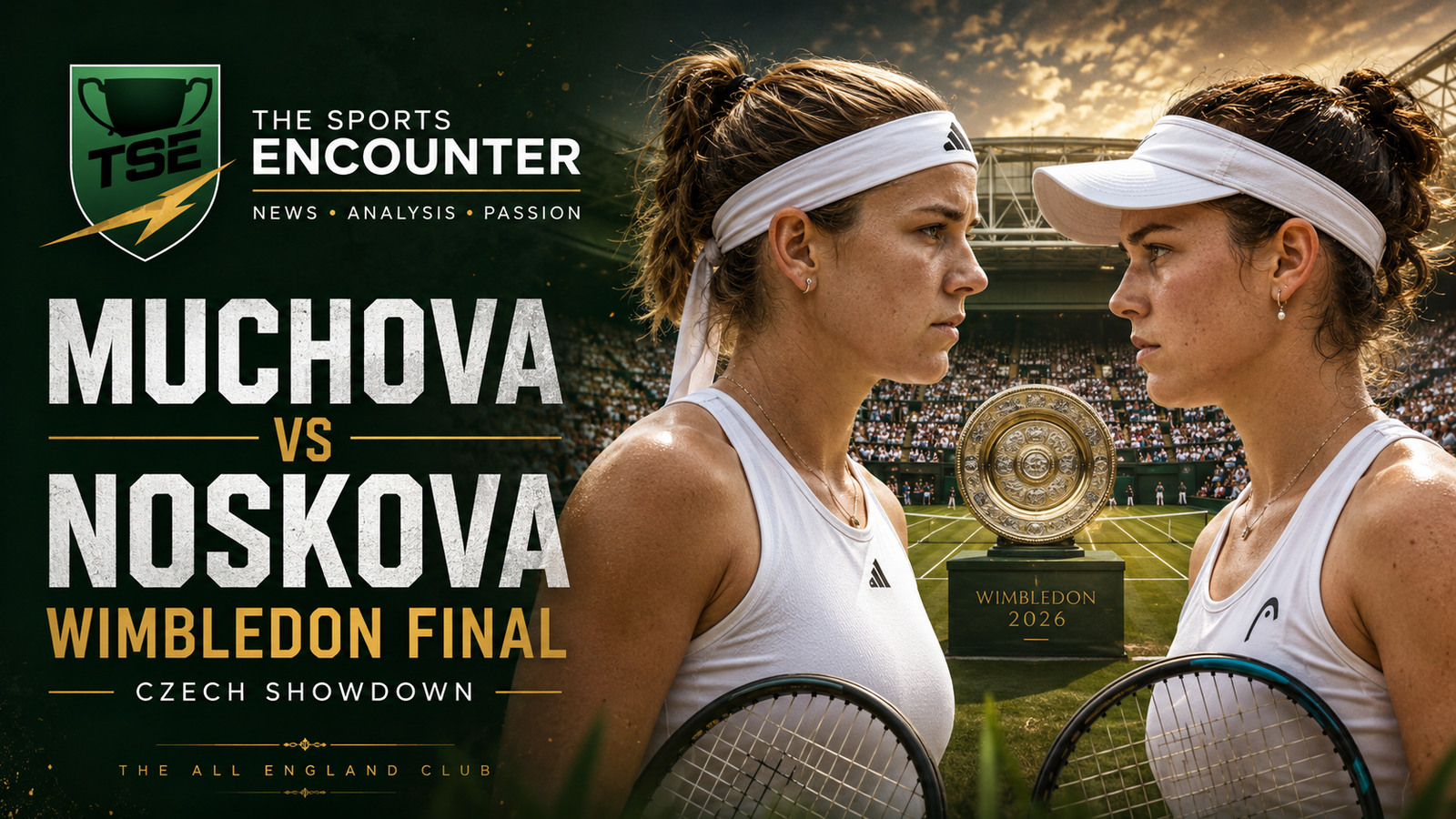
But the revival carried familiar pain. Muchová lost the Wimbledon final to compatriot Linda Nosková after producing one of the tournament’s most memorable semifinal victories against Coco Gauff. She then underwent a medical procedure, missed part of the North American hard-court season and returned to a competitive landscape that offered little time to rebuild momentum. Her qualification for the season-ending championship was not confirmed until Marta Kostyuk’s withdrawal at Ningbo ended the last mathematical challenge to her place. Now, after years of extraordinary tennis and frustrating interruptions, Muchová finally has the opportunity to compete at a championship she previously qualified for but never played.
Karolína Muchová in 2026: Key Facts
| Category | Details |
|---|---|
| Full name | Karolína Muchová |
| Nationality | Czechia |
| Date of birth | August 21, 1996 |
| Age | 30, as of November 4, 2026 |
| Birthplace | Olomouc, Czechia |
| Height | 180 cm (5 feet, 11 inches) |
| Playing hand | Right-handed |
| November 2 world ranking | No. 7 |
| November 2 ranking points | 4,665 |
| 2026 career-high ranking | No. 6 |
| 2026 pre-Finals singles record | 41 wins, 12 losses |
| 2026 singles titles | Doha and Bad Homburg |
| Career WTA singles titles | 3: Seoul 2019, Doha 2026, Bad Homburg 2026 |
| Grand Slam singles finals | Roland-Garros 2023 and Wimbledon 2026 |
| 2026 Grand Slam mixed doubles title | US Open, with Jakub Menšík |
| Coach | Sven Groeneveld |
| WTA Finals appearances | First actual appearance in 2026, after qualifying but withdrawing in 2023 |
TL;DR: Karolína Muchová began 2026 outside the world’s Top 15 before winning Doha, finishing runner-up at Stuttgart, claiming Bad Homburg and reaching the Wimbledon final. She also won the US Open mixed doubles championship alongside Jakub Menšík. A medical procedure after Wimbledon interrupted her season, but her earlier results helped secure a place at the WTA Finals. Her challenge now is to combine her exceptional all-court skills with sustained physical and competitive consistency.
Read next Zverev’s Long Wait for World No. 1 Ends in Vienna as Rybakina Seals Historic Year-End Crown in Tokyo
Who Is Karolína Muchová? Her Childhood, Parents and Life in Olomouc
Muchová was born on August 21, 1996, in Olomouc, a historic city in eastern Czechia.
Her childhood took place in a sporting family rather than a household devoted exclusively to tennis.
Her father, Josef Mucha, was a professional soccer player who competed in the Czech first division. Her mother, Hana Muchová, supported the family’s sporting interests, while her brother, Filip Mucha, also pursued soccer and became a goalkeeper.
Karolína grew up playing different sports, developing the balance, coordination and spatial awareness that would eventually become essential to her tennis.
The family encouraged movement and athletic variety. Muchová participated in handball and other activities before concentrating on tennis.
According to a detailed interview published by the Women’s Tennis Association, tennis courts were situated approximately 50 meters from her childhood home.
She started playing around the age of seven.
By approximately 12, the demands of training and competition made it difficult to continue both tennis and handball seriously.
Muchová chose tennis, although the influence of her other sporting experiences remained visible in her movement and instinctive shot selection.
Her Father Josef Mucha and the Soccer Connection
Josef Mucha’s professional sporting background exposed his daughter to competitive athletics long before she reached the WTA Tour.
Watching her father play soccer helped Karolína understand the importance of physical conditioning, tactical decisions and performing under pressure.
Rather than pushing her toward one discipline immediately, her family encouraged her to develop a broad range of sporting skills.
That background offers an explanation for one of the most recognizable aspects of her tennis.
Muchová rarely looks uncomfortable moving forward, backward or sideways. She can adjust her body position quickly, reach awkward balls and improvise solutions during rallies.
Her movement is not merely a defensive asset. It allows her to turn defensive positions into attacking opportunities.
Her Mother Hana Muchová and Brother Filip Mucha
Muchová’s mother, Hana, has maintained a comparatively private public profile. Her involvement in the family and support for Karolína’s career are better documented than details of her personal life.
Her brother, Filip, continued the family’s soccer tradition by becoming a goalkeeper.
The siblings’ different sporting paths reflect a childhood in which competitive athletics formed a normal part of family life.
Karolína Muchová’s Personal Life: Is She Married or Does She Have a Boyfriend?
Muchová has generally maintained a distinction between her professional career and her private relationships.
As of November 4, 2026, the credible public sources reviewed for this article do not establish a confirmed marriage or identify a publicly acknowledged current spouse.
Similarly, no reliably verified public announcement reviewed for this profile confirms the identity of a current boyfriend or romantic partner.
Claims appearing on celebrity biography websites should not be treated as established facts merely because they are repeated online.
Muchová’s decision to keep her private life largely separate from public discussion deserves respect.
Her Personality, Interests and Sporting Idols
Muchová has identified Roger Federer as an important childhood tennis idol.
The connection is understandable.
Federer’s attacking variety, comfort at the net and ability to change the pace of a rally are qualities that also appear in Muchová’s game, although the two developed in different competitive environments.
Her childhood participation in handball and other sports also helps explain why she values athletic creativity over a rigid playing style.
Muchová’s career reflects patience rather than an immediate rise to stardom.
Karolína Muchová’s Professional Career: The Long Road Before 2026
Muchová’s professional journey began on the ITF circuit in 2013.
Her early progress was gradual, and she did not become an established Top 100 player as quickly as some of her contemporaries.
But her versatility made her dangerous against opponents whose ranking positions suggested they should dominate her.
2018: Announcing Herself at the US Open
Muchová reached the third round of the 2018 US Open after qualifying for the main draw.
Her victory over Garbiñe Muguruza demonstrated that she could challenge a Grand Slam champion on one of tennis’s biggest stages.
It was an early indication that her ranking did not always reflect her competitive ceiling.
2019: Her First WTA Title and Wimbledon Breakthrough
In 2019, Muchová reached the Prague final, climbed into the world’s Top 100 and made a major breakthrough at Wimbledon.
She defeated Karolína Plíšková in the fourth round at the All England Club before reaching her first Grand Slam quarterfinal.
Later that season, she won her first WTA singles championship in Seoul, defeating Magda Linette in the final.
The title confirmed that she could turn impressive performances into tournament victories.
However, another singles trophy would not arrive until 2026.
2021: Australian Open Semifinal and Victory Over Ashleigh Barty
Muchová reached the Australian Open semifinal in 2021 after defeating world No. 1 Ashleigh Barty in the quarterfinals.
She also made the Wimbledon quarterfinals and entered the world’s Top 20.
Her performances demonstrated an unusual ability to trouble the best players through tactical changes, defensive recovery and creative attacking tennis.
Yet injuries continued to interrupt her progress.
2023: Roland-Garros Heartbreak and a First WTA Finals Qualification
The 2023 season brought Muchová closer than ever to a Grand Slam singles championship.
She reached the French Open final against Iga Świątek and pushed the defending champion into a deciding set before losing.
She also reached the Cincinnati WTA 1000 final and qualified for the WTA Finals.
However, a wrist injury prevented her from competing at the year-end championship.
The injury eventually required surgery in February 2024.
What should have been the beginning of a sustained period among the world’s elite became another lengthy interruption.
2024 and 2025: Rebuilding Her Career
Muchová returned from wrist surgery in 2024 and reached the US Open semifinals.
She also contested singles finals in Palermo and Beijing.
Her 2025 campaign included semifinals in Linz and Dubai and a quarterfinal appearance at the US Open.
Those results demonstrated that her ability had survived the injury setbacks.
But the central question remained unresolved: could she finally win another singles title and maintain her form across an entire season?
Karolína Muchová’s Complete 2026 Tournament Results and Season Journey
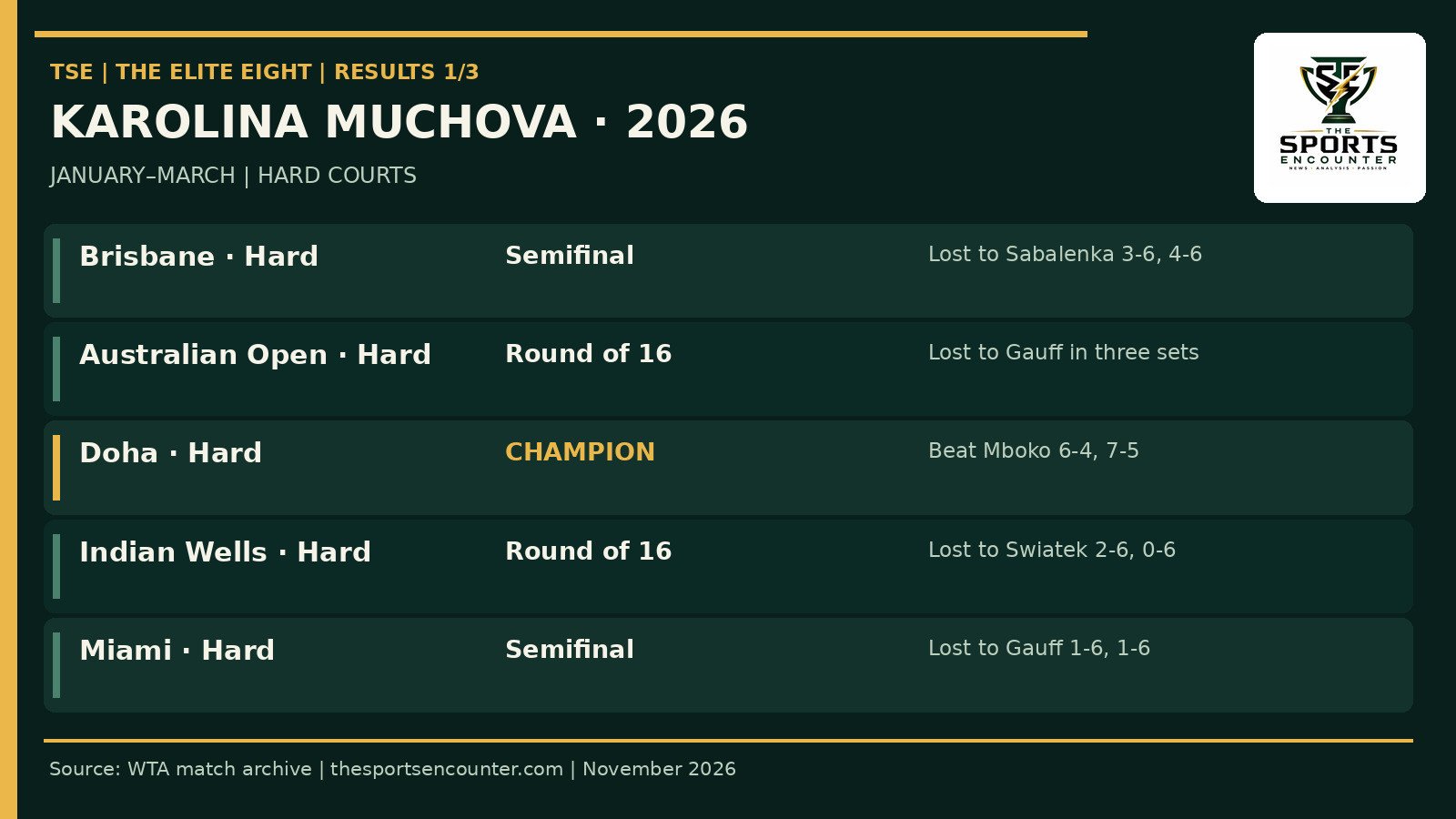
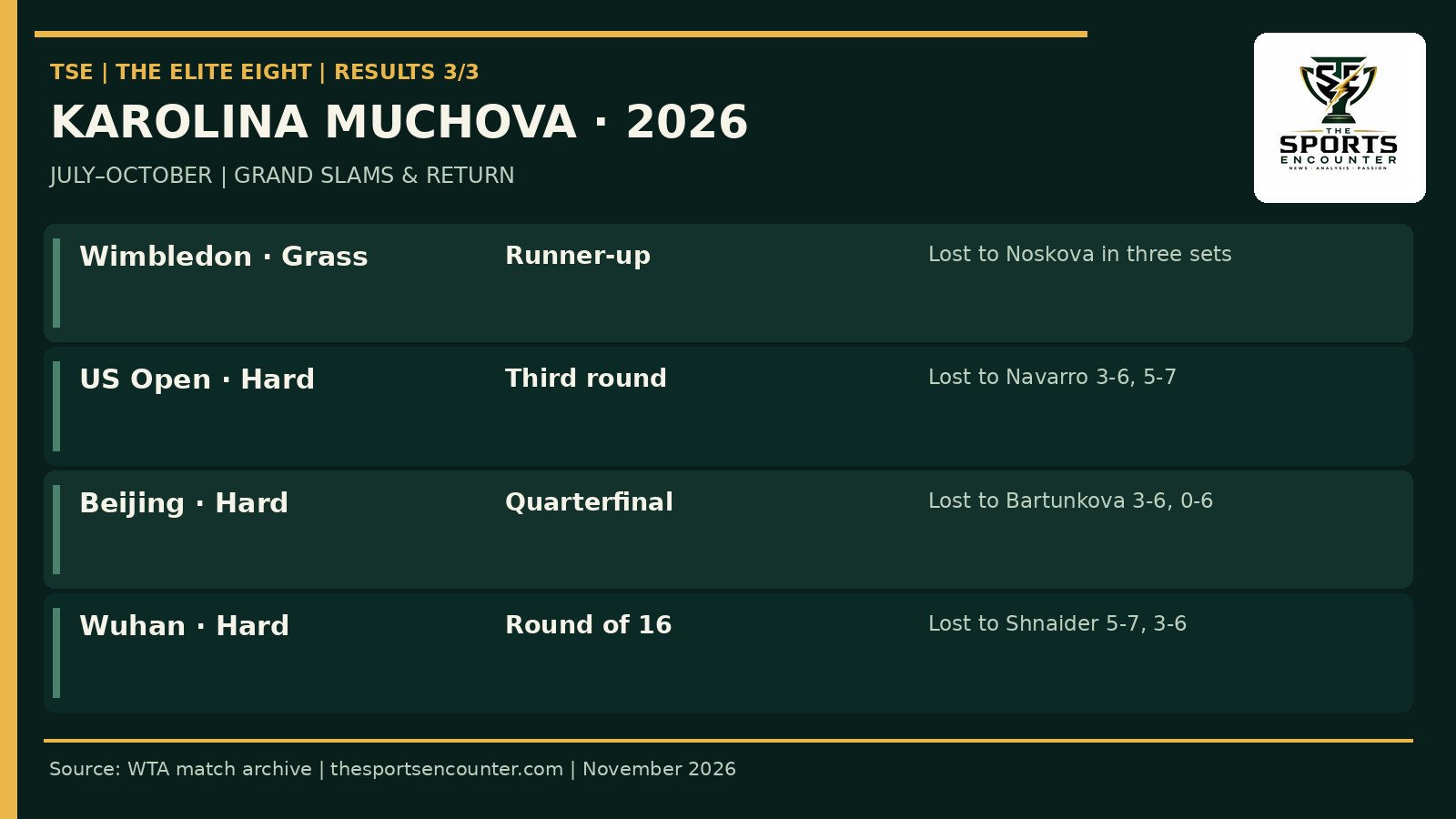
Muchová’s 2026 season unfolded in contrasting stages. She began strongly on Australian hard courts, produced her biggest tournament victory in Doha, reached another final on clay and enjoyed an exceptional grass-court summer before a medical interruption.
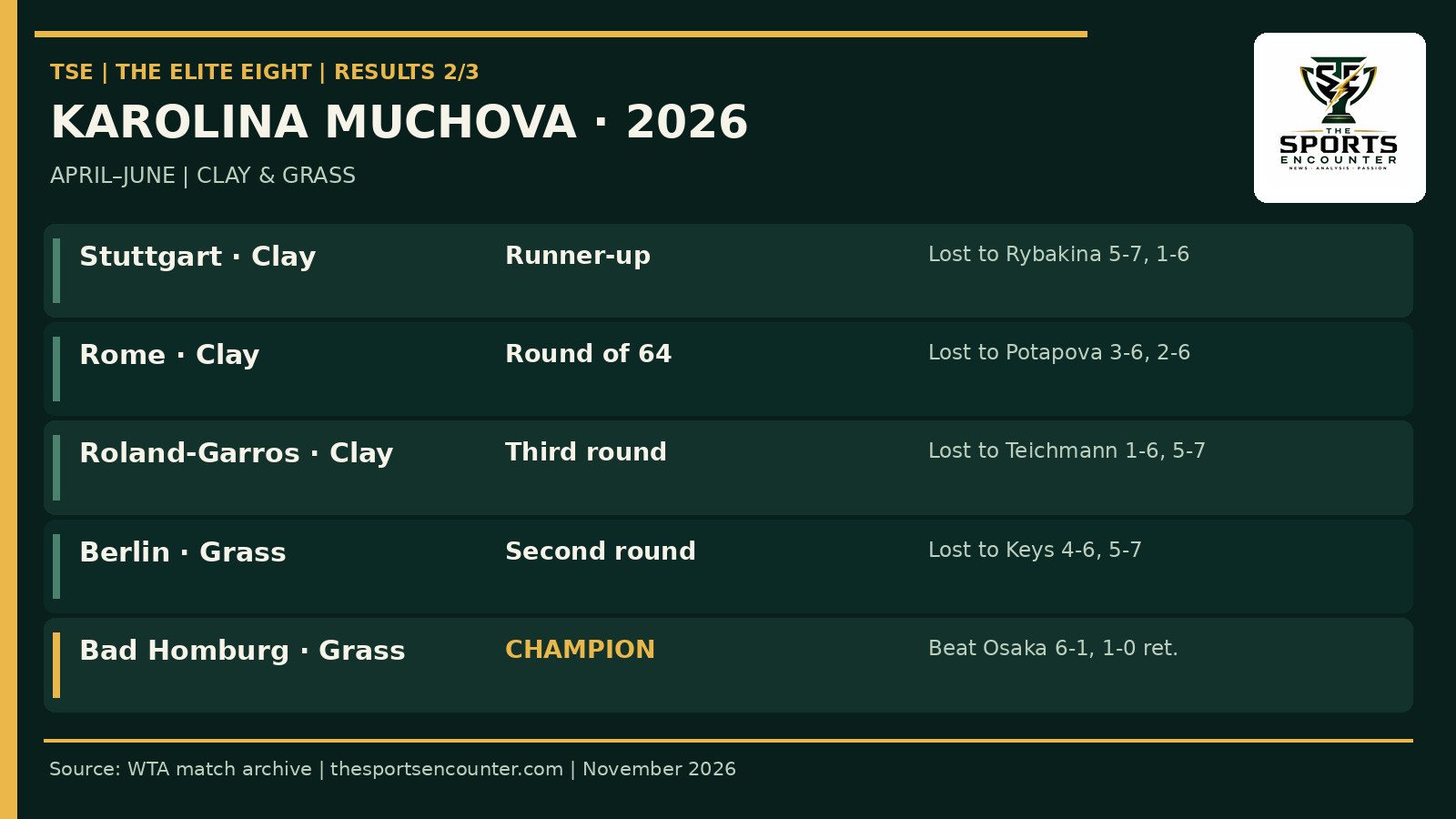
The following three shareable statistical graphics cover her documented singles tournaments before the WTA Finals. The complete HTML table follows so readers, search engines and assistive technologies can access the underlying data.
| Tournament | Surface | Final round | Final opponent/result | Season significance |
|---|---|---|---|---|
| Brisbane | Hard | Semifinal | Lost to Aryna Sabalenka, 3-6, 4-6 | Defeated Elena Rybakina in the quarterfinals, establishing early momentum against elite opposition. |
| Australian Open | Hard | Fourth round | Lost to Coco Gauff, 1-6, 6-3, 3-6 | Reached the last 16, maintaining her strong start to the season. |
| Doha | Hard | Champion | Beat Victoria Mboko, 6-4, 7-5 | Won her first WTA 1000 title and ended a singles title drought stretching back to 2019. |
| Indian Wells | Hard | Fourth round | Lost to Iga Świątek, 2-6, 0-6 | Defeated Anna Bondár and Antonia Ružić before a heavy defeat against an elite opponent. |
| Miami | Hard | Semifinal | Lost to Coco Gauff, 1-6, 1-6 | Defeated Victoria Mboko in the quarterfinals before Gauff dominated their semifinal. |
| Stuttgart | Clay | Runner-up | Lost to Elena Rybakina, 5-7, 1-6 | Beat Coco Gauff and Elina Svitolina before losing the championship match. |
| Rome | Clay | Second round | Lost to Anastasia Potapova, 3-6, 2-6 | Unexpected early defeat after an impressive Stuttgart campaign. |
| French Open | Clay | Third round | Lost to Jil Teichmann, 1-6, 5-7 | Failed to replicate her 2023 run to the Roland-Garros final. |
| Berlin | Grass | Second round | Lost to Madison Keys, 4-6, 5-7 | Keys served effectively and denied Muchová a quarterfinal place. |
| Bad Homburg | Grass | Champion | Beat Naomi Osaka, 6-1, 1-0 ret. | Won her first grass-court title after Osaka retired with a foot injury. |
| Wimbledon | Grass | Runner-up | Lost to Linda Nosková, 2-6, 7-5, 3-6 | Reached her second Grand Slam singles final after defeating Coco Gauff in a dramatic semifinal. |
| US Open | Hard | Third round | Lost to Emma Navarro, 3-6, 5-7 | Returned after a medical interruption and separately won the mixed doubles title. |
| Beijing | Hard | Quarterfinal | Lost to Nikola Bartůňková, 3-6, 0-6 | Rebuilt momentum with victories over Katie Boulter, Liudmila Samsonova and Naomi Osaka. |
| Wuhan | Hard | Fourth round | Lost to Diana Shnaider, 5-7, 3-6 | Her last documented WTA singles tournament before securing the final championship qualification place. |
The season’s central statistical pattern is the strength of her performances across multiple surfaces.
Muchová reached finals on hard courts, clay and grass. That range distinguished her from opponents whose strongest results were concentrated on one type of court.
Her 41-12 pre-Finals singles record represented a winning percentage of approximately 77.4%.
More importantly, she converted two of her four singles finals into titles.
That was a meaningful improvement for a player whose earlier career had been characterized by several major near misses.
Doha 2026: The Title That Changed Muchová’s Career
The Qatar TotalEnergies Open represented a turning point.
Muchová entered Doha ranked No. 19 and seeded 14th.
She had not won a WTA singles title since Seoul in 2019.
Over six matches in Qatar, she changed that record.
Muchová’s Complete Doha 2026 Championship Run
| Round | Opponent | Result | Significance |
|---|---|---|---|
| First round | Jaqueline Cristian | Won 6-2, 6-3 | Controlled the opening match. |
| Second round | Tereza Valentová | Won 6-1, 6-4 | Defeated a fellow Czech opponent. |
| Third round | Karolína Plíšková | Won 5-2 ret. | Advanced following Plíšková’s retirement. |
| Quarterfinal | Anna Kalinskaya | Won 6-3, 6-4 | Moved into the semifinals. |
| Semifinal | Maria Sakkari | Won 3-6, 6-4, 6-1 | Recovered from losing the first set. |
| Final | Victoria Mboko | Won 6-4, 7-5 | Secured her first WTA 1000 championship. |
The semifinal against Maria Sakkari was arguably her most demanding test.
Muchová lost the opening set 3-6 but gradually asserted greater control, winning the second 6-4 and dominating the decider 6-1.
Against Victoria Mboko in the final, Muchová showed the combination of patience and attacking precision that had been missing from some of her previous championship performances.
She won 6-4, 7-5 to claim her biggest singles title.
The importance of the achievement extended beyond ranking points.
Muchová demonstrated that her ability to beat elite opponents could produce a major tournament championship, not merely memorable individual victories.
Stuttgart 2026: Another Final, but Elena Rybakina Denied Her
After her hard-court success, Muchová carried her form onto clay.
At the Porsche Tennis Grand Prix in Stuttgart, she defeated Aliaksandra Sasnovich and Elise Mertens before confronting two formidable opponents.
In the quarterfinals, she beat Coco Gauff 6-3, 5-7, 6-3.
She then defeated Elina Svitolina 6-4, 2-6, 6-4 in the semifinals.
Those victories were particularly important because they came against players capable of extending rallies and testing her tactical discipline.
The final against Elena Rybakina proved more difficult.
Rybakina won 7-5, 6-1, denying Muchová a second title of the season.
Although the defeat was disappointing, the tournament established that Muchová was competitive on clay as well as hard courts.
Bad Homburg 2026: The Grass-Court Title Before Wimbledon
Muchová’s grass-court season became the most successful stretch of her year.
At Bad Homburg, she defeated Irina-Camelia Begu, Clara Tauson and Elena-Gabriela Ruse to reach the final.
Her championship opponent was Naomi Osaka.
Muchová made a commanding start, taking the first set 6-1.
She then held serve for a 1-0 lead in the second set before Osaka retired because of a foot injury.
The retirement meant the final did not provide a complete competitive test.
However, it should not obscure Muchová’s strong tournament performance.
She had navigated the draw successfully and was controlling the final when it ended.
The title was her first on grass and her second singles championship of 2026.
Wimbledon 2026: Seven Matches, One Heartbreaking Final
The All England Club had already played an important role in Muchová’s career.
She reached the Wimbledon quarterfinals in 2019 and 2021.
In 2026, she finally advanced beyond that stage.
Her route included victories over established Grand Slam champions and one of the most dramatic semifinals of the tournament.
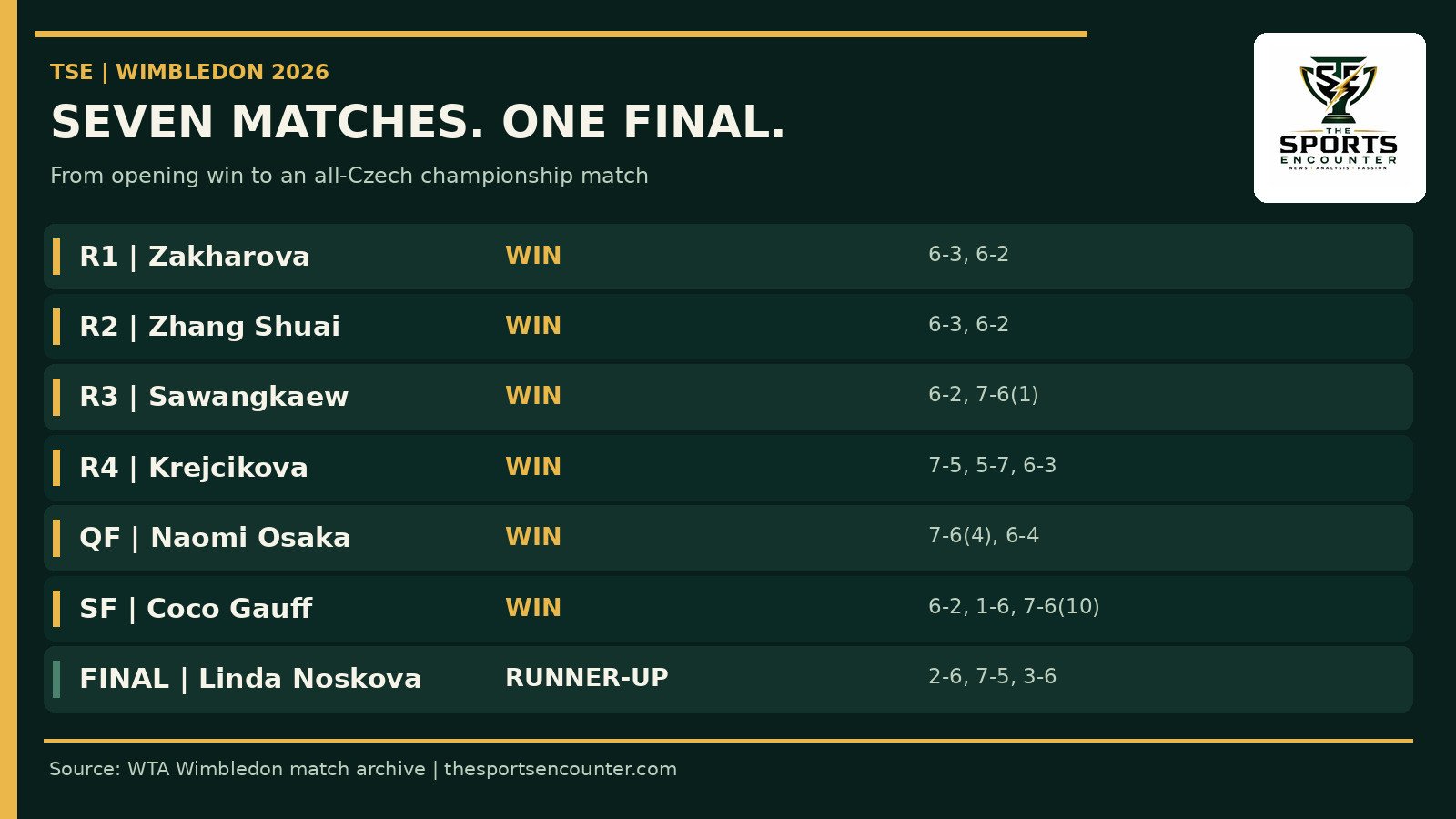
Karolína Muchová’s Complete Wimbledon 2026 Results
| Round | Opponent | Result | Turning point or significance |
|---|---|---|---|
| First round | Anastasia Zakharova | Won 6-3, 6-2 | Comfortable opening victory. |
| Second round | Zhang Shuai | Won 6-3, 6-2 | Maintained control through varied attacking play. |
| Third round | Mananchaya Sawangkaew | Won 6-2, 7-6(1) | Withstood second-set resistance. |
| Fourth round | Barbora Krejčíková | Won 7-5, 5-7, 6-3 | Overcame a fellow Czech and former Wimbledon champion. |
| Quarterfinal | Naomi Osaka | Won 7-6(4), 6-4 | Defeated Osaka for the second consecutive tournament. |
| Semifinal | Coco Gauff | Won 6-2, 1-6, 7-6(10) | Saved a match point and survived an extraordinary deciding tiebreak. |
| Final | Linda Nosková | Lost 2-6, 7-5, 3-6 | Recovered five championship points against her but could not complete the comeback. |
The Semifinal Against Coco Gauff: A Match That Captured Muchová’s Genius
Muchová’s semifinal victory over Coco Gauff illustrated why she is considered one of the most creative players on the WTA Tour.
She won the opening set 6-2 but lost the second 1-6.
The deciding set became a test of nerve, variety and physical commitment.
Gauff held match point at 9-8 in the final-set tiebreak.
The American attempted a drop shot, but the ball went into the net.
Muchová survived.
She then produced a lob winner to create a match point of her own, only to lose that opportunity after slipping on the grass.
The contest continued until Muchová finally converted her next chance and completed a 6-2, 1-6, 7-6(10) victory.
Muchová was willing to attack the net, change the pace of rallies and attempt difficult shots at crucial moments.
She also showed the mental resilience required to recover after facing elimination.
The Wimbledon Final Against Linda Nosková
The final created a historic moment for Czech tennis.
Two women representing the same country met in a Grand Slam singles championship match, with both seeking their first major singles title.
Nosková’s direct attacking game contrasted sharply with Muchová’s movement, tactical flexibility and use of different spins and angles.
Nosková won the first set 6-2 and moved ahead 5-2 in the second.
The younger player reached five championship points.
Muchová refused to surrender.
She won five consecutive games to take the second set 7-5, turning what had appeared to be a straightforward final into a dramatic contest.
However, Nosková recovered in the deciding set and won 6-3 to claim the Wimbledon championship.
For Muchová, it was another Grand Slam final defeat after her loss to Iga Świątek at Roland-Garros in 2023.
But her performance also demonstrated the extraordinary level she could reach under pressure.
Our detailed profile of Linda Nosková’s 2026 season and Wimbledon championship examines the final from the winner’s perspective.
For the broader national significance, read our report on the historic all-Czech Wimbledon final.
Muchová’s 2026 Grand Slam Results: Where Did She Perform Best?
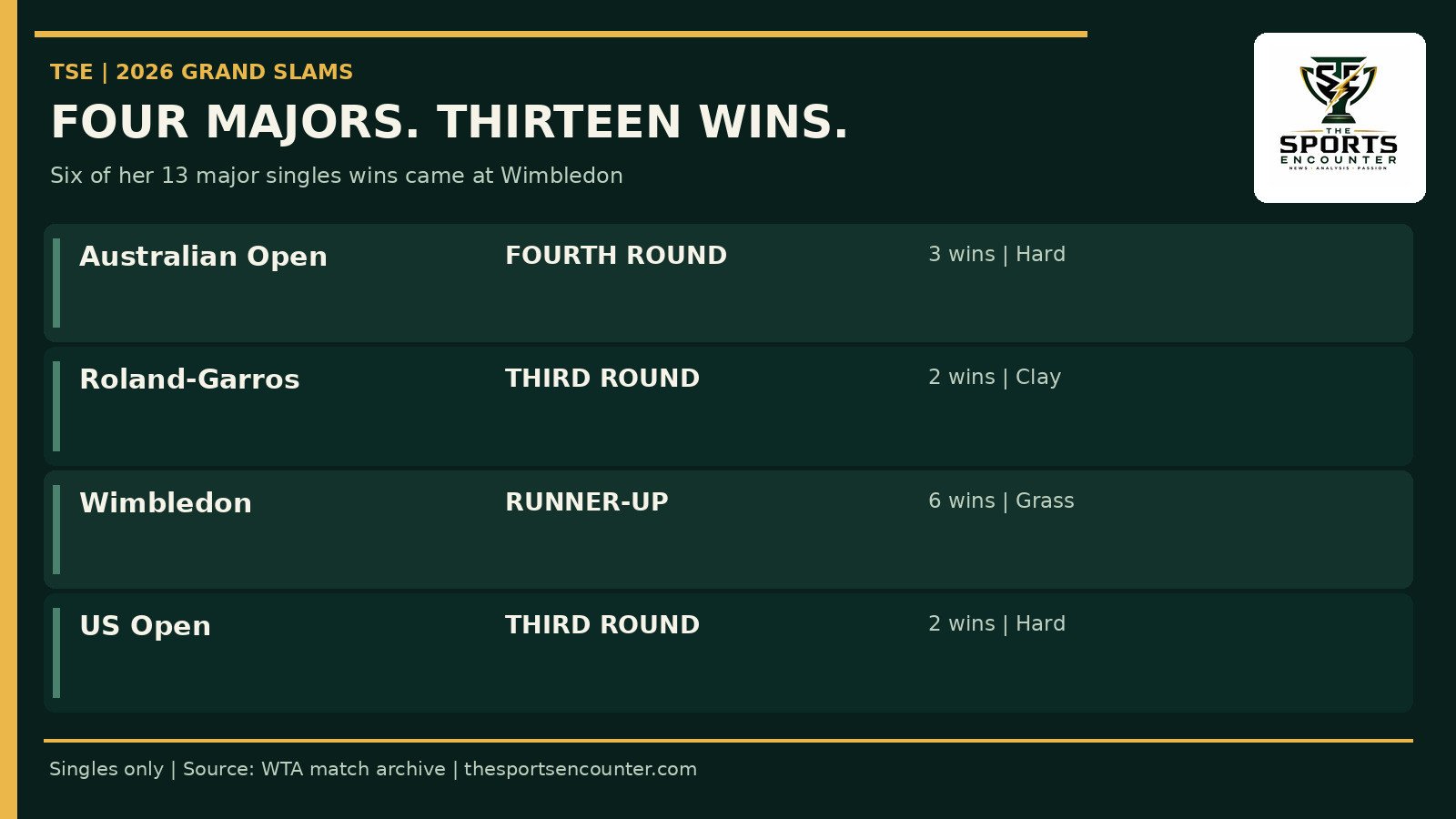
The four Grand Slam tournaments provide a useful measure of Muchová’s consistency and the limits of her season.
| Grand Slam | Surface | Final round | Singles match wins | Defining result |
|---|---|---|---|---|
| Australian Open | Hard | Fourth round | 3 | Lost to Coco Gauff in three sets. |
| French Open | Clay | Third round | 2 | Lost to Jil Teichmann. |
| Wimbledon | Grass | Runner-up | 6 | Defeated Gauff before losing the final to Nosková. |
| US Open | Hard | Third round | 2 | Lost to Emma Navarro following her return from a medical interruption. |
Across the four majors, Muchová recorded 13 singles victories and four defeats.
Her Wimbledon campaign accounted for six of those 13 wins, approximately 46% of her Grand Slam singles victories in 2026.
That concentration illustrates how strongly the grass-court season contributed to her year-end standing.
However, the Australian Open and US Open results also demonstrated that she could compete effectively on hard courts.
The US Open Mixed Doubles Title: A Historic Partnership With Jakub Menšík
Muchová’s Grand Slam success in 2026 was not limited to singles.
At the US Open, she partnered fellow Czech Jakub Menšík in the mixed doubles competition.
The pair reached the final after surviving a dramatic semifinal against Mirra Andreeva and Andrey Rublev.
They saved two match points from 7-9 in the deciding match tiebreak before winning the final four points.
In the championship match, Muchová and Menšík defeated Belinda Bencic and Flavio Cobolli 6-3, 1-6, [10-6].
The victory gave Muchová her first Grand Slam title in any discipline.
Mixed doubles requires quick reactions, precise positioning, intelligent shot selection and the confidence to attack short balls.
Those are central components of Muchová’s singles game.
The championship represented an important achievement in a season otherwise defined by her pursuit of a first Grand Slam singles title.
Injuries and Surgery: Why Muchová’s 2026 Season Was Interrupted Again
Muchová’s career has repeatedly been affected by physical setbacks.
The most significant earlier interruption involved the wrist injury that prevented her from competing at the 2023 WTA Finals and eventually required surgery in February 2024.
In 2026, another medical issue emerged immediately after Wimbledon.
What Happened After the Wimbledon Final?
In July, Muchová announced that she had undergone a small medical procedure.
She said the procedure had gone well and that she expected to miss several weeks while recovering.
She did not publicly identify the precise nature of the medical issue in the announcement reviewed for this article.
For that reason, it would be inappropriate to claim that the procedure involved a specific injury or body part without reliable confirmation.
The interruption forced her to miss the Canadian Open and Cincinnati.
Those withdrawals deprived her of valuable preparation and opportunities to accumulate ranking points before the US Open.
Why the Injury History Matters at the WTA Finals
Muchová’s playing style requires exceptional movement and athletic flexibility.
She changes direction frequently, approaches the net, slides into difficult positions and improvises while defending.
Those abilities make her dangerous, but they also require physical readiness.
At the WTA Finals, she will face elite opponents repeatedly across a compressed schedule.
Even relatively small limitations in movement, recovery or confidence could influence the outcome.
Her performances in Beijing and Wuhan suggest that she was able to return to competitive tennis, but they do not establish that every physical concern has been permanently resolved.
How Karolína Muchová Qualified for the WTA Finals 2026
Muchová’s qualification was one of the most dramatic developments in the closing stages of the season.
She had accumulated a strong points total through Doha, Stuttgart, Bad Homburg and Wimbledon.
However, her absence from part of the summer hard-court swing left competitors with opportunities to challenge her position.
The decisive development occurred at the Ningbo Open in October.
Marta Kostyuk needed to reach the final to prevent Muchová from securing the remaining qualification place.
But Kostyuk retired from her second-round match against Ekaterina Alexandrova after receiving medical treatment.
The result ended her mathematical opportunity to overtake Muchová in the qualification race.
Muchová’s place at the WTA Finals was confirmed.
It was an important personal milestone.
She had qualified for the competition in 2023 but could not participate because of injury.
In 2026, she finally earned the opportunity to play.
The Sports Encounter previously examined the circumstances in our report on Muchová’s qualification following Kostyuk’s Ningbo retirement.
How Karolína Muchová’s Ranking Changed Throughout 2026
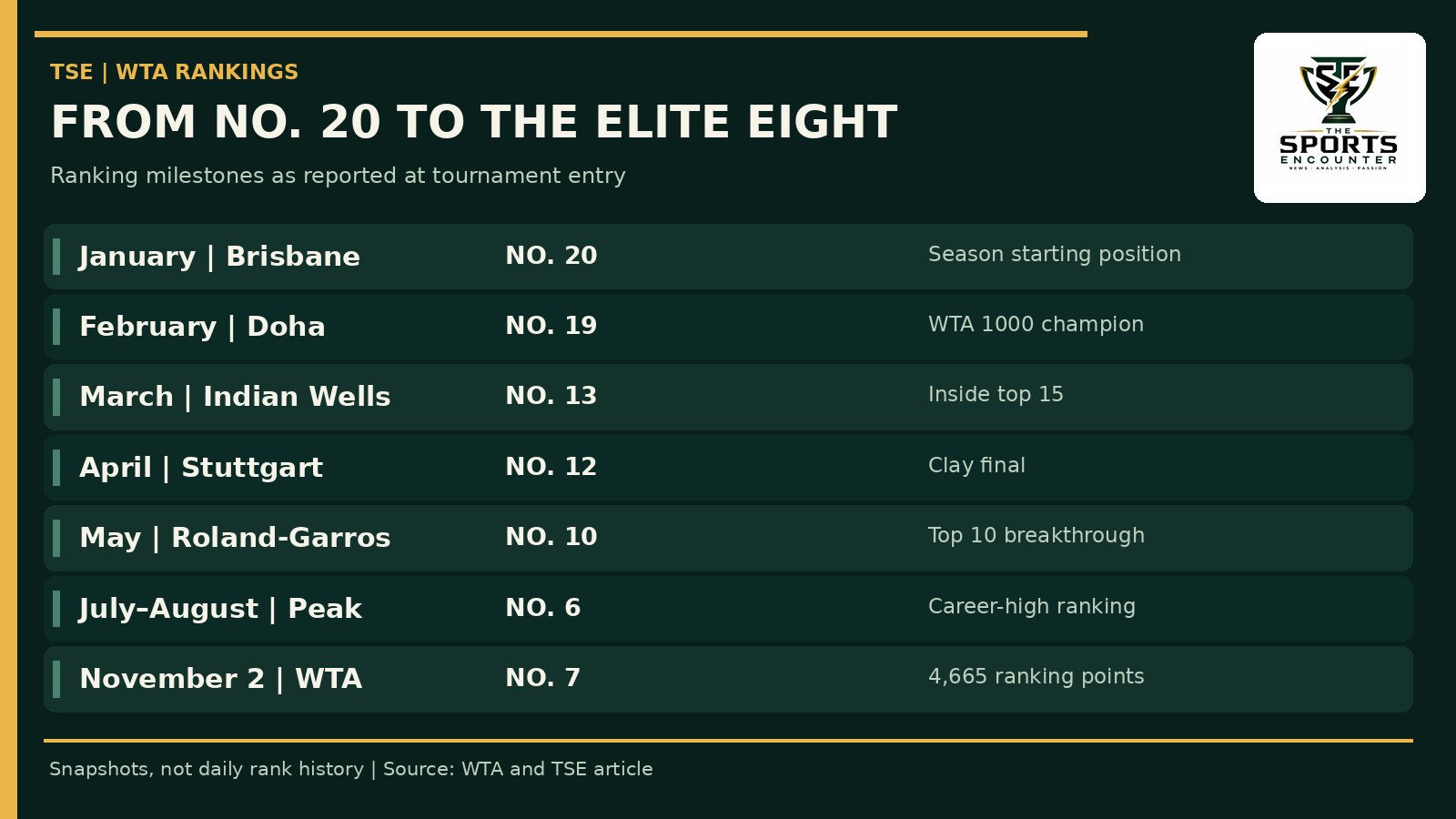
Muchová began the season outside the world’s Top 15 and gradually climbed through championship victories and deep tournament runs.
Her strongest upward movements followed Doha and the grass-court season.
| Period | Ranking reference | What changed |
|---|---|---|
| January, Brisbane | World No. 20 | Started the season outside the Top 15. |
| February, Doha | World No. 19 entering the tournament | Won her first WTA 1000 title. |
| March, Indian Wells | World No. 13 entering the tournament | Moved closer to the Top 10. |
| April, Stuttgart | World No. 12 entering the tournament | Reached another final against elite opposition. |
| May, Roland-Garros | World No. 10 entering the tournament | Established herself inside the Top 10. |
| June, Bad Homburg | World No. 11 entering the tournament | Claimed her first grass-court championship. |
| July–August | Career-high No. 6 | Wimbledon runner-up finish transformed her ranking position. |
| November 2 | World No. 7 | Entered the WTA Finals period among the eight qualified players. |
The distinction between her January and November positions is significant.
Muchová improved from approximately 20th in the world at the start of the season to seventh before the WTA Finals.
That rise was not achieved through one isolated result.
Doha provided a major championship, Stuttgart demonstrated clay-court consistency, and the grass-court season delivered a title and a Grand Slam final.
Karolína Muchová’s Most Important Rivalries in 2026
Muchová’s season featured several notable encounters against opponents who could influence the WTA Finals.
Her results reveal both opportunities and potential weaknesses.
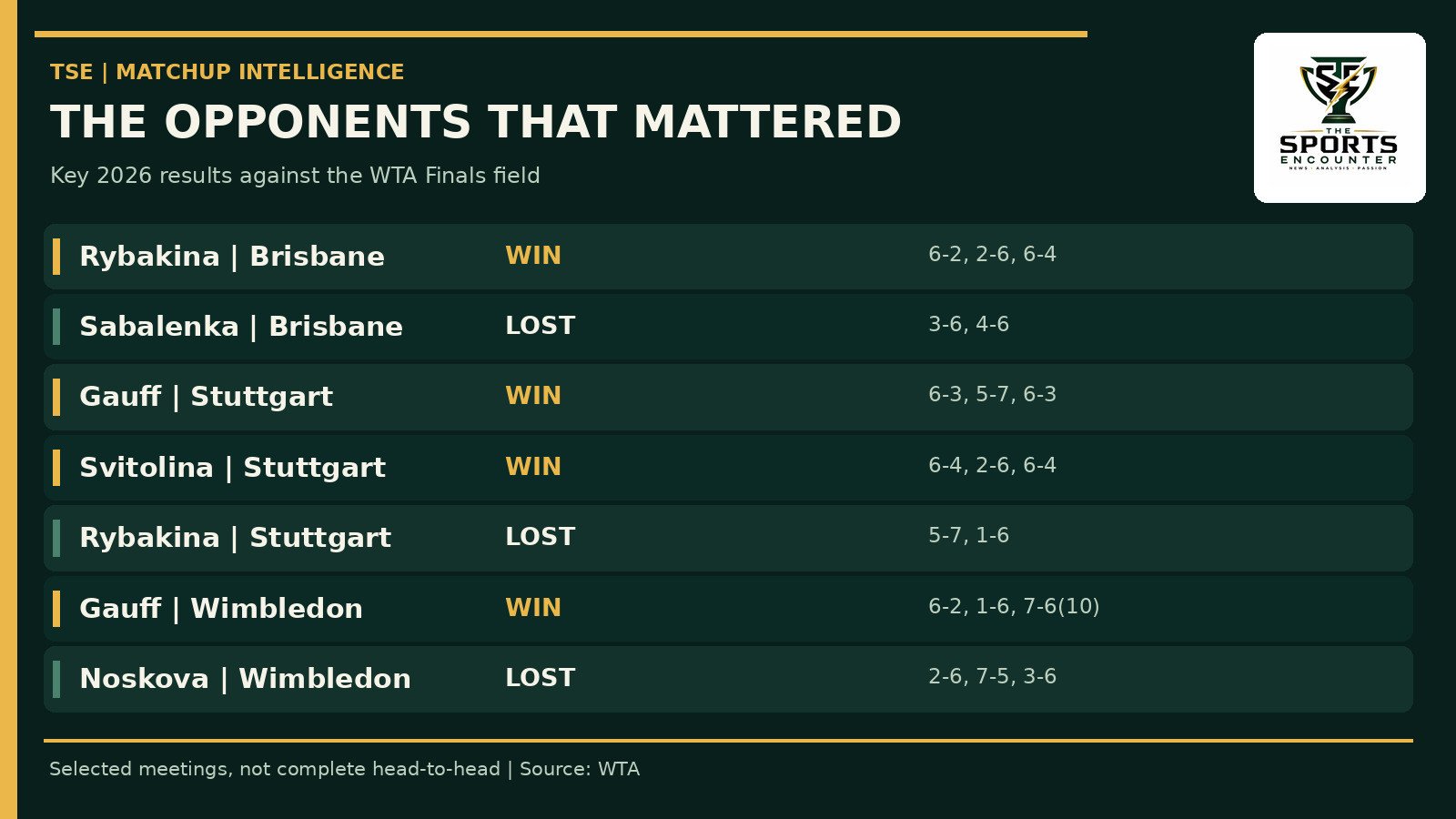
| Opponent | 2026 meeting | Result for Muchová | Competitive lesson |
|---|---|---|---|
| Elena Rybakina | Brisbane quarterfinal | Won 6-2, 2-6, 6-4 | Her tactical variety can trouble a powerful baseline player. |
| Aryna Sabalenka | Brisbane semifinal | Lost 3-6, 4-6 | Sabalenka’s pace limited Muchová’s ability to dictate rallies. |
| Coco Gauff | Australian Open fourth round | Lost 1-6, 6-3, 3-6 | Gauff’s movement and defensive consistency remained challenging. |
| Coco Gauff | Miami semifinal | Lost 1-6, 1-6 | Gauff controlled the baseline exchanges decisively. |
| Coco Gauff | Stuttgart quarterfinal | Won 6-3, 5-7, 6-3 | Demonstrated improvement against an elite defender. |
| Elina Svitolina | Stuttgart semifinal | Won 6-4, 2-6, 6-4 | Found ways to break down sustained defensive pressure. |
| Elena Rybakina | Stuttgart final | Lost 5-7, 1-6 | Rybakina’s attacking consistency controlled the decisive stages. |
| Coco Gauff | Wimbledon semifinal | Won 6-2, 1-6, 7-6(10) | Saved a match point through aggressive, inventive tennis. |
| Linda Nosková | Wimbledon final | Lost 2-6, 7-5, 3-6 | Recovered from five championship points against her but lost the decider. |
Linda Nosková: A Historic Czech Rivalry
Muchová and Nosková represent different styles of Czech tennis.
Nosková relies heavily on direct power, aggressive groundstrokes and first-strike opportunities.
Muchová prefers to create uncertainty through variety, changes of pace, movement and approaches to the net.
The Wimbledon final showed that neither style guarantees victory.
Nosková dominated the opening exchanges, but Muchová adjusted and forced a deciding set.
A rematch at the WTA Finals would offer an intriguing tactical contest between two players who know each other’s strengths.
Coco Gauff: The Rival Who Forces Muchová to Find Answers
Gauff’s defensive ability creates a different challenge.
She can extend rallies, cover the court and force opponents to play additional attacking shots.
Muchová’s Australian Open defeat, Miami setback, Stuttgart victory and Wimbledon semifinal demonstrated that this matchup can change significantly depending on conditions and execution.
At Wimbledon, Muchová’s willingness to approach the net helped her escape a match that had appeared lost.
Why Muchová’s Playing Style Is So Difficult to Defend
Muchová does not rely entirely on power or defensive endurance.
Her greatest strength is the ability to change the structure of a rally.
She can attack with flat groundstrokes, introduce slices, create short angles, approach the net or use a drop shot to force an opponent forward.
Those options make it difficult for rivals to settle into predictable patterns.
One particularly revealing statistic comes from the WTA’s 2026 season review.
Muchová won 72% of her net points, the highest percentage among the eight WTA Finals singles qualifiers according to that review.
This figure is especially meaningful because her willingness to move forward is central to her identity as a player.
Rather than remaining behind the baseline in every rally, she looks for opportunities to finish points earlier.
However, attacking the net carries risks.
Opponents with strong passing shots, accurate returns and excellent movement can expose poorly timed approaches.
Can Karolína Muchová Win the WTA Finals 2026?
Muchová enters the championship as a legitimate contender, but not the overwhelming favorite.
Elena Rybakina and Aryna Sabalenka possess formidable attacking games, while Coco Gauff and Jessica Pegula bring considerable experience and consistency.
Mirra Andreeva, Elina Svitolina and Linda Nosková add further tactical challenges.
Still, Muchová has several important advantages.
1. She Can Adapt to Different Opponents
Her variety allows her to change tactics during a match.
Against powerful opponents, she can slow rallies and create awkward positions.
Against defensive players, she can approach the net and attempt to shorten points.
2. She Has Already Beaten Elite Players in 2026
Muchová’s victories over Rybakina, Gauff and Svitolina provide evidence that she can defeat highly ranked opponents.
Her Wimbledon semifinal demonstrated her ability to recover from a match point against her.
But those victories do not guarantee future success.
3. Her Net Game Could Be a Major Advantage
Her strong net-point winning percentage is an indication of attacking efficiency.
On a hard court, well-timed approaches can prevent opponents from developing their preferred baseline rhythm.
4. Her Physical Readiness Remains a Key Question
The biggest concern is whether her body can withstand a demanding championship schedule.
She missed important hard-court tournaments following her post-Wimbledon medical procedure.
Although she returned successfully, a round-robin format presents different recovery demands from a conventional knockout event.
What Must Muchová Do to Reach the WTA Finals Semifinals?
Muchová’s route to the semifinals will depend on her draw and the opponents assigned to her group.
At the WTA Finals, each player faces the other three members of her group.
The two leading players advance to the semifinals.
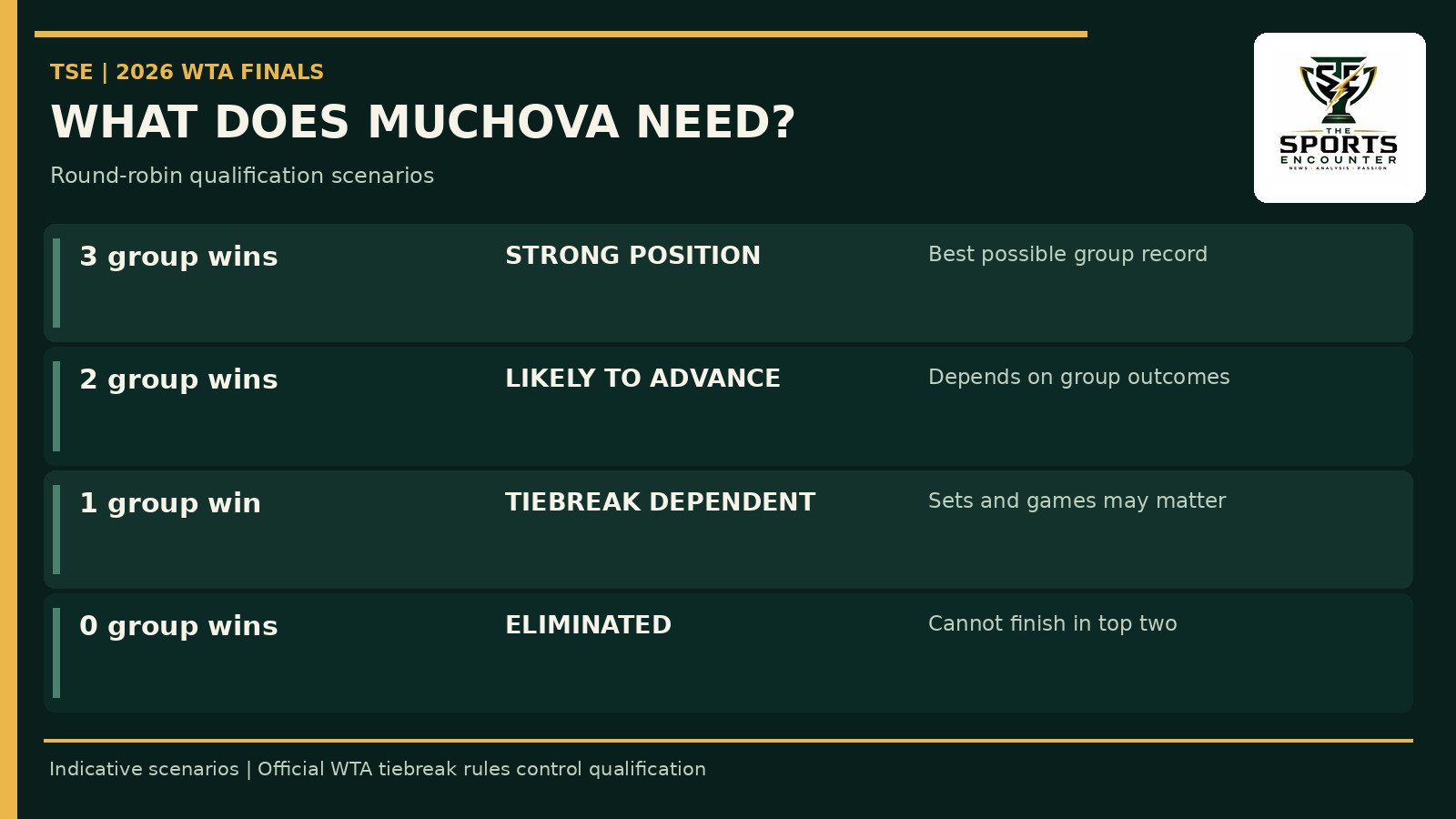
| Scenario | What it means | Muchová’s priority |
|---|---|---|
| Three group wins | Strongest possible round-robin record and guarantees advancement. | Maintain consistency and manage recovery. |
| Two group wins | Normally puts a player in a strong position, but qualification depends on other group outcomes and tiebreak criteria. | Protect sets and games even during difficult passages. |
| One group win | Advancement is possible in certain three-way ties, depending on official tiebreak criteria. | Avoid heavy defeats and compete for every game. |
| Three group defeats | Elimination from semifinal contention. | Assess performance against the elite field. |
The table describes possible scenarios rather than predicting a confirmed outcome. Actual advancement depends on official group standings and the competition’s tiebreak rules.
For the complete schedule, confirmed draw and updated results, follow The Sports Encounter’s WTA Finals 2026 hub.
The Sports Encounter Verdict: Muchová Has the Talent, but Can She Finally Complete the Journey?
Karolína Muchová’s 2026 season has already answered several questions.
She can win a WTA 1000 championship.
She can compete for titles on hard courts, clay and grass.
She can recover from difficult matches against elite opponents.
And she can return from another medical interruption to compete at the highest level.
But the biggest singles achievement remains missing.
She has reached two Grand Slam singles finals without winning either.
Her first opportunity to compete at the WTA Finals gives her another chance to turn extraordinary talent into a major championship.
The competition’s round-robin format could suit her creativity because she does not need to win every match to progress.
However, the same format demands sustained physical and tactical consistency against opponents who will be difficult to defeat.
Our assessment: Muchová is a credible semifinal contender and one of the most dangerous tactical opponents in the field. A championship run is possible if she maintains her physical condition, protects her serve and converts her net opportunities. Her recent results justify ambition, but the strength of the field prevents her from being considered the clear favorite.
For additional tournament context, read our comprehensive WTA Finals 2026 preview, which examines the eight contenders and the challenges awaiting them at Indian Wells.
Continue the WTA Finals Story
 WTA FinalsLinda Nosková’s Remarkable 2026: Wimbledon Glory, Personal Loss and a WTA Finals Dream
 WTA FinalsElina Svitolina’s Defiant 2026: 20 Titles, a Wimbledon Collapse and One More Shot at WTA Finals Glory
 WTA FinalsCoco Gauff’s Turbulent 2026: A Rebuilt Serve, Cincinnati Glory, and the Fight for WTA Finals Redemption
Frequently Asked Questions About Karolína Muchová
How Old Is Karolína Muchová?
She was born on August 21, 1996, and is 30 years old as of November 4, 2026.
Where Was Karolína Muchová Born?
She was born in Olomouc, Czechia.
Who Are Karolína Muchová’s Parents?
Her father is Josef Mucha, a former professional soccer player. Her mother is Hana Muchová.
Does Karolína Muchová Have a Brother?
Yes. Her brother, Filip Mucha, pursued a career as a soccer goalkeeper.
Is Karolína Muchová Married?
There is no reliably verified public confirmation of a marriage in the sources reviewed for this article.
Does Karolína Muchová Have a Boyfriend?
Her current romantic relationship status has not been reliably established through the public sources reviewed for this profile.
Who Is Karolína Muchová’s Coach?
The WTA identifies Sven Groeneveld as her coach.
What Is Karolína Muchová’s Current Ranking?
She was ranked world No. 7 in the November 2, 2026 standings, having reached a career-high No. 6.
How Many WTA Singles Titles Has Muchová Won?
She has won three WTA singles championships: Seoul in 2019, Doha in 2026 and Bad Homburg in 2026.
Has Karolína Muchová Won a Grand Slam?
She won the US Open mixed doubles championship with Jakub Menšík in 2026. She has not won a Grand Slam singles title, having finished runner-up at Roland-Garros in 2023 and Wimbledon in 2026.
Who Beat Karolína Muchová in the Wimbledon 2026 Final?
Linda Nosková defeated Muchová 6-2, 5-7, 6-3.
Why Did Karolína Muchová Miss Toronto and Cincinnati?
She underwent a medical procedure after Wimbledon and missed several weeks while recovering. The precise nature of the procedure was not publicly disclosed in the announcement reviewed for this article.
Is Karolína Muchová Playing in the WTA Finals 2026?
Yes. She qualified for the season-ending championship in Indian Wells. It will be her first actual appearance after an injury prevented her from participating following her qualification in 2023.
Official Sources and Further Reading
Muchová’s official WTA player profile provides her biography, career statistics and title history. The WTA match archive contains her tournament-by-tournament results. The WTA’s Doha championship report documents her first WTA 1000 title.
This article is the second installment of The Elite Eight: Road to the WTA Finals 2026, The Sports Encounter’s eight-player series examining the careers, personal histories, seasonal performances and championship prospects of the women qualified for the season-ending tournament.