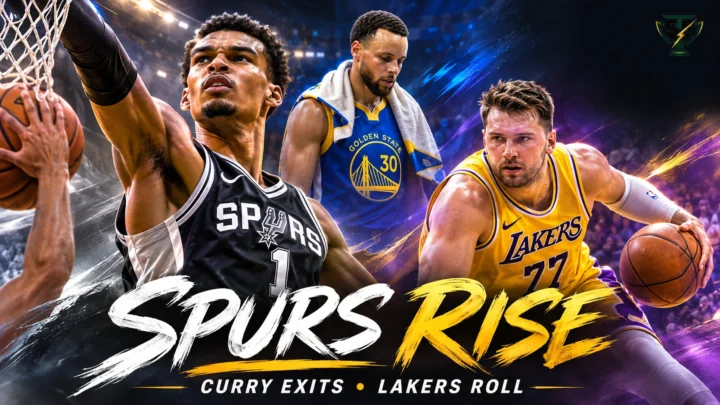
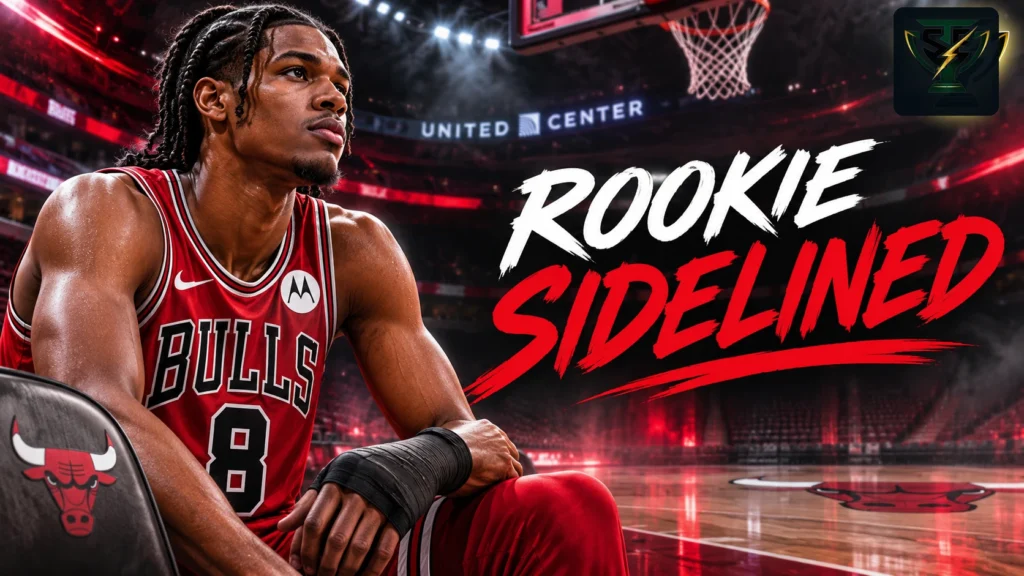
CHICAGO, United States, November 12, 2026: Chicago Bulls rookie Caleb Wilson is expected to miss four to six weeks after fracturing his right hand during Wednesday’s 124-119 defeat to the San Antonio Spurs. The 20-year-old forward, selected fourth overall in the NBA Draft, will undergo surgery after sustaining the injury while attempting to defend Victor Wembanyama. Wilson’s absence removes one of Chicago’s most productive players from a team that has opened the season with nine defeats in 10 games.
The Caleb Wilson injury is especially damaging because the former North Carolina standout had already established himself as a central figure in Chicago’s rebuilding project. He entered the Spurs game averaging 19.3 points and 6.3 rebounds, then scored 15 points in only 15 minutes before leaving. The Bulls subsequently squandered a 22-point lead, extending their losing streak to eight games. Coach Tiago Splitter must now redistribute Wilson’s scoring and defensive responsibilities while protecting the development of one of the franchise’s most valuable young players.
Key Takeaways
- Chicago Bulls rookie Caleb Wilson is expected to miss four to six weeks after fracturing his right hand during Wednesday’s 124-119 defeat to the San Antonio Spurs.
- The Caleb Wilson injury is especially damaging because the former North Carolina standout had already established himself as a central figure in Chicago’s rebuilding project.
- The Bulls have won only one of their first 10 games under first-year head coach Tiago Splitter.
- The Caleb Wilson injury deprives Chicago of one of the strongest individual performances from its opening 10 games.
Caleb Wilson Injury Update: Surgery and Recovery Timeline
Wilson suffered the fracture during the third quarter against San Antonio at the United Center.
Story at a glance
Caleb Wilson Injury Update: Surgery and Recovery Timeline
Wilson suffered the fracture during the third quarter against San Antonio at the United Center.
Caleb Wilson Was Emerging as Chicago’s Most Important Young Player
The Bulls selected Wilson with the fourth overall pick in the draft after his outstanding freshman season at North Carolina.
How Chicago Lost a 22-Point Lead Against San Antonio
The injury occurred during a game that initially looked capable of ending Chicago’s losing streak.
Who Replaces Caleb Wilson in the Bulls’ Rotation?
Splitter has several possible options, although none offers an exact replacement for Wilson’s combination of size, athleticism and developing offensive ability.
Chicago’s 1-9 Start Makes the Injury Even More Damaging
The Bulls have won only one of their first 10 games under first-year head coach Tiago Splitter.
He was attempting to disrupt a possession involving Wembanyama when his right hand made contact during the defensive play. Wilson subsequently left the floor and did not return.
Chicago initially announced that he was unavailable for the remainder of the game because of a right-hand injury.
Further examination established the fracture, with subsequent reporting confirming that surgery would be required.
The projected recovery period is four to six weeks. Chicago Sports Network reporter K.C. Johnson also reported that Wilson would likely undergo reevaluation after approximately three weeks.
The NBA’s official injury coverage documents the play against San Antonio and the team’s initial decision to rule him out.
| Injury Detail | Confirmed or Reported Information |
|---|---|
| Player | Caleb Wilson, Chicago Bulls |
| Age | 20 |
| Injury | Fractured right hand |
| When it occurred | Against San Antonio, November 11 |
| Treatment | Surgery reported as required |
| Estimated absence | Four to six weeks |
| Expected reevaluation | Approximately three weeks |
| Official return date | Not established |
A four-week absence would extend into approximately mid-December, while six weeks would take Wilson toward the final part of December.
Those are calendar illustrations of the reported recovery window, not guaranteed return dates. Medical clearance, healing and basketball-specific rehabilitation will determine his actual availability.
Why the Caleb Wilson Injury Raises Additional Concern
The latest fracture follows two separate hand injuries during Wilson’s freshman season at North Carolina.
He broke a bone in his left hand in February, an injury that interrupted his college campaign.
While preparing to return, he then fractured his right thumb during a practice drill in March. That injury required surgery and ended his season before the NCAA tournament.
Wilson therefore enters another recovery period less than a year after experiencing significant problems involving both hands.
However, those previous injuries do not establish that the latest fracture was caused by an underlying medical condition or that he faces a greater risk of another injury.
The earlier fractures involved different circumstances, and publicly available reporting does not provide sufficient clinical evidence to establish a common cause.
Chicago’s immediate responsibility is ensuring that Wilson completes the necessary recovery before returning to competitive basketball.
Caleb Wilson Was Emerging as Chicago’s Most Important Young Player
The Bulls selected Wilson with the fourth overall pick in the draft after his outstanding freshman season at North Carolina.
His combination of athleticism, length, scoring ability and defensive activity made him an attractive prospect for a franchise undergoing substantial roster changes.
Through his first 10 NBA appearances, Wilson has averaged 18.9 points, 6.2 rebounds, 1.9 assists and approximately 1.8 steals.
His field-goal percentage is around 42%, showing that his offensive efficiency remains a work in progress despite encouraging scoring production.
He has also taken considerably more three-point attempts than during his college career, a significant adjustment for a young forward learning to operate within NBA spacing and defensive schemes.
According to the Chicago Bulls’ official player profile, Wilson entered the San Antonio matchup averaging 19.3 points and 6.3 rebounds.
The slightly lower 18.9-point and 6.2-rebound figures reported afterward reflect the updated 10-game sample, including his abbreviated appearance against the Spurs.
What His Rookie Numbers Reveal
| Measure | Through 10 Games |
|---|---|
| Points per game | 18.9 |
| Rebounds per game | 6.2 |
| Assists per game | 1.9 |
| Steals per game | Approximately 1.8 |
| Field-goal percentage | Approximately 42% |
| Team record | 1-9 |
| Draft position | Fourth overall |
Wilson’s scoring represents a substantial portion of Chicago’s offensive production, but his value also lies in the defensive activity and versatility he brings to the forward positions.
He can challenge shots, disrupt passing lanes and contribute in transition.
His offensive game remains unfinished, particularly when creating efficient attempts against established NBA defenders.
That developmental stage makes his injury different from the loss of an established veteran.
Chicago is losing both immediate production and several weeks of important NBA experience for a player expected to help shape the franchise’s future.
How Chicago Lost a 22-Point Lead Against San Antonio
The injury occurred during a game that initially looked capable of ending Chicago’s losing streak.
The Bulls scored 41 points in the opening quarter and led 70-56 at halftime.
They had established a lead of 22 points during the second quarter, using effective ball movement and accurate shooting to trouble San Antonio’s defense.
Jalen Smith matched his career high with 23 points, while Wilson contributed 15 points on five-of-seven shooting before exiting.
The game changed after halftime.
Chicago committed eight turnovers during the third quarter as San Antonio intensified its defensive pressure.
The Spurs outscored the Bulls 68-49 in the second half and began the fourth quarter with an 11-2 run.
Wembanyama finished with 32 points and nine rebounds, helping San Antonio extend its winning streak to 10 games.
Dylan Harper added 18 points and 10 assists, while De’Aaron Fox contributed 17 points.
Chicago’s late attempt to recover proved insufficient, with the Spurs winning 124-119.
The Bulls’ official game analysis identifies second-half turnovers and the inability to sustain their early offensive rhythm as central factors in the defeat.
Was Wilson’s Departure the Turning Point?
Wilson’s absence removed an effective scorer and active defender from Chicago’s rotation.
However, the Bulls’ problems cannot be attributed entirely to his injury.
San Antonio had already begun recovering from its first-half deficit, and Chicago’s turnovers were a major factor in the change of momentum.
Wilson’s departure made the situation more difficult by reducing Splitter’s options during the second half.
It did not independently cause the Bulls to lose a 22-point advantage.
That distinction matters when assessing the team’s broader problems.
Chicago was already struggling to win games with Wilson available. His injury now removes one of the players who had provided the strongest evidence of progress.
Who Replaces Caleb Wilson in the Bulls’ Rotation?
Splitter has several possible options, although none offers an exact replacement for Wilson’s combination of size, athleticism and developing offensive ability.
Noa Essengue, Patrick Williams and Leonard Miller are among the players who could receive additional playing time.
Josh Giddey and Matas Buzelis may also be required to handle greater offensive responsibilities.
| Player | Possible Adjustment | Main Consideration |
|---|---|---|
| Matas Buzelis | Greater scoring responsibility | Shot creation and offensive consistency |
| Josh Giddey | More playmaking responsibility | Ball security and organizing possessions |
| Patrick Williams | Additional forward minutes | Defensive assignments and availability |
| Noa Essengue | Larger developmental role | Experience against NBA-level opposition |
| Leonard Miller | Additional frontcourt opportunities | Rebounding and defensive coverage |
| Norman Powell | Potential additional perimeter scoring | Return from back-related absence |
These are potential rotation adjustments, not a confirmed starting lineup or an announcement of additional minutes for any individual player.
Buzelis represents one of Chicago’s most important remaining young building blocks.
He has the size and attacking skill to assume more responsibility, but the Spurs game highlighted the need for better decision-making under defensive pressure.
Giddey faces a similar challenge as a primary organizer of Chicago’s offense.
When Wilson was available, the Bulls could distribute certain offensive responsibilities across several players.
His absence increases the importance of maintaining good spacing, avoiding turnovers and creating opportunities through collective movement.
Chicago’s 1-9 Start Makes the Injury Even More Damaging
The Bulls have won only one of their first 10 games under first-year head coach Tiago Splitter.
Their eight-game losing streak has already placed them among the league’s poorest-performing teams.
According to contemporary NBA statistical reporting, Chicago also sits at the bottom of the league’s net-rating rankings.
Wilson’s injury makes immediate improvement more difficult, although the team’s problems existed before he was hurt.
The Bulls have struggled to sustain defensive intensity, protect possession and convert strong stretches of play into victories.
The San Antonio game demonstrated all three issues.
Chicago’s early offense was highly effective, but the team could not maintain that standard when the Spurs increased pressure after halftime.
Wilson had been one of the few players providing consistent scoring and defensive activity.
Without him, Chicago must identify which younger players can shoulder greater responsibility while ensuring that the team’s development plan does not depend entirely on short-term results.
The Sports Encounter’s earlier NBA roundup featuring Wembanyama and other emerging stars provides context for the increasingly influential role young players are taking across the league.
What the Injury Means for the Rookie of the Year Race
Wilson’s performances had placed him among the notable early candidates for NBA Rookie of the Year.
His scoring, rebounding and defensive activity offered encouraging evidence that he could compete for individual recognition despite Chicago’s difficult team results.
The injury interrupts that campaign at an important stage.
A four-to-six-week absence would remove multiple opportunities to accumulate games, develop consistency and demonstrate progress against different opponents.
The impact on the award race will depend on how many games he ultimately misses, his performance following his return and the results produced by other rookies.
The injury does not automatically eliminate him from award consideration.
However, the NBA’s minimum-game participation rules for major awards may become relevant if his absence extends or if he misses additional games later in the season.
Wilson is part of a talented rookie class that includes players such as Cameron Boozer, A.J. Dybantsa and Yaxel Lendeborg.
Several have already demonstrated an ability to make meaningful contributions during their first professional seasons.
The Sports Encounter’s recent NBA results roundup offers additional context on the competitive environment in which emerging players are establishing themselves.
Continue the NBA Story


For Chicago, however, Wilson’s long-term development is more important than the outcome of one individual award.
The Recovery Period Is Also a Test of Chicago’s Development Plan
The Bulls must manage two competing priorities.
They need to remain competitive while Wilson is unavailable, but they must also protect a player expected to have an important role in the franchise’s future.
That makes the recovery process more significant than simply identifying the earliest possible return date.
Wilson’s shooting, ballhandling and defensive responsibilities place repeated demands on his hands.
His return must therefore account for his ability to perform basketball-specific movements safely, rather than relying solely on the passage of four or six weeks.
There is no public medical evidence establishing that Wilson will experience lasting limitations from the fracture.
Equally, it would be premature to guarantee that he will resume his previous workload immediately after receiving clearance.
His rehabilitation and the Bulls’ medical assessments will determine that progression.
Chicago must also resist allowing a difficult team record to create unnecessary pressure for an accelerated return.
Injuries to other prominent NBA players have similarly forced teams to balance availability with longer-term competitive objectives. TSE previously examined that challenge in its coverage of Kawhi Leonard’s recovery and Toronto’s roster decisions.
Can the Bulls Stabilize Their Season Without Wilson?
Chicago’s immediate schedule continues with a home game against the Atlanta Hawks on Friday.
That contest presents an early test of how Splitter adjusts his rotation without the rookie forward.
The Bulls will need stronger contributions from their established players while providing meaningful opportunities to younger members of the squad.
Improving ball security should be a priority after the turnover problems that allowed San Antonio to overcome a substantial deficit.
Chicago also needs more consistent defensive execution, particularly against opponents capable of accelerating the pace after forcing turnovers.
The team’s previous defeats have highlighted how quickly games can turn when Chicago loses control of possession.
That problem cannot be solved solely through an individual player’s return.
Splitter must develop a more dependable collective approach regardless of which players are available.
The Bulls’ broader difficulties form part of a competitive Eastern Conference in which teams such as Philadelphia have already demonstrated the value of reliable offensive organization. The Sports Encounter examined that quality in its analysis of Philadelphia’s comeback against Cleveland.
Caleb Wilson’s Absence Changes Chicago’s Immediate Priorities
The Caleb Wilson injury deprives Chicago of one of the strongest individual performances from its opening 10 games.
Wilson had already demonstrated that he could score, rebound and contribute defensively against established NBA players.
He was also gaining valuable experience in a rebuilding team that needs to identify its future core.
His fractured right hand now interrupts that progress for an estimated four to six weeks.
For the Bulls, the immediate challenge is redistributing his responsibilities while addressing the problems that produced a 1-9 start.
For Wilson, the priority is completing surgery and rehabilitation before returning to the court.
Chicago’s long-term outlook will depend more on his sustained development than on whether he returns at the earliest end of the projected recovery window.
The Bulls have lost one of their brightest young contributors. Their response over the coming weeks will reveal how effectively the rest of the roster can develop without him.