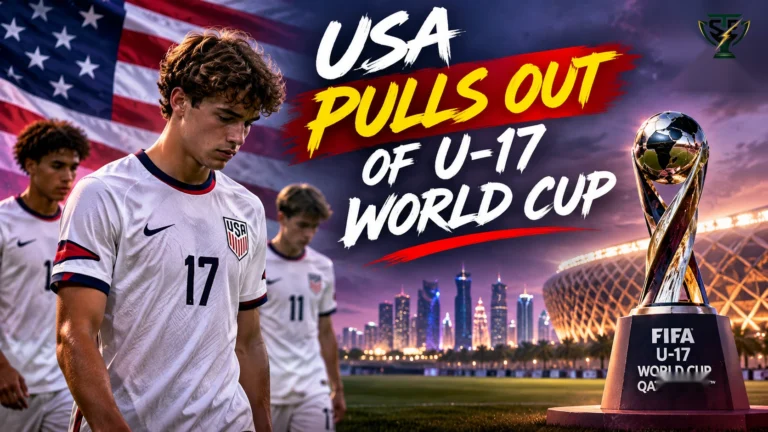
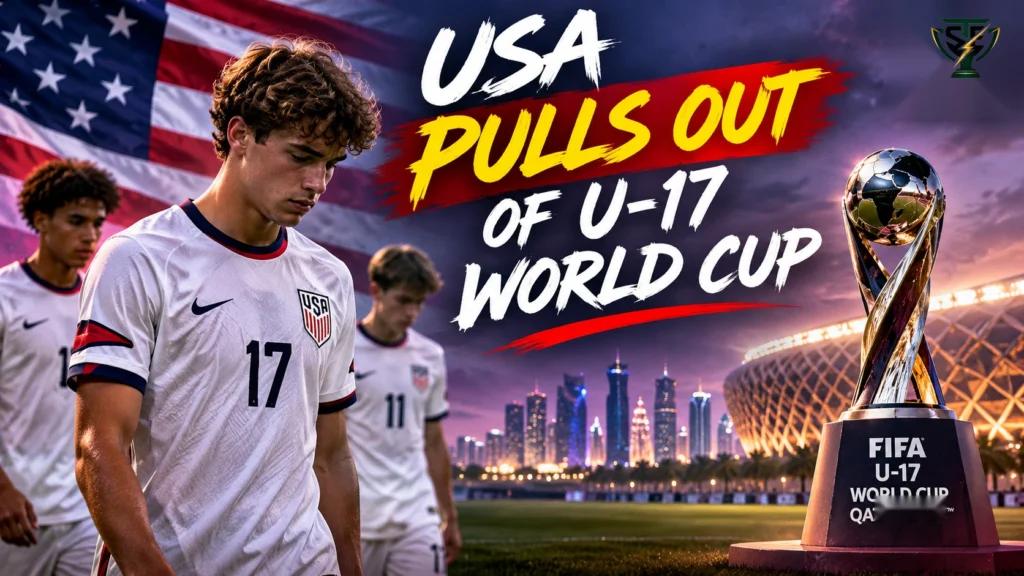
ATLANTA, United States, November 12, 2026: The United States has withdrawn its men’s Under-17 national team from the FIFA U-17 World Cup in Qatar over security concerns, ending the participation of 21 young players just eight days before the tournament begins. U.S. Soccer informed the squad on Wednesday that it was cancelling both the team’s pre-tournament training camp and its World Cup appearance, citing the State Department’s Level 3 travel advisory and the risks associated with the continuing conflict in the Middle East.
FIFA acknowledged the withdrawal but maintained that its security assessment for the tournament had not changed. The decision leaves Group J without one of its four original participants and raises questions about a possible replacement, disciplinary penalties and the competitive consequences for Montenegro, Chile and Algeria. It also denies a promising American squad the opportunity to compete on the international stage after qualifying earlier this year.
Key Takeaways
- The United States has withdrawn its men’s Under-17 national team from the FIFA U-17 World Cup in Qatar over security concerns, ending the participation of 21 young players just eight days before the tournament begins.
- The letter explained that the decision reflected the State Department’s travel advisory and restrictions affecting American diplomatic personnel in the region.
- The central factor behind the withdrawal is the United States government’s Level 3 travel advisory for Qatar, which instructs American citizens to reconsider travel because of the risk of armed conflict.
- The controversy is particularly important because FIFA selected Qatar to host the men’s U-17 World Cup annually from 2025 through 2029.
Why the United States Withdrew From the FIFA U-17 World Cup
U.S. Soccer communicated its decision directly to players and staff in a letter obtained by Reuters.
Story at a glance
Why the United States Withdrew From the FIFA U-17 World Cup
U.S. Soccer communicated its decision directly to players and staff in a letter obtained by Reuters.
US State Department’s Qatar Advisory Explains the Security Concerns
The central factor behind the withdrawal is the United States government’s Level 3 travel advisory for Qatar, which instructs American citizens to reconsider travel because of the risk of armed conflict.
FIFA Disagrees That Security Conditions Have Changed
FIFA’s response introduced an important distinction between the federation’s decision and the tournament organizer’s assessment.
USA’s Withdrawal Leaves Group J Facing Uncertainty
The United States had been drawn into Group J alongside Montenegro, Chile and Algeria.
Could the Dominican Republic Replace the United States?
The Dominican Republic has emerged as a potential replacement because it finished second behind the United States in their CONCACAF qualifying group.
The federation said it had evaluated the current security environment and concluded that sending its youth squad to Qatar was no longer appropriate.
The letter explained that the decision reflected the State Department’s travel advisory and restrictions affecting American diplomatic personnel in the region.
It emphasized the federation’s responsibility to protect its players and staff while acknowledging the disappointment caused by withdrawing from a tournament for which the squad had already prepared.
U.S. Soccer also informed the players that their clubs would be notified and requested that they avoid public comments until FIFA had formally addressed the withdrawal.
The decision came only five days after head coach Alex Aldaz announced his 21-player World Cup roster.
Those selections included promising players from Major League Soccer academies and established European clubs. Several had played important roles in the qualification campaign, making the withdrawal especially consequential for athletes who had earned their places through competitive performances.
US State Department’s Qatar Advisory Explains the Security Concerns
The central factor behind the withdrawal is the United States government’s Level 3 travel advisory for Qatar, which instructs American citizens to reconsider travel because of the risk of armed conflict.
The State Department’s official Qatar travel advisory was updated on October 23, reflecting increased concern about regional hostilities and potential attacks.
The advisory specifically identifies threats associated with Iranian-supported Houthi forces, including attacks on civilian airports and critical infrastructure in neighboring Saudi Arabia.
It also notes concerns about efforts to target American government officials in the region.
These developments have created an increasingly complicated security environment for international travel, particularly for American organizations responsible for sending large groups of personnel overseas.
Although Qatar has continued hosting international events, U.S. Soccer faced an additional responsibility because its delegation consisted primarily of minors.
The players were largely 16 and 17 years old, accompanied by coaches, medical personnel and administrative staff.
The federation therefore had to consider not only the safety of its delegation during the competition but also the risks associated with international travel, emergency contingencies and potential changes to regional security conditions.
A Level 3 advisory does not automatically prohibit all travel. However, the federation determined that the combination of the advisory and other security considerations warranted withdrawing the team.
FIFA Disagrees That Security Conditions Have Changed
FIFA’s response introduced an important distinction between the federation’s decision and the tournament organizer’s assessment.
The governing body confirmed that it had received notification from U.S. Soccer but said its own security assessments remained unchanged.
FIFA also indicated that no new developments had altered its evaluation of the tournament’s safety arrangements.
It stressed its continuing coordination with Qatari authorities and pointed to international sporting events that had already been staged in the country.
Consequently, the World Cup remains scheduled to proceed from November 19 through December 13.
The disagreement does not necessarily mean that either organization is applying the same standard of risk.
U.S. Soccer must assess the implications of American government guidance for its own delegation. FIFA must evaluate whether the tournament can operate with appropriate security arrangements for all participating teams.
Those responsibilities overlap but are not identical.
The withdrawal therefore represents a national federation declining to participate under existing conditions rather than FIFA cancelling or relocating the competition.
That distinction matters when considering the potential disciplinary consequences and the possibility of replacing the United States in the tournament.
USA’s Withdrawal Leaves Group J Facing Uncertainty
The United States had been drawn into Group J alongside Montenegro, Chile and Algeria.
The Americans were scheduled to begin their campaign against Montenegro on November 21, followed by Chile on November 24 and Algeria on November 27.
All three group matches were scheduled for the Aspire Zone Sports Complex in Qatar.
| Scheduled Date | USA Opponent | Original Kickoff | Current Position |
|---|---|---|---|
| November 21 | Montenegro | 5:30 p.m. Qatar time | USA withdrawn; fixture resolution pending |
| November 24 | Chile | 5:30 p.m. Qatar time | USA withdrawn; fixture resolution pending |
| November 27 | Algeria | 6:00 p.m. Qatar time | USA withdrawn; fixture resolution pending |
FIFA has not announced whether another country will replace the United States or how the three affected matches will be handled.
That decision matters because the tournament’s expanded format allows the top two teams from each of the 12 groups, along with the eight best third-place finishers, to advance to the Round of 32.
Any change to the number of teams or matches in Group J could affect the competitive balance and the method used to determine advancement.
For example, allowing the group to proceed with only three countries would require FIFA to clarify how its results compare with those from four-team groups.
Alternatively, introducing a replacement nation would preserve the original group structure but create a substantial logistical challenge with the tournament approaching.
Neither outcome should be treated as confirmed until FIFA announces its decision.
Could the Dominican Republic Replace the United States?
The Dominican Republic has emerged as a potential replacement because it finished second behind the United States in their CONCACAF qualifying group.
However, FIFA has not confirmed that the Caribbean nation will receive the vacant place.
The competition’s regulations allow FIFA to consider replacing a participating association that withdraws, but the decision rests with the governing body’s relevant authorities.
The timing presents practical complications.
A replacement federation would need to assemble an eligible squad, complete administrative requirements and arrange travel with very little preparation time.
FIFA would also need to consider whether the replacement country accepts the tournament’s existing conditions and can meet its operational obligations.
The Dominican Republic’s position in qualifying makes it a logical candidate for consideration, but it does not establish an automatic right to participate.
Until FIFA announces a replacement or confirms an alternative arrangement, Group J’s final composition remains unresolved.
Could U.S. Soccer Face a Financial Penalty?
The timing of the withdrawal also creates a potential disciplinary issue.
FIFA’s tournament regulations provide for a minimum fine of 20,000 Swiss francs when a qualified association withdraws fewer than 30 days before the competition begins.
That provision could apply to the United States, which confirmed its withdrawal eight days before the opening matches.
However, the existence of a regulatory penalty does not mean FIFA has already imposed it.
The disciplinary authorities would need to consider the circumstances and the applicable regulations before announcing any sanction.
The security justification may form part of that evaluation, but there is no confirmed decision establishing whether the withdrawal will be accepted without a penalty or result in disciplinary action.
Any additional consequences should likewise be treated as conditional rather than established.
The Withdrawal Denies 21 American Players a Major Development Opportunity
Beyond the tournament’s administrative consequences, the most immediate impact falls on the players.
Head coach Alex Aldaz had selected a 21-man squad featuring 14 players affiliated with MLS clubs and seven based with European teams.
The overseas contingent included players from Ajax, Feyenoord, PSV Eindhoven, AC Milan, Augsburg, Girona and Queens Park Rangers.
The roster reflected the increasingly international development pathway available to talented American teenagers.
According to U.S. Soccer’s official squad announcement, nine players had already represented the country during World Cup qualification.
The federation had selected 18 players born in 2009 and three born in 2010, creating a group with considerable potential for future youth and senior international involvement.
The World Cup would have provided an opportunity to face different tactical systems, experience international tournament pressure and test their development against leading players from other confederations.
Those opportunities cannot be fully replicated through domestic academy competition or ordinary international training camps.
For some players, the tournament might also have provided increased visibility among scouts and development specialists from overseas clubs.
Its cancellation means those athletes lose an important competitive experience, regardless of whether they eventually progress to higher levels of international football.
Malik Jakupovic’s Qualification Record Shows What the Squad Was Losing
Philadelphia Union forward Malik Jakupovic was among the most prominent members of the selected squad.
He scored eight goals during the United States’ three-match qualification campaign, contributing significantly to the team’s place at the World Cup.
The Americans opened qualifying with an 8-0 victory over Saint Vincent and the Grenadines before defeating Saint Kitts and Nevis 10-0.
They subsequently drew 1-1 with the Dominican Republic despite playing the closing 12 minutes with 10 men.
The results secured first place in Group E and confirmed qualification.
| U.S. Qualification Record | Result |
|---|---|
| Matches played | 3 |
| Wins | 2 |
| Draws | 1 |
| Defeats | 0 |
| Goals scored | 19 |
| Goals conceded | 1 |
| Malik Jakupovic goals | 8 |
TSE statistical analysis: Jakupovic accounted for 42.1% of the United States’ 19 qualifying goals. This share is calculated from the federation’s published totals and demonstrates his importance to the team’s successful campaign.
His performances made him one of the players worth watching at the tournament.
The withdrawal also interrupts the international development of other promising players, including those attached to established European academies.
The Sports Encounter has examined the broader challenge of developing young footballers in its analysis of FIFA’s new youth soccer development initiatives, including the importance of providing international competitive opportunities at younger ages.
The cancellation of the American team’s participation illustrates how circumstances outside the game can disrupt that development pathway.
Regional Conflict Has Already Disrupted Major Sporting Events
The American withdrawal is part of a wider pattern of international sporting events being affected by the security situation in the Middle East.
Organizers across different sports have faced difficult decisions involving travel, venue suitability, participant safety and the financial consequences of postponements.
Formula One has retained Qatar and Abu Dhabi on its season-ending calendar despite continued uncertainty over regional security conditions.
That decision, and the possibility that the calendar could change if the situation deteriorates, was examined in TSE’s report on Formula One’s Gulf race safety assessments.
MotoGP has faced similar concerns, with the Qatar Grand Prix becoming part of the wider debate about the feasibility of staging elite competitions during a period of regional instability.
The Sports Encounter explored those concerns in its coverage of the Qatar MotoGP event and its security challenges.
Soccer has also experienced direct disruption.
The Asian Football Confederation postponed the 2027 Asian Cup in Saudi Arabia following the escalating conflict, creating substantial changes to the regional football calendar.
TSE previously detailed the sporting implications in its report on the AFC Asian Cup postponement.
Those examples demonstrate how security concerns can affect different sports and governing bodies in different ways.
However, the circumstances surrounding each event are not identical, and a decision by one organizer does not automatically establish that another tournament must be cancelled.
FIFA’s Five-Year Qatar Agreement Faces an Early Test
The controversy is particularly important because FIFA selected Qatar to host the men’s U-17 World Cup annually from 2025 through 2029.
Continue the Soccer Story



The arrangement accompanied the expansion of the tournament from 24 to 48 teams and its transition to an annual competition.
FIFA’s stated objective was to create more international opportunities for young players while using existing infrastructure to improve operational efficiency.
Qatar’s stadiums, training facilities and experience hosting major international tournaments were important factors supporting the arrangement.
The country staged the senior men’s World Cup in 2022 and hosted the first expanded U-17 competition last year.
However, the American withdrawal raises a question that goes beyond the suitability of Qatar’s football facilities.
Long-term hosting agreements also depend on the ability of qualifying countries to travel and participate under conditions their federations consider acceptable.
When those assessments differ, FIFA must balance its contractual responsibilities, competition regulations and the concerns expressed by national associations.
The situation also illustrates the importance of contingency planning for major tournaments involving dozens of teams from different regions.
Security considerations have already influenced international football operations elsewhere, including protective measures around the senior World Cup.
The Sports Encounter previously investigated those challenges in its report on security threats and protective arrangements surrounding the FIFA World Cup.
Why the U-17 World Cup Withdrawal Matters for US Soccer
The immediate disappointment for American youth soccer comes at a time when the federation has been seeking to develop a stronger pathway between youth national teams, professional clubs and the senior men’s program.
International youth tournaments play an important role in that development because they expose players to different competitive approaches before they reach senior international level.
The withdrawal interrupts a campaign in which the United States had qualified convincingly and assembled a promising squad.
It also creates uncertainty for the players’ immediate schedules.
Some may return to their clubs for domestic competition or development programs, while others may resume training without an equivalent international tournament available.
The federation has not announced a replacement international competition for the affected squad.
Any future camp or alternative development opportunity will therefore require a separate announcement rather than being assumed as part of the withdrawal.
The decision also comes amid wider questions about the direction of American soccer after the senior men’s World Cup.
TSE explored that broader environment in its analysis of soccer’s growing audience in the United States and the challenge of sustaining that momentum.
Youth development remains an important part of building on that interest, particularly as MLS academies and international clubs provide more opportunities for young American players.
What FIFA Must Decide Before the Tournament Begins
The immediate administrative responsibility now rests with FIFA.
The governing body must clarify whether Group J will receive a replacement nation, how the affected fixtures will be handled and whether disciplinary proceedings will follow the American withdrawal.
Those decisions must be communicated before the competition reaches the affected group matches.
For Montenegro, Chile and Algeria, uncertainty surrounding the identity of their fourth group opponent complicates the final stages of tactical preparation.
A replacement team could introduce a different playing style and require last-minute adjustments to scouting plans.
If no replacement is selected, the group could operate under modified conditions, although FIFA would need to explain the implications for qualification and competitive fairness.
There is also a wider responsibility to maintain confidence among other participating nations.
FIFA has stated that its security assessment remains unchanged, but national federations will continue making their own decisions about the welfare of their delegations.
For U.S. Soccer, the decision is already final. The federation has withdrawn its team and cancelled the pre-tournament camp.
For the 21 American players, the consequence is immediate: an international opportunity earned through qualification has disappeared before a ball could be kicked.
The tournament is still scheduled to proceed in Qatar, but FIFA’s response to the withdrawal will now determine whether Group J begins with its intended structure and how the competition protects fairness for the teams that remain.
Qatar
- US Withdraws From U-17 World Cup in Qatar as Safety Fears Override Qualification
- Asian Juggernauts Lock Horns in International Soccer Friendlies
- Gulf Cup 27 Semifinals: Saudi Arabia’s Perfect Run Meets Qatar as UAE Face Oman’s Second Chance
- UAE and Qatar Seal Gulf Cup Semifinal Spots as Defending Champions Bahrain Bow Out
- Khoukhi and Al-Haydos Reset Qatar’s Mood as Holders Bahrain Fall 2-0