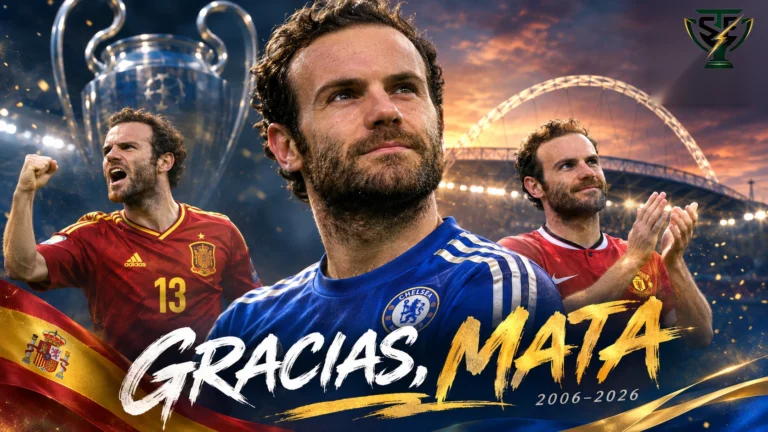
MADRID, Spain, November 19, 2026: Some footballers are remembered for the goals they scored. Others for the trophies they lifted, the defenders they tormented or the championships they helped win. Juan Mata will be remembered for all those things, but also for something increasingly rare in modern soccer: the quiet dignity with which he carried himself through two decades at the highest level. On November 18, the Spanish World Cup winner announced his retirement at 38, closing a remarkable career that took him from Valencia to Chelsea, Manchester United, Turkey, Japan and Australia.
The Juan Mata retirement marks the departure of one of Spain’s most accomplished and respected creative midfielders. A member of the country’s victorious 2010 World Cup squad, a scorer in the Euro 2012 final, a Champions League winner with Chelsea and a two-time Europa League champion, Mata collected honors that most professionals can only dream about. Yet his influence reached well beyond the scoreboard. Through his work with Common Goal, the former Manchester United playmaker demonstrated that football’s greatest rewards can also create opportunities for people who may never set foot inside a major stadium.
TL;DR: Juan Mata’s Retirement and Football Legacy
- Retirement: Juan Mata announced the end of his professional playing career on November 18, 2026, aged 38.
- International honors: Won the 2010 FIFA World Cup and UEFA Euro 2012 with Spain.
- Career-defining European success: Won the Champions League in 2012 and Europa League in 2013 with Chelsea, followed by another Europa League title with Manchester United in 2017.
- Unforgettable Wembley moment: Scored Manchester United’s equalizer in the 2016 FA Cup final against Crystal Palace.
- International record: Earned 41 Spain caps and scored ten goals.
- Global career: Represented Valencia, Chelsea, Manchester United, Galatasaray, Vissel Kobe, Western Sydney Wanderers and Melbourne Victory.
- Final playing chapter: Earned individual recognition for his performances with Melbourne Victory during the 2025-26 A-League season.
- Beyond football: Helped launch Common Goal’s 1% movement, encouraging footballers to direct resources toward community initiatives.
A Farewell That Says Everything About Juan Mata
Mata’s retirement announcement carried the same thoughtful tone that defined much of his playing career.
Rather than framing his departure around fading physical ability or the frustrations that can accompany the final years of a professional career, he approached retirement as the conclusion of a relationship that had shaped almost his entire life.
Story at a glance
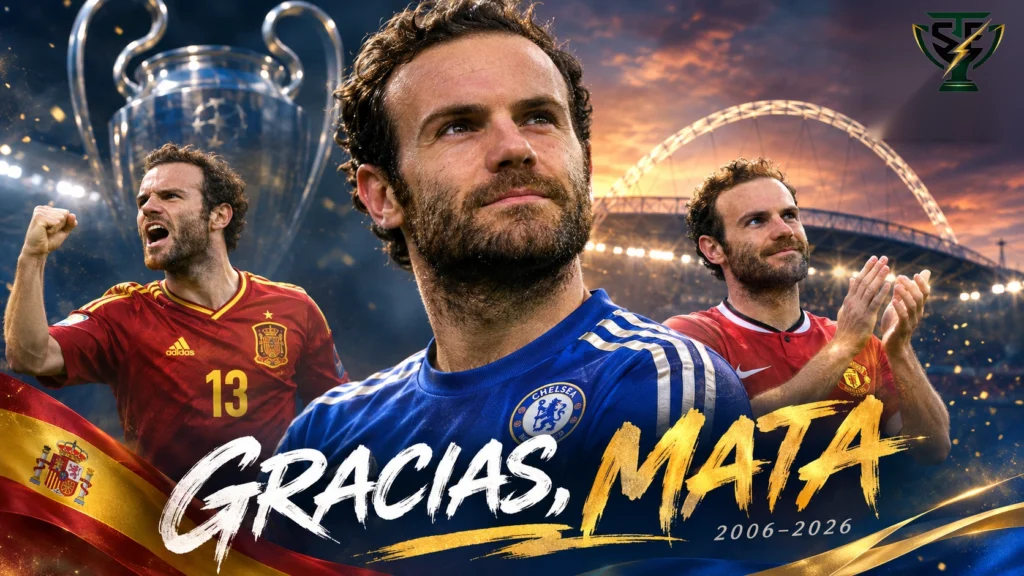
A Farewell That Says Everything About Juan Mata
Mata’s retirement announcement carried the same thoughtful tone that defined much of his playing career.
From Burgos to Valencia: The Making of a Different Kind of Playmaker
Born on April 28, 1988, in Burgos, Spain, Juan Manuel Mata García developed his footballing education in the youth systems of Real Oviedo and Real Madrid.
The Spain Years: World Cup Glory and a Goal in the Euro 2012 Final
International success arrived during the most extraordinary era in Spanish football history.
Chelsea’s Little Magician: The Player Who Helped Make European History
When Mata arrived at Chelsea from Valencia in August 2011, he joined a club searching for its first Champions League title.
The Corner That Helped Chelsea Win the 2013 Europa League
One of Mata’s most meaningful contributions at Chelsea came in the 2013 Europa League final against Benfica.
In a farewell shared through his official channels, Mata reflected on his affection for the game and the difficulty of knowing when to step away.
He acknowledged that football would continue to be part of his life, even if he would no longer experience it as a professional player.
The announcement prompted tributes from former clubs, teammates and supporters across different countries.
Chelsea remembered an elegant midfielder who had helped the club conquer Europe. Manchester United recalled a creative player whose technical ability and professionalism endured through years of enormous institutional change.
Melbourne Victory, his final club, thanked him for an outstanding contribution during the 2025-26 season.
That international response illustrates an important aspect of Mata’s reputation. He belonged to more than one footballing community, and each remembers a different part of the same career.
From Burgos to Valencia: The Making of a Different Kind of Playmaker
Born on April 28, 1988, in Burgos, Spain, Juan Manuel Mata García developed his footballing education in the youth systems of Real Oviedo and Real Madrid.
He progressed through Real Madrid Castilla but found his breakthrough in senior football after moving to Valencia in 2007.
It was there that his qualities became impossible to overlook.
Mata was not the kind of player who relied on intimidating physical strength or extraordinary sprinting speed. His game revolved around awareness, anticipation, balance and the ability to recognize opportunities before defenders understood that danger was developing.
He could operate between midfield and attack, receive the ball under pressure, change the direction of play and deliver the final pass with remarkable precision.
At Valencia, those qualities helped him establish himself as one of Spain’s most promising attacking midfielders.
His early success included the 2007-08 Copa del Rey, the first major trophy of a career that would eventually carry him to the highest level of international and European club football.
For Mata, Valencia was more than a steppingstone. It was the club where his football education developed into a recognizable senior identity.
The Spain Years: World Cup Glory and a Goal in the Euro 2012 Final
International success arrived during the most extraordinary era in Spanish football history.
Spain entered the 2010 World Cup with a generation capable of combining technical mastery, patient possession and exceptional positional intelligence.
Xavi Hernández, Andrés Iniesta, Iker Casillas, Xabi Alonso, Sergio Busquets and David Villa formed the foundation of a team that would transform how international soccer was played.
Mata was among the younger players selected for the tournament.
He made a substitute appearance against Honduras during the group stage and was part of the squad that went on to defeat the Netherlands in the final.
Iniesta’s extra-time winner secured Spain’s first World Cup title.
Mata did not play in that final, and his role in the tournament was limited. But he belonged to the group that achieved the greatest moment in the country’s soccer history.
The story became even more personal two years later.
At UEFA Euro 2012, Spain reached another major final, this time against Italy in Kyiv.
Vicente del Bosque’s team was already leading 3-0 when Mata entered late in the match.
He needed only a few minutes to make his contribution, receiving a pass from Fernando Torres and scoring Spain’s fourth goal.
It completed a 4-0 victory and secured Spain’s second successive European Championship.
For a player who had been a supporting member of the World Cup squad, scoring in a European Championship final represented a particularly meaningful moment.
TSE revisited the legacy of Spain’s 2010 triumph in From Johannesburg to New Jersey: Spain’s Two World Cup Heroes, comparing Iniesta’s defining contribution with Spain’s return to the summit in 2026.
Juan Mata’s International Career
| Milestone | Achievement | Importance |
|---|---|---|
| Senior international appearances | 41 | Represented Spain during its greatest modern era |
| International goals | 10 | Contributed from attacking midfield and wide positions |
| 2010 FIFA World Cup | Champion | Member of Spain’s first World Cup-winning squad |
| UEFA Euro 2012 | Champion | Scored Spain’s fourth goal against Italy in the final |
| 2011 UEFA European Under-21 Championship | Champion | Helped establish Spain’s next generation |
The overlooked distinction: Mata was part of Spain’s 2010 World Cup-winning squad, but his defining senior international moment on the pitch came in the Euro 2012 final.
That difference matters when assessing his career honestly. He was not the central architect of Spain’s international dominance, but he belonged to its golden generation and left a memorable contribution to one of its most celebrated victories.
Chelsea’s Little Magician: The Player Who Helped Make European History
When Mata arrived at Chelsea from Valencia in August 2011, he joined a club searching for its first Champions League title.
He quickly became an important part of the team’s attacking structure.
His intelligence between the lines, passing range and ability to create chances from crowded positions complemented the physicality and experience of players such as Didier Drogba, Frank Lampard and John Terry.
Chelsea’s 2011-12 campaign became one of the most memorable in European club history.
The London club survived difficult moments during the knockout stages before overcoming Bayern Munich in the Champions League final at the Allianz Arena.
Mata started the final, delivering creative support during a contest in which Chelsea spent long periods defending.
His attempt in the penalty shootout was saved by Manuel Neuer, but teammates recovered, Petr Čech produced crucial saves, and Drogba converted the decisive kick.
It was Chelsea’s first European Cup.
Mata had joined the club only months earlier, yet he finished his debut season as a Champions League and FA Cup winner.
And the next campaign would deliver another European trophy.
The Corner That Helped Chelsea Win the 2013 Europa League
One of Mata’s most meaningful contributions at Chelsea came in the 2013 Europa League final against Benfica.
With the score tied 1-1 in added time, Chelsea won a corner.
Mata delivered the ball into the penalty area, where Branislav Ivanović rose to score the winning header.
The goal secured a 2-1 victory in Amsterdam.
Chelsea had become the first club to hold the Champions League and Europa League titles simultaneously, albeit briefly before the following Champions League final.
Mata’s role in the winning goal captured the essence of his game.
He was not always the player finishing an attack. Frequently, he was the footballer who made the decisive finish possible.
His delivery against Benfica was one of those moments.
His creativity helped Chelsea navigate a period when the club was experiencing major managerial and tactical changes, yet continued collecting important trophies.
The evolution of Chelsea’s place in English soccer is explored in TSE’s examination of the Arsenal-Chelsea rivalry, which considers how the London club’s competitive identity changed across different eras.
Mata’s Major Chelsea Honors
| Season | Competition | Mata’s contribution |
|---|---|---|
| 2011-12 | UEFA Champions League | Part of Chelsea’s first European Cup-winning team |
| 2011-12 | FA Cup | Important creative player in the cup-winning campaign |
| 2012-13 | UEFA Europa League | Delivered the corner for Ivanović’s final-winning header |
| 2011-12 | Chelsea Player of the Year | Recognized for his outstanding debut season |
| 2012-13 | Chelsea Player of the Year | Retained the award after another exceptional campaign |
TSE’s historical perspective: Mata won Chelsea’s Player of the Year award in both of his first two seasons, while helping the club secure the Champions League and Europa League in successive campaigns.
That unusual combination explains why his time at Stamford Bridge remains one of the most celebrated chapters of his career, despite lasting less than three full seasons.
Manchester United: Eight Years of Loyalty Through Uncertainty
In January 2014, Mata joined Manchester United during one of the club’s most difficult transitions.
Sir Alex Ferguson had retired the previous year, ending an era of extraordinary domestic dominance.
United were struggling to redefine themselves under David Moyes, and Mata arrived as a major signing carrying considerable expectations.
His transfer represented more than another addition to the squad.
It was an attempt to restore creativity, ambition and optimism to a team experiencing unfamiliar instability.
Mata remained at Old Trafford until 2022, working under multiple managers and adapting to changing formations and tactical responsibilities.
Louis van Gaal, José Mourinho and Ole Gunnar Solskjær each approached football differently.
Mata’s position and playing time changed accordingly.
But his attitude toward his teammates, supporters and the responsibilities of representing Manchester United remained one of the consistent features of his career.
He won the FA Cup, League Cup and Europa League with United.
Those honors did not reproduce the sustained Premier League dominance supporters had experienced under Ferguson, but they offered meaningful moments during a period of repeated rebuilding.
That institutional context is explored in TSE’s analysis of Manchester United’s decline after Ferguson, which traces the club’s changing identity and managerial instability.
Juanfield: The Two Goals Liverpool Fans Still Remember
Of all Mata’s Manchester United performances, his display against Liverpool at Anfield on March 22, 2015, occupies a special place.
He scored twice in United’s 2-1 Premier League victory.
The second goal was particularly memorable.
After a passing move involving Ángel Di María, Mata adjusted his body and struck an acrobatic scissor kick beyond Liverpool goalkeeper Simon Mignolet.
The finish combined timing, coordination and composure.
It was the kind of technically difficult goal that looked almost natural when performed by Mata.
The performance became so closely associated with him that supporters affectionately referred to Anfield as “Juanfield.”
It demonstrated another side of his footballing identity.
Mata was admired for his passing and creativity, but he could also provide the decisive individual moment in one of English football’s most emotionally charged fixtures.
The 2016 FA Cup Final: When Mata Refused to Let United Lose
Another defining moment arrived at Wembley on May 21, 2016.
Manchester United were trailing Crystal Palace 1-0 in the FA Cup final after Jason Puncheon’s second-half goal.
Time was running out.
In the 81st minute, Mata reacted to a ball delivered into the penalty area and volleyed United level.
The match continued into extra time, where Jesse Lingard scored the winning goal.
United lifted the FA Cup, and Mata had played a crucial role in turning the contest around.
Unlike a spectacular individual league goal, this was a contribution with direct championship consequences.
His equalizer helped protect the club’s chance to win its first major trophy after Ferguson’s departure.
The official Manchester United retirement tribute highlights Mata’s contribution to that final and the important moments he produced during his eight years at Old Trafford.
A Footballer Who Left More Than One Legacy at Manchester United
Mata’s eight years at United coincided with constant debate over recruitment, managerial changes and the team’s struggle to establish a reliable identity.
He was not always a regular starter, particularly during the final seasons of his stay.
Yet his professionalism and willingness to contribute from different positions helped preserve his standing among supporters.
There is a reason that some footballers remain respected even when their influence on the pitch begins to diminish.
Mata’s relationship with United was built on more than appearances and statistics.
He appeared to understand that representing a club meant maintaining standards even when personal circumstances were disappointing.
That is a meaningful contrast with the recurring crises explored in TSE’s analysis of Michael Carrick’s attempt to rebuild Manchester United.
Different generations face different problems, but professionalism remains one of the qualities that help clubs endure difficult periods.
From Turkey and Japan to Australia: Mata’s Final Footballing Journey
Leaving Manchester United in 2022 did not immediately end Mata’s playing career.
He continued searching for new footballing experiences, representing Galatasaray in Turkey and Vissel Kobe in Japan.
Both spells added championship honors to his record.
He later moved to Australia, where he represented Western Sydney Wanderers before joining Melbourne Victory.
His final season proved that his technical qualities could still influence matches.
With Melbourne Victory during the 2025-26 season, Mata recorded five goals and 13 assists, according to the club’s official retirement announcement.
He earned individual recognition and selection in the Professional Footballers Australia’s Men’s A-League Team of the Season.
That final chapter was particularly appropriate.
Mata had spent years developing his reputation as a creator, and even near the end of his career, he was still helping teammates score.
The official Melbourne Victory tribute recognizes the Spanish midfielder’s contributions and the influence he brought to Australian soccer.
Juan Mata’s Career Timeline: Two Decades Across Three Continents
| Period | Club or country | Defining achievement |
|---|---|---|
| 2006-07 | Real Madrid Castilla | Early senior development |
| 2007-11 | Valencia | Copa del Rey winner and emerging Spain international |
| 2010 | Spain | FIFA World Cup champion |
| 2011-14 | Chelsea | Champions League, Europa League and FA Cup winner |
| 2012 | Spain | Euro 2012 champion and scorer in the final |
| 2014-22 | Manchester United | FA Cup, League Cup and Europa League winner |
| 2022-23 | Galatasaray | Turkish Süper Lig champion |
| 2023 | Vissel Kobe | Part of the J1 League title-winning club |
| 2024-25 | Western Sydney Wanderers | Australian football chapter begins |
| 2025-26 | Melbourne Victory | Five goals, 13 assists and individual recognition |
| November 18, 2026 | Retirement | Concludes a 20-year professional career |
The Other Juan Mata: A Footballer Who Wanted to Change Lives
Trophies explain why Mata belongs in football’s history.
His commitment to Common Goal explains why his influence may continue long after his retirement.
In 2017, while playing for Manchester United, Mata became the first footballer to publicly pledge 1% of his salary toward initiatives using soccer to improve lives.
The commitment helped launch Common Goal, a movement designed to connect the financial success of professional football with community development.
The idea was straightforward.
Football generates enormous wealth, attention and emotional investment across the world. A small portion of that success could make a substantial difference to communities with fewer opportunities.
Mata encouraged other players, clubs and organizations to make similar commitments.
What began as an individual pledge developed into an international movement supporting community organizations and programs focused on inclusion, education, equality and social opportunity.
The official Common Goal 1% initiative explains how Mata’s involvement helped establish a model for athletes and organizations to contribute toward wider social outcomes.
His role has also evolved into organizational leadership. In 2026, he was appointed co-chair of Common Goal’s board alongside Sharon Thorne.
It is difficult to imagine a clearer expression of the way Mata understood his responsibilities beyond the sport.
He did not need to become a campaigner to justify his football career. His achievements on the pitch already spoke for themselves.
He chose to use the platform those achievements created.
Why Juan Mata Belongs in Our Tribute to Heroes Series
Football’s most celebrated personalities are often remembered through individual records.
Goals, assists, appearances and trophies provide measurable evidence of a player’s achievements.
But they cannot completely explain the emotional relationship between an athlete and the supporters who watched him.
Mata’s career demonstrates that influence can take different forms.
He was part of Spain’s World Cup-winning generation without being one of its regular starters.
He became a leading creative figure at Chelsea during one of the greatest periods in the club’s history.
He supplied memorable moments for Manchester United during years when stability was difficult to find.
And he used his professional success to build a movement that encouraged others to help people beyond the game.
Those achievements form an unusually complete legacy.
Another footballer remembered for elegance, sporting achievement and a lasting emotional connection with supporters is Kaká, whose career TSE celebrated in its tribute to the Brazilian legend at San Siro.
Mata and Kaká followed different career paths, but both demonstrated that technical excellence and personal respect can remain central to a player’s reputation long after the trophies have been awarded.
Five Moments That Explain the Juan Mata Legacy
| Moment | Achievement | Why supporters remember it |
|---|---|---|
| 2010 World Cup | Spain become world champions | Mata belongs to his country’s greatest international generation |
| 2012 Champions League | Chelsea defeat Bayern Munich | Mata helps the club secure its first European Cup |
| 2012 European Championship | Scores in Spain’s 4-0 final victory | A personal contribution to an extraordinary national triumph |
| 2015 at Anfield | Scores twice against Liverpool | His acrobatic winner becomes a Manchester United classic |
| 2017 Common Goal | Publicly pledges 1% of his salary | Uses football success to support wider community development |
The table illustrates why Mata’s legacy cannot be reduced to one club or one competition.
His major moments occurred in different countries, different tactical systems and different stages of his career.
What remained constant was his ability to contribute through skill, awareness and a sense of responsibility.
How Should Juan Mata Be Remembered Among Spain’s Great Midfielders?
Spain’s modern history includes some of the most influential midfielders international soccer has produced.
Xavi and Iniesta shaped the national team’s possession-based identity.
Busquets supplied tactical discipline and positional intelligence.
David Silva, Cesc Fàbregas and Mata contributed creativity in different attacking roles.
Mata’s international career was shorter and less central to the national side’s tactical identity than those of Xavi or Iniesta.
But that should not diminish his achievements.
He played during an era when competition for Spain’s creative midfield positions was extraordinarily demanding.
His club career provided the space to demonstrate his abilities more consistently, particularly at Valencia, Chelsea and Manchester United.
He also remained part of the wider Spanish football tradition that valued technique, intelligent movement and control of possession.
That tradition continues to influence the national side, as examined in TSE’s analysis of Spain’s modern World Cup-winning generation and its plans for 2030.
For Mata, belonging to Spain’s golden generation was an extraordinary achievement. Building a distinguished career beyond it was another.
The True Measure of a Football Hero
There is a temptation to describe every retiring champion as irreplaceable.
Football rarely works that way.
New generations emerge, tactical systems change, and young players eventually take the positions once occupied by established stars.
Mata’s particular combination of qualities, however, deserves recognition.
He was technically gifted without appearing preoccupied with individual status.
He won major trophies without allowing those achievements to define the limits of his ambition.
He remained respected across rival clubs because his behavior and professional reputation rarely depended on the immediate result.
And when he had the opportunity to support people through football, he made that commitment part of his career rather than waiting until retirement.
His example offers a useful reminder to the next generation that sporting achievement and personal responsibility do not have to compete with one another.
Continue the Soccer Story
Frequently Asked Questions About Juan Mata’s Retirement
When did Juan Mata retire from professional football?
Juan Mata announced his retirement on November 18, 2026, bringing his 20-year professional playing career to an end.
How old was Juan Mata when he retired?
Mata was 38 years old. He was born on April 28, 1988, in Burgos, Spain.
Did Juan Mata win the FIFA World Cup?
Yes. Mata was a member of Spain’s squad that won the 2010 FIFA World Cup in South Africa.
Did Juan Mata score in a European Championship final?
Yes. Mata scored Spain’s fourth goal in the 4-0 victory over Italy in the UEFA Euro 2012 final.
How many Champions League titles did Juan Mata win?
Mata won one UEFA Champions League title, with Chelsea in 2012.
What trophies did Juan Mata win with Manchester United?
Mata won the FA Cup in 2016, the League Cup in 2017 and the UEFA Europa League in 2017 with Manchester United.
What was Juan Mata’s most famous Manchester United goal?
His acrobatic scissor-kick winner against Liverpool at Anfield in March 2015 remains one of his most celebrated goals. His equalizer in the 2016 FA Cup final was another defining moment.
What was Juan Mata’s final professional club?
Melbourne Victory in Australia’s A-League was his final professional club. He recorded five goals and 13 assists during the 2025-26 season.
What is Juan Mata’s Common Goal initiative?
Common Goal is a football-based social-impact movement that Mata helped launch in 2017. Its 1% pledge encourages players, clubs and other organizations to commit resources toward community development initiatives.
Tribute to Heroes: Thank You, Juan Mata
The Juan Mata retirement closes a career that reached the summit of international soccer, conquered Europe with Chelsea and provided countless memorable moments for Manchester United supporters.
There were the trophies, of course. The World Cup in South Africa. The European Championship in Ukraine. Chelsea’s unforgettable night in Munich. The Europa League triumphs. The FA Cup victories.
There was the breathtaking scissor kick against Liverpool, the late equalizer against Crystal Palace and the carefully delivered corner that helped Chelsea defeat Benfica.
But there was also the other side of Mata’s career.
The footballer who recognized that his opportunities were extraordinary and that others deserved opportunities of their own.
The professional who remained thoughtful through transfers, tactical changes and diminishing playing time.
The champion who understood that winning matters, but so does the way a player treats the people around him.
Those qualities will outlast his final appearance.
Football will produce more outstanding midfielders. There will be new World Cup champions, Champions League winners and creators capable of producing moments that seem almost impossible.
But Juan Mata leaves behind a standard that deserves to be remembered alongside his trophies: excellence expressed with humility, and success used to create opportunity for others.
Thank you, Juan Mata. For the passes we did not see coming, the goals we will never forget, and the example you set beyond the pitch.