Key Takeaways
- When the Brazilian stepped onto the San Siro pitch, Milan supporters responded with a standing ovation.
- If one season explains why San Siro still celebrates Kaká with such affection, it is 2006-07.
- The 2007 Champions League semifinal against Manchester United remains among the most celebrated chapters of Kaká’s career.
- Kaká’s Champions League performances formed the centerpiece of his outstanding 2007 season.
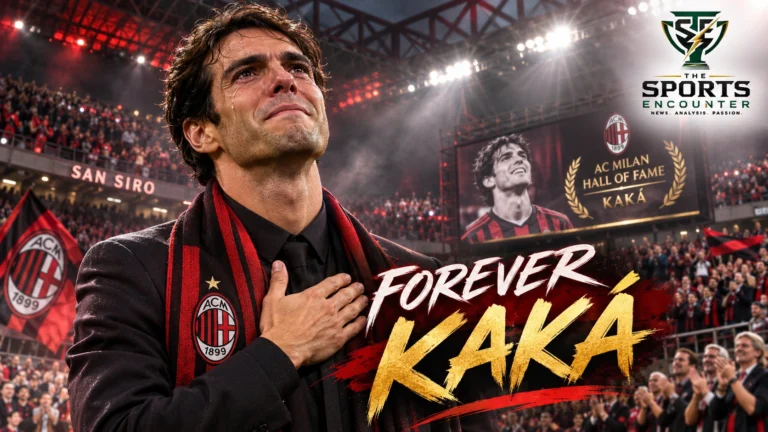
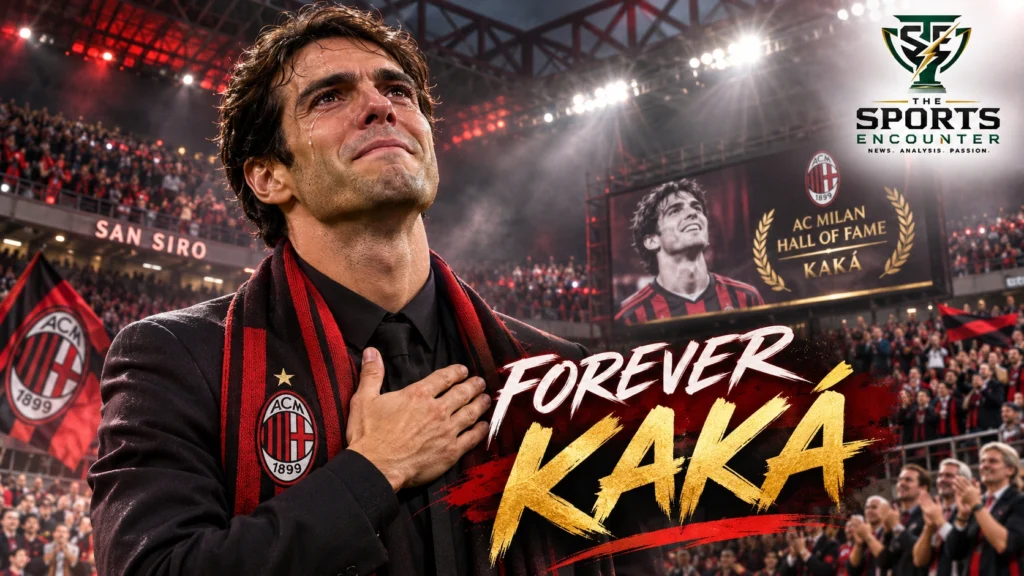
MILAN, Italy, November 1, 2026: Kaká, the Brazilian football icon whose brilliance helped AC Milan conquer Europe in 2007, was moved to tears as thousands of Rossoneri supporters rose to honor him at San Siro on Saturday, October 31. The 44-year-old former attacking midfielder returned to the pitch before the Derby della Madonnina against Inter to receive recognition for his induction into Milan’s Hall of Fame. The standing ovation, accompanied by the familiar chant celebrating his goals, brought an emotional response from the man who won the 2007 Ballon d’Or and became one of the most beloved players in the club’s history. The evening became even more memorable when Milan defeated Inter 3-1, ending their rivals’ unbeaten Serie A start.
The ceremony recognized a career that included the 2003-04 Serie A championship, the 2006-07 UEFA Champions League, the 2007 UEFA Super Cup and the FIFA Club World Cup. Kaká, who represented Milan from 2003 to 2009 before returning for the 2013-14 season, was officially elected to the club’s Hall of Fame in April 2026 alongside Carlo Ancelotti and Ruud Gullit. His October appearance provided the opportunity for supporters to celebrate that recognition in person. Nearly two decades after his extraordinary Champions League campaign, Kaká once again stood at the center of San Siro, not because of a goal or an assist, but because the crowd wanted him to know what he still meant to Milan.
Why Did Kaká Cry During AC Milan’s Hall of Fame Ceremony?
Some football moments are powerful precisely because nothing competitive is at stake.
Story at a glance
Why Did Kaká Cry During AC Milan’s Hall of Fame Ceremony?
Some football moments are powerful precisely because nothing competitive is at stake.
Kaká’s Hall of Fame Induction: What Actually Happened in 2026?
The October 31 ceremony followed an earlier club decision.
Kaká’s AC Milan Career: From São Paulo Prospect to Ballon d’Or Winner
Kaká joined AC Milan from São Paulo in 2003.
The 2006-07 Champions League Campaign That Defined Kaká’s Greatness
If one season explains why San Siro still celebrates Kaká with such affection, it is 2006-07.
Kaká Against Manchester United: The Performances That Defined an Era
The 2007 Champions League semifinal against Manchester United remains among the most celebrated chapters of Kaká’s career.
Read next Serie A: Bologna Stun Milan 4-2, Inter Catch Lazio as Mbangula Hat Trick Shakes Up Title Race
Kaká was not preparing to face Inter. He was not chasing another trophy or attempting to prove himself against the next generation.
He had returned to the stadium where some of the finest years of his career unfolded.
When the Brazilian stepped onto the San Siro pitch, Milan supporters responded with a standing ovation.
The crowd revived the chant that had once accompanied his performances, celebrating the goals and memories he had given them.
Kaká visibly struggled to contain his emotions.
The tears reflected a relationship that had survived retirement, transfers, changing ownership and nearly two decades of footballing change.
He had returned to Milan for a formal honor.
The supporters transformed it into a personal tribute.
Kaká’s Emotional Return to San Siro
The former attacking midfielder received commemorative recognition for his place among the club’s Hall of Fame legends.
He acknowledged the supporters and recreated his familiar celebration, raising his arms toward the sky.
It was a gesture instantly recognizable to fans who watched him dominate matches in the red-and-black shirt.
After the ceremony, Kaká spoke about the affection he continued to receive at San Siro.
He described the occasion as another special evening and acknowledged how difficult it was to express his emotions.
AC Milan published official video coverage of Kaká’s Hall of Fame ceremony, documenting the tribute.
Kaká’s Hall of Fame Induction: What Actually Happened in 2026?
The October 31 ceremony followed an earlier club decision.
On April 23, 2026, AC Milan announced that supporters had selected Kaká, Carlo Ancelotti and Ruud Gullit as Hall of Fame midfielders.
The three figures represent different chapters of Milan’s history.
Gullit helped transform the club during the late 1980s.
Ancelotti contributed as both a player and a manager, guiding Milan through some of their greatest European nights.
Kaká became the attacking force behind the club’s 2007 Champions League triumph.
The October ceremony therefore celebrated an honor already conferred rather than announcing an entirely new selection.
The club’s official April announcement confirms the three midfielders and the supporters’ role in their election.
AC Milan Hall of Fame: The Midfield Legends Honored in 2026
| Hall of Fame Honoree | Milan Connection | Historical Significance |
|---|---|---|
| Kaká | Attacking midfielder, 2003-09 and 2013-14 | 2007 Ballon d’Or winner and Champions League star |
| Carlo Ancelotti | Former midfielder and manager | European Cup winner as a player and Champions League-winning coach |
| Ruud Gullit | Midfielder and forward during Milan’s golden era | Key figure in the club’s European dominance under Arrigo Sacchi |
The recognition also connects different generations of Milan supporters.
Older fans remember Gullit’s power and Ancelotti’s influence.
Supporters who grew up during the 2000s remember Kaká accelerating through midfield, carrying the ball beyond defenders and producing decisive moments against Europe’s strongest teams.
Kaká’s AC Milan Career: From São Paulo Prospect to Ballon d’Or Winner
Kaká joined AC Milan from São Paulo in 2003.
He arrived as a talented young Brazilian but soon became one of Europe’s most complete attacking midfielders.
His game combined qualities rarely found together.
He was technically composed, capable of running at extraordinary speed with the ball and unusually effective when transitioning from midfield into attack.
Unlike a traditional playmaker who relied primarily on close control in crowded areas, Kaká could create danger by carrying possession across large distances.
Defenders frequently faced an uncomfortable choice.
Step forward and risk being beaten by his acceleration, or retreat and give him space to shoot or deliver a final pass.
That ability made him a devastating presence in European competition.
The 2003-04 Scudetto Was His First Major Milan Triumph
Kaká’s arrival coincided with an exceptional Milan side.
Under Carlo Ancelotti, the squad included Paolo Maldini, Alessandro Nesta, Andrea Pirlo, Clarence Seedorf, Gennaro Gattuso and Andriy Shevchenko.
He immediately added energy and attacking imagination.
Milan won Serie A in his first season.
That championship established him as an important member of the team rather than simply a promising new signing.
The years that followed would elevate his reputation even further.
The 2006-07 Champions League Campaign That Defined Kaká’s Greatness
If one season explains why San Siro still celebrates Kaká with such affection, it is 2006-07.
Milan entered the competition determined to recover from their painful 2005 Champions League final defeat to Liverpool.
Kaká became the driving attacking force.
He scored ten Champions League goals across 13 appearances from the group stage to the final.
No other player matched that total.
The four players sharing second place in the scoring standings each finished with six.
Kaká did not score in the final itself, but his contributions throughout the campaign were essential to Milan reaching Athens.
The Rossoneri defeated Liverpool 2-1 through two Filippo Inzaghi goals to win their seventh European Cup.
UEFA confirmed the Brazilian’s ten-goal campaign in its official report on the 2006-07 Champions League scoring race.
Why His Ten Goals Were So Important
Kaká’s scoring record was impressive because he was not operating as a conventional center-forward.
His role required him to connect midfield and attack, create opportunities and carry the ball through defensive lines.
Yet he also became the competition’s leading scorer.
That combination made his contribution especially valuable.
The season’s final scoring table illustrates his advantage.
| Player | Club | 2006-07 Champions League Goals |
|---|---|---|
| Kaká | AC Milan | 10 |
| Peter Crouch | Liverpool | 6 |
| Didier Drogba | Chelsea | 6 |
| Ruud van Nistelrooy | Real Madrid | 6 |
| Fernando Morientes | Valencia | 6 |
TSE statistical insight: Kaká scored four more goals than any other player in the 2006-07 competition. His ten goals were approximately 66.7 percent higher than the six scored by each of the joint runners-up.
That margin is particularly notable for a midfielder expected to influence multiple phases of play.
Kaká Against Manchester United: The Performances That Defined an Era
The 2007 Champions League semifinal against Manchester United remains among the most celebrated chapters of Kaká’s career.
In the first leg at Old Trafford, he scored twice despite Milan losing 3-2.
One of those goals became a defining image of his career.
He controlled the ball, navigated pressure from United defenders and finished with the composure that characterized his best performances.
In the return leg at San Siro, he scored again as Milan won 3-0.
Milan advanced 5-3 on aggregate.
It was the sort of European night that made Kaká indispensable to Milan’s attacking identity.
The Semifinal Results
| Match | Score | Kaká’s Contribution |
|---|---|---|
| Manchester United vs AC Milan, first leg | Manchester United 3-2 Milan | Two goals |
| AC Milan vs Manchester United, second leg | Milan 3-0 Manchester United | One goal |
| Aggregate | Milan won 5-3 | Three goals across two games |
Those performances explain why the Brazilian’s reputation extends well beyond statistics accumulated across domestic league matches.
He excelled when elite opponents posed the greatest challenges.
Why Kaká Won the 2007 Ballon d’Or
Kaká’s Champions League performances formed the centerpiece of his outstanding 2007 season.
He won the Ballon d’Or, the FIFA World Player of the Year award and UEFA’s Club Footballer of the Year recognition.
The honors reflected his importance to Milan’s European triumph and his individual influence during the campaign.
His victory also occupies a distinctive place in football history.
It came before Lionel Messi and Cristiano Ronaldo established their long period of dominance over the Ballon d’Or.
For Milan supporters, the award provided international recognition of what they had witnessed every week.
Kaká was not simply part of a great team.
He was one of the principal reasons that team could defeat Europe’s finest opposition.
Major Honors From Kaká’s First Milan Spell
| Year | Honor | Category |
|---|---|---|
| 2003-04 | Serie A championship | Club |
| 2004 | Supercoppa Italiana | Club |
| 2006-07 | UEFA Champions League | Club |
| 2007 | UEFA Super Cup | Club |
| 2007 | FIFA Club World Cup | Club |
| 2007 | Ballon d’Or | Individual |
| 2007 | FIFA World Player of the Year | Individual |
| 2007 | UEFA Club Footballer of the Year | Individual |
Why Kaká’s Relationship With AC Milan Survived His Real Madrid Transfer
Kaká departed Milan for Real Madrid in 2009.
The move brought an end to his extraordinary first spell in Italy.
His career in Spain did not consistently reproduce the exceptional form that had made him a Ballon d’Or winner.
Injuries and competition for places affected his opportunities.
But the relationship between Kaká and Milan supporters remained strong.
In 2013, he returned to San Siro for another season.
The second spell did not recreate the championship success of his earlier years.
It nevertheless reaffirmed the emotional connection between the player and the club.
Saturday’s standing ovation demonstrated that supporters still associate him with Milan’s identity and its most memorable European nights.
Milan 3-1 Inter: The Perfect Ending to Kaká’s Emotional Night
The Hall of Fame ceremony was followed by an important result for Milan’s current team.
Under Rúben Amorim, the Rossoneri defeated Inter 3-1 in the Derby della Madonnina.
Christian Pulisic opened the scoring in the fourth minute.
Adrien Rabiot doubled the lead six minutes later.
Alessandro Bastoni pulled a goal back for Inter in the 22nd minute.
But Diego Moreira restored Milan’s two-goal advantage with a spectacular free kick in the 43rd.
The result ended Inter’s unbeaten Serie A start and reduced Milan’s gap to their rivals to four points.
Our complete Milan derby analysis examines Moreira’s outstanding display, Milan’s three goals and the wider consequences for the title race.
The Derby Goals That Followed Kaká’s Tribute
| Minute | Scorer | Team | Score |
|---|---|---|---|
| 4 | Christian Pulisic | AC Milan | 1-0 |
| 10 | Adrien Rabiot | AC Milan | 2-0 |
| 22 | Alessandro Bastoni | Inter | 2-1 |
| 43 | Diego Moreira | AC Milan | 3-1 |
Diego Moreira provided two assists and scored Milan’s third goal.
His influence offered supporters another reason to celebrate after the pre-match tribute.
For a club rebuilding its competitive identity, the combination of a historic ceremony and a major derby victory carried obvious emotional significance.
Kaká’s Thoughts on Modern Milan, Luka Modrić and Christian Pulisic
Kaká did more than accept recognition.
He also spoke positively about Milan’s future and the quality of players currently representing the club.
He expressed hope that more Brazilian players would join leading European clubs, including Milan.
He also acknowledged his friendship with Luka Modrić and his admiration for the Croatian midfielder.
Modrić’s role in Milan’s rebuilding project has attracted considerable attention, particularly because of his experience and ability to control matches.
The Sports Encounter previously examined why Modrić’s contract extension through 2027 matters to Milan’s longer-term plans.
Can Christian Pulisic Become One of Milan’s Modern Icons?
Kaká also spoke warmly about Pulisic.
The American has become an important attacking figure for Milan.
His fourth-minute derby goal demonstrated the impact he can have in important matches.
But comparisons between modern players and established legends must be handled carefully.
Kaká’s standing was built over several seasons, including a defining Champions League campaign.
Pulisic’s legacy will depend on the trophies, performances and memorable matches he contributes during his own Milan career.
The club’s recent domestic performances, including its victory over Lecce during Serie A Matchday 5, show how Pulisic and the current attacking group are developing under Amorim.
What Does Kaká’s Hall of Fame Recognition Mean for Milan’s Identity?
Hall of Fame recognition serves a purpose beyond celebrating famous former players.
It helps a club preserve the values and achievements that define its identity.
Milan have experienced different periods of dominance, decline and rebuilding.
The club’s great players represent the connections between those eras.
Franco Baresi symbolized loyalty and defensive leadership.
Paolo Maldini represented exceptional longevity and continuity.
Ruud Gullit brought power, imagination and international recognition to the Sacchi era.
Kaká became the defining creative figure of another European triumph.
The Sports Encounter explored that connection between individual greatness and club identity in its tribute to Franco Baresi and the standards he established at Milan.
Why Great Clubs Need Their History
Successful football institutions are not built exclusively around their current squads.
Supporters also develop their relationships with clubs through shared memories.
A Champions League victory, an unforgettable derby or an individual performance against a fierce rival can influence how generations of fans understand a team’s identity.
The Hall of Fame creates a formal place for those memories.
It reminds today’s players of the expectations established by their predecessors.
For Milan’s current squad, the message is especially relevant.
The Rossoneri are attempting to become consistent domestic and European contenders again.
Our 2026-27 Serie A season preview examined the opportunities and challenges facing Milan under Amorim before the campaign began.
How Does Kaká Compare With Milan’s Other Legendary Midfielders?
Direct comparisons between players from different decades are imperfect.
Football tactics, physical demands and positional roles have changed.
Nevertheless, examining the distinctive strengths of Milan’s Hall of Fame midfielders helps explain why each deserves recognition.
| Player | Defining Quality | Major Milan Contribution |
|---|---|---|
| Kaká | Explosive ball carrying, attacking movement and finishing | Led 2006-07 Champions League scoring with ten goals |
| Carlo Ancelotti | Midfield intelligence and positional discipline | European Cup success as a player; later Champions League-winning manager |
| Ruud Gullit | Physical power, movement and technical versatility | Central figure in Milan’s late-1980s European dominance |
Each player represented a different footballing environment.
All three contributed to a period in which Milan were respected among the strongest clubs in Europe.
Their election together gives the Hall of Fame recognition greater historical depth.
Why Milan’s October 31 Derby Victory Matters Beyond Kaká’s Tribute
The pre-match ceremony created the emotional atmosphere, but Milan’s performance ensured the evening also carried competitive significance.
Inter arrived unbeaten in Serie A.
They had secured eight wins and one draw from their opening nine league matches.
Milan had already suffered setbacks during the season, including a home defeat to Bologna.
Amorim’s side needed a result that could restore belief and improve its position in the title race.
The derby provided that opportunity.
For the broader context of Milan’s early development, see our opening-weekend analysis of the team’s evolving tactical identity.
How Inter’s Unbeaten Run Finally Ended
Inter had already demonstrated an ability to recover from difficult situations earlier in the campaign.
They overturned a two-goal deficit to defeat Udinese 5-3 in September.
That performance revealed considerable attacking resilience.
But against Milan, the early defensive mistakes proved too costly.
Our report on Inter’s five-goal comeback against Udinese provides an important comparison between the defending champions’ ability to recover and the defensive vulnerabilities that Milan exploited.
The derby also offered a contrast with the earlier Serie A weekend when Juventus and Milan drew while Inter and Roma maintained their perfect starts.
By October 31, the balance of the title race had become more complicated.
Five Reasons Kaká Remains One of Milan’s Most Beloved Players
Kaká’s standing at San Siro can be explained through more than one famous season.
1. He Helped Restore Milan’s European Supremacy
The Champions League victory in 2007 reinforced Milan’s place among Europe’s most successful clubs.
Kaká was the competition’s outstanding attacking performer.
2. His Style Was Immediately Recognizable
His ability to accelerate with the ball created a distinctive style that supporters remember long after retirement.
3. He Delivered Against Elite Opposition
His performances against Manchester United in 2007 remain among the clearest examples of his quality under pressure.
4. He Earned Football’s Highest Individual Recognition
The 2007 Ballon d’Or confirmed his place among the world’s leading players.
5. His Relationship With Milan Continued After His Departure
His return in 2013 and his emotional response to Saturday’s tribute demonstrated that his connection with the club had not disappeared.
TSE Statistical Perspective: Why Kaká’s 2007 Champions League Record Still Stands Out
For historical comparisons, Kaká’s Champions League statistics provide the clearest measurable evidence of his influence.
He scored ten goals in 13 matches during Milan’s victorious 2006-07 campaign.
That is approximately 0.77 goals per appearance.
His closest rivals each finished with six goals.
He also led UEFA’s competition statistics with 28 attempts on target.
The figures demonstrate an attacking midfielder who consistently arrived in dangerous positions and converted opportunities.
| Metric | Kaká, 2006-07 | Why It Matters |
|---|---|---|
| Champions League appearances | 13 | Played throughout the European campaign |
| Champions League goals | 10 | Competition’s leading scorer |
| Goals per appearance | 0.77 | Exceptional output for an attacking midfielder |
| Goals ahead of joint second place | 4 | Clear scoring advantage |
| Attempts on target | 28 | Led UEFA’s recorded category |
| Champions League outcome | Winner | Seventh European Cup for Milan |
| Individual outcome | Ballon d’Or winner | Recognized as the world’s leading player |
TSE original insight: Kaká’s 0.77 goals per Champions League appearance in 2006-07 is especially significant when considered alongside his role as a creator and ball carrier. His value cannot be measured solely through scoring, but the ten-goal total shows that he also delivered the final action against elite opponents.
What the Standing Ovation Says About Football’s Relationship With Its Legends
Modern football often focuses on transfers, salaries, results and tactical decisions.
Those subjects are important, but they do not fully explain why supporters remain attached to a club.
Memory also matters.
A player who delivers memorable performances during a successful era becomes connected to personal experiences across thousands of supporters.
For many Milan fans, Kaká’s greatest goals are associated with childhood, family, friendships and unforgettable European evenings.
Saturday’s ceremony allowed those memories to return in one shared moment.
The applause was therefore about more than his playing record.
It was recognition of the emotions his football had created.
The relationship between players, clubs and supporters remains part of our broader Serie A coverage, where current results are examined alongside the traditions and rivalries that give Italian football its identity.
Continue the Serie A Story
 Serie AMilan’s Derby Masterclass Ends Inter’s Unbeaten Run as Roma’s Five-Goal Warning Turns Up Serie A Title Heat
 Serie ASerie A: Bologna Stun Milan 4-2, Inter Catch Lazio as Mbangula Hat Trick Shakes Up Title Race
 Serie ASerie A: Venezia Stun Napoli, Inter Extend Unbeaten Run as Milan Survive Atalanta Fightback
Frequently Asked Questions About Kaká’s AC Milan Hall of Fame Induction
Why Was Kaká Crying at San Siro?
Kaká became emotional after receiving a standing ovation from AC Milan supporters during his Hall of Fame tribute before the October 31, 2026 derby against Inter.
When Was Kaká Inducted Into AC Milan’s Hall of Fame?
AC Milan announced his election on April 23, 2026. The public ceremony at San Siro took place on October 31.
Who Else Joined Kaká in the Hall of Fame?
Carlo Ancelotti and Ruud Gullit were elected alongside him as the club’s Hall of Fame midfielders.
What Happened in the Milan Derby After the Ceremony?
AC Milan defeated Inter 3-1 through goals from Christian Pulisic, Adrien Rabiot and Diego Moreira.
Did Kaká Win the Ballon d’Or?
Yes. He won the Ballon d’Or in 2007 following an outstanding season that included Milan’s Champions League triumph.
How Many Champions League Goals Did Kaká Score in 2006-07?
He scored ten goals in 13 appearances, finishing as the competition’s leading scorer.
Which Teams Did Kaká Play for During His Club Career?
His major clubs included São Paulo, AC Milan, Real Madrid and Orlando City.
How Many Times Did Kaká Play for AC Milan?
He represented the club in two separate spells: from 2003 to 2009 and during the 2013-14 season.
What Was Kaká’s Greatest Champions League Performance?
His 2007 semifinal displays against Manchester United are among his most celebrated performances. He scored three goals across the two legs as Milan advanced 5-3 on aggregate.
Who Won the 2007 Champions League Final?
AC Milan defeated Liverpool 2-1 in Athens, with Filippo Inzaghi scoring both goals.
Why Is Kaká Considered an AC Milan Legend?
He combined technical brilliance with decisive Champions League performances, major trophies, the 2007 Ballon d’Or and a lasting bond with Milan supporters.
Is Kaká Still Connected to AC Milan?
Yes. His Hall of Fame recognition and his return to San Siro demonstrate the continuing relationship between the former midfielder and the club.
The Sports Encounter Verdict: Kaká’s Tears Tell a Story That Trophies Alone Cannot
Kaká’s career can be summarized through impressive numbers.
Ten Champions League goals in 2006-07.
A European title.
A Serie A championship.
A Ballon d’Or.
And a place among Milan’s greatest midfielders.
But the standing ovation at San Siro revealed something those statistics cannot fully capture.
Nearly two decades after his most celebrated season, supporters still remember how he made them feel.
The Brazilian arrived in Milan as a young talent and developed into one of the finest attacking players in world football.
He helped deliver unforgettable European nights, departed for Real Madrid, returned for another spell and eventually retired.
Yet the bond remained.
On October 31, 2026, that relationship became visible again.
There was no need for another extraordinary run through midfield.
There was no defender to beat or goalkeeper to overcome.
Kaká simply walked onto the San Siro pitch.
The supporters stood and applauded.
He cried.
Later, Milan defeated Inter 3-1, adding a contemporary sporting triumph to the evening’s emotional significance.
For supporters, it became a reminder of both the club’s extraordinary past and its aspirations for the future.
Players can be remembered for individual moments.
Great players can become part of a club’s identity.
Kaká belongs to the second group.
And Saturday’s standing ovation showed that his place in Milan’s history was secure long before the Hall of Fame made it official.
Ballon d’Or
- Kaká Breaks Down in Tears as San Siro Welcomes Its 2007 Ballon d’Or Hero Into Milan’s Hall of Fame
- Ronaldinho Comes Out of Retirement for the Final Swansong at an Italian Club
- Harry Kane Golden Shoe 2026: 36 Bundesliga Goals and Ballon d’Or Case
- Is Lionel Messi the Greatest Athlete Ever? The Case, By the Numbers