Key Takeaways
- The meet was part of the national selection process for the World Short Course Championships in Beijing.
- The 100m freestyle world record was the final achievement of an extraordinary competition for Douglass.
- The World Aquatics Swimming Championships (25m) are scheduled for December 1-6, 2026, in Beijing.
- The American’s achievement adds to a remarkable sequence of records across international swimming in 2026.
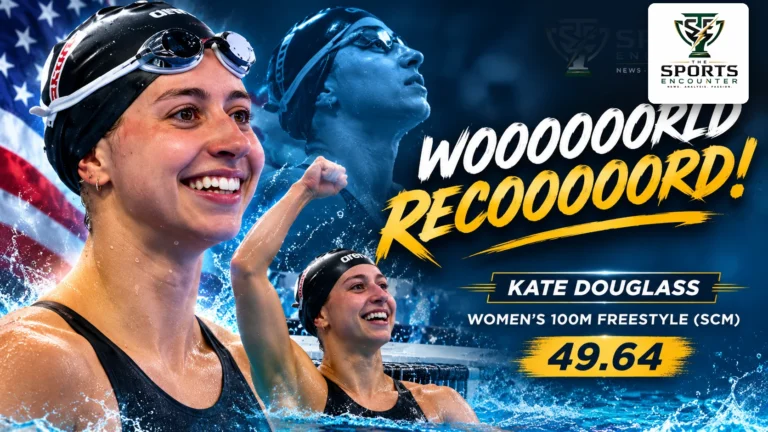
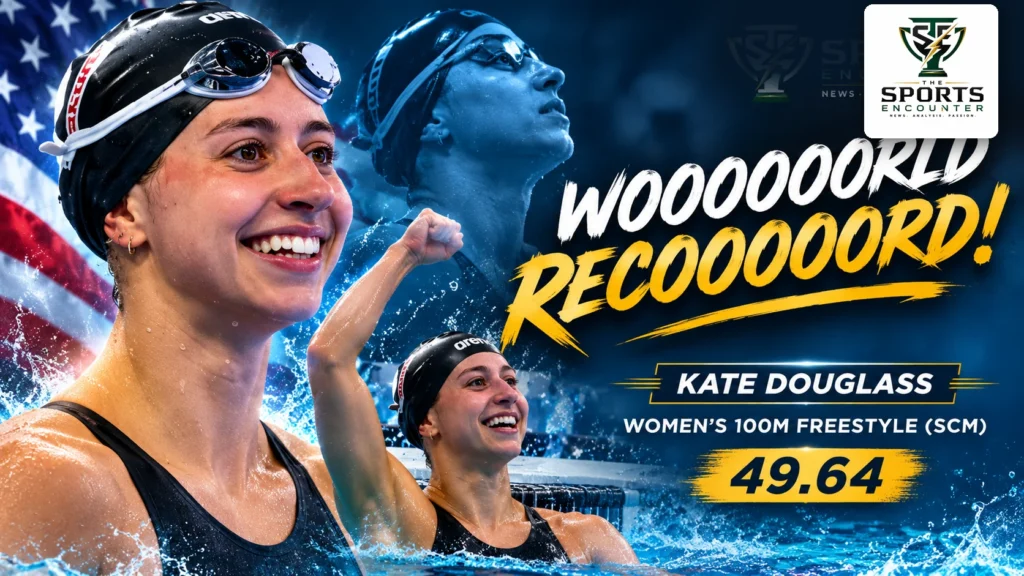
WESTMONT, United States, November 1, 2026: American swimming star Kate Douglass delivered another extraordinary performance on Saturday night, October 31, breaking her own women’s 100m freestyle short-course world record with a breathtaking 49.64 seconds at the USA Swimming Short Course World Championship Trials in Westmont, Illinois. The 24-year-old took 0.29 seconds off the 49.93 record she established in Toronto in October 2025, opening the race in 23.52 seconds before returning in 26.12. Gretchen Walsh finished second in 50.61, with Liberty Clark third in 50.94, as Douglass strengthened her position as the only woman to have broken 50 seconds in the event.
The record completed an exceptional four-win meet for the Olympic champion at FMC Natatorium, where she also equaled Walsh’s 50m freestyle world record of 22.75, won the 200m breaststroke in 2:14.12 and secured the 200m individual medley in 2:01.66. Douglass now heads toward the World Aquatics Swimming Championships (25m) in Beijing, scheduled for December 1-6, with fresh evidence of her versatility and outstanding sprinting form. More importantly, her 49.64 was not a marginal improvement produced by a perfect finish. She attacked the first half of the race so aggressively that she was already 0.41 seconds inside her previous record pace at the turn.
Kate Douglass’ 49.64 World Record: The Essential Facts
| Record Detail | Verified Result |
|---|---|
| Swimmer | Kate Douglass, United States |
| Event | Women’s 100m freestyle |
| Pool format | Short course, 25 meters |
| New world record | 49.64 seconds |
| Previous world record | 49.93 seconds, Kate Douglass |
| Improvement | 0.29 seconds |
| First 50 meters | 23.52 seconds |
| Second 50 meters | 26.12 seconds |
| Date | October 31, 2026 |
| Competition | U.S. Short Course World Championship Trials |
| Venue | FMC Natatorium, Westmont, Illinois |
| Runner-up | Gretchen Walsh, 50.61 |
| Third place | Liberty Clark, 50.94 |
The meet was part of the national selection process for the World Short Course Championships in Beijing. USA Swimming’s official event calendar identifies the Westmont competition as running from October 28-31 in a 25-meter pool.
Story at a glance
Kate Douglass’ 49.64 World Record: The Essential Facts
The meet was part of the national selection process for the World Short Course Championships in Beijing. USA Swimming’s official event calendar identifies the Westmont competition as running from October 28-31 in a 25-meter pool.
How Kate Douglass Broke the 100m Freestyle World Record
The most important feature of Douglass’ record-breaking swim was her opening speed.
Women’s 100m Freestyle Final: Complete Top Eight Results
Douglass won decisively, finishing almost a full second ahead of Gretchen Walsh.
Why Kate Douglass’ 49.64 Is a Historic Swimming Performance
The significance extends beyond improving one record by 0.29 seconds.
Kate Douglass Wins Four Events at the U.S. Short Course World Championship Trials
The 100m freestyle world record was the final achievement of an extraordinary competition for Douglass.
How Kate Douglass Broke the 100m Freestyle World Record
The most important feature of Douglass’ record-breaking swim was her opening speed.
She completed the first 50 meters in 23.52 seconds.
That was substantially quicker than the 23.93 opening split she recorded when setting the previous 49.93 world record.
She reached halfway already 0.41 seconds ahead of her old record pace.
That enormous early advantage gave her room to withstand a slightly slower second half.
Douglass completed the final 50 meters in 26.12 seconds.
Her previous record had featured a faster closing split of 26.00.
Yet the improvement at the beginning of the race was greater than the time lost during the return length.
The result was a net improvement of 0.29 seconds.
The Two Splits That Explain the 49.64
| Race Segment | Previous Record, 2025 | New Record, 2026 | Difference |
|---|---|---|---|
| First 50m | 23.93 | 23.52 | 0.41 seconds faster |
| Second 50m | 26.00 | 26.12 | 0.12 seconds slower |
| Total | 49.93 | 49.64 | 0.29 seconds faster |
TSE statistical insight: Douglass gained 0.41 seconds in the opening half but surrendered 0.12 seconds in the closing half. Her overall improvement was therefore driven entirely by the increased first-half speed.
The calculation also shows why the final time was so significant.
Douglass did not need to swim a personal-best closing 50 meters to break the record.
She created enough separation early to finish comfortably inside her previous mark.
Why the Opening 50 Meters Changed Everything
Elite sprint swimming depends on more than raw strength.
Starts, underwater phases, turns and stroke efficiency all influence the final result.
In a 25-meter pool, the 100m freestyle includes three turns, making technical execution particularly important.
Douglass’ opening split demonstrated her willingness to take an aggressive approach rather than preserve energy for the second half.
That strategy carries risk.
An excessively fast opening can cause a swimmer’s stroke to deteriorate later.
But Douglass maintained enough speed to complete the race in world-record time.
Women’s 100m Freestyle Final: Complete Top Eight Results
Douglass won decisively, finishing almost a full second ahead of Gretchen Walsh.
Walsh touched in 50.61.
Liberty Clark secured third place with 50.94.
| Position | Swimmer | Time | Gap to Douglass |
|---|---|---|---|
| 1 | Kate Douglass | 49.64 | World record |
| 2 | Gretchen Walsh | 50.61 | +0.97 |
| 3 | Liberty Clark | 50.94 | +1.30 |
| 4 | Rylee Erisman | 51.22 | +1.58 |
| 5 | Camille Spink | 51.66 | +2.02 |
| 6 | Simone Manuel | 52.26 | +2.62 |
| 7 | Cadence Vincent | 52.34 | +2.70 |
| 8 | Chloe Stepanek | 53.23 | +3.59 |
The result demonstrates both Douglass’ exceptional performance and the depth of American women’s sprint freestyle.
Walsh is herself a world-record holder.
Manuel is an established Olympic champion.
Yet neither could match Douglass on this occasion.
Why Kate Douglass’ 49.64 Is a Historic Swimming Performance
The significance extends beyond improving one record by 0.29 seconds.
Douglass had become the first woman to break 50 seconds in the short-course 100m freestyle when she swam 49.93 in Toronto in October 2025.
Her 49.64 has now moved that benchmark considerably lower.
She remains the only woman confirmed to have broken the 50-second barrier in the event.
That distinction is important because a world record reflects both the fastest individual performance and the broader limits of competition at a particular moment.
Douglass is not merely fractionally ahead of another swimmer’s record.
She has repeatedly reached a time range that the rest of the field has not matched.
How the Women’s Short-Course 100m Freestyle Record Developed
| Date | Swimmer | Time | Significance |
|---|---|---|---|
| October 2017 | Cate Campbell, Australia | 50.25 | Long-standing world record |
| October 19, 2025 | Kate Douglass, United States | 50.19 | World record in Westmont |
| October 25, 2025 | Kate Douglass, United States | 49.93 | First woman below 50 seconds |
| October 31, 2026 | Kate Douglass, United States | 49.64 | New world record |
The progression reveals three major improvements in little more than a year.
Douglass reduced the record from 50.25 to 49.64, an overall improvement of 0.61 seconds across that period.
For comparison, Sara Curtis also produced a major swimming breakthrough when she broke the women’s 50m backstroke world record at the 2026 European Championships.
Curtis subsequently improved her own record again, as documented in The Sports Encounter’s report on her second world record in Paris.
Kate Douglass Wins Four Events at the U.S. Short Course World Championship Trials
The 100m freestyle world record was the final achievement of an extraordinary competition for Douglass.
She won four individual events across the meet.
Two of those performances equaled or improved world records.
The variety of strokes involved made the results particularly impressive.
| Event | Winning Time | Achievement |
|---|---|---|
| Women’s 50m freestyle | 22.75 | Equaled world record |
| Women’s 100m freestyle | 49.64 | New world record |
| Women’s 200m breaststroke | 2:14.12 | Event victory |
| Women’s 200m individual medley | 2:01.66 | Event victory and U.S. Open record |
Douglass Also Equals Gretchen Walsh’s 50m Freestyle World Record
Earlier in the trials, Douglass recorded 22.75 in the women’s 50m freestyle.
That equaled the world record set by Walsh in October 2026.
The result demonstrated that Douglass could compete at an exceptional level in the shortest freestyle race as well as the 100m event.
Walsh finished second to her in both sprint freestyle finals in Westmont.
The competition between the two Americans remains one of the most interesting developments in women’s sprint swimming.
Why Her Breaststroke and Individual Medley Victories Matter
The 200m breaststroke and 200m individual medley require different physical and technical qualities from sprint freestyle.
Douglass won the 200m breaststroke in 2:14.12.
She then recorded 2:01.66 in the 200m individual medley.
Those performances underline a versatility that is unusual among elite swimmers specializing in sprint events.
Her ability to compete across multiple strokes has been a defining feature of her career.
The Sports Encounter explored her place among elite medley swimmers in our ranking of the fastest women’s 200m individual medley performers in history.
Kate Douglass vs Gretchen Walsh: How Close Is the American Sprint Rivalry?
Douglass and Walsh have helped redefine expectations in short-course sprint swimming.
Both have produced world-record performances.
Both have excelled in sprint freestyle.
And both understand the technical demands of racing in 25-meter pools.
But the latest 100m freestyle result created a significant separation between them.
Douglass finished in 49.64.
Walsh recorded 50.61.
The gap was 0.97 seconds.
In a sprint race lasting less than a minute, that is a substantial margin.
However, Walsh’s own 50m freestyle world record demonstrates that the rivalry remains highly competitive across different distances.
How the Two Americans Compared in Westmont
| Event | Kate Douglass | Gretchen Walsh | Outcome |
|---|---|---|---|
| 50m freestyle | 22.75 | 22.99 | Douglass won by 0.24 seconds |
| 100m freestyle | 49.64 | 50.61 | Douglass won by 0.97 seconds |
| World-record status | 50m equal record, 100m world record | 50m world-record co-holder | Both hold major short-course sprint distinctions |
These results are a snapshot of one meet, not a guarantee of future outcomes.
But they offer a clear indication of how strong Douglass’ form has become before December’s world championships.
Short Course vs Long Course: Why the 49.64 Record Must Be Identified Correctly
The distinction between short-course and long-course swimming is essential.
Douglass’ 49.64 was recorded in a 25-meter pool.
It is therefore a short-course meters world record.
Olympic swimming events are held in 50-meter pools.
A 100m race in a short-course pool includes three turns.
The same distance in a 50-meter pool includes only one turn.
That difference affects underwater phases, acceleration and race strategy.
Consequently, a short-course world record should not be presented as if it were the Olympic long-course world record.
The same distinction is important when covering the World Aquatics Swimming World Cup, as explained in our analysis of the Astana Swimming World Cup.
What Does Kate Douglass’ 49.64 Mean for the Beijing World Championships?
The World Aquatics Swimming Championships (25m) are scheduled for December 1-6, 2026, in Beijing.
Douglass’ performances in Westmont place her among the leading contenders across several events.
She has demonstrated exceptional sprint speed in freestyle.
She remains a major force in breaststroke.
And she continues to compete at the highest level in the individual medley.
But championship success is not guaranteed by a fast trials performance.
World championships feature different competitors, greater pressure and demanding multi-event schedules.
Douglass will need to manage that schedule carefully.
USA Swimming’s official website provides the national team’s competition updates and event information.
Could Kate Douglass Break the World Record Again in Beijing?
Her Westmont performance makes another record attempt plausible.
The most encouraging detail is that she improved the first-half split by 0.41 seconds compared with her previous record.
Her final 50 meters was slightly slower than in the 2025 record-breaking race.
In theory, a swim combining the faster opening pace with a stronger return could produce an even quicker time.
However, that is a hypothetical combination of two separate performances.
It does not mean such a swim is physically guaranteed or that the two fastest splits can simply be added together in competition.
Racing conditions, fatigue and tactical decisions all affect the final performance.
TSE Statistical Analysis: How Dominant Was Douglass’ World Record?
Several calculations illustrate the scale of her performance.
Her world-record improvement was 0.29 seconds.
That represents approximately a 0.58 percent reduction from the previous record of 49.93.
She defeated Walsh by 0.97 seconds.
She finished 1.30 seconds ahead of third-placed Clark.
Her first 50 meters accounted for approximately 47.4 percent of her total race time.
The second half accounted for approximately 52.6 percent.
| Performance Measure | Value | Interpretation |
|---|---|---|
| Previous record | 49.93 | Douglass, Toronto 2025 |
| New record | 49.64 | Westmont 2026 |
| Absolute improvement | 0.29 seconds | New global benchmark |
| Percentage improvement | 0.58% | Relative reduction in total time |
| Margin over Walsh | 0.97 seconds | Gap to second place |
| Margin over Clark | 1.30 seconds | Gap to third place |
| First-half share | 47.4% | 23.52 of 49.64 seconds |
| Second-half share | 52.6% | 26.12 of 49.64 seconds |
TSE original finding: Douglass’ record was won through a first-half improvement larger than her net finishing gain. That separates the tactical explanation of the performance from the headline figure alone.
How Douglass Fits Into an Extraordinary Year for Swimming Records
The American’s achievement adds to a remarkable sequence of records across international swimming in 2026.
In August, Sara Curtis lowered the women’s 50m backstroke world record twice during the European Championships.
Other swimmers have produced significant advances in freestyle, backstroke, butterfly and individual medley events.
The Sports Encounter documented several of those performances in our report on the European Championships’ record-breaking fourth day.
Another important chapter came during the third day of the European Aquatics Championships, when international stars delivered a succession of exceptional swims.
Records are not directly interchangeable across distances or pool formats.
Nevertheless, the broader pattern demonstrates how technical development, training methods and competitive depth continue pushing elite swimming standards forward.
Kate Douglass’ Olympic Success Adds Weight to Her Short-Course Dominance
Douglass is already an accomplished Olympic swimmer.
She won the women’s 200m breaststroke gold medal at Paris 2024.
Her Olympic career has also included major relay and individual successes.
That background distinguishes her from a swimmer whose achievements are limited to short-course racing.
She has demonstrated the ability to succeed in both 25-meter and 50-meter pools.
Her versatility was also evident when she helped the United States set a mixed 4x100m medley relay world record at the 2026 Pan Pacific Championships.
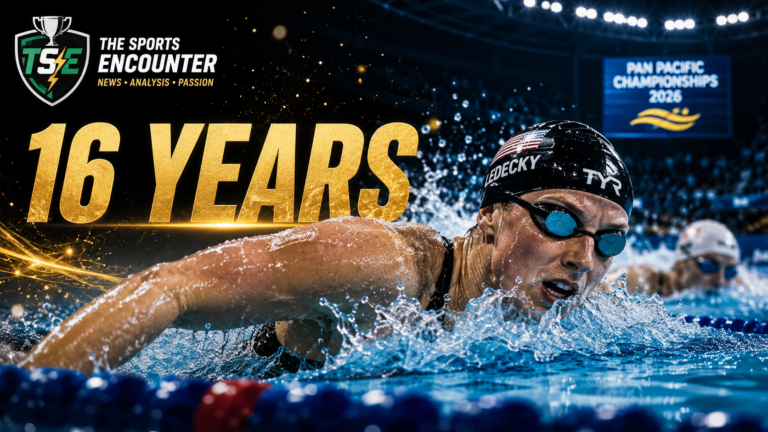
That performance was part of an outstanding American meet covered in our feature on Katie Ledecky’s 16-year unbeaten 1500m streak.
Why Sprint Records Matter Beyond One Swimmer
A new world record alters expectations across an entire event.
Douglass’ 49.64 establishes a new benchmark for every swimmer competing in the women’s short-course 100m freestyle.
Other elite competitors must now evaluate how they can close the gap.
That may involve improving starts, refining underwater phases or adjusting race distribution.
But the benchmark itself is not a training prescription.
Different swimmers have different strengths.
What works for Douglass may not be the optimal strategy for Walsh, Clark or another contender.
The consequences of improved sprint standards can also be seen in other competitions.
For example, Kim Young-beom’s record-breaking Asian Games 50m freestyle victory demonstrated how marginal improvements can determine championship outcomes.
What Is Kate Douglass’ Place Among the Greatest American Swimmers?
Douglass’ career already includes Olympic success, world championship achievements and multiple world records.
Her versatility makes her particularly unusual.
Many elite swimmers specialize in one stroke or one narrow group of distances.
Douglass has demonstrated world-class performance in sprint freestyle, breaststroke and individual medley.
That breadth is an important part of her sporting identity.
However, comparisons across generations require care.
Competition formats, event schedules, equipment and the international depth of swimming have changed substantially.
A single world-record performance does not settle debates about the greatest swimmers in history.
But Douglass’ repeated ability to establish exceptional standards across different events strengthens her standing among the most accomplished swimmers of her generation.
Continue the Swimming Story
Frequently Asked Questions About Kate Douglass’ 49.64 World Record
What World Record Did Kate Douglass Break?
Kate Douglass broke the women’s 100m freestyle short-course world record, finishing in 49.64 seconds.
When Did Kate Douglass Set the 49.64 World Record?
She set the record on October 31, 2026, at the U.S. Short Course World Championship Trials.
Where Did She Break the Record?
At FMC Natatorium in Westmont, Illinois, United States.
What Was Her Previous World Record?
Douglass held the previous mark of 49.93, set in Toronto in October 2025.
How Much Did Kate Douglass Improve Her World Record?
She improved it by 0.29 seconds.
Who Finished Second Behind Kate Douglass?
Gretchen Walsh finished second in 50.61 seconds.
Who Finished Third?
Liberty Clark took third place in 50.94 seconds.
What Were Douglass’ 50m Splits?
She swam the opening 50 meters in 23.52 and the second 50 meters in 26.12 seconds.
Did Kate Douglass Also Break the 50m Freestyle World Record?
She equaled the existing 50m freestyle world record of 22.75 seconds during the same trials.
How Many Events Did Douglass Win in Westmont?
Four: 50m freestyle, 100m freestyle, 200m breaststroke and 200m individual medley.
Is 49.64 the Olympic 100m Freestyle World Record?
No. It is the short-course world record in a 25-meter pool. Olympic swimming uses 50-meter pools and maintains separate records.
When Are the 2026 World Short Course Swimming Championships?
The championships are scheduled for December 1-6, 2026, in Beijing, China.
The Sports Encounter Verdict: Kate Douglass Has Made Sub-50 Swimming Her Territory
Kate Douglass did not simply improve a world record in Westmont.
She strengthened her position at the forefront of women’s short-course sprint freestyle.
Her 49.64 was 0.29 seconds faster than her previous record.
She defeated the nearest challenger by almost a second.
And she completed the meet with four individual victories across three different strokes.
Perhaps the most remarkable aspect was the method.
Douglass attacked the opening half of the 100m freestyle with greater speed than she had shown in her previous record-breaking performance.
Even though her closing 50 meters was slightly slower, the advantage she had already created proved decisive.
That provides a meaningful insight into a performance that could otherwise be reduced to one number.
The result was not simply 49.64.
It was a calculated, aggressive swim that demonstrated exceptional speed and control.
Beijing will offer another opportunity to test those qualities against international opposition.
Whether Douglass improves the record again remains uncertain.
What is already established is that she has moved the women’s short-course 100m freestyle into territory no other swimmer has yet reached.
For further swimming analysis, follow The Sports Encounter’s swimming coverage and explore our latest sports reports and original analysis.