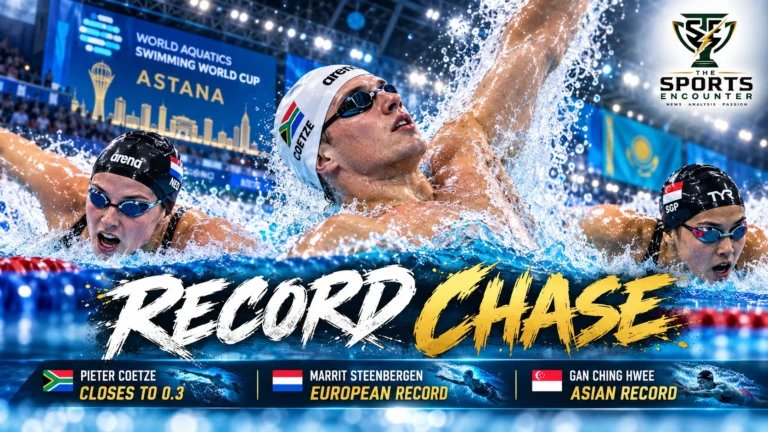
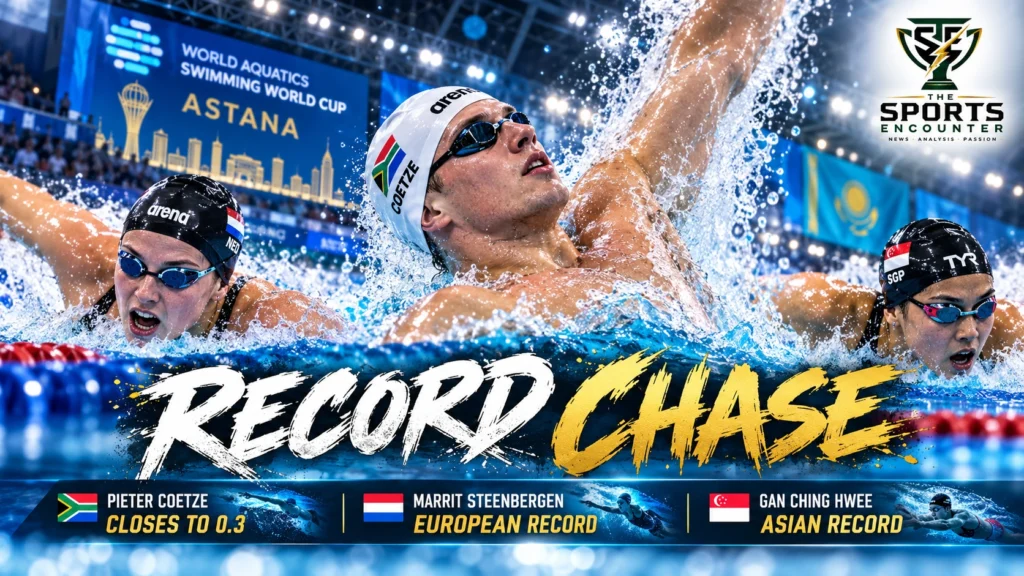
ASTANA, Kazakhstan, October 15, 2026: Pieter Coetze moved within 0.3 points of Egor Kornev in the men’s overall World Aquatics Swimming World Cup standings after winning the 100m backstroke in 48.40 seconds on Thursday, while Marrit Steenbergen broke the European women’s 200m freestyle record and Singapore’s Gan Ching Hwee shattered the Asian 1500m freestyle mark during a record-filled opening session at Barys Arena. Coetze’s victory was his third in the event across the three World Cup stops, securing a $10,000 Triple Crown bonus, although he finished 0.24 seconds outside the world record he narrowly missed in Tashkent last week.
Steenbergen was the day’s only double individual winner, claiming the women’s 200m freestyle in a European-record 1:50.23 before adding the 50m backstroke title in 25.67. Gan produced one of the most impressive distance swims of the season with 15:38.41, taking 3.39 seconds off the previous Asian record. China’s Yu Yiting set a national record in the 400m individual medley, Belgium’s Roos Vanotterdijk extended her remarkable butterfly record, and Australia’s Cameron McEvoy defeated Kornev in the men’s 100m freestyle. Across 12 completed medal events, seven swimmers collected World Cup Triple Crown honors, while the final two competition days promise an exceptionally close contest for the men’s overall championship.
Astana Swimming World Cup 2026: All 12 Winners From October 15
The opening day of the final World Aquatics Swimming World Cup stop produced victories for swimmers representing nine countries.
The events took place in a 25-meter pool, meaning all performances belong to short-course swimming. They should not be compared directly with records established in standard 50-meter Olympic pools.
Story at a glance
Astana Swimming World Cup 2026: All 12 Winners From October 15
The opening day of the final World Aquatics Swimming World Cup stop produced victories for swimmers representing nine countries.
Pieter Coetze Wins 100m Backstroke Triple Crown but Misses the World Record
Coetze arrived in Astana as one of the most closely watched swimmers in the competition.
Coetze Moves Within 0.3 Points of Egor Kornev in the Overall World Cup Race
The most important consequence of Coetze’s victory extends beyond the individual event.
Marrit Steenbergen Breaks the European 200m Freestyle Record
Marrit Steenbergen strengthened her position as the leading woman in the World Cup with another outstanding session.
Steenbergen Adds 50m Backstroke Gold and Another Triple Crown
Steenbergen returned later in the session to win the women’s 50m backstroke in 25.67 seconds.
| Event | Gold Medalist | Country | Winning Time |
|---|---|---|---|
| Women’s 1500m freestyle | Gan Ching Hwee | Singapore | 15:38.41 (Asian record) |
| Men’s 1500m freestyle | Lucas Pierre Henveaux | Belgium | 14:33.14 |
| Women’s 400m individual medley | Yu Yiting | China | 4:22.74 (Chinese record) |
| Men’s 100m freestyle | Cameron McEvoy | Australia | 45.11 |
| Women’s 50m butterfly | Roos Vanotterdijk | Belgium | 24.56 (Belgian record) |
| Men’s 50m breaststroke | Kirill Prigoda | Russia | 25.77 |
| Women’s 200m freestyle | Marrit Steenbergen | Netherlands | 1:50.23 (European record) |
| Men’s 200m butterfly | So Ogata | Japan | 1:49.89 |
| Women’s 100m breaststroke | Mona McSharry | Ireland | 1:04.03 |
| Men’s 100m backstroke | Pieter Coetze | South Africa | 48.40 |
| Women’s 50m backstroke | Marrit Steenbergen | Netherlands | 25.67 |
| Men’s 200m individual medley | Shaine Casas | United States | 1:51.98 |
The World Aquatics Swimming World Cup is being held across Baku, Azerbaijan, from October 1-3; Tashkent, Uzbekistan, from October 8-10; and Astana, Kazakhstan, from October 15-17.
The official World Aquatics Astana competition page provides the final stop’s event information and competition framework.
Pieter Coetze Wins 100m Backstroke Triple Crown but Misses the World Record
Coetze arrived in Astana as one of the most closely watched swimmers in the competition.
Only six days earlier, he had broken the men’s 50m short-course backstroke world record in Tashkent, finishing in 22.09 seconds and improving Kliment Kolesnikov’s previous mark of 22.11.
He followed that achievement on October 10 by winning the 100m backstroke in an African-record 48.21.
The performance was only 0.05 seconds outside Hungary’s Hubert Kós’ world record of 48.16.
That made another world-record attempt a major storyline heading into Astana.
Coetze did not match his Tashkent time, but he still produced a dominant performance.
Coetze Wins by 0.89 Seconds
| Position | Swimmer | Country | Time |
|---|---|---|---|
| Gold | Pieter Coetze | South Africa | 48.40 |
| Silver | Pavel Samusenko | Russia | 49.29 |
| Bronze | Ralf Tribuntsov | Estonia | 49.88 |
Coetze defeated Samusenko by 0.89 seconds and Tribuntsov by 1.48 seconds.
His 48.40 was 0.19 seconds slower than his African record but remained among the fastest performances ever recorded in the event.
It was reported as the fourth-fastest men’s 100m short-course backstroke swim in history at the time.
In an event where world records are decided by hundredths of a second, Coetze’s margin over the rest of the field illustrates how far ahead he was in this particular final.
Three Cities, Three Gold Medals
| World Cup Stop | Date | 100m Backstroke Winning Time |
|---|---|---|
| Baku, Azerbaijan | October 3 | 49.11 |
| Tashkent, Uzbekistan | October 10 | 48.21 |
| Astana, Kazakhstan | October 15 | 48.40 |
The three victories secured Coetze the event’s World Cup Triple Crown and its additional $10,000 prize.
The consistency is especially notable because the swims took place across three consecutive international meets, requiring repeated travel, competition and recovery.
He has also demonstrated that he can remain close to world-record pace under different competitive conditions.
His next two Astana appearances will determine whether that consistency translates into an even bigger championship achievement.
Coetze Moves Within 0.3 Points of Egor Kornev in the Overall World Cup Race
The most important consequence of Coetze’s victory extends beyond the individual event.
Before Astana, Kornev led the men’s overall standings with 116.7 points.
Coetze was second on 114.3.
The gap stood at 2.4 points.
Thursday’s performances changed the situation dramatically.
Coetze received 19.8 World Cup points for his backstroke victory, increasing his overall total to 134.1.
Kornev finished second in the 100m freestyle, earning 17.7 points and moving to 134.4.
| Rank | Swimmer | Country | Points After October 15 |
|---|---|---|---|
| 1 | Egor Kornev | Russia | 134.4 |
| 2 | Pieter Coetze | South Africa | 134.1 |
| 3 | Luke Barr | United States | 128.0 |
| 4 | So Ogata | Japan | 126.8 |
| 5 | Lucas Henveaux | Belgium | 125.4 |
These are provisional overall series standings after Astana’s opening day, not the final World Cup classification.
Only 0.3 points now separate the two leading men.
The difference is exceptionally small in a competition where swimmers receive points based on both race placings and the quality of their performances.
Why the Remaining Two Days Matter So Much
Coetze is scheduled to compete in the 200m backstroke on October 16 and the 50m backstroke on October 17.
He has already won the 200m backstroke at both Baku and Tashkent, creating an opportunity to earn another Triple Crown.
He also enters the 50m backstroke as the current world-record holder.
Kornev has important events remaining, including the 50m butterfly, in which he broke the world record in Tashkent.
That means the final men’s title cannot be projected confidently from Thursday’s standings alone.
The remaining performances, final placings and performance points will determine the winner.
Marrit Steenbergen Breaks the European 200m Freestyle Record
Marrit Steenbergen strengthened her position as the leading woman in the World Cup with another outstanding session.
The Dutch swimmer won the women’s 200m freestyle in 1:50.23, improving her own European short-course record of 1:50.33.
She reduced the mark by 0.10 seconds.
Hong Kong’s Siobhan Haughey finished second in 1:50.87, with American Anna Peplowski third in 1:52.36.
| Position | Swimmer | Time |
|---|---|---|
| Gold | Marrit Steenbergen, Netherlands | 1:50.23 |
| Silver | Siobhan Haughey, Hong Kong | 1:50.87 |
| Bronze | Anna Peplowski, United States | 1:52.36 |
Steenbergen’s victory was important for several reasons.
She established a new continental record.
She defeated Haughey, who had won the event at both previous World Cup stops.
She also moved into second place on the all-time women’s short-course 200m freestyle performers list, behind Australia’s Mollie O’Callaghan.
Haughey’s Triple Crown Attempt Ends
Haughey entered Astana seeking a third consecutive World Cup victory in the 200m freestyle.
She had already won the event in Baku and Tashkent.
However, Steenbergen’s European-record performance denied her the clean sweep.
Under the World Cup bonus system, the result also earned Steenbergen a $2,500 Crown Buster bonus for defeating a swimmer pursuing a Triple Crown.
Haughey remains one of the world’s strongest freestyle competitors.
At the 2026 Asian Games, she successfully defended her women’s 200m freestyle title in 1:54.96 in a 50-meter pool.
The Sports Encounter’s analysis of Haughey’s Asian Games victory examined her ability to control a high-pressure championship final against younger challengers.
Her Astana silver does not diminish that achievement, but it demonstrates the exceptional standard required to win repeatedly against the world’s leading short-course swimmers.
Steenbergen Adds 50m Backstroke Gold and Another Triple Crown
Steenbergen returned later in the session to win the women’s 50m backstroke in 25.67 seconds.
Russia’s Mariia Osetrova finished second in 26.19, while Dutch teammate Tessa Giele took bronze in 26.41.
Steenbergen’s victory completed a three-stop sweep in the event.
She had won the 50m backstroke in Baku in 25.75 and repeated the success in Tashkent.
The Astana gold therefore delivered another $10,000 Triple Crown bonus.
Her two victories on Thursday followed eight wins across the first two World Cup stops.
That gives her 10 individual victories during the 2026 series through October 15.
The Dutch swimmer has established herself as the leading figure in the women’s competition, combining sprint backstroke success with record-breaking freestyle performances.
Can Anyone Catch Steenbergen in the Overall Women’s Standings?
Before the final World Cup stop, Steenbergen led the overall women’s standings with 116.7 points.
China’s Yu Yiting followed with 111.0, while Belgium’s Roos Vanotterdijk held third with 108.8.
All three produced major performances on Thursday.
Steenbergen won twice.
Yu captured the 400m individual medley.
Vanotterdijk won the 50m butterfly.
The continuing competition means the women’s overall title is not yet formally settled.
However, Steenbergen strengthened her position by winning two events and adding another world-class performance to her record.
Gan Ching Hwee Smashes the Asian Women’s 1500m Freestyle Record
Singapore’s Gan Ching Hwee produced one of the most significant performances of the opening day.
She won the women’s 1500m freestyle in 15:38.41, breaking the Asian short-course record.
The previous continental mark of 15:41.80 belonged to China’s Li Bingjie.
Gan improved it by 3.39 seconds.
New Zealand’s Caitlin Deans finished second in 15:48.38.
The winning margin was 9.97 seconds.
That is substantial in an international championship race featuring leading distance swimmers.
Gan’s Progression Shows Why the Record Was Significant
Gan had already won the women’s distance freestyle competition at the earlier World Cup stops.
She claimed the 800m freestyle in Baku before winning the 1500m freestyle in Tashkent.
She then completed the distance freestyle series sweep in Astana with an Asian record.
The distance freestyle classification is important here because the series included an 800m event at one stop and 1500m events at the others.
The World Cup’s recognized distance category allowed Gan to complete the corresponding Triple Crown across the three stops.
Her performance also extends a strong period for Singapore’s distance-swimming program.
At the Asian Games in September, 16-year-old Russel Pang broke Singapore’s men’s 1500m freestyle record in 15:22.16.
Our detailed report on Pang’s record-breaking progression examined how he lowered his national mark across successive major competitions.
Gan and Pang compete in separate categories, but their performances demonstrate how Singapore’s established distance swimmers and emerging athletes are improving international benchmarks.
Yu Yiting Breaks Chinese Record in the Women’s 400m Individual Medley
China’s Yu Yiting continued her impressive World Cup campaign by winning the 400m individual medley in 4:22.74.
The time established a Chinese short-course record and came within one-hundredth of the Asian record.
Japan’s Waka Kobori finished second in 4:26.99, with Britain’s Abbie Wood third in 4:27.38.
Yu won by 4.25 seconds.
The result was also her third consecutive World Cup victory in the event.
| World Cup Stop | Yu Yiting’s 400m IM Winning Time |
|---|---|
| Baku | 4:24.09 |
| Tashkent | 4:27.09 |
| Astana | 4:22.74 |
Her Astana performance was the fastest of the three victories.
It also secured the 400m individual medley Triple Crown.
China’s Medley Depth Extends Beyond Yu Yiting
Yu’s achievements come during an exceptional year for Chinese women’s individual medley swimming.
At the Asian Games, 13-year-old Yu Zidi won the women’s 200m individual medley in 2:06.10, breaking the Asian and world junior records in the long-course format.
TSE’s investigation of Yu Zidi’s record-breaking 200m medley examined how the teenager moved within 0.40 seconds of Summer McIntosh’s world record.
Yu Zidi subsequently won the Asian Games 400m individual medley in 4:28.56.
Our analysis of her third Asian Games gold explored the significance of that performance in the 50-meter pool.
Yu Yiting’s Astana record belongs to the short-course format and cannot be compared directly with Yu Zidi’s long-course performance.
Together, however, the results demonstrate China’s depth across the individual medley disciplines.
Cameron McEvoy Beats Egor Kornev and Ends His 100m Freestyle Triple Crown Chase
One of the most important races in the men’s overall championship was the 100m freestyle.
Kornev entered Astana as the series leader and a contender for the event’s Triple Crown.
He had equaled the world record of 44.84 in Baku before sharing victory with McEvoy in Tashkent.
However, the Australian emerged ahead in Kazakhstan.
| Position | Swimmer | Time |
|---|---|---|
| Gold | Cameron McEvoy, Australia | 45.11 |
| Silver | Egor Kornev, Russia | 45.23 |
| Bronze | Sean Niewold, Netherlands | 46.72 |
McEvoy won by 0.12 seconds.
The result denied Kornev the 100m freestyle Triple Crown and its $10,000 bonus.
It also affected the World Cup standings because Kornev received fewer points for second place than he would have earned by winning.
That allowed Coetze to narrow the overall gap substantially.
Two Rivalries Are Now Influencing One Championship
McEvoy and Kornev have developed an intense sprint rivalry during the 2026 World Cup.
McEvoy has repeatedly challenged the Russian swimmer in the 50m and 100m freestyle events.
However, Kornev’s results also influence Coetze’s hopes of winning the overall championship.
The South African specializes in backstroke, while Kornev earns points across sprint freestyle, butterfly and backstroke.
That means the outcome of a freestyle final can significantly affect a championship involving a backstroke specialist.
At the Asian Games, South Korea’s Kim Young-beom also demonstrated the extraordinarily narrow margins involved in elite freestyle sprinting.
Kim finished only 0.04 seconds behind Pan Zhanle in the 100m freestyle before winning 50m gold the following day.
TSE’s account of Kim’s sprint breakthrough examined how his response to that narrow defeat produced another major title.
McEvoy’s Astana result provides another illustration of how decisive a few hundredths can become at international level.
Roos Vanotterdijk Sets Another Belgian Record in the 50m Butterfly
Belgium’s Roos Vanotterdijk won the women’s 50m butterfly in 24.56 seconds.
Russia’s Arina Surkova took silver in 24.99, while compatriot Daria Klepikova finished third in 25.08.
The Belgian swimmer’s victory lowered her national record again.
It was her third consecutive national-record performance in the event during the World Cup series.
The time also placed her among the fastest women’s 50m short-course butterfly performers in history.
Vanotterdijk completed her own Triple Crown, having won at the previous two stops.
The $10,000 bonus added a financial reward to an already successful season.
Her performance also helped maintain pressure on Steenbergen and Yu Yiting in the women’s overall standings.
Mona McSharry Completes a Three-Stop 100m Breaststroke Sweep
Ireland’s Mona McSharry secured another significant World Cup achievement by winning the women’s 100m breaststroke.
She finished in 1:04.03, ahead of Russia’s Evgeniia Chikunova in 1:04.76 and the Netherlands’ Tes Schouten in 1:05.13.
The victory completed McSharry’s third consecutive World Cup title in the event.
She had won in Baku in 1:04.21 and Tashkent in 1:04.25.
Her Astana time was the fastest of her three victories.
She also finished only 0.19 seconds outside her Irish record of 1:03.84.
McSharry Turns Consistency Into a $10,000 Bonus
The Triple Crown provides an additional $10,000 payment to swimmers winning the same eligible event across all three stops.
McSharry qualified for the award through victories in Azerbaijan, Uzbekistan and Kazakhstan.
Her success is especially notable because she improved her winning performance at the final stop rather than simply matching her earlier efforts.
The Paris 2024 Olympic bronze medalist now has another significant achievement in the buildup to December’s World Aquatics Swimming Championships (25m).
She will have further opportunities in Astana before the competition concludes.
Lucas Henveaux and So Ogata Deliver Important Distance and Butterfly Victories
Belgium’s Lucas Pierre Henveaux won the men’s 1500m freestyle in 14:33.14.
Hungary’s Oliver Papai finished second in 14:40.55, while Uzbekistan’s Ilia Sibirtsev took bronze in 14:43.97.
Henveaux’s winning margin was 7.41 seconds.
The victory completed his distance freestyle Triple Crown, following success in the 1500m at Baku and the 800m at Tashkent.
Japan’s So Ogata delivered another notable performance in the men’s 200m butterfly.
Ogata won in 1:49.89, defeating China’s Chen Juner, who finished in 1:50.13.
American Carson Foster took third in 1:50.98.
The result was particularly significant because Chen had won the 200m butterfly at both previous World Cup stops.
Ogata’s victory ended Chen’s Triple Crown opportunity.
Japan’s International Swimming Depth Continues to Produce Results
Ogata’s win follows a strong period for Japanese swimming.
During September’s Asian Games, Japan recorded several major individual achievements, including Xu Jiayu’s Chinese backstroke dominance being challenged by younger Asian competitors across the men’s events.
Japan also produced a world-record performance from Shin Ohashi in the men’s 200m breaststroke.
TSE’s report on Ohashi’s world-record victory examined how the Japanese swimmer lowered the long-course global mark to 2:04.83.
Ogata’s Astana victory belongs to a different event and pool format, but adds another significant result for Japanese swimmers against international competition.
Kirill Prigoda Wins 50m Breaststroke by Six-Hundredths
Russia’s Kirill Prigoda produced one of the closest victories of the session.
He won the men’s 50m breaststroke in 25.77.
China’s Qin Haiyang finished second in 25.83, only 0.06 seconds behind.
The Netherlands’ Caspar Corbeau was third in 25.87.
Just one-tenth of a second separated all three medalists.
Prigoda’s win was particularly impressive because Qin had already demonstrated his ability to win at this level.
The contest also reinforced the importance of starts, underwater movement and finishing precision in short-course sprint swimming.
One small difference at the wall can change the entire podium order.
Shaine Casas Holds Off Alberto Razzetti in the Men’s 200m Individual Medley
American Shaine Casas won the men’s 200m individual medley in 1:51.98.
Italy’s Alberto Razzetti finished second in 1:52.16, with American Luke Barr taking bronze in 1:52.37.
Only 0.18 seconds separated Casas and Razzetti.
The Italian had already earned silver at the Baku stop before finishing fourth in Tashkent.
His Astana performance marked an improvement over both previous World Cup appearances.
Casas, meanwhile, secured another important victory after winning the same event in Tashkent.
The result adds further interest to the final two days, when the men’s overall standings could continue changing through performances in several different disciplines.
Seven Triple Crowns Awarded in Astana’s Opening Session
Seven swimmers completed World Cup Triple Crowns on October 15.
The award recognizes a swimmer who wins the same eligible event or designated distance category at all three stops of the series.
| Swimmer | Country | Triple Crown Event |
|---|---|---|
| Pieter Coetze | South Africa | Men’s 100m backstroke |
| Marrit Steenbergen | Netherlands | Women’s 50m backstroke |
| Gan Ching Hwee | Singapore | Women’s distance freestyle |
| Yu Yiting | China | Women’s 400m individual medley |
| Roos Vanotterdijk | Belgium | Women’s 50m butterfly |
| Mona McSharry | Ireland | Women’s 100m breaststroke |
| Lucas Pierre Henveaux | Belgium | Men’s distance freestyle |
Each Triple Crown carries a $10,000 bonus.
Continue the Swimming Story
 Asian Games 2026Asian Games 2026 End With China on Top, India’s Late Gold Rush and a New Generation of Asian Stars
 Asian Games 2026Ohashi Smashes World Record as Yulo, Japan and Indonesia End Long Asian Games Waits
 Asian Games 2026Asian Games 2026: China Sweep Historic Race-Walk Debuts, Choo Ga-eun Breaks Asian Record
The seven awards therefore represent $70,000 in additional bonuses associated with Thursday’s completed achievements.
The distance freestyle awards need particular clarification because the schedule included different distances across the stops.
Gan won an 800m event in Baku and 1500m events at the subsequent stops.
Henveaux won 1500m in Baku, 800m in Tashkent and 1500m in Astana.
Both qualified through the corresponding World Cup distance category.
The European Aquatics report on Astana’s opening records and Triple Crowns provides additional confirmation of the major achievements.
Why Triple Crowns Matter Beyond Prize Money
Winning one World Cup event requires a strong performance against international opposition.
Winning the same competition across three consecutive stops requires a greater degree of consistency.
Swimmers must handle travel, recovery, repeated qualification sessions and different competitive circumstances.
The bonus also distinguishes athletes who have performed well throughout the series from those who produce one exceptional result.
That distinction is particularly important in swimming, where a single race can be decided by hundredths of a second.
Coetze won three 100m backstroke finals despite posting different winning times.
Steenbergen maintained her 50m backstroke supremacy while also breaking a European freestyle record.
McSharry improved her winning 100m breaststroke time at the final stop.
Gan delivered a continental record in her last distance event.
Their achievements demonstrate different paths to the same three-stop accomplishment.
World Records, Continental Records and the Difference Between 25m and 50m Pools
The record performances in Astana belong to short-course swimming.
A short-course pool is 25 meters long.
An Olympic long-course pool is 50 meters long.
The difference affects the number of turns, underwater phases and the overall distribution of swimming effort.
For example, Coetze’s 48.40 short-course 100m backstroke performance cannot be compared directly against the long-course world record.
Similarly, Yu Yiting’s 4:22.74 in the short-course 400m individual medley should not be directly compared against Yu Zidi’s long-course Asian Games performances.
Both are exceptional achievements, but they were produced under different competitive conditions.
That distinction is equally important when discussing Steenbergen’s 200m freestyle European record and Gan’s 1500m freestyle Asian record.
Astana’s Final Two Days Could Reshape Both Overall Championships
The World Cup continues on October 16 and 17.
Coetze’s immediate opportunities are the 200m backstroke and 50m backstroke.
He can potentially add another Triple Crown and improve his position in the men’s overall standings.
Kornev also has strong remaining events, including the 50m butterfly, where he broke the world record in Tashkent.
Steenbergen remains the leading contender for the women’s overall championship, but Yu Yiting and Roos Vanotterdijk are still competing for points.
The next sessions may also produce additional Triple Crown winners and record attempts.
| Date | Important Events to Monitor | Potential Consequence |
|---|---|---|
| October 16 | Men’s 200m backstroke | Coetze’s opportunity for another Triple Crown |
| October 16 | Additional women’s freestyle, medley and breaststroke finals | Further points toward the women’s overall championship |
| October 17 | Men’s 50m backstroke | Coetze returns to his world-record event |
| October 17 | Men’s 50m butterfly | Kornev targets another victory in his record-setting event |
| October 17 | Final overall standings | World Cup champions confirmed |
The World Cup’s official series portal provides the competition schedule, event updates and results.
What Do Astana’s Opening Results Tell Us About the 2026 Swimming Season?
Thursday’s 12 medal events produced several different examples of international excellence.
Coetze demonstrated consistency in an event where he has already approached the world record.
Steenbergen combined two individual victories with a new European benchmark.
Gan lowered a continental distance record by more than three seconds.
Yu Yiting strengthened China’s individual medley credentials.
Vanotterdijk and McSharry completed highly successful three-stop campaigns in their specialist events.
McEvoy disrupted the men’s championship race by beating Kornev.
Ogata denied Chen Juner another victory, while Casas and Prigoda survived extremely close finishes.
The record-breaking performances also continue a season in which Asian swimmers have repeatedly established new continental and world standards.
During September’s Asian Games, China’s men won the 4x200m freestyle relay in an Asian-record 7:00.17.
TSE’s detailed analysis of China’s record-breaking relay examined how Zhang Zhanshuo overturned Japan’s advantage on the anchor leg.
Astana has added more evidence that international swimming’s record progression is being driven by athletes from a wide range of countries.
But the most significant championship question remains unresolved.
Kornev leads Coetze by only 0.3 points.
Two competition days remain.
And Coetze has another chance to compete in the event in which he broke the world record just one week ago.
The opening day established the records and the Triple Crowns. The final two days will determine the World Cup’s overall champions.
Astana Swimming World Cup 2026: Frequently Asked Questions
Who Won the Men’s 100m Backstroke in Astana?
South Africa’s Pieter Coetze won in 48.40 seconds on October 15, 2026, ahead of Russia’s Pavel Samusenko and Estonia’s Ralf Tribuntsov.
Did Pieter Coetze Break the World Record in Astana?
No. His 48.40 was 0.24 seconds outside Hubert Kós’ short-course world record of 48.16. Coetze had come within 0.05 seconds of that record in Tashkent on October 10.
What World Record Does Pieter Coetze Hold?
Coetze set the men’s 50m short-course backstroke world record of 22.09 seconds in Tashkent on October 9, 2026.
Who Leads the Men’s Overall Swimming World Cup Standings?
After Astana’s opening day, Egor Kornev led with 134.4 points, followed by Pieter Coetze on 134.1.
What European Record Did Marrit Steenbergen Break?
Steenbergen won the women’s 200m short-course freestyle in 1:50.23, lowering her previous European record of 1:50.33 by 0.10 seconds.
What Asian Record Did Gan Ching Hwee Break?
Gan won the women’s 1500m short-course freestyle in 15:38.41, lowering the previous Asian record of 15:41.80 by 3.39 seconds.
How Many Triple Crowns Were Awarded on October 15?
Seven swimmers completed Triple Crowns: Pieter Coetze, Marrit Steenbergen, Gan Ching Hwee, Yu Yiting, Roos Vanotterdijk, Mona McSharry and Lucas Pierre Henveaux.
Who Beat Egor Kornev in the 100m Freestyle?
Australia’s Cameron McEvoy won in 45.11, finishing 0.12 seconds ahead of Kornev and ending his attempt to win the event at all three World Cup stops.
When Does the Astana Swimming World Cup Finish?
The final World Cup stop runs from October 15-17, 2026, with the men’s and women’s overall championship winners to be decided after the final session.