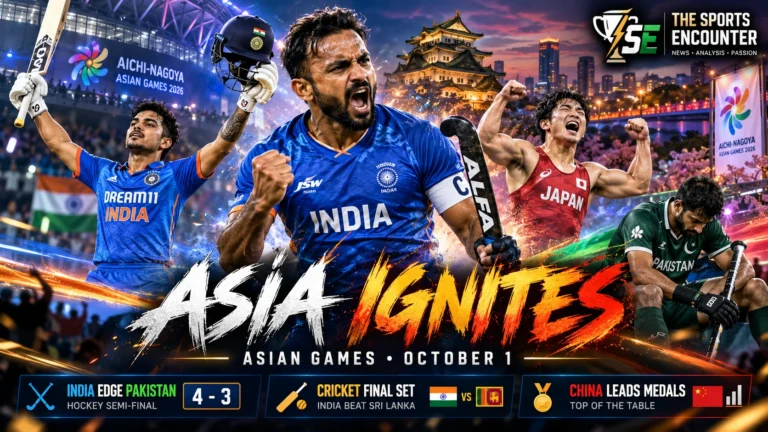
NAGOYA, Japan, October 4, 2026: China left Aichi-Nagoya with 169 gold medals, 341 medals overall and another emphatic demonstration of the depth that continues to separate its sporting system from the rest of Asia.
Yet the final numbers tell only part of the story of the 20th Asian Games.
Host Japan finished second with 83 golds and 269 medals. South Korea took third with 39 golds, while India transformed the closing stages of its campaign to finish fourth with 21 golds and 85 medals. Uzbekistan also won 21 golds, but India’s 27 silver medals against Uzbekistan’s 25 settled fourth place.
The Games formally concluded on October 4 after the final equestrian jumping medals and the closing ceremony. October 3, however, supplied the last enormous multi-sport surge: India won major titles in cricket and hockey, South Korea extended a men’s soccer dynasty, Japan overturned China in women’s rugby sevens, Hong Kong, China completed a rugby three-peat, wrestling produced champions and shocks, and Coleman Wong delivered a breakthrough tennis title.
Story at a glance

What Did Asian Games 2026 Ultimately Tell Us About the Balance of Power in Asia?
China’s dominance was comprehensive rather than dependent on one cluster of sports.
Why Did October 3 Become the Decisive Day of the Final Weekend?
Many delegations had already completed most of their programs by Saturday, October 3, but the remaining schedule contained enough championship events to change national campaigns dramatically.
October 4 Supplied the Last Medals and Settled the Final Standings
The last competitive medals were awarded in equestrian jumping on Sunday before the closing ceremony.
Asian Games 2026 Final Medal Table
Rankings are determined first by gold medals, followed by silver and bronze.
What Will Aichi-Nagoya 2026 Be Remembered For?
The medal table will preserve China’s 169 golds. It should also preserve how wide the competitive map became beneath China.
It was a fitting final weekend for a competition that began with 469 medal events across 43 sports and developed into a Games defined by teenage excellence, world records, national breakthroughs and remarkable competitive depth.
What Did Asian Games 2026 Ultimately Tell Us About the Balance of Power in Asia?
China’s dominance was comprehensive rather than dependent on one cluster of sports.
Its 169 titles represented approximately 36 percent of the 469 gold medals available across the program. China had already established control on the first full medal day, then continued accumulating titles through swimming, shooting, gymnastics, diving, rowing, weightlifting, table tennis and numerous other disciplines.
The pattern had become unmistakable by September 21. China could lose an individual final or even an important team event and still increase its overall advantage because another discipline was producing medals simultaneously.
Japan’s 83 golds gave the host nation a powerful second-place finish, while its 95 silver medals were the highest of any delegation. South Korea remained firmly inside the continental top three despite a much smaller overall haul than the leading two nations.
Below them, the table exposed an important feature of Asian Games ranking. India finished fourth with 85 medals while Kazakhstan, with 84, placed eighth because Kazakhstan won only 12 golds. Bahrain reached the top 10 with just 22 total medals because 11 of them were gold.
Gold conversion, rather than medal volume alone, determined where nations finished.
Why Did October 3 Become the Decisive Day of the Final Weekend?
Many delegations had already completed most of their programs by Saturday, October 3, but the remaining schedule contained enough championship events to change national campaigns dramatically.
India Turned the Closing Saturday Into a Five-Gold Surge
India’s most visible victories came in two of the continent’s biggest team sports.
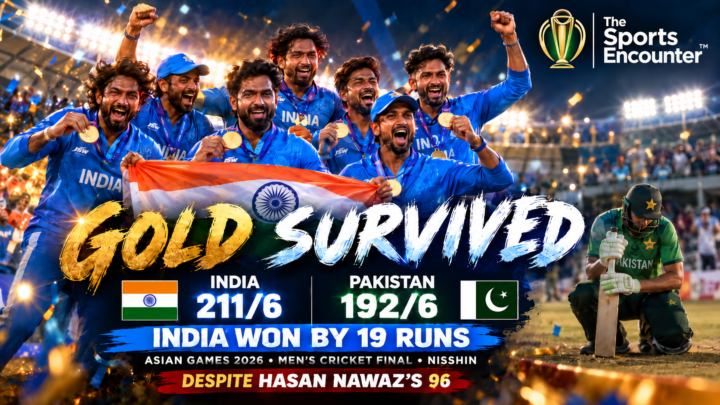
The men’s cricket team retained its Asian Games title by beating Pakistan by 19 runs at Korogi Athletic Park. India made 211 for six, with Abhishek Sharma hammering 61 from 28 balls and Tilak Varma finishing unbeaten on 51 from 22. Hasan Nawaz gave Pakistan a genuine chance with 96 from 51 balls, but Pakistan finished on 192 for six.
The victory completed an Indian cricket double after the women’s team had already won gold. The Olympic Council of Asia confirmed the full final result.
Later, India’s men’s hockey team overwhelmed Malaysia 5-1 to retain the title. Captain Harmanpreet Singh scored twice, with Jugraj Singh, Hardik Singh and Shilanand Lakra also finding the net. The title was India’s fifth men’s Asian Games hockey gold and secured direct qualification for the Los Angeles 2028 Olympics.
India’s women had already won the hockey title, creating the first Asian Games at which the country captured both men’s and women’s hockey golds. The official OCA report confirmed the double and Olympic qualification.
Aman Sehrawat added freestyle wrestling gold at 57kg with an 11-7 victory over world champion Han Chong Song of DPR Korea. Kumkum Mohod won the women’s individual recurve archery title, while Pranavi Urs took women’s individual golf gold.
The acceleration was particularly striking because India’s campaign had required patience. Earlier stages produced important shooting breakthroughs such as Suruchi Singh and Kamaljeet’s Asian-record pistol gold, followed by a multi-sport surge through kabaddi and other disciplines. The decisive movement toward fourth place arrived late.
South Korea Extended a Men’s Soccer Dynasty to Four Straight Titles
South Korea’s men’s soccer team faced a Japanese side that controlled long stretches of the final at Toyota Stadium, but Eom Ji-sung supplied the goal that mattered.
Eom struck in the 61st minute to secure a 1-0 victory in front of more than 30,000 spectators.
The result gave South Korea a fourth consecutive Asian Games men’s soccer gold and a third successive final victory over Japan. Japan pushed for an equalizer and struck the post late, but goalkeeper Kim Joon-hong and the Korean defense protected the lead.
The final completed the storyline that had taken shape when South Korea and Japan advanced from the semifinals four days earlier.
Japan Reversed the Women’s Rugby Final Against China
The host nation found another major home title in women’s rugby sevens.
Japan defeated defending champion China 10-5 after losing to the same opponent in the Hangzhou final. Yume Hirano and Marin Kajiki scored before halftime to create a 10-0 lead, and Japan survived China’s late pressure to complete the victory.
The result carried extra meaning for a home crowd watching the same two countries meet in the women’s final for a fourth consecutive Asian Games.
Hong Kong, China Made Three Straight Rugby Sevens Golds Look Ruthlessly Simple
Hong Kong, China produced one of the most complete team performances of the Games in men’s rugby sevens.
The defending champions beat China 26-0 in the final to claim a third consecutive Asian Games title. They kept five of their six opponents scoreless during the tournament and have not lost an Asian Games match since the 2014 final.
Harry Sayers scored twice in the championship match before Dafydd Phillips and Juan Oyana added tries, completing a tournament built as much around defensive control as attacking speed.
Iran, India and China Shared a Wrestling Day Full of Reversals
Iran won two of the three men’s freestyle titles available on the last day of wrestling.
Yones Emami recovered from 5-0 down to defeat Japan’s Yoshinosuke Aoyagi 9-5 in the 74kg final, while Amirali Azarpira beat Uzbekistan’s Sherzod Poyonov 10-0 at 97kg. Aman Sehrawat prevented an Iranian sweep of the men’s freestyle titles by taking the 57kg crown for India.
The women’s competition supplied an even bigger shock when DPR Korea’s Son Il Sam ended Japanese Olympic champion Akari Fujinami’s 155-match winning streak in the semifinals. China’s Hong Kexin then defeated Son 7-2 for 57kg gold.
Coleman Wong Turned Tennis Gold Into an Olympic Ticket
Coleman Wong gave Hong Kong, China its first Asian Games men’s singles tennis gold and secured direct qualification for the Los Angeles 2028 Olympics.
His victory added another historic result to a delegation that eventually finished ninth with 11 gold medals and 54 medals overall.
October 4 Supplied the Last Medals and Settled the Final Standings
The last competitive medals were awarded in equestrian jumping on Sunday before the closing ceremony.
Qatar’s Faleh Alajami won Competition A riding Qapella, ahead of the UAE’s Abdulla Almheiri and Saudi Arabia’s Khaled Almobty.
Saudi Arabia then took gold and silver in Competition B through Ramzy Al Duhami and Abdulrahman Alrajhi, while Qatar’s Basem Mohammed won bronze.
Those medals explain why several final standings differ from tables published after October 3. Qatar finished with six golds, the UAE with seven golds and five silvers, and Saudi Arabia with four golds.
Asian Games 2026 Final Medal Table
Rankings are determined first by gold medals, followed by silver and bronze.
| Rank | Nation | Gold | Silver | Bronze | Total |
|---|---|---|---|---|---|
| 1 | China | 169 | 89 | 83 | 341 |
| 2 | Japan | 83 | 95 | 91 | 269 |
| 3 | South Korea | 39 | 43 | 68 | 150 |
| 4 | India | 21 | 27 | 37 | 85 |
| 5 | Uzbekistan | 21 | 25 | 24 | 70 |
| 6 | Iran | 19 | 18 | 15 | 52 |
| 7 | Thailand | 18 | 13 | 21 | 52 |
| 8 | Kazakhstan | 12 | 24 | 48 | 84 |
| 9 | Hong Kong, China | 11 | 19 | 24 | 54 |
| 10 | Bahrain | 11 | 5 | 6 | 22 |
| 11 | Malaysia | 9 | 7 | 16 | 32 |
| 12 | DPR Korea | 7 | 13 | 9 | 29 |
| 13 | United Arab Emirates | 7 | 5 | 1 | 13 |
| 14 | Qatar | 6 | 6 | 6 | 18 |
| 15 | Chinese Taipei | 5 | 17 | 33 | 55 |
| 16 | Indonesia | 5 | 11 | 23 | 39 |
| 17 | Philippines | 4 | 9 | 16 | 29 |
| 18 | Saudi Arabia | 4 | 3 | 10 | 17 |
| 19 | Kuwait | 4 | 1 | 4 | 9 |
| 20 | Vietnam | 3 | 3 | 19 | 25 |
| 21 | Singapore | 2 | 9 | 7 | 18 |
| 22 | Tajikistan | 2 | 5 | 9 | 16 |
| 23 | Jordan | 2 | 3 | 6 | 11 |
| 24 | Myanmar | 2 | 1 | 2 | 5 |
| 25 | Macao, China | 1 | 4 | 1 | 6 |
| 26 | Kyrgyzstan | 1 | 3 | 10 | 14 |
| 27 | Mongolia | 1 | 1 | 13 | 15 |
| 28 | Sri Lanka | 1 | 1 | 1 | 3 |
| 29 | Pakistan | 0 | 2 | 8 | 10 |
| 30 | Iraq | 0 | 2 | 3 | 5 |
| 31 | Turkmenistan | 0 | 2 | 0 | 2 |
| 32 | Afghanistan | 0 | 1 | 2 | 3 |
| 32 | Lebanon | 0 | 1 | 2 | 3 |
| 34 | Oman | 0 | 1 | 1 | 2 |
| 35 | Cambodia | 0 | 0 | 4 | 4 |
| 36 | Nepal | 0 | 0 | 2 | 2 |
| 37 | Bangladesh | 0 | 0 | 1 | 1 |
| 37 | Brunei Darussalam | 0 | 0 | 1 | 1 |
| 37 | Laos | 0 | 0 | 1 | 1 |
| 37 | Syria | 0 | 0 | 1 | 1 |
| 41 | Bhutan | 0 | 0 | 0 | 0 |
| 41 | Maldives | 0 | 0 | 0 | 0 |
| 41 | Palestine | 0 | 0 | 0 | 0 |
| 41 | Timor-Leste | 0 | 0 | 0 | 0 |
| 41 | Yemen | 0 | 0 | 0 | 0 |
Forty of the 45 participating National Olympic Committees won at least one medal, meaning almost 89 percent of the participating NOCs reached the podium.
Who Were the Top Performers of Asian Games 2026?
Yu Zidi: Three Golds at 13 and the Female MVP Award
Yu Zidi arrived in Japan as one of swimming’s most remarkable young talents. She left as the official Female Most Valuable Player of the Games.
The 13-year-old Chinese swimmer won every individual event she entered: the 200m butterfly in 2:05.08, the 200m individual medley in 2:06.10 and the 400m individual medley in 4:28.56.
All three were Asian Games records. Her 200m IM time was also an Asian record.
TSE followed her progression from the opening 200m butterfly breakthrough through to the three-event individual sweep.
The OCA named Yu and Thailand’s Puripol Boonson the official MVPs. AINAGOC also identified Yu as the youngest MVP in Asian Games history.
Puripol Boonson: Asia Has a New Sprint Standard
Puripol Boonson produced the defining sprint campaign of Aichi-Nagoya.
The 20-year-old Thai won the 100m in 9.90 seconds after already breaking the Asian Games record with 9.91 in the semifinal. He then completed the sprint double with 19.88 in the 200m, another Games record and a time that equaled the Asian record.
He also earned silver in the mixed 4x100m relay.
TSE’s analysis of Boonson’s sprint double identified why his 200m performance moved the conversation beyond one breakthrough race. The OCA later confirmed him as the Male MVP of the Games.
Zhang Zhanshuo: Seven Gold Medals From One Swimming Meet
No athlete in this group accumulated gold medals at Zhang Zhanshuo’s rate.
The 19-year-old Chinese swimmer won seven titles: the 200m, 400m, 800m and 1500m freestyle events plus three relay golds.
His final individual race produced another benchmark. Zhang won the 400m freestyle in 3:41.28, breaking the Asian Games record that Park Tae-hwan had held since Guangzhou 2010.
Seven gold medals across sprint-to-distance freestyle range and relays made Zhang one of the clearest expressions of China’s swimming depth.
Shin Ohashi: A World Record in Front of a Home Nation
Japan’s Shin Ohashi supplied one of the purest performance peaks of the Games.
The 17-year-old won the men’s 200m breaststroke in 2:04.83, cutting 0.65 seconds from Qin Haiyang’s previous world record of 2:05.48.
Ohashi had already shared 100m breaststroke gold earlier in the meet. His world-record swim then became the centerpiece of a day TSE examined in detail in our report on Japan’s and Asia’s major September 24 breakthroughs.
Winfred Yavi: An Asian Games Distance Treble Nobody Had Completed Before
Bahrain’s Winfred Yavi added a unique historical achievement to an already elite career.
Continue the Asian Games 2026 Story
 Asian Games 2026India-Pakistan Drama, Japan’s Wrestling Golds and China’s Medal Surge Define Asian Games Action
 Asian Games 2026China Reaches 100 Straight Diving Golds as India Sweeps Archery and Korea-Japan Final Takes Shape
 Asian Games 2026Indians Revel in a Three-Sport Statement at Asian Games 2026
She became the first athlete in Asian Games history to win the women’s 3000m steeplechase, 5000m and 10,000m at the same edition.
The Olympic steeplechase champion combined endurance, recovery and tactical speed across three very different races. Her 5000m victory in 15:10.18 completed a treble that had never previously been achieved at the Games.
Ri Song-gum: Three World Records and a Third Straight Asian Games Gold
DPR Korea’s Ri Song-gum turned the weightlifting platform into another record center.
Ri won the women’s 49kg title for a third consecutive Asian Games and was credited with world records in the snatch, clean and jerk and total under weightlifting’s restructured classifications.
Her performance also reflected a wider DPR Korean strength in Nagoya, where the delegation’s weightlifters repeatedly challenged world standards across several categories.
What Will Aichi-Nagoya 2026 Be Remembered For?
The medal table will preserve China’s 169 golds. It should also preserve how wide the competitive map became beneath China.
Japan produced 83 home gold medals. South Korea extended major team-sport dynasties. India recovered from a slow start and finished fourth. Hong Kong, China reached 11 golds. Bahrain converted 22 medals into 11 titles. Forty of 45 National Olympic Committees reached the podium.
The performance standards were equally significant. The OCA’s final competition briefing reported 54 world records, 89 Asian records, 212 Asian Games records and 11 junior world records.
The route to those numbers ran through established champions and athletes still young enough to be central figures at Los Angeles 2028.
Yu Zidi is 13. Shin Ohashi is 17. Zhang Zhanshuo is 19. Puripol Boonson is 20.
When Aichi-Nagoya officially opened on September 19, one of the central questions was whether a new generation would use Asia’s biggest sporting stage to announce itself.
Sixteen days later, the answer is written across the record books.
Asian Games 2026 FAQs
When did the Asian Games 2026 officially end?
The 20th Asian Games officially concluded on October 4, 2026. October 3 was the final full day of major medal action for most sports, while the last equestrian jumping medals and closing ceremony took place on October 4.
Which country topped the Asian Games 2026 medal table?
China finished first with 169 gold, 89 silver and 83 bronze medals for 341 overall.
How many medals did Japan win at the Asian Games 2026?
Host Japan finished second with 269 medals, including 83 gold, 95 silver and 91 bronze.
Where did India finish in the Asian Games 2026 medal table?
India finished fourth with 21 gold, 27 silver and 37 bronze medals for 85 overall. India ranked ahead of Uzbekistan, which also won 21 golds, because India collected two more silver medals.
Who were the Asian Games 2026 MVPs?
China’s 13-year-old swimmer Yu Zidi was named Female MVP, while Thailand sprinter Puripol Boonson received the Male MVP award.
Who won the Asian Games 2026 men’s cricket gold?
India defeated Pakistan by 19 runs in the men’s T20 final after scoring 211 for six and restricting Pakistan to 192 for six.
Who won the Asian Games 2026 men’s hockey gold?
India retained the men’s hockey title by defeating Malaysia 5-1 and qualified directly for the Los Angeles 2028 Olympic Games.
Who won the Asian Games 2026 men’s soccer gold?
South Korea defeated Japan 1-0 through Eom Ji-sung’s 61st-minute goal, securing a fourth consecutive Asian Games men’s soccer title.
How many participating countries and regions won medals?
Forty of the 45 participating National Olympic Committees won at least one medal at Aichi-Nagoya 2026.
China
- Asian Games 2026 End With China on Top, India’s Late Gold Rush and a New Generation of Asian Stars
- Matt Orr and Everton Camargo Crown Unbeaten Hong Kong as First FIFA ASEAN Challenge Cup Champions
- WTA Closes the WTA 1000 Pay Gap in 2027, but Tennis’ Equality Project Is Not Finished
- India-Pakistan Drama, Japan’s Wrestling Golds and China’s Medal Surge Define Asian Games Action
- Zverev Holds Firm, Shang Delivers at Home, While Safiullin Shocks Cobolli in China Open